Francesco Cavalli, named as her teacher in the dedication of Op. 2 (1651)
Circle
Giulio Strozzi’s house and the Accademia degli Unisoni, Venice, from the 1630s
Publications
Opp. 1–8, Venice, 1644–64; Op. 4 is lost
Output
Madrigals, cantatas, arias, duets and sacred motets for voices with continuo
“harmonic notes, which are tongues of the soul and instruments of the heart”
Life
Barbara was baptised on 6 August 1619 in the parish of Santa Sofia, Venice, as Barbara Valle. Her mother, Isabella Garzoni, was called la Griega or la Greghetta, and the register names no father. The writer Giulio Strozzi, a prominent member of the Accademia degli Incogniti, adopted her. A will of 1628 still called her Barbara Valle; in a later one Giulio named “Barbara di Santa Sofia” as his chosen daughter, “commonly called la Strozzi”. Isabella lived with them both until her death in 1653. On 8 May 1677, a few months before Barbara died, a notarial document drawn up by her declared that she was the daughter of the late Giulio, perhaps for the first time.
1619–37Giulio Strozzi’s house
Giulio, born in Venice in 1583, wrote verse, prose and opera libretti and had worked with Monteverdi. By 1634 Barbara was singing in his house, and Francesco Cavalli, one of the leading Venetian composers, taught her; in 1651 she called him her “courteous teacher” from childhood. In 1635 and 1636 Nicolò Fontei published two books of Bizzarrie poetiche for one to three voices, mostly to texts by Giulio. He dedicated the first to Giovanni Paolo Widmann, a Carinthian merchant living in Venice, and wrote that he had composed the songs chiefly to please “the most gentle and most accomplished young woman, Signora Barbara”, “almost a tenth sister” to the Muses.
The Genoese poet Gian Vincenzo Imperiale, another Incognito, noted in his travel journal for 1 November 1635 that he had heard Barbara sing at her father’s house; all esteemed her “one of the Muses of Parnassus”. He returned a few days later and wrote of the evening: “I do not know which was greater, the pleasure received from the music or that felt from the discourses.”
1637–44The Unisoni and the Widmann family
In 1637 Giulio founded a formal academy, the Accademia degli Unisoni, with several Incogniti among its members. Accounts of its meetings were printed as Le veglie de’ signori Unisoni (1638) and dedicated to “Signora Barbara Strozzi”, who performed with other musicians and acted as mistress of ceremonies at some debates. She delivered the discourses written by Matteo Dandolo and Giovanni Francesco Loredan for the Contesa del canto e delle lagrime (1638), on whether song or tears did more to stir love. In the printed text she told the academicians that they would not have honoured her with their presence “if I had invited you to see me weep, not to hear me sing”. Satires aimed at the Unisoni mocked Giulio’s poetry and Barbara’s reputation as a courtesan. No record shows her on an opera stage, although the first Venetian opera houses opened in these years and Giulio was involved in them from 1639 at the latest.
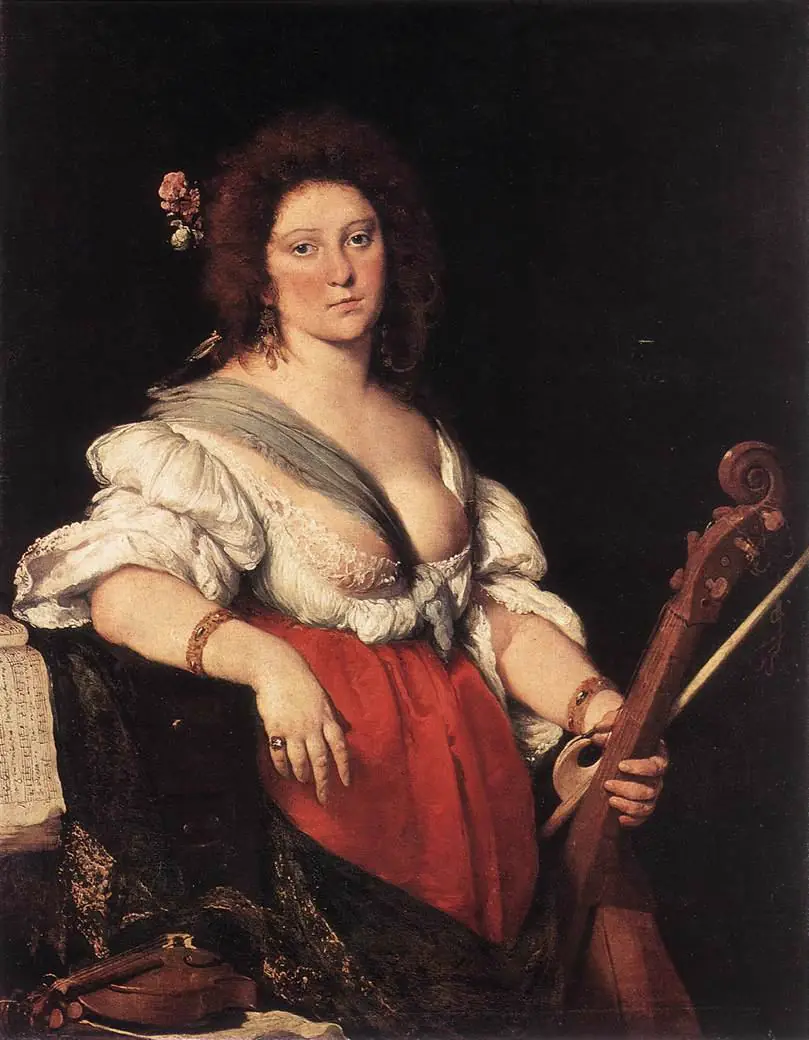
Bernardo Strozzi, a Genoese painter active in Venice from the early 1630s and no relation of the family, painted a young woman musician who is generally identified as Barbara; a copy was made in 1639. He also painted Giulio and Monteverdi.
By 1640 Barbara was close to Widmann, a friend of her father who had admired her singing since 1634. Widmann was married. Their son Giulio Pietro was baptised on 6 February 1641, less than a month after the first performance of La finta pazza, a drama by Giulio Strozzi dedicated to Widmann, with music by Francesco Sacrati. Glixon considers Widmann probably the father of three more children: Isabella Aquilina, baptised on 18 March 1642; Lauretta, born on 10 December 1643; and Massimo. In December 1642 Barbara lent Widmann 2,000 ducats.
1644–64Eight books
Barbara was twenty-five when her Il primo libro de’ madrigali for two to five voices was printed by Alessandro Vincenti in 1644, a few months after Lauretta’s birth. Giulio wrote every text. The book was dedicated to Vittoria della Rovere, Grand Duchess of Tuscany. In the dedication Barbara called it “the first work, which as a woman I send into the light too boldly”, and asked that it rest “under an oak of gold” safe from “the thunderbolts of readied slander”. Monteverdi had died the year before. Glixon suggests the book may have been meant as a tribute to him; Barbara knew him but never called him her teacher.
In 1650 Giulio made a will describing himself as without means. The house where he lived was rented by Barbara, and he trusted her to make the customary charitable gifts on his behalf, as she would do willingly, “remembering what I have done for her in bringing her up and setting her on the path of virtue”.
The second book, Cantate, ariette e duetti (Gardano, 1651), was dedicated to the Emperor Ferdinand III and opened with a piece for his marriage to Eleonora Gonzaga. Its dedication, dated 1 June 1651, names Cavalli. The book contained the first of her many laments, on the execution of the Marquis of Cinq-Mars, a favourite of Louis XIII who had joined a plot against Richelieu. Only two of its texts were by Giulio. He died on 31 March 1652.
Her third book (1654) carried the dedication Ignotae deae, to an unknown goddess. A fourth, which according to her letter of 10 November 1655 was to be finished that year and dedicated to Carlo II, Duke of Mantua, is lost. The fifth, Sacri musicali affetti (1655), is a book of devotional pieces for solo voice dedicated to Anna de’ Medici, Archduchess of Austria; only its Salve regina sets a liturgical text, and Glixon notes the intimate tone of its Latin dedication. In 1656 Barbara’s two daughters entered the convent of the Santo Sepolcro, and her motet Quis dabit mihi, for alto, tenor and bass, was printed in Bartolomeo Marcesso’s anthology Sacra corona.
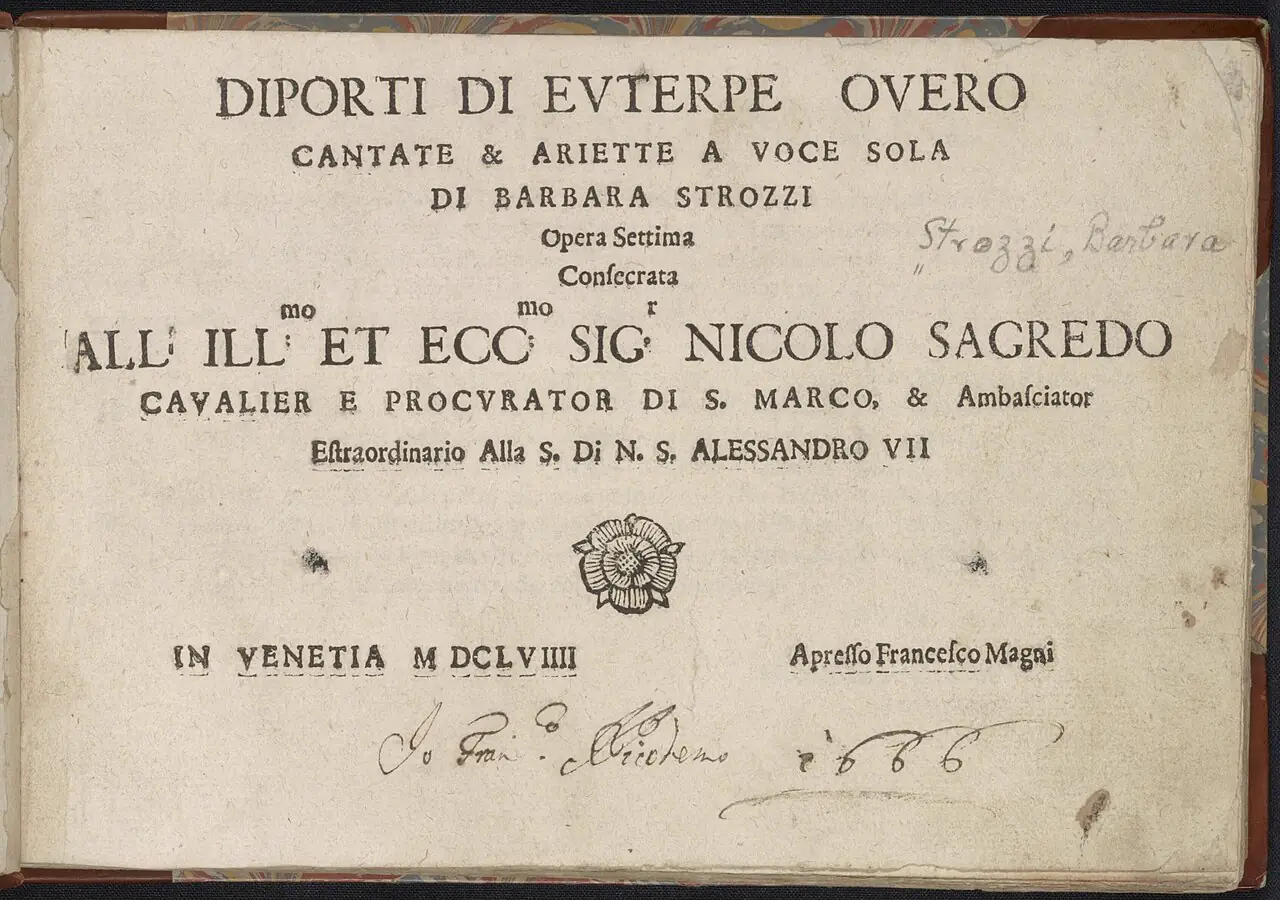
The sixth book, Ariette a voce sola (1657), was dedicated to Prince Francesco Carafa, who had already heard several of its pieces. The seventh, Diporti di Euterpe (1659), went to Nicolò Sagredo, procurator of San Marco and ambassador extraordinary to Pope Alexander VII, whom she addressed as her “tutelary god”; he was the only Venetian dedicatee of her books. Her eighth, Arie (1664), was dedicated to Sophia, Duchess of Brunswick-Lüneburg, who visited Venice that year, and opens with a poem by Giuseppe Artale in praise of her.
1665–77Padua
The last mention of new music is a letter of 30 May 1665 about pieces she had composed for the Duke of Mantua. Very little is known of her musical activity in her last decade. She died in Padua on 11 November 1677 after three months of illness and was buried in the church of the Eremitani.
Her printed books and manuscript copies kept her name known in England. On 4 May 1940 Luigi Dallapiccola’s orchestration of Amor dormiglione, a canzonetta from her second book, was played at the Palazzo Strozzi in Florence in a concert of Medici-era music during the sixth Maggio Musicale Fiorentino.
Where to hear it
La voce sola — songs from Opp. 2, 3, 5, 6, 7 and 82021
A survey of Strozzi’s books in chronological order, from Op. 2 to Op. 8, with Lagrime mie and what the label describes as the first recording of a piece without an opus number. The linked video is the complete album; the times below are the chapters given in its description.
Havete torto, from Cantate à voce sola di diversi auttori
Sino alla morte, Op. 7
Che si può fare, Op. 8
Lagrime mie, Op. 7Video published 2019
Mary Bevan, soprano; Elizabeth Kenny, theorbo; Orchestra of the Age of Enlightenment
A performance by a soprano and a theorbo player, published on the orchestra’s own channel with details of its Strozzi concert at Kings Place, London. The piece is the lament that opens with the words “Lagrime mie”.
Aurata Fonte; Anna Simboli and Miho Kamiya, sopranos; Andrea Arrivabene, alto; Perikli Pite, viola da gamba; Valeria Montanari, harpsichord; Giuseppe Monari, organ · Tactus, TC 611990
The label calls this the first complete recording of the book. It comprises fourteen motets for solo voice on two discs, from Mater Anna to Iubilemus, and includes Oleum effusum and Surgite, surgite.
These recordings are under copyright, so the Hall cannot play them; the links go to the labels’ and artists’ own uploads and to streaming services.
Places
Every recorded place, joined in date order. Strozzi on the MapAll 14 places, with sources
Santa Sofia, Venice · 6 August 1619 · born
Baptised in the parish of Santa Sofia as Barbara Valle, daughter of Isabella Garzoni; the register names no father. Her birth date is unknown. The point marks the church. It does not mark a house.
From 1634 she sang in her adoptive father’s house, where Imperiale heard her in November 1635 and the Accademia degli Unisoni met from 1637. Giulio’s will of 1650 records that the house where he lived was rented by Barbara. Her residence there for the whole period is inferred from these records; the house has not been located, and the point marks Venice.
Accademia degli Unisoni, Venice · 1637–1638 · worked
Giulio Strozzi founded the academy in 1637. Barbara performed with other musicians, acted as mistress of ceremonies at some debates and recited the discourses of the Contesa del canto e delle lagrime. The Veglie, dedicated to her, and the Contesa were printed in 1638.
Venice, Il primo libro de’ madrigali · 1644 · worked
Her first book, for two to five voices to texts by Giulio Strozzi, printed by Alessandro Vincenti and dedicated to Vittoria della Rovere, Grand Duchess of Tuscany. Il primo libro de’ madrigali, Op. 1.
Her second book, printed by Gardano and dedicated to the Emperor Ferdinand III; the dedication is dated Venice, 1 June 1651, and names Francesco Cavalli as her teacher. Cantate, ariette e duetti, Op. 2.
Her fifth book, devotional pieces for solo voice, printed by Francesco Magni and dedicated to Anna de’ Medici, Archduchess of Austria. Sacri musicali affetti, Op. 5.
Her motet Quis dabit mihi, for alto, tenor and bass, was printed as the first three-voice motet in Bartolomeo Marcesso’s anthology Sacra corona. Quis dabit mihi.
Her seventh book, printed by Francesco Magni and dedicated to Nicolò Sagredo, procurator of San Marco, the only Venetian dedicatee of her books. Only two complete copies survive. Diporti di Euterpe, Op. 7.
Her eighth and last known book, printed by Francesco Magni and dedicated to Sophia, Duchess of Brunswick-Lüneburg, who visited Venice that year. Arie, Op. 8.
Posthumous performance. Luigi Dallapiccola’s orchestration of her canzonetta Amor dormiglione was played in the Concerto di musiche medicee of the sixth Maggio Musicale Fiorentino, conducted by Luigi Colonna. Amor dormiglione.
Most of her pieces are for one voice, usually a soprano, with basso continuo. The exceptions include the madrigals for two to five voices of Op. 1, the duets of Op. 2, the motet Quis dabit mihi for alto, tenor and bass, and the serenata Hor che Apollo in Op. 8, which adds two violins. On page 5 of the 1659 print, the last staff of Sino alla morte is a run of fast notes with no new syllable beneath it.
♯Forms
Strozzi named her pieces aria, cantata, arietta, soliloquio, lamento and, once, serenata. Ruffini counts more than half of the pieces in Op. 2 as strophic arias in two sections, with the same music for each stanza; the later books have longer designs, such as ABCD and ABCDA. Johan van Veen, reviewing a Harmonia Mundi disc, singled out the alternation of recitative, arioso and aria, and described L’astratto, in which the lover begins an aria several times and breaks off into recitative.
♭Laments
The piece beginning Lagrime mie is headed “Lamento” in the 1659 print. Ruffini notes that her modal framework is often minor, especially in the laments. The lament on Cinq-Mars takes a political event as its subject; van Veen heard a fast repeated chord in the continuo under its closing line, about Paris trembling and the Seine growing agitated. He also found dissonance and chromaticism on words such as tormento, morte and lamenti across the disc.
𝄞Texts
Giulio Strozzi wrote every text of Op. 1 and two of those in Op. 2. Among the poets she set were authors of dramas for music, including Pietro Paolo Bissari, Aurelio Aureli, Giuseppe Artale and Gaudenzio Brunacci, and noble amateurs such as Marc’Antonio Corraro, Nicola Beregan and Pietro Dolfin. Op. 7 includes verses by the Roman poets Sebastiano Baldini and Giovanni Pietro Monesio. According to Glixon she never set verses by Guarini or Marino, though many of her contemporaries set them.
♩Virtuosity and wit
Glixon writes that Strozzi’s music is very often highly virtuosic and was certainly cut to the measure of her own voice, and that pathos alternates with the witty spirit that must have animated her. The programme for the 1940 concert described Amor dormiglione as a triple-time opening, a short recitative with vocal flourishes and a return of the opening. Its text begins “Amor, non dormir più” (Love, sleep no more) and later calls Love sluggish and slow.
Works
A selection from the composer’s works.
1644
Il primo libro de’ madrigali, Op. 1Two to five voices and continuo
Madrigals to texts by Giulio Strozzi, printed by Alessandro Vincenti and dedicated to Vittoria della Rovere, Grand Duchess of Tuscany.
1651
Cantate, ariette e duetti, Op. 2One or two voices and continuo
Printed by Gardano and dedicated to Ferdinand III. The book includes Amor dormiglione and the lament on the execution of Cinq-Mars.
1654
Cantate, ariette a una, due e tre voci, Op. 3One to three voices and continuo
Printed by Gardano with the dedication Ignotae deae.
1655
Sacri musicali affetti, Op. 5Solo voice and continuo
Fourteen devotional pieces dedicated to Anna de’ Medici; only the Salve regina sets a liturgical text. The book includes Mater Anna, Oleum effusum and Surgite, surgite.
1656
Quis dabit mihiAlto, tenor, bass and continuo
Motet printed in Bartolomeo Marcesso’s anthology Sacra corona, where it is the first three-voice motet.
1657
Ariette a voce sola, Op. 6Solo voice and continuo
Dedicated to Prince Francesco Carafa. Amore è bandito is No. 13 in Luigi Torchi’s anthology of 1895.
1659
Diporti di Euterpe, Op. 7Solo voice and continuo
Fifteen pieces dedicated to Nicolò Sagredo, among them Sino alla morte, Appresso ai molli argenti and Lagrime mie. Only two complete copies of the print survive.
1664
Arie, Op. 8Solo voice and continuo; two violins in one piece
Five cantatas, six arias and a serenata, dedicated to Sophia, Duchess of Brunswick-Lüneburg. Hor che Apollo adds two violins.
In the score
Short examples, engraved and playable.
Op. 6, 1657 — quotedAmore è bandito, bars 1–2
The voice part of bars 1–2 from Luigi Torchi’s edition (Eleganti canzoni ed arie italiane del secolo XVII, Ricordi, 1895, no. 13, p. 34), read from the public-domain scan on IMSLP. The signature has two flats and the metre is 12/8. Bar 1 has a crotchet rest and ten quavers, the text running “A-mo-re è ban-di-to a-man-ti”; bar 2 has a crotchet D, eight quavers, a dotted quaver and a semiquaver. Torchi’s tempo (Allegro brillante) and dynamic (mf) are his additions; the breath mark he prints above the staff after the crotchet in bar 2 is not reproduced, the metronome mark is for playback only, and his piano part is left out.
Descending tetrachord — invented schematicDescending bass from G to D
An invented schematic; no bar of Strozzi’s music is quoted. The bass falls by step from G to D, one note to a bar, with a plain triad above each note (G minor, F major, E♭ major, D major). Ellen Rosand’s article “The Descending Tetrachord: An Emblem of Lament” (Musical Quarterly, 1979) discusses this pattern in seventeenth-century vocal music. In the 1659 print the piece beginning Lagrime mie is headed “Lamento”.
Sister arts
Francesco Magni (printer)Title page of Diporti di Euterpe, Op. 7, 1659Letterpress title page · Library of Congress, Washington, DC
The title page reads “Diporti di Euterpe overo cantate & ariette a voce sola di Barbara Strozzi, opera settima”, consecrated to Nicolò Sagredo, procurator of San Marco and ambassador extraordinary to Pope Alexander VII, and printed at Venice by Francesco Magni. Only two complete copies survive, in Bologna and at the Library of Congress; this is the Library of Congress copy. The table at the end lists fifteen pieces with the poet of each, and names Pietro Dolfin as the author of Lagrime mie, which begins on page 76.
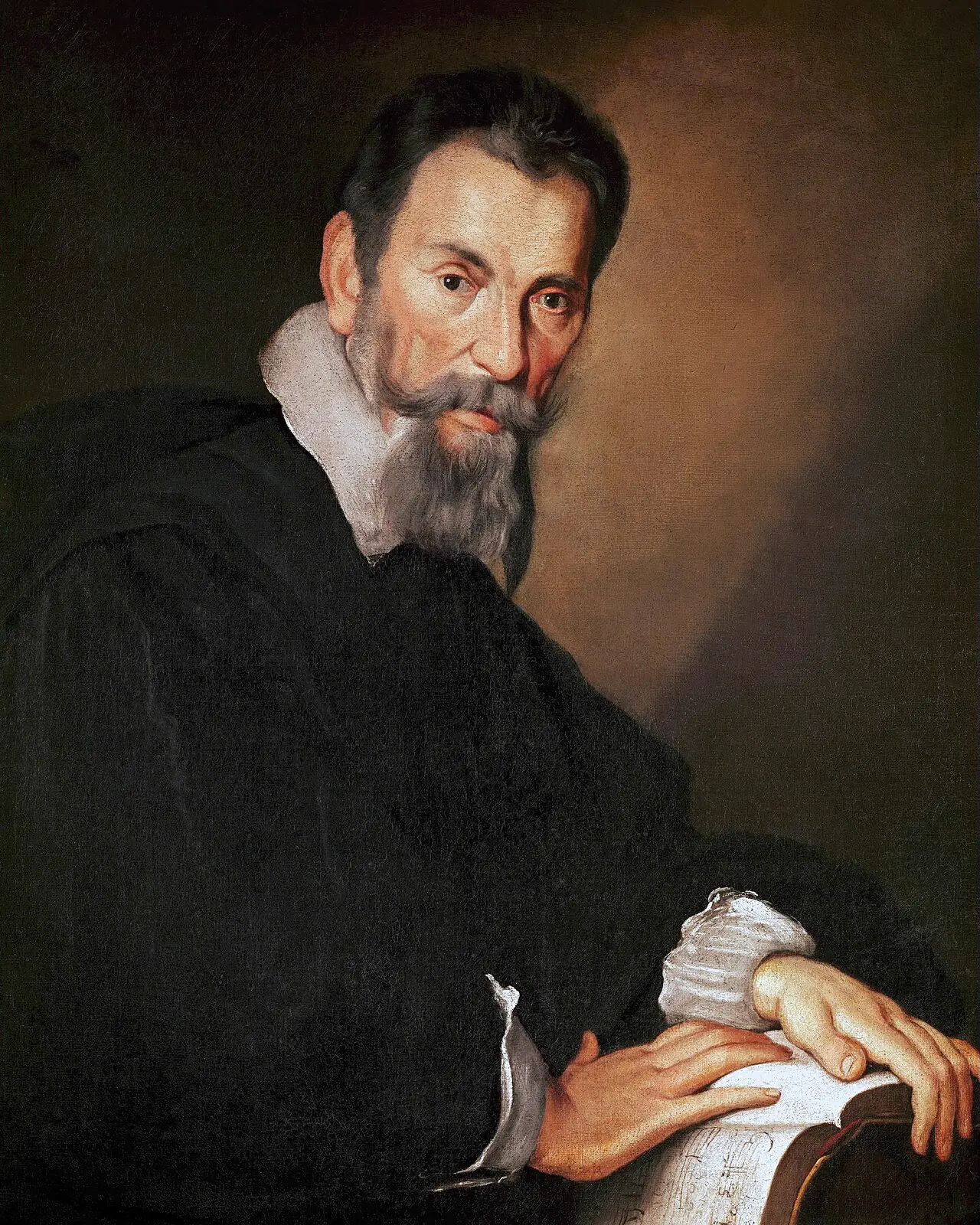
Bernardo StrozziPortrait identified as Claudio Monteverdi, c. 1630Oil on canvas · Tiroler Landesmuseum Ferdinandeum, Innsbruck
Bernardo Strozzi, who painted the young woman now identified as Barbara, also painted her adoptive father Giulio and Monteverdi, according to Glixon. Giulio Strozzi had known Monteverdi since 1621 and wrote texts for him. The sitter of this portrait is identified through the engraving in the memorial volume Fiori poetici (1644).
Pietro Dolfin
Lagrime mie, opening
Set by Strozzi in Diporti di Euterpe, 1659
ItalianLagrime mie, à che vi trattenete,
perche non isfogate il fier dolore
che mi toglie’l respiro e opprime il core?
Our translationMy tears, why do you hold back?
Why do you not let out the fierce pain
that takes my breath and weighs on my heart?
The first three lines of the text of the piece that begins on page 76 of the 1659 book under the heading “Lamento”. The table at the end gives “Parole dell’Illustrissimo Sig. Pietro Dolfino”. Dolfin was one of the Venetian noble amateurs whose verses Strozzi set. The punctuation is editorial.
Recommended recordings
Cantatas and arias, including L’astratto, Appresso ai molli argenti and the Cinq-Mars lamentJudith Nelson, soprano; Christophe Coin, cello; John Hutchinson, triple harp; William Christie, harpsichordHarmonia Mundi, HMX 290114 · recorded December 1982Johan van Veen, reviewing the reissue for MusicWeb International in 2004, took it to be one of the first discs devoted entirely to her music, and praised the flexibility of Nelson’s voice, her diction and the use of the triple harp in the continuo. The reissue prints the texts.
Cavalli taught her, and Giulio Strozzi wrote the texts of her first book and brought her into the Incogniti and the Unisoni. Glixon found an affinity between some of the 1644 madrigals and Monteverdi’s last books, and R. L. Kendrick compared her motet Quis dabit mihi with a scene from his Il ritorno d’Ulisse in patria; she never called herself his pupil. Dallapiccola orchestrated Amor dormiglione for the concert of 4 May 1940.
Further reading
Beth L. Glixon, “Strozzi, Barbara”, Dizionario Biografico degli Italiani, vol. 94 (Istituto della Enciclopedia Italiana, 2019). encyclopaedia article
An archival biography in Italian by the scholar who found many of the records, establishing dates, documents and dedications, with a bibliography.
A study of her career and style that relates her life, the Unisoni and the satires written against them to her arias and cantatas. Later accounts draw on it.
Beth L. Glixon, “New Light on the Life and Career of Barbara Strozzi”, The Musical Quarterly 81/2 (1997), pp. 311–335. journal article
Archival findings on her children, her loans and her finances, and on the letters of 1655 and 1665 that bear on her last books.
Beth L. Glixon and Wendy Heller, eds., Barbara Strozzi in Context (Cambridge University Press, 2026). essay collection
On family, sex and the position of women in seventeenth-century Venice, and how they bore on her career. The essays include chapters on Giulio Strozzi and on Barbara as daughter and mother.
Susan Clermont, “Barbara Strozzi at 400”, In The Muse (Library of Congress, 17 September 2019). blog essay
A short account of the Library of Congress copy of Diporti di Euterpe, Op. 7, of its dedication to Sagredo, and of the motet Quis dabit mihi in Sacra corona.
On when, and by whom, Amor dormiglione was orchestrated. Documents the 1940 concert and Dallapiccola’s lost score, with a summary of her life and a bibliography.
Cite this page
Contrapunctus. “Barbara Strozzi.” Accessed 20 October 2026. https://mottopanikeiku.github.io/contrapunctus/composers/strozzi.html.