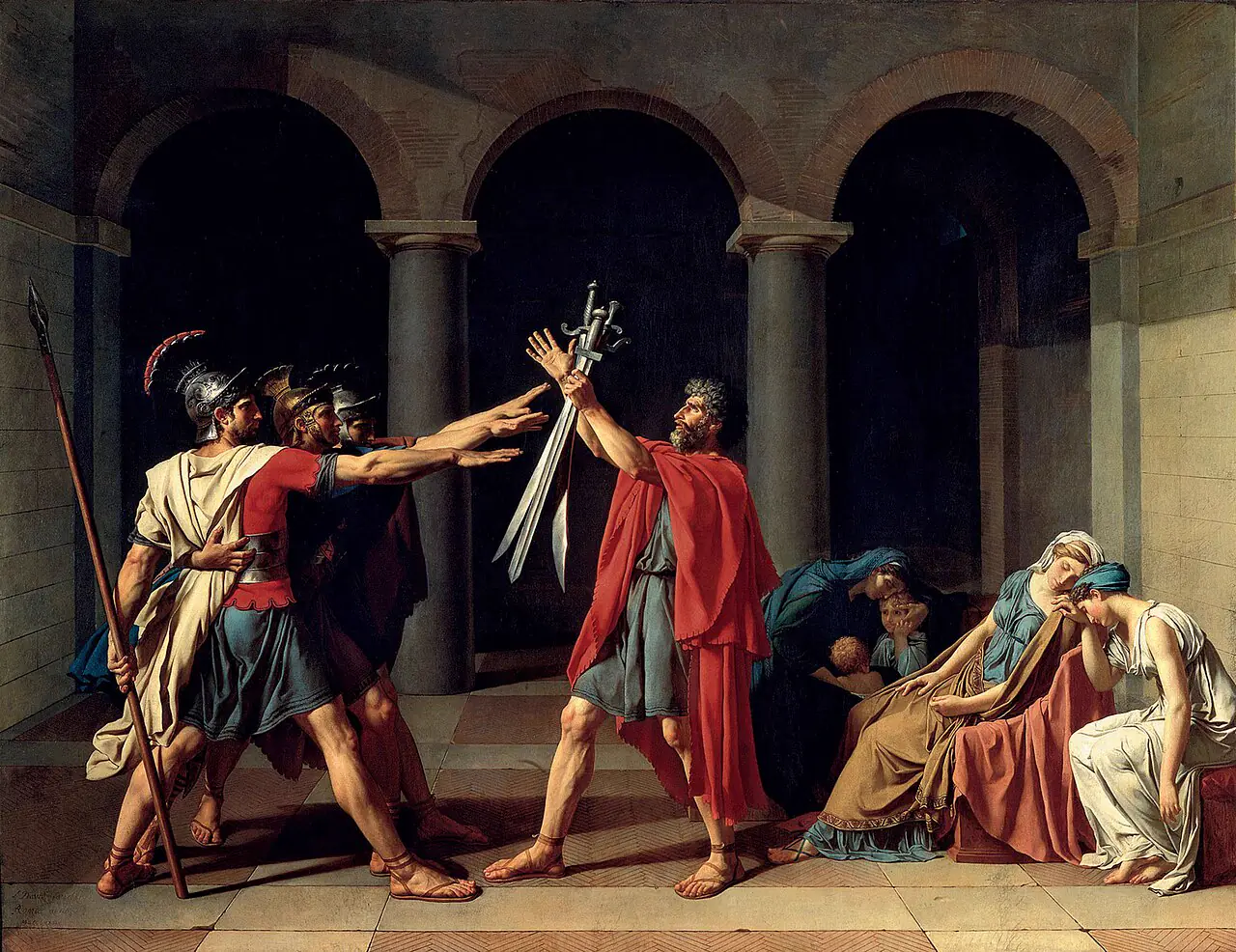
Jacques-Louis DavidThe Oath of the Horatii, 1784 Musée du Louvre, Paris
Overview
At London’s Hanover Square Rooms on 23 March 1792, Haydn presented a new symphony with an unusually plain slow movement. The violins played a short tune, marked semplice. It was repeated more quietly. Then the whole orchestra played a fortissimo chord, with timpani.
In a tune with a clear accompaniment, the phrase endings are exposed. Four bars can come to rest on G, the dominant of C major, with a pause long enough for a breath. Four more can return to C and close the sentence. The invented period below has these two endings. An extra bar would delay the answer, and a sudden silence would make the missing beat conspicuous.
C. P. E. Bach’s keyboard music breaks off, changes register and changes direction in the middle of a phrase. His Essay on the True Manner of Playing the Clavier, published in two parts in 1753 and 1762, treats performance together with fingering and ornaments, including which finger takes a note, how an ornament begins and where a phrase should pause.
FormSonata form, symphony and concerto
Sonata form gives a change of key consequences that can last through a movement. In a C major exposition, G may begin as an ordinary chord within C. An F♯ in a D major chord then pulls towards G, and a firm cadence establishes G as a key in its own right. The exposition can end there and repeat. By that point it has presented themes in the second key.
During the development, a composer can take a few notes from a tune and move them through unfamiliar keys. A fragment passes from violin to bassoon; a repeated figure rises a step each time. The opening theme eventually returns in the tonic. In this recapitulation, material first heard in the second key must now close in the home key.
Beethoven’s Fifth Symphony builds its entire first movement from a four-note figure. The opening rhythm repeatedly interrupts the lyrical phrases, passes between instruments and drives passages in which little melody remains. The orchestra can repeat a short figure many times before the next note arrives. In a string quartet, two violins, viola and cello can carry out the same kind of argument on a smaller scale, with each player responsible for one exposed line.
A concerto adds a soloist to the orchestra. In Mozart’s piano concertos, the orchestra may state a theme before the soloist has played a note. The piano can answer with a decorated version of it or introduce new material. Near the end of a movement, a pause on a chord can leave the soloist alone for a cadenza. A trill prepares the orchestra’s return.
The instrumentsStein’s fortepiano and the natural horn
Mozart visited the Augsburg piano maker Johann Andreas Stein in October 1777. In a letter to his father on the 17th, he praised the care Stein took with his instruments, writing that Stein “scrapes and works until the piano can do everything”. Mozart wrote with particular approval of the escapement. The hammer fell away from the string as soon as it had struck, even while the finger held the key down, so that the note could sound without the hammer damping it.
The force of the touch changed the sound. On a fortepiano, a melody could be louder than the broken chords beneath it, and a single note could carry an accent. The strings faded relatively quickly, leaving space after each attack. Mozart also admired Stein’s knee lever, which lifted the dampers with scarcely a touch. Releasing it stopped the sound that was still ringing. A phrase could join smoothly across the bar, then end cleanly.
Wind instruments gave the orchestra sounds that a keyboard could only approximate. An oboe could hold a note after the strings’ initial attack; horns could fill out a cadence without taking the melody. Beethoven saved a much larger change for the finale of his Fifth. After the quiet passage led by the timpani out of the scherzo, the finale opens in C major with piccolo, contrabassoon and three trombones added to the orchestra.
The listenersPatrons and ticket buyers
Haydn wrote his London symphonies for paying audiences after decades in the service of the Esterházy family. The death of Prince Nikolaus in 1790 left him free to travel. At his first London season in 1791, a composer used to writing for a court’s musicians arrived in a city where a concert had to attract customers. The “Surprise” belonged to his second season, and it contains a sudden loud chord.
On 22 December 1808 Beethoven presented the first performances of his Fifth and Sixth symphonies in a bitterly cold Vienna theatre. The programme also included the Fourth Piano Concerto and ended with the Choral Fantasy.
Mozart’s Le nozze di Figaro gives its people equally different things to attend to. In the last act, the Count woos his own wife, disguised as her maid. Figaro sees a betrayal; Susanna, wearing the Countess’s clothes, has to deal with his jealousy. The orchestra holds these mistaken conversations together. When the real Countess reveals herself, her husband has to ask forgiveness in front of everyone.
On 7 May 1824, in Vienna, Beethoven brought voices into the finale of his Ninth Symphony. A bass soloist interrupts with words Beethoven wrote himself: “O friends, not these sounds!” Schiller’s poem follows, and the chorus takes up its invitation to become brothers. The tune, first played by the orchestra, is then sung to the words.
Terms of art
Period
A pair of related musical phrases in which the second ends more firmly than the first. An eight-bar period often divides into two four-bar phrases.
Sentence
A phrase that presents a short idea, repeats it, then moves towards a cadence. The closing part often uses shorter fragments of the opening idea or quicker notes.
Sonata form
A design for a movement with three main sections. The exposition establishes a home key and a second key; the development works on the musical ideas; the recapitulation brings them back, with the later material now resolving in the home key.
Development
The reshaping of an existing musical idea, for example by breaking it into fragments, changing its key or combining it with another tune. The term also names the middle section of a sonata-form movement, where this often happens.
String quartet
An ensemble of two violins, viola and cello, with one player to each part. The term also means a piece written for this ensemble.
Cadenza
A solo passage, often near the end of a concerto movement, during which the orchestra is silent. It may be improvised or written out, and often ends with a trill before the orchestra returns.
Fortepiano
A name used for the pianos of the eighteenth and early nineteenth centuries, and modern copies of them. Their hammers strike strings in a lightly built wooden frame, producing a sound that generally fades more quickly than a modern concert grand’s.
In the score
Phrase construction · schematicQuestion on V, answer on I
An invented eight-bar period. Bars 1–4 stop on G major, a half cadence. Bars 5–8 begin the same way, then cadence on G7–C as the melody rises from B to C, a full close.
Changing tonal area · schematicModulation to the dominant by one accidental
An invented modulation from C major to G major. At first G belongs to the key of C. The D7 chord introduces F♯, which leads up to G, so that the final chord is heard as the new tonic.
Sister arts
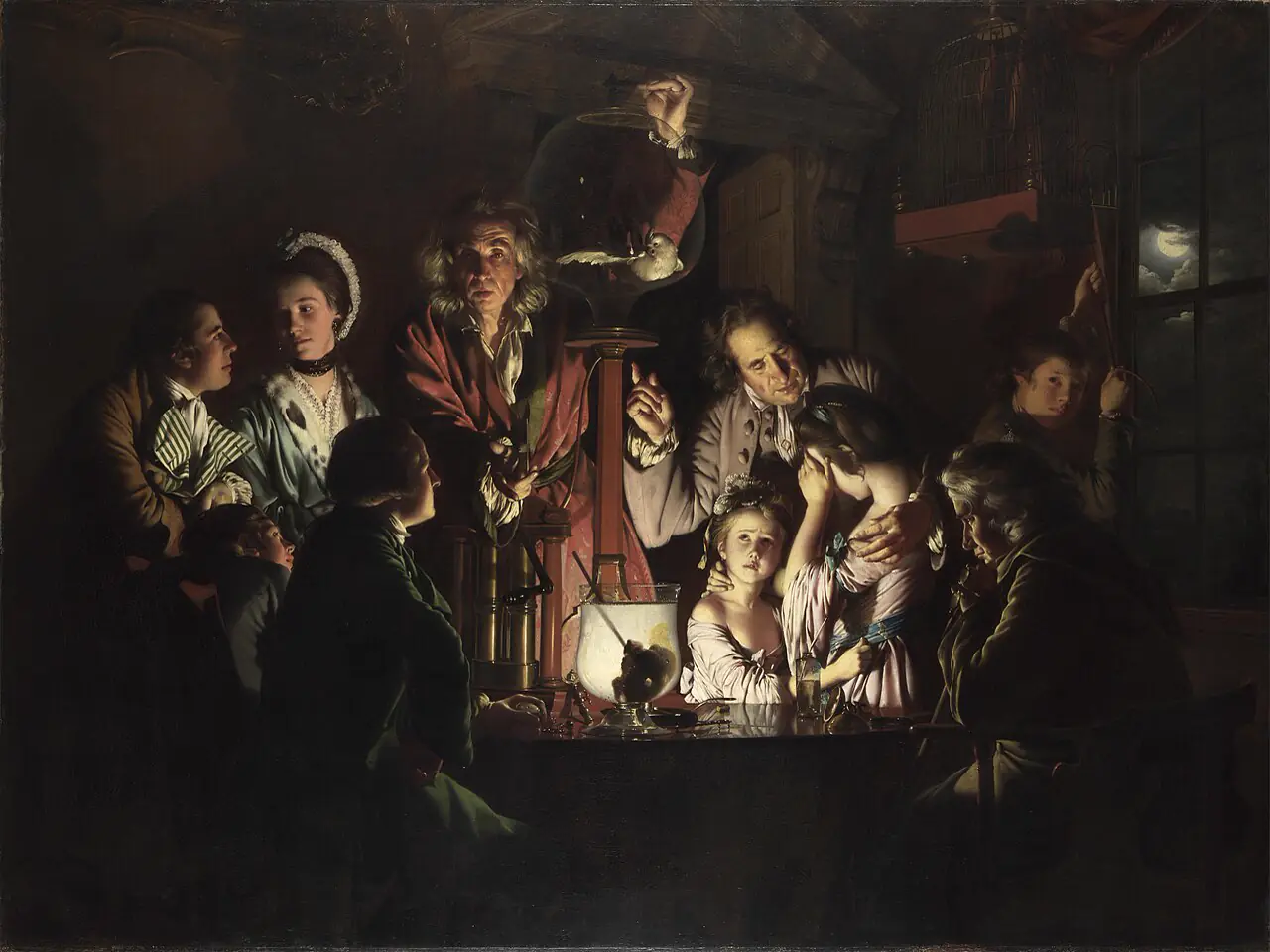
Joseph Wright of DerbyAn Experiment on a Bird in the Air Pump, 1768Oil on canvas · National Gallery, London
The cockatoo struggles inside the glass vessel. One girl covers her eyes; her father tries to reassure her. Across the table, a young couple look at each other and miss the experiment altogether. Wright gives the figures separate responses to the one event, as Mozart does in operatic ensembles where the characters sing together with quite different things on their minds.
Friedrich Schiller
An die Freude — first stanza
1785; revised c. 1803
GermanFreude, schöner Götterfunken,
Tochter aus Elysium,
Wir betreten feuertrunken,
Himmlische, dein Heiligtum.
Deine Zauber binden wieder,
Was die Mode streng geteilt,
Alle Menschen werden Brüder,
Wo dein sanfter Flügel weilt.
Our translationJoy, lovely spark of the gods,
Daughter from Elysium,
Drunk with fire we enter,
Heavenly one, your sanctuary.
Your spells bind together again
What custom has strictly divided;
All people become brothers
Where your gentle wing rests.
In the Ninth Symphony Beethoven set Schiller’s words “All people become brothers” for soloists and chorus. Before the poem begins, the bass sings Beethoven’s own words, “O Freunde, nicht diese Töne!” (“O friends, not these sounds!”). The orchestra has already played the melody that the voices will take up.