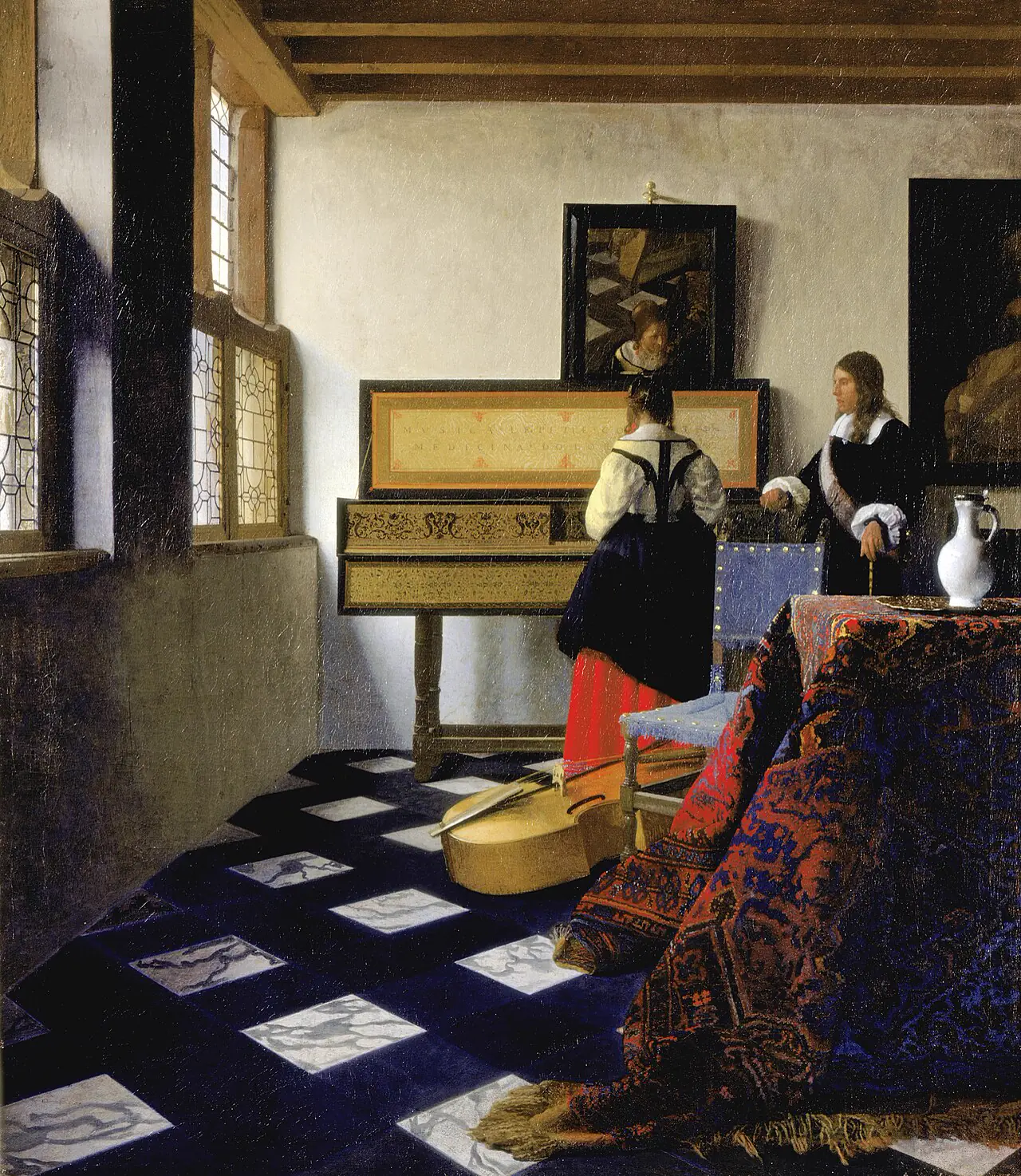
Johannes VermeerThe Music Lesson (Lady at the Virginals with a Gentleman), c. 1662–65 Royal Collection, London
Overview
In 1637 Venice opened its first public opera house. A performance that had belonged to the court could now pay for itself by selling admission. At the centre stood a singer, with a text to deliver and a bass line beneath the voice. The accompanying player filled in the chords. Much of the music now called Baroque begins with that economical arrangement.
The basso continuo could be a harpsichord and cello, an organ with bassoon, or a plucked instrument accompanying a voice. The bass player played the written line, and the chord player chose how to fill the space above it. A harpsichordist could spread a chord, keep the right hand close to the singer’s part, or stop playing between phrases. Two performances from the same figured bass could contain quite different notes.
Two moving parts are enough to produce a dissonance. In the example below, an upper F begins as a consonance over another F. The bass moves to C while the upper note is held, so the F becomes a dissonance against the new bass; the dissonance resolves when F falls to E. This is a suspension. In a chain of suspensions, one voice moves to its next note while the other is still held over from the previous chord. Repeated bass patterns and cadences also establish the pull of major and minor keys.
The employersLeipzig, Venice and London
In Leipzig, where Bach became Thomaskantor in 1723, the church calendar kept the composer at his desk. Cantatas were required for Sundays and feast days, and choirboys helped copy the parts. In his second annual cycle, Bach built the cantatas around familiar chorales. A hymn could appear in long notes above busy instrumental writing, pass through the changed words of an aria, and return in a plain harmonisation at the end.
In August 1730 Bach sent the Leipzig council a memorandum that set out what church music needed and what he actually had. Several indispensable posts were vacant. Students filled the gaps, and schoolboys taken from the choir had to play instruments. The document counts the violins and oboes required and those available.
Vivaldi worked with a different body of musicians at the Ospedale della Pietà in Venice, which employed him as a violin teacher in 1703. Its girls and women sang and played for visitors who came to hear them. His concertos make the division between soloist and ensemble plain. The orchestra plays a returning passage, the ritornello, and the solo violin moves into quicker notes. The orchestral passage then returns in the home key.
The opera singer had a similar opportunity in the da capo aria. After a contrasting middle section, the score sent the singer back to the beginning, where ornaments could make the familiar melody elaborate. Handel wrote these arias for London’s Italian opera stage, then brought English biblical drama to audiences in his oratorios. In the oratorios a chorus could carry the story.
The instrumentsHarpsichord, temperament and trumpet
“I much prefer what moves me to what surprises me,” Couperin wrote in the preface to his first book of harpsichord pieces in 1713. On the harpsichord that preference raised a practical difficulty. Its strings are plucked, and a harder blow on the key cannot produce the swelling accent a pianist can make. Expression has to come from a small delay, the careful release of a note or a chord spread between the hands. Couperin filled his pages with signs showing exactly where each ornament belonged.
A keyboard is also bound by its tuning. A singer can adjust a note during a phrase; a harpsichord string remains where the tuner left it. Temperament distributes small compromises among the intervals so that the required keys will work. Bach’s The Well-Tempered Clavier goes through all twenty-four major and minor keys, pairing a prelude with a fugue in each. The first book dates from 1722; about twenty years later he assembled a second.
Trumpeters faced a different limit. Without valves, they drew their notes from the harmonic series of one length of tubing. High in that series, the notes lie close enough together to make melodies; lower down, there are large gaps. Baroque trumpet parts are limited by those gaps. The high notes in Bach’s festive church music required a player who could hit them reliably.
Print and performancePrinted music, suites and fugues
Printed music could travel much farther than its author. Couperin’s books carried his ornaments into other people’s houses; Rameau’s Traité de l’harmonie, published in Paris in 1722, set out principles of composition and accompaniment. Bach’s church musicians still worked from manuscript parts. At Café Zimmermann in Leipzig, where he directed the Collegium Musicum from 1729, the public could hear his concertos and orchestral suites alongside music by other composers.
The movements of a suite are based on dances. They often share a key, but the flowing steps of an allemande and the quick compound beat of a gigue put different demands on the bow or the fingers. The sarabande is in slow triple time, with a weight on the second beat. The dance rhythms remain in the music when it is played on a harpsichord with no dancers present.
A fugue begins by making a tune recognisable. One voice states the subject; another answers while the first continues. As more voices join, the same melody can be heard from above or below, or begin before the preceding entry has finished. Every line must remain singable while its notes fit the other lines. Bach could build pages of such entries from a brief subject.
Dryden’s A Song for St Cecilia’s Day gives the flute a verse of melancholy complaints. Handel set the poem in 1739 and had the named instrument play alongside the voice. In another verse the trumpet calls soldiers to battle.
Terms of art
Basso continuo
A bass part accompanied by chords supplied by a keyboard or plucked instrument, often with a cello or another bass instrument playing the written line. Figures above or below the bass tell the chord player which intervals to include.
Ritornello
A passage that returns during a piece. In a Baroque concerto, it is usually played by the orchestra between solo episodes; later returns may be shorter or in another key.
Affect
A state of feeling, such as grief, joy or anger, expressed in music. Baroque composers often sustained one principal affect through a movement.
Fugue
A piece or passage in which several independent voices enter in turn with the same main melody, called the subject. The voices continue together, and the subject returns at different pitches and in different combinations.
Suite
A set of instrumental movements played in sequence. A Baroque suite usually brings together dances in the same key, each with its own metre and characteristic rhythm.
Da capo aria
A solo vocal piece in three sections: an opening, a contrasting middle, and a return to the opening. “Da capo” means “from the head”; the singer commonly adds ornaments on the return.
Temperament
A system for adjusting intervals when tuning a keyboard or another fixed-pitch instrument. Equal temperament divides the octave into twelve equal semitones; unequal systems give some intervals purer tuning at the expense of others.
In the score
Continuo and counterpoint · schematicPrepared fourth and its resolution to a third
An invented example of a suspension. The upper F is held as the bass moves from F to C, so that a consonance becomes a dissonance. F then falls to E, and the fourth above the bass resolves to a third.
Harmonic sequence · schematicFifths through the diatonic scale
An invented sequence using the notes of C major. The chord roots run C–F–B–E–A–D–G–C; F–B is a diminished fifth. The pattern repeats on each new bass note until the sequence returns to C.
Sister arts
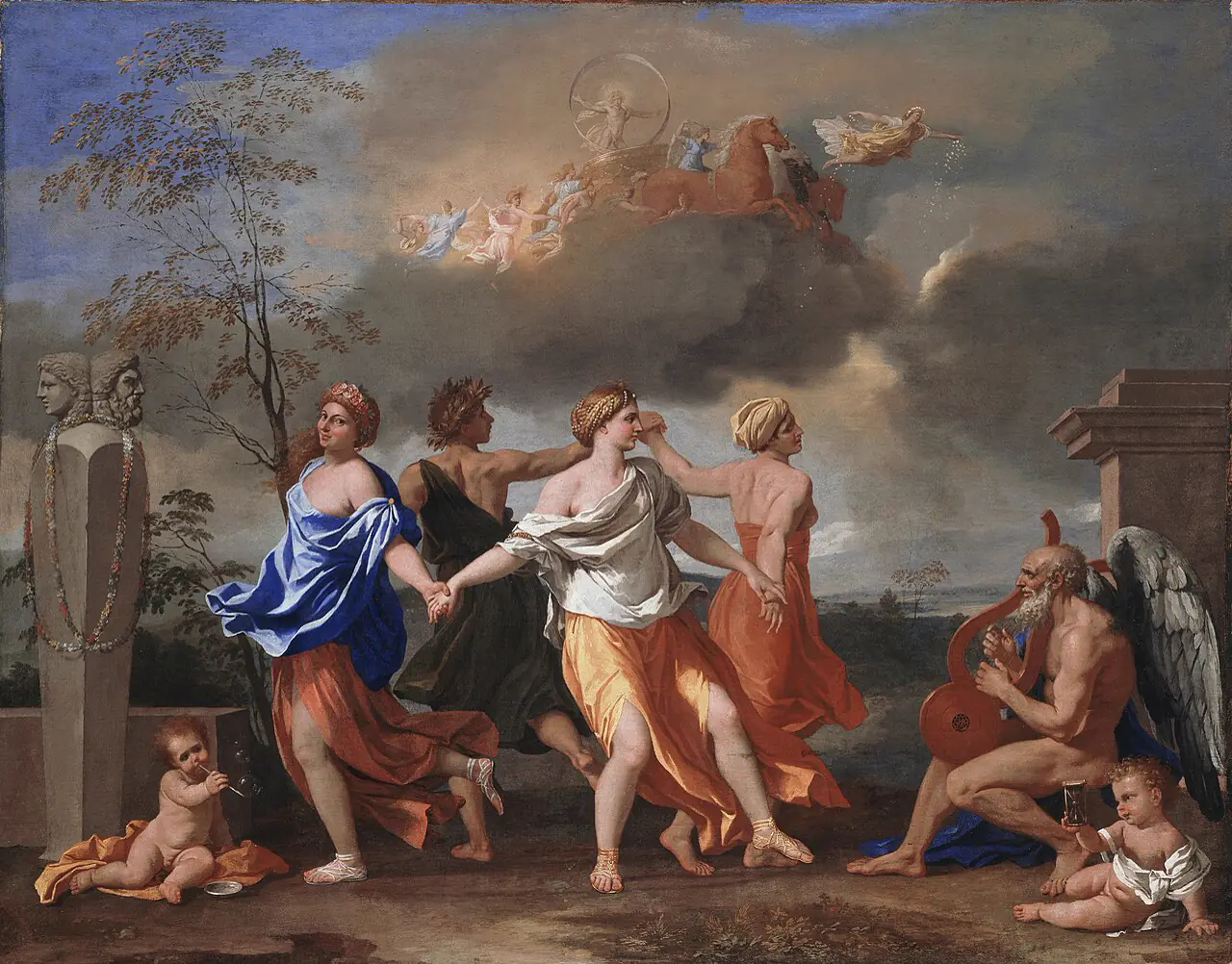
Nicolas PoussinA Dance to the Music of Time, c. 1634–36Oil on canvas · Wallace Collection, London
Four dancers hold hands while Father Time plays the lyre; beside him, a child holds an hourglass. Poussin painted it in Rome for Giulio Rospigliosi, the future Pope Clement IX. At the other side of the dance, another child blows bubbles.
John Dryden
A Song for St Cecilia’s Day — opening
1687
EnglishFrom harmony, from heavenly harmony,
This universal frame began.
When Nature underneath a heap
Of jarring atoms lay,
And could not heave her head,
The tuneful voice was heard from high,
“Arise, ye more than dead!”
Then cold, and hot, and moist, and dry,
In order to their stations leap,
And Music’s power obey.
Dryden’s poem begins with the creation of the universe, commanded into order by a voice from above. Handel set it in his Ode for St Cecilia’s Day, HWV 76, in 1739. Later stanzas name the trumpet and the flute, and the orchestra supplies the instruments the words name.
A survey of Strozzi’s books in chronological order, from Op. 2 to Op. 8, with Lagrime mie and what the label describes as the first recording of a piece without an opus number. The linked video is the complete album; the times below are the chapters given in its description.
Havete torto, from Cantate à voce sola di diversi auttori
Sino alla morte, Op. 7
Che si può fare, Op. 8
Lagrime mie, Op. 7Video published 2019
Mary Bevan, soprano; Elizabeth Kenny, theorbo; Orchestra of the Age of Enlightenment
A performance by a soprano and a theorbo player, published on the orchestra’s own channel with details of its Strozzi concert at Kings Place, London. The piece is the lament that opens with the words “Lagrime mie”.