Organist, teacher, cantor and director of Leipzig’s Collegium Musicum
Output
Cantatas and Passions; organ and keyboard collections; concertos and solo string music
Life
Bach grew up in a house full of working musicians. His father, Johann Ambrosius, served the town of Eisenach; apprentices lived with the family, and relatives held church and civic posts across Thuringia. Johann Sebastian was born in 1685. His mother died when he was nine, his father the following year, and he moved to Ohrdruf to live with his elder brother Johann Christoph, an organist taught by Pachelbel. He sang in the school choir and learnt the organ at home. At fifteen he went to St Michael’s School in Lüneburg, where his voice helped pay for his education. In 2006 some of his schoolboy copies of north German organ works, including two of the hardest pieces of the day, were found in the Anna Amalia Library in Weimar.
In 1702 he won the organist’s post at Sangerhausen, until the duke intervened and gave it to someone else. The next year Arnstadt hired him to examine its new organ and then to play it. Two years later he set off on foot to hear Dieterich Buxtehude in Lübeck. He stayed for months, far beyond his authorised leave, and came back to a reprimand. In 1707 he moved to Mühlhausen and on 17 October married his second cousin Maria Barbara at Dornheim. The cantata for the inauguration of Mühlhausen’s town council in February 1708, Gott ist mein König, BWV 71, was one of the few works printed in his lifetime. In his cantata Aus der Tiefen, BWV 131, one voice sings the psalmist’s plea while another sings a hymn in long notes above it.
1708–17Weimar
In 1708 Bach became court organist at Weimar, and from 1714 he also held the rank of concertmaster, with a new cantata due every month. Telemann, with whom he exchanged scores, became godfather to his son Carl Philipp Emanuel that year. Bach copied and arranged Italian concertos, especially Vivaldi’s. In the organ arrangements, the orchestra’s replies to a solo violin could be divided between the keyboards, and the bass was given to the pedals. Vivaldi’s recurring refrains and his sequences through changing keys were taken into Bach’s own concertos, which added inner voices between the melody and the bass.
The short chorale preludes of the Orgelbüchlein were as demanding. A hymn tune may sit in long notes above a short figure that runs with few breaks, and the pedal has a part of its own. Bach’s title page offered a beginning organist guidance in developing a chorale “in all sorts of ways” and in gaining skill at the pedals, “since the pedal is treated entirely obbligato”. He completed forty-six pieces in a book planned for many more. In each the organist has to keep the congregation’s tune audible while playing the other lines clearly.
When Bach accepted a new post at Köthen in 1717, the Duke of Weimar refused to release him. Bach insisted on leaving. The duke had him imprisoned for nearly a month, then dismissed him. Prince Leopold of Anhalt-Köthen, his next employer, was a keen musician with a good ensemble; the Calvinist court had little use for elaborate church cantatas, and Bach could spend his time on instrumental music.
KöthenConcertos, solo violin and keyboard works
In 1721 he sent six concertos to the Margrave of Brandenburg. Each uses a different group of solo instruments. The Second has trumpet, recorder, oboe and violin as soloists; the Sixth has no violins. In the Fifth, the harpsichord starts as part of the accompaniment and later plays a long solo while the orchestra is silent.
The manuscript of his unaccompanied violin sonatas and partitas is dated 1720. In these works a single bow plays bass notes, chords and separate voices that would otherwise be given to an ensemble. The D minor Chaconne takes its recurring harmonies through broken chords and large groups of stopped strings. The cello suites put similar demands into dance forms. Their allemandes and sarabandes keep the rhythm of the dance audible even where the player has only one note sounding.
In 1720 Bach returned from travelling with Leopold and learned that Maria Barbara had died and been buried. He married the court singer Anna Magdalena Wilcke the following year. Their music books contain both lessons and household entertainment. Writing to his old schoolfriend Georg Erdmann on 28 October 1730, he boasted of the children: “They are all born musicians.” He added that his household could already form a vocal and instrumental ensemble, since Anna Magdalena sang a clear soprano and his eldest daughter was good too.
The first book of The Well-Tempered Clavier, dated 1722, contains a prelude and fugue in every major and minor key. Bach’s title page offered it for “the use and profit of musical youth eager to learn”, and as a “pastime” for those already skilled. An earlier, shorter version of its opening C major Prelude appears in the lesson book for his eldest son Wilhelm Friedemann. The two-part Inventions and three-part Sinfonias are likewise exercises in independence of the hands. Their title page, dated 1723, named “a singing manner of playing” and “a strong foretaste of composition” among the chief aims.
1723–50Thomaskantor in Leipzig
Leipzig appointed him Thomaskantor in 1723, after Telemann and Graupner proved unavailable. He had schoolboys to teach and church music to direct, and in the early years he wrote cantatas in close succession. Parts had to be copied and rehearsed before Sunday. The cycle begun in 1724 often builds each cantata round one hymn. The first stanza becomes a large chorus, inner stanzas are recast as arias and recitatives, and the congregation’s melody returns at the close.
Bach’s relations with the council were difficult. In that October 1730 letter to Erdmann, Bach described “a strange authority with little devotion to music” and asked whether his friend knew of another job. Leipzig was expensive, and funeral fees fluctuated with the death rate. In a healthier year he had lost more than a hundred thalers. Earlier that summer he had sent the council a ten-page “Short but Most Necessary Draft for a Well-Appointed Church Music”, describing the singers and instrumentalists he needed. In 1736, after repeated requests, he was named Composer to the Electoral Saxon and Royal Polish Court, a title that strengthened his position against the Leipzig authorities. He remained in Leipzig for the rest of his life.
The St John Passion was first heard in 1724, the St Matthew Passion in 1727. In both, a tenor Evangelist narrates the Gospel text. The arias pause the narrative to reflect on what has happened, and the chorales bring familiar hymn tunes into the drama. The St Matthew uses two choirs and two orchestras, which answer each other. Sustained strings accompany the words of Jesus until his cry of abandonment, where they stop. After Peter’s denial, a solo violin begins Erbarme dich before the alto enters.
From 1729 Bach also directed the Collegium Musicum at Zimmermann’s coffeehouse. There he could play concertos and present secular cantatas outside the control of the church authorities; for one of its special concerts he wrote the Coffee Cantata, BWV 211, a joke about the venue. Music passed between the two establishments. In the Christmas Oratorio, performed over six feast days in 1734–35, movements written for secular celebrations were given new words and a place in the Nativity story.
The later collectionsGoldberg Variations and The Musical Offering
The four parts of Clavier-Übung gathered keyboard partitas, an Italian Concerto and French Overture, organ music, and finally the Goldberg Variations. Thirty variations follow the opening aria’s bass and harmonies. Every third one through No. 27 is a canon, the imitating voice entering at a successively wider interval. In the place of a tenth canon, Bach put a quodlibet, a mixture of popular tunes. The aria then returns unchanged.
In May 1747 he visited Frederick II at Potsdam, where his son Carl Philipp Emanuel worked. A Berlin newspaper reported his evening arrival on its front page. He played “on the so-called forte and piano”, and the king challenged him to improvise a fugue on a theme he supplied. Bach took the theme home and made The Musical Offering: canons, two ricercars and a trio sonata with a flute part for the king’s instrument. He was also assembling the B minor Mass from music reaching back decades. Its Kyrie and Gloria had gone to the new Elector of Saxony in Dresden in 1733, partly in the hope of a court title. The Crucifixus reworks a chorus from the 1714 cantata Weinen, Klagen, Sorgen, Zagen, and its descending bass repeats beneath the voices.
His eyesight failed. The ophthalmologist Sir John Taylor, who was in Leipzig from 4 to 7 April 1750, operated on him, and a second operation followed. Bach saw again for a short time, then suffered a stroke and died on 28 July. The Art of Fugue left related D minor subjects inverted, augmented and combined; its unfinished fugue introduces the notes B♭–A–C–B♮, which spell his surname in German notation. His children and pupils preserved scores, though many were lost. Mozart and Beethoven studied the music before Mendelssohn performed an abridged St Matthew Passion in Berlin in 1829. Later, Brahms arranged the Chaconne for piano left hand, and Webernorchestrated the six-part ricercar, dividing its lines among the instruments a few notes at a time.
Places
Every recorded place, joined in date order. J. S. Bach on the MapAll 25 places, with sources
Eisenach · 31 March 1685 – 1695 · born
Born 21 March (Old Style); attended the Latin school 1693–95; his parents died in 1694 and 1695.
Each part keeps moving while the others play. In the C major Fugue from The Well-Tempered Clavier, a new entry of the subject repeatedly begins before the previous one has finished. This overlap is called stretto. In The Art of Fugue, the subject can be inverted or played in longer notes and still fit the other parts.
♮The bass
In Weinen, Klagen, Sorgen, Zagen, the bass descends by semitones while the voices lament above it; Bach returned to that music for the Mass’s Crucifixus. Elsewhere a held upper note becomes a dissonance against a new bass note, then moves down a step to resolve. Figured bass gives the continuo player the changing chords to play.
𝅘𝅥Dances
The cello suites and violin partitas keep the steps of the dances they are named after. An allemande moves differently from a sarabande, which places weight on its second beat, or from a quick gigue. Bach could put a bass note on one beat and a melody note on the next, so that a single instrument plays more than one part. Chords occur often enough to keep the harmony and metre of the dance clear.
𝄞Hymn tunes
A Lutheran chorale came with words the congregation already knew. In Wachet auf, the sopranos sing Nicolai’s tune in long notes across the opening chorus; later the tenors sing another stanza against a flowing string melody. In Aus der Tiefen, a chorale and a psalm are sung at the same time.
𝆑Instrumental partners
Many of Bach’s arias are written for a singer and a solo instrument together. In Erbarme dich the solo violin begins its lament before the alto enters. Each of the Brandenburg Concertos uses a different combination of instruments. No. 2 pairs a high trumpet with recorder, oboe and violin, and No. 5 gives the harpsichord a long solo in the first movement.
𝄋Collections
Bach often set himself a fixed rule for a whole collection. The Goldberg Variations keep the aria’s bass and harmonies while the dance, the number of voices and the difficulty of the hand-crossing change from variation to variation. The Well-Tempered Clavier has a prelude and fugue in every major and minor key, from C to B. A second book goes through all the keys again with new preludes and fugues.
Works
A selection from the composer’s works.
1707–08
Aus der Tiefen rufe ich, Herr, zu dirBWV 131Soloists, chorus, oboe, strings and continuo
Sets Psalm 130 with a Lutheran hymn; one singer has the psalm, another the chorale in long notes. An early case of Bach setting two texts at once.
c. 1708–17
OrgelbüchleinBWV 599–644Organ
Forty-six chorale preludes were completed, and space was left for many more. The feet play an independent line while the hands keep the hymn clear.
A descending chromatic bass underpins the first chorus. More than thirty years later, Bach reworked the chorus as the Crucifixus of his B minor Mass.
c. 1717–23
Six Cello SuitesBWV 1007–1012Unaccompanied cello; five-string instrument specified for No. 6
The Fifth asks for the top string to be tuned down. Each suite begins with a prelude and continues with dances.
1720
Sonatas and Partitas for Solo ViolinBWV 1001–1006Unaccompanied violin
Three sonatas alternate with three dance collections in the manuscript dated 1720. The D minor Partita ends with the Chaconne, written for one violin playing alone.
1721
Six Brandenburg ConcertosBWV 1046–1051Six different instrumental ensembles
Sent to the Margrave of Brandenburg in 1721, drawing on earlier music. No. 2 has a high trumpet; No. 6 has no violins.
Twenty-four prelude-and-fugue pairs, ascending from C major and C minor to B major and B minor. The first prelude began as a lesson for Wilhelm Friedemann.
Fifteen pieces in two parts, followed by fifteen in three. Bach’s title page asks for clean playing, a singing touch and a first grounding in composition.
1724
St John PassionBWV 245Soloists, chorus, orchestra and continuo
First performed in Leipzig on 7 April 1724 and revised several times afterwards. The tenor Evangelist narrates the story, and the chorus sings the parts of the crowd.
1727; revised 1736
St Matthew PassionBWV 244Soloists, two choirs and orchestras, additional soprano ripieno
In the opening movement two choirs alternate in question and answer while a third group sings a chorale above them. Picander wrote the reflective poetry set around the text of Matthew’s Gospel.
Wachet auf, ruft uns die StimmeBWV 140Soloists, chorus, horn, oboes, taille, strings and continuo
All three stanzas of Nicolai’s hymn appear. The fourth movement sets the chorale in the tenors against a string melody that Bach later arranged as an organ chorale.
1734–35
Christmas OratorioBWV 248Soloists, chorus and orchestra
Six cantatas for six feast days, from Christmas Day to Epiphany. Several movements had first been written for royal birthdays, with other texts, before they were given their sacred words.
1735
Italian ConcertoBWV 971Two-manual harpsichord
One player takes the parts of both soloist and orchestra, with forte and piano markings separating the two. In the slow movement a heavily ornamented melody is played over a steady accompaniment.
1739
Clavier-Übung IIIOrgan
The E♭ major Prelude and Fugue frame hymn settings and four duets. Some chorales appear both in large settings with pedals and in smaller versions for hands alone.
c. 1740–50; published 1751
The Art of FugueBWV 1080Unspecified; normally performed on keyboard or by instrumental ensemble
A family of D minor subjects is inverted, lengthened and combined. The unfinished fugue introduces B♭–A–C–B♮ (B–A–C–H in German note names).
Thirty variations on the opening aria’s bass and harmonies, with a canon at every third variation up to No. 27. A medley of popular tunes comes before the aria returns.
The Well-Tempered Clavier, Book IIBWV 870–893Keyboard
Another twenty-four preludes and fugues, assembled from music written at different times. As before, each major key is placed beside its minor.
1747
The Musical OfferingBWV 1079Keyboard and chamber instruments; trio sonata for flute, violin and continuo
Frederick II supplied the theme, and Bach sent back fugues, puzzle canons and a trio sonata. In the six-part ricercar, six independent voices share the same chromatic subject.
Assembled 1748–49
Mass in B minorBWV 232Soloists, chorus, orchestra and continuo
The complete Latin Ordinary, assembled from decades of work. After the descending lament of the Crucifixus, trumpets and drums return for Et resurrexit.
In the score
Short examples, engraved and playable.
The Well-Tempered Clavier I · BWV 846Fugue subject suited to stretto
The subject quoted from bars 1–2 of the C major Fugue, BWV 846, at its original pitch. The alto begins alone; the final E is lengthened and rests complete the example. Later voices enter before the subject has finished, an overlap called stretto.
The Art of Fugue · a musical spellingB–A–C–H
A pitch schematic of B–A–C–H: B♭–A–C–B♮ in German note names. Bach used this musical signature in the unfinished fugue of The Art of Fugue. The two falling semitones lie on either side of a rising minor third.
Figured bassBass line with one possible realisation
A schematic figured-bass realisation. The figures give intervals above the bass: 6 above E makes a first-inversion C major chord; 7 above G adds F. In the last chord, the upper F resolves to E and B rises to C.
Sister arts
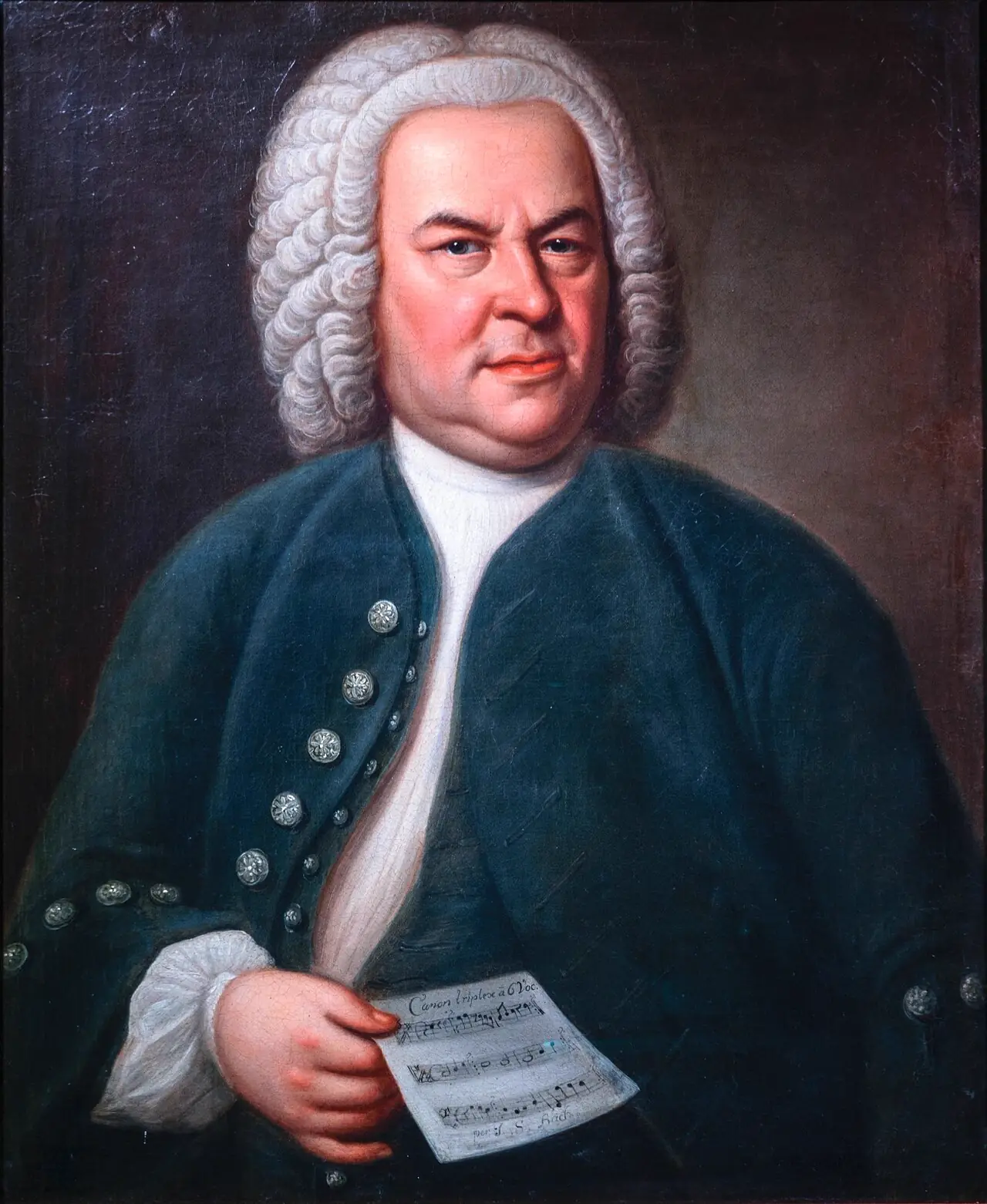
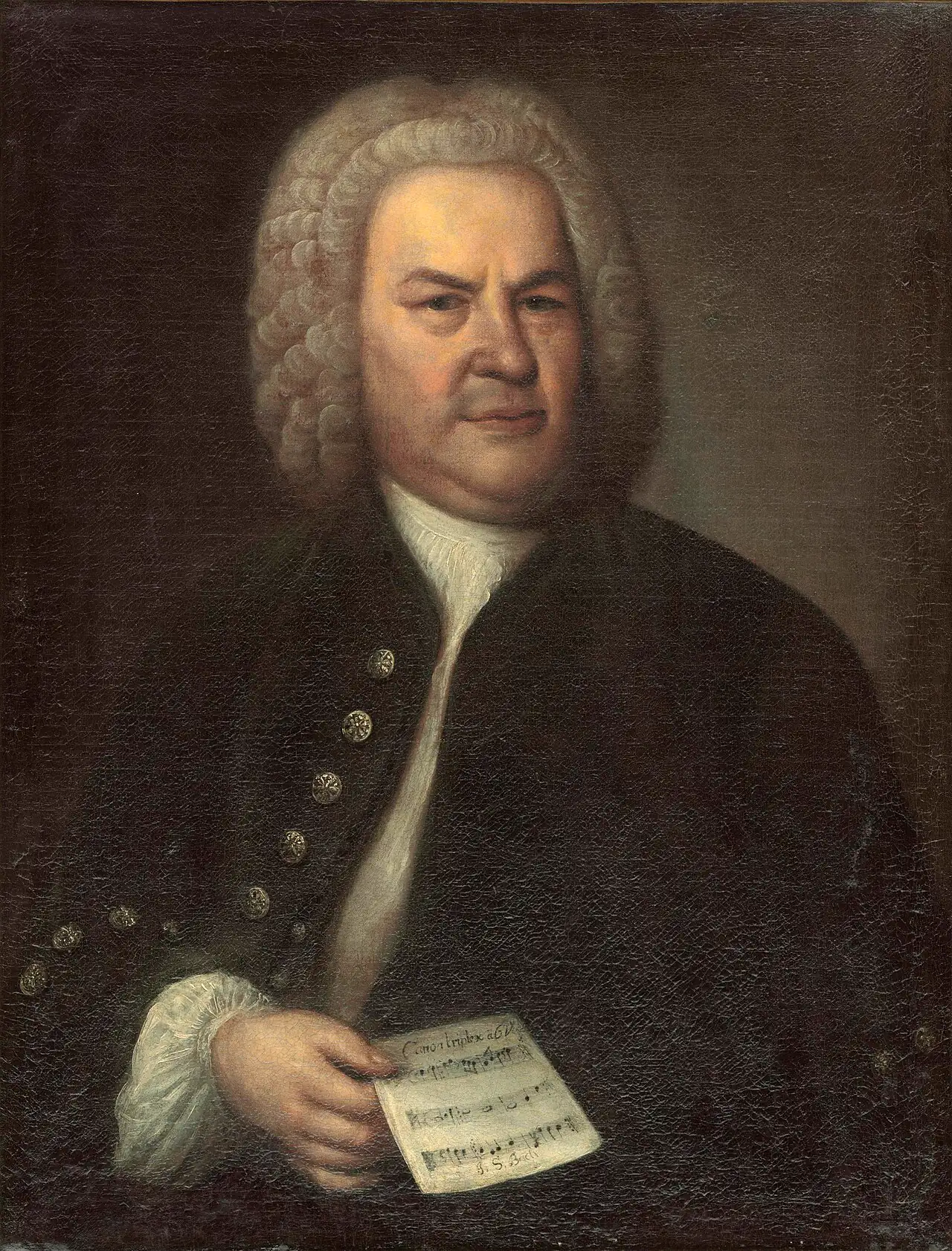
Elias Gottlob HaussmannJohann Sebastian Bach, 1746Oil on canvas · Stadtgeschichtliches Museum Leipzig
Bach holds out a canon towards the painter, the Canon triplex a 6 voci, BWV 1076. Its three written lines produce six sounding parts. Haussmann painted him twice, in 1746 and 1748. The later picture passed to Carl Philipp Emanuel, who kept it in his collection of musicians’ portraits. It returned to Leipzig after 265 years away and now belongs to the Bach-Archiv.
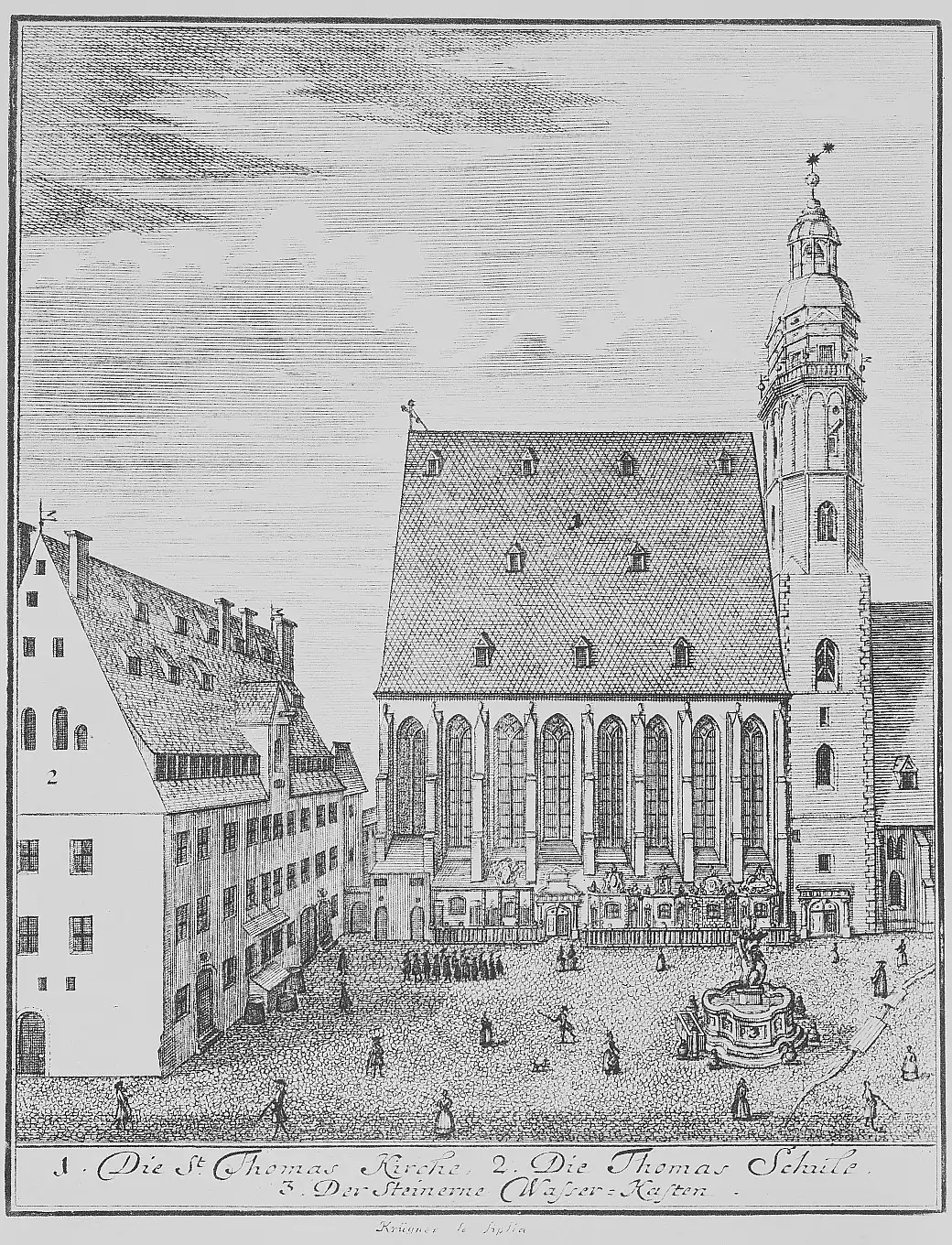
Johann Gottfried KrügnerSt Thomas’s Church and School, Leipzig, 1723Engraving
Church, school and home stood next to one another. Bach’s family lived in the Thomasschule, whose boys supplied singers for Leipzig’s churches. This engraving dates from 1723, the year he arrived.
Martin Luther
Aus tiefer Not schrei ich zu dir — first stanza
1524
GermanAus tiefer Not schrei ich zu dir,
Herr Gott, erhör mein Rufen.
Dein gnädig’ Ohren kehr zu mir
und meiner Bitt sie öffne.
Denn so du willst das sehen an,
was Sünd und Unrecht ist getan,
wer kann, Herr, vor dir bleiben?
Our translationFrom deep distress I cry to you;
Lord God, hear my calling.
Turn your gracious ears towards me
and open them to my petition.
For if you choose to look upon
the sin and wrong that have been done,
who, Lord, can stand before you?
Luther’s paraphrase of Psalm 130 was the basis of Bach’s Cantata BWV 38 and of two organ settings in Clavier-Übung III. BWV 686 is written in six parts, two of them played on the pedals. Luther’s tune runs through the six-part texture.
Philipp Nicolai
Wachet auf, ruft uns die Stimme — opening lines
1599
GermanWachet auf, ruft uns die Stimme
der Wächter sehr hoch auf der Zinne,
wach auf, du Stadt Jerusalem!
Mitternacht heißt diese Stunde;
sie rufen uns mit hellem Munde:
Wo seid ihr klugen Jungfrauen?
Our translationWake up, the voice calls to us,
of the watchmen high upon the battlement;
wake up, you city of Jerusalem!
This hour is called midnight;
they call to us with ringing voices:
where are you, wise maidens?
In Nicolai’s hymn, watchmen call the city awake at midnight. Bach set all three stanzas in Wachet auf, first performed in 1731. The sopranos carry the hymn in the opening movement; the tenors take the second stanza against an independent string melody. The words refer to the wise and foolish virgins in Matthew 25.
Recommended recordings
Goldberg VariationsGlenn Gould, pianoColumbia · 1955Fast playing with a dry edge, and each voice clearly separated. In Gould’s first recording the hand-crossing variations are taken at speed, and the canons are played with the same lightness.
St Matthew PassionCollegium Vocale Gent, Philippe HerrewegheHarmonia MundiAn unforced account of the drama. The choir is light enough for the crowd’s quick interjections, and the chorales are sung on an intimate scale.
Mass in B minorDunedin Consort, John ButtLinnThe performance uses ten singers and nineteen instrumentalists. With forces of this size, individual lines can be heard in the quick choruses and in the eight-part writing.
Six Cello SuitesPablo Casals, celloEMI · 1936–39Casals leans on bass notes, slides between pitches and takes liberties with the dance rhythms.
Cantatas — Bach Cantata PilgrimageMonteverdi Choir, English Baroque Soloists, John Eliot GardinerSoli Deo GloriaThe 2000 pilgrimage recordings group the cantatas by their place in the church year; each programme brings together several cantatas Bach wrote for the same Sunday. Gardiner’s performances use a forceful attack and put weight on the words.
Bach learnt from Buxtehude’s organ music and from the Vivaldi concertos he arranged for keyboard. Later composers worked from his scores. Brahms arranged the D minor Chaconne for the left hand alone, Webern orchestrated the six-part ricercar, and Shostakovich wrote his own cycle of twenty-four preludes and fugues. Carl Philipp Emanuel learnt the craft directly from his father.
Documentary biography covering Bach’s employment, education, performing and composition.
Christoph Wolff and Walter Emery, ‘Bach, Johann Sebastian’, Grove Music Online (Oxford University Press, 2001; revised 2024). reference
Detailed chronology, genre surveys, work-list and bibliography; subscription required.
Wolfgang Schmieder, Bach-Werke-Verzeichnis, third edition, revised by Christine Blanken, Christoph Wolff and Peter Wollny (Wiesbaden: Breitkopf & Härtel, 2022). catalogue
BWV³ distinguishes work versions and incorporates source research since the earlier catalogues.