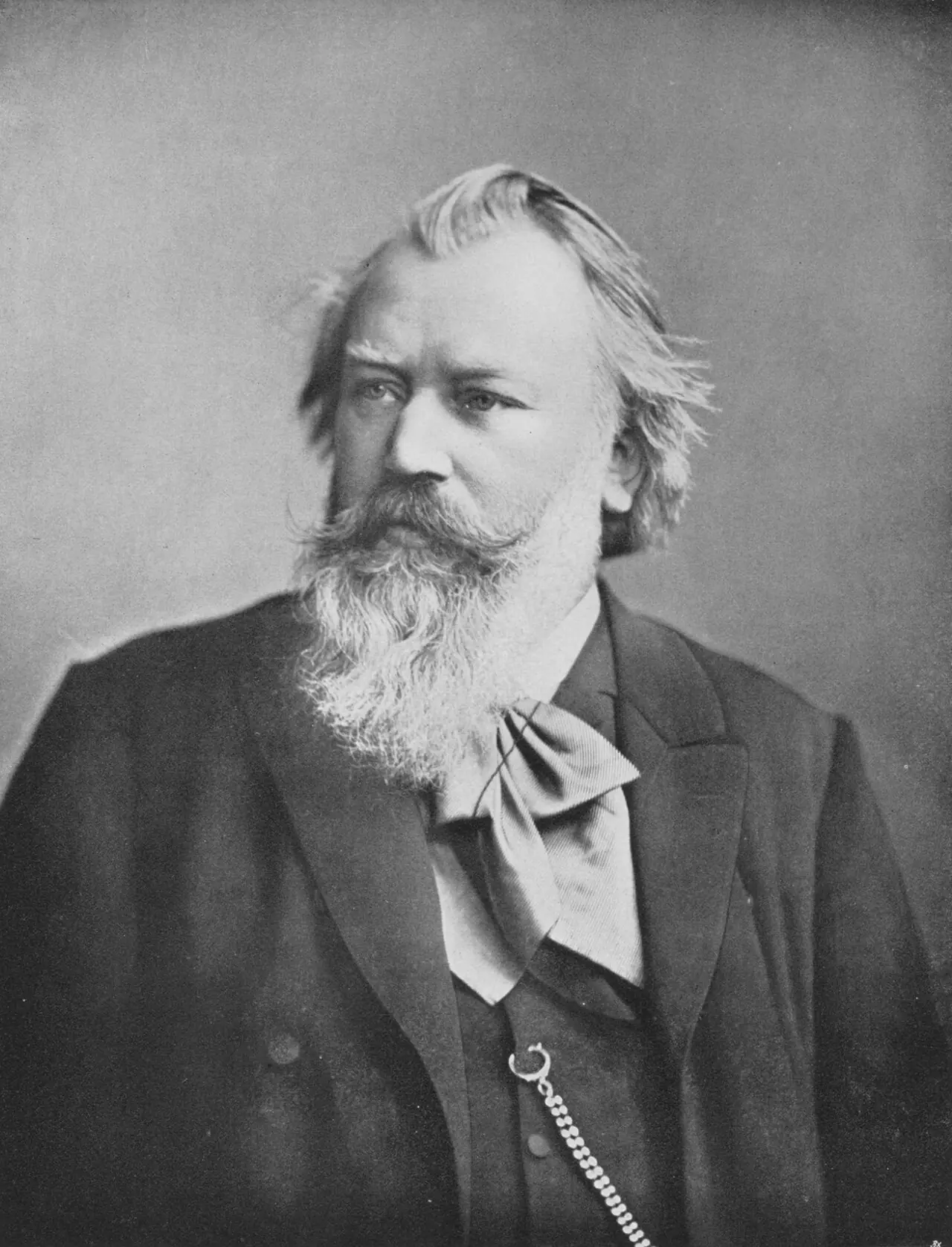
Piano with Otto Cossel; piano and composition with Eduard Marxsen in Hamburg
Posts
Detmold, 1857–59 · Vienna Singakademie, 1863–64 · Gesellschaft der Musikfreunde, 1872–75
Home and summers
Vienna; summers in Baden-Baden, Pörtschach, Mürzzuschlag and Bad Ischl
Output
Four symphonies, four concertos, chamber music, piano pieces, songs and choral works; no opera
Life
In the autumn of 1853 a twenty-year-old pianist from Hamburg arrived at the Schumanns’ home in Düsseldorf with an introduction from Joseph Joachim. Johannes Brahms played his own music to them. Robert Schumann heard in him a composer of the future and announced him that October in an article called Neue Bahnen (New Paths). Publishers became interested. Brahms was now expected to fulfil a public prophecy before most of the public had heard any of his music. His piano sonatas were large-scale works. The symphonies Schumann expected took much longer to arrive.
Brahms was born in Hamburg in 1833. His father, Johann Jakob, earned his living playing instruments including the horn and double bass. His mother, Christiane Nissen, was a seamstress. He studied piano with Otto Cossel and then piano and composition with Eduard Marxsen, who grounded him in Bach, Mozart and Beethoven. He played, arranged and accompanied for money. A tour with the Hungarian violinist Ede Reményi in 1853 brought him to Joachim, and Joachim sent him on to Düsseldorf.
1854–61Clara and the First Piano Concerto
Schumann attempted suicide in February 1854 and entered the asylum at Endenich. Brahms went to help Clara with the children and the household’s practical affairs while she continued earning money at the piano. Robert died in 1856. Brahms wrote to Clara with an intensity he seldom showed in public; their friendship lasted more than forty years. She read his drafts, performed his music and told him what she thought of it. She did not always approve.
The First Piano Concerto began as music for two pianos, passed through an attempt at a symphony and was completed in D minor with a long, turbulent orchestral opening. The piano enters quietly. Brahms played the première in Hanover in January 1859, with Joachim conducting. At Leipzig five days later he was hissed. For much of the long first movement the soloist plays within the orchestral texture, and several of the hardest passages are not written for display.
He also worked with singers at the Detmold court and with a women’s choir in Hamburg. In the Serenades and the First String Sextet he tried out orchestral and chamber combinations. In 1861 he took an aria from Handel’s B♭ keyboard suite and wrote twenty-five variations and a fugue on it. The variations turn the theme into a march, an ornamented line and a heavy chordal statement, and the pianist’s figuration changes from one variation to the next.
Brahms revised his work with the help of friends. Joachim tried Brahms’s string parts; the surgeon and amateur musician Theodor Billroth read his chamber music; Clara played through new work. The F minor Quintet reached its final combination in 1864 after advice from Clara, Joachim and Hermann Levi. Brahms destroyed many discarded scores. He let the two-piano version of the quintet, one of the alternatives he considered, survive.
ViennaVienna posts and Ein deutsches Requiem
He first visited Vienna in 1862 and made it his principal home after hopes of a leading appointment in Hamburg came to nothing. He directed the Singakademie in 1863–64 and the Gesellschaft der Musikfreunde’s concerts from 1872 to 1875. Publishing and performing eventually paid well enough for him to give up regular conducting. He collected manuscripts and early editions, studied Renaissance music and edited older works.
Critics cast him as Wagner’s opposite. In 1860 Brahms had helped Joachim draft a declaration against the New German School. It reached print before they had gathered the intended signatures, and it was ridiculed. After that he kept out of such campaigns. He knew and admired Wagner’s music, though he never wrote an opera.
His mother died in 1865, while Ein deutsches Requiem was taking shape. Brahms chose his text from Luther’s Bible, beginning with a blessing for those who mourn and ending with one for the dead. Before the Bremen performance, the conductor Carl Reinthaler objected that the text omitted Christ’s redemptive death. On 9 October 1867 Brahms replied: “I would gladly leave out ‘German’ too and simply put ‘human’.” He did not change the text.
On Good Friday 1868 Brahms conducted six movements in Bremen Cathedral, with Clara in the audience. The success made his name far beyond the circle that already knew his chamber music. He added a movement for soprano and chorus, whose words promise comfort like a mother’s, and the complete seven-movement work was heard in Leipzig in 1869. The choral writing runs from Denn alles Fleisch to Wie lieblich sind deine Wohnungen.
1876–85Four symphonies
The First Symphony reached Karlsruhe in November 1876. It begins with timpani beating beneath lines that move chromatically in opposite directions. In the finale, a horn call enters over the C minor music; Brahms had sent that tune to Clara as a birthday greeting from the Alps in 1868. A brass chorale follows, then the C major melody that resembles Beethoven’s Ninth. He began the Second Symphony the next summer at Pörtschach, beside the Wörthersee.
Early in the Second’s first movement, trombones and tuba enter, and the second theme, which has the shape of a lullaby, arrives with minor-key harmony beneath it. Brahms gives the tune a stable melodic line and puts unsettled harmony in the accompaniment. In the Violin Concerto of 1878, written with Joachim’s advice, he gives the slow movement’s first melody to an oboe. The Second Piano Concerto, completed in 1881, has four movements and another borrowed soloist. A solo cello plays the opening of the slow movement while the piano is silent.
All four movements of the Third Symphony, completed in 1883, end quietly. Near the end of the finale the first movement’s opening returns. The Fourth was written in 1884–85. Its first tune is made from a chain of thirds, some inverted as rising sixths. For the finale Brahms took an eight-bar progression from the closing chorus of Bach’s cantata Nach dir, Herr, verlanget mich, BWV 150, altered it and built a sequence of variations on it. The last pages are in E minor.
His independence now allowed him to help others. Through the Austrian state stipend scheme he encountered Dvořák’s scores, supported the younger man and recommended him to Simrock. His own Hungarian Dances, many based on tunes already circulating, sold far beyond the audiences for his symphonies.
1891–97Mühlfeld and the late works
Brahms had considered retiring from composition in 1890. After hearing Richard Mühlfeld of the Meiningen orchestra he wrote a Clarinet Trio and a Clarinet Quintet in 1891, then two sonatas in 1894. In the slow movement of the quintet the clarinet plays an elaborate solo passage over muted strings; at the end of the finale the music with which the work began returns. The piano collections Opp. 116–119 belong to the same late period. They are short pieces, with restless rhythms and melodies in the middle voices.
Clara died in May 1896. Brahms had completed his Four Serious Songs that spring, setting biblical words about death and love, and his final organ preludes were based on Lutheran chorales. In March 1897 he attended a performance of the Fourth Symphony in Vienna. He died on 3 April. The books and scores in his library went to musicians.
Places
Every recorded place, joined in date order. Brahms on the MapAll 20 places, with sources
Specksgang 24, Hamburg · 7 May 1833 – 1853 · born
Born in a small flat and baptised at St Michaelis; studied with Cossel, then Marxsen from 1845.
The Fourth Symphony opens B–G, then E–C, falling thirds separated by upward leaps. The same interval supplies the notes for the rest of the melody. Brahms lengthened the thirds, changed their rhythm or moved them into another part, and the connection to the opening remains audible. Schoenberg called this process developing variation, in which a theme is already being developed during its first statement.
𝅘𝅥Placement of the downbeat
Brahms can set three beats against two, or carry a melody across a bar line while the accompaniment keeps the metre underneath. The opening horn phrase of the Second Symphony obscures where a bar begins. A hemiola works in a related way, with two bars of three crotchets regrouped as three groups of two.
𝄢The bass line
In the finale of the Fourth Symphony an eight-bar progression returns again and again while the orchestra changes what happens around it. At times the tune is plainly audible; at others a flute solo draws attention away from the progression beneath. The Handel Variations for piano also keep the bass in view. Even where the surface becomes elaborate, much of the original theme remains beneath it.
♭Major and minor
The Third Symphony opens in F major with the motto F–A♭–F, whose middle note comes from the minor scale. This clash between major and minor recurs in Brahms. In the Second Symphony, the second theme, which resembles a lullaby, begins in F♯ minor. The melody is easy to sing, but the accompanying chords are not settled.
𝄞Another player’s solo
A horn opens the Second Piano Concerto, and the piano answers. In its slow movement a solo cello plays the first long melody. In the Adagio of the Violin Concerto an oboe plays the melody before the solo violin enters. In several of his concertos Brahms wrote passages in which the soloist accompanies other instruments.
𝄆Returning openings
The Clarinet Quintet ends with a theme and five variations. Near the end, music from the first movement returns. The Third Symphony also returns to its opening material in its final pages, played softly.
Works
A selection from the composer’s works.
1859
Piano Concerto No. 1 in D minorOp. 15Piano and orchestra
Brahms played the Hanover première with Joachim conducting, and was hissed at Leipzig five days later. The piano enters quietly after a long, loud orchestral opening.
1861
Variations and Fugue on a Theme by HandelOp. 24Piano
Twenty-five variations and a fugue on an aria from Handel’s B♭ suite, HWV 434. The variations keep to the harmony of Handel’s theme.
1864
Piano Quintet in F minorOp. 34Piano, two violins, viola and cello
The music went through versions for string quintet and for two pianos before reaching this combination. Clara Schumann thought the two-piano score lost ideas that needed other instruments.
1865–68
Ein deutsches RequiemOp. 45Soprano, baritone, chorus and orchestra
Brahms assembled his own text from Luther’s Bible. He added the soprano movement after the six-movement Bremen performance; all seven movements were performed in Leipzig in 1869.
1873
Variations on a Theme by Joseph HaydnOp. 56aOrchestra; also a two-piano version, Op. 56b
The theme came from a wind piece then attributed to Haydn; its composer remains uncertain. Its unusual five-bar phrases feed the finale’s repeating bass.
The finale’s horn call first appeared in a birthday greeting Brahms sent Clara Schumann from the Alps in 1868. It comes before a brass chorale and the broad C major Allegro.
Begun in the summer at Pörtschach and completed that autumn in Baden-Baden. A quiet three-note figure in the bass opens the work and leads to a melody for the horns; trombones and tuba enter soon after.
1878
Violin Concerto in D majorOp. 77Violin and orchestra
Joachim advised on the solo part and gave the Leipzig première on New Year’s Day 1879. At the start of the Adagio the oboe plays the melody before the solo violin enters.
1881
Piano Concerto No. 2 in B♭ majorOp. 83Piano and orchestra
The concerto is in four movements, one of them a scherzo in D minor. It opens with a solo horn, and its slow movement opens with a solo cello.
The finale is a set of variations on an eight-bar progression adapted from Bach’s BWV 150. Brahms keeps the trombones in reserve until this last movement.
Clarinet Quintet in B minorOp. 115Clarinet, two violins, viola and cello
Written for Richard Mühlfeld, whose playing ended Brahms’s plans to retire. The final variations return to the opening music of the first movement.
In the score
Short examples, engraved and playable.
F–A–F and the Third Symphony — schematicMotto and inflected third
A schematic in even note values. F–A–F is the letter motto associated with frei aber froh, “free but happy”. The Third Symphony opens with F–A♭–F, shown in the second bar. The lowered A gives a minor third in a work in F major.
Symphony No. 4, first movement — pitch reductionB–G–E–C–A–F♯–D♯–B
A schematic of the Fourth Symphony’s opening pitches, with rhythm simplified and octave placement regularised. Read as a continuous descent, B–G–E–C–A–F♯–D♯–B moves entirely in thirds. In the melody as Brahms wrote it, some of these notes are placed in higher octaves.
Hemiola — schematicThree minims across two bars of three
An invented schematic of hemiola. The bass counts two bars of three crotchets. The upper part divides those six crotchets into three minims, with the middle minim tied across the bar line. The three minims cut across the written grouping of two bars.
Sister arts
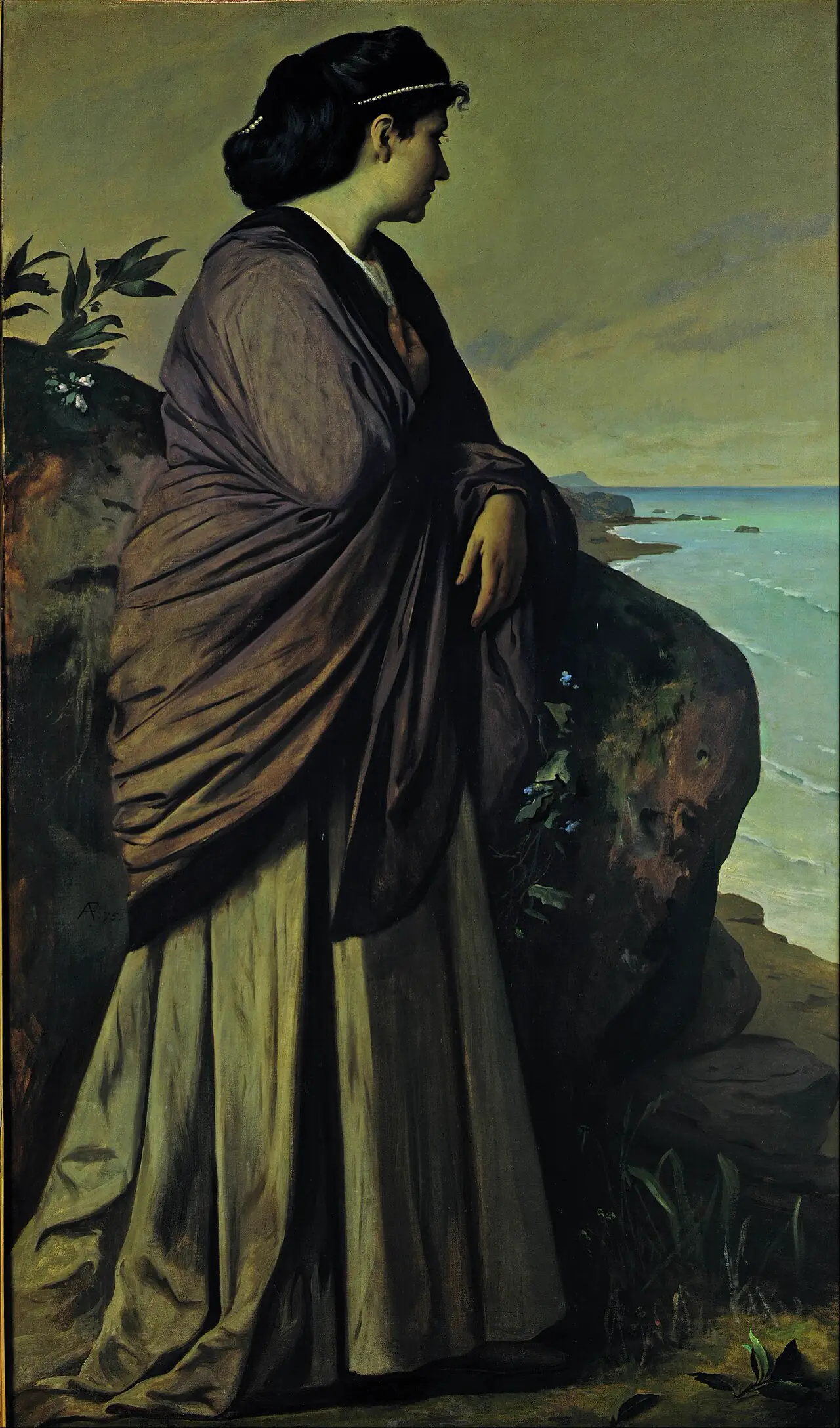
Anselm FeuerbachOn the Seashore (Modern Iphigenia), 1875Oil on canvas · Museum Kunstpalast, Düsseldorf
After Feuerbach died in 1880, Brahms wrote Nänie in his memory and dedicated it to the painter’s stepmother Henriette. Schiller’s poem mourns figures from Greek myth, a world Feuerbach painted many times. The poem names grieving mothers and lost children, and this painting shows a woman on the shore.
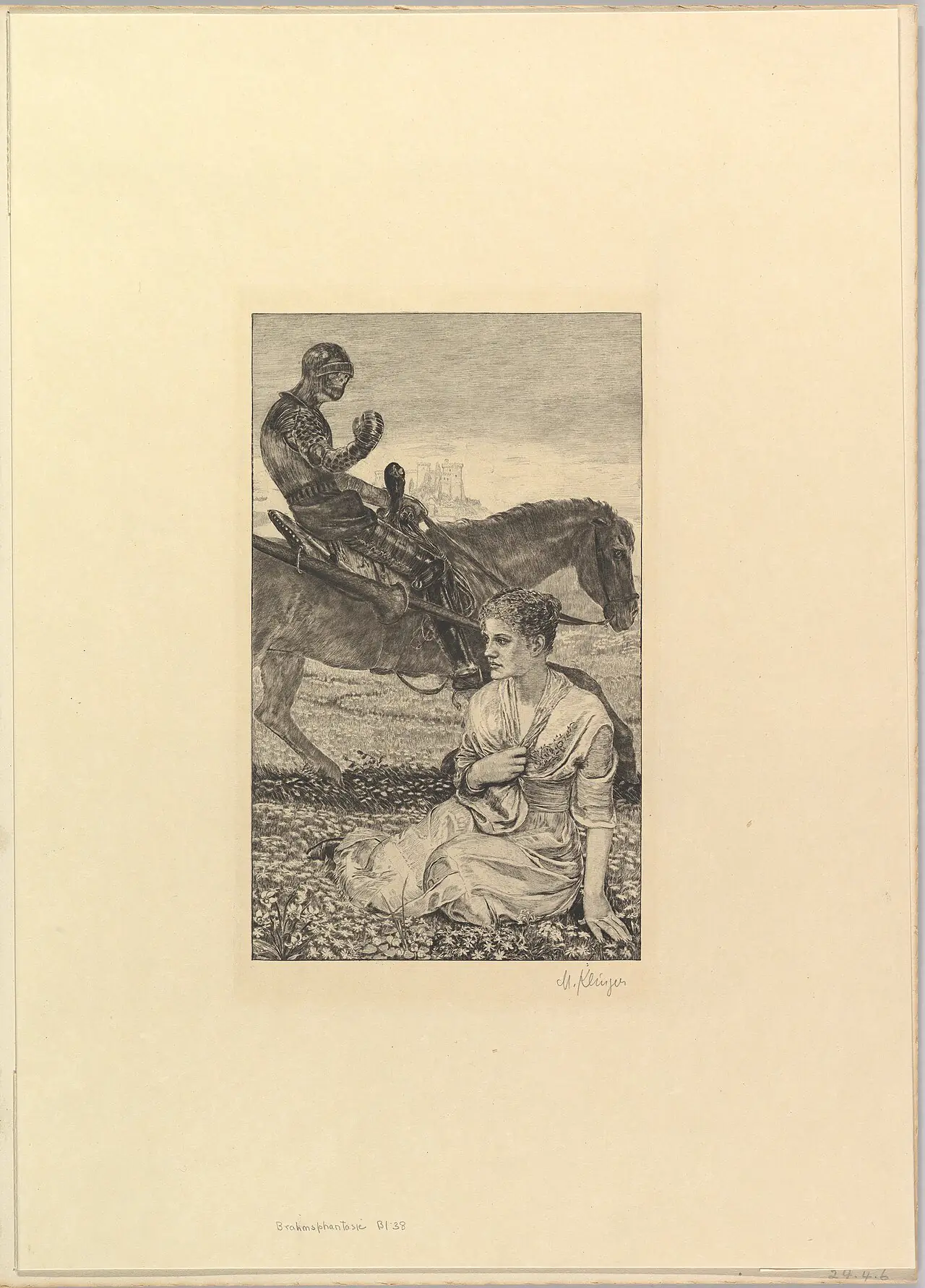
Max KlingerRitter Tod, from Brahmsphantasie, 1894Etching, engraving, aquatint and mezzotint · Metropolitan Museum of Art, New York
Klinger kept a piano in his studio and gave his print cycles opus numbers, as composers numbered their works. His Brahmsphantasie sets prints alongside five songs and the Schicksalslied, and Brahms received the finished book in 1894. Its images depict dreams and encounters drawn from the music, among them this meeting with Death. Wesleyan’s account reproduces the book and traces the friendship between the two artists.
Friedrich Schiller
Nänie
1800; set by Brahms in 1880–81
GermanAuch das Schöne muß sterben! Das Menschen und Götter bezwinget,
Nicht die eherne Brust rührt es des stygischen Zeus.
Einmal nur erweichte die Liebe den Schattenbeherrscher,
Und an der Schwelle noch, streng, rief er zurück sein Geschenk.
Nicht stillt Aphrodite dem schönen Knaben die Wunde,
Die in den zierlichen Leib grausam der Eber geritzt.
Nicht errettet den göttlichen Held die unsterbliche Mutter,
Wann er, am skäischen Tor fallend, sein Schicksal erfüllt.
Aber sie steigt aus dem Meer mit allen Töchtern des Nereus,
Und die Klage hebt an um den verherrlichten Sohn.
Siehe! Da weinen die Götter, es weinen die Göttinnen alle,
Daß das Schöne vergeht, daß das Vollkommene stirbt.
Auch ein Klaglied zu sein im Mund der Geliebten, ist herrlich,
Denn das Gemeine geht klanglos zum Orkus hinab.
Our translationEven beauty must die! What overcomes humans and gods
cannot move the bronze breast of the Zeus beneath the earth.
Only once did love soften the ruler of shadows,
and sternly, even at the threshold, he recalled his gift.
Aphrodite cannot close the beautiful boy’s wound,
cruelly torn in his delicate body by the boar.
The immortal mother cannot save the godlike hero
when, falling at the Scaean gate, he fulfils his fate.
But she rises from the sea with all the daughters of Nereus,
and the lament begins for her glorious son.
Look: the gods weep, and all the goddesses weep,
because beauty passes away, because perfection dies.
Even to be a lament in the mouths of loved ones is splendid,
for the common thing descends to Orcus without a sound.
Eurydice is recalled to the underworld; Adonis dies of his wound; Achilles’ mother cannot save him. Brahms began this lament with a long oboe solo in D major, after which the choral voices enter in imitation. At the end he returned to Schiller’s penultimate line, which says that even to survive as a song of mourning is splendid. German text.
Friedrich Hölderlin
Hyperions Schicksalslied — first stanza
1799; set by Brahms in 1868–71
GermanIhr wandelt droben im Licht
Auf weichem Boden, selige Genien!
Glänzende Götterlüfte
Rühren euch leicht,
Wie die Finger der Künstlerin
Heilige Saiten.
Our translationYou walk above in the light
on gentle ground, blessed spirits.
Shining breezes of the gods
touch you lightly,
as a woman musician’s fingers
touch sacred strings.
Brahms found the poem in his friend Albert Dietrich’s house in 1868 and began sketching during a visit to Wilhelmshaven. In the poem the gods live in light, and the mortals who appear later fall blindly into suffering. His setting moves from E♭ major into C minor. After the singers have finished, the orchestra plays the music of the opening again, in C major. He had thought of repeating the opening words instead; Hermann Levi talked him out of it.
Recommended recordings
Piano Concertos Nos. 1 and 2Emil Gilels, Berlin Philharmonic, Eugen JochumDeutsche GrammophonGilels plays the First’s stormy passages with weight and takes the Second’s slow movement at a patient pace. Jochum gives the Berlin strings full room in reply.
Ein deutsches RequiemElisabeth Schwarzkopf, Dietrich Fischer-Dieskau, Philharmonia Orchestra and Chorus, Otto KlempererEMI · 1961A grave, spacious reading with a firm tread beneath the choral lines. The fugues gain weight and stay clear. Schwarzkopf sings the soprano movement.
Clarinet QuintetKarl Leister, Amadeus QuartetDeutsche GrammophonLeister’s rounded tone blends with the Amadeus strings. The five players keep a close ensemble, especially after the clarinet’s flourishes in the slow movement.
Dvořák received encouragement from Brahms and an introduction to Simrock. Schoenberg, in Brahms the Progressive, explained how in Brahms a phrase can keep changing while its smallest intervals remain recognisable. Reger took up Brahms’s use of variation and counterpoint in piano and organ scores of greater density.