Largely self-taught; lessons with Alexander Zemlinsky
Pupils
Alban Berg and Anton Webern from 1904; later Hanns Eisler and John Cage
Teaching
Prussian Academy of Arts, Berlin, 1926–33; UCLA, 1936–44
Beyond composing
Painter; author of Harmonielehre (1911); founder of the Society for Private Musical Performances
Life
At the première of Pierrot lunaire in Berlin on 16 October 1912, Albertine Zehme stood onstage in a Pierrot costume. Behind a screen, five instrumentalists watched Arnold Schoenberg conduct. They had held twenty-five ensemble rehearsals to prepare thirty-odd minutes of music in which the voice slid away from its written notes, the flautist also played piccolo and the violinist also played viola.
1874–1906Vienna, Berlin and early works
Schoenberg was born in Vienna’s Leopoldstadt in 1874 and began learning the violin as a child. His father died when he was fifteen. From 1891 to 1895 he worked in a bank, making music with friends and teaching himself from scores. Alexander Zemlinsky, whom he met through the amateur orchestra Polyhymnia, gave him lessons. From Brahms he learnt how a small phrase could grow through continual change, and from Wagner how long the resolution of a chord could be delayed.
In 1899 he wrote Verklärte Nacht for six strings. In Richard Dehmel’s poem, a woman tells her lover that she is carrying another man’s child. He accepts her, and Schoenberg moves the music from D minor to D major, with muted strings and harmonics. He married Zemlinsky’s sister Mathilde in 1901. His Brettl-Lieder, written that year, helped him secure the conducting post at Berlin’s Überbrettl cabaret; Richard Strauss helped him find teaching work.
In Berlin in 1903 he finished Pelleas und Melisande, a large orchestral treatment of the play Debussy had made into an opera. He returned to Vienna that year; Berg and Webern became his pupils the following year. Mahler gave him practical support and defended the music in public. The First Quartet set a whole four-movement cycle as one continuous movement. The Chamber Symphony of 1906 reduced the orchestra to fifteen soloists, five strings and ten winds, with a horn rising through a chain of fourths.
1908–11Freely atonal music
The Second Quartet brought a soprano into its last two movements. In the finale she sings Stefan George’s “I feel air from another planet”; the movement has no key signature, though an F♯ major chord closes the work. While Schoenberg was composing it, Mathilde left him for the painter Richard Gerstl. She returned; Gerstl killed himself in November 1908. At the quartet’s December première the audience laughed and shouted. Introducing the Kolisch Quartet’s recording in 1936–37, Schoenberg recalled that, after the singer stopped, the final string coda was heard quietly: “Perhaps even my enemies and adversaries might have felt something here.”
In the summer of 1909, at Steinakirchen, he wrote the Five Orchestral Pieces, finished the Three Piano Pieces, Op. 11, and composed Erwartung. Marie Pappenheim’s monodrama follows a woman through a dark wood to her lover’s corpse. Zemlinsky conducted the first staging in Prague in 1924.
In Farben, the third orchestral piece, a five-note chord passes from instrument to instrument, and the changes in its sound are the main event. Rehearsing the two-piano arrangement on 23 January 1912, Schoenberg complained in his diary: “I’m missing the sounds! The colours.” His Harmonielehre, published in 1911 and dedicated to Mahler’s memory, still taught the traditional rules of chords and resolutions. At its end he raised the possibility of making melodies from changes of instrumental colour.
He also painted, chiefly faces and self-portraits, often with eyes staring out of dark heads. His first exhibition opened in Vienna in 1910. Wassily Kandinsky heard his music in Munich the following January and then wrote to him. In his reply of 24 January 1911 Schoenberg wrote: “Art belongs to the unconscious!” Four of his paintings were shown in the first Blaue Reiter exhibition that December.
1912–18Pierrot lunaire and the Society
Zehme commissioned Pierrot lunaire in 1912. Schoenberg chose twenty-one of Albert Giraud’s poems in Otto Erich Hartleben’s German versions, arranged them in three groups of seven and changed the instrumental combination for each. In Nacht, a passacaglia accompanies images of giant black moths. In Der Mondfleck, the instruments play in canon and then run backwards, while the clown tries to rub a patch of moonlight off his coat.
In 1913 Franz Schreker conducted the première of Gurre-Lieder, which was a success. Schoenberg had begun the enormous late-Romantic work in 1900 and finished orchestrating it in 1911. Military service interrupted his work during the war, and Die Jakobsleiter remained unfinished. In 1918 he founded the Society for Private Musical Performances, which offered members carefully rehearsed performances, sometimes repeated, and excluded newspaper critics. Works by Debussy, Ravel, Stravinsky and Mahler appeared on its programmes.
1921–32The twelve-note method and Moses und Aron
After years of experiments, Schoenberg found a way to make one ordered set of twelve notes supply both a tune and its accompanying chords. The set could run backwards, be turned upside down or begin on another pitch. It did not fix the rhythm of a minuet or the shape of a melody. The Suite for Piano, Op. 25, written in 1921–23, used the method in a prelude, gavotte, musette, intermezzo, minuet and gigue. The row ends with four notes which, read backwards, spell Bach’s name in German notation.
Mathilde died in 1923. The following year he married Gertrud Kolisch, sister of the violinist Rudolf Kolisch; in 1926 he began teaching at the Prussian Academy of Arts in Berlin. The Variations for Orchestra, Op. 31, extended his twelve-note writing to a theme, nine variations and a finale. In Moses und Aron, begun as an opera around 1930, a single row supplies the material for two acts of argument, miracles and crowd scenes. Moses struggles to put an idea into words; Aron wins people over with singing and images. Schoenberg did not complete the score of the third act.
1933–51California
The Nazis drove him from his Berlin post in 1933. In Paris he formally returned to Judaism, with Marc Chagall as a witness; he had converted to Protestantism in 1898. That autumn he sailed to America. After teaching in Boston, he settled in Los Angeles in 1934 and joined UCLA in 1936. John Cage studied with him in California. In English the surname became Schoenberg. His teaching still began with the craft of the old masters. He also continued writing tonal music, including the Suite in G for strings.
The Piano Concerto of 1942 opens with a lilting tune and moves through four linked sections. In the sketches Schoenberg wrote a private programme ending “But life goes on.” He wrote most of the String Trio after a severe illness in 1946; its phrases are repeatedly broken off and pieced together. A Survivor from Warsaw followed in 1947. In it a narrator recalls a Nazi roundup, the counting accelerates, and a men’s chorus breaks in with the Shema Yisrael. Schoenberg died in Los Angeles on 13 July 1951, leaving Moses und Aron and Die Jakobsleiter unfinished.
Places
Every recorded place, joined in date order. Schoenberg on the MapAll 22 places, with sources
Schoenberg built whole movements from short phrases that change each time they return. In the Second Quartet, themes in the scherzo and in the soprano’s Litanei grow out of earlier phrases. An interval widens or a rhythm contracts, and the same notes come back in a different order. Schoenberg learned this economy from Brahms and kept it after he gave up the home key.
♮Harmony
Verklärte Nacht moves from D minor to D major. A decade later, Farben begins with the chord C–G♯–B–E–A, which is held and altered by degrees as different instruments take it over. The piece contains no dominant seventh resolving to a tonic.
𝄆Twelve notes
A row is an ordering of the twelve different notes of the chromatic scale. Schoenberg turned it backwards or upside down, moved it to another starting pitch and divided it between melody and chords. In the Op. 25 Suite the same row serves a minuet and a gigue; their accents, speeds and phrasing make them different dances.
𝅘𝅥The voice
The woman in Erwartung sings, sometimes at the edge of her range. The reciter in Pierrot lunaire follows the written rhythms while speaking away from the indicated pitches. In Moses und Aron the two brothers are set apart by vocal technique. Moses usually speaks and Aron sings.
𝄞Instrumental colour
The Chamber Symphony sets five string players against ten winds, so individual voices stay exposed. In Pierrot lunaire five players cover eight instruments, in a different combination for each poem. At the other extreme, the large orchestra of Farben barely moves. Players pass a chord between them so softly that its colour changes before its notes do.
𝄐Old forms
Schoenberg went on using the fugue, the canon and the dance suite. Pierrot has a passacaglia under its black moths and counterpoint that runs backwards under its patch of moonlight. In the Op. 25 Suite, the trio of the minuet is a canon. These forms are built on repetition and imitation that can be heard, and Schoenberg kept using them in music that no longer moved between major and minor keys.
Gurre-LiederSoloists, speaker, choruses and very large orchestra
Jacobsen’s poems reached Schoenberg in Robert Franz Arnold’s German translation. Most of the music was composed in 1900–01; after a long interruption, he finished the orchestration in 1911.
1906
Chamber Symphony No. 1 in E majorOp. 9Fifteen solo instruments
Five strings and ten winds play one continuous movement with scherzo and slow sections. The horn plays a figure of rising fourths.
Five Orchestral PiecesOp. 16Large orchestra; revised scoring 1949
The publisher asked for titles; Schoenberg reluctantly supplied them. In the third piece, Farben, a chord changes its sound as instruments exchange its notes.
1909
Erwartung (Expectation)Op. 17Soprano and orchestra; monodrama to a text by Marie Pappenheim
The work has one character, a woman, and four continuous scenes set in a dark wood; her lover is dead. Zemlinsky conducted the first staging in Prague in 1924.
1912
Pierrot lunaireOp. 21Speaking voice and five instrumentalists
Twenty-one poems, three groups of seven, eight instruments shared by five players. The first performers held twenty-five ensemble rehearsals before the Berlin première.
1921–23
Suite for PianoOp. 25Piano
One twelve-note row underlies all six pieces. Its last four notes, read backwards, spell B–A–C–H in German note names.
1926–28
Variations for OrchestraOp. 31Orchestra
An introduction, theme, nine variations and finale for large orchestra in twelve-note writing. Bach’s four-note signature appears.
1930–32
Moses und AronOpera for soloists, chorus and orchestra; two acts completed
Moses carries the idea and Aron the persuasive singing voice. The third act survives as a libretto and musical sketches, without a completed score.
1942
Piano ConcertoOp. 42Piano and orchestra
Four sections run without a break, beginning with a melody in the piano. Schoenberg’s sketches attach a private programme to the music, ending “But life goes on.”
1947
A Survivor from WarsawOp. 46Narrator, men’s chorus and orchestra
English narration and shouted German orders lead to the men’s Hebrew prayer, Shema Yisrael. Schoenberg wrote the text as well as the music.
In the score
Short examples, engraved and playable.
Suite for Piano, Op. 25Twelve-note row ending with Bach
A schematic of the Op. 25 row. The first three bars contain its twelve notes; the fourth reverses the last four to give B♭–A–C–B♮, or B–A–C–H in German. The equal note lengths are for demonstration; Schoenberg supplied his own rhythms in each piece.
Five Orchestral Pieces, Op. 16, No. 3The five pitches of Farben
A schematic of the opening five-note chord of Farben: C–G♯–B–E–A, from bottom to top. Here it lasts two bars. In the score, its notes pass between instruments and begin to shift by small steps.
An invented schematic for Sprechstimme: starting pitches and measured rhythms. In Pierrot lunaire, crossed stems tell the performer to leave each pitch in a spoken rise or fall. The piano playback marks those starting pitches only.
Sister arts
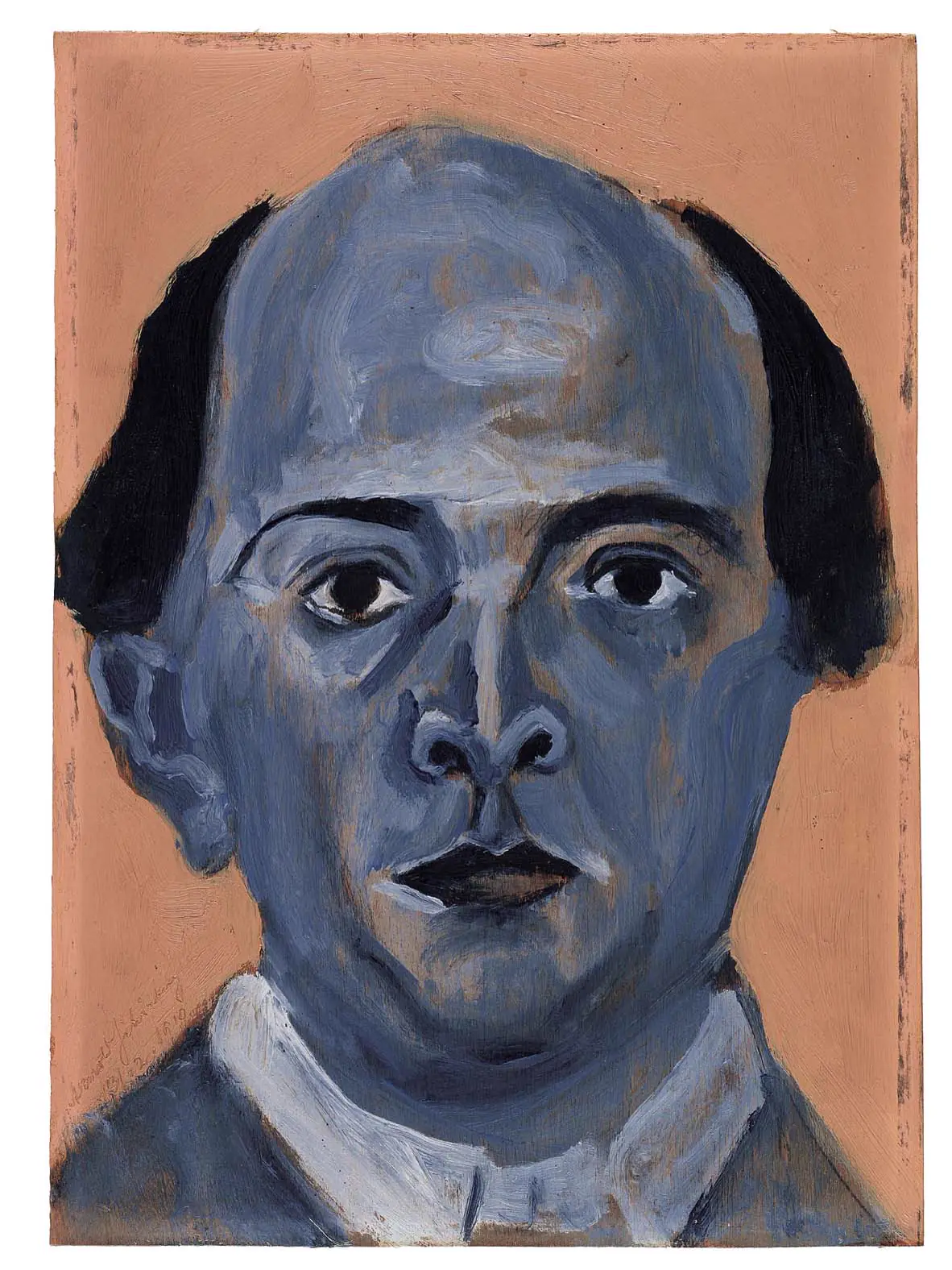
Arnold SchoenbergBlue Self-Portrait, 1910Oil on panel · Arnold Schönberg Center, Vienna / Belmont Music Publishers collection
The face is painted blue and looks straight out of the picture. Schoenberg painted it during the years of his first freely atonal music and showed his paintings publicly in Vienna in 1910. A year later he told Kandinsky that he cared about expressive colour; he worried that photographs of his pictures would lose it.
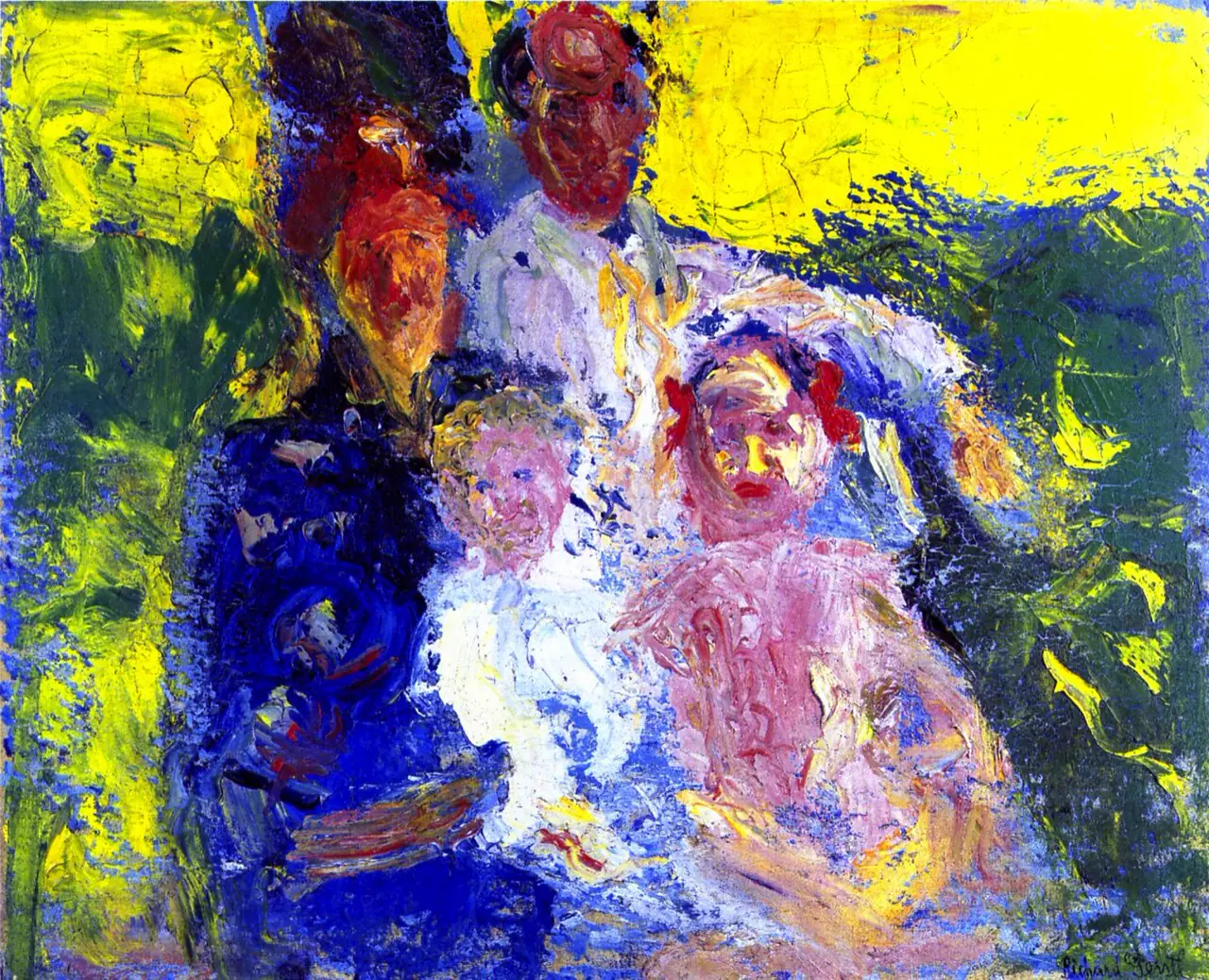
Richard GerstlThe Schoenberg Family, 1908Oil on canvas · mumok, Vienna
Gerstl taught Arnold and Mathilde to paint and made portraits of the family. In this group the faces are barely distinguishable from the brushwork. During 1908 Mathilde left Schoenberg for Gerstl, then returned; Gerstl died by suicide that November. The painting was made in the household while Schoenberg was writing the Second Quartet.
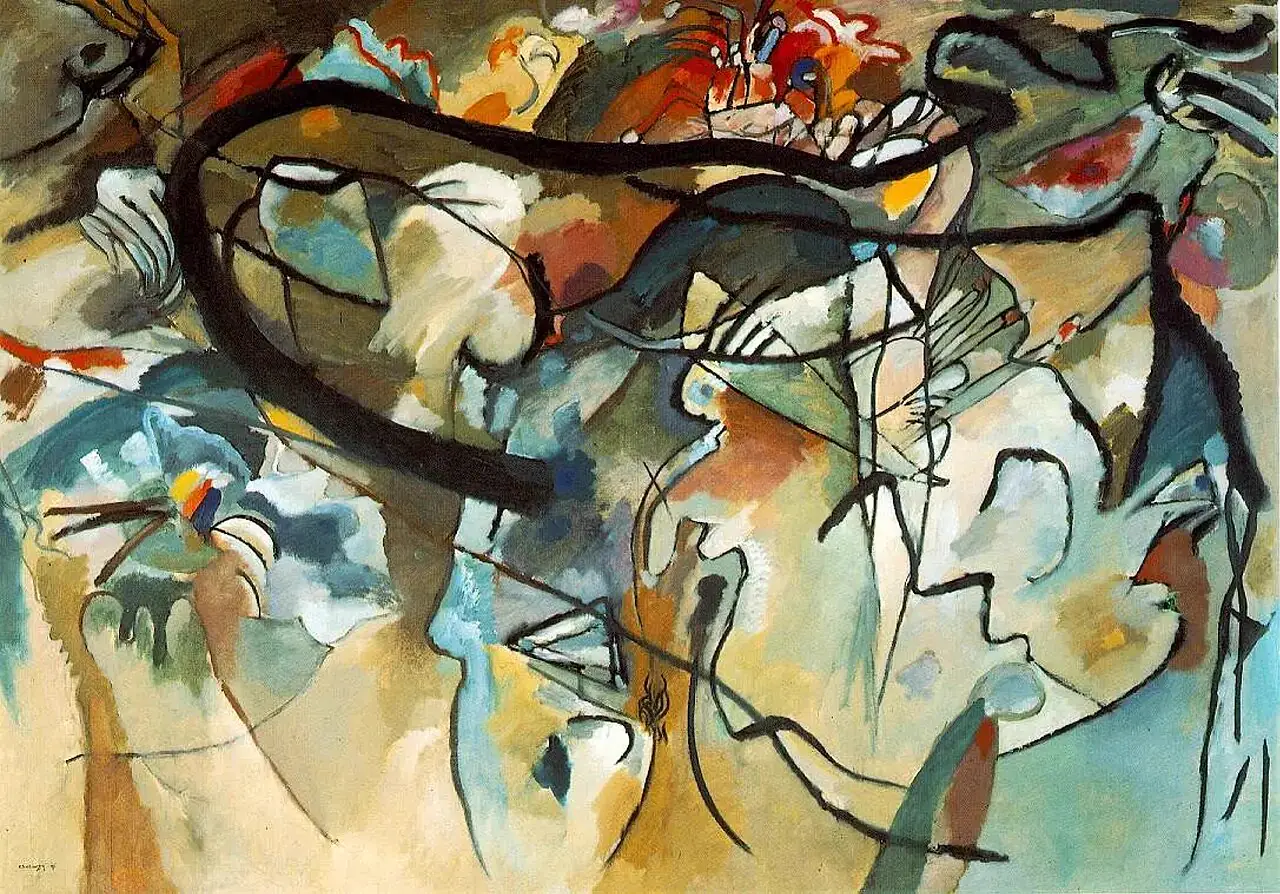
Wassily KandinskyComposition V, 1911Oil on canvas · Private collection
Kandinsky began writing to Schoenberg after hearing his music in Munich in January 1911. By December they were exhibiting together with Der Blaue Reiter. Composition V is made up of broken lines and surges of colour.
Albert Giraud, German version by Otto Erich Hartleben
Mondestrunken
French original 1884; German version 1892
GermanDen Wein, den man mit Augen trinkt,
Gießt Nachts der Mond in Wogen nieder,
Und eine Springflut überschwemmt
Den stillen Horizont.
Gelüste schauerlich und süß,
Durchschwimmen ohne Zahl die Fluten!
Den Wein, den man mit Augen trinkt,
Gießt Nachts der Mond in Wogen nieder.
Our translationThe wine that one drinks with the eyes
The moon pours down in waves at night,
And a spring tide floods
The silent horizon.
Desires, dreadful and sweet,
Swim without number through the waters!
The wine that one drinks with the eyes
The moon pours down in waves at night.
The poem turns moonlight into wine poured through the eyes. Hartleben made his own German poems from Giraud’s French rondels and kept their repeated lines. Schoenberg chose this one to open Pierrot lunaire; the words return, but their musical setting changes. These are the first two stanzas.
Recommended recordings
Pierrot lunaireChristine Schäfer, Ensemble intercontemporain, Pierre BoulezDeutsche GrammophonSchäfer moves the spoken line towards song without fully singing it, and Boulez’s players take the small contrapuntal jokes quickly and precisely. The words of the poems remain intelligible throughout.
Solo piano worksMaurizio PolliniDeutsche GrammophonPollini plays the dances of Op. 25 with sharp rhythmic attack. He takes the quieter Op. 11 pieces more inwardly.
Piano ConcertoMaurizio Pollini, Berlin Philharmonic, Claudio AbbadoDeutsche GrammophonA next step after Pollini’s solo disc. The coupling is Schumann’s Piano Concerto, which places Schoenberg beside one of his musical relatives.
Zemlinsky taught him, Mahler defended him, and Bach and Brahms remained his models. Berg and Webern took his teaching into very different music, Berg towards opera and Webern towards compressed instrumental pieces. Cage’s lessons with him in California also began with musical craft.