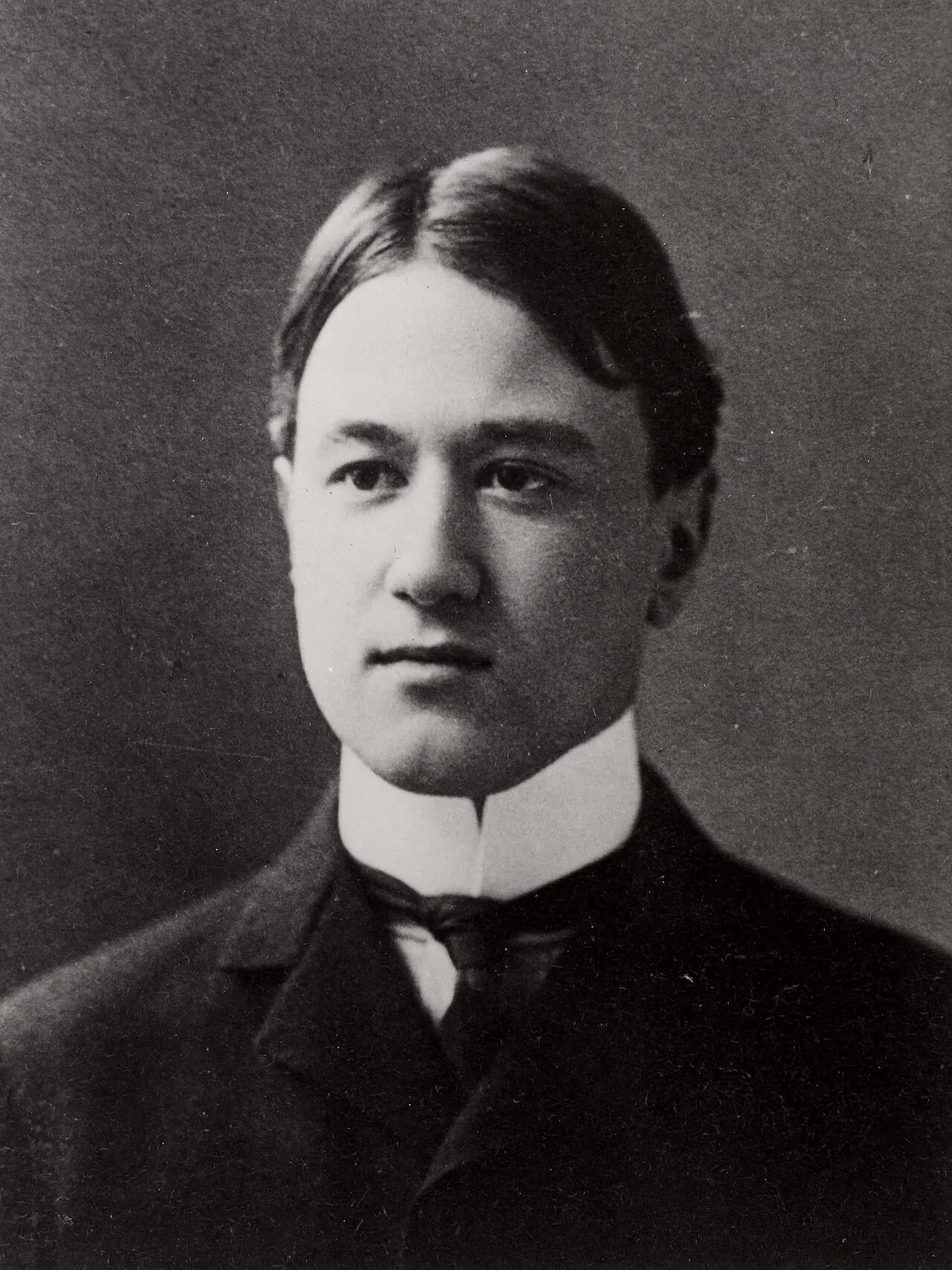
His father George Ives; Horatio Parker at Yale, 1894–98
Livelihood
Church organist until 1902; insurance executive at Ives & Myrick
Self-published
Concord Sonata and Essays Before a Sonata, 1920; 114 Songs, 1922
Home ground
Danbury bands and hymn singing; the New England of Emerson and Thoreau
Life
George Ives played his cornet across a pond so that his son could hear what distance did to the sound. He made the boy sing in one key while he accompanied in another, built instruments that could play quarter-tones and tried out the collision of two marching bands. A former Union Army bandmaster, he earned his living teaching and directing music in Danbury, Connecticut, where his son Charles was born in 1874.
The lessons also involved work. By fourteen Charles was a salaried church organist; at seventeen he wrote the Variations on America, a set of variations for keyboard on the tune of God Save the King. At Yale, which he entered in 1894, Horatio Parker taught him counterpoint, orchestration and the construction of a symphony. His First Symphony, written in a European idiom, came out of that teaching. George died of a stroke during Charles’s first term.
1898–1908Mutual Life Insurance and New York
After graduation Ives went to New York and took a fifteen-dollar-a-week job at the Mutual Life Insurance Company. He went on playing the organ in church until 1902, when he resigned his last post. With Julian Myrick he built an insurance agency that made enough money to pay for copyists, printed scores and concerts of other composers’ music. He composed in the evenings, at weekends and on holidays.
His Second Symphony brought American songs into the forms Parker had taught him. The Third, The Camp Meeting, drew on the hymns he had played in church. In some movements a tune is not heard whole until near the end. Fragments of it appear in separate instruments, grow louder and fuller, and finally join up. In Ives the point at which the complete tune is heard can be the climax of the movement.
Central Park in the Dark sets the city’s ragtime and street noise over quiet strings. The Unanswered Question is sparer. The strings play slowly; a trumpet repeats a short phrase; four woodwinds reply to it several times. The strings do not change. At the end the trumpet plays its phrase once more, the woodwinds have stopped, and the strings continue alone.
1908–17Marriage and Three Places in New England
In June 1908 Ives married Harmony Twichell, a settlement-house nurse and the daughter of a minister. On their honeymoon they walked beside the Housatonic River at Stockbridge and heard singing from a church across the water. In The Housatonic at Stockbridge, restless strings surround a hymn-like tune. Charles and Harmony later adopted a daughter, Edith. In the same years Ives wrote the Holidays Symphony, the Second String Quartet, much of the Fourth Symphony and the Concord Sonata.
The Housatonic piece ends Three Places in New England. Its first movement stands before Saint-Gaudens’s monument in Boston to Colonel Robert Gould Shaw and the Black soldiers of the 54th Massachusetts Regiment. Marching songs pass slowly through the orchestra at a low dynamic. Between these two slow movements comes Putnam’s Camp, which depicts a Fourth of July picnic, a child wandering into the woods, a vision of Revolutionary soldiers and a return to the games. The band falls out of step.
Decoration Day, from the Holidays Symphony, depicts another Danbury ceremony. George’s band led the town to the cemetery, he played Taps over the graves, and the band came home to a brisker tune. Ives kept fragments of the slow music sounding around the march.
ConcordThe Concord Sonata
The sonata’s movements are named for Emerson, Hawthorne, the Alcotts and Thoreau. Emerson is written in long paragraphs of piano writing, with phrases cutting across one another. Hawthorne is a scherzo full of sudden changes, ragtime and a dream railway. Here Ives asks for a felt-covered board to press down a stretch of black keys while a melody continues beneath. The Alcotts is set in the family parlour, where he pictures the piano-playing daughter Lizzy trying out Beethoven’s Fifth.
Then comes Thoreau. Near the end an optional flute joins the piano, the instrument the writer played at Walden. Beneath it, the piano returns to a small repeating figure. Ives printed the score at his own expense in 1920 and mailed copies the following January, together with a book of essays explaining his literary companions.
These prefatory essays were written by the composer for those who can’t stand his music—and the music for those who can’t stand his essays.
The Fourth Symphony needs larger forces than the earlier symphonies. A chorus sings Watchman, tell us of the night in the opening movement. The second movement sets hymns and marching music against each other at different speeds, and the third is a fugue. In the finale the percussion plays in its own tempo beneath the orchestra, and Nearer, My God, to Thee returns. Performances have sometimes used more than one conductor to keep the independent tempos together.
1918–65Illness, revisions and first performances
A serious illness in 1918 slowed his work. He still assembled and published 114 Songs in 1922, placing love songs beside political protests and experimental pieces. Around 1927, Harmony recalled, he came downstairs in tears: “I can’t seem to compose any more. I try and try and nothing comes out right.” He retired from insurance in 1930, but went on revising scores and paying for performances of his music.
Henry Cowell championed him; Nicolas Slonimsky took Three Places to Europe. John Kirkpatrick gave the complete public première of Concord at New York’s Town Hall in 1939, from memory. Lou Harrison conducted the Third Symphony in 1946; it won the Pulitzer Prize the next year. Bernstein introduced the Second in 1951. Ives died in 1954. The Fourth was first performed complete in 1965, when Leopold Stokowski and two assisting conductors brought it to Carnegie Hall.
Places
Every recorded place, joined in date order. Ives on the MapAll 14 places, with sources
Ives often presented a hymn in pieces. One instrument plays its opening, another a fragment of the middle, and the complete tune is heard only late in the movement. In Concord, the broad melody stated plainly in The Alcotts is the source of fragments heard earlier in the sonata. Beethoven’s four-note motto belongs to the same material.
♮Clashing keys
Ives often set two ordinary tunes against each other, keeping each in its own key so that their sharps and flats clash, and he corrected neither part. In Hawthorne a board holds down a cluster of black keys. The Three Quarter-Tone Pieces use two pianos tuned a quarter-tone apart, which adds pitches that lie between the keys of a normally tuned piano.
𝅘𝅥Independent beats
One band can march past another without the two sharing a beat. Ives used this outdoor practice in the Fourth Symphony, where groups of players move at different speeds and may need separate conductors. He also drew on ragtime, in which an accent falls before the expected beat while a second part keeps the accent on the beat.
𝄞Distance
In The Unanswered Question the trumpet and the strings play in separate layers. The trumpet repeats its phrase over the strings’ slow chords while the winds grow more agitated. The strings keep the same pace throughout. Ives also placed the members of the small ensemble apart in space.
𝄐Remembered occasions
Decoration Day follows a procession to the cemetery and home again; Putnam’s Camp moves from a picnic to a child’s dream of Revolutionary soldiers. Both pieces change direction abruptly. A half-heard hymn, a bugle call or the return of the band marks the place in the story, even where the orchestra plays several layers of music at once.
Works
A selection from the composer’s works.
c. 1891–92
Variations on “America”Organ
Written at seventeen, the piece puts the tune of God Save the King through a series of organists’ devices. William Schuman later made the orchestral arrangement.
c. 1902–09
Symphony No. 2Orchestra
The five movements bring American songs into a European symphony. Bernstein gave the first performance in 1951, half a century after the work was begun.
1904–13
A Symphony: New England HolidaysOrchestra; chorus in the final movement
The four occasions are Washington’s Birthday, Decoration Day, the Fourth of July, and Thanksgiving and Forefathers’ Day. In Decoration Day, the town band plays a quick march as it returns from the cemetery.
c. 1908–11
Symphony No. 3 “The Camp Meeting”Chamber orchestra
Hymn tunes from Ives’s church years fill its three movements. Lou Harrison conducted the 1946 première; the Pulitzer followed in 1947.
1908; revised 1930–35
The Unanswered QuestionTrumpet, four woodwinds and strings
A trumpet repeats the same short question while four winds answer more and more frantically. The slow strings continue after the last answer.
c. 1908–21; revised 1929, 1933–35
Three Places in New EnglandOrchestra; also a reduced-orchestra version
The Shaw memorial in Boston, a child’s Fourth of July picnic and a honeymoon walk beside the Housatonic. Slonimsky first performed the reduced-orchestra version in 1931.
c. 1909; revised c. 1936
Central Park in the DarkChamber orchestra, including two pianos
Quiet strings play beneath a growing din of popular tunes and city sounds. The strings continue after the din stops.
1910–25
Symphony No. 4Large orchestra, chorus, keyboards and separately coordinated groups
A chorus sings a hymn in the opening movement. The second movement combines several tempos at once and is notoriously difficult to conduct. The first complete performance took place in 1965, eleven years after Ives died.
Four New England literary portraits, with quotations from Beethoven’s Fifth running through them. In Hawthorne the pianist uses a felt-covered board to play clusters on the black keys; in Thoreau a flute may join the pianist.
Ives paid to publish this collection of songs written over several decades. It printed the sentimental songs beside the dissonant ones and the political protests.
In the score
Short examples, engraved and playable.
PolytonalityTwo tunes in two different keys
A schematic with two invented tunes, one in C major above one in F♯ major. Each line is consistent in its own key; sounded together, their notes clash. Neither player changes key.
Competing pulsesThree-against-four polyrhythm
A schematic of three against four. Each bar holds twelve quavers. The upper part divides them into three equal beats, the lower into four. Their attacks meet only at the beginning of the bar.
Sister arts
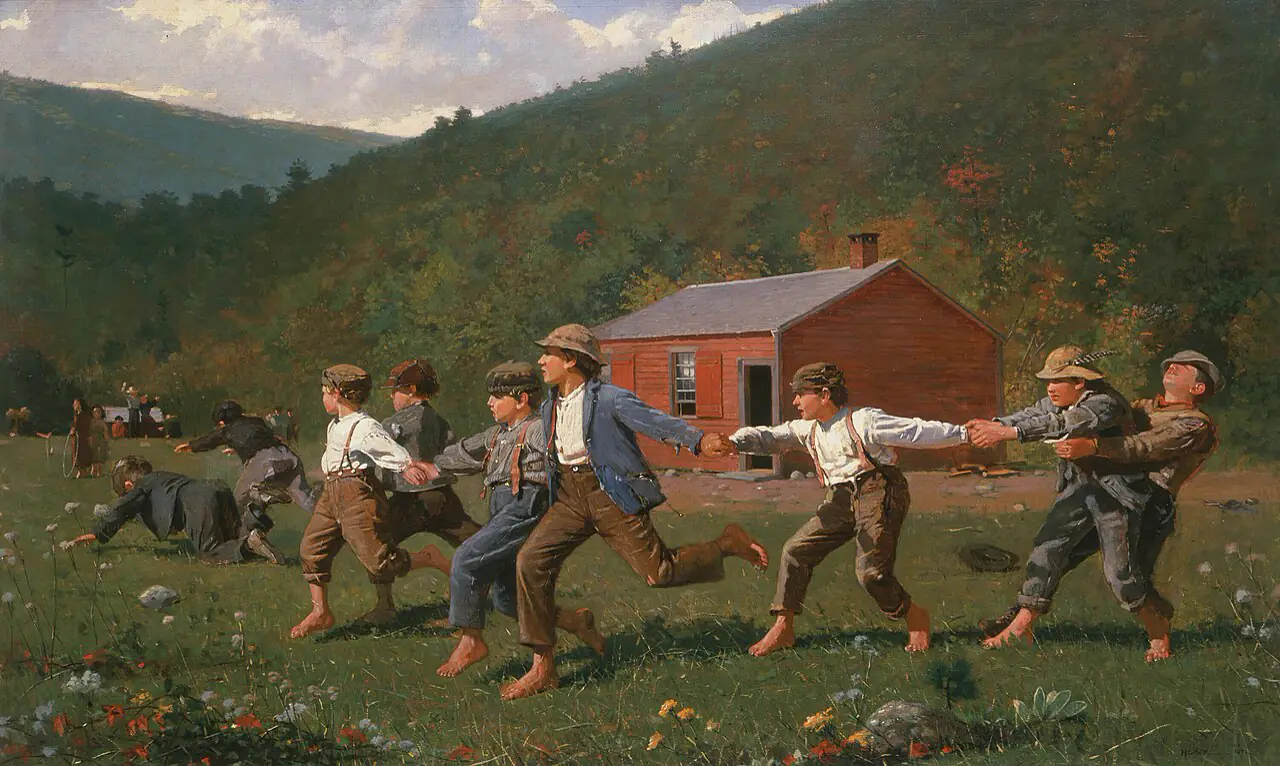
Winslow HomerSnap the Whip, 1872Oil on canvas · Butler Institute of American Art, Youngstown, Ohio
Homer’s schoolboys hold hands and run until the end of the chain breaks away. The rural game belongs beside the picnic and the children’s play in Putnam’s Camp, where a whole group is also caught up in a single activity. The little red schoolhouse stands behind them.
Ralph Waldo Emerson
Self-Reliance — excerpt
1841
EnglishThe virtue in most request is conformity. Self-reliance is its aversion. …
Whoso would be a man must be a nonconformist.
He who would gather immortal palms must not be hindered by the name of goodness, but must explore if it be goodness.
Nothing is at last sacred but the integrity of our own mind.
Ives devoted the first movement of Concord and a long chapter of his accompanying essays to Emerson. These sentences from Self-Reliance help explain the attraction. In the sonata, short phrases interrupt one another and return changed. The excerpt is prose.
Henry David Thoreau
Walden, “Sounds” — excerpt
1854
EnglishThe whistle of the locomotive penetrates my woods summer and winter, sounding like the scream of a hawk sailing over some farmer’s yard, informing me that many restless city merchants are arriving within the circle of the town, or adventurous country traders from the other side.
In the prose chapter ‘Sounds’ in Walden, Thoreau wrote of hearing the train inside his woods and compared it with a hawk. In Concord, Ives referred both to the writer’s ear and to his flute-playing. Near the end of the last movement an optional flute enters above the piano’s repeating figure.
Recommended recordings
Concord SonataPierre-Laurent AimardWarner Classics · 2004A first choice for the sonata’s large contrasts, with forceful ragtime in Hawthorne and room given to the quieter phrases. Emmanuel Pahud plays the flute part. The coupling is a selection of songs with Susan Graham.
Concord SonataJohn KirkpatrickColumbia · 1945The historical account, recorded in 1945 and released in 1948. Kirkpatrick had given the first complete public performance in 1939.
Symphony No. 4American Symphony Orchestra, Schola Cantorum of New York, Leopold StokowskiColumbia / Sony · 1965The first complete recording, made just after the première, decades after the symphony was written. Worth having alongside a modern account.
George Ives supplied the experiments, Parker the symphonic training and Danbury the tunes. Henry Cowell helped the scores reach musicians, and Ives in turn spent his insurance money supporting new music. The inheritance can be heard in passages where independent parts move at different beats, and where a familiar song is quoted in a concert work.
Further reading
Jan Swafford, Charles Ives (W. W. Norton, 1996). biography
Connects the music with Ives’s Connecticut background, family, church work and insurance career.