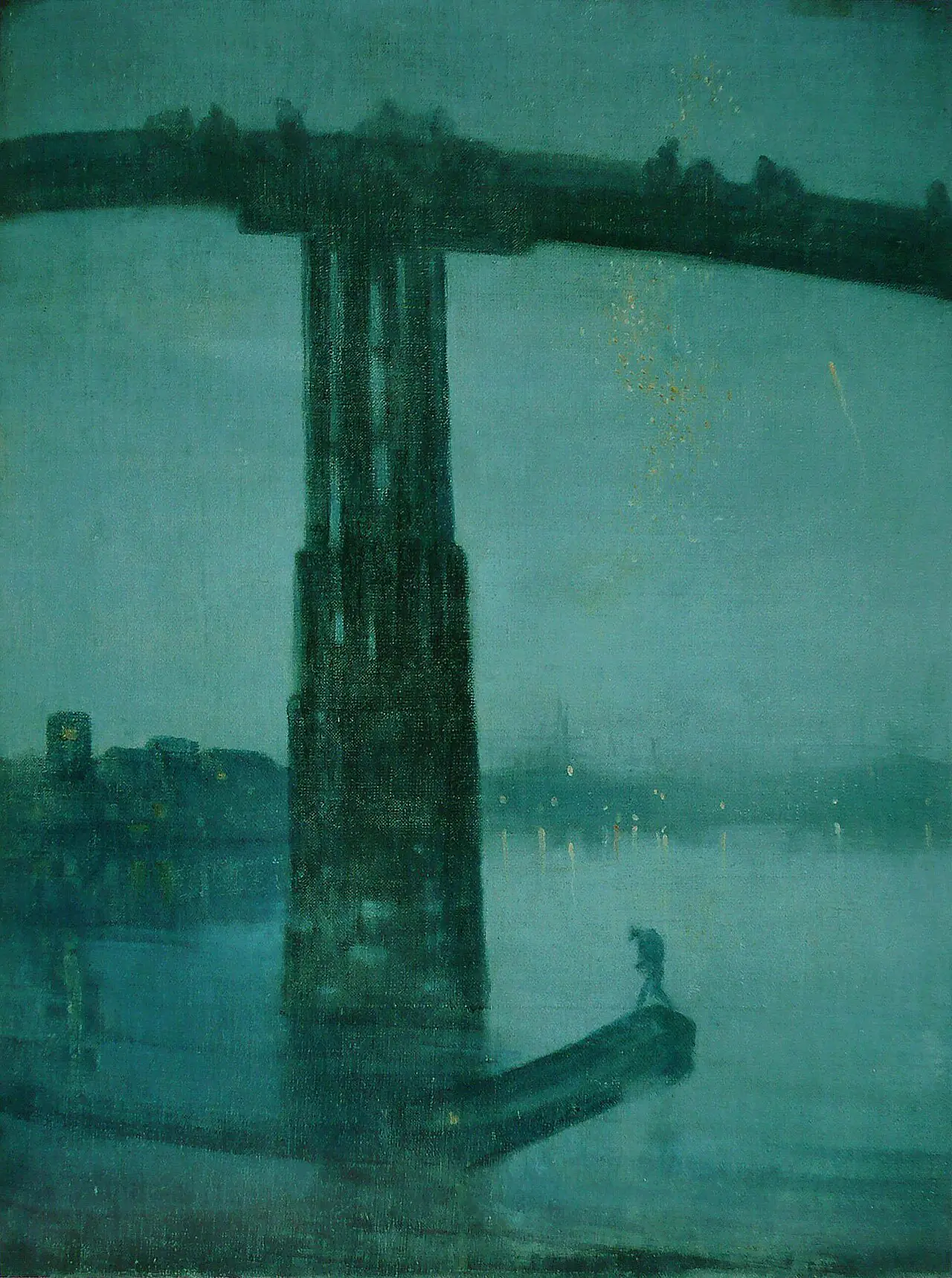
James McNeill WhistlerNocturne: Blue and Gold — Old Battersea Bridge, c. 1872–75 Tate Britain, London
Overview
On 22 December 1894, Gustave Doret conducted Debussy’s Prélude à l’après-midi d’un faune at a Société Nationale de Musique concert in Paris. A flute began alone. Harp and horns answered. The orchestra had no trumpets, trombones or timpani. The piece was based on Mallarmé’s poem of a faun dreaming of nymphs in the afternoon heat. The audience demanded that the whole piece be played again.
The society had been founded in February 1871 by Saint-Saëns, Romain Bussine and their colleagues to get new French music performed. Fauré joined them. He had been educated at the École Niedermeyer, where Saint-Saëns taught him; his first post, in 1866, was as organist in Rennes. He later taught Ravel at the Conservatoire, and in 1905 he became its director.
The piano offers a quick way into these composers’ scales. C–D–E–F♯–G♯–A♯ divides the octave into six equal steps. This is the whole-tone collection, which contains neither a semitone nor a perfect fifth. C–D–E–G–A is pentatonic. It has five notes, with wider gaps from E to G and from A to C, and it keeps the perfect fifth C–G.
Harmony and linePlaning; Debussy, Fauré and Satie
A chord can move without changing its shape. C–E–G rises to D–F♯–A and then E–G♯–B, with every voice moving a whole tone. This is called planing. In Debussy’s La cathédrale engloutie, open fifths rise through the piano like distant bells. Later, broad C major chords fill both hands, like an organ sounding above a deep bass C. The same tune returns softly in a lower register, where the cathedral is pictured sunk beneath the water.
Fauré’s Clair de lune sets Verlaine’s masked dancers against a minuet in the piano. The singer moves at the pace of the words while the dance continues underneath. Verlaine’s figures scarcely believe in the happiness they sing about. Their song of conquering love is in the minor.
Satie’s first Gymnopédie, written in 1888, begins with a low G, then a chord on the second beat; the next bass note is D. Four bars pass before the melody enters. The music is then repeated with few changes, until F♮ replaces F♯ near the end and the last chord is D minor.
InstrumentsRavel, Debussy and the rival harps
Ravel’s Gaspard de la nuit (1908) sets three of Aloysius Bertrand’s nightmares for piano. In Le Gibet, a B♭ sounds in octaves through the whole piece while chords build up and die away around it. The writing is spread across three staves. In Scarbo, repeated notes and sudden leaps depict a goblin darting into the room.
In 1904 Pleyel commissioned Debussy’s Danse sacrée et danse profane to promote its chromatic harp. Érard answered the following year by commissioning Ravel’s Introduction et Allegro for its pedal harp, with flute, clarinet and string quartet. The work is laid out as a small concerto. Flute and clarinet introduce a theme in thirds; the harp decorates it, then takes the lead. Debussy’s dances are now played on the pedal harp.
Ravel’s Ma mère l’Oye began as piano duets. Two young Conservatoire pupils, Jeanne Leleu and Geneviève Durony, gave the first performance in Paris in 1910. When Ravel orchestrated the pieces, he gave the part of the Beast to a contrabassoon, and wrote for harp, celesta and glockenspiel in the music for Laideronnette’s court.
Influences and institutionsParis, 1889–1932
At the Paris Exposition of 1889, Debussy kept returning to the Javanese village in the Dutch colonial section. There he heard the gamelan’s gongs and tuned percussion accompanying dancers. These instruments had tunings of their own. In Pagodes (1903), a low B and F♯ are held in the pedal like a gong, and quicker figures and a slower tune occupy different parts of the keyboard. The hands move on while the bass keeps sounding.
The first edition of La Mer, published by Durand in 1905, had a cover that used a detail from Hokusai’s The Great Wave off Kanagawa. The detail left out Mount Fuji and kept the great curl of water.
Diaghilev’s Ballets Russes brought the painters into the theatre. For Satie’s Parade, first performed in Paris on 18 May 1917, Cocteau supplied the scenario, Picasso the designs and Massine the choreography. Satie’s orchestra included a typewriter, sirens and a pistol.
Older instruments returned too. Wanda Landowska played the first performance of Poulenc’s harpsichord concerto Concert champêtre in Paris on 3 May 1929, with Pierre Monteux conducting. Ravel’s Piano Concerto in G, completed in 1931, opens with a whip-crack and uses blue notes in the piano and wind parts.
Ravel’s Boléro repeated its material at great length: two tunes over a snare-drum rhythm that never changes, with the orchestra building up gradually. In a 1932 interview for the London Evening Standard, he said what scene he wanted behind it: “It was a factory which inspired my Boléro. I would like it always to be played with a vast factory in the background.”
Terms of art
Planing
A chord moved up or down as a single shape. C–E–G becoming D–F♯–A preserves every interval; C–E–G becoming D–F–A stays on the white notes and changes the chord from major to minor.
Whole-tone collection
Six notes a whole tone apart, for example C–D–E–F♯–G♯–A♯. Every step is the same size, so there is no semitone to act as a leading note and no perfect fifth to support a dominant chord.
Anhemitonic pentatonic scale
A five-note scale without semitones. C–D–E–G–A is one; the five black keys make another. Whole tones and minor thirds divide the octave unevenly.
Modal harmony
Chords drawn from a mode. In C Mixolydian, B♭ replaces the B♮ of C major. C can remain the home note, but the semitone step from B to C is lost.
Mélodie
A French art song, usually for voice and piano. Fauré’s Clair de lune is a mélodie. The voice sings Verlaine’s words, and the piano plays a separate dance.
Arabesque
An ornamental melody that turns around its notes, rising and falling in short arches. A flute run or the upper line of a piano part can take this shape.
Orchestral transcription
Music rewritten for orchestra from another set of instruments. Ravel’s Ma mère l’Oye, first written for piano duet, was orchestrated for winds, strings, harp and percussion; in the orchestral version the contrabassoon plays the Beast.
In the score
Pitch collections · schematicSix equal steps and five unequal steps
Two scales on the flute, in equal temperament. The first two bars take six equal steps round the octave; the last two use C–D–E–G–A, with larger gaps between some notes. Neither scale has semitones. The pentatonic scale contains the perfect fifth C–G.
Parallel harmony · schematicParallel major triads
Four invented chords showing planing: C major, D major, E major, then D major again. Each keeps its major third and perfect fifth. The F♯ and G♯ keep the chords major; with F♮ and G♮ the middle chords would be minor.
Sister arts
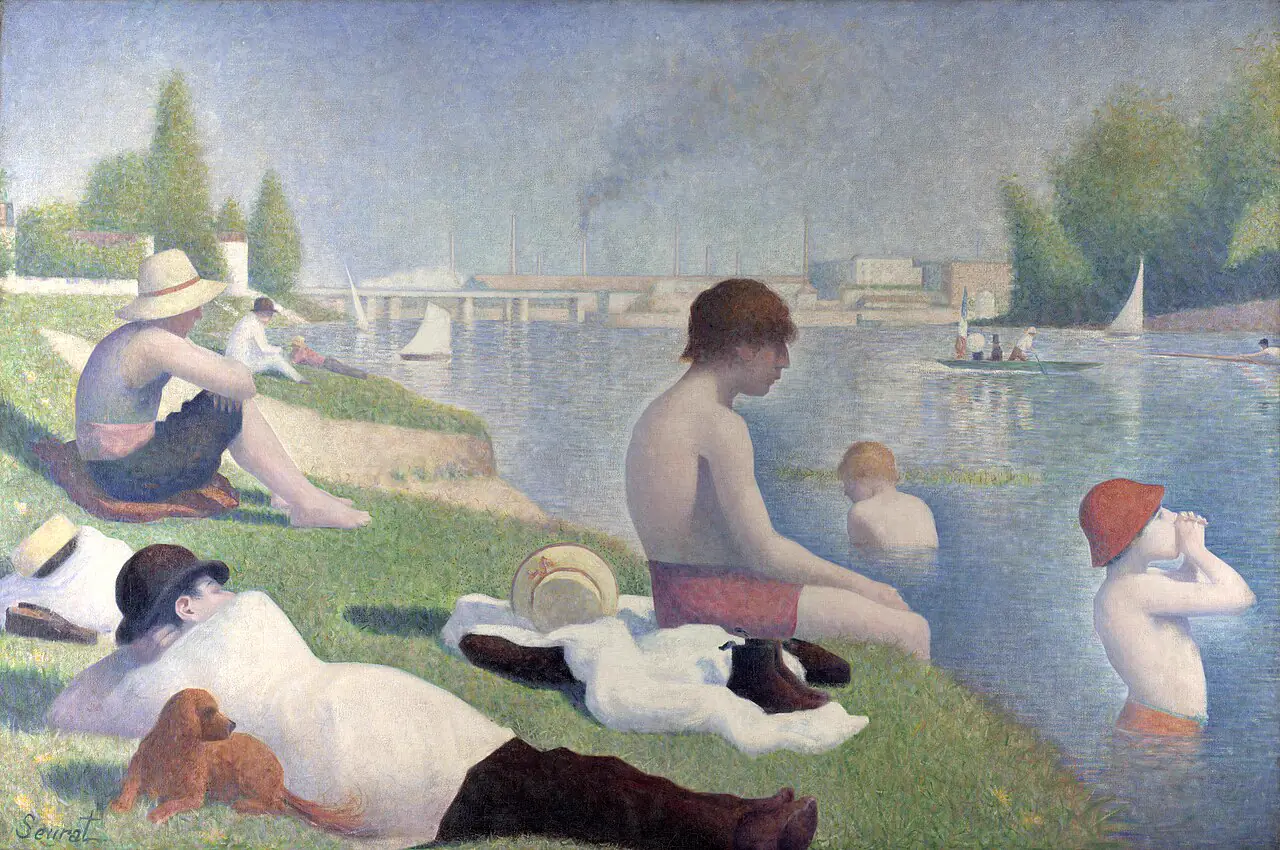
Georges SeuratBathers at Asnières, 1884, retouched c. 1887Oil on canvas · National Gallery, London
Men and boys rest beside the Seine, with factory chimneys on the far bank. Seurat planned this large canvas in studies before the Salon rejected it in 1884. Later he added dots of yellow and blue to the orange hat. The patch can be set beside Ravel’s orchestral mixtures; in Boléro, a flute joins a muted trumpet.
Paul Verlaine
Art poétique — first and fourth stanzas
written 1874; published in Jadis et naguère, 1884
FrenchDe la musique avant toute chose,
Et pour cela préfère l’Impair
Plus vague et plus soluble dans l’air,
Sans rien en lui qui pèse ou qui pose.
Car nous voulons la Nuance encor,
Pas la Couleur, rien que la nuance !
Oh ! la nuance seule fiance
Le rêve au rêve et la flûte au cor !
Our translationMusic before everything else,
and for that, prefer the odd-numbered line,
vaguer and more soluble in air,
with nothing in it that weighs or poses.
For what we want is Nuance still,
not Colour — nothing but nuance!
Oh, nuance alone can betroth
dream to dream, and flute to horn!
Verlaine’s Art poétique, collected in Jadis et naguère in 1884, asks for music first and is written in nine-syllable lines. The fourth stanza pairs a flute with a horn. In Clair de lune Fauré set this poet’s lines about masked dancers to a minuet; the piano keeps the minuet going under words that doubt the dancers’ happiness.