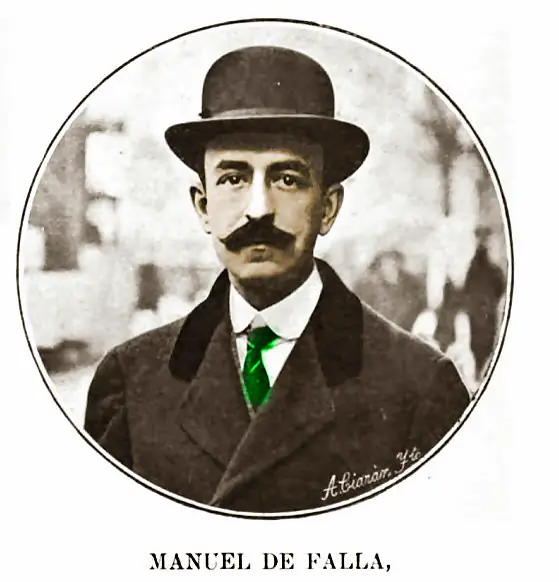
Piano with José Tragó in Madrid (first prize, 1899); composition with Felipe Pedrell from 1901
Paris, 1907–14
Guided by Paul Dukas and Debussy; friends with Albéniz, Ravel and Ricardo Viñes
Collaborators
Gregorio Martínez Sierra and María Lejárraga · Diaghilev and Massine · Picasso · Lorca
Output
An opera, a gitanería and a ballet, a nocturne for piano and orchestra, songs, a puppet opera and a harpsichord concerto; Atlántida unfinished
“For everything that concerns my trade, my homeland is Paris.”
Life
As a boy in Cádiz, Manuel de Falla ran an imaginary city called Colón. It had a council, newspapers and a theatre, and according to Roland-Manuel’s 1930 biography the great success of the day there was El conde de Villamediana, an opera seria composed and conducted by a certain Manuel de Falla. He kept the game going for six years. Falla was born on 23 November 1876 at 3 Plaza de Mina, and he first intended to be a writer. He told Roland-Manuel in 1928 that at seventeen a conviction at once timid and deep had turned him towards composition.
In Madrid he studied the piano with José Tragó and won the conservatoire’s first prize in 1899. Two years later he asked the Catalan musicologist Felipe Pedrell to teach him; from Pedrell, he told his biographer Jaime Pahissa, came the clearest and most solid guidance for his work.
The libretto was by Carlos Fernández Shaw. La vida breve won the Academy of Fine Arts competition on 13 November 1905, but no theatre would stage it. In 1907, encouraged by Joaquín Turina, Falla left for Paris as pianist to a touring company of André Wormser’s L’Enfant prodigue. He stayed in Paris for seven years.
1907–14Paris
Soon after he arrived he played La vida breve to Paul Dukas. Dukas’s warm words, Falla wrote to Fernández Shaw in 1910, left him feeling that he was waking from a bad dream. Dukas and Debussy became his guides. Isaac Albéniz won him a grant from the Spanish crown in 1908, and he met Ravel and the pianist Ricardo Viñes. On 27 March 1909 Viñes played the Pièces espagnoles at the Salle Érard, and Jacques Durand published them on the word of Dukas, Debussy and Ravel.
Falla began Noches en los jardines de España in Paris in 1909. In 1910 he met Stravinsky. La vida breve was first staged at Nice on 1 April 1913 and at the Opéra-Comique on 7 January 1914. Years later, in a letter to the painter Ignacio Zuloaga, he wrote of this period: “for everything that concerns my trade, my homeland is Paris.” When war broke out in 1914 he returned to Madrid.
1915–19Madrid
On 15 January 1915 the soprano Luisa Vela sang the Siete canciones populares españolas at the Ateneo de Madrid, with Falla at the piano. On 15 April the Teatro Lara gave El amor brujo, a gitanería built around the dancer Pastora Imperio. Next day he told La Patria they had made a new, unusual work which they had “felt”, and he could not say how the audience would take it.
María Lejárraga, the author behind her husband Gregorio Martínez Sierra’s name, had taken Falla to Granada for the first time in the weeks before the première. At the Alhambra she told him to shut his eyes, led him by the hand to the middle window of the Ambassadors’ Hall and said, “Look!” She later recalled the “Aaah!” he gave, which she described as close to a cry.
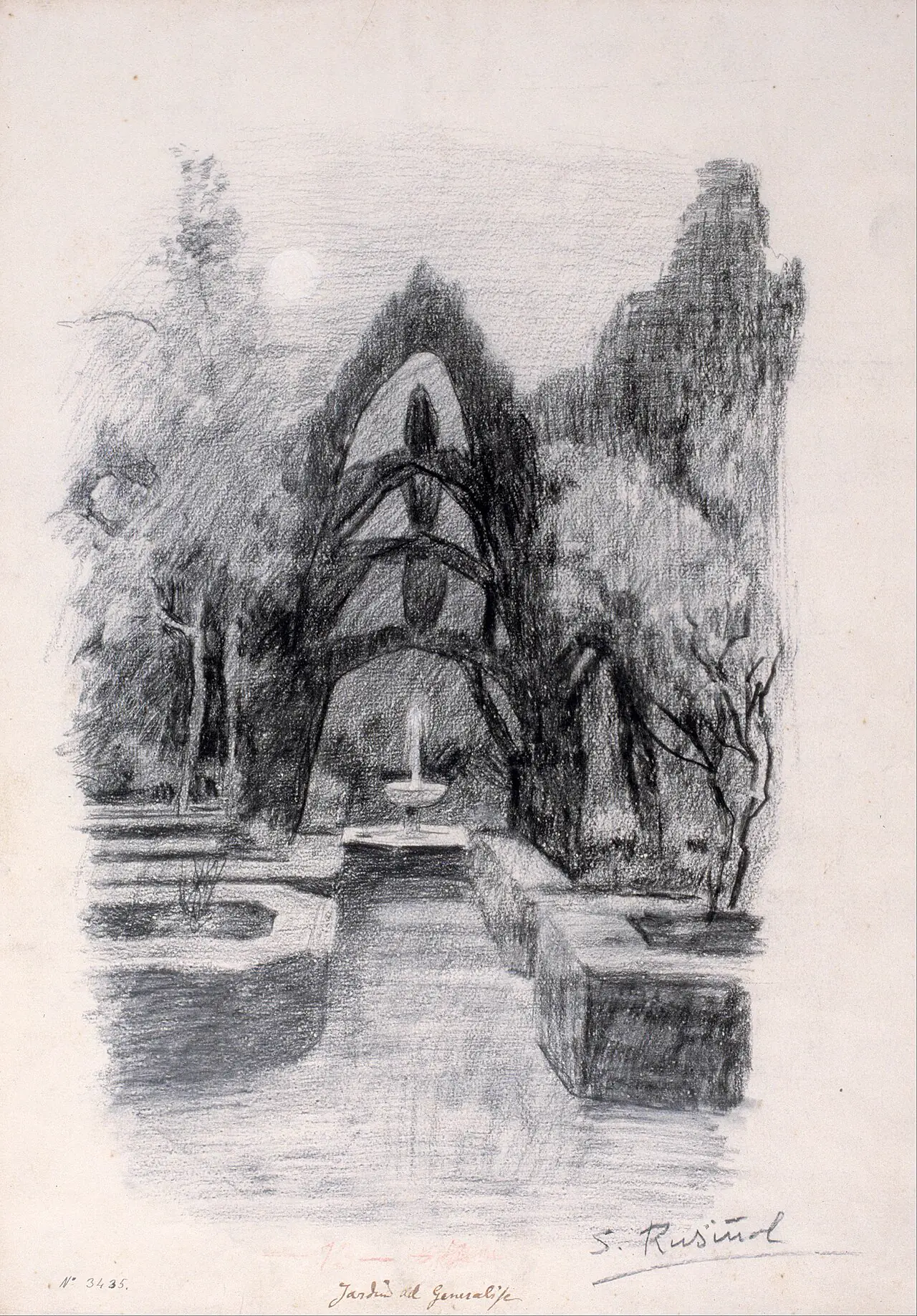
He worked on Noches that year in Santiago Rusiñol’s house, the Cau Ferrat at Sitges. José Cubiles played it with Enrique Fernández Arbós and the Madrid orchestra at the Teatro Real on 9 April 1916. Falla’s note described the three “symphonic impressions” as settings of places, sensations and sentiments, and added: “melancholy and mystery have their part also.” On 26 June he played the piano part himself at the Palace of Charles V in Granada, with Diaghilev and Massine in the audience.
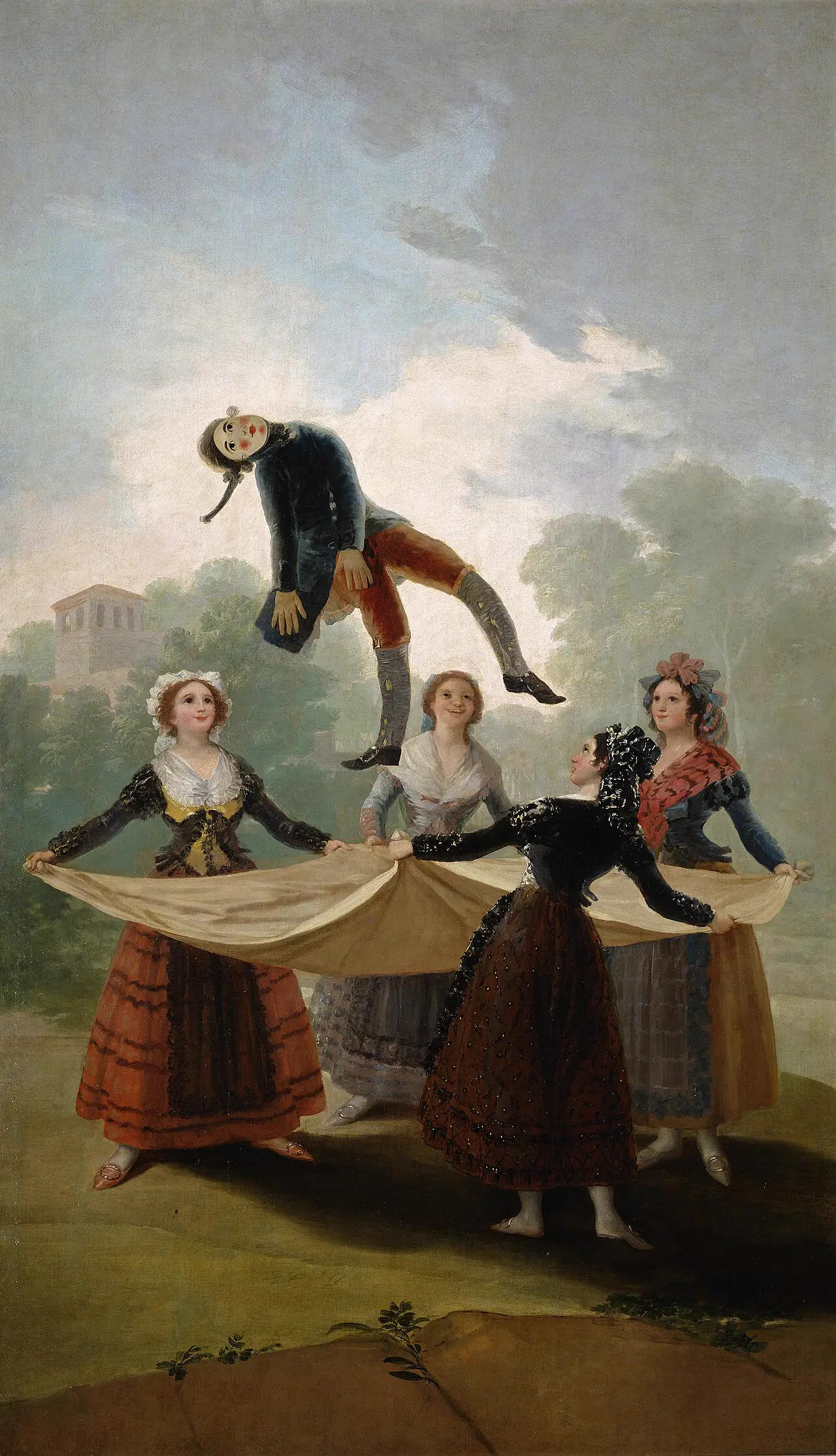
Diaghilev wanted a ballet. The material began as a mimed play by Falla and the Martínez Sierras, El corregidor y la molinera, given at the Teatro Eslava on 7 April 1917, and Diaghilev, “stubborn and impatient” in María’s words, pressed for it to be turned into one. In October 1918 Falla sent him a postcard of Goya’s El pelele with a popular tune written across the picture. El sombrero de tres picos opened at the Alhambra Theatre in London on 22 July 1919, with Massine as the Miller and sets and costumes by Picasso. Falla was not there, because his mother had died in Madrid that day. Juan Ramón Jiménez wrote five days later that he had read, in the same copy of El Sol, of a son’s sorrow and a musician’s success.
1920–39Granada
The first piece Falla finished in Granada, in August 1920, was Homenaje, for guitar, in memory of Debussy. In 1922 he settled with his sister María del Carmen in a small house with a walled garden on the Antequeruela Alta. Emilio García Gómez remembered the evenings there: wicker chairs round a circular table, the sister’s cat purring in a corner, and “almost anything” discussed in preference to music.
With Federico García Lorca, Zuloaga and others, Falla organised a Cante Jondo Competition, held on 13 and 14 June 1922 in the Plaza de los Aljibes at the Alhambra. “A great hush fell on the square,” a reporter wrote in El Liberal. On 6 January 1923 he helped Lorca and Hermenegildo Lanz put on a puppet show at the Lorca house. To make the music sound old he covered the strings of the piano with tissue paper, and Francisco García Lorca remembered that it sounded rather like a harpsichord.
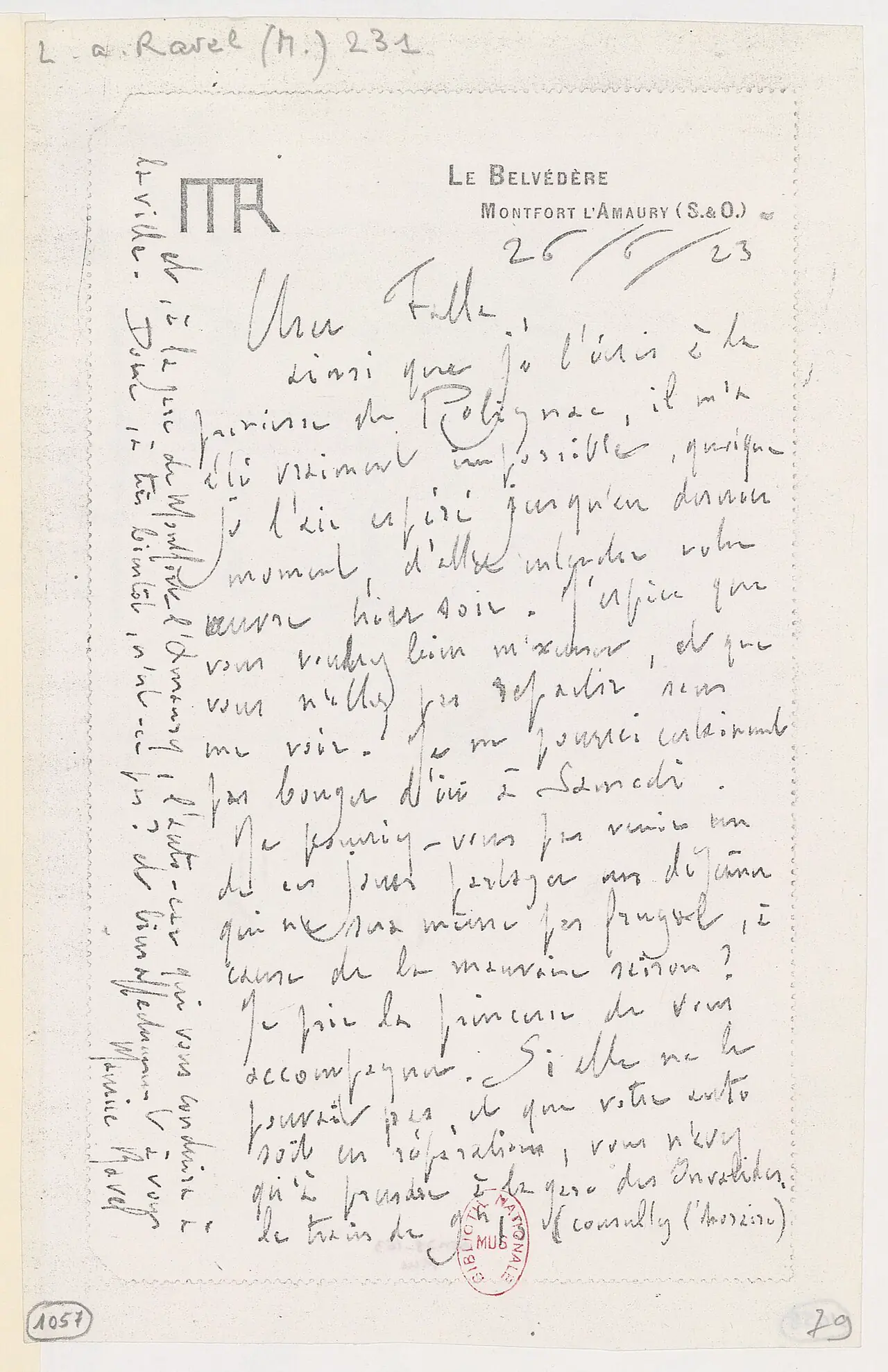
Falla’s puppet opera, El retablo de maese Pedro, was staged on 25 June 1923 in the Princesse de Polignac’s palace in Paris. Ravel, who had hoped to the last to be there, wrote the next day that he had been unable to come, and asked Falla not to leave Paris without seeing him. For Wanda Landowska, Falla wrote the Concerto for harpsichord and five instruments, which they gave in Barcelona on 5 November 1926 with Falla conducting. On 31 March 1928, in Paris, he accompanied the soprano María Barrientos at the piano while Columbia recorded El paño moruno, Seguidilla murciana, Asturiana and Jota.
Falla was troubled by noise. He went to Mallorca in 1933 and 1934 to escape it, and in June 1935 he told Arbós that loudspeakers had played for sixteen hours straight as a prelude to the Corpus festivities. On 19 August 1936 Lorca was assassinated in Granada. Falla was badly affected, and two weeks later he was writing to a captain on behalf of their friend Lanz.
1939–46Argentina
On 28 September 1939 Falla and his sister left Granada. They sailed from Barcelona on 2 October and reached Buenos Aires on 18 October, where he had four concerts to conduct at the Teatro Colón. Franco’s government offered him a substantial life pension, payable whenever he chose to return, and he refused it. On 15 December 1940, while conducting for Radio El Mundo, he made the only known recording of his voice. From 1942 he lived at Los Espinillos, near Alta Gracia.
He was still working at Atlántida, conceived in 1927 and never finished. Writing to Ernesto Halffter in April 1946, he said he would be going against his moral principles if he stopped composing, and would do all he could to finish “poor Atlántida”. He died in his sleep at Los Espinillos on 14 November 1946, nine days before his seventieth birthday. His body reached Cádiz on 9 January 1947 and was laid in the cathedral crypt. Rafael Alberti, who had visited him at Alta Gracia, later saw the tomb and pictured Falla “surrounded by darting fish that disturb his dreams”.
Places
Every recorded place, joined in date order. Falla on the MapAll 21 places, with sources
Cádiz · 1876–1896 · childhood
Grew up in the port city. He had his first piano lessons with Eloísa Galluzo from 1885, and later studied with Alejandro Odero and Enrique Broca.
Lived in Paris until the war. Dukas and Debussy were his principal mentors, and he met Albéniz, Ravel and Viñes there. Cuatro piezas españolas; Trois mélodies; Noches en los jardines de España.
Granada · September 1920 – 28 September 1939 · lived
Settled in Granada, first in the Pensión Carmona and the Carmen de Santa Engracia, from 1922 at 11 Antequeruela Alta; left on 28 September 1939. Homenaje pour le Tombeau de Claude Debussy.
Falla studied cante jondo, the deep song of Andalusia, around the time of El amor brujo. In 1922 he identified three of its features: modulation by enharmonic change, a melodic range seldom wider than a sixth, and the obsessive repetition of a single note. John Henken’s note for the Los Angeles Philharmonic adds that El amor brujo quotes no actual folk songs and that the idiom is Falla’s own.
𝄞The guitar
In 1922 Falla called the guitar playing of the cante jondo without a rival in Europe. The Los Angeles Philharmonic’s note describes guitar-inspired phrases for piano over hazy strings in the third movement of Noches, and Roger Nichols’s Hyperion note quotes Ronald Crichton on the guitar figurations of the Fantasía bética, “transformed into pianistic terms”. Homenaje was written for the guitar itself.
𝄾Named dances
The Three-Cornered Hat is a ballet made up of named dances. The Miller’s Wife dances a fandango, the neighbours dance seguidillas and the Miller dances a farruca, and a jota brings the ballet’s themes together. In the Siete canciones the Jota is in 3/8, Allegro vivo, with a long piano introduction before the voice enters. The Pantomima of El amor brujo is in an uneven metre of seven.
𝄢Paris colour
The first movement of Noches opens Allegretto tranquillo e misterioso with the harp played sulla tavola, close to the soundboard, violas sul ponticello, plucked notes in the first violins and the low strings, and the piano silent. The second begins with four solo violas con sordino. The Los Angeles Philharmonic’s note calls the work three connected nocturnes in the manner of Debussy, whose La soirée dans Grenade and Ibéria Falla remembered in his Homenaje.
♩Old music, new instruments
The Cervantes puppet opera, the harpsichord concerto written for Landowska and the fourteen Scarlatti sonatas Falla played at the Ateneo de Granada in 1927 show a composer who returned repeatedly to older music. For the Lorca puppet show of 1923 he covered the piano strings with tissue paper to give the music an old sound, and the piano sounded similar to a harpsichord.
Works
A selection from the composer’s works.
1904–05
La vida breveLyric drama in two acts and four tableaux; libretto by Carlos Fernández Shaw
Set in Granada, a city its composer had not yet seen. It won the Academy of Fine Arts competition on 13 November 1905, was first staged at Nice on 1 April 1913 and reached the Opéra-Comique on 7 January 1914.
1906–08
Cuatro piezas españolas (Pièces espagnoles)Piano
Begun in Madrid and finished in Paris. Ricardo Viñes played them at the Salle Érard on 27 March 1909, and Jacques Durand published them on the recommendation of Dukas, Debussy and Ravel.
1909–10
Trois mélodiesVoice and piano; poems by Théophile Gautier
First sung on 4 May 1910 at the Société Musicale Indépendante by Ada Adiny-Milliet, with Falla at the piano.
Three “symphonic impressions”: En el Generalife, Danza lejana and En los jardines de la Sierra de Córdoba. Begun in Paris; first played at the Teatro Real, Madrid, on 9 April 1916 by José Cubiles under Arbós.
Seven traditional songs with piano parts by Falla: El paño moruno, Seguidilla murciana, Asturiana, Jota, Nana, Canción and Polo. Luisa Vela and Falla gave the first performance at the Ateneo de Madrid on 15 January 1915.
El amor brujoGitanería with dances, songs and spoken text; later a ballet and a concert suite
Built around Pastora Imperio, who danced Candelas at the Teatro Lara on 15 April 1915. The concert version was given in Madrid on 28 March 1916, and the definitive ballet at the Trianon-Lyrique, Paris, on 22 May 1925 with Falla conducting.
El corregidor y la molineraMimed play for small orchestra
Falla and the Martínez Sierras’ version of Alarcón’s El sombrero de tres picos, given at the Teatro Eslava, Madrid, on 7 April 1917 under Joaquín Turina. Diaghilev asked for a ballet.
Massine’s ballet for the Ballets Russes, with Picasso’s curtain, sets and costumes, first danced at the Alhambra Theatre, London, on 22 July 1919. Falla drew two suites from it in 1921.
Written after a commission from Arthur Rubinstein, who gave the first performance in New York on 8 February 1920.
1919–23
El retablo de maese PedroPuppet opera after Cervantes; small orchestra
Commissioned by the Princesse de Polignac in 1918 and staged in her Paris palace on 25 June 1923, with puppets by Hermenegildo Lanz and designs by Manuel Ángeles Ortiz.
1920
Homenaje pour le Tombeau de Claude DebussyGuitar; also arranged for piano
The first piece Falla completed in Granada, for a memorial issue of La Revue musicale. Marie-Louise Casadesus gave the first performance on a harp-lute in Paris on 24 January 1921.
1923–26
ConcertoHarpsichord (or piano), flute, oboe, clarinet, violin and cello
Written at Wanda Landowska’s request. She and soloists of the Orquestra Pau Casals gave the first performance in Barcelona on 5 November 1926, with Falla conducting.
1927–46
AtlántidaLarge-scale stage work; unfinished
Conceived in 1927 and worked on until his last months in Argentina. The score was unfinished at his death.
1935
Pour le tombeau de Paul DukasPiano
Written for La Revue musicale after Dukas died in May 1935; Joaquín Nin-Culmell gave the first performance in Paris on 28 April 1936.
1938–39
HomenajesOrchestral suite
Built from earlier works and projects. Falla conducted the first performance at the Teatro Colón, Buenos Aires, on 18 November 1939.
An invented four-bar schematic: A minor, G major, F major and E major, with the bass stepping down A–G–F–E. This descending progression is the cadence of flamenco guitar playing, and it ends on the major chord a semitone below F. It quotes no Falla score.
Phrygian with a raised third — invented schematicE mode with semitone and augmented second
The scale rising and falling from E: a semitone from E to F, an augmented second from F to G♯, then A, B, C, D, E. The semitone above the tonic and the major third together give the colour associated with Andalusian song. The example is invented for illustration and is not quoted from any work.
The guitar — the instrument’s tuningSix open strings at sounding pitch
The six open strings of a guitar at sounding pitch, E–A–D–G–B–E, played one by one and then together: four perfect fourths and a major third. Falla’s Homenaje and the strummed passages of his piano and orchestral writing draw on this tuning. An illustration of the instrument; no Falla bars are quoted.
Sister arts
Francisco de GoyaEl pelele (The Straw Manikin), 1791–92Oil on canvas; design for a royal weaving · Museo del Prado, Madrid
On 21 October 1918 Falla sent Diaghilev, in London, a postcard of this picture with a popular tune written out across it. The tune came back in El sombrero de tres picos. Goya’s four young women in majas’ dress toss a straw dummy in a blanket; at the end of the ballet the villagers toss the Corregidor in one.
Santiago RusiñolGardens of the Generalife, 1895Conté pencil and coloured pencil on paper · Museu Nacional d’Art de Catalunya, Barcelona
The Generalife is the first of the three gardens in Noches en los jardines de España. Rusiñol drew its terraces in 1895; twenty years later he invited Falla to his house at Sitges, the Cau Ferrat, where Falla worked intensively on the piece.
Maurice RavelLetter to Manuel de Falla, Montfort-l’Amaury, 26 June 1923Autograph letter, first page (photocopy) · Bibliothèque nationale de France, Département de la Musique
Written the day after the staged première of El retablo de maese Pedro in the Princesse de Polignac’s palace. Ravel told Falla that, as he had told the Princesse, he could not come, though he had hoped to the last, and that he hoped Falla would not leave Paris without seeing him. He asked him to come out to lunch at Montfort-l’Amaury one of these days.
Traditional
Jota — first couplet, as set by Falla
Set in 1914
SpanishDicen que no nos queremos
porque no nos ven hablar;
a tu corazón y al mío
se lo pueden preguntar.
Our translationThey say we do not love each other
because they never see us talk;
to your heart and to mine
they can put the question.
The voice enters on these lines in the fourth of the Siete canciones populares españolas, after a long piano introduction in 3/8. The second couplet is a farewell: “goodbye, my girl, until tomorrow”. María Barrientos sang the song with Falla at the piano in Paris in 1928.
Recommended recordings
Siete canciones populares españolasMaría Barrientos, soprano; Manuel de Falla, pianoColumbia · 1928–30The composer played the piano parts. Recorded in Paris from 31 March 1928.
El amor brujoCarol Brice, contralto; Pittsburgh Symphony Orchestra, Fritz ReinerColumbia Masterworks; reissued by Sony Classical · 1946All thirteen numbers of the ballet, recorded at the Syria Mosque, Pittsburgh, on 5 February 1946.
Noches en los jardines de EspañaClifford Curzon, piano; National Symphony Orchestra, Enrique JordáDecca · 1945A 78-rpm set made at Kingsway Hall, London. Curzon recorded the work again with Jordá for an LP in 1951.
Where to hear more
Fantasía bética · Homenaje ‘Pour le tombeau de Claude Debussy’ · Cuatro piezas españolas — piano works1906–20
Garrick Ohlsson, piano · Hyperion, CDA68177 · 2016
Falla’s piano music in one programme, recorded at St Silas the Martyr, Kentish Town, in November 2016. Roger Nichols’s booklet note identifies reminiscences of Debussy’s La soirée dans Grenade at the end of the Homenaje.
Homenaje ‘Pour le tombeau de Claude Debussy’ — guitar version1920
Christoph Denoth, guitar · Signum Classics, SIGCD404 · 2012
The piece as Falla first wrote it, for solo guitar, in the album Homages, recorded in January 2012 and released in October 2014. It runs three minutes forty-one seconds.
Pedrell taught him from 1901. Dukas and Debussy were his guides in Paris, and Albéniz found him a grant. The link with Scarlatti is one of repertoire; Falla played fourteen of his sonatas at the Ateneo de Granada in 1927. Ernesto Halffter was his pupil and conducted the Orquesta Bética de Cámara that Falla founded in Seville. Poulenc took the theme of the Pantomima for his third Novelette.
Dates and places of each work, journey and première, year by year, with extracts from the letters preserved in the Granada archive.
Jaime Pahissa, Vida y obra de Manuel de Falla (Ricordi Americana, 1947; second edition 1956). biography
Pahissa, a Catalan composer in exile in Buenos Aires, made notes on what Falla said about his own life in his last years during a visit to Los Espinillos in 1944, for this early life.
Cite this page
Contrapunctus. “Manuel de Falla.” Accessed 20 October 2026. https://mottopanikeiku.github.io/contrapunctus/composers/falla.html.
@misc{contrapunctus-composers-falla,
  author = {{Contrapunctus}},
  title = {Manuel de Falla},
  howpublished = {\url{https://mottopanikeiku.github.io/contrapunctus/composers/falla.html}},
  note = {Accessed 2026-10-20}
}