Noches en los jardines de España
25 min
Recording
- Complete: I. En el Generalife; II. Danza lejana; III. En los jardines de la Sierra de CórdobaClifford Curzon, piano; National Symphony Orchestra; Enrique Jordá · 194524:46
Clifford Curzon and Enrique Jordá recorded all three of Falla’s “symphonic impressions” in London in 1945, on a six-side Decca set. The first, En el Generalife, opens with a harp played close to its soundboard, and the piano is silent for the whole first page.
Listening notes
- Harp sulla tavola, first movement
Allegretto tranquillo e misterioso, in 6/8. The harp plays sulla tavola, close to the soundboard; violas play sul ponticello; cellos and basses play pizzicato. The solo piano rests.
- Piano entry
Just over a minute in, the piano enters with a fast, ringing figure marked “ben marcato”, over long notes in the wind and horns marked “perdendosi”.
- Poco più animato, figure 5
At “Poco più animato” (dotted crotchet = 66) the full orchestra builds to its first crescendo. Winds and harp enter together, and the piano plays broken chords.
- Composition and first performances, 1909–1916
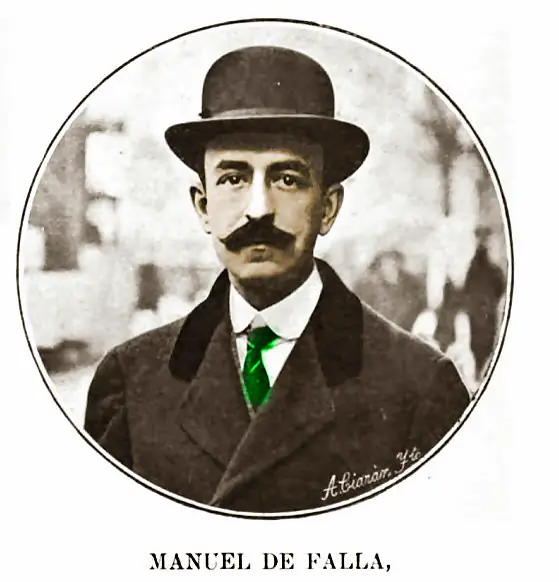
Falla began the piece in Paris in 1909. It was first played at the Teatro Real in Madrid on 9 April 1916, with José Cubiles as soloist and Enrique Fernández Arbós conducting. Falla played it himself in Granada that June.
- Composer’s note on the work
Falla’s note states that the three “symphonic impressions” aim only to “evoke places, sensations, and sentiments”, and that “melancholy and mystery have their part also.”
- Climax of “En el Generalife”
Over a minute or more the movement builds to its loudest point, with the full orchestra playing. The texture then thins to near-silence before the second movement. Columbia’s 1954 Spanish catalogue lists the closing part, “En el Generalife. Conclusión”, on a record side of its own.
- Opening of Danza lejana
Allegretto giusto, in 3/4. Four solo violas, muted, play a trill over pizzicato cellos and a solo double bass. Flutes and cor anglais enter pianissimo and marcato.
- Performance in Granada, 1916
On 26 June 1916 Falla played the piano part himself at the Palace of Charles V in Granada, with the Madrid orchestra under Arturo Saco de Valle. Diaghilev and Massine were in the audience.
- Link to the third movement
Danza lejana ends with repeated piano chords marked crescendo, while flutes and oboes rise in the last bar, and the score is marked “Attacca subito”. The third movement, Vivo, follows at once with cymbals, a piano chord and trills in the strings.
- Piano phrases over strings
After the opening storm comes a calmer passage. Jessica Schilling’s note for the Los Angeles Philharmonic describes it as “crystalline, guitar-inspired” phrases for the piano over hazy strings. The stormy music returns soon after.
- Final section, last side
In the Los Angeles Philharmonic’s note, the piece “roars through its final five minutes”, with harsh interruptions from the full orchestra. On this three-disc set the closing portion, “En las sierras de Córdoba. Final”, fills the last side.
- Diaghilev’s proposed ballet
Diaghilev first wanted to make a ballet of Nights. Falla was not keen, and the contract the two men signed was for El sombrero de tres picos instead.