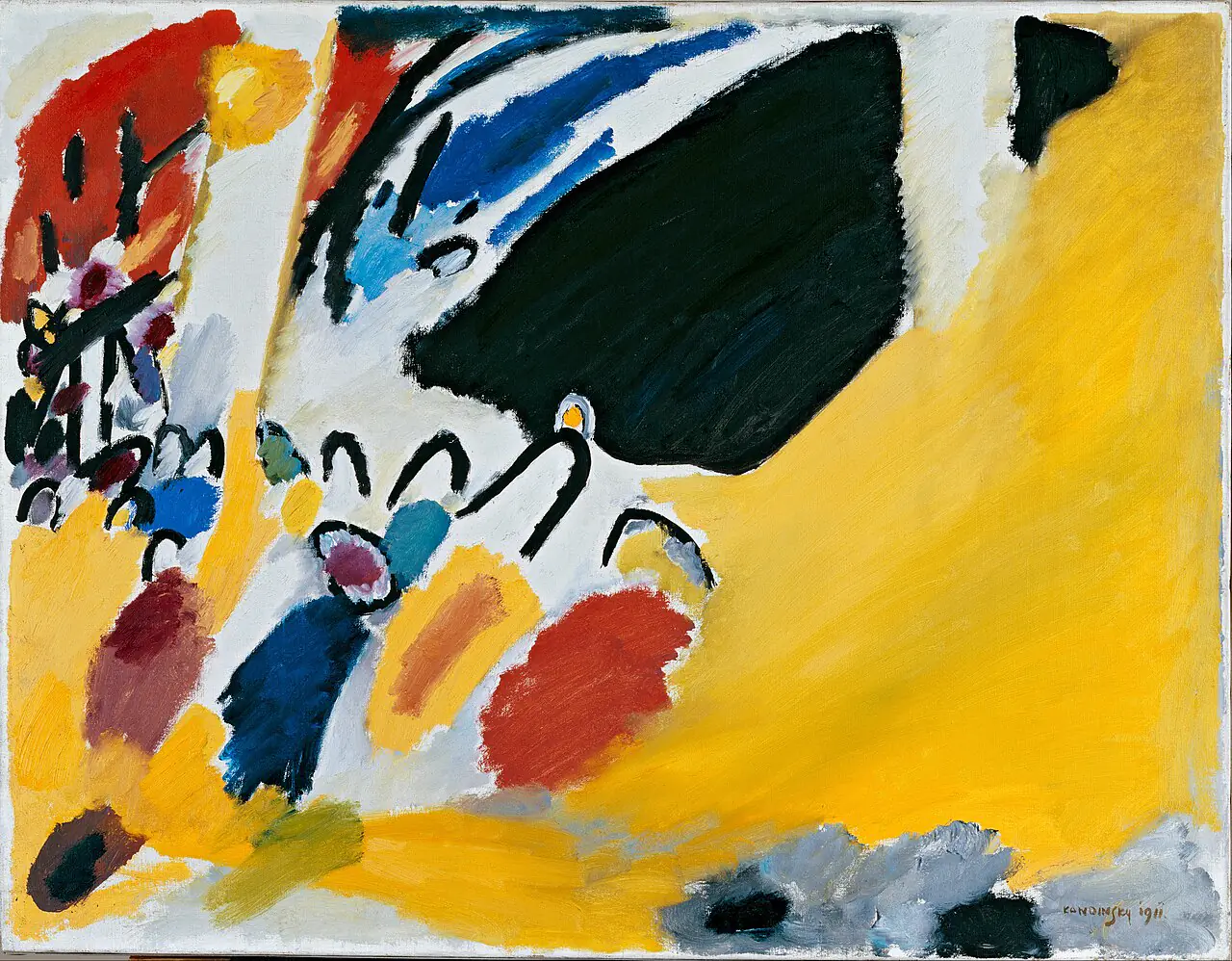
Wassily KandinskyImpression III (Concert), 1911 Städtische Galerie im Lenbachhaus, Munich
Overview
In December 1908 the soprano Marie Gutheil-Schoder joined the Rosé Quartet in Vienna for the première of Schoenberg’s Second String Quartet. A voice enters in the last two movements. In the finale, which sets Stefan George’s poem about a departure from earth, long stretches of the music have no fixed key and move far from the F♯ minor of the first movement. Writing in Los Angeles for a private recording in 1936–37, Schoenberg recalled laughter and interruptions during the soprano’s singing. The audience was quiet only in the coda, when the strings played alone.
For Pierrot lunaire, commissioned by the reciter Albertine Zehme in Berlin in 1912, Schoenberg wrote for five instrumentalists and a speaking voice. In Nacht he reduces the group to bass clarinet, cello and piano. The piece is built on three notes, E–G–E♭, a minor third up and then a major third down. The figure returns in different parts and at different speeds, filling the low register while the poem describes giant black moths blotting out the sun. Atonality does without a governing tonic. In this piece the repeated three-note shape runs through all twenty-six bars.
Schoenberg’s Suite for Piano, Op. 25 (1921–23), applies the twelve-note method to old dances. Its row supplies both the melodies and the accompanying chords, and the gavotte and musette are derived from the same twelve-note row. In the Intermezzo, some of the row’s notes form a repeated figure above a low melody. A row does not fix how long a note lasts or how hard the pianist strikes it; those remain the composer’s choice. The closing gigue is written in 2/2, with accents that cut across the beat and occasional bars of 3/4.
Schoenberg and his pupils Berg and Webern became known as the Second Viennese School. Each used the row differently. In Webern’s Symphony, Op. 21 (1928), a line passes from horn to clarinet to cello while its partner moves through the same intervals in the opposite direction. In Berg’s Violin Concerto (1935), the soloist enters on the violin’s open strings, G–D–A–E. Those notes also belong to the row’s overlapping minor and major chords. Its first five pitches, G–B♭–D–F♯–A, contain both a G minor and a D major triad.
The beatStravinsky, Bartók and Ives
At the Théâtre des Champs-Élysées in Paris on 29 May 1913, Nijinsky’s dancers stamped to Stravinsky’s The Rite of Spring. The stamping follows the music. In The Augurs of Spring, the strings repeat a chord made from an F♭ major triad with an E♭ seventh chord above it. The quavers are even, and the heavy accents fall in shifting places. Eight horns double the accents against the strings’ continuing quavers.
Bartók heard unfamiliar scales in folk singing. At Gerlice-puszta in 1904 he heard Lidi Dósa, a young woman from Transylvania, sing, and he wrote down her songs. From 1905–06 he and Zoltán Kodály used phonograph cylinders alongside their notebooks. A recording could be slowed down until a quick ornament was clear enough to transcribe. Among the older Hungarian songs they studied were pentatonic tunes whose phrases descended and returned a fifth lower. Bartók also collected Slovak and Romanian music, and his archive included songs from across borders.
The church music and town bands of Danbury, Connecticut, supplied Ives with different memories. In The Unanswered Question, quiet strings hold slow chords while a solo trumpet repeats a short phrase, the question of the title. Four woodwinds play answers, each faster and more agitated than the last; the strings continue at their own tempo. After the seventh question the winds do not answer. Ives revised the piece in the 1930s; its first public performance came in 1946.
NeoclassicismStravinsky, Prokofiev, Berg and Bartók
For Pulcinella in 1920, Diaghilev brought Stravinsky music attributed to Pergolesi, and Picasso supplied sets and costumes. Stravinsky kept much of the old melody while cutting beats out of phrases and sharpening the harmony. The chamber orchestra has neither clarinets nor percussion. At the Paris première on 15 May, Massine danced the amorous Pulcinella.
Prokofiev had already completed his “Classical” Symphony in 1917. Its four movements and paired wind instruments follow Haydn’s model. In the third movement, a gavotte, the tune repeatedly leaps by octaves, and the bassoon adds grace notes. Neoclassicism could borrow an actual eighteenth-century score, as in Pulcinella, or invent a new piece in an older manner. Prokofiev’s gavotte places clashing major chords inside a dance that lasts little more than a minute.
Berg used old forms for darker subjects in Wozzeck, first performed in Berlin on 14 December 1925. The Doctor, who pays the soldier to submit to dietary experiments, is given a passacaglia, in which variations on a returning theme accompany his obsession. The second act is built as a five-movement symphony while Wozzeck’s jealousy grows. In the last act, the scene in which he murders Marie beside a pond is built on the note B♮. After her death the orchestra plays that single note in two crescendos.
Bartók scored his Sonata of 1937 for two pianos and two percussionists. He and his wife, Ditta Pásztory, played the piano parts at its première in Basel on 16 January 1938. The first movement opens with a quiet timpani roll and a piano introduction; later, the pianos are paired with the xylophone. The percussion parts distinguish side drums with and without snares as carefully as the piano parts distinguish pitches. The percussion also includes a suspended cymbal and a tam-tam.
Institutions and politicsBroadcasting, recording and emigration
Schoenberg’s Society for Private Musical Performances, founded in Vienna in 1918, banned applause and repeated works so that members could hear them again. Orchestral music often arrived in chamber arrangements because the society could not afford an orchestra. Inflation forced more inventive fundraising. On 27 May 1921, Schoenberg played violin, Berg harmonium and Webern cello in arrangements of Johann Strauss waltzes, then offered the manuscripts at auction. Trying to push up the price of Webern’s arrangement, Schoenberg accidentally bought it himself for 9,000 crowns.
The BBC Symphony Orchestra gave its first public concert under Adrian Boult on 22 October 1930, with a full-time, salaried body of players behind the microphone. Broadcasting now paid orchestral wages. Recording had also changed. In 1925 Columbia and Victor introduced electrical recording commercially, which used a microphone in place of the acoustic horn and captured a wider range of sound.
For Eisenstein’s film Alexander Nevsky (1938), Prokofiev placed the horns so close to the microphones that their sound crackled and distorted. These were the horns of the invading Teutonic knights. Brass and chorus were recorded separately and then mixed. When he turned the score into a concert cantata in 1939, he cut repetitions and reorchestrated the music, and the film fragments became continuous movements for orchestra and chorus.
The Nazis drove Schoenberg out of his Berlin Academy post in 1933. In Paris he formally returned to Judaism, with Marc Chagall as a witness, before emigrating to the United States with his wife and daughter. There Schoenberg, whose quartet had caused uproar in Vienna, taught in Boston and New York. By 1936 he held a professorship at the University of California, Los Angeles.
In the Soviet Union, Shostakovich was threatened in print. The unsigned Pravda editorial of 28 January 1936 attacked Lady Macbeth of the Mtsensk District and warned that such musical experiments “may end very badly”. Prokofiev settled with his family in Moscow that May. He could still tour abroad for a time. After a Western tour in 1938, the authorities took his passport for an administrative formality and never returned it.
Years before those departures, painters had been sitting in the concert audience. On 2 January 1911 in Munich, Kandinsky, Gabriele Münter and Franz Marc heard Schoenberg’s Second String Quartet and piano pieces. Kandinsky painted Impression III (Concert) the next day and began corresponding with the composer. The 1912 Der Blaue Reiter almanac included Schoenberg’s essay on words and music, reproductions of his paintings, and songs by him, Berg and Webern bound into the book.
Terms of art
Atonality
Music without a governing tonic, in which no home chord organises the other notes around itself. In Schoenberg’s Nacht, the returning E–G–E♭ figure holds the music together as it moves between bass clarinet, cello and piano.
Twelve-note row
A chosen ordering of all twelve pitch classes, with a note in any octave counting as the same pitch class. Berg’s Violin Concerto begins its row G–B♭–D–F♯–A, notes that form two overlapping triads. A row can be transposed, played backwards or have its intervals inverted; its notes can also be shared among simultaneous parts.
Sprechstimme
Notated speech in which the voice follows a written rhythm and uses pitches as points of departure. In Pierrot lunaire, Schoenberg asked the reciter to leave each pitch immediately by rising or falling.
Polyrhythm
Different rhythmic divisions sounding together. A pianist can fit three evenly spaced notes in the right hand against two in the left over the same span; the hands start together, then their attacks separate before they next coincide.
Additive metre
Metre built by joining unequal groups of shorter notes. A bar of 7/8 grouped 2+2+3 has two short beats and one longer beat, all measured by the same quaver. The last beat lasts half as long again as either of the first two.
Neoclassicism
New music written in older forms or styles. Prokofiev’s “Classical” Symphony uses a small orchestra and includes a gavotte; the dance tune is spread across octave leaps, with clashing major chords beneath it.
Polymodality
Different modes used together. Over a shared C, Lydian supplies F♯ while Phrygian supplies D♭ and E♭; the notes of both can be used around the same home pitch. Bartók described this practice in his Harvard lectures of 1943.
Ostinato
A short musical pattern repeated many times. In The Augurs of Spring, Stravinsky’s strings play the same chord in even quavers while the accents shift from one beat to another.
In the score
Twelve-note operation · schematicA row and its inversion
An invented twelve-note row occupies bars 1–4, using each pitch class once. The next four bars invert it around C, so that D becomes B♭, E becomes A♭, and F♯ remains a tritone from C. The octaves have been chosen to keep the piano line within a compact span; the inversion applies to the pitch classes.
Accent and pulse · schematicDifferent groupings of eight quavers
An invented string figure on E. Both bars contain eight equal quavers in 4/4, but the accents divide the first into 3+3+2 and the second into 2+3+3. The second bar brings its middle accent a quaver earlier. The pulse stays even under the changed accents.
Sister arts
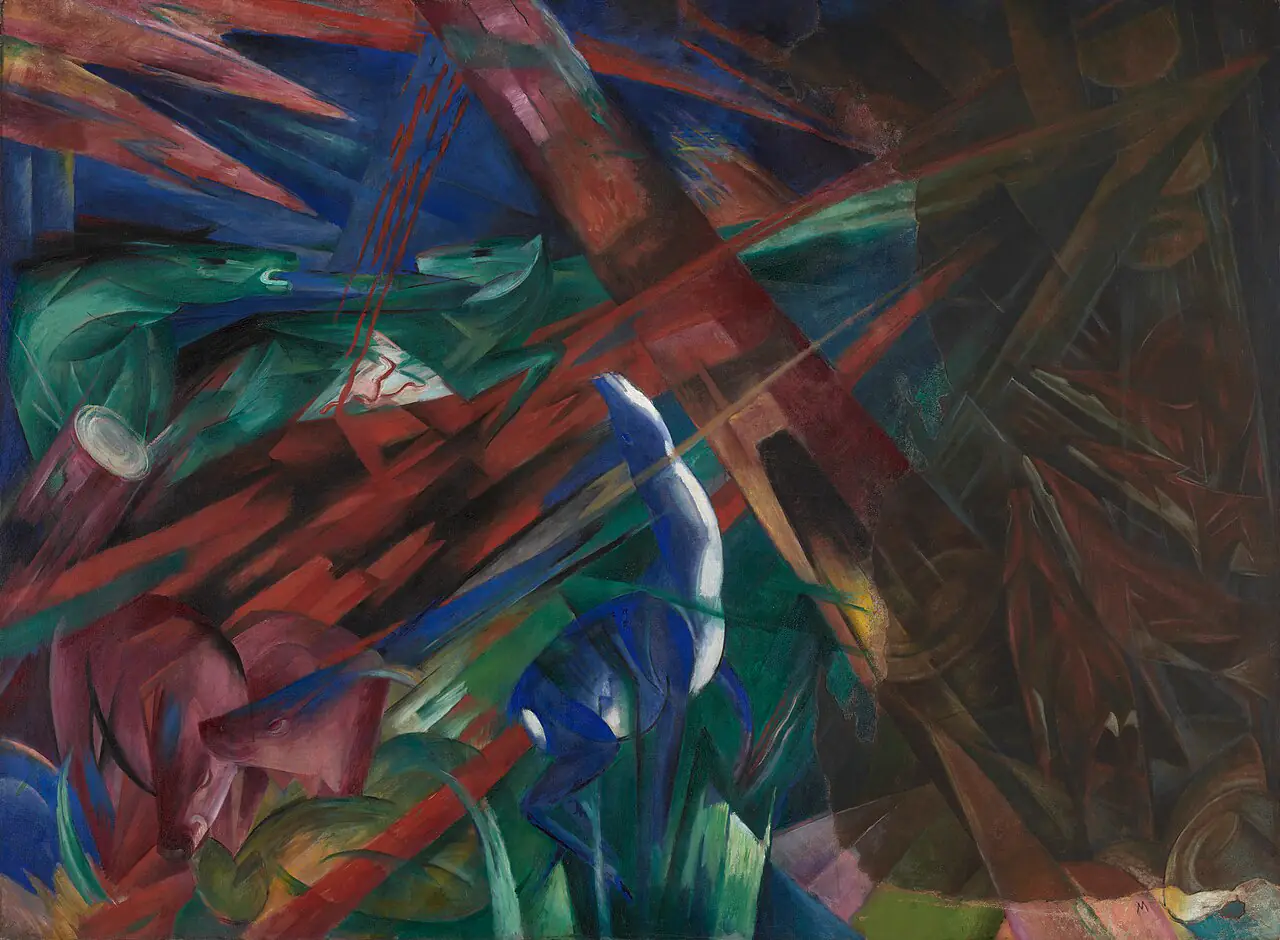
Franz MarcFate of the Animals, 1913Oil on canvas · Kunstmuseum Basel
Marc painted Fate of the Animals in 1913, two years after hearing Schoenberg in Munich with Kandinsky and Münter. Trees and animals are drawn into the same network of diagonals. The damage to the painting is still visible. A fire in a storeroom destroyed its right third, and in 1919 Paul Klee reconstructed that section from studies and reproductions, using darker colours to mark the loss.
Guillaume Apollinaire
Zone — opening
1913, in Alcools
FrenchÀ la fin tu es las de ce monde ancien
Bergère ô tour Eiffel le troupeau des ponts bêle ce matin
Tu en as assez de vivre dans l’antiquité grecque et romaine
Ici même les automobiles ont l’air d’être anciennes
Our translationAt last you are weary of this old world
Shepherdess O Eiffel Tower the flock of bridges bleats this morning
You have had enough of living in Greek and Roman antiquity
Here even the motorcars seem to be old
Apollinaire opened Alcools (1913) on a Paris morning, with the Eiffel Tower as a shepherdess and the bridges bleating. The lines move from this pastoral image to a complaint about classical antiquity without a full stop, in the way Stravinsky cuts between orchestral groups. By the fourth line the cars are counted among the antiques as well.