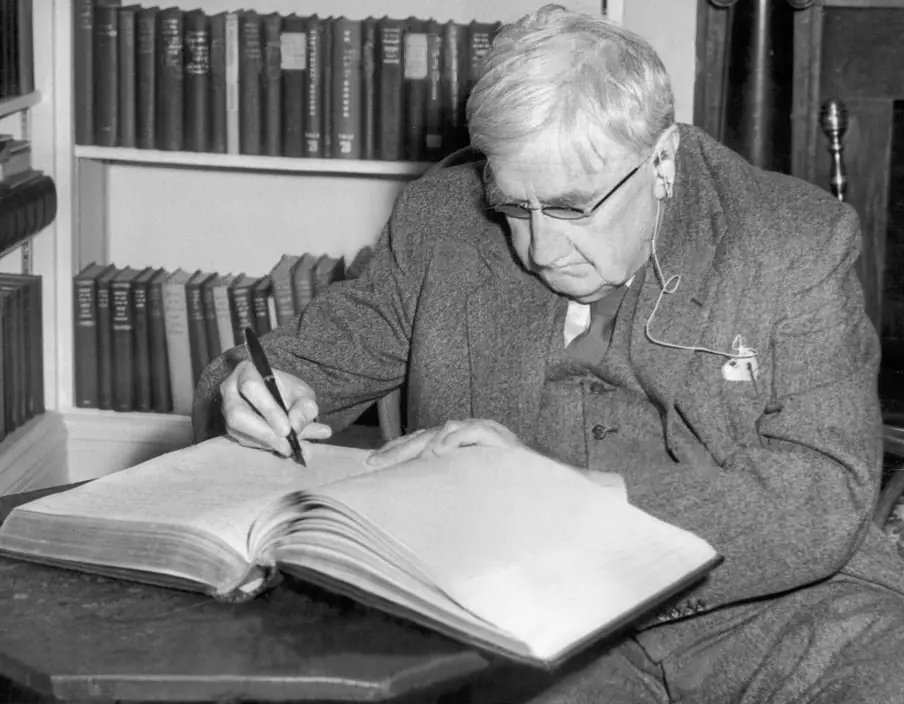
Hubert Parry, Charles Wood and Charles Villiers Stanford in London and Cambridge; Max Bruch in Berlin, 1897; Maurice Ravel in Paris, 1907–08
At work
Composer, folk-song collector, hymn-book editor, teacher and conductor; Leith Hill Musical Festival, 1905–53
Friends and partners
Gustav Holst · Adeline and Ursula Vaughan Williams · Adrian Boult · Hubert Foss at Oxford University Press
Output
Nine symphonies, operas, a masque for dancing, choral works, songs, hymn tunes, film scores and music for amateurs
“In the next world, I shan’t be doing music, with all the striving and disappointments. I shall be being it.”
Life
On 9 February 1875 Arthur Vaughan Williams, vicar of All Saints, Down Ampney, died after a brief illness. His third child, Ralph, born in the vicarage on 12 October 1872, was two. His widow Margaret, a Wedgwood, took the children to her family’s house at Leith Hill Place in Surrey. Aunt Sophy gave the boy piano lessons, and at six he wrote a piece called The Robin’s Nest. He went to Charterhouse in 1887 and to the Royal College of Music in 1890, where Hubert Parry taught him composition; in 1892 he went up to Trinity College, Cambridge, to read history as well as music.
On 9 October 1897, three days before his twenty-fifth birthday, he married Adeline Fisher at All Saints, Hove. She was a cellist and pianist, and Virginia Woolf was her first cousin. After a brief spell of study with Max Bruch in Berlin he returned to his post as organist at St Barnabas, South Lambeth. He had held the post since 1895 and disliked it, and he gave it up in 1899.
1903–08Folk-song collecting and study with Ravel
In December 1903, at Ingrave in Essex, he took down Bushes and Briars from a village singer. It was the first of more than 800 songs and carols he collected over the next ten years in East Anglia, Sussex and Herefordshire, and its modal turns remained in his writing for the rest of his life. From 1904 to 1906 he was music editor of The English Hymnal. The work brought him into daily contact with Tudor psalm tunes, and he contributed four tunes of his own, among them Sine Nomine (“For all the saints”) and Down Ampney (“Come down, O Love Divine”), named for his birthplace.
1910Two premières in five weeks
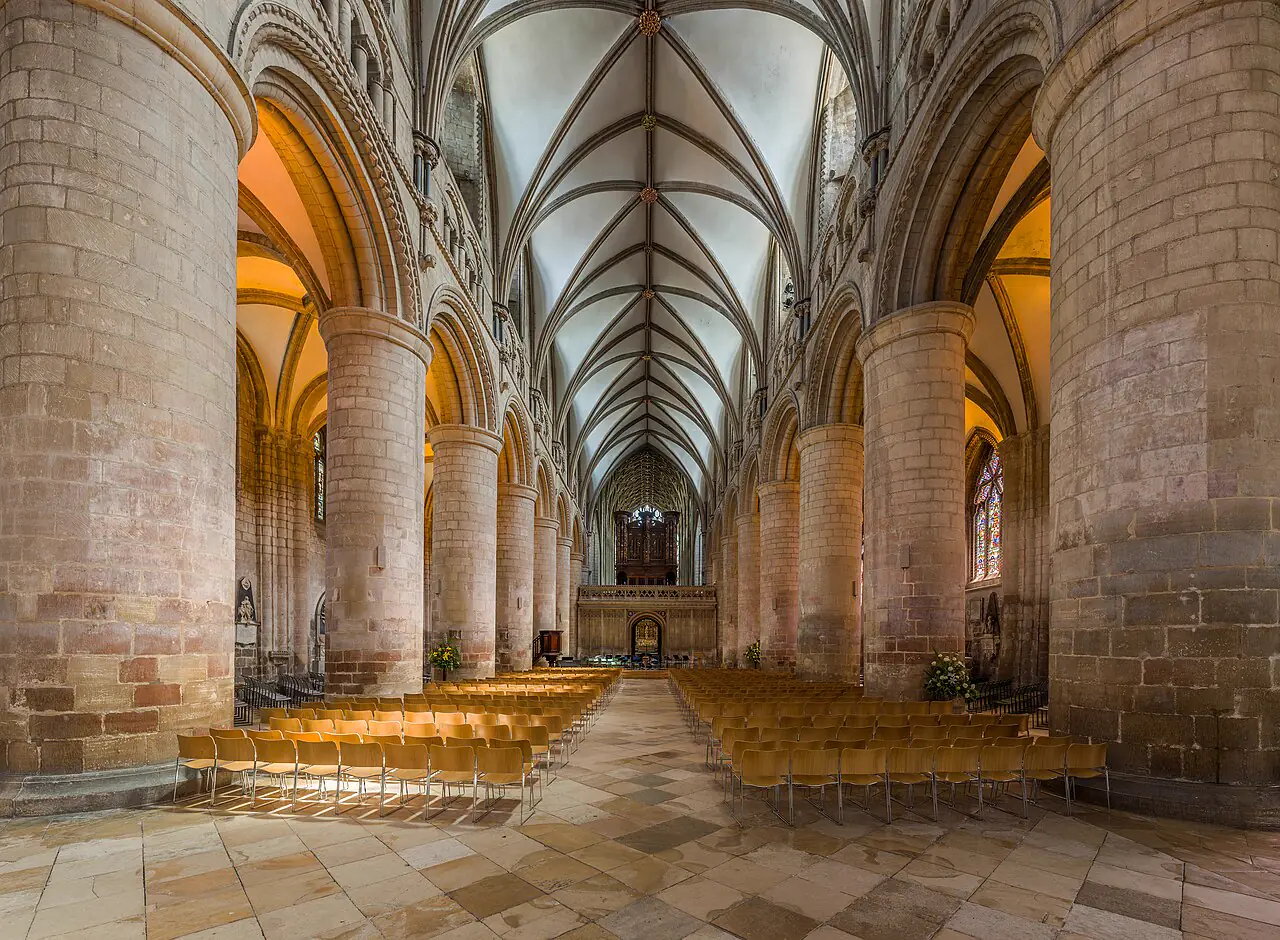
On the evening of 6 September 1910 some two thousand people crowded into Gloucester Cathedral for the Three Choirs Festival, most of them to hear Elgar conduct The Dream of Gerontius. First came the Fantasia on a Theme by Thomas Tallis, a new piece for strings conducted by its thirty-seven-year-old composer. The cathedral’s organist, Herbert Brewer, called it “a queer, mad work by an odd fellow from Chelsea”. In the audience was the seventeen-year-old Herbert Howells, who recalled it seventy-one years later as “so disturbing and moving that I even asked RVW for his autograph – and got it!” He and Ivor Gurney spent the night walking the streets of Gloucester. On 12 October, Vaughan Williams’s thirty-eighth birthday, A Sea Symphony, on texts by Walt Whitman, was first performed at the Leeds Festival.
1914–22War service and the Pastoral Symphony
On New Year’s Eve 1914, aged forty-two, he enlisted as a private in the Royal Army Medical Corps. In late June 1916, newly in France with his field ambulance, he wrote to Holst: “I am ‘Wagon orderly’ and go up the line every night to bring back wounded & sick on a motor ambulance.” His unit moved to Salonika that autumn. In 1917 he trained for a commission in the Royal Garrison Artillery, and he was demobilised on 15 February 1919.
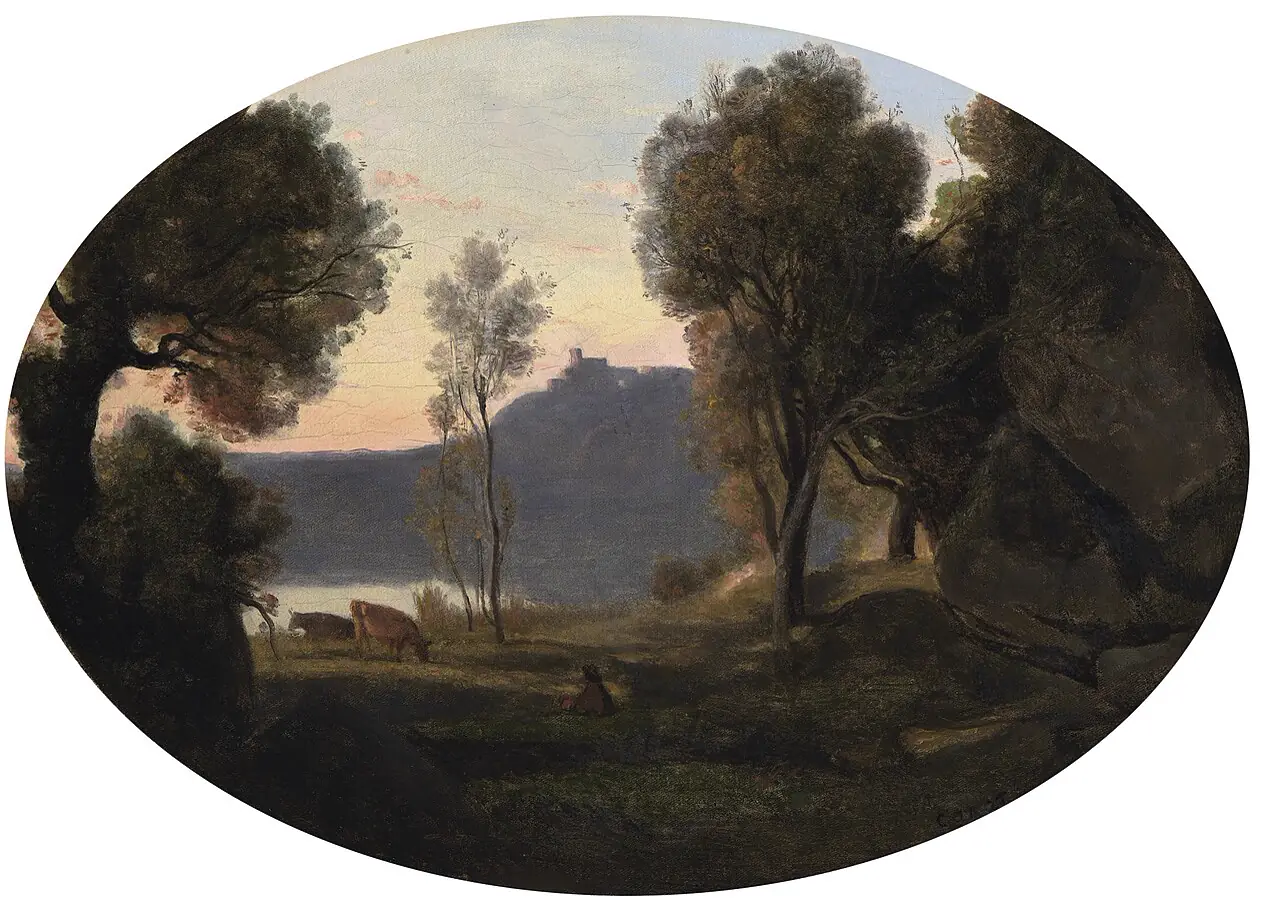
The Pastoral Symphony, played at Queen’s Hall by the Royal Philharmonic Society under Adrian Boult on 26 January 1922, grew out of those nights. “It is really war time music,” he told Ursula Wood in a letter of October 1938, “… it’s not really Lambkins frisking at all as most people take for granted.” In the letter he named the place as a steep hill at Écoivres, seen from the ambulance wagon, with “a wonderful Corot-like landscape in the sunset”.
1919–35Bach Choir, Dorking, Fourth Symphony
In 1919 he began teaching composition at the Royal College and returned to the Leith Hill Musical Festival, which his sister Margaret and Lady Evangeline Farrer had founded in 1905; he conducted it until 1953. From 1921 to 1928 he was musical director of the Bach Choir. In 1929 he and Adeline moved from Cheyne Walk to The White Gates at Dorking, a house that suited her, as her arthritis was getting worse.
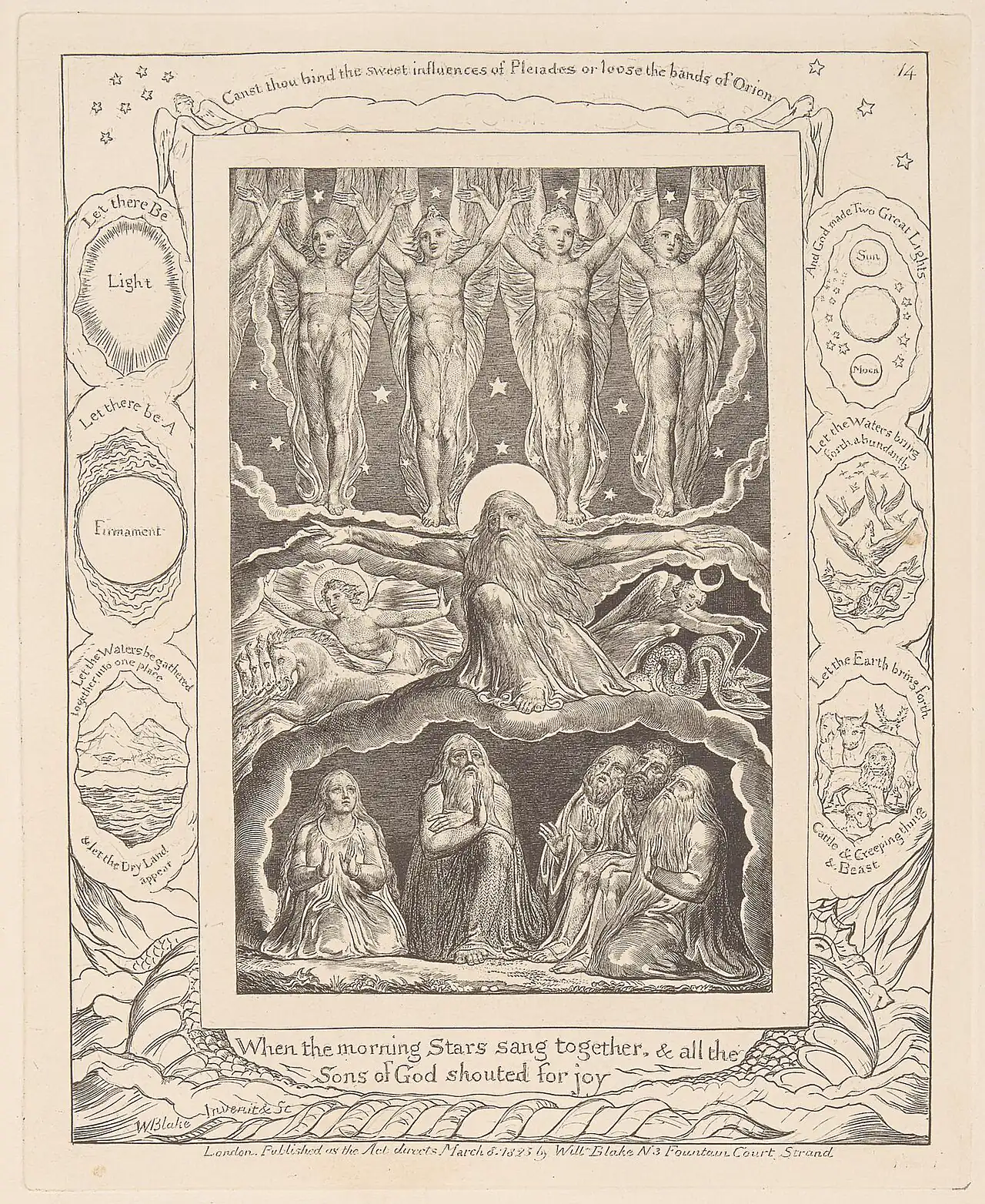
The music of those years includes Job, a masque for dancing drawn from Blake’s engravings of the Book of Job and staged in London in July 1931, and the Fourth Symphony, first played by the BBC Symphony Orchestra under Boult at Queen’s Hall on 10 April 1935. It opens with a dissonant semitone clash. He always denied that it answered events in Europe. Ursula’s explanation was that “without any philosophical, prophetic or political germ, No 4 took its life from a paragraph in The Times.”
1938–58Ursula Wood, Fifth and Ninth Symphonies
On 31 March 1938 the young poet Ursula Wood met him to talk over a ballet scenario based on the ballad Clerk Saunders, and he took her to lunch. On 5 October that year sixteen solo singers gave the first Serenade to Music, his setting of Shakespeare’s moonlit scene from The Merchant of Venice, at Henry Wood’s jubilee concert in the Royal Albert Hall.
On 24 June 1943 he conducted the first performance of the Fifth Symphony at a Promenade Concert, asking the London Philharmonic “not to take too much notice of me—just make music”. The score is inscribed “Dedicated without permission to Jean Sibelius”. Sibelius received a copy through the British Council and replied in June 1946: “I have seldom heard anything that is more English.”
Adeline died on 10 May 1951, a fortnight after The Pilgrim’s Progress, the Bunyan opera he had been turning over since 1905, opened at Covent Garden. He married Ursula on 7 February 1953 at St Pancras Vestry Chapel, and they moved to 10 Hanover Terrace, beside Regent’s Park. Malcolm Sargent conducted the Royal Philharmonic in the first performance of the Ninth Symphony on 2 April 1958. Vaughan Williams died on 26 August that year. At the service in Westminster Abbey on 19 September, Boult conducted Five Variants of Dives and Lazarus, and the congregation sang Come down, O Love Divine to the tune he had named for his birthplace while the casket was carried to the north aisle.
Down Ampney, Gloucestershire · 12 October 1872 · born
Born in the vicarage, the third child of the vicar Arthur Vaughan Williams and Margaret, née Wedgwood. His father died here on 9 February 1875. The coordinates are those of the village, and do not mark the vicarage itself.
Leith Hill Place, Holmbury St Mary, Surrey · 1875 · childhood
After his father’s death in early 1875 his mother took the children to the Wedgwood family house. He gave it to the National Trust in 1945. Coordinates mark Holmbury St Mary, not the house.
Royal College of Music, South Kensington, London · September 1890 · studied
Entered the college in September 1890 and, after two terms, became a pupil of Hubert Parry. He returned in 1895, became a close friend of Gustav Holst and went to Stanford for lessons; after the war he taught composition here.
A brief period of study with Max Bruch, after which he returned to his post at St Barnabas. The Society’s biography places it between his marriage in October 1897 and his return to Lambeth, but gives no month.
Took down Bushes and Briars here in December 1903, the first song he collected. Over the next ten years he collected more than 800 songs and carols. Coordinates mark the village.
Dorking, Surrey (Leith Hill Musical Festival) · 10 May 1905 – 1953 · worked
Conducted the first combined concert of the Leith Hill Musical Festival at the Public Hall on 10 May 1905 and remained festival conductor until 1953, rehearsing village choirs and conducting Bach’s St Matthew Passion. Coordinates mark Dorking.
13 Cheyne Walk, Chelsea, London · November 1905 – 1929 · lived
Moved in November 1905 and lived here for 24 years. The plaque beside his bust in Chelsea Embankment Gardens lists the Sea, London and Pastoral Symphonies, The Lark Ascending, the Tallis Fantasia and Sancta Civitas from these years. The house no longer stands; coordinates mark Cheyne Walk.
Gloucester Cathedral · 6 September 1910 · premiere
First performance of the Fantasia on a Theme by Thomas Tallis at the Three Choirs Festival, conducted by the composer, to an audience of about two thousand. Fantasia on a Theme by Thomas Tallis.
Écoivres, Pas-de-Calais · June 1916 – November 1916 · worked
Went out with the 2/4th London Field Ambulance on 22 June 1916 and drove the ambulance wagon up the line at night. The Pastoral Symphony grew from these nights. Coordinates mark the village. A Pastoral Symphony.
Shirehampton Public Hall, Bristol · 15 December 1920 · premiere
Marie Hall and the pianist Geoffrey Mendham gave the first performance of The Lark Ascending, in the version for violin and piano. The coordinates mark Shirehampton, not the hall. The Lark Ascending.
First performance, on 4 July 1923, of the Folk Song Suite for military band, written at the request of the Royal Military School of Music. The coordinates mark Kneller Hall. Folk Song Suite.
Settled here in 1929 after living at Holmbury St Mary and St Paul’s Road; Adeline died here in 1951. The Society lists Symphonies 4–7, Serenade to Music, The Pilgrim’s Progress and Hodie among the works composed here. The house was demolished in 1964; the coordinates mark Dorking.
Queen’s Hall, Langham Place, London · 10 April 1935 · premiere
First performance of Symphony No. 4, by the BBC Symphony Orchestra under Adrian Boult. The hall no longer stands; the coordinates mark its site. Symphony No. 4.
Royal Opera House, Covent Garden, London · 26 April 1951 · premiere
First staging of The Pilgrim’s Progress, conducted by Leonard Hancock and produced by Nevill Coghill, as part of the Festival of Britain. The Pilgrim’s Progress.
10 Hanover Terrace, Regent’s Park, London · 1953 – 26 August 1958 · lived
After their marriage on 7 February 1953 Vaughan Williams and Ursula took the house on a twenty-one-year lease, which he thought too short. Symphonies 8 and 9 were composed here. Coordinates mark Hanover Terrace.
Westminster Abbey, London · 19 September 1958 · buried
After the funeral service of 19 September 1958 the casket was carried to the north choir aisle as the congregation sang Come down, O Love Divine to his tune Down Ampney. His ashes lie near Purcell, Stanford and Howells.
Tallis’s psalm tune is in the Phrygian mode, the white notes of the piano from E to E, with a flat second and a rising phrase to which Vaughan Williams returns repeatedly in the Fantasia. The oboe tune that opens the Intermezzo of the English Folk Song Suite, My Bonny Boy, is in F Dorian. Vaughan Williams took these modal scales both from Tudor psalm tunes and from Essex singers.
𝄢Strings in groups
The Tallis Fantasia splits the strings three ways: a main orchestra, a second orchestra of nine players (two first violins, two seconds, two violas, two cellos and one double bass) and a solo quartet. The small group often plays in alternation with the large one.
𝄞Bird and violin
In The Lark Ascending the soloist enters with a cadenza marked pianissimo and sur la touche, bowed over the fingerboard, and its quick flurries stand for the skylark’s song. The 6/8 melody that follows has the shape of a folk song. The piece borrows no actual folk tune.
♩Quiet symphonies
The Pastoral Symphony has hardly three moments of fortissimo from first bar to last. Its large orchestra thickens the texture, and each melodic line carries its own harmony. The Fifth Symphony, in D, uses the smallest orchestra of all nine and opens over a low C in the strings, with a call on two horns.
♯Hard edges
The Fourth Symphony begins with a semitone clash, and a four-note figure runs through most of it. The finale is headed con epilogo fugato, and the clash from the opening returns near the end.
𝄋Tunes for general use
The hymn tunes Sine Nomine and Down Ampney come from The English Hymnal of 1906. He was joint music editor of Songs of Praise in 1925 and of The Oxford Book of Carols in 1928, and he conducted amateur choirs at Dorking for nearly fifty years.
Works
A selection from the composer’s works.
1901
Linden LeaVoice and piano
A setting of William Barnes’s poem, and the first of his works to be printed.
1906
The English HymnalHymn book, music editor
He edited the music from 1904 and contributed four tunes, among them Sine Nomine and Down Ampney.
Walt Whitman’s texts on sailors and ships; first heard at the Leeds Festival on 12 October 1910, his thirty-eighth birthday.
1911
Five Mystical SongsBaritone, chorus and orchestra
Poems by George Herbert, a Three Choirs Festival commission for Worcester.
1913–14
A London SymphonyOrchestra
George Butterworth suggested that he write a symphony; Vaughan Williams called the result a “Symphony by a Londoner”. It was first performed on 27 March 1914.
Prefaced by lines of Meredith’s poem and dedicated to Marie Hall, who played the first performances of the piano version (1920) and the orchestral version (1921).
A Pastoral Symphony (Symphony No. 3)Orchestra with wordless solo soprano
Conceived at Écoivres in 1916 and first played at Queen’s Hall on 26 January 1922. A soprano sings a wordless line at the start of the finale.
1923
Folk Song SuiteMilitary band
Written for the Royal Military School of Music; first played at Kneller Hall on 4 July 1923. Gordon Jacob’s orchestration is the version most often heard as the English Folk Song Suite.
1924
Hugh the DroverOpera
Begun in 1910 to a libretto by Harold Child. The Royal College of Music staged it first, in July 1924; the British National Opera Company gave the first professional performance at His Majesty’s Theatre on 14 July under Malcolm Sargent.
1925
Flos CampiSolo viola, wordless chorus and small orchestra
Each movement carries a Latin quotation from the Song of Solomon. Sancta Civitas, his only oratorio, appeared the same year.
1930–31
Job: A Masque for DancingOrchestra, for dancers
Geoffrey Keynes saw a ballet in Blake’s Book of Job engravings. It was heard in orchestral form at the Norwich Festival in 1930 and staged in London in July 1931.
Serenade to MusicSixteen solo voices and orchestra
Written for Henry Wood’s jubilee, to words from Act V of The Merchant of Venice; first sung at the Royal Albert Hall on 5 October 1938.
1938–43
Symphony No. 5 in D majorOrchestra
“Dedicated without permission to Jean Sibelius.” First performed at a Promenade Concert on 24 June 1943, with the composer conducting.
1951
The Pilgrim’s ProgressOpera (a “morality”) after Bunyan
The Bunyan work he had returned to since 1905, first staged at Covent Garden on 26 April 1951.
1952
Sinfonia antartica (Symphony No. 7)Orchestra with wordless soprano
Reworked from his music for the film Scott of the Antarctic (1948); Barbirolli and the Hallé gave the first performance on 14 January 1953, with Margaret Ritchie as the soprano.
1953–54
HodieChristmas cantata
Includes Hardy’s The Oxen; dedicated to Herbert Howells and first performed at Worcester on 8 September 1954.
1953–55
Symphony No. 8 in D minorOrchestra
Dedicated to Barbirolli, who gave the first performance on 2 May 1956. The score adds extra tuned percussion, in the composer’s words “all the ’phones and ’spiels known to the composer”.
1957–58
Symphony No. 9 in E minorOrchestra with three saxophones and flugelhorn
First performed by the Royal Philharmonic under Malcolm Sargent on 2 April 1958, less than five months before his death.
In the score
Short examples, engraved and playable.
Phrygian mode — schematicWhite notes from E to E
A schematic, not a quotation. The Phrygian mode is the piano’s white notes from E to E; the rising phrase e–f–g–a–g–f–e that Steve Schwartz’s guide describes in the Tallis Fantasia uses the same pattern. The semitone between E and F at the bottom of the scale is the mode’s flat second.
Dorian mode — schematicThe folk scale of My Bonny Boy
This is a schematic scale and does not reproduce any bar of the Folk Song Suite. F Dorian has the notes of E♭ major starting on F, so its sixth degree, D, is natural; the raised sixth distinguishes it from the F minor scale. The oboe tune that opens the Intermezzo of the English Folk Song Suite is in this mode.
Picardy third — schematicMinor chord with a major ending
A schematic cadence, not a quotation. A G minor chord (G, B♭, D) is followed by G major (G, B, D), the same chord with its third raised. The Tallis Fantasia ends on G major, and the first two movements of the English Folk Song Suite end on a major chord of this type after music in a minor key.
Sister arts
William BlakeWhen the Morning Stars Sang Together (Illustrations of the Book of Job, plate 14), 1825Engraving · Yale Center for British Art, New Haven
Geoffrey Keynes, a surgeon and Blake scholar, saw dramatic groupings and gestures in the plates of the Illustrations of the Book of Job and proposed a ballet. Gwen Raverat, Vaughan Williams’s cousin, helped design it. The masque that resulted includes a Pavane and a Galliard of the Sons of the Morning. In plate 14 the morning stars stand in a row above the seated Creator, with the text “When the morning Stars sang together” beneath.
Jean-Baptiste-Camille CorotLe soir (prairie boisée au bord d’un lac), c. 1848Oil on canvas, in a painted oval · Private collection; offered at Sotheby’s, New York, 2018
Writing to Ursula Wood in 1938, Vaughan Williams recalled the ambulance route at Écoivres as “a wonderful Corot-like landscape in the sunset”. This oval evening scene, with cattle by a lake and a hill town against a pink sky, was catalogued in an 1897 sale as an effect of the setting sun.
DiliffGloucester Cathedral, the nave seen from the west, 9 July 2014Photograph · Wikimedia Commons
The Fantasia on a Theme by Thomas Tallis was first played in Gloucester Cathedral on 6 September 1910, before an audience of about two thousand. Vaughan Williams divided his strings into three groups, which play in alternation across the building.
George Meredith
The Lark Ascending — the lines in Vaughan Williams’s score
1881
EnglishHe rises and begins to round,
He drops the silver chain of sound,
Of many links without a break,
In chirrup, whistle, slur and shake [ … ]
For singing till his heaven fills,
‘Tis love of earth that he instils,
And ever winging up and up,
Our valley is his golden cup,
And he the wine which overflows
To lift us with him as he goes [ … ]
Till lost on his aërial rings
In light, and then the fancy sings.
Vaughan Williams chose these three passages from Meredith’s poem to preface the score. The solo violin plays trills and runs that stand for the skylark’s “silver chain of sound”.
Recommended recordings
Symphony No. 4 in F minorBBC Symphony Orchestra, Ralph Vaughan WilliamsHMV (78 rpm) · 1937The composer conducting the BBC Symphony Orchestra in Abbey Road Studio 1 on 11 October 1937, two and a half years after the first performance.
Where to hear more
Symphony No. 5 in D major1943
London Symphony Orchestra; Sir Antonio Pappano · LSO Live · 17 & 18 April 2024, Barbican Hall, London
The score is inscribed “Dedicated without permission to Jean Sibelius”. This LSO0900 disc, recorded in April and December 2024 and released on 26 September 2025, pairs the Fifth with the Ninth, the last symphony; the label describes the Fifth as reaching for hope amid the turmoil of war. Pappano’s earlier Vaughan Williams recordings with the orchestra were of the Fourth and Sixth. The orchestra’s own channel carries the slow movement, the Romanza.
A Pastoral Symphony (No. 3) and Symphony No. 41921; 1935
BBC Symphony Orchestra; Martyn Brabbins · Hyperion · Watford Colosseum
The Pastoral, with its natural-trumpet fanfare in the second movement, appears beside the grinding semitones of the Fourth. Recorded at Watford Colosseum and issued in January 2020. Hyperion’s page for CDA68280 carries Robert Matthew-Walker’s booklet note, which discusses the two symphonies together, and the label’s listing of both.
Julia Hwang, violin; Charles Matthews, piano · Signum Classics · September 2016, Snape Maltings, Suffolk
The violin-and-piano version that Marie Hall and Geoffrey Mendham gave at Shirehampton on 15 December 1920, its first performance, appears on Hwang’s debut album Subito (SIGCD486), released in June 2017. Hyperion’s page for the release reproduces Richard Bratby’s booklet note on the piece.
Parry taught him at the Royal College and introduced him to an English choral tradition. Tallis’s psalm tune became the basis of the Fantasia. Holst was his closest friend and critic. Ravel gave him three months of lessons in 1907–08. The Fifth Symphony is dedicated to Sibelius, who replied in 1946. Howells was in the audience at Gloucester in 1910 and later received the dedication of Hodie. Gordon Jacob, his pupil, made the orchestration of the Folk Song Suite that is most often heard today.
Some 750 letters, selected from about 3,300 then known and arranged chronologically, covering Vaughan Williams’s musical, personal and political concerns, including his music, his war service and his friends. The Vaughan Williams Foundation’s online database now holds over 5,000.
Each transcript gives the date, the recipient, the location of the original and the page in Cobbe’s edition, so that a quotation can be checked against the whole correspondence.
His widow’s biography records the composer’s life as the household remembered it, from the origins of the Pastoral Symphony at Écoivres to the paragraph in The Times behind the Fourth. The Foundation calls it a key study and a mine of information.