Guido of Arezzo took a book of chants to Rome and taught a pope to sing a tune he had never heard. Six centuries later, Monteverdi gave Orpheus a song to charm the keeper of the underworld. In the centuries between, musicians learned to write rhythm down, to set a second voice against a melody and to write a bass line that left room for a player’s invention.
𝄐
iSouthern Italy · c. 530 BC
Pythagoras and the monochord
String lengths: octave one-half, fifth two-thirds
Pythagoras settled in Croton, in southern Italy, around 530 BC. Later writers told how he passed a blacksmith’s shop where the hammers sounded in consonant intervals, weighed the hammers and found the numerical ratios behind them. The legend is attached to the idea that the octave, the fifth and the fourth can be expressed as ratios of small whole numbers.
A monochord has one string stretched over a box and a movable bridge beneath it. With the tension unchanged, a bridge at the halfway point makes the string sound an octave higher. Two-thirds of the length gives a fifth; three-quarters gives a fourth. The shorter the string, the faster it vibrates. The pitches have frequency ratios of 2:1, 3:2 and 4:3; the string lengths run the other way round.
The string also vibrates in several ways at once. As well as vibrating along its whole length, it vibrates in halves, thirds and smaller divisions. These produce its partials. For an ideal flexible string, their frequencies are one, two, three and more times the lowest. Over a low C, the first six are C, C, G, C, E and G, rising through the octaves. The fifth partial gives an E, a pure major third above the C of the fourth partial.
The harmonic series over CBar height ≈ relative strength (1/n). Gold partials are more than 20 cents from the nearest equal-tempered note; these are the 7th, 11th, 13th and 14th, which a keyboard in equal temperament cannot play. Select a partial to play it with the fundamental.
A violin and a flute can play the same C and still sound different, because their partials sound with different strengths. Pythagorean tuning builds its notes by stacking pure fifths. Four such fifths lead to an E which, brought down into C’s octave, makes a wider third than the harmonic series supplies, 81:64 against 5:4. Both notes are called E, and the difference between them is a problem in tuning.
Around the beginning of the sixth century AD, Boethius gathered Greek musical learning into his Latin De institutione musica. His book carried the ratios into medieval classrooms, where music belonged to the quadrivium with arithmetic, geometry and astronomy.
Greek theorists also divided scales into tetrachords, groups of four notes spanning a fourth. Medieval musicians later gave the names Dorian, Phrygian and Lydian to the church modes. A white-note scale from D to D models medieval Dorian; ancient Greek Dorian used a different arrangement.
Schematic · intervalsOctave, fifth, fourth
Each bar returns to C, then rises by an octave, a fifth or a fourth. This schematic sets out the intervals associated with 2:1, 3:2 and 4:3. The keyboard playback uses equal temperament; the harmonic-series diagram above gives the exact integer ratios.
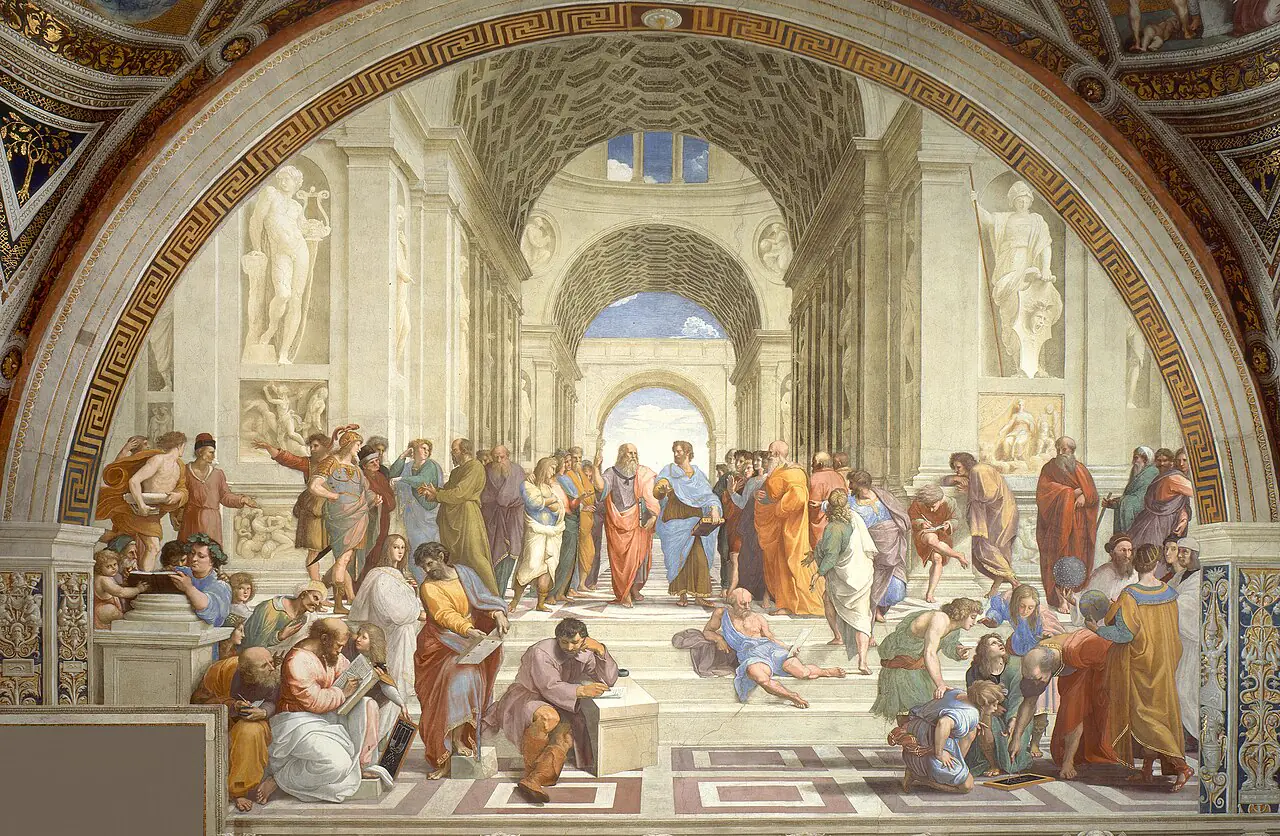
RaphaelThe School of Athens, 1509–11Fresco · Stanza della Segnatura, Vatican Museums
Raphael’s Pythagoras bends over a book while a young figure holds up a tablet of musical proportions. Around him, philosophers argue and pupils gather. The tablet shows the fourth, the diatessaron, and the same fresco in the Vatican includes Euclid with his geometry.
iiRome and the Frankish churches · c. 750–1200
Gregorian chant
Single melody for psalm, prayer and Alleluia
Pepin and his son Charlemagne made Roman worship a concern of the Frankish kings. From the middle of the eighth century the chant of Rome spread through their churches and monasteries, and Frankish singers changed it as they sang it. This became the repertory now called Gregorian chant. Its name honours Pope Gregory the Great, who had died in 604.
The singers had a great deal to remember. At Mass, the Kyrie, Gloria and Sanctus returned with the same words each time, and other texts changed with the feast. Around the Mass lay the Divine Office, the daily round of psalms, readings and prayers. All of these could be sung on a single melodic line, by one singer or by a whole choir. A setting with one note to a syllable carried the words quickly. A melisma set one vowel to a succession of notes.
A psalm tone made a long text manageable. A few opening notes brought the singers to a reciting pitch, where they could stay for as many syllables as the verse required. A small turn marked the middle of the verse and another marked its end. The antiphon sung around the psalm determined which formula would fit. A choir could sing a new verse to a tune it already knew.
Scribes began to add neumes above the Latin words. These were small marks showing notes that rise, fall or are grouped together. In the early-tenth-century St Gall Cantatorium, these signs record fine details of a solo singer’s delivery. They were used together with the singer’s memory. Later scribes placed the notes at different heights, and then against reference lines, until an unfamiliar interval could be read from the page.
The later medieval sequence Dies irae begins F–E–F–D–E–C–D–D. The melody circles D with a C♮ below it, where a modern minor key would have a sharpened leading note. Its opening stanza calls David and the Sibyl as witnesses to the day of judgement. Those eight notes appear in Berlioz’s Symphonie fantastique and recur in Rachmaninoff’s music.
At Rupertsberg in the twelfth century, Hildegard of Bingen wrote chants for her nuns with leaps and long melismas that took the voice beyond the range of many older melodies. Near the end of her life, a dispute over a burial brought an interdict on the community, and the women had to recite their services instead of singing them. Writing to the prelates of Mainz in 1178–79, Hildegard told them that those who unjustly silenced a church would “lose their share in the angels’ praises in heaven”.
Quotation · medieval sequenceDies irae — first stanza
The first stanza of Dies irae, from the Liber Usualis (Solesmes, 1961), p. 1810. The opening eight notes fall back to D; the second line sets several notes to single syllables. There is no regular metre; phrases are marked by separators. The transcription uses quavers as its unit, and dotted chant endings are doubled in length for playback. Sources: printed page and GregoBase.
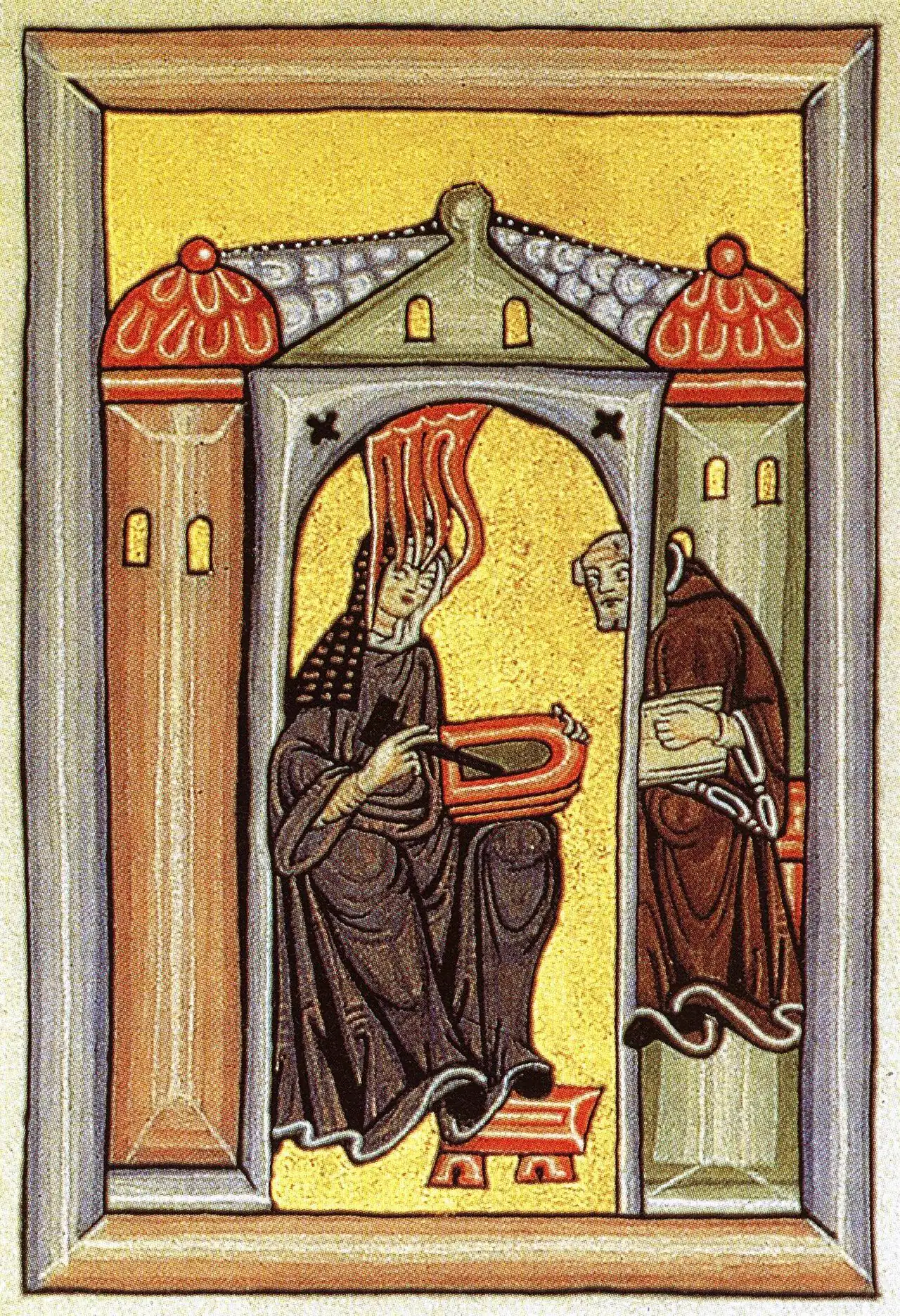
Anonymous Rupertsberg illuminatorHildegard receiving a vision, Late twelfth centuryManuscript illumination, reproduced from the Rupertsberg Scivias · Formerly Wiesbaden, manuscript lost during the Second World War
Flames descend into Hildegard’s head as she writes; beside her, a scribe holds his own tablet. She was the author of the visionary book Scivias, completed in 1151. She also wrote the words and melodies of her community’s chants, and in her drama Ordo Virtutum the Virtues sing.
iiiArezzo and Rome · c. 1025
Guido of Arezzo
Guido’s staff and sight-singing
Around 1028, Guido of Arezzo brought his chant book to Pope John XIX in Rome. The pope turned its pages and studied the rules. Guido later told his fellow monk Michael of Pomposa that John would not leave his seat until he had learnt a verse he had never heard, because he wanted to try for himself what he found scarcely believable in the schoolboys.
Guido was concerned with the slow business of teaching an enormous repertory by ear. His Micrologus, written around 1025–28, combined practical instruction with interval theory. Pitch letters and reference lines already existed. In the staff system he promoted, both lines and spaces gave each note a fixed position. A C or F at the beginning of the staff fixed the surrounding tones and semitones, and coloured lines marked them for the reader.
Guido’s other aid was a hymn to John the Baptist, Ut queant laxis. In its teaching melody, six phrases begin on successively higher notes: C, D, E, F, G and A. Their first syllables are ut, re, mi, fa, sol, la. A boy who knew the hymn could recall the opening of a phrase and so find its note. The semitone, E–F, lay between mi and fa.
Later teachers developed overlapping six-note scales, or hexachords. The natural hexachord began on C. The hard hexachord began on G and included B♮; the soft hexachord began on F and included B♭. Every hexachord kept its semitone between mi and fa. When a tune went beyond six notes, the singer changed hexachord, and the change was called a mutation. G could become ut where it had been sol a moment before, without changing pitch.
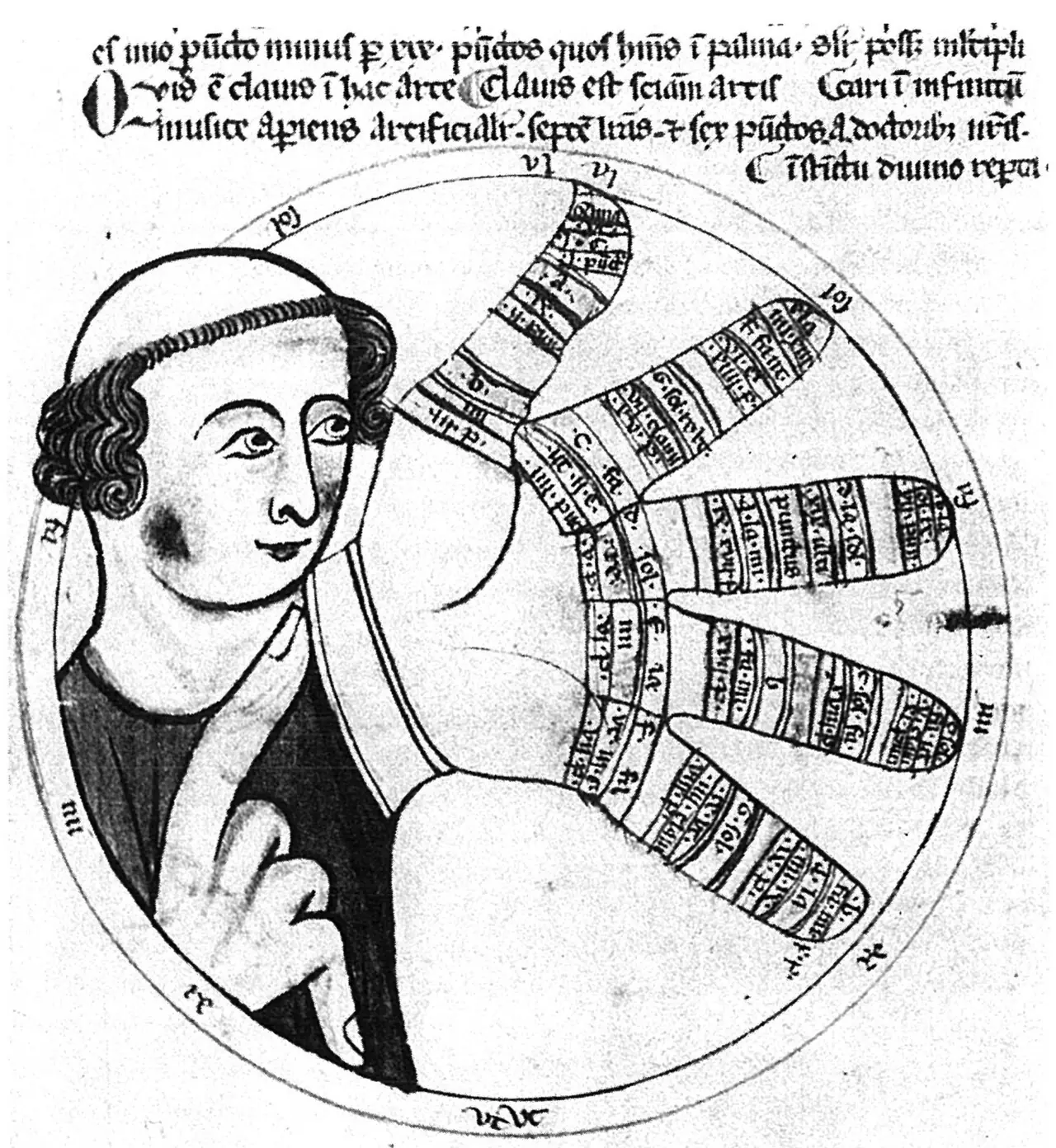
The hand placed those notes on the body. A teacher pointed to a fingertip or joint, and the pupil gave its pitch and syllable. In the thirteenth-century picture below, a very large hand is covered with small inscriptions. The master’s face appears beside it.
A staff could carry a melody far beyond Guido’s classroom, with its intervals intact. Singers still learnt pronunciation and phrasing from one another. The notes on the page fixed the pitch. Once composers began to set several voices moving together, scribes also had to show how long each note should last.
Schematic · solmisationNatural, hard and soft hexachords
Three schematic hexachords, beginning on C, G and F. The semitone always falls between mi and fa: E–F, B–C, then A–B♭. The syllables stay the same while the pitches change. Bar lines separate the three teaching examples.
The hand is much larger than the smiling figure beside it. Pitches and syllables are written closely on each joint and fingertip. This copy of Elias Salomonis’s Scientia artis musicae was made around 1274.
Our translationSo that your servants
may sing with loosened voices
the wonders of your deeds,
release the guilt
of defiled lips,
Saint John.
The singers ask John the Baptist to free their lips for praise. Guido took the syllables ut, re, mi, fa, sol, la from the beginnings of the prayer’s six half-lines. The final invocation, Sancte Ioannes, falls outside his six-note series.
ivNotre-Dame, Paris · c. 900–1200
Organum at Notre-Dame
Three voices above a sustained chant note
An English theorist writing after 1280 remembered two Parisian masters. Léonin had made a great book of organum for worship at Notre-Dame; Pérotin had revised it and written music in three and four parts. The theorist, whose name is lost, called him “Pérotin the Great”. He named Viderunt and Sederunt among his excellent four-part pieces. This witness is known as Anonymous IV.
The extra voice had a much older history. The ninth-century Musica enchiriadis describes singers joining a chant at the fourth or fifth, sometimes doubling the parts at the octave. In a parallel passage the two voices rise and fall together. Elsewhere one voice holds a note while the other moves, and they end on the same note.
In the Notre-Dame repertory the added voice could become much more elaborate. The chant moved into a tenor part, from the Latin tenere, to hold. One tenor note might last through a whole phrase of the upper voice. When both parts moved in measured rhythm, the passage was in discant. A service could pass from plainchant into these elaborate sections and back again.
Pérotin’s Viderunt omnes adds three upper parts to the tenor. The Christmas gradual begins with the words ‘All the ends of the earth have seen the salvation of our God’, but the opening syllable is drawn out at great length. Above the held chant note, short figures turn and pass between the singers. When one voice rests, another fills the gap.
A measured section could be lifted out and replaced with another setting of the same chant fragment. Such a section was called a clausula. When singers added words to an upper part, they helped create the motet. Soon different voices could sing different texts at once, while the tenor kept to its fragment of chant.
Schematic · parallel organumA melody and its fifth
An invented melody, sung with a second voice a fifth above, as a schematic of parallel organum. C and G rise together to D and A, then E and B. Both parts have exactly the same rhythm.
Schematic · sustained tenorTwo rates of movement
The tenor holds D through all four bars while the upper voice rises and falls. This invented schematic is written in modern 6/8 metre.
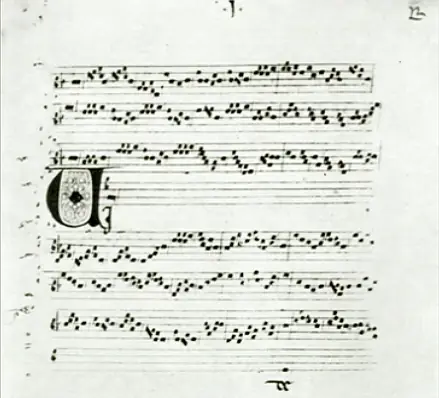
Anonymous Parisian scribeOpening of Pérotin’s Viderunt omnes, Thirteenth centuryMusic manuscript on parchment · Biblioteca Medicea Laurenziana, Florence, MS Pluteo 29.1
This thirteenth-century page from the Florence manuscript, now MS Pluteo 29.1, holds the opening of Viderunt omnes. Groups of square notes fill the upper staves. The tenor has far fewer.
vMachaut’s France · c. 1320–1370
Machaut and the ars nova
Repeating rhythm with different notes each time
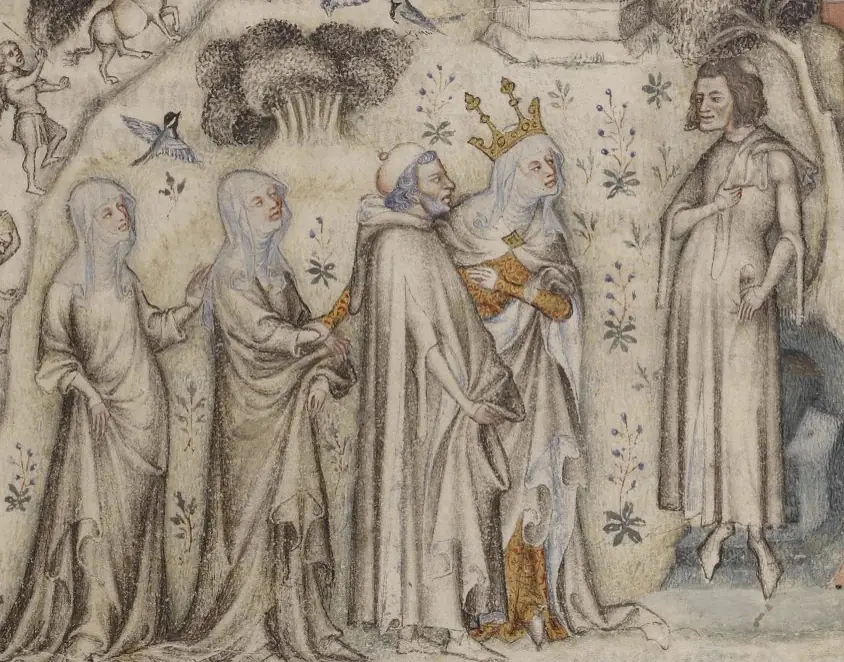
Guillaume de Machaut spent years in the service of John, King of Bohemia, before settling in Reims, where he was a canon of the cathedral. He wrote love songs, long narrative poems and sacred music, and saw them collected in carefully arranged manuscript books. In the illustrations to these books, Nature comes to him and gives him Sense, Rhetoric and Music.
He inherited a new precision in musical notation. Around 1320 the ars nova (‘new art’), associated with Philippe de Vitry, extended the ways scribes could divide a note. A breve could hold two semibreves or three; each semibreve could in turn hold two minims or three. The two choices were independent of each other. A singer could sustain a note across an expected division while another part marked it.
In an isorhythmic tenor, the composer repeats a rhythm called the talea through a sequence of pitches called the color. The two can have different lengths. In the example below, three durations (long, short, short) are applied to five notes, D–E–F–G–A. The next D falls on the last beat of the second bar. The talea and the color begin together again only after fifteen attacks.
Above a slowly repeating tenor, Machaut’s upper voices can trade quick notes and rests. In hocket, one voice sounds exactly where another stops, breaking a phrase into short fragments. A cadence brings the parts together again. The tenor’s recurring rhythm can shape a whole span of music while the upper voices move on to the next syllable.
His four-voice Messe de Nostre Dame, usually dated to the 1360s, sets the Mass Ordinary from Kyrie to Ite, missa est. The movements with short texts are set in extended chant-based, isorhythmic music. In the long Gloria and Credo the voices often declaim the text together, syllable by syllable. The tenor and contratenor cross beneath the two upper parts, so the lowest sounding note can pass from one of these voices to the other.
Machaut also used repetition in his secular songs. In a rondeau the refrain returns with its words; a virelai alternates between refrain and verse; a ballade repeats its stanza form. The same manuscript could contain a lover’s complaint and a Mass, both by Machaut as poet and composer.
Schematic · isorhythmThree durations, five pitches
An invented isorhythmic tenor. The rhythm long–short–short repeats five times; D–E–F–G–A repeats three times. D first falls on a long note, then on a short one. Both patterns end together after fifteen attacks.
Anonymous French illuminatorNature presents Sense, Rhetoric and Music to Machaut, Fourteenth centuryManuscript illumination
Nature brings Sense, Rhetoric and Music to Machaut, who stands ready with a book. They are characters in the Prologue to his collected works.
viFlorence, Rome and England · c. 1430–1600
Polyphony from Dufay to Tallis
Four separate vocal entries on one prayer
On 25 March 1436, Pope Eugene IV consecrated Florence Cathedral. Guillaume Dufay supplied Nuper rosarum flores, a motet whose two lower parts draw on the chant for the dedication of a church. Above their long notes, two quicker voices sing of the pope’s gift of roses and ask the Virgin to hear the people of Florence.
A borrowed melody could also run through the movements of a Mass. This cantus firmus, or ‘fixed song’, might come from worship or from a secular song. Dufay and many successors built Masses on L’homme armé, a song about an armed man. The tune could move to a different voice or stretch into longer notes. At the same time, thirds and sixths were becoming familiar consonances between the open fifths and octaves of cadences. In fauxbourdon, voices move together through a chain of sixth chords.
In 1502 a singer advising Duke Ercole I d’Este of Ferrara reported that Josquin des Prez wrote better music than his rival Heinrich Isaac, but warned that “he composes when he wants to”. Isaac also cost less. The duke chose Josquin.
In Josquin’s Ave Maria … virgo serena, the greeting descends through four voices, each entering with the same melody. Later, pairs of singers answer each other; at the final plea, ‘O mother of God, remember me’, all four sing together.
Palestrina’s Missa Papae Marcelli, published in Rome in 1567, is written for six voices and keeps the words audible. In the long Gloria and Credo, groups of singers often pronounce their syllables together. Elsewhere, one voice holds a note while the voices around it move, so that a consonance becomes a dissonance and then resolves down by a step. This figure is called a suspension.
Thomas Tallis enlarged the company to forty in Spem in alium, written around 1570. Eight choirs of five parts enter in turn, overlap and join in the full ensemble. A phrase begun by a few singers can be answered by voices on the far side of the room. At points all forty voices sing together.
Schematic · imitation in two voicesAnswer at one bar’s distance
In this invented example, the lower voice enters one bar later, an octave below. It copies the first two bars of the upper melody while the upper voice continues on its own.
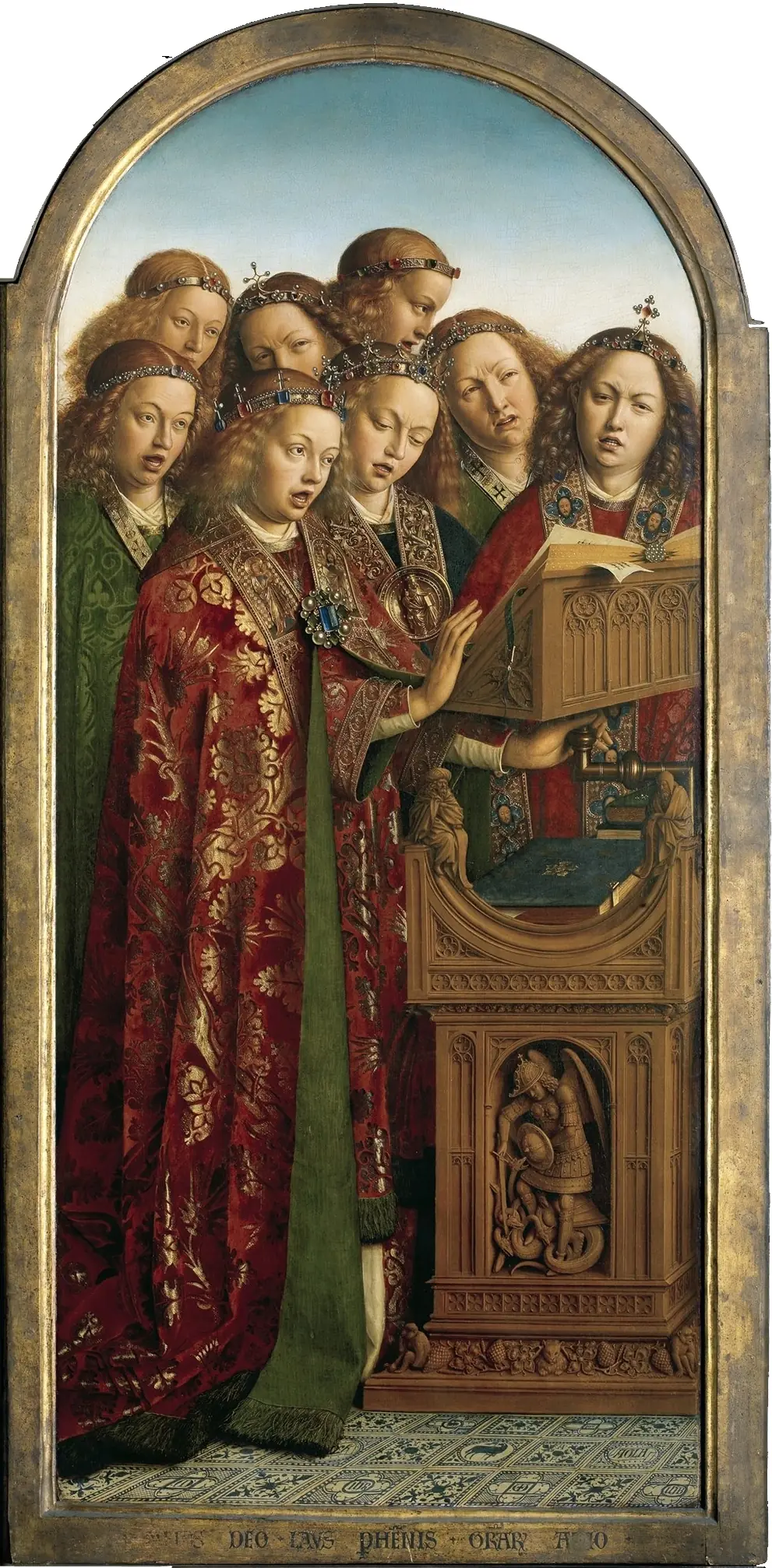
Hubert and Jan van EyckThe Ghent Altarpiece: Singing Angels, 1432Oil on oak panel · St Bavo’s Cathedral, Ghent
The Van Eycks’ angels stand close around a single book, their mouths open at different angles. Elsewhere in the altarpiece other angels play an organ and a harp, and one holds a bowed string instrument. A strand of a second angel’s hair shows at the far left of the organ panel, presumably belonging to the angel working the bellows.
Dieterich Buxtehude became organist of St Mary’s in Lübeck in 1668. In 1705 the young Bach walked there to hear him. An organist could keep a bass going with the feet while both hands played above it, and changing keyboards or drawing a stop brought another set of pipes into the music. Bach stayed far longer than his employers in Arnstadt had allowed.
Bellows feed air to the organ’s pipes. A held key admits wind, and the note continues for as long as the supply lasts. An 8-foot stop sounds at ordinary keyboard pitch; a 4-foot stop sounds an octave higher, a 16-foot stop an octave lower. Several stops can sound together from one key. The organist chooses which pipes will sound before choosing the notes.
A lute note begins to die away as soon as the finger releases the string. The European instrument descends from the Arabic ʿūd; its rounded body carries a fretted neck and strings grouped in courses, usually pairs. A player arranging a song in several parts for one instrument has to choose which notes to hold, which to repeat and which to let go. Lute tablature shows positions on the strings. The long-necked theorbo has additional low bass strings for accompanying a singer.
The bow lets a string sound for longer than a plucked note. A player can increase the pressure on a note or let it fade before changing pitch. Viols usually have frets and six strings, tuned mostly in fourths with a third in the middle; even the smaller sizes are held against the legs. Violins have no frets and normally carry four strings tuned in fifths. Their curved bridges let the bow reach one string without touching the strings beside it.
In sixteenth-century Cremona, Andrea Amati made violins with the familiar narrow waist and arched wooden body. His family’s workshops passed the craft through four generations. One surviving Amati violin from the 1560s, now in the Musical Instrument Museum in Phoenix, combines spruce and maple with ebony and rosewood.
A harpsichord brings the plucked string to a keyboard. Pressing a key raises a jack; its small plectrum plucks the string, and a damper stops it when the key comes up. The player can lengthen the gap between notes or add more notes to a chord, but a harder touch does little to increase the volume. In the long harpsichord solo of Bach’s Fifth Brandenburg Concerto, the sound is kept going by repeated fresh attacks.
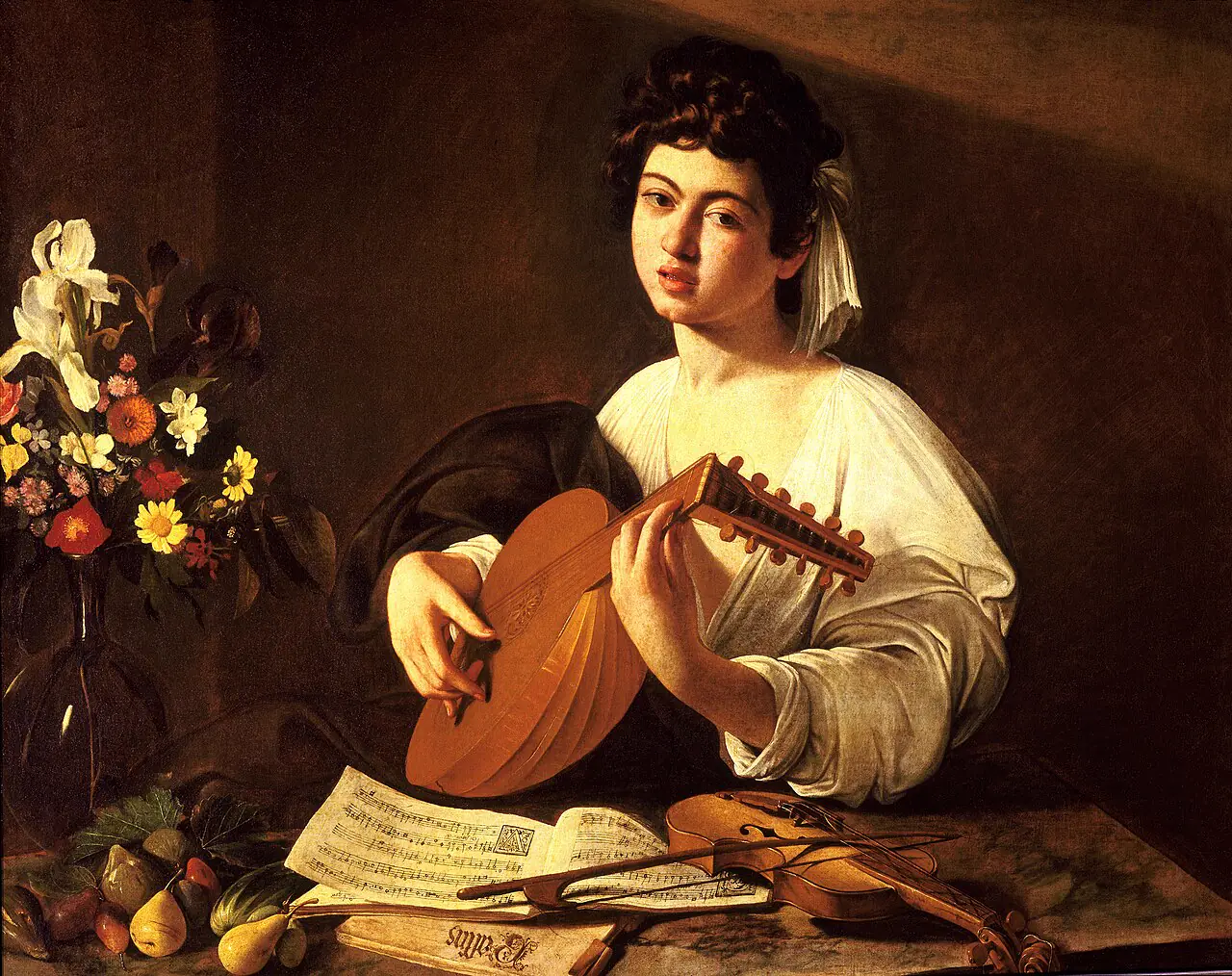
CaravaggioThe Lute Player, c. 1595–96Oil on canvas · State Hermitage Museum, St Petersburg
Caravaggio’s singer holds a lute close to the chest. A violin lies on the table beside the music books, whose painted pages include madrigals by Jacques Arcadelt, here sung by one person who also plays.
On 23 February 1607 Carlo Magno wrote from Mantua to his brother in Rome about the entertainment planned for the following evening. He called it unusual, because “all the characters will speak musically”. The work was Monteverdi’s L’Orfeo, with words by Alessandro Striggio, performed at the Gonzaga court on 24 February.
The experiment had a Florentine past. In the 1570s and 1580s, musicians and scholars met at Giovanni de’ Bardi’s house to discuss ancient Greek drama. Among them were Vincenzo Galilei, Galileo’s father, and the singer Giulio Caccini. They wanted a solo voice that carried every word, with instrumental support that left the text audible. Caccini’s Le nuove musiche, published in 1602, contained solo songs and advice on how to sing them. Jacopo Peri had already brought Dafne to the stage in 1598 and Euridice in 1600.
Monteverdi was already in a dispute about words before he put Orpheus onstage. In books published in 1600 and 1603, Giovanni Maria Artusi attacked his treatment of dissonance. The disputed passages broke rules about how a note should approach or leave a clash. Artusi printed the offending notes without their words.
Cruda Amarilli, one of the madrigals under attack, opened Monteverdi’s Fifth Book in 1605. The lover in the poem praises Amarilli’s beauty, then calls her deafer and more elusive than a snake. In 1607 Monteverdi’s brother Giulio Cesare explained the seconda pratica as a practice in which the words govern the harmony.
In L’Orfeo, a messenger interrupts the shepherds’ celebration with news of Eurydice’s death. Orpheus begins Tu se’ morta by setting her death against his own continuing life. The vocal line pauses and rises, and Orpheus resolves to follow her. In the next act he reaches Charon, keeper of the crossing into the underworld.
Charon sings in a low register, accompanied by a small reed organ. Orpheus sings Possente spirto, a song with elaborate flourishes addressed to Charon. Two violins answer, then two cornetts, then a double harp. In the 1609 printed score, a plain vocal line is printed beside an elaborately ornamented one. Charon refuses Orpheus passage. Orpheus crosses only after his later lament has put Charon to sleep.
The Mantuan audience came by invitation. From 1637, Venice offered opera to people who bought a ticket. Monteverdi had been in the city since 1613 as music director at San Marco; in his last years he also wrote for its commercial theatres.
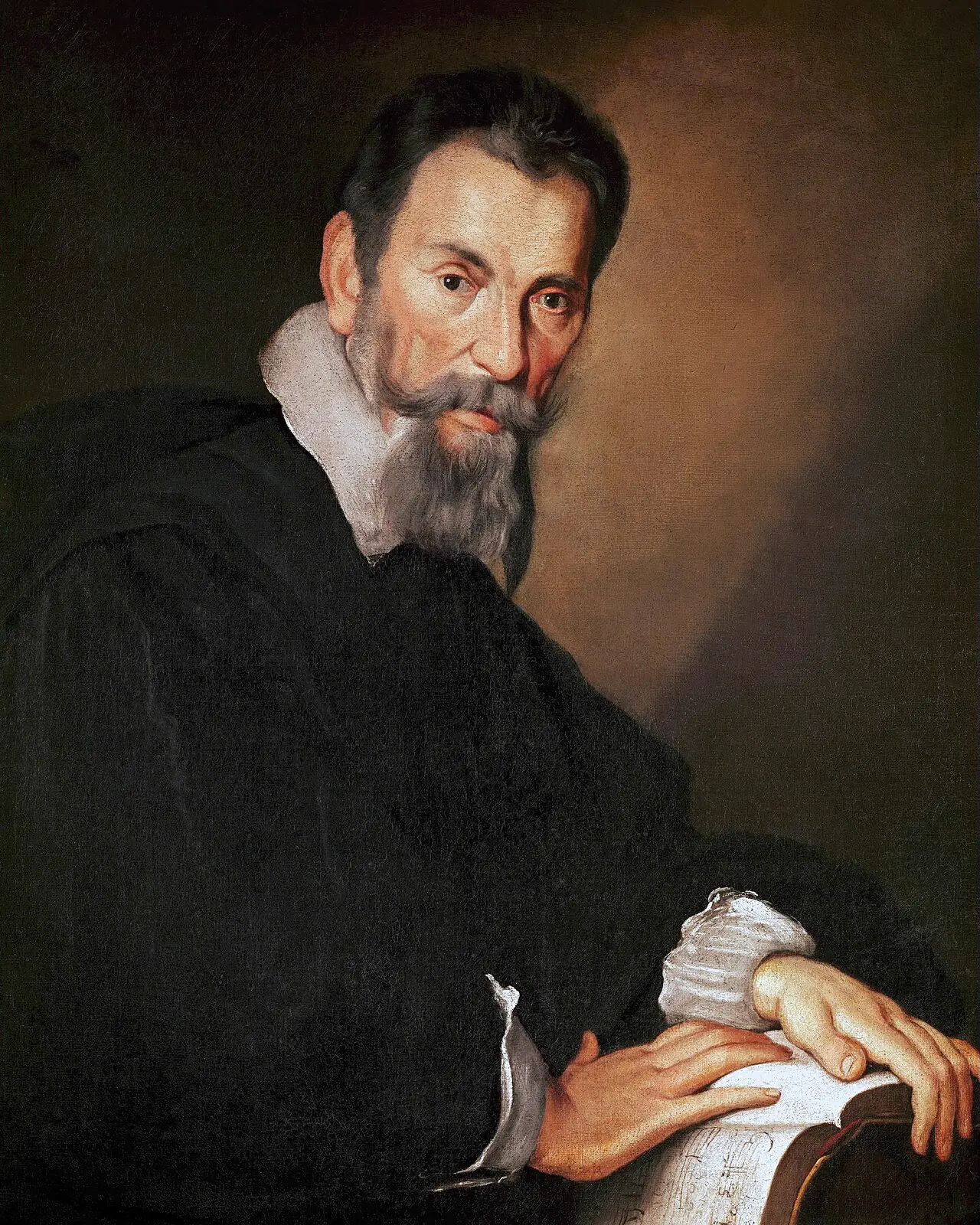
Bernardo StrozziPortrait identified as Claudio Monteverdi, c. 1630Oil on canvas · Tiroler Landesmuseum Ferdinandeum, Innsbruck
By the time of this portrait, Monteverdi had left Mantua for Venice and had directed the music at San Marco for some years. The dark clothes and white collar show an older man than the composer who first set the story of Orpheus’s descent to the underworld. The sitter is identified by his likeness to the engraving in the memorial volume Fiori poetici, published in 1644.
Three centuries later, Mimì introduces herself in short sung phrases that follow the rhythms of conversation. La bohème
After the hesitant exchanges of her introduction, Mimì sings a long lyrical phrase. La bohème
Agostino Agazzari objected to busy lute players. In his 1607 book on accompanying an ensemble, published in Siena, he complained of players who ran through divisions from beginning to end, especially when others were doing the same. The result, he wrote, was “soup and confusion”. In his view a good accompanist needed to hear the singer and leave space.
The basso continuo gave that accompanist a written bass line and, where needed, figures specifying the notes above it. An organ, harpsichord or plucked-string instrument could fill in the chords; a bowed bass could share the lower line. Agazzari advised fuller chords for many voices and fewer notes for a soloist. He also noted the convenience of the system, since an organist expected to keep every vocal part in full score would need a library larger than a lawyer’s.
Over C, the accompanist might supply E and G. Over E marked with a 6, the notes G and C make the same C major chord with a different note at the bottom. A 4–3 over G calls for C to move down to B. In the example below, C belongs to the preceding F major chord; the bass then moves to G, and the held C becomes a dissonance that resolves down a step. The figures give the essential motion. The player chooses where to put the other notes and how much to play.
The cadence G–C in the bass, with B rising to C above it, became one of the familiar ways to close a phrase in C major. Composers could establish another key with another such cadence and then return to the home key. In his Traité de l’harmonie of 1722, Rameau explained chords through their roots and inversions, so that the lowest sounding note and the root of the chord can differ. His ‘fundamental bass’ follows those roots beneath the notes the players actually sound.
Quarter-comma meantone narrows the fifths to make several major thirds pure, among them C–E. On an ordinary twelve-note keyboard, the remaining ‘wolf’ interval makes some distant keys painful. Some instruments supplied extra notes with split keys. Equal temperament spreads the compromise evenly through twelve semitones, giving every major third the same slightly wide span.
Unequal circulating temperaments make every key available while giving their thirds and fifths different sizes. Bach dated the first book of The Well-Tempered Clavier 1722. It contains a prelude and fugue in each of the twelve major keys and twelve minor keys. A player begins in C major, moves to C minor and works through the keyboard to B minor.
Schematic · a figured-bass cadenceThe held C, then B
An invented cadence in C major. The upper C is held as the bass moves from F to G, so that the consonant fifth becomes a dissonant fourth. The C then falls to B and rises to C at the final chord. The figures 4–3 specify the descent; the chords shown are one possible realisation.
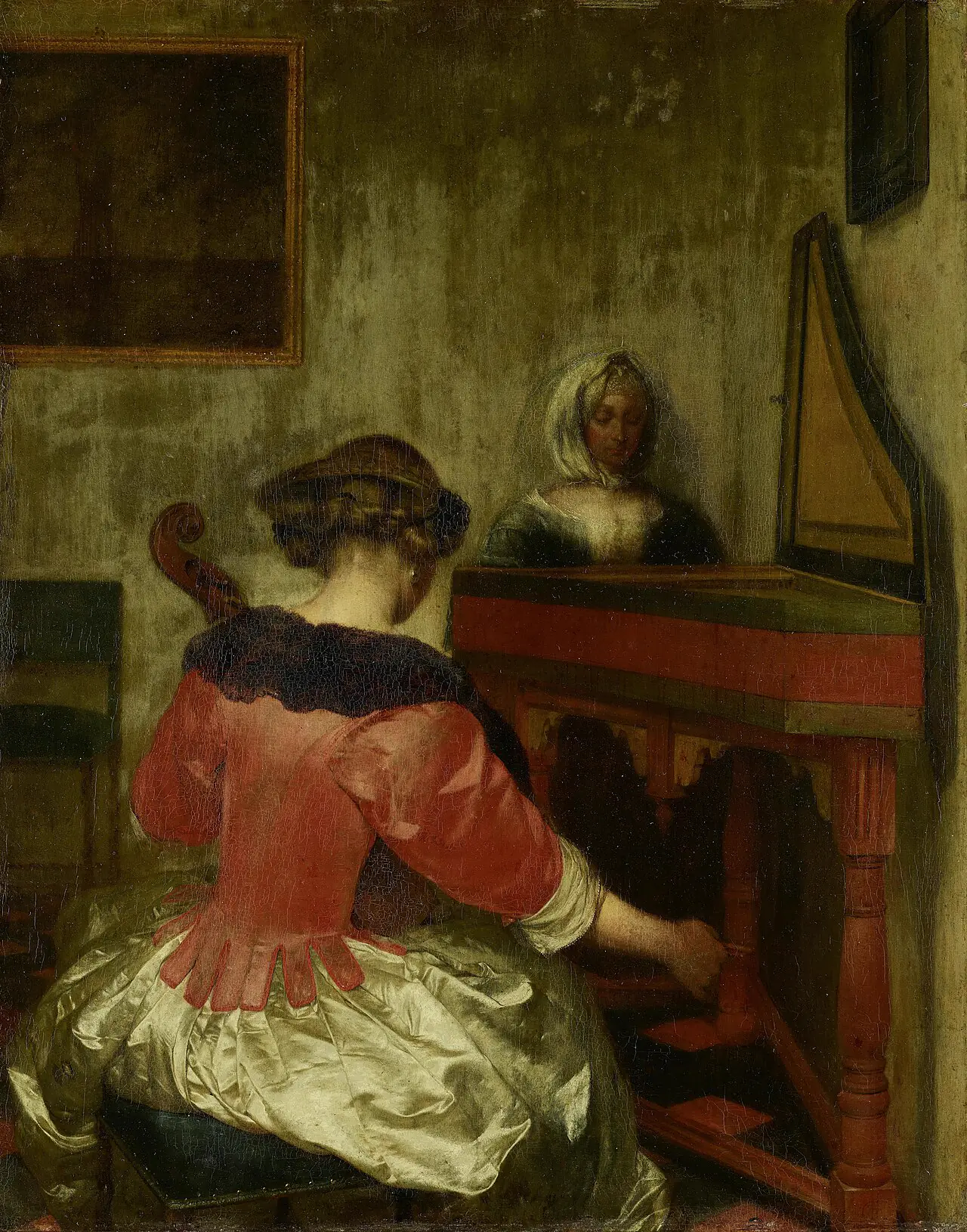
Gerard ter BorchThe Concert, c. 1675Oil on panel · Gemäldegalerie, Berlin
Ter Borch places a bowed bass in the foreground, its player turned away from the viewer, with a harpsichord beyond. The satin catches the light. Bowed bass and keyboard were a familiar pair for continuo, one sustaining the line while the other supplied chords.
The keyboard supplies harmony while the viol shares its bass line beneath two independent upper parts. Les Nations