Les Nations
10 min
Recording
- La Piémontaise · SonadeNew Comma Baroque: Matthew C. Cataldi, Baroque violin; Leighann Daihl, Baroque flute; Phillip W. Serna, viola da gamba; Emily J. Morlan, historical keyboards · 10 September 201210:03
The Sonade opens La Piémontaise, from Couperin’s Les Nations, and is written in three parts, with violin and flute playing long notes, quick runs and short airs over the bass. New Comma Baroque performs it with four players, as viola da gamba and keyboard share the bass line.
Listening notes · joins
- Scoring and opening Gravement
Violin and flute take the two upper parts; gamba and keyboard share the bass. In the opening Gravement, one upper voice often holds a note while the other moves. Trills decorate the long notes, and the bass has its own ornaments.
- Death of Charles Couperin, 1679
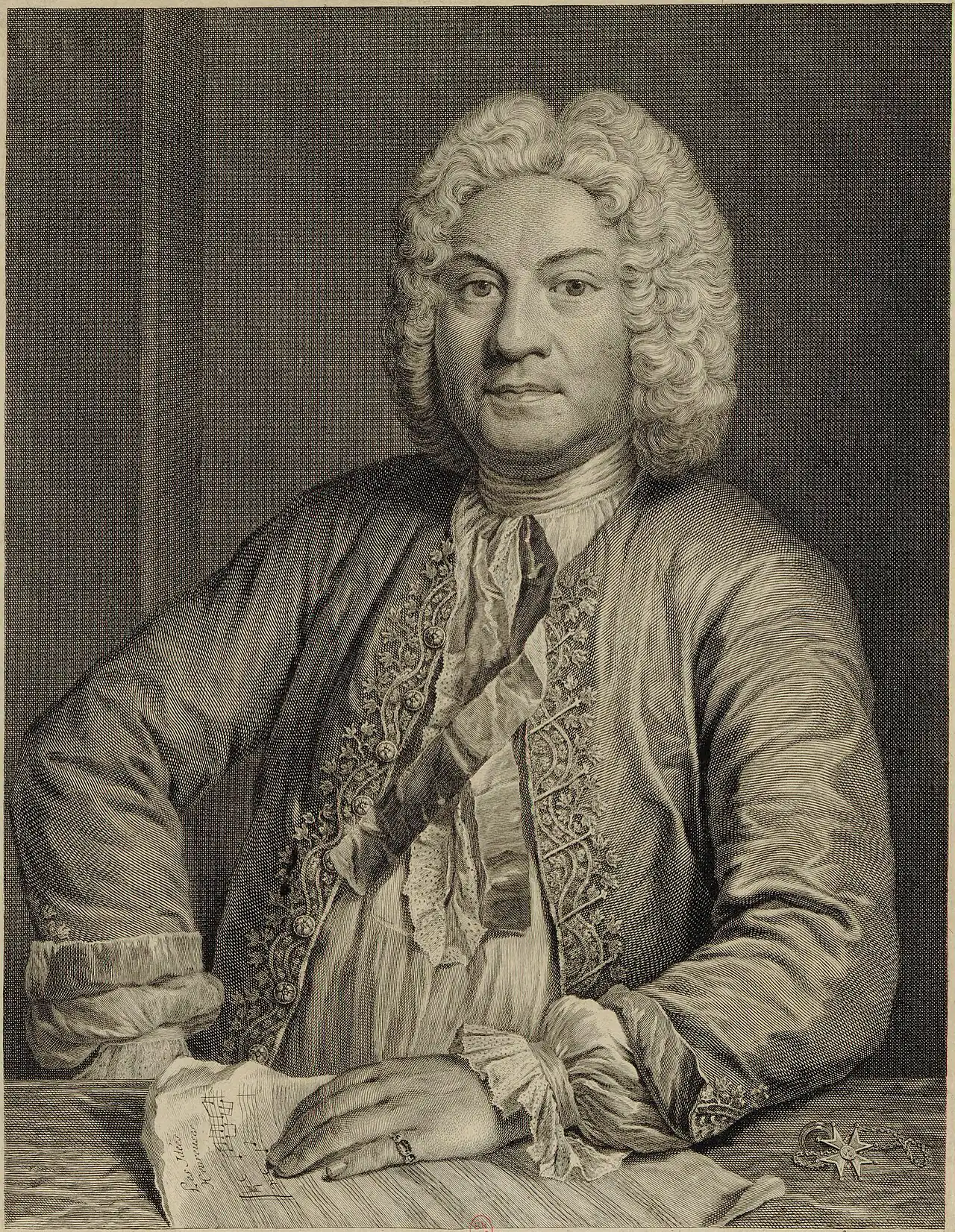
Couperin’s father Charles, organist of Saint-Gervais in Paris, died in 1679, and the post was held in reserve for the boy. Lalande filled the organ bench until François took it himself in 1685.
- Bass semiquavers, first Vivement
The Vivement gives running semiquavers to the bass as well as to the upper parts. A phrase can begin below the violin and flute and rise into their register. The keyboard and gamba have substantial material together.
- Couperin’s preface, 1726
In his 1726 preface, Couperin told a story about his first sonata. He presented it as the work of an Italian composer whose name was an anagram of his own, and it was well received. He then wrote more sonatas under the same disguise.
- Royal chapel organist, 1693
Couperin’s teacher Thomelin, organist of the royal chapel, died in 1693. Couperin won the competition for the post and served the January quarter of each year. He remained an organist of the royal chapel for the rest of his working life.
- First air, violin solo
The first air is in G major and marked Gracieusement. The violin plays the opening phrase above the bass in bars 1–7 while the flute rests, and the bass moves in small steps with ornaments. Then the flute takes up the tune and the violin rests.
- The four ordres of Les Nations
The four ordres of Les Nations are named after France, Spain, the Empire and Piedmont. Each opens with a sonata in the Italian style, followed by French dances. In this ordre the printed score follows the sonata with an allemande marked “nobly, and without slowness”.
- L’Art de toucher le clavecin, 1716
In L’Art de toucher le clavecin (1716) Couperin recommended putting a mirror on the music desk to cure a pupil’s grimaces. With small children he took the key of the harpsichord home, so that nothing he had spent three quarters of an hour setting right would be undone while he was away.
- Preface to Les Nations, 1726
In his preface to Les Nations (1726), Couperin named both Corelli and Lully, “both of whose compositions I shall love as long as I live”. The book contains Italian sonatas and French dances.
- Opening of the Gravement et marqué
The later Gravement et marqué begins with a long C in the bass. The violin plays a dotted figure, and the flute enters with it a bar later.
- Final Légèrement in six-eight
The final Légèrement is in six-eight. The flute begins the running quavers while the violin rests, and the figures soon pass between the upper parts and the bass. The three lines continue to exchange them until the end of the sonata.
Joins
- The bass breaks into running notes
A D major chord closes the slow opening. Vivement begins in G minor and common time. The violin drops out after its first note while flute and bass continue. Running semiquavers soon pass between the gamba, keyboard and upper instruments.
- E♭ under the held notes
The new Gravement opens on E♭ major, with E♭ in the bass and G and B♭ in the upper parts. The metre returns to three-two, and violin and flute hold long notes. Later Couperin asks for notes égales, evenly played notes, as the gamba and keyboard bass begin to move beneath them.
- Into the Air in G major
The quick movement slows to très lentement and closes on D major. The air follows in G major, in triple metre, with G in the bass. Marked Gracieusement, it opens with the violin playing a rounded, ornamented phrase over gamba and keyboard. The flute rests at first and enters later for its own turn.
- From dotted notes to six-eight
The slow section ends in D major, and Légèrement begins over G in the bass. The metre changes from common time to six-eight. The flute starts a run of continuous quavers. The violin plays a single note and then rests. Under the first phrase the gamba and keyboard hold dotted crotchets, and after that they join the faster movement.