In a Bach fugue a second voice enters while the first continues. In Ravel’s Boléro the same tune changes in character when the clarinet takes it over from the flute. Eighteen lessons examine details of this kind, using passages from real scores and short, playable examples.
𝄢
iMelodies together
Counterpoint
Independent melodies sounding together
Counterpoint combines melodies that are each independent enough to be followed on their own. In Couperin’s La Piémontoise, violin and flute pass short phrases between them while the bass plays its own line. Each note belongs both to a melody moving through time and to the chord sounding at that moment.
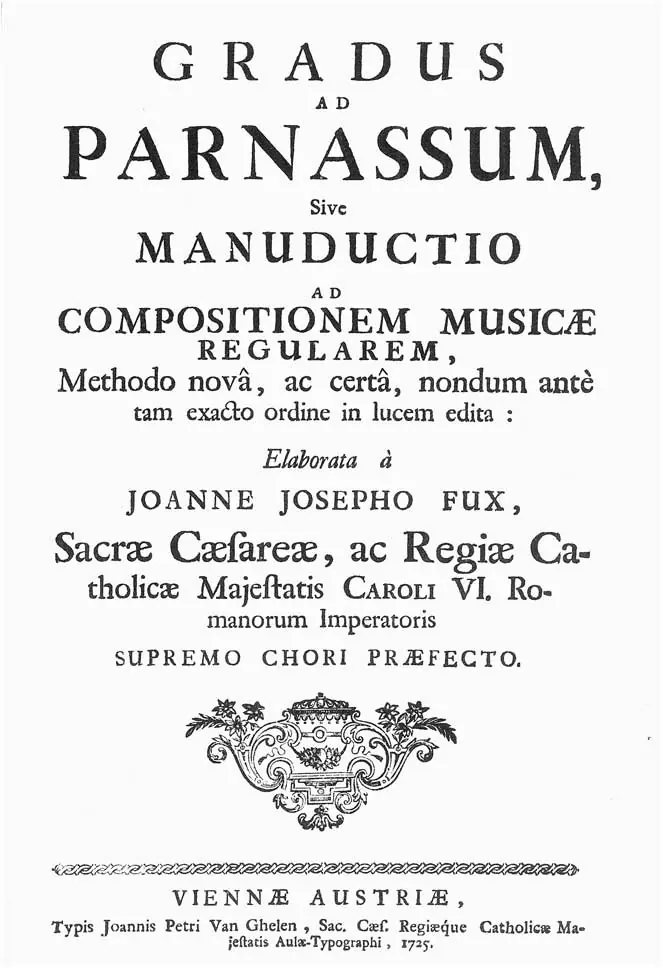
Johann Joseph Fux turned this problem into a course of lessons in Gradus ad Parnassum, published in Vienna in 1725. His imaginary teacher, Aloysius, represented Palestrina; the pupil, Josephus, kept trying examples. The first exercise adds one note against each long note of a given melody, the cantus firmus. Every meeting must be consonant: a unison, fifth, octave, third or sixth. Consecutive parallel fifths and octaves are forbidden; thirds and sixths may move in parallel.
Rhythm allows dissonance. In second species, a passing note on the weak half of the bar can move by step between consonances. In fourth species, a note that fitted the previous chord is held while the bass changes beneath it. The held note is dissonant against the new harmony and then falls one step. This is a suspension. A held F over C can resolve to E, so the fourth becomes a third.
Invertible counterpoint lets complete lines exchange places. In the second example, E–F starts above C–D; moving C–D up an octave turns the thirds into sixths. A fifth would turn into a fourth and would need care. Fugues depend on this technique for the lines that recur with the subject. In Bach’s C minor Fugue, BWV 847, the subject and countersubjects return in new positions relative to one another.
Schematic · first speciesOne note against one note
An invented note-against-note exercise: a twelfth, two tenths and an octave. A tenth is a third plus an octave. At the close the bass rises B–C while the upper voice falls D–C.
Schematic · invertible at the octaveThirds inverted as sixths
Bars 1–2 put E–F above C–D. In bars 3–4, C–D moves up an octave while E–F stays where it was. The same two short lines now make sixths. This is an invented example of invertible counterpoint.
Johann Joseph Fux; title-page designer uncreditedGradus ad Parnassum: title page, 1725Printed title page · First edition, Vienna
Fux’s Gradus ad Parnassum, printed in Vienna in 1725, is written as a conversation between an imaginary pupil and teacher. Josephus brings his exercises; Aloysius, modelled on Palestrina, corrects them one note at a time.
Violin and flute exchange quick figures, and the bass joins in with runs of its own. Les Nations
iiOne tune, several voices
Fugue
New voice entering while earlier voices continue singing
A fugue states a tune on its own before other tunes are set around it. In bars 1–2 of Bach’s C major Fugue, BWV 846, an inner voice rises C–D–E–F, turns round G and continues. This is the subject. During bar 2 a higher voice starts the same tune on G. The first voice continues to move beneath it.
The second entrance is the answer, usually starting a fifth above or a fourth below the subject. A real answer preserves every interval; a tonal answer adjusts some intervals to keep the exchange close to the home key. BWV 846 has a real answer. Its opening entries come in the unusual order subject, answer, answer, subject: alto, soprano, tenor, bass.
A recurring tune that accompanies the subject is a countersubject. It often has to work both above and below its partner, using invertible counterpoint. BWV 846 has no regular countersubject. Bach’s C minor Fugue, BWV 847, has two. By the end of its eight-bar exposition all three voices have entered. Bar 9 begins an episode, in which fragments of the subject move through a sequence without a complete statement of the tune.
In stretto, one voice starts the subject before another has finished it. After its opening entries the C major Fugue contains many of these overlaps. The subject has to fit against a delayed copy of itself, sometimes against several copies. Bach builds the fugue on these overlapping entries and introduces no new theme.
Bach · BWV 846, fugue, bars 1–2The subject and its first continuation
Bach’s opening alto, bars 1–2, with the other voices left out. The fourteen-note subject ends on the first E in bar 2; the semiquavers continue beyond it. Pitches and rhythm follow the Mutopia score. The playback tempo was chosen for this site.
Bass figures and the player’s realised accompaniment
Figured bass tells an accompanist which notes belong above a written bass line. In the opening of Couperin’s La Piémontoise, four players share three lines. Violin and flute take the upper parts, and gamba and keyboard share the bass. The keyboard player also supplies chords, choosing how widely to spread them and when to repeat them. This shared bass part, with its chords, is called the basso continuo.
A bare bass note usually implies a third and fifth above it. The figure 6 normally means a third and sixth: over E in C major, G and C make a C major chord with its third at the bottom. A 6/4 over G calls for C and E. At a cadence those notes can fall to B and D while G is held. The figures 6–5 and 4–3 describe the two downward steps.
An accidental beside a figure alters that interval; an accidental on its own usually alters the third. The figures leave many choices to the player. E–G–C and G–C–E both realise a 6 over a bass E, but their top lines lead to different notes. Under a singer holding a dissonant note, the player may need to add a chord; during a long instrumental note, the player may add a short answering phrase.
In the example, the right hand holds E–G–C while the bass moves from C to E. The chord keeps its name, but the figures change. At the end the accompanist leads the individual voices into the final chord, with B rising to C and F falling to E.
Schematic · one possible realisationSame upper chord over a different bass
An invented realisation. The first two bars keep E–G–C in the right hand while the bass moves C–E, changing 5/3 to 6. In the final bar, B rises to C and F falls to E. The last chord contains three Cs and an E; its fifth, G, is left out.
Gamba and keyboard share the bass beneath violin and flute; the keyboard fills out the chords. Les Nations
ivTuning the keyboard
Temperament
Keyboard tuning: distributing an unavoidable small discrepancy
A pure fifth and a pure major third cannot both be kept on a keyboard. Four pure fifths, C–G–D–A–E, produce an E that is noticeably higher than the E of a pure C major third once the octaves are brought together. A tuner has to decide where to make the adjustment, and the resulting compromise is called a temperament.
Twelve pure fifths do not close the circle. They exceed seven octaves by about 23.46 cents, the Pythagorean comma, 531441:524288. Quarter-comma meantone narrows each regular fifth by about 5.38 cents, which makes its major thirds pure. On a conventional twelve-note keyboard the closing interval is then badly out of tune; it is called the “wolf”. G♯ and A♭ need separate keys, and some old keyboards provide them.
Unequal well temperaments spread the adjustments so that all twenty-four major and minor keys are usable, while their thirds and fifths differ in size. Equal temperament divides the octave into twelve equal semitones, each with the ratio 21/12. Its fifth is 700 cents; its major third is 400 cents, wider than pure by about 13.69 cents. Bach’s Well-Tempered Clavier ranges through every key, from its opening C major to the closing B minor.
The buttons below play the compromise. Each pair of notes contains upper tones, called partials. When two partials nearly coincide, they produce a regular throbbing, or beating. Over the low A used here, the equal-tempered fifth beats slowly and the equal-tempered major third beats much faster. With the pure ratios, the corresponding partials coincide and that particular beating stops.
Tuning laboratory
Each button pairs the same low A, tuned to 220 Hz, with a note above it.
Schematic · equal-tempered referenceA fifth and a major third above A
A fifth and a major third above A3, the A below middle C. This notation player uses equal temperament. The laboratory keeps that low A at 220 Hz and changes the upper note, so that the beating between corresponding partials can quicken, slow down or disappear.
vChords and cadences
Harmony
Voice leading and harmonic arrival
In bars 1–4 of Bach’s C major Prelude, BWV 846, the right hand repeats its figure while the harmony moves from C major through D minor seventh and G7, then back to C. The bass moves from C to B and returns. In the return to C, F falls to E.
A cadence closes a phrase. A dominant-to-tonic arrival, V–I, is an authentic cadence; its strongest textbook form puts both chord roots in the bass and ends with the tonic on top. A phrase ending on V makes a half cadence. A deceptive cadence moves V to a chord other than I, often to A minor in the key of C. IV–I, F major to C major, makes the plagal close.
Chords also prepare those arrivals. F major or D minor can lead into G7, and the first chord is then a predominant, preparing the dominant. A chain of descending fifths can extend the approach, as in E–A–D–G–C. Within a key, the chords take their notes from its scale, so the chain includes minor chords and sometimes a diminished fifth between roots.
The second example uses A minor as a hinge. It is vi in C major and ii in G major. D7 then introduces F♯, which rises to G as the chord’s C falls to B. Bach’s prelude reached C by the same movement; here it leads to G.
Schematic · tonic, predominant, dominantI–IV–V7–I in C
An invented I–IV–V7–I cadence in C. The G7 leaves out D, its fifth, but keeps the two notes that resolve most strongly. F falls to E and B rises to C, moving in contrary motion in the upper parts.
Schematic · a pivot chordA minor
An invented progression from C towards G. A minor belongs to both keys. In bar 3, F♯ leads up to G while C leads down to B. The final G major chord becomes a new tonic if the music that follows confirms it.
The sonade’s running lines converge on the closing cadence. Les Nations
viKeys in a movement
Sonata form
Beethoven’s Fifth: the second theme returns in C major
In sonata form, music that leaves the home key returns to it later in the movement. In the first movement of Beethoven’s Fifth Symphony, the opening is in C minor. At bar 63 the first violins begin a quiet melody in E♭ major, marked dolce (sweetly). The same melody returns at bar 307 in C major, the home key with a major third in place of the opening’s minor third.
The development works on what the exposition has introduced. Beethoven starts his at bar 125, after the exposition repeat. The horn call returns in altered form; strings answer with D♭ falling to C. Later, the four-note rhythm is reduced to isolated chords passed between winds and strings.
The recapitulation brings back the principal themes and changes the route between them. Beethoven’s second group now reaches C major, with bassoons taking the call previously played by horns. Beneath the violin melody, the opening rhythm continues. After the coda, the movement’s closing section, the Fifth’s first movement ends in C minor.
A sonata-form movement does not need a second tune. It can use the same theme in both key areas, which are defined by the key in which the music settles. In the Fifth, the four-note rhythm of the opening continues beneath the new violin theme. At bars 65–66, the cellos play three short B♭s and a longer E♭.
Schematic · Beethoven’s Fifth, first movementReturn of the second key area on C
A schematic map of the first movement of the Fifth. The exposition moves from C minor to E♭ major. In the recapitulation the second group is transposed to C but stays in the major; the coda restores C minor. The held chords stand for the key areas and do not reproduce their lengths.
The first violins play in E♭ major while the opening short–short–short–long rhythm continues beneath them. Symphony No. 5, Op. 67
The second group returns in C major, on the same home note as the opening music. Symphony No. 5, Op. 67
Chromatic notes lie outside the scale of the current key. In Chopin’s E minor Prelude, Op. 28 No. 4, the left-hand chords descend by small steps beneath a melody that barely moves. In bars 1–4 the bass falls G–F♯–F–E. F♮ is not part of the ordinary E minor scale; it falls between F♯ and E in a descent by semitones.
Some chromatic chords have standard functions. In C minor, D♭–F–A♭ is the Neapolitan, a major chord on the lowered second scale degree. It usually appears with F in the bass and prepares the dominant, G. An augmented-sixth chord approaches that G from both sides. A♭ falls and F♯ rises, and the two voices move outward to an octave.
Spelling tells a player where the notes are going. A♭–C–E♭–F♯ can lead towards G as a German sixth in C. Written A♭–C–E♭–G♭, the same piano keys make A♭7, which can resolve to D♭. This enharmonic reinterpretation lets one chord link two keys.
A diminished seventh offers several such junctions. B–D–F–A♭ can lead into C minor. With A♭ rewritten as G♯, the chord becomes G♯–B–D–F and can lead into A minor instead. The two versions in the second example sound identical on an equal-tempered piano. The resolution shows which note was the leading note: B rising to C, or G♯ rising to A.
Schematic · chromatic predominantsNeapolitan and German sixth chords towards G
An invented progression in C minor. D♭ major over F is the Neapolitan sixth. In the next chord, A♭ and F♯ move outwards to G; C and E♭ then fall to B and D over that G bass.
Schematic · enharmonic reinterpretationOne diminished seventh chord, two resolutions
An invented pair of resolutions. Bars 1 and 3 use the same piano keys, but A♭ is spelt as G♯ in the second. The first chord resolves to C minor; in the second, G♯ acts as the leading note and the chord resolves to A minor.
In this concert-band performance, the pilgrims’ hymn continues in long phrases while the chords beneath it change. Tannhäuser, WWV 70
viiiWagner’s opening chord
The Tristan chord
Wagner: the unresolved dominant
The Tristan chord is the first harmony in Wagner’s Tristan und Isolde. After the cellos’ opening phrase, F–B–D♯–G♯ sounds in bar 2. The oboe’s G♯ rises. By bar 3 the harmony has reached E7, the dominant of A minor, which would normally resolve to an A minor chord. Wagner follows it with a silence.
One influential explanation treats G♯ as an appoggiatura, a note leaning towards its neighbour A. That A would complete F–A–B–D♯, a French augmented sixth preparing E. The oboe continues upwards, G♯–A–A♯–B, a four-note phrase that moves across the changing harmony.
The second chord has not yet resolved. The first dissonance has resolved, and a second dissonance has replaced it. During the pause E7 is held before the phrase begins again at a new pitch.
Debussy later quoted this opening in Golliwogg’s Cake-walk, from Children’s Corner. In the middle of the dance the piano takes up Wagner’s phrase. The quotation is identified by the rising phrase and the pause that follows it, as well as by the four notes of the chord.
Schematic · exact pitch collectionsF–B–D♯–G♯ to E7
The two pitch collections, held as schematic chords. F falls to E and D♯ falls to D, while B and G♯ are held. Wagner’s oboe line moves through the change; this reduction isolates the arrival on E7, which does not yet resolve to A minor.
ixRecurring themes
Leitmotif
Returning phrase representing an absent person or object
A leitmotif is a recurring musical idea with a dramatic association. In Wagner’s Ring, the sword Nothung has its own music, which can sound before anyone draws a blade. The same idea accompanies the weapon as it is promised, possessed, broken and reforged across Das Rheingold, Die Walküre and Siegfried.
A motive stays recognisable through changes because one distinctive feature stays the same, such as its opening leap or the pattern of its long and short notes. Transposition moves it to another pitch. Augmentation lengthens its notes in proportion. Reharmonisation puts different chords beneath the tune, so a phrase first heard over a major chord can return over a different bass.
In Berlioz’s Symphonie fantastique (1830), the beloved has a recurring melody, the idée fixe. It appears in all five movements. In the finale, a high E♭ clarinet plays it as a dance with trills, representing the beloved at the witches’ sabbath.
The invented C–E–G figure below keeps its rising outline in each version. With E♭ the first leap becomes a minor third. Halving the note lengths makes it twice as fast, and doubling them spreads it across two bars. A composer could attach any of these versions to the sword’s next appearance on stage.
Schematic · thematic transformationChanges of mode and duration in a cell
An invented figure, C–E–G, altered three ways. The minor version lowers E to E♭. Diminution halves every note length; augmentation doubles it. The proportion short–short–long stays the same at both speeds.
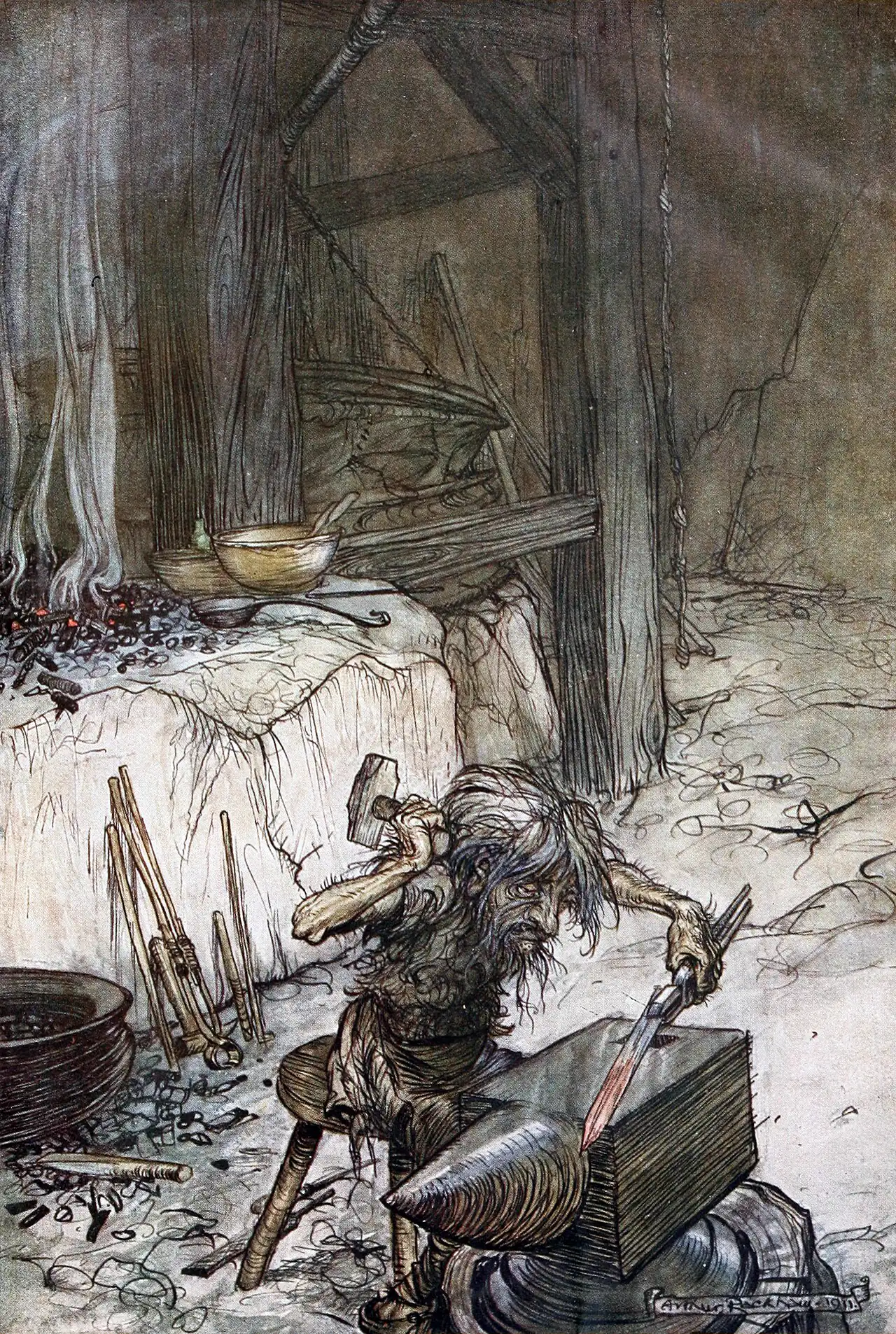
Arthur RackhamMime at the anvil, 1911Colour book illustration · Siegfried and the Twilight of the Gods, William Heinemann
Rackham’s 1911 illustration for Siegfried shows Mime bent over his anvil in a smoky workshop. He can make swords, but he cannot mend Nothung, and Siegfried later does what he cannot. In the opera, the sword’s music from earlier in the cycle returns in this scene.
The pilgrims’ hymn opens the overture, its long phrases played here by a concert band. Tannhäuser, WWV 70
The pilgrims’ hymn returns after the Venusberg music, bringing back the slow tempo of the overture’s opening. Tannhäuser, WWV 70
A mode gives a familiar set of notes a different centre. The piano’s white keys make C major when C is the tonal centre. With D as the resting note, they make D Dorian: D–E–F–G–A–B–C. F gives it a minor third, and B♮ gives it a major sixth. Ordinary D natural minor has B♭.
The other modes alter different degrees. E Phrygian begins with the close semitone E–F. F Lydian has B♮, a raised fourth compared with F major. G Mixolydian has F♮, a lowered seventh compared with G major. Transposing a mode preserves these distances: C Lydian needs F♯; D Mixolydian needs F♯ and C♮.
In Debussy’s L’isle joyeuse (1904), the broad second theme begins at bar 67 around A major, with the D♯ of A Lydian in its harmony. A Lydian contains A–B–C♯–D♯–E–F♯–G♯. Lowering that G♯ to G produces the acoustic scale, which Debussy also used.
The examples put two minor-third modes beside two major-third modes. Dorian’s B and Phrygian’s F lie at very different places above their centres. In the second pair, C Lydian has F♯ and G Mixolydian has F♮.
Schematic · minor-third modesD Dorian and E Phrygian
Two white-key scales with different resting notes. D Dorian has B♮, a major sixth above D. E Phrygian begins E–F, a semitone. These are schematic scales, with their steps laid out evenly.
Schematic · major-third modesC Lydian and G Mixolydian
Two schematic scales with major thirds. C Lydian raises C major’s F to F♯. G Mixolydian lowers G major’s F♯ to F♮.
The whole-tone scale has six notes, each a whole tone from the next: C–D–E–F♯–G♯–A♯, then C again. There are no semitones and no perfect fifths. C has the same neighbours, at the same distances, as every other note. A long bass note can still make one pitch stand out. In Debussy’s Voiles the bass keeps returning to low B♭.
Alternate notes make an augmented triad: C–E–G♯, three major thirds dividing the octave. The remaining notes make D–F♯–A♯. Both chords belong entirely to the scale. They can slide up and down together without acquiring the leading note and perfect fifth of a conventional dominant chord.
Debussy’s Voiles keeps to whole-tone writing for bars 1–41. At bar 42 the piano moves to a pentatonic passage on the five black keys, whose scale has unequal steps, including minor thirds. The whole-tone notes return at bar 48. The pentatonic passage lasts six bars and is the only sustained departure from the whole-tone scale in the piece.
In the example, the scale becomes two chords. C–E–G♯ and D–F♯–A♯ contain all six notes between them, without overlap. Neither chord supplies a B that can rise by a semitone into C. The bass, the rhythm and the placement of a phrase ending must do that work instead.
Schematic · whole-tone collectionA scale and its two augmented triads
A schematic whole-tone scale followed by its two augmented triads. C–E–G♯ and D–F♯–A♯ divide the six notes between them. Every step of the scale is a tone; every step within either chord is a major third.
xiiSemitone, tone, semitone
Octatonic harmony
Two major chords from one eight-note scale
An octatonic scale alternates semitones and whole tones. From C, one version runs C–D♭–E♭–E–F♯–G–A–B♭, then back to C. Its eight notes include C major’s C–E–G and F♯ major’s F♯–A♯–C♯, with A♯ and C♯ respelled as B♭ and D♭. Two chords a tritone apart can therefore share the same scale.
The same eight notes divide into two diminished-seventh chords, each built from minor thirds. In the example they are F♯–A–C–E♭ and C♯–E–G–B♭. Moving one chord up a minor third rearranges its notes. Moving it a semitone produces the other chord.
Stravinsky combined C major and F♯ major in the second tableau of Petrushka. Clarinets play the two triads together as the puppet’s motif. Their six notes all belong to the octatonic collection printed here. At the end of the third tableau, versions on A and E♭ add the remaining notes.
Whole-tone harmony removes semitones; octatonic harmony has four of them spaced around the octave. C–D♭, E♭–E, F♯–G and A–B♭ can each form an adjacent pair. A repeated bass or a strongly accented chord can bring one pair to the foreground while the others remain available.
Schematic · Messiaen mode 2, first transpositionEight notes, two diminished sevenths
A schematic octatonic scale and its two diminished sevenths. E♮ follows E♭ by a semitone. The scale’s D♭ is written as C♯ in the second chord, so its stacked minor thirds read C♯–E–G–B♭.
xiiiBeyond the home key
Atonality
Note groups as structure without dominant–tonic cadence
Atonal music abandons the rule of tonic and dominant. At the opening of the finale of Schoenberg’s Second String Quartet, the strings play chromatic lines before a soprano enters. The movement’s title is Entrückung, rapture. In places its harmony has no home key, although tonal cadences return elsewhere in the movement.
A recurring group of intervals can hold such music together. The invented C–C♯–F figure below rises one semitone, then four. G–G♯–C repeats those distances a fifth higher. C–B–G turns both movements downwards. In each figure the small step comes first and the larger one second.
A composer can spread those notes across the keyboard or sound them together as a chord. Pitch-class analysis sets aside the octave differences to describe such relationships. Every C belongs to one pitch class. The ear also hears how far apart the notes are, which instrument plays them and how long the gaps last. A high violin harmonic and a low cello note can belong to the same pitch class and have very different effects.
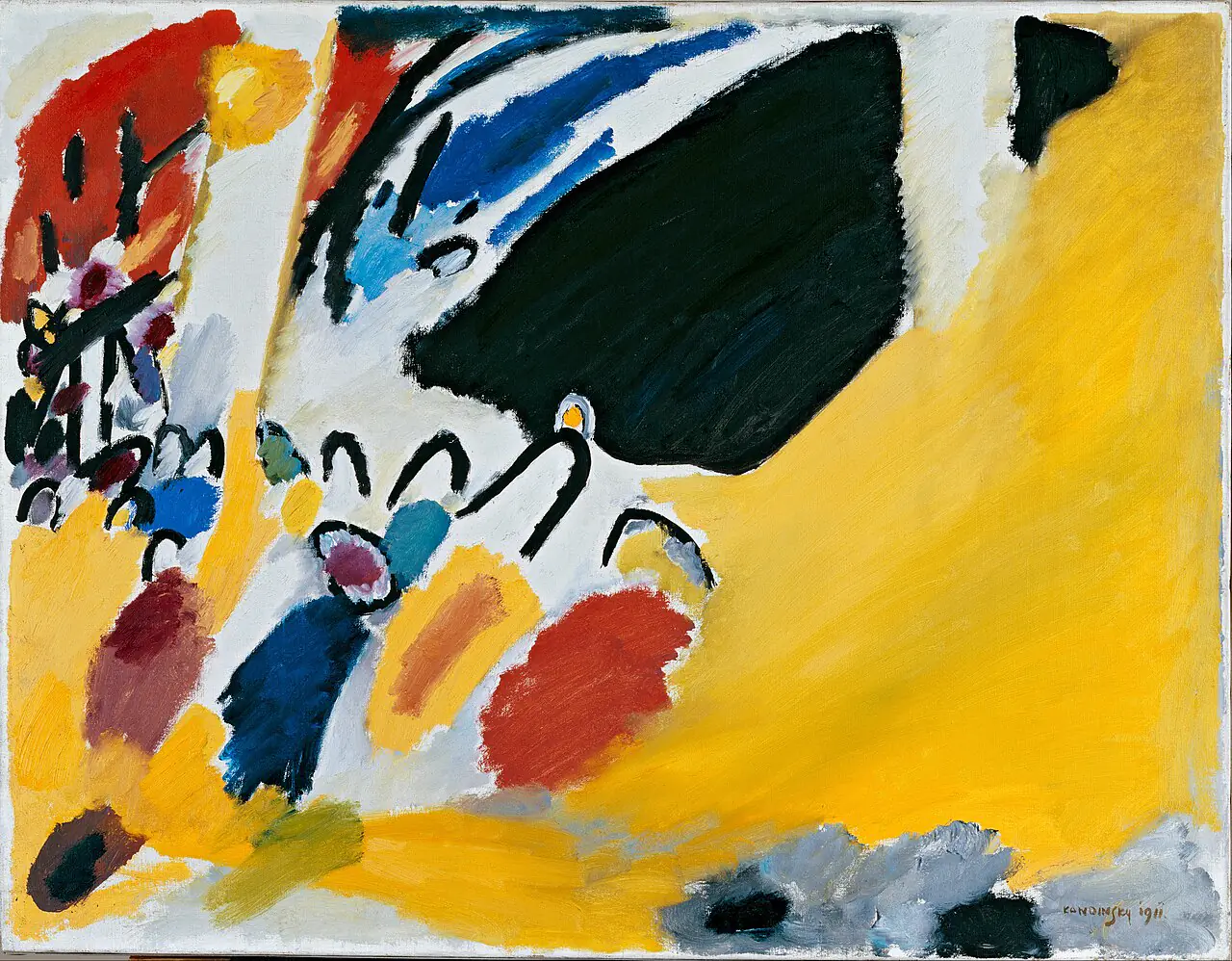
On 2 January 1911 Kandinsky heard Schoenberg’s music at a concert in Munich. Soon afterwards he painted Impression III (Concert), in which the piano is a black shape and a field of yellow spreads across the room.
Schematic · interval-cell organisationCell with one transposition and two inversions
An invented three-note figure. Its rises of one and four semitones become falls of one and four in the inversion. The second bar moves the original up a fifth; the last moves the inversion up a tone. No twelve-note row is involved.
Wassily KandinskyImpression III (Concert), 1911Oil on canvas · Lenbachhaus, Munich
Kandinsky attended a Schoenberg concert in Munich on 2 January 1911, with Franz Marc among his companions. He painted Impression III (Concert) soon afterwards. The black grand piano and the bent backs of the audience remain recognisable within the large area of yellow. The Lenbachhaus account also identifies them in the preparatory drawings.
The four string parts rise and cross one another before the soprano enters, and no home key is established beneath them. String Quartet No. 2, Op. 10
xivTwelve notes in order
Twelve-note writing
Schoenberg: fixed pitch order, free rhythm
Twelve-note writing starts with an ordering of all twelve chromatic pitch classes, each used once. Schoenberg’s Suite for Piano, Op. 25, is based on E–F–G–D♭–G♭–E♭–A♭–D–B–C–A–B♭. That row can supply a melody, be divided between several voices or be grouped into chords. It fixes neither the note lengths nor the octave in which each note sounds.
The row has four standard forms. The prime gives the chosen order. Inversion reverses the direction of each interval, so E–F becomes E–E♭. Retrograde reads the order backwards; retrograde inversion reads the inverted order backwards. Each form can begin on any of twelve pitch levels, which gives forty-eight possibilities before any duplicates caused by symmetry in the row.
Schoenberg used only eight of those possibilities in Op. 25, the four forms and their transpositions by a tritone. His Gavotte and Musette have different characters, and the Prelude moves forward on repeated pitches from bar 3. Immediate repetitions of a note do not break a row’s ordering, and the method does not forbid repeating a pitch that has just sounded.
Writing to Nicolas Slonimsky on 3 June 1937, Schoenberg recalled wanting “a uniform musical idea” that could govern both themes and their accompaniment. Op. 25, composed in 1921–23, puts that idea into practice. The same row underlies a calm low melody in the Intermezzo and the sharply accented music of the Gigue.
Schoenberg · Op. 25 row, schematic rhythmPrime and inversion, both beginning on E
The exact pitch-class order of Op. 25, followed by its inversion about E. E–F–G rises by a semitone and a tone; E–E♭–D♭ falls by the same intervals. The equal crotchets and the octave placement are schematic.
Schematic · operations on the same rowRetrograde and retrograde inversion
The preceding two rows read backwards, with schematic rhythm. The retrograde begins B♭–A–C–B♮, spelling B–A–C–H in German note names. Every note appears once in each twelve-note group.
xvWhere the accents fall
Rhythm
Steady pulse under conflicting larger groupings
Rhythm is the pattern of notes and silences; metre groups them into beats and bars. The plucked opening of the scherzo in Ravel’s String Quartet groups six quavers in two ways at once, as two groups of three (as in 6/8) and as three groups of two (as in 3/4). The quavers stay at the same speed while the grouping into larger beats changes.
Additive rhythm joins unequal groups. In Bartók’s first Dance in Bulgarian Rhythm, No. 148 of Mikrokosmos, nine quavers divide 4+2+3. The next dance uses 2+2+3. In both, the quaver stays constant while the groups vary in length.
Messiaen’s added values alter a pattern from within. A short note, rest or dot lengthens part of a familiar rhythm. In the example, two quavers plus two become three plus two, and the extra quaver delays the start of the next group. His non-retrogradable rhythms have a different property. A sequence such as 2–3–2 has the same durations forwards and backwards.
Polyrhythm sounds different divisions of one span at once. In three against two, the upper part places three evenly spaced notes against two below. Dividing the span into six equal units puts the upper attacks at 0, 2 and 4, and the lower ones at 0 and 3. They meet again at 6. In the second example, only the first note of each bar is attacked together.
Schematic · regrouping and additionTriple metre, hemiola, unequal groups
Invented rhythms on one note. Bars 2–3 make three minims across two bars of 3/4; the tied note crosses the barline without a new attack. Later, 7/8 divides 2+2+3. The last bar adds a quaver to the preceding bar’s first note.
Schematic · three against twoThree attacks against two
An invented three-against-two pattern. The upper part fits three triplet crotchets into the time of the bass’s two ordinary crotchets. Both parts begin together, separate and meet again at the next barline.
Plucked strings set groups of three quavers against groups of two, so the six quavers of the dance can be counted in two ways at once. String Quartet in F major
xviChoosing the player
Orchestration
Same notes, different instrument: changes of timbre
Orchestration decides which instrument plays each note. In Ravel’s Boléro, the first tune passes from solo flute to clarinet while the snare drum repeats its two-bar rhythm. On its second appearance the melody is the same and the instrument playing it is different. Later, the second tune climbs into the bassoon’s high range, where every note sounds more exposed.
Ravel also made new voices by combining instruments. A horn carries the tune with celesta and piccolos sounding above it, so that the separate parts suggest the upper tones of one composite instrument. Elsewhere, a muted trumpet shares a statement with a flute, and a high trombone solo brings the line closer to a sliding human voice.
The way a note begins matters as much as the way it is sustained. A plucked violin string starts sharply and dies away; a bowed note can grow louder after it begins. A mute changes the sound again. Sul ponticello brings the bow close to the bridge; col legno uses its wood. Wind multiphonics use special fingerings and ways of blowing to sound several pitches together.
Boléro keeps its two tunes and its repeating bass in place for nearly the whole piece, so each new player is conspicuous. Later, whole sections take the melody, and the orchestra around the drum rhythm grows very large. The example below reduces this to two solo sounds: a flute plays a phrase, then an oboe plays the same notes.
Schematic · identical melody, different instrumentFlute followed by oboe
An invented two-bar phrase, first on flute, then oboe, at the same sounding pitch and speed. The synthesised playback isolates the change of instrument. Live players would also shape the notes with breath and articulation.
A solo flute plays the first tune over the snare drum and the bass’s alternating C and G. Boléro
A clarinet takes the same tune while the drum and bass continue their pattern. Boléro
xviiRepetition and gradual change
Minimalism
Repeated figure against a partner one note ahead
In late 1966, Steve Reich made a tape loop of a short piano pattern and tried playing along with it. He had already developed phasing with tape recorders and now wanted to do it with live performers. Piano Phase (1967) begins with two pianists repeating the same figure together. One speeds up slightly until the parts are one note apart. The overlapping notes form patterns that neither pianist plays alone.
Terry Riley gave performers a different freedom in In C (1964). All the players have the same fifty-three patterns in the same order, and each player chooses how many times to repeat a pattern before moving on to the next. Riley asked the players to stay within two or three patterns of one another. A repeated high C can keep the quaver pulse while the neighbouring patterns interlock.
Philip Glass’s Two Pages lengthens and shortens a repeating line. The technique is called additive process, in which a figure returns with an extra piece attached or with a piece removed. An invented C–D–E could become C–D–E–G, then C–D–E–G–A. The notes keep their speed, but the beginning comes round later.
In Pärt’s Für Alina (1976), the piano pairs a free-moving melody with notes of the B minor triad. Phrases gain a note at a time, then lose them again. The second example below invents a simpler rule in A minor: each melody note receives the nearest strictly lower A, C or E. When the melody reaches F, the partner is E, leaving a bare semitone between them.
Schematic · two phase positionsOne-quaver advance in the lower pattern
An invented four-note pattern. The two parts coincide in bars 1–2. In bars 3–4 the lower part starts on D, one quaver ahead. Reich’s opening figure has twelve notes, and his players move gradually between alignments; this example shows the two endpoints.
Schematic · a tintinnabuli ruleScale voice with the nearest lower triad note
An invented tintinnabuli rule: the lower part always takes the nearest A, C or E strictly below the melody. Under a melodic E it plays C; under F it plays E. The rule produces close seconds as readily as thirds.
xviiiHarmonic spectra
Spectralism
Overtones of one note as a chord
An instrumental note usually combines a fundamental with higher tones. In an ideal harmonic spectrum, these upper tones vibrate at two, three, four and more times the frequency of the fundamental. Over a low E, the first few fall near E, B, E, G♯, B, D and E. Differences in their relative strengths help make a bowed string sound different from a horn playing the same note.
Spectral composition turns those inner relationships into notes for instruments. Gérard Grisey’s Partiels (1975), for eighteen musicians, opens around a low E. Other instruments enter above it and spread the E’s upper tones across several octaves. The timing of each entrance helps the separate notes merge into one large sound.
Tristan Murail’s Gondwana (1980) uses calculated pitches to build bell-like chords for orchestra. These chords can change by degrees towards more harmonic spectra. The intervals between the notes shift while instruments hold or re-attack them, so a chord’s make-up can change before it moves to another chord.
The piano can only approximate some of these pitches. Above E, the fifth harmonic falls about 13.69 cents below the equal-tempered G♯; the seventh falls about 31.17 cents below D. A cent is one hundredth of a semitone. String and wind players can adjust those notes, while the equal-tempered example below fixes them to the piano’s keys.
Schematic · equal-tempered landmarks onlyEight partials in equal temperament
An invented piano map of the first eight harmonics above E, with frequency ratios 1:2:3:4:5:6:7:8. The octave Es are exact. The true third and sixth harmonics lie about 1.96 cents above these Bs; the fifth is 13.69 cents below G♯, and the seventh 31.17 cents below D.
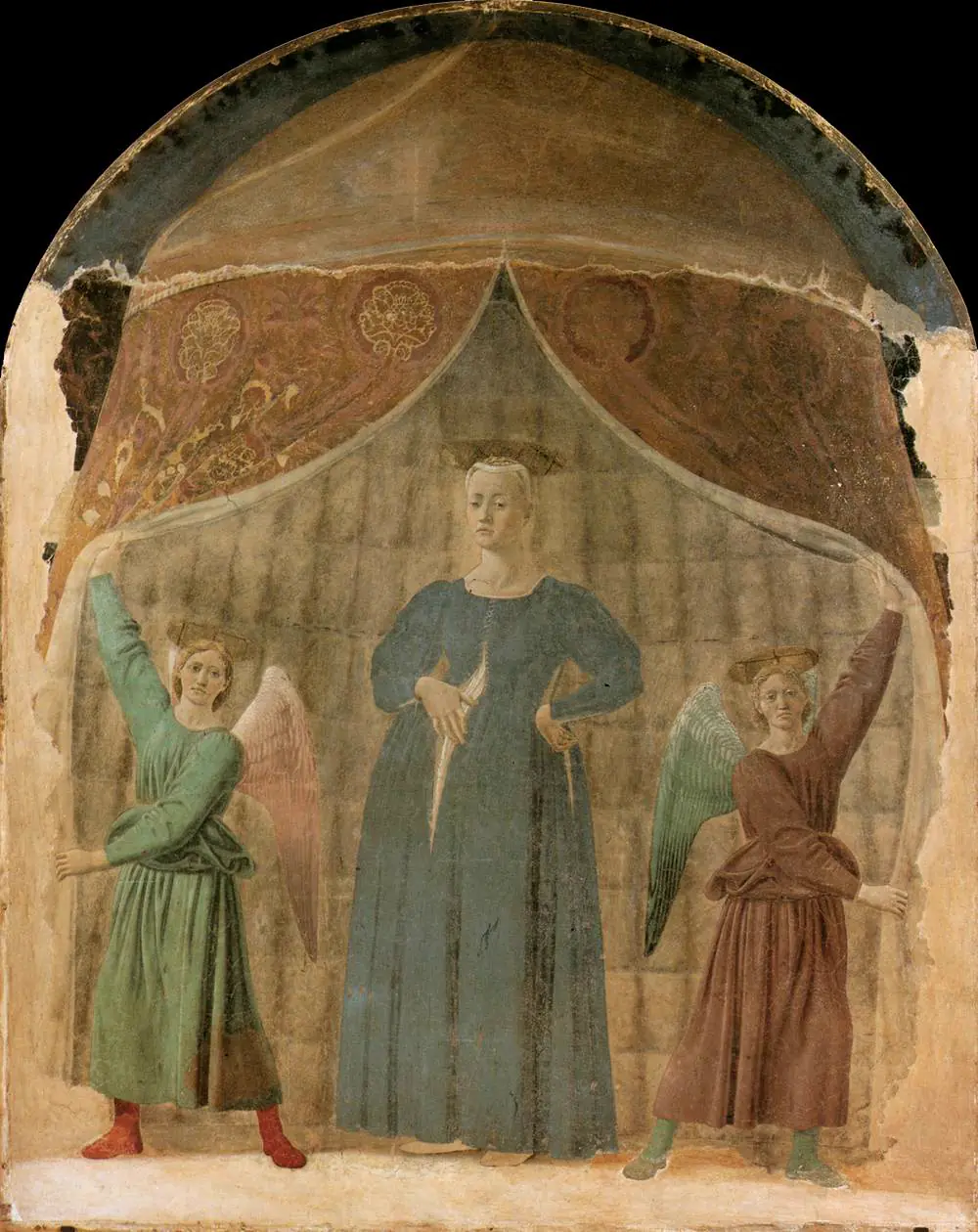
Piero della FrancescaMadonna del Parto, c. 1450–65Fresco, detached · Musei Civici Madonna del Parto, Monterchi
In Piero’s Madonna del Parto, two angels open a tent and Mary’s fingers part her dress; Grisey saw one opening inside the other. In his programme note for L’Icône paradoxale, published at Festival Musica in 1996, he described turning the fresco’s proportions, 3:5:8:12, into musical durations. The two singers sing Piero’s names and words from his treatise on perspective. The composer’s account also describes how these proportions are carried into the divided orchestra.
Joins
Joins between sections
A cadence can close a section; a held bass note, a sequence or a shared motif can carry the music into the next. Four joins from the Hall, each with its passage:
Flute refrain returns in F♯ minor
Brandenburg Concerto No. 5, BWV 1050 · A · Violin and flute in B minor → B · Flute refrain in F♯ minor
The harpsichord’s running right-hand line ends, and the flute brings back the dotted refrain in F♯ minor. The violin follows over the keyboard bass. Bach marks the returning solo lines forte, and the harpsichord goes back to accompanying.
Bach-Gesellschaft score (1871), II, p. 150, first and second systems: third refrain.
From opening refrain to first episode
Brandenburg Concerto No. 5, BWV 1050 · A · Opening ritornello, strings, D major → B · Flute, violin and harpsichord
The eight-bar string refrain closes in D major. Flute and solo violin then exchange phrases above the harpsichord’s bass, and the keyboard’s right hand joins their runs. The pulse is unchanged. The solo episode modulates to A major, and the next string refrain enters in that key.
Bach-Gesellschaft score (1871), I, bars 1–19; San Francisco Conservatory form chart: sfcm.edu
Triplets turn to B minor
Brandenburg Concerto No. 5, BWV 1050 · A · Fugue subject in violin, flute and harpsichord → B · Triplets in B minor
The outer section closes on D major. The violin then begins broken-chord triplets in B minor, marked piano. The two-beat metre continues unchanged, and the middle section develops the soloists’ figures through a succession of new keys.
Bach-Gesellschaft score, III, bars 77–89; Mutopia edition, music ID 548.
Fermata on D, then a rising scale
Cello Suite No. 1, BWV 1007 · A · G major broken chords → B · Scales after the held D
In bar 22 the cello climbs to a D marked with a fermata. After the pause, semiquavers run up the scale and spread across a wider range. The bass and upper notes are still played by a single bow. D is the dominant of G, and the harmony does not yet resolve to the tonic.