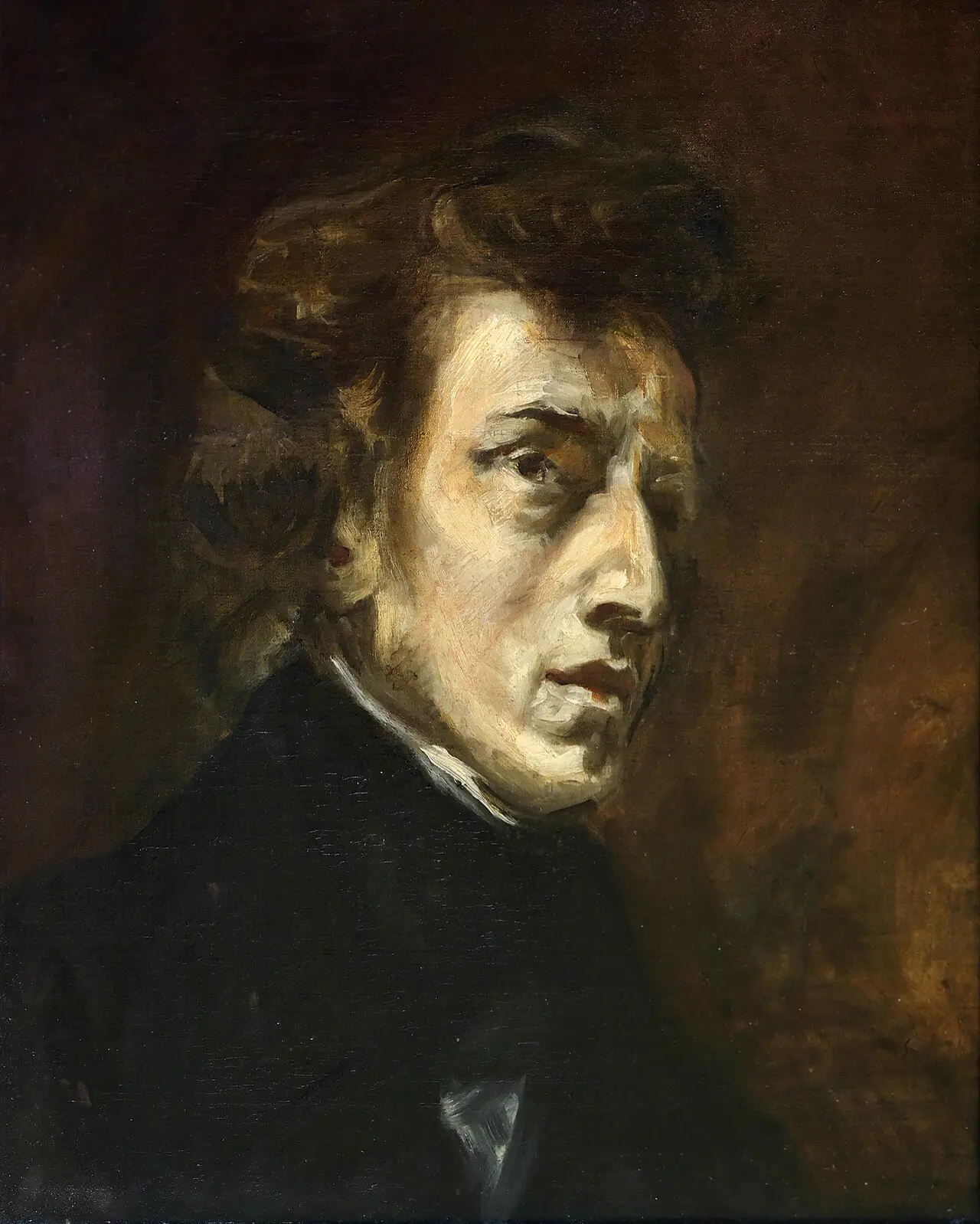
Wojciech Żywny; composition with Józef Elsner in Warsaw, 1826–29
Homes
Warsaw · Paris from 1831 · summers at Nohant
Livelihood
Piano lessons, publishing and occasional concerts
Instrument
The piano, from a few lines of mazurka to concertos and sonatas
Life
In February 1832 Chopin, a twenty-one-year-old Polish pianist, played in the Pleyel rooms in Paris. He had arrived the previous autumn, with two concertos behind him. The concert caught the attention of the city’s publishers, and teaching soon supplied his living. For the rest of his life his profession depended on people hearing him at close quarters. The great public virtuosos travelled from one concert city to the next; Chopin stayed in Paris and gave lessons.
He was born at Żelazowa Wola in 1810. His father, Nicolas, had come from France and worked as a tutor; his mother, Justyna Krzyżanowska, was Polish. The family moved to Warsaw while Fryderyk was still a baby, when Nicolas obtained a teaching post at the Lyceum. At seven the boy had a polonaise in print. Wojciech Żywny taught him the piano, with Bach and Mozart among his models; Józef Elsner later gave him a rigorous training in composition at Warsaw’s Main School of Music.
Holidays took him out of the capital. At Szafarnia and other country estates he heard village musicians, attended weddings and harvest celebrations, and danced himself. Those uneven accents recur in the mazurkas he wrote throughout his life. In Warsaw he also heard Italian opera. The slow movements of his two piano concertos give the soloist long melodies that break into runs and ornaments, in the way an operatic singer might embellish a returning phrase. He wrote the F minor Concerto before the E minor; publication reversed their numbering.
1830–32From Warsaw to Paris
He left Warsaw on 2 November 1830, and his friend Tytus Woyciechowski joined him in Kalisz. When news of the uprising against Russian rule reached them in Vienna, Woyciechowski went back to join it. Chopin stayed. After months of uncertainty he travelled west, learned in Stuttgart that Warsaw had fallen, and reached Paris in 1831. He never returned to Poland. Polish friends and émigré gatherings remained part of his daily life. He used the French spelling Frédéric and continued to write home in Polish.
In Paris his colleagues included Bellini, Liszt and Eugène Delacroix. He also had wealthy pupils, who paid for his exacting attention. He favoured Pleyel pianos, and in teaching he attended to the smallest difference between a singing note and the notes beneath it. He treated fingering as important because fingers differ, and the thumb and little finger could never become identical hammers. His pupils’ copies preserve alternative ornaments and fingerings worked out in lessons at the keyboard.
The piano lessonThe Études and the nocturnes
The first two Études of Op. 10 form a pair. In the first, the right hand plays wide arpeggios above a firm bass. In the second, its outer fingers play a chromatic scale while the thumb and index finger supply accompanying notes. In Op. 25 he writes studies in thirds, sixths and octaves, and in one the pianist must sustain a melody inside the figuration that surrounds it.
John Field had established the piano nocturne; Chopin wrote a more restless melodic line. In the D♭ major Nocturne, Op. 27 No. 2, a second line joins the first above the rocking left hand. An ornament can delay the note on which the phrase depends, then hurry to reach it, in the manner of a singer taking time over a vowel. Some of the nocturnes are violent: in the C minor, Op. 48 No. 1, the principal melody returns with an urgency far from the quiet opening.
1838–39Mallorca, Valldemossa and the Preludes
His relationship with George Sand began in 1838. That autumn they went to Mallorca with her children, Maurice and Solange. The weather turned bad. On 3 December Chopin wrote to Julian Fontana about the island’s three celebrated doctors: “One said I was dead, the second that I was dying, the third that I would die.” He had resisted bloodletting and wanted the news kept quiet. Eleven days later he wrote again: “My manuscripts are asleep, while I cannot sleep at all; I only cough.”
On 15 December they moved into the former Carthusian monastery at Valldemossa. Chopin described his vaulted cell to Fontana, its windows looking out on orange trees and cypresses, Bach on the table beside his own scribblings. His Pleyel had not yet arrived. Here he completed the twenty-four Preludes, which he had begun before the voyage. Each major key is followed by its relative minor, and the pairs move round the circle of fifths, from C major and A minor to F major and D minor. Some pieces stop soon after their opening figure is stated. In the E minor Prelude the narrow melody repeats while the chords beneath descend by semitones.
NohantSummers at Nohant and late works
From 1839 Chopin spent his summers working at Sand’s country house at Nohant, except in 1840. Delacroix visited; Sand wrote while Chopin composed and revised. He built the B♭ minor Sonata around a funeral march he had already written. The finale, which follows the march, has both hands playing together in bare octaves, with scarcely anything that can be called an accompaniment. The B minor Sonata of 1844 gives much more room to song, above all in its long B major Largo.
His single-movement pieces could be equally large in scale. In the four ballades the themes are changed when they return; in the Fourth the principal melody is passed through imitation and increasingly elaborate ornaments before the quiet chords that precede the coda. The scherzos keep triple metre but extend the dance with passages of loud repeated chords, fast passagework and sudden rests. In the late Barcarolle, two voices move in thirds and sixths over a rocking bass in the manner of a boat song; the Polonaise-Fantaisie opens with isolated chords and arpeggios before the dance rhythm is established.
In the late Nocturnes, Op. 62, the trills form part of the melodic line and inner voices answer it. The Cello Sonata divides that exchange between two instruments. Chopin wrote it for his friend Auguste Franchomme. The piano part is substantial, and the cello holds notes that would die away on the piano. The short Largo stands between two much busier movements.
1847–49Britain and death in Paris
Chopin and Sand separated in 1847 after quarrels within her family. The following year, with Paris shaken by revolution and his health failing, he accepted his pupil Jane Stirling’s help in arranging a visit to Britain. He played in England and travelled through Scotland, increasingly exhausted. His last public appearance was for Polish émigrés at London’s Guildhall on 16 November 1848. He returned to Paris and died of tuberculosis on 17 October 1849, aged thirty-nine. His sister Ludwika, who had come to care for him, took his heart to Warsaw; his body was buried at Père-Lachaise.
His music had already spread through three publishing markets while he was alive. The printed scores are precise in their detail. They give separate stems for a voice hidden inside a chord, fingerings that cross one finger over another, and runs whose notes do not divide evenly against the bass.
Places
Every recorded place, joined in date order. Chopin on the MapAll 25 places, with sources
Żelazowa Wola · 1 March 1810 – October 1810 · born (disputed)
Born west of Warsaw to a French father; the parish record gives 22 February, tradition 1 March.
National Theatre, Warsaw · 17 March 1830 · premiere
Played the premiere of the work published as Piano Concerto No. 2 at the age of twenty; No. 1 was first performed on 11 October. Piano Concerto No. 2 in F minor.
In the D♭ major Nocturne, Op. 27 No. 2, the right hand decorates and varies its phrases above a steady rocking figure in the left. Appoggiaturas lean on dissonances before resolving; a second voice joins the tune. The ornaments are part of the line, like syllables stretched over several notes in an aria.
♯Chromatic voices
In the E minor Prelude, Op. 28 No. 4, the melody barely moves. Under its repeated note, the left-hand chords descend a semitone at a time, one voice moving while the others hold, so that the harmony changes one note at a time.
𝄾Dance accent
A mazurka can put the accent on the second or third beat, where a waltz puts it on the first. Chopin drew on the quick oberek and the slower, singing kujawiak as well as on the mazur itself. A drone or a sharpened fourth can recall the village band even when the harmony has moved into distant keys.
𝄞The pianist’s hand
In Op. 10 No. 2, three fingers of the right hand play chromatic scales up and down while the other two fingers of the same hand add chords. Other studies in the set call for wide arpeggios, paired thirds or fast octaves, always with a phrase to be sustained through the figuration.
𝄋Return
In the Fourth Ballade the principal theme returns several times in different forms. A plain statement is followed by an ornamented one, and in passages of imitation one voice follows another through the same phrase. Near the end, a passage of quiet chords stands between the preceding climax and the violent coda.
𝄢Counterpoint
Chopin kept Bach with him at Valldemossa, and the late music often requires the hands to play independent voices. The Barcarolle has a duet above its rocking bass; in the E♭ major Nocturne, Op. 55 No. 2, the voices intertwine within the melodic phrases.
Works
A selection from the composer’s works.
1827
Variations on “Là ci darem la mano”Op. 2Piano and orchestra
A young pianist’s piece on Mozart’s seduction duet from Don Giovanni. Schumann’s enthusiastic review appeared in 1831.
1829–30
Piano Concerto No. 2 in F minorOp. 21Piano and orchestra
Written before No. 1, though published later. In the Larghetto the piano has an extended solo in an operatic manner, with long ornamented lines.
1829–32
Twelve ÉtudesOp. 10Piano
Dedicated to Liszt. In No. 2 the right hand’s outer fingers play a chromatic scale while the remaining fingers accompany them.
1830
Piano Concerto No. 1 in E minorOp. 11Piano and orchestra
The Romance is in E major; the finale is built on the syncopated krakowiak. Chopin played the concerto at his Warsaw farewell concert.
The studies in thirds, sixths and octaves sit alongside pieces whose chief difficulty is playing a melody cantabile. In No. 7 the left hand has a melody in the cello register.
1835
Two NocturnesOp. 27Piano
C♯ minor and D♭ major have tonics on the same piano key, spelt differently. In the second, a duet enters above the rocking accompaniment.
1836–39
Twenty-four PreludesOp. 28Piano
Completed on Mallorca. The pieces follow the circle of fifths, each major key followed by its relative minor; some are only a few bars long.
1837–39
Piano Sonata No. 2 in B♭ minorOp. 35Piano
Chopin built the sonata around an existing funeral march. In the finale, which follows the march, both hands play in octaves.
The central episode sets the left hand’s repeated octaves beneath a rising march. They require stamina as well as speed.
1844
Piano Sonata No. 3 in B minorOp. 58Piano
The long Largo in B major is the slow movement at the centre of the four. In the finale the recurring theme is more urgent on each return.
1845–46
Barcarolle in F♯ majorOp. 60Piano
A Venetian boat-song in 12/8, with two voices moving in thirds and sixths. When they return, decorated, both parts have trills.
1845–46
Polonaise-Fantaisie in A♭ majorOp. 61Piano
The piece opens with chords and widely spaced arpeggios, and the dance rhythm is not yet clearly heard. The rhythm then gradually becomes established.
1845–46
Cello Sonata in G minorOp. 65Cello and piano
Written for Auguste Franchomme. The Largo is short and placed between the more densely written outer movements.
In the score
Short examples, engraved and playable.
Nocturne workshopA held dissonance
A schematic of a melodic line above broken chords. In bar 1, G♭ is held against D♭ major and resolves to F; in bar 3, D♭ delays the C in A♭7. A triplet ornaments the line between the longer notes.
Mazurka workshopAccent on beat two
A schematic of displaced dance accents. The bass marks the first beat; the accent falls on the second beat in both hands. The bar keeps three beats, and the strongest accent comes after the downbeat.
Sister arts
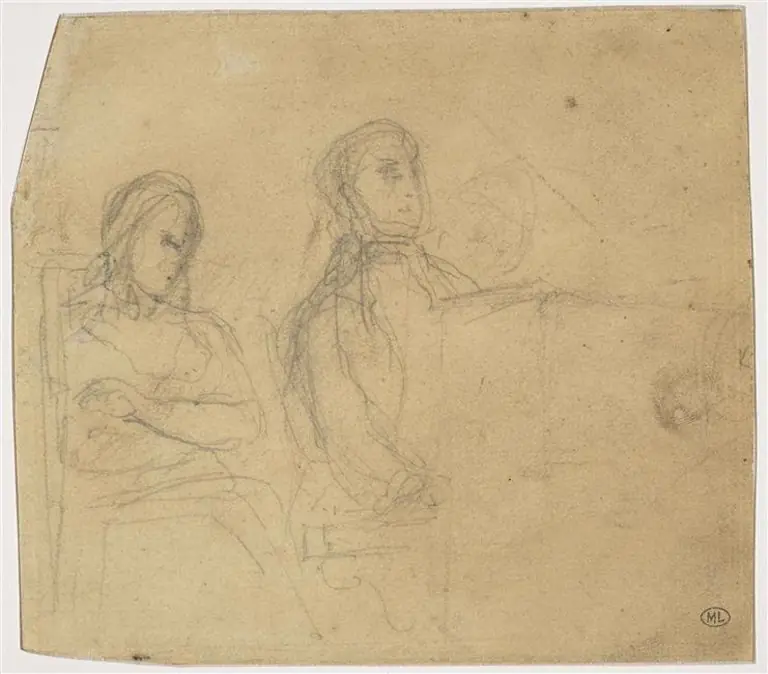
Eugène DelacroixStudy for the Double Portrait of Chopin and George Sand, c. 1838Graphite on brown paper · Musée du Louvre, Department of Prints and Drawings, RF 9357
Delacroix planned to show his two friends together, Chopin at the piano and Sand beside him. This small drawing records the composition of the unfinished painting before it was cut in two. Louvre catalogue.
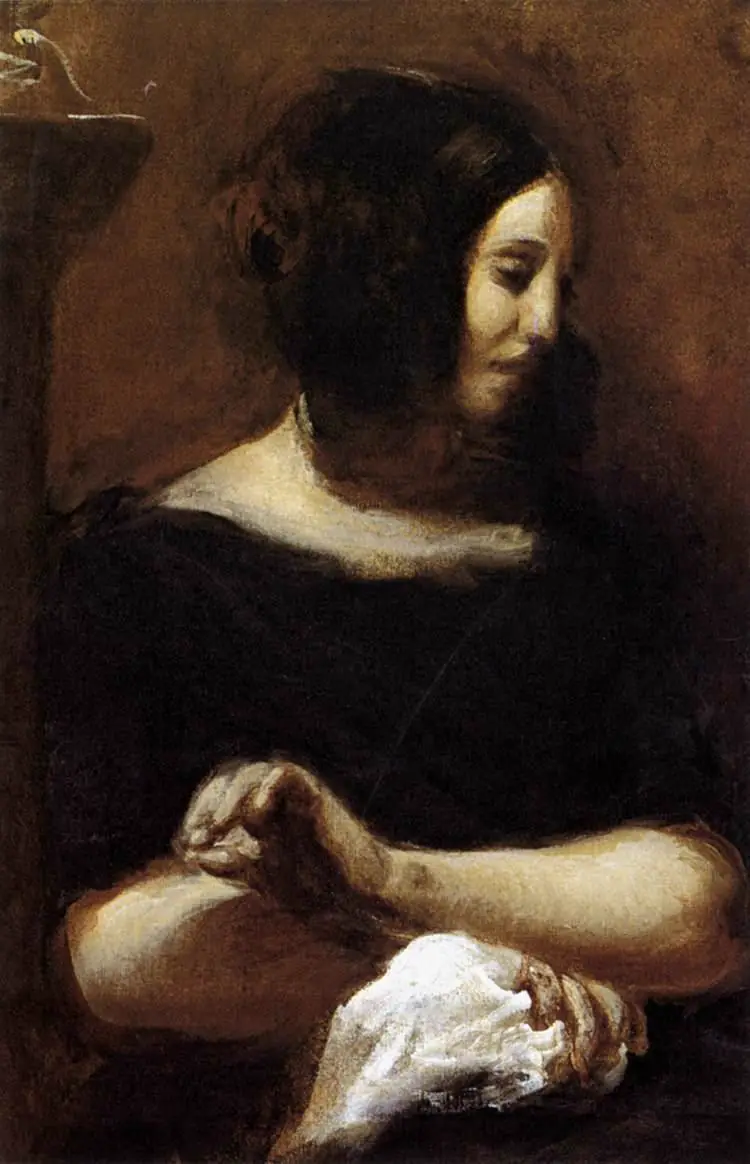
Eugène DelacroixGeorge Sand, 1838Oil on canvas; fragment of an unfinished double portrait · Ordrupgaard, Denmark
Sand’s half of Delacroix’s double portrait is now in Denmark; Chopin’s is in Paris. Delacroix began the portrait in the summer of 1838, when Sand and Chopin’s relationship was new. Soon afterwards Sand travelled to Mallorca with Chopin and her two children.
Stefan Witwicki
Wiosna · opening three stanzas
Set by Chopin in 1838
PolishBłyszczą, krople rosy,
Mruczy zdrój po błoni,
Ukryta we wrzosy
Gdzieś jałówka dzwoni.
Piękną, miłą błonią
Leci wzrok wesoło;
W koło kwiaty wonią,
Kwitną gaje w koło.
Paś się, błąkaj, trzódko,
Ja pod skałą siędę,
Piosnkę lubą, słodką
Śpiewać sobie będę.
Our translationDrops of dew gleam;
a spring murmurs across the meadow.
Hidden somewhere in the heather,
a heifer’s bell rings.
Across the lovely meadow
my gaze flies gladly;
flowers give their scent all round,
and all around the groves are blooming.
Graze and wander, little herd;
I shall sit beneath the rock
and sing myself
a dear, sweet song.
Chopin set Witwicki’s Wiosna in 1838 and copied it into albums several times, sometimes as a piano piece. In the opening stanzas the singer is beside a grazing herd; later stanzas of the poem turn to sorrow. The song was published after his death as Op. 74 No. 2. Polish sung text.
Recommended recordings
NocturnesIvan MoravecConnoisseur SocietyThe recording to start with for singing tone at the piano. Moravec gives the melody room and plays its returning notes each with a slightly different colour.
MazurkasArthur RubinsteinRCAThe first choice for the dances. The pulse stays firm under flexible phrasing, and the slower, kujawiak-like pieces are played with warmth. The stereo cycle has the clearest recorded sound.
Études, Opp. 10 and 25Maurizio PolliniDeutsche GrammophonBrisk and unsentimental. The rapid figures are played cleanly over a firm bass, and the difficult passages are played without strain.
Twenty-four Preludes, Op. 28Martha ArgerichDeutsche GrammophonThe cycle is played with impatience and at times with ferocity; No. 16 is taken very fast, and the E minor Prelude reaches a fierce climax.
BalladesKrystian ZimermanDeutsche GrammophonThe long spans are controlled throughout. Repeated phrases are varied by small changes of touch, and the climaxes are prepared well in advance.
Field supplied the nocturne, Bellini the example of an ornamented singing line, and Bach the discipline of independent voices. Liszt, Debussy and Scriabin took up and extended Chopin’s concert étude; Fauré returned to the nocturne and the barcarolle.
Further reading
Jim Samson, Chopin (Oxford University Press, 1996). biography
Life-and-works study by the author of the Grove article.
Jim Samson, ‘Chopin, Fryderyk Franciszek’, Grove Music Online (Oxford University Press, 2001). reference
Biographical reference, work-list and bibliography; subscription required.
Frédéric Chopin, Chopin’s Letters, collected by Henryk Opieński, translated by E. L. Voynich (New York: Knopf, 1931). letters
English correspondence collection; catalogue also identifies the 1973 Vienna House reprint.
John Rink, Christophe Grabowski and collaborators, Chopin Online (online editions and catalogues, n.d.; accessed 16 October 2026). catalogue
Free first-edition catalogue, digitised early prints and a manuscript–edition comparison tool.
Cite this page
Contrapunctus. “Frédéric Chopin.” Accessed 20 October 2026. https://mottopanikeiku.github.io/contrapunctus/composers/chopin.html.