Born 27 January 1756, SalzburgDied 5 December 1791, Vienna
Composer of operas in which a servant outwits a count, and of piano concertos in which the soloist sometimes enters before the orchestra has finished its opening.
Childhood tours across Europe; three Italian visits, 1769–73
Vienna
His home from 1781; concertos, quartets and the Da Ponte operas
Catalogue
K. or KV: Köchel’s catalogue, first published in 1862 and revised since
“In an opera, poetry must simply be music’s obedient daughter.”
Life
When Leopold Mozart arrived in Vienna on 11 February 1785, the copyist was still writing out his son’s new concerto for that evening’s concert at the Mehlgrube. Wolfgang had been so busy supervising the copying that he had found no time to play the finale through. The work was K. 466 in D minor. It opens with syncopated strings, and the piano enters with a tune of its own. Leopold thought the concert excellent.
The next day, Haydn heard three quartets at Wolfgang’s home. Leopold recorded his verdict in a letter to Nannerl begun on 14 February: “Before God, and as an honest man, I tell you that your son is the greatest composer I know, personally or by name.” Haydn praised his taste and his knowledge of composition. Mozart later dedicated the quartets to him.
On the roadThe Mozart family tours, 1763–66
Wolfgang was born in Salzburg on 27 January 1756, the seventh child of Leopold Mozart and Anna Maria Pertl. Only he and his elder sister Maria Anna survived infancy. Leopold served the archbishop as a violinist and published his violin treatise in the year of Wolfgang’s birth. He taught both children. Maria Anna, known as Nannerl, was an accomplished keyboard player; the early tours advertised the brother and sister together.
The family spent much of 1763–66 travelling through German courts, Paris, London and the Netherlands. Leopold arranged engagements, kept the accounts and supervised lessons; illness interrupted the tour. In London Wolfgang met Johann Christian Bach and heard the Italianate singing style found in Bach’s keyboard music and operas.
Salzburg and ItalyItalian operas and Salzburg concertos
Three Italian visits with Leopold, between 1769 and 1773, brought commissions for the theatre. Milan heard Mitridate, re di Ponto in 1770 and Lucio Silla in 1772. Mozart learnt to fit his arias to a singer’s range and breath.
Under Archbishop Colloredo, his duties in Salzburg included church music and orchestral works. In the five violin concertos of 1773–75 the soloist’s entrance is sometimes unexpected: in K. 219 the violin enters with a sudden Adagio. In the 1777 “Jenamy” Concerto the piano answers the orchestra in the opening bars. The slow movement, in C minor, is written for the keyboard in the manner of an operatic lament.
In 1777 he left with his mother to look for a better appointment. At Mannheim he heard the famous orchestra and fell in love with the singer Aloysia Weber. Paris offered work but no secure position. His mother died there in July 1778. Back in Salzburg in 1779, he became court organist; a Munich commission later took him into another theatre. Idomeneo, first performed in 1781, concerns a father’s vow and the threatened death of his son, and the chorus takes part in the catastrophe.
ViennaDie Entführung aus dem Serail
A quarrel with Colloredo ended his Salzburg employment in 1781. Mozart settled in Vienna, where he earned money from pupils, concerts, publishers and commissions and cultivated patrons. In 1782 he married Constanze Weber, Aloysia’s younger sister. They had six children; two sons survived infancy. His letters moved between household business and the work on his desk with very little ceremony.
Writing to Leopold on 13 October 1781 about Die Entführung aus dem Serail, he set out a rule: “In an opera, poetry must simply be music’s obedient daughter.” He was arguing for words that would work in the theatre, and was discussing revisions with his librettist, Gottlieb Stephanie. The opera opened in Vienna in 1782. It combines spoken German with Konstanze’s taxing arias, Osmin’s comic bass role and the loud percussion of the “Turkish” band.
At the pianoPiano concertos, mid-1780s
Mozart’s subscription concerts of the mid-1780s needed new concertos. In K. 466 the piano’s first theme follows the orchestral opening and differs from it. In the A major Concerto K. 488, clarinets replace the oboes. The slow movement is in F♯ minor, and the piano plays a melody in a halting dance rhythm. In the finale, flute and bassoon play an E major melody together.
The “Dissonance” Quartet, K. 465, begins with repeated C’s in the cello. The viola and violins enter one by one, and their entries form dissonances against the notes already sounding. The harmony then resolves to C major. The C major and G minor quintets of 1787 add a second viola, which gives the lower part of the texture an additional instrument.
Da PonteThe three Da Ponte operas
Lorenzo Da Ponte supplied Le nozze di Figaro in 1786, Don Giovanni in 1787 and Così fan tutte in 1790. In Figaro, drawn from Beaumarchais, the Count pursues his servant Susanna while his wife and servants plot to thwart him. In the Act II finale new characters keep entering a domestic quarrel, and each arrival changes what the others can believe. Mozart changes tempo and key as the situation changes, and the finale runs continuously without recitative.
Prague’s enthusiasm for Figaro brought the commission for Don Giovanni. At Giovanni’s party, three bands play three dances in different metres while the host tries to get Zerlina alone. Later the murdered Commendatore comes to supper as a statue, and with him come trombones and the D minor of the overture. Mozart revised the opera for Vienna in 1788, writing three new numbers for it. In the Prague original, the opera continues after Giovanni goes to hell, with the surviving characters arranging their lives.
In Così, two men test their fiancées by courting them in disguise. The men set out to prove a proposition about the women’s constancy, and the women go through the feelings that the test produces.
The last yearsLast symphonies, 1791 and the Requiem
Money became harder to find in the later 1780s. Mozart asked his fellow Freemason Michael Puchberg for loans. In the summer of 1788 he completed his final three symphonies within weeks: E♭ major, G minor and C major. The last ends by bringing five themes together. He later returned to the G minor score to add clarinets and rewrite the oboe parts.
In 1791 Mozart wrote Stadler’s Clarinet Concerto and two operas for very different stages. La clemenza di Tito was written for Leopold II’s coronation as King of Bohemia in Prague. Die Zauberflöte was written for Emanuel Schikaneder’s suburban Vienna theatre, with spoken dialogue, spectacular scenery and Papageno, who wants a wife and food. Its initiations draw on the Masonic world Mozart had joined in 1784.
On 13 October he collected Salieri and the soprano Caterina Cavalieri in a carriage and took them to The Magic Flute. Writing to Constanze the next day, he reported that Salieri followed the opera attentively from the overture to the final chorus, and that scarcely a number passed without “bravo” or “bello”. His seven-year-old son Carl was there too.
He died on 5 December 1791, aged thirty-five, leaving the Requiem unfinished. Count Franz von Walsegg had commissioned it anonymously in memory of his wife. Constanze arranged its completion; Franz Xaver Süssmayr supplied the version that became standard. Mozart was buried in a common grave at St Marx, according to Viennese practice.
Places
Every recorded place, joined in date order. Mozart on the MapAll 25 places, with sources
Getreidegasse 9, Salzburg · 27 January 1756 – 1762 · born
Born in the family flat; baptised next day at the cathedral. Leopold was his only teacher.
At the beginning of the “Jenamy” Concerto, K. 271, the piano enters in reply to the orchestra’s opening phrase. In the Fifth Violin Concerto the soloist’s entry changes the tempo to an Adagio.
♮Doubtful C major
The cello begins the “Dissonance” Quartet with repeated C’s. Above it, the viola enters on A♭, the second violin on E♭, then the first violin on A♮. The parts move in different harmonic directions. Each player holds a note while another moves, and the dissonances between them come before the C major of the Allegro.
𝄋The second viola
Adding a viola to the string quartet gave Mozart two voices in the middle of the ensemble. In the G minor Quintet K. 516, all five players use mutes in the Adagio, which is in E♭ major. The finale opens with another substantial Adagio before a fast section in G major.
𝄞Woodwinds
In the A major Piano Concerto K. 488, two clarinets replace the oboes, and there are no trumpets or drums. In the finale, flute and bassoon introduce a new tune in E major before the piano’s next entry.
𝄢Five themes combined
The finale of the “Jupiter” Symphony presents several short themes, then combines five of them in its coda. Each is short and distinct enough to remain recognisable when the other parts enter against it. The movement is fast and scored for full orchestra.
𝄾Three simultaneous dances
At the party in Don Giovanni, a minuet in 3/4, a contredanse in 2/4 and a German dance in 3/8 sound together. The masked aristocrats have the minuet; Giovanni dances with Zerlina while Leporello distracts Masetto.
Works
A selection from the composer’s works.
1773
Symphony No. 25 in G minorK. 183Orchestra with four horns
Four horns, in pairs in G and B♭, thicken the wind sound. The opening uses syncopations, unison attacks and wide leaps.
1775
Violin Concerto No. 5 in A majorK. 219Solo violin and orchestra
The violin’s first entrance stops the fast opening for six bars of Adagio. In the finale, a noisy minor-key “Turkish” episode breaks into the minuet.
1777
Piano Concerto No. 9 in E♭ major “Jenamy”K. 271Piano and orchestra
Written for Victoire Jenamy, whose name was long misremembered as “Jeunehomme”. The piano enters soon after the orchestra; in the C minor slow movement it has much longer solo passages.
1781
Idomeneo, re di CretaK. 366Opera seria in three acts
Idomeneo’s vow to Neptune puts his own son’s life in danger. Besides the solo arias, the opera has a sea monster, large choruses and orchestral recitatives.
1782
Die Entführung aus dem SerailK. 384German Singspiel in three acts
Konstanze’s arias demand as much from a singer as Italian opera seria. Around them come spoken dialogue, Osmin’s bass-register bluster and the orchestra’s “Turkish” percussion.
1782–85
Six Quartets dedicated to HaydnK. 387, 421, 428, 458, 464, 465String quartet
A gift to a living master, with contrapuntal finales and a dissonant slow introduction to the last quartet, the “Dissonance”. Haydn heard the final three at Mozart’s home on 12 February 1785.
1785
Piano Concerto No. 20 in D minorK. 466Piano and orchestra
The orchestra is already playing syncopated figures when the piano enters with a new tune. Beethoven later wrote cadenzas for the first movement and finale.
1786
Piano Concerto No. 23 in A majorK. 488Piano and orchestra with clarinets
The first movement introduces a new E major theme at the start of its development. Between the A major outer movements stands an Adagio in F♯ minor, in which the clarinets darken the sound.
1786
Le nozze di FigaroK. 492Opera buffa in four acts; libretto by Da Ponte
On a wedding day the Count is set against the household he expects to obey him. In the Act II finale new characters keep arriving, and nobody agrees about what has happened.
1787
String Quintets in C major and G minorK. 515 and 516Two violins, two violas and cello
A second viola fills out the middle of the ensemble. In the G minor work all five instruments are muted for the Adagio, and the finale opens with another slow passage.
1787
Don GiovanniK. 527Dramma giocoso in two acts; libretto by Da Ponte
Mozart revised the Prague score for Vienna in 1788, leaving performers a choice of numbers. In the Prague version the surviving characters return after the supernatural punishment and say what each of them will do next.
Symphonies Nos. 39, 40 and 41K. 543, 550, 551Orchestra
E♭ major, G minor and C major, completed in one summer. No. 40 survives in versions with and without clarinets; in the finale of the “Jupiter”, five themes are combined within a sonata design.
1790
Così fan tutteK. 588Opera buffa in two acts; libretto by Da Ponte
Two men disguise themselves to test their fiancées’ fidelity, having made a wager on the outcome.
1791
La clemenza di TitoK. 621Opera seria in two acts
Written for Leopold II’s coronation in Prague. Anton Stadler played the obbligato basset clarinet and basset horn in two of its arias.
1791
Die ZauberflöteK. 620German Singspiel in two acts; libretto by Schikaneder
Papageno’s plain wants repeatedly interrupt the trials and solemn pronouncements. The rival powers are given distinct voices, the Queen’s high coloratura and Sarastro’s deep bass.
Stadler’s clarinet reached four semitones below the ordinary instrument. Modern basset-clarinet versions restore the low passages that early publishers moved up or rewrote.
Twelve Variations on “Ah, vous dirai-je maman”, K. 265A tune before its transformations
Quoted from bars 1–8 of the theme of K. 265, melody only; the piano accompaniment is omitted. Each pair of repeated notes steps on to the next pair. The twelve variations keep this outline.
Sonata form · schematicSecond theme area in a new key
A schematic of a major-key sonata movement, without the development. The exposition moves from C major to its dominant, G major. In the recapitulation the second group of themes stays in C major. The chords show only the keys reached; in Mozart’s movements each modulation takes many more bars.
Operatic harmony · schematicDissonance in one voice
A schematic showing a voice holding a note while the chord beneath it changes. A is held from F major into C major before falling to G; F is held from D minor into C major before falling to E. The upper line and the bass reach their new notes at different moments.
Sister arts
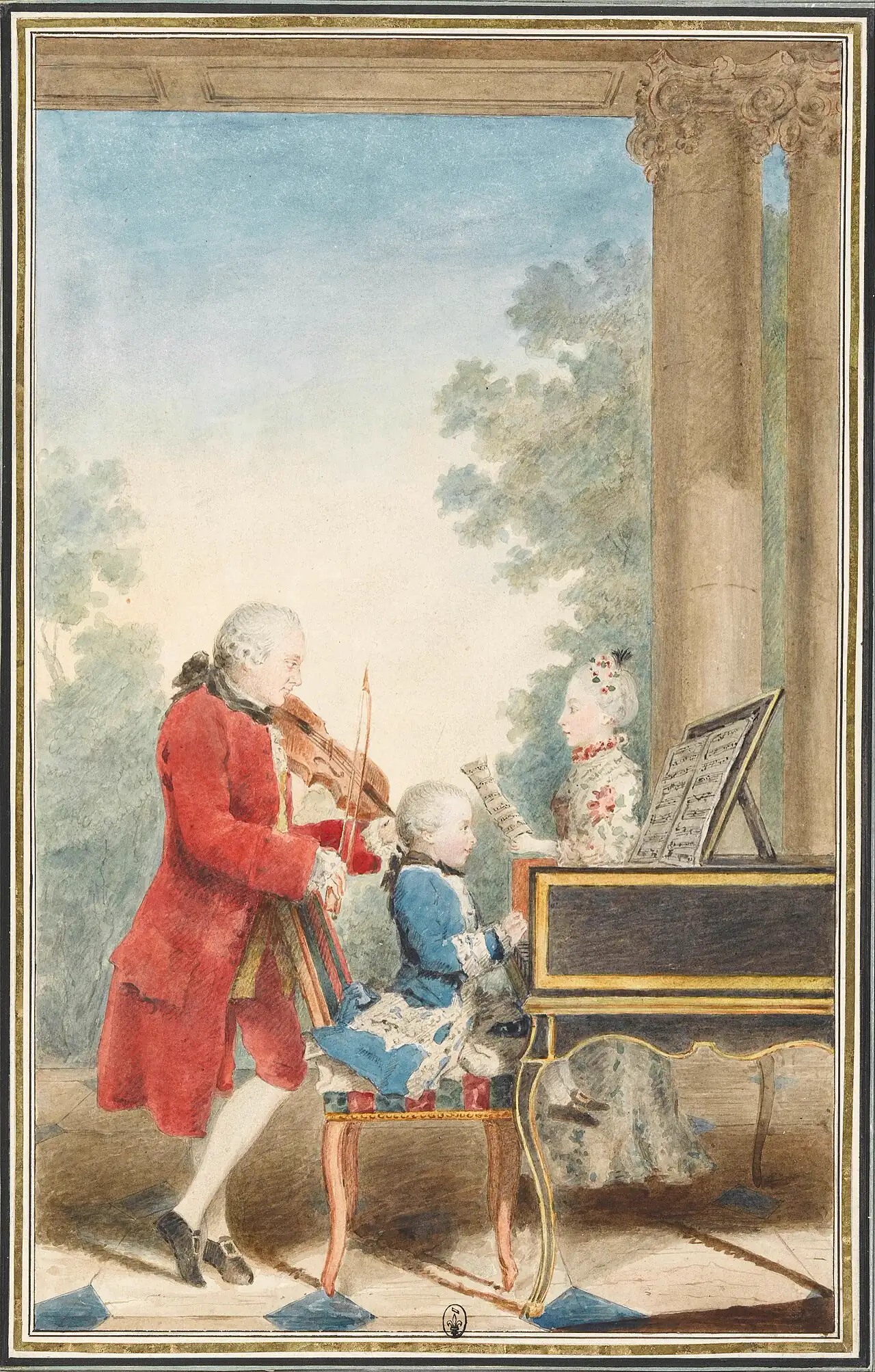
Louis Carrogis CarmontelleThe Mozart Family in Paris, 1763–64Watercolour and bodycolour over drawing · Musée Condé, Chantilly
Wolfgang sits at the harpsichord, Leopold stands behind him with his violin, and Nannerl holds the music. Carmontelle drew the family during their Paris visit. In April 1764 Leopold reported that an engraving of the portrait was being prepared, which would help carry the children’s fame beyond the rooms where they played. Museum catalogue.
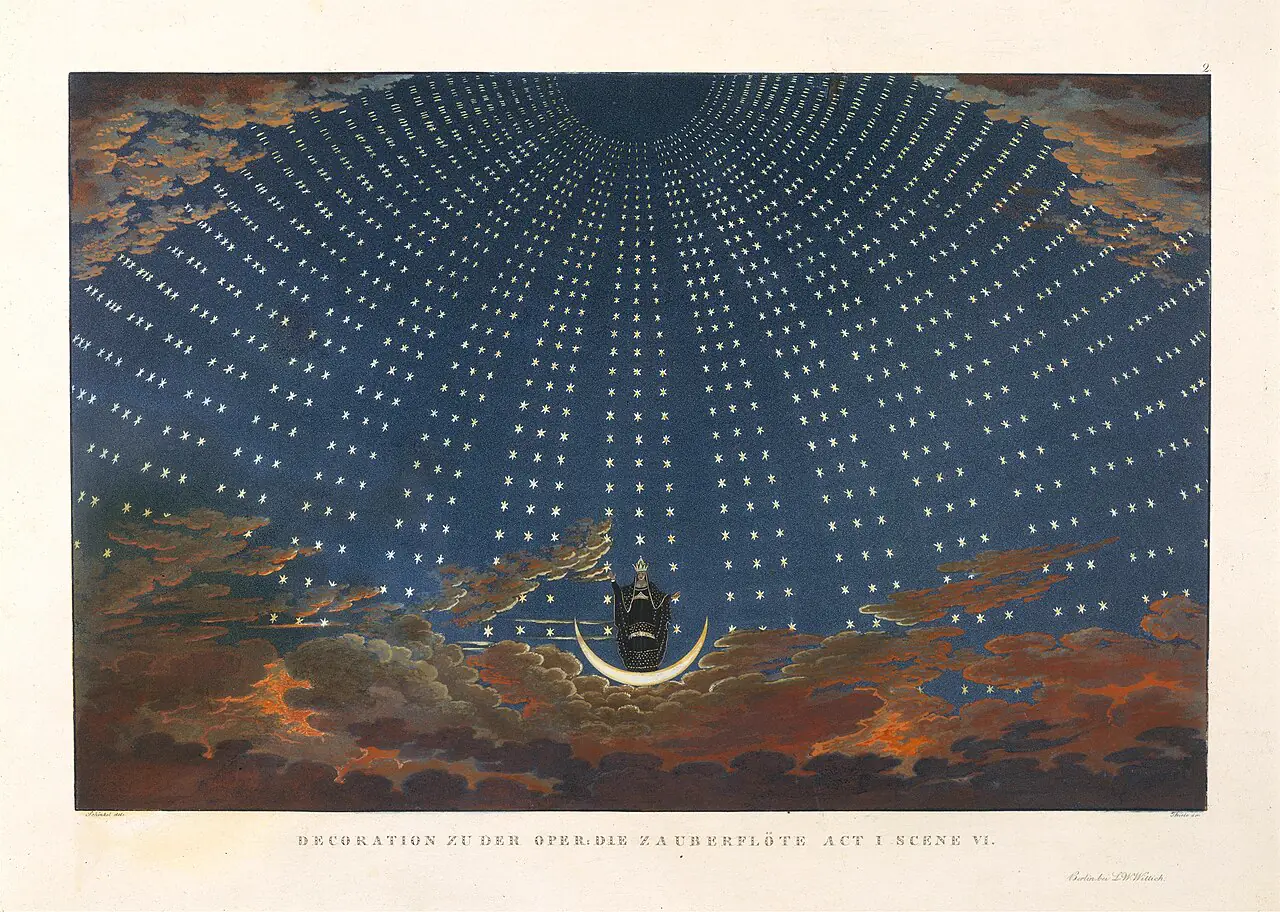
Karl Friedrich Thiele, after Karl Friedrich SchinkelThe Hall of Stars in the Palace of the Queen of the Night, 1847–49, after the design for the 1816 productionHand-coloured aquatint · Metropolitan Museum of Art, New York
The Queen stands on a crescent moon beneath rows of stars that curve into a dome. Schinkel made this setting for the Berlin Magic Flute of 1816; Thiele’s later print records it. The singer is a small figure inside the painted sky. Museum catalogue.
Johann Wolfgang von Goethe
Das Veilchen — opening
1774; published 1775
GermanEin Veilchen auf der Wiese stand,
Gebückt in sich und unbekannt,
Es war ein herzigs Veilchen.
Da kam eine junge Schäferin
Mit leichtem Schritt und munterm Sinn
Daher, daher,
Die Wiese her und sang:
Our translationA violet stood in the meadow,
bent into itself and unknown;
it was a dear little violet.
Then came a young shepherdess,
with light step and cheerful mind,
this way, this way,
across the meadow, singing:
In Goethe’s poem a violet wishes to be picked by a passing girl, who treads on it instead. Mozart set the poem on 8 June 1785 and added words of his own at the end: Das arme Veilchen! After a pause he repeats the words that called it a dear little flower. Köchel catalogue record.
Lorenzo Da Ponte
Le nozze di Figaro — forgiveness in the final scene
1786
ItalianIL CONTE: Contessa, perdono!
LA CONTESSA: Più docile io sono,
e dico di sì.
TUTTI: Ah tutti contenti
saremo così.
Our translationTHE COUNT: Countess, forgive me!
THE COUNTESS: I am more yielding,
and I say yes.
ALL: Ah, then we shall all
be content.
Shortly before, the Count answered every plea for forgiveness with “No”. He then asked forgiveness himself. The Countess grants it, and Mozart has the whole company take up her music. Da Ponte gave her few words. Text: the 1786 Vienna libretto.
Recommended recordings
Le nozze di FigaroGundula Janowitz, Edith Mathis, Hermann Prey, Dietrich Fischer-Dieskau; Deutsche Oper Berlin, Karl BöhmDeutsche Grammophon · 1968The main reason to choose this recording is Janowitz’s Countess, sung with long, sustained lines. Fischer-Dieskau plays the Count as a dangerous man. Böhm keeps the ensembles together and does not hurry the singers.
Don GiovanniEberhard Wächter, Elisabeth Schwarzkopf, Joan Sutherland, Giuseppe Taddei; Philharmonia Orchestra, Carlo Maria GiuliniEMI · 1959Taddei sings Leporello and Wächter sings Giovanni, and the continuo keeps their recitative exchanges moving. Giulini conducts the Philharmonia, with Frick as the Commendatore.
Piano ConcertosMitsuko Uchida, English Chamber Orchestra, Jeffrey TatePhilipsWorth hearing for Uchida, though Tate’s English Chamber Orchestra sometimes lets the argument slacken. Her later Cleveland recording of K. 488 has more alert orchestral replies.
Symphonies Nos. 39–41Royal Concertgebouw Orchestra, Nikolaus HarnoncourtTeldecThe G minor Symphony has an unusually firm pulse. In the “Jupiter” finale, the Concertgebouw’s precision keeps the competing themes audible through the coda.
Lineage
Drew fromJohann Christian BachLeopold MozartJoseph HaydnItalian opera
The dedication to Haydn went with music that the older composer had heard in Mozart’s rooms. Beethoven played the D minor Concerto and wrote cadenzas for its first movement and finale. His cadenzas return repeatedly to the rhythms Mozart had given the orchestra.
Further reading
Maynard Solomon, Mozart: A Life (HarperCollins, 1995). biography
Document-based biography with an explicitly interpretative account of Mozart’s family and career.
Cliff Eisen and Stanley Sadie, ‘Mozart, (Johann Chrysostom) Wolfgang Amadeus’, Grove Music Online (Oxford University Press, 2001). reference
Biographical reference, work-list and bibliography; subscription required.