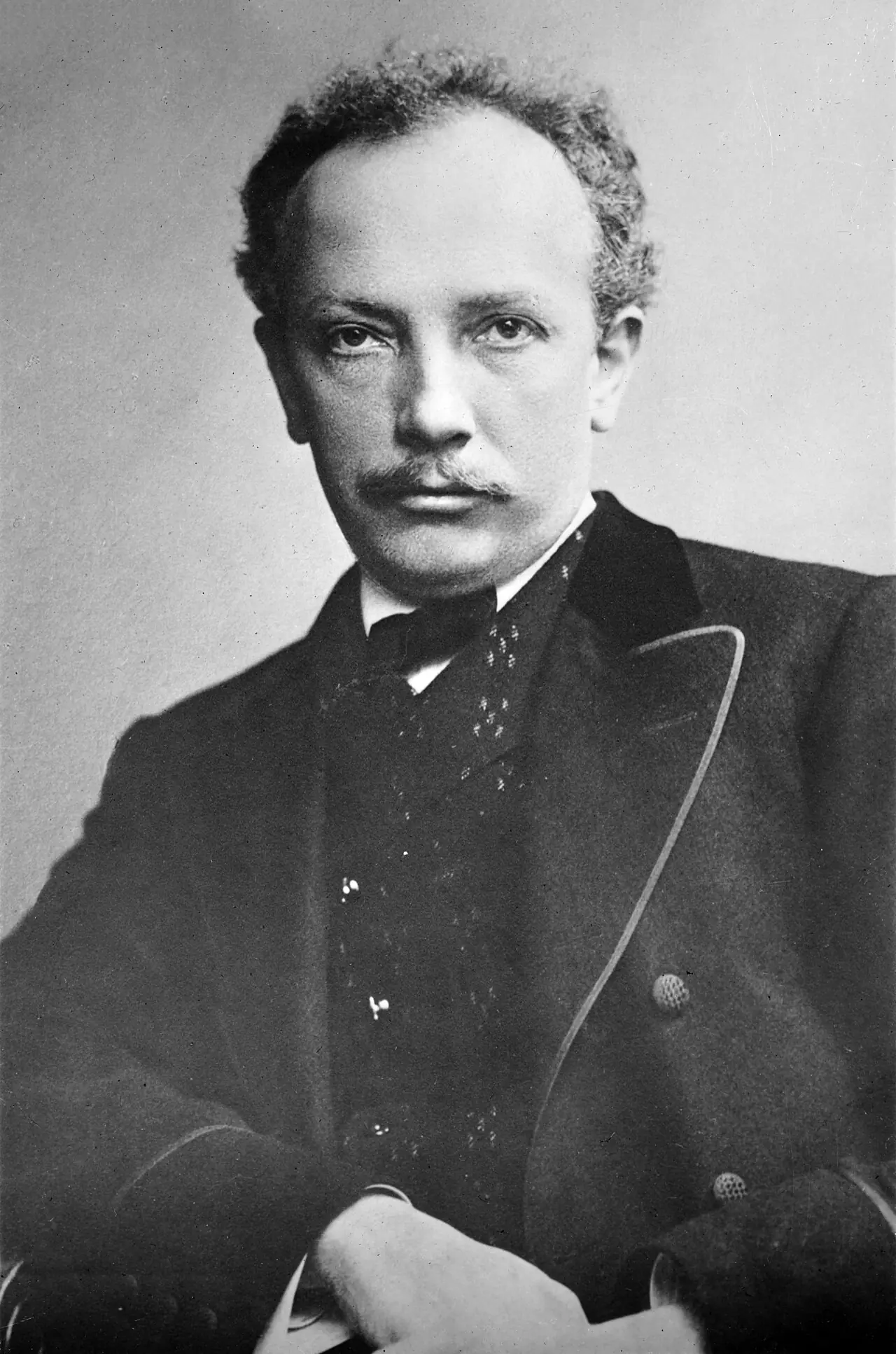
Munich, with Friedrich Wilhelm Meyer; conducting with Hans von Bülow at Meiningen
Posts
Munich · Weimar · Berlin Court Opera, 1898–1918 · Vienna State Opera, 1919–24
Collaborator
Hugo von Hofmannsthal: six operas, 1909–33
Output
Tone poems, fifteen operas, two horn concertos and more than two hundred songs
Life
Richard Strauss grew up hearing the horn. His father Franz played in the Munich Court Orchestra, including the first performances of Wagner’s Tristan and Die Meistersinger, and detested the music. At home, Mozart was placed above every other composer, and Haydn and Beethoven were also approved. Richard, born in 1864, had piano lessons from the age of four and was composing at six. His mother Josepha came from the Pschorr brewing family. He studied privately with Friedrich Wilhelm Meyer and learnt how an orchestra sounds from the players who worked beside his father.
Hans von Bülow took him to Meiningen in 1885. At twenty-one he had an orchestra of his own to rehearse, as well as a choir and a princess to teach. The violinist Alexander Ritter, married to Wagner’s niece, completed his conversion to the music his father disliked. Ritter also urged Liszt’s symphonic poems upon him. Strauss spent the next decade writing for the concert orchestra without voices.
1888–98The tone poems and marriage
He conducted Don Juan at Weimar in November 1889. The strings open with a rapid upward rush; later, an oboe plays a long love theme and four horns answer with a theme in unison. Then the E major of the opening changes to E minor. Tod und Verklärung follows a dying artist through memories towards a large final vision; Till Eulenspiegel gives its rogue a horn theme and a clarinet figure that represents a laugh. Till goes to the gallows, and the music continues after the execution.
In Also sprach Zarathustra (1896), Nietzsche’s sun rises from a low C and a trumpet’s C–G–C. The third of the chord alternates between major and minor. Much later, after the fugue and the waltz, the high woodwind hold B major while the basses continue to pluck C. Don Quixote makes a solo cello the knight and gives Sancho Panza a viola, with bass clarinet and tenor tuba. Flutter-tonguing winds imitate the sheep the knight mistakes for an army. A wind machine accompanies his flight through the air, which takes place only in his own estimation.
In 1894 Strauss married the soprano Pauline de Ahna and gave her the four songs of Op. 27 as a wedding present. She had sung Freihild in his first opera, Guntram, and later appeared with him in song recitals. In Ein Heldenleben she is portrayed by the solo violin, which is by turns coaxing and argumentative, and the hero’s achievements include quotations from Strauss’s earlier scores. Their son Franz was born in 1897. In Sinfonia domestica, first performed in New York in 1904, the orchestra portrays the whole family.
1905–09Salome and Elektra
Salome opened in Dresden on 9 December 1905. Strauss had cut Oscar Wilde’s play in Hedwig Lachmann’s German translation and set the remaining words himself. A clarinet curls upwards at the start; before the act is over, Salome will kiss the severed head of the prophet who refused her. The orchestra makes the kiss sound like the fulfilment of a love scene. Herod has her killed. Strauss had spent years conducting opera in Munich, Weimar and Berlin.
Hofmannsthal’s Elektra offered another woman who could think of little except a dead man. Strauss was uncertain about following Salome with it, but on 11 March 1906 he told the poet: “We were born for one another.” Elektra opened in Dresden in January 1909. Its orchestra can cover a voice, then drop away to leave a few words exposed. When Elektra recognises her brother Orest, the music on his name turns quiet and lyrical. After he has killed their mother, she dances in triumph and then collapses. The score sets E major against C♯ major until E♮ and E♯ sound together as a dissonance.
1911–29Der Rosenkavalier and Hofmannsthal
Then came Der Rosenkavalier. In its invented eighteenth-century Vienna, nineteenth-century waltzes accompany a boorish baron, a young man in disguise and the woman who knows she will lose him. The Marschallin’s Act I talk about time is close to conversation; in the last trio her voice must float beside those of Octavian and Sophie as she lets the lovers go. It opened in Dresden in 1911. Ariadne auf Naxos followed in 1912, awkwardly attached to Molière’s Le Bourgeois gentilhomme. In 1916 a new prologue explained the absurdity: a rich patron has ordered the tragic opera and the comedians to perform at once.
Strauss continued to write large orchestral works. Eine Alpensinfonie (1915) begins before dawn, reaches a summit and brings the climbers down through a storm, with parts for wind machine and thunder machine. Die Frau ohne Schatten, completed during the war and first performed in Vienna in 1919, sets Hofmannsthal’s fairy tale of an empress who must acquire a human shadow. Strauss co-directed the Vienna State Opera from 1919 to 1924 and helped Hofmannsthal and Max Reinhardt establish the Salzburg Festival. His own domestic comedy, Intermezzo, put a version of Pauline on stage.
Hofmannsthal died in July 1929, before he could make the revisions Strauss wanted to Arabella. The composer wrote to his widow: “No one will replace him for me or for the musical world.” Stefan Zweig became his next librettist and wrote Die schweigsame Frau. By the time of its Dresden première in 1935, the name of a Jewish writer on a theatre programme had become a matter of political dispute.
1933–49Reichsmusikkammer, late works and death
In 1933 Strauss accepted the presidency of the Reichsmusikkammer, the Nazi state’s music authority. He used his fame in its service and continued taking official commissions. Zweig wanted to end their collaboration. In a letter of 17 June 1935, Strauss abused his “Jewish obstinacy”, then declared that the nationality of his audience was immaterial, “as long as the people have paid the full box-office price”. The Gestapo intercepted the letter; he lost his office. His Olympic Hymn was performed at the Berlin Games the following year.
In 1944, after lunch at Garmisch, Strauss sat at the piano and played and sang songs to Hans Hotter for four hours. Hotter remembered the jokes and the energy of a man approaching eighty. In the Second Horn Concerto Strauss had returned to the instrument of his childhood; the Oboe Concerto followed in 1945. That year he also finished Metamorphosen for twenty-three solo strings. Munich’s opera house had burned. In the work the string parts move around one another until the bass plays the funeral march from Beethoven’s “Eroica”. Strauss wrote “In memoriam” beside it.
He and Pauline spent the post-war years in Switzerland and returned to Garmisch in 1949. Strauss wrote four orchestral songs in 1948. In September a solo horn plays after the singer has stopped; in Beim Schlafengehen a violin rises. Im Abendrot recalls the theme from Tod und Verklärung, written nearly sixty years earlier. Strauss died on 8 September 1949. The publisher gave the songs their collective title and order; Kirsten Flagstad and Wilhelm Furtwängler first performed them in London in May 1950.
Places
Every recorded place, joined in date order. Strauss on the MapAll 25 places, with sources
Munich · 11 June 1864 · born
Born into a musical family; his father Franz was a court-orchestra horn player.
In Don Quixote solo instruments represent characters. The cello plays the knight and a viola plays Sancho Panza, with bass clarinet and tenor tuba also taking part in the servant’s music. Flutter-tongued wind instruments imitate the bleating of the sheep.
♯Harmony
Strauss could set two plain chords against each other. The Elektra chord combines E major with C♯ major: they share G♯, but E♮ clashes with E♯. At the end of Zarathustra, the woodwind play B major while the basses pluck C, and the piece ends without resolving the two.
𝄢Counterpoint
In Metamorphosen, each of the twenty-three string players has a separate part. Phrases pass from player to player and build gradually into a long, slow polyphonic movement. Near the end, the bass quotes the funeral march from Beethoven’s “Eroica”, which makes the resemblance explicit. The other voices continue around the quotation.
𝅘𝅥Voice
The Marschallin’s lines are set close to the rhythm of ordinary speech. In the last trio of Der Rosenkavalier, her phrases lengthen beside Octavian’s and Sophie’s, and the three women’s voices sing the farewell together. Strauss’s soprano writing can call for very long phrases on a single breath; in Beim Schlafengehen, a solo violin plays an extended passage before the singer returns.
𝄋Form and story
The horn tune in Till Eulenspiegel returns with each new prank, and serves as the subject of a rondo. Don Quixote consists of ten variations depicting ten adventures, from the windmills to the defeat by the Knight of the White Moon. At the end, the cello stops playing the hero and plays a quiet farewell to the dying man.
𝄆Waltzes
The waltzes of Der Rosenkavalier are anachronistic. The opera is set in the eighteenth century, and the waltz belongs to the century after it. Strauss used waltz rhythm to make Baron Ochs both seductive and ridiculous. The same triple time appears in the dance in Zarathustra and in the fatal celebrations of Elektra.
After Nikolaus Lenau; Strauss conducted the first performance in Weimar in 1889. The work moves from a fast E major opening to a quiet close in E minor.
Also sprach ZarathustraOp. 30Large orchestra and organ
After Nietzsche, with chapter titles borrowed from his book. The famous sunrise occupies only the opening of a work lasting about half an hour.
1896–97
Don QuixoteOp. 35Orchestra with solo cello and viola
Ten variations follow Cervantes’s knight through his adventures. After the battles, the solo cello plays his return to sanity and his death.
1897–98
Ein HeldenlebenOp. 40Large orchestra with extensive solo violin
The hero’s companion is a solo violin portrait of Pauline. When his works of peace are recalled, the orchestra quotes Strauss’s own scores.
1903–05
SalomeOp. 54Opera in one act
Wilde’s play in Hedwig Lachmann’s German translation, cut by Strauss. The last monologue is sung to Jochanaan’s severed head.
1906–08
ElektraOp. 58Opera in one act; very large orchestra
The first opera with Hofmannsthal, premièred in Dresden in 1909. The recognition of Orest is a brief respite in a score whose subject is murder.
1909–10
Der RosenkavalierOp. 59Opera in three acts
Octavian is a young man sung by a woman, and he spends part of the opera disguised as a woman. In the final trio he sings with the Marschallin and Sophie.
1911–12; revised 1916
Ariadne auf NaxosOp. 60Opera with chamber orchestra
In the 1916 version, a patron requires the tragic opera and the comedy to be performed together on the same stage. The new prologue shows the backstage negotiations that follow.
1911–15
Eine AlpensinfonieOp. 64Large orchestra, offstage brass, organ, wind and thunder machines
Twenty-two named sections describe a mountain climb that begins and ends in darkness. The orchestra depicts a waterfall, cowbells and a storm.
1944–45
MetamorphosenTrV 290Twenty-three solo strings
Completed in April 1945. The closing quotation from Beethoven’s “Eroica” carries the inscription “In memoriam”.
Three poems by Hesse and one by Eichendorff, gathered under their title after Strauss’s death. Im Abendrot, usually performed last, was composed first; Strauss wrote Malven afterwards.
Also sprach Zarathustra, first trumpet entryC–G–C and the third
Quoted from bars 5–6 of Also sprach Zarathustra, the first trumpet at concert pitch. C–G–C gives a fifth and an octave; the final quaver adds E♮, immediately before the harmony changes. The opening brass staves show the surrounding parts.
A schematic of the Elektra chord. E major and C♯ major share G♯; superimposing them puts E♮ against E♯, a semitone apart. Each of the two triads remains recognisable on its own.
Sister arts
Friedrich Nietzsche
Also sprach Zarathustra — Zarathustra’s prologue, §1
1883
GermanDu grosses Gestirn! Was wäre dein Glück, wenn du nicht Die hättest, welchen du leuchtest!
Our translationYou great star! What would your happiness be if you did not have those upon whom you shine!
After ten years in the mountains, Zarathustra addresses the sun and prepares to descend to other people. Strauss begins his response with the low C and trumpet call of sunrise. Later headings, including the dance and the convalescent, come from other chapters of Nietzsche’s book.
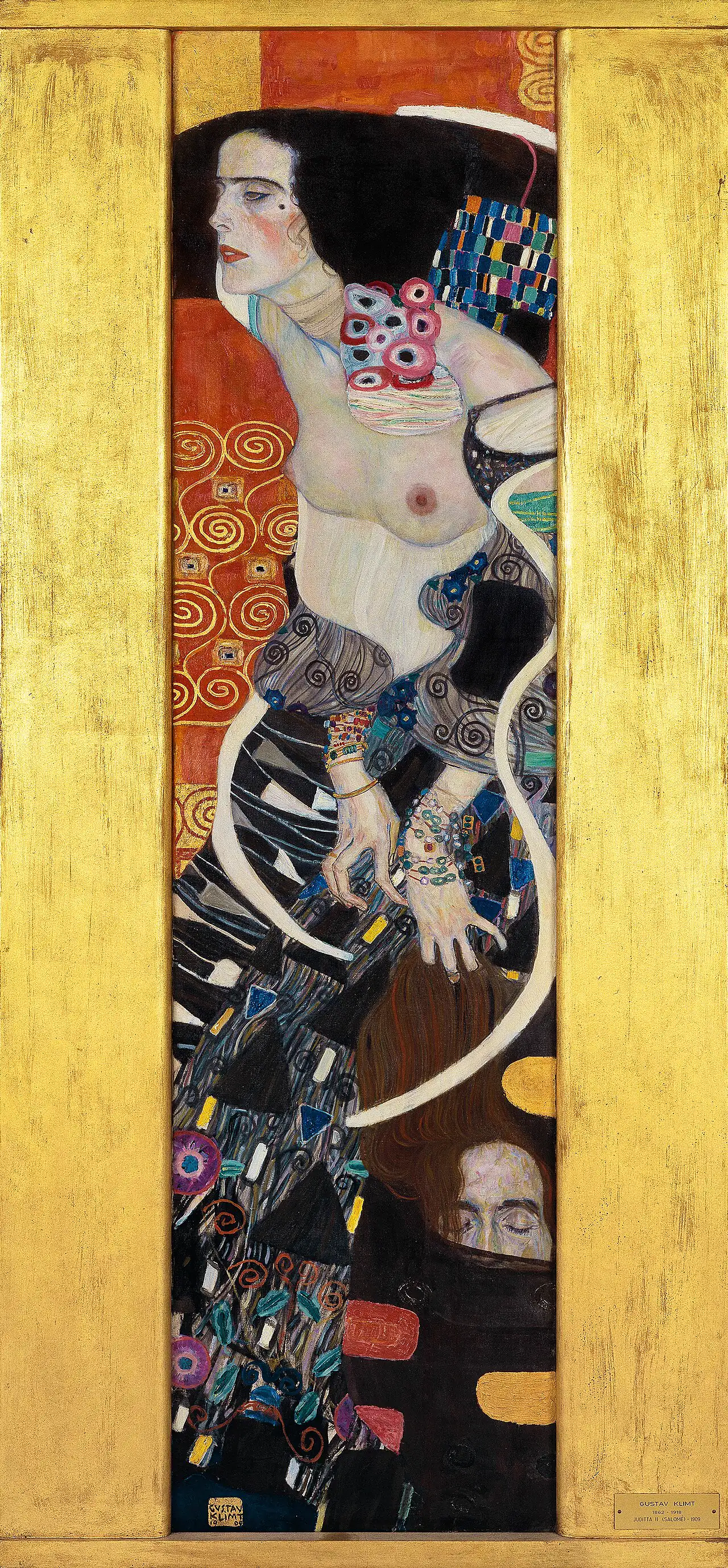
Gustav KlimtJudith II (Salome), 1909Oil on canvas · Ca’ Pesaro, Venice
When Klimt showed this painting in Venice in 1910, the critic Gino Damerini called its woman a little sister of Wilde’s Salome. Judith was already being confused with Salome in the picture’s early reception. The painting shows her tense hands and the severed head, and it is placed here beside Strauss’s opera.
Hugo von Hofmannsthal
Der Rosenkavalier — the Marschallin on time
1911
GermanDie Zeit, die ist ein sonderbar Ding.
Wenn man so hinlebt, ist sie rein gar nichts.
Aber dann auf einmal,
da spürt man nichts als sie.
Sie ist um uns herum,
sie ist auch in uns drinnen.
Our translationTime is a strange thing.
When you simply go on living, it is nothing at all.
But then, all at once,
you feel nothing but time.
It is all around us;
it is also inside us.
Hofmannsthal gave the Marschallin these words in Act I, when she is alone with Octavian, the young lover she knows she will lose. Strauss set them close to speech, with pauses filled by the orchestra. In the final trio she lets Octavian leave with Sophie.
Recommended recordings
SalomeBirgit Nilsson, Gerhard Stolze, Eberhard Wächter, Vienna Philharmonic, Georg SoltiDecca · 1961Nilsson’s top notes are bright and steady and carry over the orchestra. Stolze sings Herod in short, broken phrases. Solti conducts the scenes between them at full intensity.
ElektraBirgit Nilsson, Regina Resnik, Marie Collier, Tom Krause, Vienna Philharmonic, Georg SoltiDecca · 1966–67Birgit Nilsson sings Elektra and softens her voice at Orest’s name. Regina Resnik sings Klytämnestra and delivers the account of her nightmares as a description of symptoms.
Der RosenkavalierElisabeth Schwarzkopf, Christa Ludwig, Teresa Stich-Randall, Otto Edelmann, Philharmonia Orchestra, Herbert von KarajanEMI · 1956Schwarzkopf marks a change of thought within a single word. Ludwig sings Octavian as an impetuous partner, and the bedroom conversation is as well performed as the final trio.
Strauss kept both his father’s Mozart and his own Wagner. In Ariadne the same small orchestra accompanies a comedian’s patter and a soprano’s great lament. Schoenberg learnt from the tone poems, and Strauss helped him early in his career. Berg and Korngold each took something different from Strauss’s operas. Berg took the use of the orchestra to show a character’s mind, and Korngold took its use in love scenes.