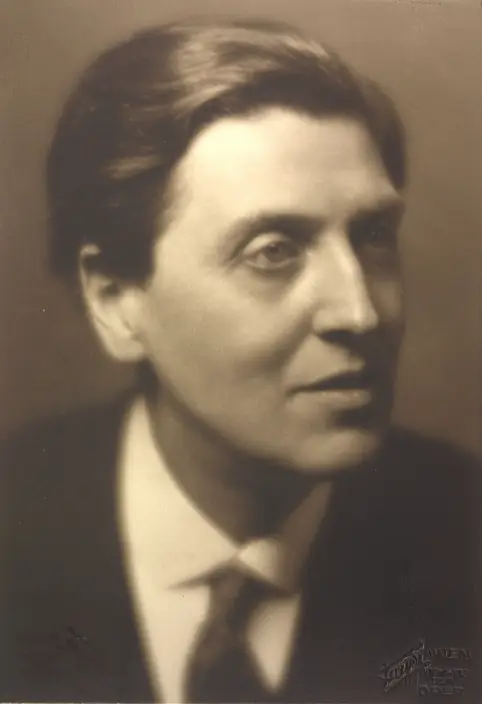
Born 9 February 1885, ViennaDied 24 December 1935, Vienna
Composer of Wozzeck, an opera about an exploited soldier, and of a twelve-note concerto that quotes a Bach chorale and is dedicated to the memory of Manon Gropius.
Violin Concerto, 1935; commissioned by Louis Krasner, dedicated to Manon Gropius
Life
In 1904 Berg’s brother Charly secretly took some of Alban’s songs to Arnold Schoenberg. Their sister Smaragda had spotted an advertisement for lessons in harmony and counterpoint. Alban was nineteen, a bookseller’s son from Vienna, writing songs and working in the civil service. His father had died four years earlier, and there was little money for tuition. Schoenberg accepted him all the same, though he could not pay the fee. Recalling their first meeting in a recording made in 1949, Schoenberg described “a very tall youngster and extremely timid”, whose songs stood stylistically between Hugo Wolf and Brahms.
An inheritance in 1906 allowed Berg to leave the office. When his mother proposed the conservatoire, Schoenberg heard, he wept until she agreed he could stay with his teacher. Lessons lasted until 1910. The Piano Sonata, Op. 1, completed in 1908, shows Schoenberg’s developing variation at work: small phrases change and grow, through whole-tone passages to a final B minor. The String Quartet, Op. 3, shares its themes between two movements; its opening idea returns near the close.
1911–14Altenberg songs and Three Orchestral Pieces
Berg married Helene Nahowski in May 1911. He knew Adolf Loos and Peter Altenberg, and read Karl Kraus’s attacks on Vienna’s newspapers and respectable morals. He set texts from Altenberg’s picture postcards as five songs for a very large orchestra. Two were played under Schoenberg in Vienna on 31 March 1913, at a concert that broke up in uproar. When Berg visited Schoenberg in Berlin that June, he received a bruising criticism of the songs and of his Four Pieces for Clarinet and Piano.
His teacher wanted a larger work. Berg began a symphony, then turned to the Three Orchestral Pieces. The Präludium opens with quiet percussion, and the climaxes of the march recall Mahler’s Sixth. He sent these two pieces to Schoenberg for his fortieth birthday in September 1914, and in his anxiety asked him to accept the good intention if the music fell short. Reigen, the waltz, was not yet finished.
1914–25Wozzeck
On 14 May 1914 Berg saw Büchner’s Woyzeck in Vienna and decided to make an opera of it. The edition he used called the soldier Wozzeck. A year later Berg was in uniform. Ill health brought him from army training to the War Ministry, where he served until 1918. “There is a part of me in this figure too,” he wrote to Helene on 7 August that year, adding that he too was “dependent on people I detest”. He worked on the opera during leave.
Wozzeck earns extra money by shaving his Captain and submitting to the Doctor’s experiments. The Captain lectures him about morality while the razor is in his hand; the Doctor is delighted by symptoms of mental collapse. Berg set the Doctor’s examination as a passacaglia, variations on a recurring twelve-note theme. In another scene Marie sings their child a lullaby. Later, after her murder, an out-of-tune tavern piano plays a polka while Wozzeck tries to dance with blood on him.
The full score was finished in 1922. At Marie’s murder, B♮ swells through the orchestra after Wozzeck has cut her throat. When he drowns in the pond where he has tried to hide the knife, an interlude brings his music together in D minor. Then children are playing outside Marie’s door. They hear that her body has been found and run off to look; her son carries on with his game before following them.
Erich Kleiber conducted the première at the Berlin State Opera on 14 December 1925. Further productions followed across Europe, and their royalties supported Berg while he worked on Lulu. He had also completed the Chamber Concerto, a belated fiftieth-birthday gift for Schoenberg. Its opening spells out musical letters from the names of Schoenberg, Webern and Berg. The piano leads the first movement and the violin the second. In the finale the two soloists play their earlier music together, accompanied by thirteen wind instruments.
1925–26The Lyric Suite and Hanna Fuchs
In Prague in 1925, Berg stayed with Herbert and Hanna Fuchs-Robettin while Zemlinsky conducted excerpts from Wozzeck. He fell in love with Hanna. Both were married. The Lyric Suite, which he wrote afterwards, had two dedications, Zemlinsky’s on the published score and Hanna’s in a copy covered with private annotations. In German note names, A–B♭ spells Alban Berg and B♮–F spells Hanna Fuchs. In the third movement the strings play these four notes. Across the six movements, the fast music grows faster and the slow music slower.
The final movement carries the words of Baudelaire’s De profundis clamavi, in Stefan George’s German translation, concealed beneath the instrumental lines. In the poem the speaker begs the beloved for pity from the bottom of a dark abyss. Berg also borrowed from Zemlinsky’s Lyric Symphony and Wagner’s Tristan und Isolde. In the second movement the cello plays repeated pizzicato Cs, “Do-Do”, the nickname of Hanna’s daughter. The Tristan chord descends over them.
1929–35Lulu and the Violin Concerto
For his second opera Berg joined Wedekind’s Erdgeist to Die Büchse der Pandora, which he had seen in Karl Kraus’s production in 1905. The first scene of Lulu takes place in a painter’s studio. Her portrait goes with her through successive households and finally to a London garret. Men marry her and bargain over her. At the centre of Act II a silent film shows her imprisonment and escape, accompanied by music that reverses around its midpoint. The singers who played her husbands return as her clients in the final scene, and the baritone who sings Dr Schön also sings Jack the Ripper.
In November 1934 Kleiber conducted the Lulu symphonic excerpts in Berlin, amid growing Nazi hostility to Berg’s music. German performances were disappearing, and his income with them. The American violinist Louis Krasner’s commission arrived early in 1935, while Berg was still orchestrating the opera. On 22 April Manon Gropius, Alma Mahler’s daughter by the architect Walter Gropius, died of polio, aged eighteen. Berg put Lulu aside and wrote on the concerto’s title page: “To the memory of an angel”.
1935The Violin Concerto
That June Krasner visited Berg at his house by the Wörthersee and improvised for hours so that the composer could learn his playing. The concerto begins with the violin playing its open strings, G–D–A–E. These notes underlie the overlapping triads in its twelve-note row. On 16 July Berg told Krasner he had finished the composition the previous day. “The work was giving me more and more pleasure,” he wrote.
The first movement includes a Carinthian folk song, passed between horn, solo violin and trumpets. The second begins violently, continues through a cadenza and then moves into the quiet chorale. During its variations, orchestral violins join the soloist one by one; Berg asks the soloist to lead them visibly as well as audibly. He finished the orchestration in August and died of septicaemia on Christmas Eve. Krasner gave the première in Barcelona in April 1936, with Hermann Scherchen conducting.
Lulu lay complete in short score, with much of Act III not yet orchestrated. Zurich staged the two finished acts in 1937. Friedrich Cerha’s completion reached the Paris Opéra in February 1979, with Pierre Boulez conducting and Teresa Stratas as Lulu. In the final scene, set in a London room, Countess Geschwitz sings the last words after Jack has stabbed her.
Places
Every recorded place, joined in date order. Berg on the MapAll 13 places, with sources
Vienna · 9 February 1885 · born
Born in Vienna, where he lived for most of his life.
The Violin Concerto’s twelve-note row contains four chords: G minor, D major, A minor and E major. Each starts on one of the violin’s open strings, and neighbouring triads share a note. At the other end of the row, four notes climbing through three whole tones prepare the opening of Bach’s chorale.
𝅘𝅥Singing and speech
In Wozzeck the Captain breaks into falsetto in the middle of a lecture on morality, and Wozzeck answers his orders on a repeated note. Marie’s lullaby uses open fourths and fifths, set in their cramped room. Berg moves between measured speech and full singing as each scene requires, so that a single character can change vocal manner within one conversation.
𝄋Forms on stage
The Doctor examines Wozzeck over a passacaglia, a recurring theme with twenty-one variations. In Lulu, the film music for the imprisonment and escape uses a palindrome, which runs backwards after a central piano arpeggio. Lulu and the people around her are given related twelve-note rows, which govern the pitches they sing.
𝄞The orchestra
The Three Orchestral Pieces begin with percussion at the edge of audibility, before violins and bassoon bring in a melody. The final march calls for six horns and a large hammer. Berg could also reduce his forces sharply. The Violin Concerto opens with harp and clarinets around the soloist’s open strings, and its last pages return to the material of the opening.
𝄪Borrowed music and initials
In the Lyric Suite, A–B♭ and B♮–F join Alban Berg’s initials to Hanna Fuchs’s; German notation calls B♭ “B” and B♮ “H”. These notes are most exposed in the quiet opening of the third movement. Other people are represented by borrowed tunes. Zemlinsky’s Lyric Symphony is quoted in the quartet, and in the concerto a Carinthian folk song passes from horn to violin.
𝄾Dance music
In the dressing-room scene of Lulu, an offstage band plays ragtime with banjo and sousaphone, followed by an English waltz. The dance band gradually merges with the pit orchestra. Wozzeck has an out-of-tune piano on stage for its tavern music, within a largely atonal score. In the Violin Concerto, Berg added an alto saxophone, played by the third clarinettist.
Works
A selection from the composer’s works.
1907–08
Piano Sonata in B minorOp. 1Piano
A single sonata movement whose opening phrases supply ideas for both hands throughout. Whole-tone passages move away from B minor, which returns in the closing bars.
1910
String QuartetOp. 3Two violins, viola and cello
Berg’s last work as Schoenberg’s pupil begins with a six-note figure in second violin and viola. The opening theme returns near the end of the second movement.
1911–12
Five Orchestral Songs on Picture-Postcard Texts by Peter AltenbergOp. 4Voice and large orchestra
Altenberg’s short postcard texts are set for full orchestra. Schoenberg conducted two of the songs at the Vienna concert of 31 March 1913, which ended in uproar.
1913
Four Pieces for Clarinet and PianoOp. 5Clarinet and piano
Four miniatures dedicated to Schoenberg and his Society for Private Musical Performances. The society gave their première in Vienna in October 1919.
1913–15
Three Orchestral PiecesOp. 6Large orchestra
The Präludium opens with quiet percussion; in Reigen the waltz rhythm is made unsteady, and Marsch builds to climaxes for a very large orchestra. Berg sent the first completed pieces to Schoenberg for his fortieth birthday.
1914–22
WozzeckOp. 7Opera in three acts; voices, orchestra and stage ensembles
Büchner’s soldier shaves the Captain, sells his body to the Doctor’s experiments and murders Marie. An orchestral interlude in D minor follows his death, and then the children return to their games.
1923–25
Chamber ConcertoPiano, violin and thirteen wind instruments
The piano’s variations and the violin’s Adagio are superimposed in the finale. Musical spellings of Schoenberg, Webern and Berg introduce this birthday present to the teacher.
Six movements. The fast tempos get faster across the set and the slow ones get broader. Berg’s copy for Hanna Fuchs-Robettin reveals their initials and the Baudelaire poem hidden in the finale.
LuluOpera in three acts; third-act orchestration completed by Friedrich Cerha
Lulu’s portrait travels from the painter’s studio to her last room in London. A palindromic film interlude divides her rise from her fall; the singers who play her husbands return as her clients.
Written for Louis Krasner in memory of Manon Gropius, in two movements divided into four sections. A Carinthian folk song and Bach’s harmonisation of Es ist genug appear within the twelve-note writing.
Violin Concerto — row schematicFour chords on the open strings
Pitch schematic: the concerto’s row in equal crotchets, with illustrative octave placement. G–B♭–D forms G minor; D–F♯–A, D major; A–C–E, A minor; E–G♯–B, E major. Each triad begins on one of the violin’s open strings. The final four notes, B–C♯–E♭–F, rise by whole tones.
Chorale and concerto — pitch schematicChorale beginning at the end of the row
Pitch schematic in equal crotchets. The chorale opens with A–B–C♯–D♯; raising it a tone gives B–C♯–D♯–E♯, the ending of Berg’s row with E♭ and F respelt. Both groups climb through three whole tones. The concerto later quotes the chorale with Bach’s harmonisation.
Sister arts
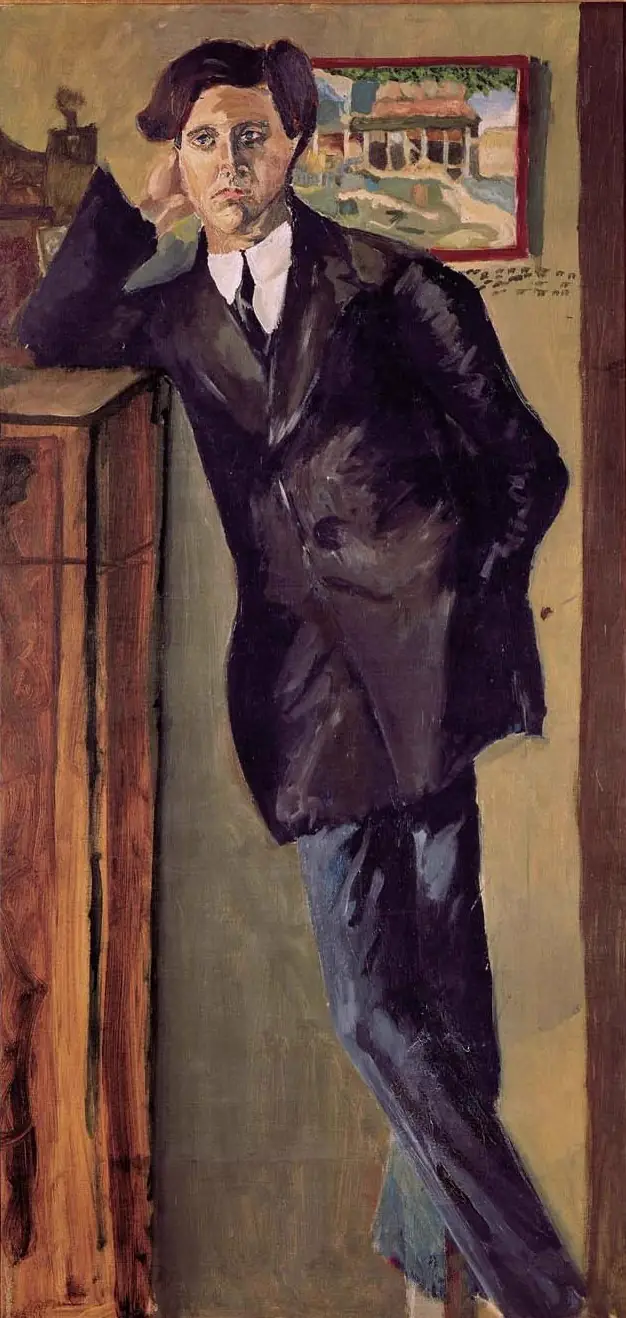
Arnold SchoenbergPortrait of Alban Berg, 1910Oil on canvas · Wien Museum, Vienna
Schoenberg painted Berg in 1910, the year his pupil finished the String Quartet, Op. 3, and his formal lessons. The canvas is almost 1.8 metres high and shows Berg as a tall, leaning figure. In a recorded reminiscence in 1949, Schoenberg recalled the nineteen-year-old who had first come to him as “extremely timid”.
Charles Baudelaire
De profundis clamavi — opening quatrain
1857; text from the 1861 edition
FrenchJ’implore ta pitié, Toi, l’unique que j’aime,
Du fond du gouffre obscur où mon cœur est tombé.
C’est un univers morne à l’horizon plombé,
Où nagent dans la nuit l’horreur et le blasphème ;
Our translationI implore your pity, You, the only one I love,
From the depths of the dark gulf where my heart has fallen.
It is a dismal universe with a leaden horizon,
Where horror and blasphemy swim in the night;
Baudelaire’s speaker calls to the beloved from a dark gulf. Berg set Stefan George’s German translation beneath the finale of the Lyric Suite, and wrote the words into the score he gave Hanna Fuchs-Robettin. The quartet’s four players perform the movement without the words; in performances with a singer the concealed text is sung.
Recommended recordings
WozzeckFranz Grundheber, Hildegard Behrens, Vienna Philharmonic, Claudio AbbadoDeutsche Grammophon · 1987The first choice for the opera as theatre. Grundheber and Behrens sing the soldier and Marie; Abbado conducts the Vienna strings. Recorded at the Vienna State Opera.
Violin ConcertoAnne-Sophie Mutter, Chicago Symphony Orchestra, James LevineDeutsche GrammophonMutter plays even the lyrical passages with an exposed tone and keeps her sweetest tone for the ending. Levine brings the orchestral lines sharply forward, which suits both the violent and the consoling music of the concerto’s second movement.
LuluTeresa Stratas, Paris Opéra forces, Pierre BoulezDeutsche Grammophon · 1979The complete version, recorded at the time of the Paris première of Cerha’s Act III. Stratas sings Lulu as a vulnerable figure, and Boulez keeps the dense orchestral writing distinct around her; Kenneth Riegel sings Alwa.
Where to hear more
Violin Concerto ‘To the Memory of an Angel’1935
Isabelle Faust, violin; Orchestra Mozart; Claudio Abbado, conductor · harmonia mundi · November 2010, Auditorio Manzoni, Bologna
Berg’s memorial to Manon Gropius quotes Bach’s chorale ‘Es ist genug’ in its final Adagio. Faust varies the colour of her violin tone, and Abbado keeps the orchestral detail clear in the approach to the chorale.
Schoenberg Quartet: Janneke van der Meer and Wim de Jong, violins; Henk Guittart, viola; Viola de Hoog, cello · Chandos · 6–8 February 2001, Waalse Kerk, Amsterdam
The six movements encode Berg’s love for Hanna Fuchs-Robettin. The fast movements become progressively faster and the slow ones progressively slower. Gramophone praised the Schoenberg Quartet’s handling of the changes of mood and the rising intensity.
Schoenberg taught Berg to build a movement from small musical ideas; Mahler’s waltzes and march climaxes return in the Three Orchestral Pieces. Britten wanted to study with Berg, but his parents refused permission. Boulez conducted Berg’s music, and in 1979 brought Cerha’s completed Lulu to the Paris stage with Teresa Stratas in the title role.