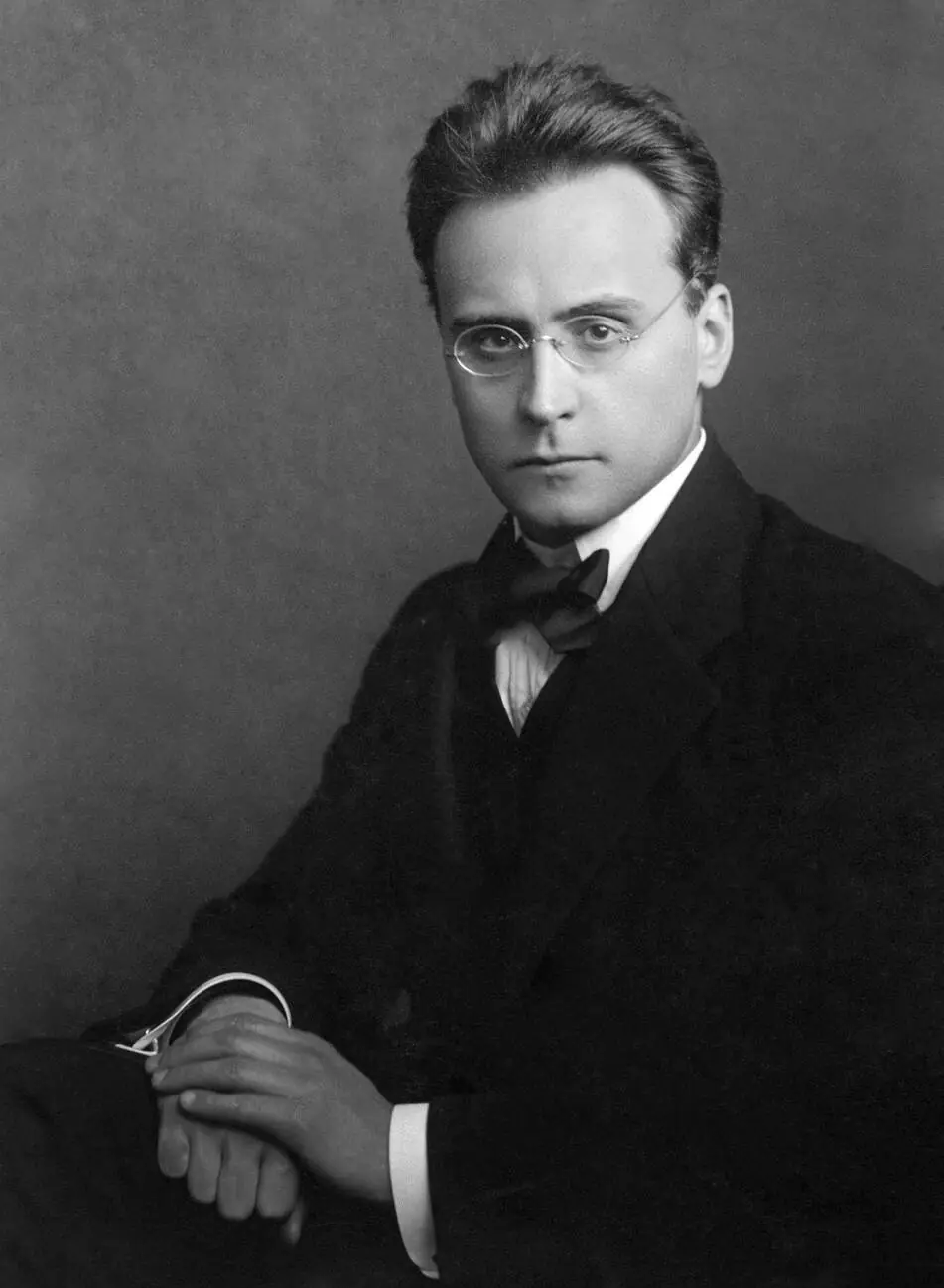
Isaac with Guido Adler; composition with Schoenberg, 1904–08
Livelihood
Theatre pits, workers’ choirs, Vienna radio and private lessons
Catalogue
Thirty-one opus numbers; further early works and arrangements
Output
String miniatures, songs, canons and two late cantatas
Life
When Peter Stadlen prepared the first performance of Webern’s Piano Variations in Vienna in 1937, the composer covered his score with instructions about expression. One phrase needed more vigour; another was an echo. Webern compared the opening movement to a late Brahms intermezzo. In the preface to his annotated edition, published in 1979, Stadlen recalled a “fervently lyrical mind bent on expressiveness”.
1883–1908Childhood, studies and Schoenberg
Webern was born in Vienna on 3 December 1883 and grew up in Graz and Klagenfurt, with holidays at Preglhof, the family estate in Carinthia. His mother, Amalie, played the piano and sang; he learnt piano and cello and joined the orchestra of the local concert society. The family played chamber music together. Later, when he was living away from home, he wrote in his letters about the woods and meadows around Preglhof and about his mother’s grave at nearby Schwabegg.
In 1902 he entered the University of Vienna to study musicology with Guido Adler. His doctorate of 1906 was an edition of music from Heinrich Isaac’s Choralis Constantinus, sacred vocal music in which the parts cross and answer one another. Composition lessons with Schoenberg began in 1904, when Berg also joined the class. That summer Webern wrote Im Sommerwind, an orchestral idyll after Bruno Wille. His unnumbered String Quartet of 1905 took its three-part design from Giovanni Segantini’s Alpine triptych.
The Passacaglia, Op. 1, completed in 1908, was his last major assignment with Schoenberg. Plucked strings state an eight-bar theme in D minor, and the orchestra builds variations above it to a sound still close to Mahler. A year later he wrote the Six Orchestral Pieces, Op. 6, which are much shorter. The fourth is a funeral march in which the percussion builds to a violent climax. Webern returned to the score in 1928, cutting instruments and revising both its phrasing and its sound.
1909–13Opp. 5 and 9, theatre posts
In the Five Movements for String Quartet, Op. 5, the players bow at the bridge, strike the strings with the wood of the bow or play harmonics, and within a few seconds the four instruments change sound. The Six Bagatelles, Op. 9, written in 1911–13, are shorter still. Several movements last less than a minute. Recalling them in a Vienna lecture in 1932, Webern said: “I had the feeling: once the twelve notes have run their course, the piece is finished.” The fifth uses faint pizzicatos and bowing near the bridge.
Meanwhile he was earning money in theatre pits. Engagements took him to Teplitz, Danzig, Stettin and Prague. Much of the work was operetta, and he resigned repeatedly. In February 1911 he married Wilhelmine Mörtl, known as Minna. They had four children. During the First World War he did intermittent military service and had little time to compose. He returned to the Vienna area, settling first in Mödling, where Schoenberg also lived, and later in Maria Enzersdorf.
After 1918Conducting, teaching and the Society
At Schoenberg’s Society for Private Musical Performances, Webern supervised rehearsals and arranged orchestral scores for the players available. Critics were excluded, and applause was forbidden. Outside the Society, he conducted workers’ choirs and the Social Democratic Workers’ Symphony Concerts. His programmes included Mahler and Brahms, and from 1927 Vienna radio also broadcast his conducting. Between 1925 and 1931 he also taught piano and directed a choir at Vienna’s Jewish Institute for the Blind.
Setting texts allowed him to write beyond the instrumental miniature. He worked on the Six Songs, Op. 14, between 1917 and 1921. They set poems by Georg Trakl, with their forests and ruined walls, for voice and changing combinations of clarinets and strings. In Abendland II the singer is accompanied by clarinet, violin and cello. Later, Hildegard Jone’s poetry provided the texts for songs and for both cantatas, which brought a chorus into his music.
In the Symphony, Op. 21, completed in 1928, a horn begins a line that continues in the clarinet and then the cello. A second horn follows with the intervals inverted. These two voices form part of a double canon, in which two pairs of lines imitate one another, spread across a small orchestra. The second movement is a theme and seven variations. Its clarinet theme divides into equal halves around the middle of the sixth bar.
The Concerto for Nine Instruments, Op. 24, followed in 1934. Its opening sets out four three-note groups, each given a different instrument and rhythm. After a rest the piano plays the row alone. Each group contains the same semitone and major third, inverted or reversed. The piano alternates with the ensemble.
1934–45Webern under Dollfuss and Nazi rule
In 1934 the Dollfuss dictatorship crushed Austria’s Social Democratic movement and dismantled the organisations that had employed Webern. His conducting career in Austria came to an end, and he came to depend more on private pupils and editorial work. Schoenberg had left for America in 1933; Berg died in 1935. Under Nazi rule Webern’s music was branded degenerate, and performances of his mature works took place largely outside the Reich.
Webern supported Hitler. On 2 May 1940 he wrote to his friend Josef Hueber praising the National Socialist state: “Created by this one man!” Hueber, then serving in the army, had sent him Mein Kampf; Webern’s reply of 4 March welcomed the book and predicted the pacification of the whole world, perhaps as far as the Pacific. He also helped Jewish friends: he wrote a recommendation for Otto Jokl to emigrate and remained in contact with Josef Polnauer. His devotion to Schoenberg continued; in 1944 he sent birthday greetings through Willi Reich.
The late scoresRicercar, Variations and Second Cantata
In 1935 he applied that way of hearing to Bach’s six-part Ricercar from The Musical Offering. Orchestral instruments take turns within the subject itself, changing colour as its chromatic notes descend. Webern conducted the première in London that April. His piano Variations of 1936 brought the same attention to short phrases. In Stadlen’s working score, arrows and slurs join notes across the spaces, and the final movement begins with an instruction to play elegiacally.
The Variations for Orchestra, Op. 30, grow from two ideas in the opening bars, given to double bass and oboe. Webern heard Hermann Scherchen conduct them in Winterthur in 1943. That year he finished his Second Cantata, Op. 31, setting Jone for soprano, bass, mixed chorus and orchestra in six movements. The orchestra includes an alto saxophone and celesta. He never heard the cantata performed; its première took place in Brussels in 1950.
September 1945Webern’s death at Mittersill
His son Peter was killed in an air attack in February 1945. In April Webern and Minna fled to Mittersill to join their family. On the evening of 15 September he went outside to smoke. American soldiers were carrying out an operation against the black-market dealings of his son-in-law, Benno Mattel, and one of them, Raymond Bell, shot Webern. He was sixty-one. Minna lived until 1949 and helped to secure publication of the music he left.
After the war, Boulez and Stockhausen studied the canons and short instrumental exchanges as starting points for their own music. Performances remained scarce. Robert Craft’s recordings, made in Los Angeles in 1954–56, made the entire numbered output available on records, from the Passacaglia for large orchestra to the Bagatelles and the late cantatas.
Places
Every recorded place, joined in date order. Webern on the MapAll 20 places, with sources
In the Six Bagatelles, a quartet movement can be over in less than a minute. A plucked note dies away before a bowed note follows; a harmonic changes the sound without adding another player. The fifth piece is played very softly, with soft pizzicato and bowing near the bridge.
𝄢Canons
The first movement of the Symphony runs two canons at once, and in each the answering line inverts the intervals. One melody passes from horn to clarinet to cello. Its partner passes from the other horn through bass clarinet to viola. The parallel routes help hold the lines together. As a student Webern had edited Isaac’s interwoven vocal parts. In the Symphony the imitating voices keep changing instrument.
𝄆Twelve-note rows
The Concerto for Nine Instruments opens with four groups of three notes, each built from a semitone and a major third. Webern turns these groups upside down or backwards to make the row. Different instruments and rhythms separate them, and then the whole ensemble rests. The piano follows alone with another statement of the row at the start of this twelve-note concerto.
𝄞String playing
In the Five Movements, Op. 5, the quartet changes the sound at its source. In harmonics a lightly touched string sounds high; bowing near the bridge gives a wiry edge; the wood of the bow strikes or strokes the string. These changes happen within short phrases, so that a violin may change its sound before the cello has finished its reply.
𝆏Piano and expression
The Piano Variations leave much of the keyboard unused, then spread a phrase across widely separated notes. Stadlen’s annotated score preserves Webern’s slurs and arrows, with an echo marked in the opening and an elegiac character marked at the start of the finale. His model for the first movement was a late Brahms intermezzo. The rests fall within phrases.
Works
A selection from the composer’s works.
1908
Passacaglia in D minorOp. 1Orchestra
Plucked strings play the eight-bar theme, and the orchestra follows with a continuous series of variations. Webern completed the work at the end of his lessons with Schoenberg.
1909
Five MovementsOp. 5String quartet; later arranged for string orchestra
The four players switch between ordinary bowing, harmonics and the wood of the bow within tightly compressed movements. Webern expanded the score for string orchestra in 1928–29.
1909; revised 1928
Six Orchestral PiecesOp. 6Large orchestra; later reduced scoring
The fourth piece is a funeral march, with the percussion building to its climax. The 1928 revision changes phrasing and dynamics and reduces the orchestra.
1911–13
Six BagatellesOp. 9String quartet
The six movements last only a few minutes in all. The strings often play a single pizzicato or a short, light bow stroke. The Amar Quartet, with Hindemith on viola, gave the première in 1924.
1917–21
Six Songs after Poems by Georg TraklOp. 14Voice and changing chamber ensemble
Three successive songs set the three parts of Abendland. The second part is scored for voice with clarinet, violin and cello.
1928
SymphonyOp. 21Clarinet, bass clarinet, two horns, harp and strings
Two interlocking canons open the first movement, their voices passing between instruments. The second has a clarinet theme, seven variations and a coda.
Concerto for Nine InstrumentsOp. 24Flute, oboe, clarinet, horn, trumpet, trombone, violin, viola and piano
At the opening of this three-movement concerto, the ensemble divides the row into four three-note groups. A rest for the whole ensemble separates that statement from the piano’s answer.
1936
Variations for PianoOp. 27Piano
Webern wrote the final movement, a theme with five variations, first. Peter Stadlen prepared the 1937 première with him and preserved his detailed instructions in an annotated score.
1940–41
Variations for OrchestraOp. 30Orchestra
Double bass and oboe introduce the ideas from which the theme and six variations are built. Webern attended the Winterthur première under Hermann Scherchen in 1943.
1941–43
Cantata No. 2Op. 31Soprano, bass, mixed chorus and orchestra
Six movements set texts by Hildegard Jone, with alto saxophone and celesta among the orchestral instruments. The first performance was given in Brussels in 1950, five years after Webern’s death.
In the score
Short examples, engraved and playable.
Symphony, Op. 21 — pitch schematicRetrograde of the row, transposed by a tritone
Schematic of the Symphony’s twelve-note row, in equal durations and a compact register. Reversing A–F♯–G–G♯–E–F–B–B♭–D–C♯–C–E♭ produces the same sequence transposed by six semitones. The four bars show the pitches only, without the Symphony’s rhythm or orchestration.
Concerto, Op. 24 — pitch schematicA three-note cell in four forms
Schematic of the Concerto’s row in four three-note groups: B–B♭–D / E♭–G–F♯ / A♭–E–F / C–C♯–A. Each group turns or reverses the same semitone-and-major-third shape. Equal note lengths replace the score’s contrasting rhythms and instrumental entries.
Sister arts
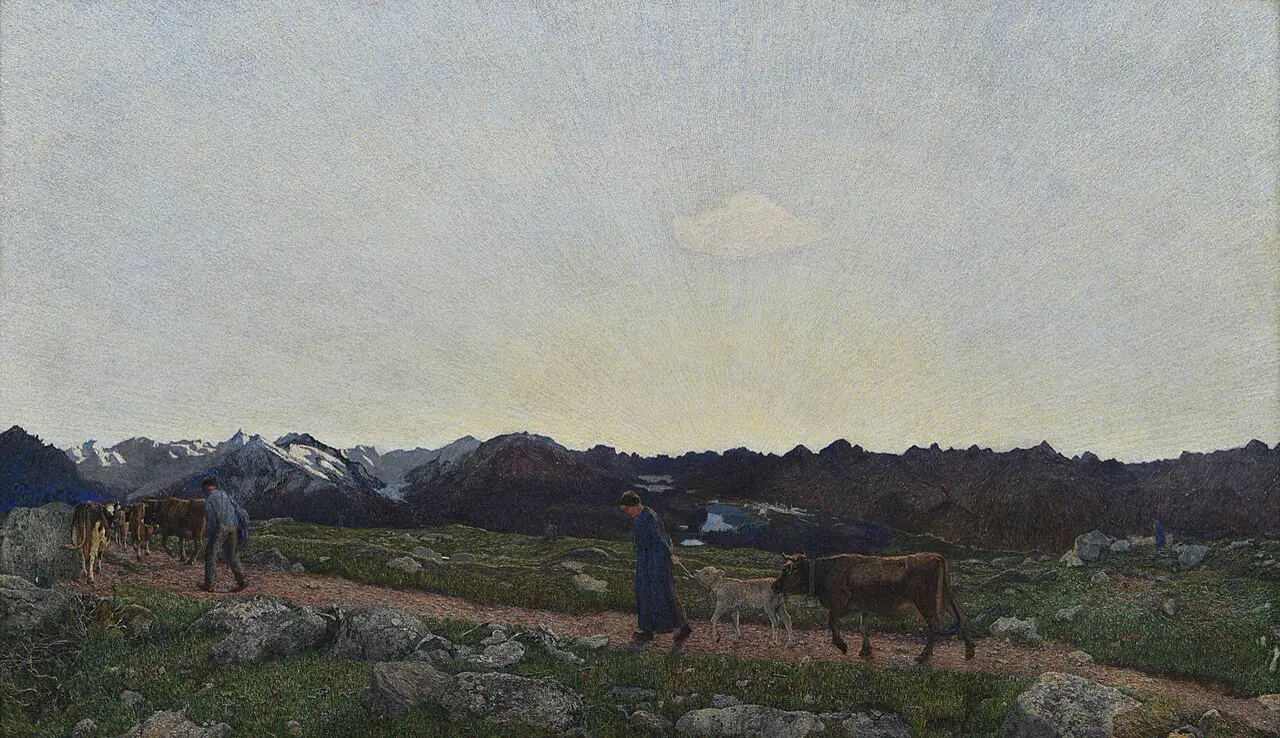
Giovanni SegantiniNature, central panel of the Alpine Triptych, 1897–99Oil on canvas · Segantini Museum, St Moritz; Gottfried Keller Foundation
A couple drive cows and a calf home along a mountain path as the sun sets beyond the Engadine peaks. Webern planned his String Quartet of 1905 around Segantini’s three panels, which he knew as Werden, Sein and Vergehen (becoming, being and passing away). The quartet has three sections in a single movement, and a three-note idea runs through all of them.
Georg Trakl
Abendland II
Published in Sebastian im Traum, 1915; set by Webern 1919
GermanSo leise sind die grünen Wälder
Unsrer Heimat,
Die kristallne Woge
Hinsterbend an verfallner Mauer
Und wir haben im Schlaf geweint;
Wandern mit zögernden Schritten
An der dornigen Hecke hin
Singende im Abendsommer,
In heiliger Ruh
Des fern verstrahlenden Weinbergs;
Schatten nun im kühlen Schoß
Der Nacht, trauernde Adler.
So leise schließt ein mondener Strahl
Die purpurnen Male der Schwermut.
Our translationSo hushed are the green forests
Of our homeland,
The crystal wave
Dying away against a crumbling wall
And in our sleep we have wept;
Wandering with hesitant steps
Along the thorn hedge,
Singing in the summer evening,
In the sacred stillness
Of the vineyard shining far away;
Shadows now in the cool lap
Of night, grieving eagles.
So gently a moonlit ray closes
The purple marks of melancholy.
Webern set these fourteen lines in 1919 as the third song of Op. 14, for voice with clarinet, violin and cello. Trakl moves from the woods of home to a crumbling wall, then into the vineyard and the night. In the middle of the poem the people wander and sing; by its end they have become shadows and grieving eagles.
Recommended recordings
Complete worksBerlin Philharmonic, Ensemble intercontemporain, BBC Singers and soloists, Pierre BoulezDeutsche GrammophonThe strongest first collection. The Berlin orchestra plays with a clear sound and Françoise Pollet sings warmly, and the instrumental pieces and the songs are given equal weight. The set also includes the early Im Sommerwind, written before the Bagatelles.
Variations for Piano, Op. 27Maurizio PolliniDeutsche GrammophonChosen for the way Pollini balances the clean edge of each attack with the need to carry a phrase across the rests.
Complete numbered worksSoloists and ensembles, Robert CraftColumbia / SonyA second collection, recorded in Los Angeles in 1954–56. The orchestral performances are rough-edged, the recorded sound is drier and the chamber playing is cautious; Boulez’s recordings are the better introduction.
Where to hear more
Symphony, Op. 211927–28
Berliner Philharmoniker; Pierre Boulez, conductor · Deutsche Grammophon · September 1994, Philharmonie, Grosser Saal, Berlin
The symphony is in two movements: the first is built on canons, and the second is a set of seven variations. Boulez’s Berlin recording has clear orchestral detail, a quality singled out by BBC Music Magazine.
Krystian Zimerman, piano · Deutsche Grammophon · October 1995, Église Saint-Jacques, Hunawihr
The three piano movements are all drawn from a single twelve-note row. Webern wrote the finale first. Greg Sandow compared Zimerman’s warm playing of the work with Chopin and counted it among the best performances in the set.
Webern learnt counterpoint by editing Isaac for Guido Adler and by composing under Schoenberg. In his orchestration of Bach’s Ricercar the counterpoint is set in changing instruments. After his death, Boulez took the scores into concerts and made two complete recording surveys; Robert Craft’s advocacy helped bring them to Stravinsky during his turn to serial composition.
Further reading
Kathryn Bailey, The Life of Webern (Cambridge University Press, 1998). biography
Examines Webern’s dependence on Schoenberg, nationalism and commitment to his concentrated musical language.