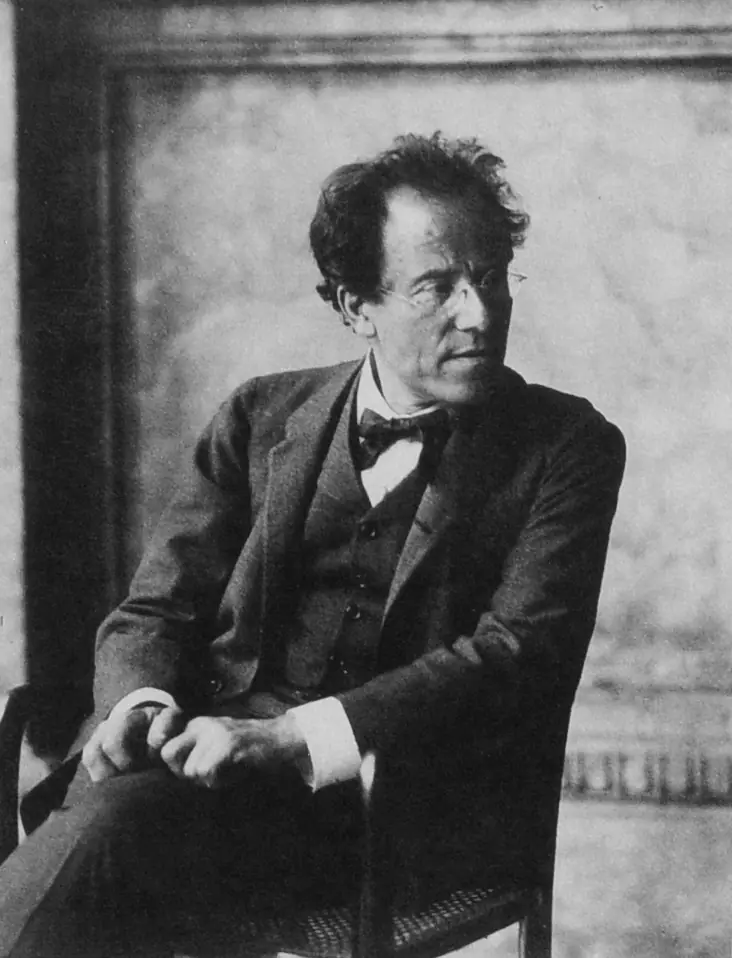
Born 7 July 1860, Kaliště, BohemiaDied 18 May 1911, Vienna
Conductor who composed during the summers and intended each symphony to contain a whole world, combining the sublime with the music of the street band.
Vienna Conservatory, 1875–78: piano with Julius Epstein, composition with Franz Krenn; attended Bruckner’s university lectures
Posts
Budapest Royal Opera 1888–91 · Hamburg Stadttheater 1891–97 · Vienna Court Opera 1897–1907 · Metropolitan Opera and New York Philharmonic 1908–11
Composed
In summer huts at Steinbach am Attersee, Maiernigg on the Wörthersee and Toblach in the Dolomites
Output
Nine numbered symphonies and an unfinished Tenth; Das Lied von der Erde; orchestral songs
“The symphony must be like the world. It must embrace everything.”
Life
Mahler was born in a Bohemian village and grew up in the garrison town of Iglau (Jihlava), the second of fourteen children, eight of whom died young. In Iglau he heard bugle calls and marches from the barracks, Czech and German folk song, the town band, the synagogue and the Catholic church, and these sounds recur throughout his music. Late in life he told Sigmund Freud that he had once run from a violent quarrel between his parents into the street, where a barrel organ was playing Ach, du lieber Augustin.
At fifteen he entered the Vienna Conservatory, where he studied piano and composition, and he sat in on Bruckner’s harmony lectures at the University. Among his friends were Hugo Wolf and Hans Rott, who died young. Rott’s symphony is so close to Mahler’s own music that Mahler later called Rott the founder of the new symphony as he understood it. The cantata Das klagende Lied, completed in 1880, failed to win the Beethoven Prize in 1881. By then he had already begun his career as a conductor.
The kapellmeisterOpera houses and summer composing
He worked up through the provincial houses at Bad Hall, Laibach, Olmütz, Kassel, Prague and Leipzig, and at twenty-eight ran the Royal Hungarian Opera in Budapest. In Hamburg (1891–97) Hans von Bülow came to admire his conducting, and Tchaikovsky travelled there to hear his production of Onegin. In 1897, having converted to Catholicism to make an appointment possible in an anti-Semitic city, he took over the Vienna Court Opera. He directed it for ten years. He darkened the auditorium, barred latecomers, abolished the claque and restored the passages customarily cut from Wagner. With the designer Alfred Roller he staged Tristan and Fidelio with simplified scenery and with strong colour and lighting that anticipated twentieth-century stage design.
That left only the summers for composing. From 1893 he worked beside the Attersee, later moving to the Wörthersee and then Toblach, with a one-room composing hut at each place. He wrote in the mornings and walked in the afternoons; the winters he spent at the opera house. When Bruno Walter visited Steinbach in the summer of 1896 and admired the mountains, Mahler told him, as Walter remembered it: “No need to look up there — I’ve composed it all away!”
The symphoniesTen symphonies
The First (1888) begins with the strings holding a single A across seven octaves, marked wie ein Naturlaut — like a sound of nature — while woodwinds play falling fourths over it and a clarinet plays a cuckoo call, a fourth instead of the usual third. Its slow movement is a funeral march built on the round Frère Jacques in the minor, introduced by a muted solo double bass in its high register. The Second, “Resurrection”, took six years and drew on an idea that came to him at the funeral of the conductor Hans von Bülow in 1894, when a choir sang Klopstock’s hymn Aufersteh’n from the organ loft. The Third is in six movements and lasts about a hundred minutes; its sequence moves from inanimate nature through flowers, animals and humanity (Nietzsche’s Midnight Song) to the angels and, finally, love.
The middle symphonies, Five, Six and Seven, have no sung texts and no programmes. The Sixth, which acquired the nickname “Tragic” in Mahler’s lifetime, is in four movements in classical form, in A minor, and blows from a hammer punctuate its finale. The Eighth (1906) is a choral work in two parts, setting the Latin hymn Veni, Creator Spiritus and the closing scene of Goethe’s Faust. It was first performed in Munich in 1910 by over a thousand performers and was the biggest public triumph of his life.
1907Vienna Opera, bereavement and illness
In one year he left the Vienna Opera after a press campaign, lost his elder daughter Maria to scarlet fever and diphtheria, and was told he had a heart-valve defect. The works that followed were Das Lied von der Erde, the Ninth and the unfinished Tenth. In them the harmony moves towards the edge of tonality, the counterpoint is dense, and the endings fade into silence. In New York he conducted at the Metropolitan Opera and then the Philharmonic. He fell ill there in February 1911 with bacterial endocarditis, sailed back to Europe, and died in Vienna in May. He was fifty.
My time will come when his is over.
His time came about fifty years later. In the 1960s Mahler moved to the centre of the orchestral repertoire, with Bernstein’s first complete recorded cycle, Deryck Cooke’s performing version of the Tenth and a centenary that became a revival. Schoenberg, whom he had championed, and the younger Berg and Webern learnt from him; later Shostakovich and Britten did too.
Places
Every recorded place, joined in date order. Mahler on the MapAll 50 places, with sources
Mahler used enormous forces like chamber music. A single line can stay audible inside the full orchestra, and instruments are placed at the extremes of their range (the solo double bass in the First, the high clarinets in E♭ that play above the marches). Mahler’s scores are covered in instructions: Schalltrichter auf (bells up), ohne Ausdruck (without expression), wie ein Naturlaut.
He brought outdoor sounds indoors: offstage brass bands, cowbells, a posthorn, sleigh bells, a birch switch (Rute) on the drum shell, mandolin and guitar, and the hammer of the Sixth.
♮Harmony
Wagnerian chromaticism laid over a largely diatonic, folk-song melodic language. His characteristic gestures include the major triad that turns to minor (the motto of the Sixth), the plagal and modal turns of chorale and folk tune, and, in late works, suspended and unresolved sonorities. Das Lied von der Erde ends on a chord with an added sixth that does not resolve.
At the climax of the Adagio of the Tenth, Mahler built a nine-note dissonance around a high A sustained by the trumpet.
𝅘𝅥Melody
Mahler’s melodies came from song. Themes from the Wayfarer songs and the Wunderhorn settings were carried over into the symphonies; the first movement of the First is built on Ging heut’ morgen übers Feld. Long lines are extended by variation and are constantly re-harmonised.
𝄾Rhythm and genre
Two rhythmic types keep returning: the march (military, funeral, grotesque) and the Ländler, the rustic Austrian dance in heavy three. They can interrupt the sublime without warning. In the First’s funeral march, oboes and clarinets bring in a street band, accompanied by bass drum and cymbal.
𝄋Form
The Third has six movements, and in them sonata form is stretched, interrupted and narrated. A long opening march is followed by a minuet, then by movements of animals, a human voice and angels. The last movement is a slow hymn without words. The symphony begins in D minor and ends in D major.
𝄢Counterpoint
Increasingly polyphonic. In the Fifth’s scherzo and the Ninth’s Rondo-Burleske fugal lines run against one another at speed; in Das Lied a melody and its decorated variant sound together (heterophony).
Works
A selection from the composer’s works.
1884–85
Lieder eines fahrenden Gesellen (Songs of a Wayfarer)Voice and orchestra; Mahler’s own texts
Four songs about a jilted journeyman. The second and fourth supply themes for the First Symphony.
1888
Symphony No. 1 in D majorOrchestra
Opens with string harmonics and birdcalls; the third movement is the Frère Jacques funeral march. First performed in Budapest in 1889 as a “symphonic poem in two parts”; Mahler himself later dropped the nickname “Titan”.
The symphony moves from a C minor funeral rite to a choral close in E♭ major. In the finale the offstage band exchanges calls with a flute and piccolo on stage (the “Great Summons”) before the choir enters at the edge of audibility.
Symphony No. 3 in D minorAlto, women’s and boys’ choirs, orchestra, offstage posthorn
Six movements, nearly a hundred minutes. The first movement, with its march for brass and percussion, is by itself longer than many complete symphonies. The finale is a slow movement, a hymn for strings that builds to a close in D major. Mahler returned to this kind of ending, in altered form, in the Ninth.
The lightest and most ironic of the symphonies. In the scherzo the leader plays a second violin tuned a tone high, for a scratchy “Death strikes up the dance”. The finale is a child’s vision of heaven from Des Knaben Wunderhorn.
Opens with a solo trumpet’s funeral fanfare in C♯ minor and ends in D major with a contrapuntal rondo. The fourth movement, the Adagietto for strings and harp, is his best-known music.
Symphony No. 6 in A minorLarge orchestra with hammer, cowbells, celesta
The most classically built of the symphonies. A march-like motto rhythm and a major chord turning to minor recur throughout; the finale lasts thirty minutes and includes the hammer blows.
1904–05
Symphony No. 7Orchestra with tenor horn, mandolin, guitar, cowbells
Two Nachtmusik movements frame a scherzo marked Schattenhaft (shadowy). Schoenberg wrote to Mahler praising it after hearing it in Vienna in 1909.
1906
Symphony No. 8 in E♭ majorEight soloists, two mixed choirs, boys’ choir, very large orchestra, organ
Part I sets the ninth-century hymn Veni, Creator Spiritus; Part II sets the last scene of Goethe’s Faust, which ends with the Chorus mysticus, “All that is transient is only a likeness.”
Six songs on Hans Bethge’s free German versions of Tang-dynasty poems. The last, Der Abschied (The Farewell), lasts half an hour and ends on the word ewig (forever), sung several times until the music stops. Mahler wrote the final lines himself.
Begins in D major with a halting, syncopated figure in the cellos and horn and ends in D♭ with an Adagio that thins out to silence, marked ersterbend (dying away). In 1912 Berg called the first movement the most magnificent thing Mahler had written.
Mahler left the first two movements in orchestral draft and the rest in short score, with anguished notes to Alma on the manuscript. Deryck Cooke’s performing version, published in 1976 and revised by his collaborators in 1989, is the most often played.
In the score
Short examples, engraved and playable.
Symphony No. 1, third movement“Bruder Martin” in the minor over timpani
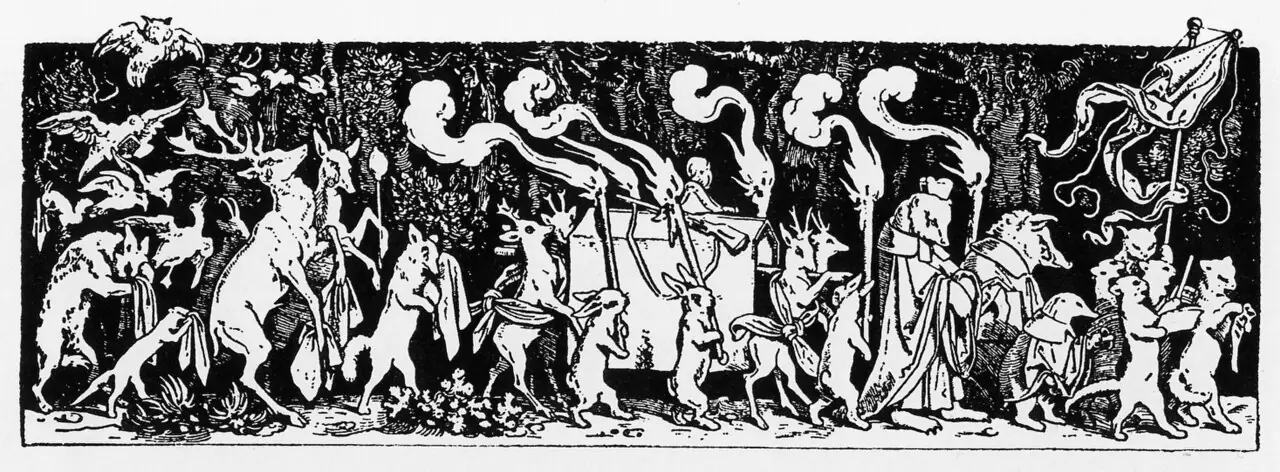
A schematic of the First Symphony’s funeral march: Frère Jacques (Bruder Martin in German) in D minor, over D and A in the timpani. In the score a single muted double bass plays the tune high in its range, and other instruments enter in canon. Mahler linked the movement to a nursery picture of animals carrying a hunter to his grave (see Sister Arts).
Symphony No. 6, mottoMajor-to-minor change
A schematic of the motto that recurs through the Sixth. Trumpets and oboes hold an A major triad that becomes A minor as it fades; only the third moves, C♯ down to C♮. In the score this is combined with a hammering march rhythm in the timpani.
Das Lied von der Erde, end of “Der Abschied”“Ewig … ewig”
A schematic of the closing harmony. The last ewig (forever) falls from E to D above a C major chord with an added sixth, A. The voice stops one step short of C, and the remaining instruments fade out around it.
Sister arts
Moritz von SchwindWie die Thiere den Jäger begraben (How the Animals Bury the Hunter), 1850Wood engraving, Münchener Bilderbogen
A children’s picture-sheet from Munich shows forest animals escorting a hunter’s coffin by torchlight, several of them weeping into handkerchiefs, with a banner raised over the line. Mahler cited this kind of image, an old Austrian nursery print, as the source of the funeral march in the First Symphony. The movement is a procession that is both mournful and absurd. A klezmer-like band of oboes, clarinets and bass drum with cymbal attached breaks in on the solemn march.
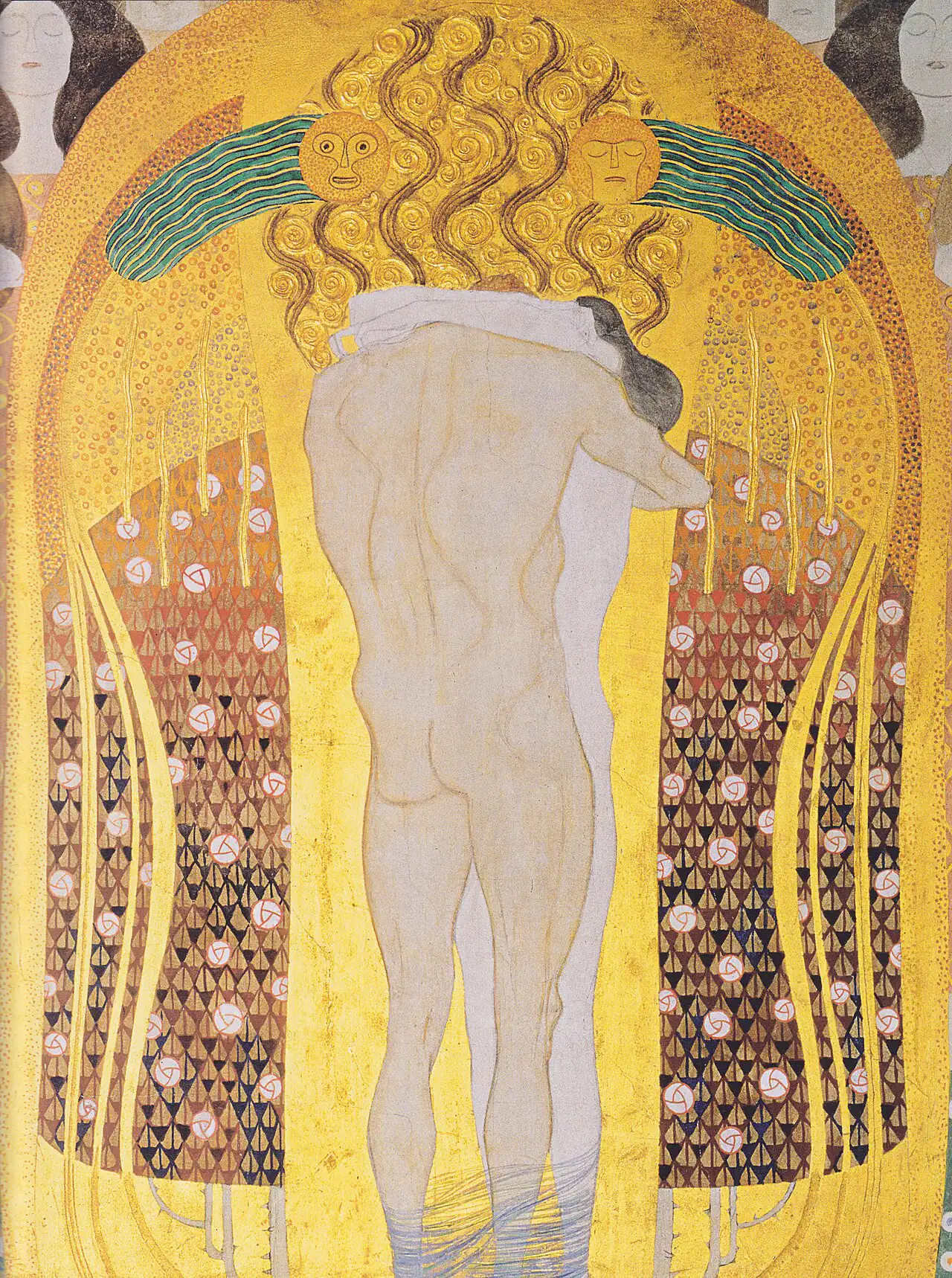
Gustav KlimtBeethoven Frieze: This Kiss to the Whole World, 1901–02Casein paint, gilt stucco and applied materials on plaster · Secession Building, Vienna
Klimt painted the frieze for the Vienna Secession’s 1902 exhibition in honour of Beethoven, as a visual reading of the Ninth Symphony; its last panel takes its title from Schiller’s Ode to Joy. Before the exhibition opened, Mahler conducted six trombonists on the staircase in his own arrangement of a passage from the Ninth’s finale. Alfred Roller, who would design Mahler’s opera productions, also contributed to the exhibition.
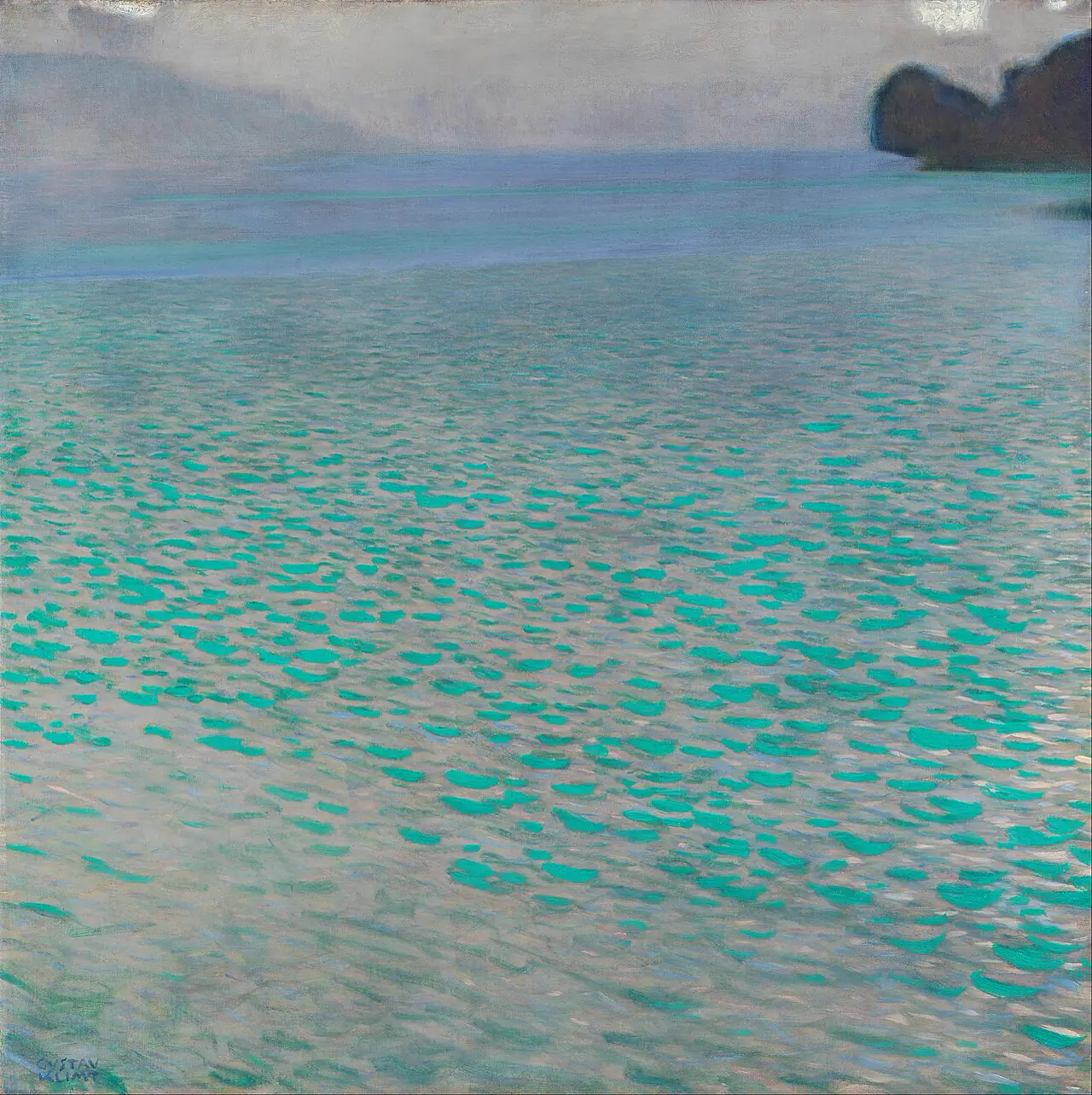
Gustav KlimtAttersee, 1900Oil on canvas · Leopold Museum, Vienna
The lake where Mahler built his first composing hut, at Steinbach, and worked on the Second and Third symphonies (1893–96). Klimt spent his summers there from 1900 and painted it on square canvases, cropping the horizon nearly out of the picture so that the water fills most of the surface. When Bruno Walter visited Mahler in 1896, Mahler made the joke about having already composed the mountains.
Friedrich Rückert
Ich bin der Welt abhanden gekommen
c. 1821; set by Mahler 1901
GermanIch bin der Welt abhanden gekommen,
mit der ich sonst viele Zeit verdorben,
sie hat so lange nichts von mir vernommen,
sie mag wohl glauben, ich sei gestorben!
Ich bin gestorben dem Weltgetümmel
und ruh’ in einem stillen Gebiet!
Ich leb’ allein in meinem Himmel,
in meinem Lieben, in meinem Lied!
Our translationI have been lost to the world
on which I once wasted so much time;
it has heard nothing of me for so long
it may well think that I am dead.
I am dead to the world’s commotion
and rest in a quiet place.
I live alone in my heaven,
in my love, in my song.
The middle stanza is omitted here. Mahler set the poem in F major for voice and a reduced orchestra, with a cor anglais line that grows out of the vocal line. “That is myself,” he told Natalie Bauer-Lechner in 1901. The Adagietto of the Fifth Symphony is in the same key.
Gustav Mahler, after Hans Bethge
Der Abschied — closing lines
1908
GermanDie liebe Erde allüberall
blüht auf im Lenz und grünt
aufs neu! Allüberall und ewig
blauen licht die Fernen!
Ewig … ewig …
Our translationThe dear earth, everywhere,
blossoms in spring and grows green
again! Everywhere and forever
the distances shine blue!
Forever … forever …
Bethge’s Die chinesische Flöte (1907) gave Mahler loose German paraphrases of Tang poets — Li Bai, Wang Wei, Meng Haoran — already filtered through French and German translations. For the end of Der Abschied Mahler stopped adapting and wrote these lines himself.
Recommended recordings
Symphony No. 9Vienna Philharmonic, Bruno WalterEMI · 1938Recorded live in January 1938, two months before the Anschluss. Walter had conducted the première in 1912. The long, quiet passages of the finale remain audible through the surface noise.
Symphony No. 9Berlin Philharmonic, Herbert von KarajanDeutsche Grammophon · 1982Live recording.
Das Lied von der ErdeKathleen Ferrier, Julius Patzak, Vienna Philharmonic, Bruno WalterDecca · 1952Ferrier was already ill with the cancer that killed her the following year. Her last “ewig” is the best known on record.
Symphony No. 3Norma Procter, London Symphony Orchestra, Jascha HorensteinUnicorn · 1970Spacious, unhurried tempos without exaggeration; the reference recording of the Third.
Symphony No. 4Judith Raskin, Cleveland Orchestra, George SzellColumbia · 1965Chamber-music clarity; every inner line of the scherzo audible.
Kindertotenlieder · Rückert-LiederJanet Baker, Hallé Orchestra and New Philharmonia, John BarbirolliEMI · 1967–69Baker sings Ich bin der Welt abhanden gekommen.
Mahler supported Schoenberg when Vienna jeered him, and in 1912 Schoenberg gave a lecture in Prague in tribute to Mahler. Berg’s Three Orchestral Pieces and Shostakovich’s Fourth Symphony are Mahlerian in scale and in their juxtaposition of the grotesque and the tragic; Britten heard the Fourth Symphony at sixteen and wrote in 1943 that he felt more affection for it than for any piece in the world. Bernstein’s first complete recorded cycle, made in the 1960s, helped bring the symphonies to a large new audience.
Further reading
Henry-Louis de La Grange, Gustav Mahler, vol. 3: Vienna (Oxford University Press, 2000). biography
A detailed documentary volume on the Vienna years; part of the larger biographical project.
Theodor W. Adorno, Mahler: A Musical Physiognomy, translated by Edmund Jephcott (University of Chicago Press, 1992). study
Interprets Mahler’s musical forms in their social and philosophical setting.