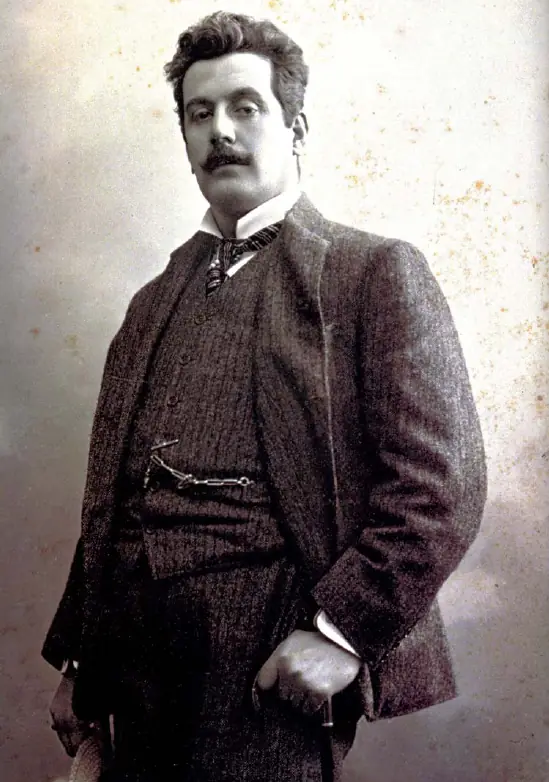
Lucca; Milan Conservatory, 1880–83, with Bazzini and Ponchielli
Collaborators
Giulio Ricordi · Luigi Illica and Giuseppe Giacosa · Giuseppe Adami and Renato Simoni
Output
Twelve operas, counting Il trittico as three; a Mass, songs and chamber music
Life
Puccini began at the organ. His family had supplied Lucca with church musicians for generations, and when his father Michele died in 1864, the five-year-old Giacomo was expected to continue the trade. He studied in the town, played in its churches and completed a Mass in 1880. In 1876, however, he had heard Verdi’s Aida in Pisa, and he turned to the theatre. A scholarship helped him into the Milan Conservatory, where Antonio Bazzini and Amilcare Ponchielli taught him composition. His graduation piece of 1883, Capriccio sinfonico, contains the music that later opened La bohème.
He submitted his first opera, Le Villi, to the Sonzogno competition on the last possible day, 31 December 1883; it did not receive a mention. The librettist Ferdinando Fontana arranged a private hearing at the journalist Marco Sala’s house, with Arrigo Boito among the guests. A subscription paid for a performance at Milan’s Teatro Dal Verme the following May. Giulio Ricordi bought the opera and commissioned another. Edgar, first performed at La Scala in 1889, was a failure that Puccini spent years trying to repair.
1891–1904Torre del Lago
In 1891 he settled at Torre del Lago, beside Lake Massaciuccoli, with Elvira Bonturi and their son Antonio. Elvira had left her husband for him; they could marry only after that husband died, and did so in 1904. Puccini hunted on the lake and acquired a taste for motor cars. Manon Lescaut, which opened in Turin in 1893, gave him a more secure income. Massenet had already made an opera from Prévost’s novel. Puccini’s version follows the same young woman through four abrupt changes of fortune and ends with her death in a desert outside New Orleans.
Several writers had a hand in Manon. For the next three operas Ricordi assembled a durable team. Luigi Illica worked out the action, Giuseppe Giacosa made the verse, and Puccini sent it back. Giacosa repeatedly threatened to leave. In an 1895 letter to Ricordi, Puccini defended the short last act of La bohème: “Brevity is a great merit.” Further down the same letter he worried about the printed slurs in the violin parts and asked to check them himself.
1896–1904La bohème, Tosca and Madame Butterfly
Toscanini conducted the first La bohème in Turin on 1 February 1896. Its young Parisians burn a manuscript to keep warm, dodge the rent and go out for supper. Puccini cut heavily from Murger’s stories, and an entire proposed act was dropped. In the Latin Quarter scene, children and street vendors crowd around the lovers while a military band passes. Back in the garret in Act IV, while Mimì is dying, the orchestra brings back the music of her first visit.
Tosca began with Sarah Bernhardt. Puccini saw her in Sardou’s play in Milan in February 1889 and went to Turin to see her again a month later. His opera reached the stage in Rome in January 1900. Three violent chords introduce the police chief Scarpia before anybody sings. In Act II, Scarpia questions Tosca while her lover is tortured in the next room; when she hears a scream through the door, her resistance gives way. Vissi d’arte interrupts the bargaining for a few minutes, after which Scarpia resumes it.
Later that year, in London, Puccini saw David Belasco’s Madame Butterfly. He was fascinated by the vigil, in which a woman waits through the night for a man who will destroy her. In the opera, the humming chorus and the orchestra carry the hours from evening to dawn. Pinkerton’s music includes The Star-Spangled Banner, and Japanese melodies are used for Butterfly’s household. She believes in the marriage long after everybody else understands its terms. At La Scala on 17 February 1904, the audience booed the opera. Puccini withdrew and revised it, and it succeeded at Brescia that May.
1909–18Doria Manfredi and La fanciulla del West
In 1909 the household at Torre del Lago broke apart. Elvira falsely accused their servant Doria Manfredi of having an affair with Puccini. Doria died by suicide, and Elvira was convicted of defamation. Work on La fanciulla del West stalled. The new opera, again based on Belasco, opened at the Metropolitan in December 1910 with Emmy Destinn and Enrico Caruso, conducted by Toscanini. Minnie runs a saloon in a California mining camp. She wins her outlaw lover’s life at cards and later confronts the men who intend to hang him. Minnie is alive at the end of the opera.
Fanciulla opens with widely spaced augmented chords and whole-tone harmony; the miners’ homesick ballad grows into a chorus. La rondine, first heard in Monte Carlo in 1917, grew from a Viennese operetta commission. Its waltzes accompany the story of a courtesan who tries to begin an ordinary life with a young lover, then leaves him. In 1918 the Metropolitan staged Il trittico, made up of a murder aboard a Seine barge, a nun’s loss of her child, and Gianni Schicchi, in which a roomful of greedy relatives watches a stranger steal their inheritance.
1920–26Turandot
For Turandot, Adami and Simoni turned to Carlo Gozzi’s fairy-tale theatre. In July 1920 Puccini wrote to Simoni: “I am already beginning to improvise in the evenings — and I am looking for chords and turns as Chinese as possible.” At Bagni di Lucca that summer, the collaborators visited Baron Fassini Camossi and heard his Chinese music box. Three of its melodies were used in the opera. Puccini set them among gongs, massed voices and executions.
In the autumn of 1924 he went to Brussels for treatment for throat cancer. He died there on 29 November, with the final duet still in sketches. Franco Alfano completed it; after Toscanini objected, Alfano made a substantially shorter second ending. At the first performance, at La Scala on 25 April 1926, Toscanini stopped after Liù’s funeral. At the next performance he also conducted the completion, in which the princess sings her declaration of love.
Places
Every recorded place, joined in date order. Puccini on the MapAll 21 places, with sources
Lucca · 22 December 1858 – 1880 · born
Born the sixth of nine children into a family that held the post of maestro di cappella in Lucca for 124 years.
In the last act of La bohème, music from Mimì’s first meeting with Rodolfo returns, nearly unchanged, as she lies dying. Puccini uses recurring motives in this way throughout the operas: the orchestra brings back a melody tied to an earlier scene, and the characters do not comment on it.
𝅘𝅥Vocal line
In Puccini’s operas, conversational passages lead into song. Mimì begins her introduction with her name and her work as a seamstress; by the time she describes the first sunlight of spring, the phrase has broadened across the orchestra. In Tosca, the clarinet plays the melody of E lucevan le stelle before Cavaradossi sings it to the words of his memories.
♯Harmony
The opening of La fanciulla del West spreads augmented chords across the orchestra and uses the whole-tone scale, whose equal steps contain no semitone and so lack the semitone’s pull towards a resolution. Soon a homesick ballad passes among the miners. Puccini moves between these chords and a tune any of the men in the saloon could sing.
𝄞Offstage sound
In Tosca, a cantata is sung outside Scarpia’s room while he eats supper and plans an arrest. Later, Cavaradossi’s cries are heard through the door of the torture chamber. At the start of Act III, a shepherd sings and the bells of Rome ring for dawn. Each of these sounds comes from someone offstage.
𝄾Waiting
During Butterfly’s night vigil there are no words. The chorus hums, the orchestra continues, and Butterfly watches for a ship’s officer who has already married another woman. Puccini stages the wait at its full length. At dawn the household learns what the audience has known all night.
Works
A selection from the composer’s works.
1883–84; revised later
Le VilliOpera; soloists, chorus and orchestra
Rejected by the Sonzogno competition, then given a subscription performance in Milan in 1884. The spirits of abandoned women dance a faithless lover to death.
1884–89; revised later
EdgarOpera
The four-act première at La Scala in 1889 failed. Puccini went on revising the opera and later reduced it to three acts.
1889–92
Manon LescautOpera in four acts
His first lasting success, in Turin in 1893. The intermezzo stands between Manon’s arrest in Paris and her deportation from Le Havre.
Sardou’s Roman thriller, first performed in Rome in 1900. The acts are set in a church, a police chief’s room and a prison roof, and each has its own bells and offstage voices.
Madama ButterflyOpera; two-act original, subsequently divided and revised
The La Scala fiasco of February 1904 began a long series of revisions. The humming chorus belongs to Butterfly’s all-night watch for Pinkerton.
1907–10
La fanciulla del WestOpera in three acts
Written for the Metropolitan, where Destinn and Caruso created the lovers in 1910. Minnie cheats at poker to save Johnson from the sheriff.
1913–18
Il tritticoThree one-act operas
First performed together at the Metropolitan in December 1918. After the deaths in Il tabarro and Suor Angelica, Gianni Schicchi is a comedy whose plot concerns a dead man and a profitable deception.
1914–16; revised later
La rondineOpera in three acts
A Viennese operetta commission became an opera, first performed in Monte Carlo in 1917. Magda leaves her lover before his respectable family can discover her past.
1920–24
TurandotOpera in three acts; unfinished
Puccini finished the score through Liù’s funeral, including Nessun dorma. Alfano supplied the final duet and the public celebration that follows it.
A schematic of the whole-tone scale and two augmented triads made from it. All six notes are a tone apart, and the scale has no semitone leading to a home note. Puccini uses these sounds in the opening of La fanciulla del West.
Melodic vocabularyFive-note figure over a changing bass: schematic
A schematic. The melody uses C–D–E–G–A, five notes without semitones. The bass moves from C through A and A♭ to G, changing the harmony under the repeated tune. In Butterfly and Turandot Puccini set borrowed melodies over similarly mobile harmony.
Sister arts
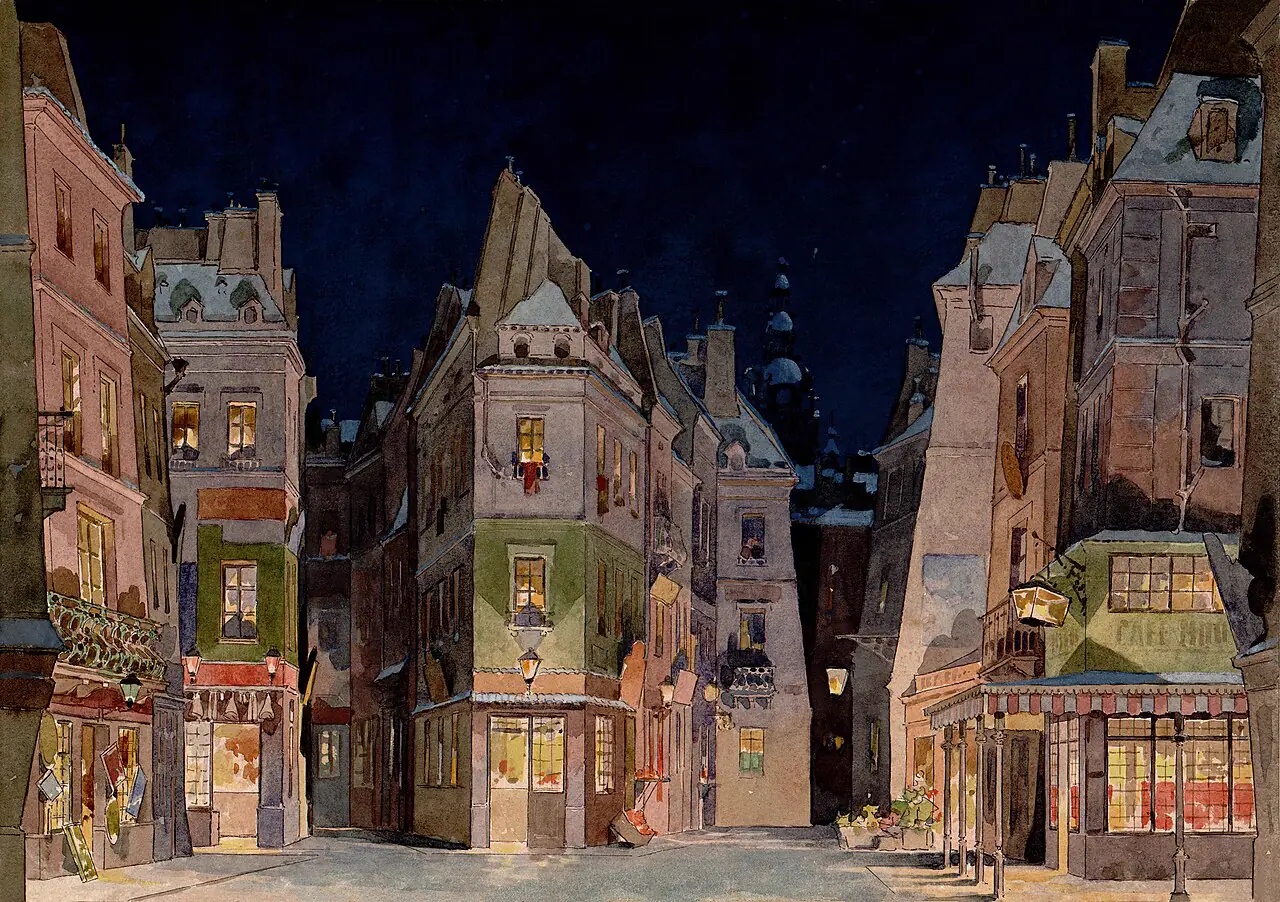
Adolfo HohensteinThe Latin Quarter: set design for La bohème, Act II, 1896Stage-design drawing · Archivio Storico Ricordi, Milan
Hohenstein’s Paris was built in Turin for the première on 1 February 1896. The set has a café and streets where the lovers sit while vendors, children and a military band fill the square around them. Musetta wins back Marcello’s attention in the middle of the crowd.
Henry Murger
Scènes de la vie de bohème — preface
1851
FrenchLa Bohème, c’est le stage de la vie artistique ; c’est la préface de l’Académie, de l’Hôtel-Dieu ou de la Morgue.
Our translationBohemia is the apprenticeship of artistic life; it is the preface to the Academy, the Hôtel-Dieu hospital or the morgue.
Murger’s preface offers his young artists three destinations, two of them places for the sick and the dead. Illica and Giacosa drew the opera from his stories and their stage adaptation. Mimì comes to the garret for the last time because she wants to be with Rodolfo.
Recommended recordings
ToscaMaria Callas, Giuseppe Di Stefano, Tito Gobbi, La Scala forces, Victor de SabataEMI · 1953The recommended first recording. Callas and Gobbi play the Act II exchange at close quarters; de Sabata’s orchestra follows each change in the balance of bargaining power.
La bohèmeMirella Freni, Luciano Pavarotti, Rolando Panerai, Nicolai Ghiaurov, Berlin Philharmonic, Herbert von KarajanDecca · 1972Freni sings conversationally and Pavarotti takes the top notes with ease in the first meeting. Karajan’s orchestral sound is full and rich for an opera about poverty.
TurandotJoan Sutherland, Luciano Pavarotti, Montserrat Caballé, London Philharmonic, Zubin MehtaDecca · 1972Sutherland sings the riddles without strain; Caballé sings Liù, with floated phrases. Mehta gives the percussion a hard attack. The opera is given in the familiar shortened Alfano version.
Passed toErich Wolfgang KorngoldFilm scoringTwentieth-century Italian opera
Verdi’s Aida helped draw him to the theatre; from Wagner he took an orchestra that recalls themes from earlier scenes. Puccini used such recalls briefly and at short notice: a familiar phrase returns in the orchestra to show what a lover has forgotten or what a policeman conceals. His whole-tone chords in Fanciulla have been compared with Debussy, and his recurring love themes anticipate the film scores of Korngold.