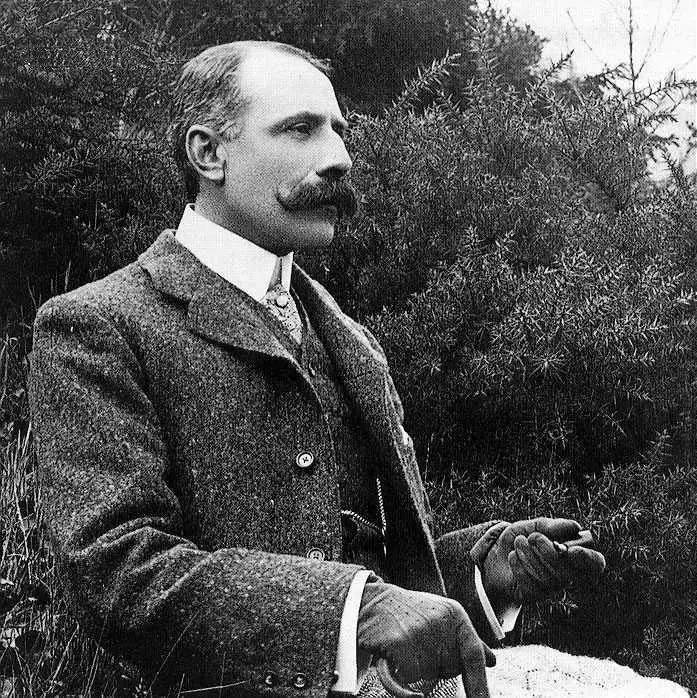
His father’s Worcester music shop; violin and organ; composition largely self-taught
Livelihood
Powick bandmaster, instrumental teacher and organist at St George’s, Worcester
Output
Two symphonies; violin and cello concertos; Gerontius; five Pomp and Circumstance marches
Later years
Master of the King’s Musick from 1924; recordings of his own orchestral works
Life
Elgar grew up among the instruments and sheet music in his father’s Worcester shop. William tuned pianos and played the organ at St George’s Catholic Church; Edward studied the scores, learned several instruments and earned money with his violin. Born at Lower Broadheath on 2 June 1857, he had hoped to study at Leipzig, but the family could not afford it. Playing in the Three Choirs Festival orchestra, he learned the choral music of Handel and Mendelssohn as a member of the string section.
From 1879 to 1884 he was bandmaster at Worcester County Asylum, Powick. He trained members of staff to play for the patients and supplied quadrilles and polkas for the Friday-evening dances. He knew each player in this orchestra individually and had to write within their capabilities. He also taught in local schools and gave private lessons in Malvern. In 1885 he succeeded William at the organ of St George’s.
1889–98Alice and the teaching years
Caroline Alice Roberts came for piano lessons in 1886. A major-general’s daughter, nine years older than Elgar, she had published a novel and wrote poetry. They married in May 1889, against the objections of relatives who disliked both his religion and his standing as a tradesman’s son. Their only child, Carice, was born in London in August 1890. In London Elgar found little work, and the family’s hardship grew. By June 1891 they were living at Forli, a house in Malvern Link, and Edward was teaching again.
Alice ruled bar lines on his manuscript paper and walked to the post with parcels of music and proofs. At Forli he finished The Black Knight and wrote King Olaf; Caractacus followed in 1898. These choral works made his name known beyond Worcestershire while the lessons continued. The Serenade for Strings was first played privately, by the Worcester Ladies’ Orchestral Class under his direction, in 1892. Its three movements last about twelve minutes, with the Larghetto at their centre.
1898–99The Enigma Variations
On 21 October 1898, home from teaching, Elgar sat at the piano and improvised. By his later account, Alice liked one of the tunes, and he began working out how their friends might play it. The result was the Enigma Variations. Hans Richter conducted the first performance at St James’s Hall, London, on 19 June 1899, when Elgar was forty-two. The work established him internationally.
Alice comes first among the fourteen portraits, and Elgar’s self-portrait comes last. Isabel Fitton’s variation begins with a string-crossing exercise for viola. In the thirteenth variation a clarinet quotes Mendelssohn’s Calm Sea and Prosperous Voyage. Nimrod is the portrait of August Jaeger, Elgar’s friend at Novello, and refers to their conversations about Beethoven’s slow movements. Jaeger also offered practical criticism. After the première he persuaded Elgar to enlarge the finale, and the ending heard today was first performed in Worcester that September.
1900The Dream of Gerontius
For Birmingham’s festival the following year, Elgar set John Henry Newman’s The Dream of Gerontius. He worked on it at Birchwood Lodge, with the Malvern Hills visible from his study. “I imagined Gerontius to be a man like us,” he wrote to Jaeger on 28 August 1900. The tenor begins in fear and short of breath, with friends praying around his bed. After death he wakes and converses with an Angel, sung by a mezzo-soprano. Elgar moved the exchange from declamation into melody, and the soul asks its questions before the chorus of demons enters.
The première, on 3 October 1900, went badly. The experienced chorus trainer Charles Swinnerton Heap had died during the preparations, and the singers were inadequately rehearsed. Richter conducted, but could not rescue the performance. Julius Buths took the work to Düsseldorf in 1901 and again in 1902. After the second German performance, Richard Strauss publicly praised Elgar.
1901–11Pomp and Circumstance and the symphonies
The first Pomp and Circumstance march appeared in 1901; A. C. Benson’s words for Land of Hope and Glory were later set to its broad middle tune. Elgar was knighted in 1904 and took up the Birmingham professorship in 1905. The Introduction and Allegro of that year set a solo string quartet against the orchestral strings, with the viola playing the melody Elgar associated with Wales. He was writing for the newly formed London Symphony Orchestra.
The First Symphony was played in Manchester on 3 December 1908, with Richter conducting the Hallé. Its opening melody, in A♭ major, moves at a steady pace; the main Allegro is in D minor. Between the middle movements a fast violin phrase slows and leads without a pause into the Adagio. The opening tune returns at full strength at the end. There were about a hundred performances in the first year.
Fritz Kreisler gave the first performance of the Violin Concerto in November 1910, with Elgar conducting. Near the end, the violin returns to earlier themes while the orchestral strings thrum with the soft parts of their fingers. The Second Symphony followed in May 1911, dedicated to the memory of Edward VII. Its slow movement is a funeral march, and the finale ends quietly. Its first audience received it with much less excitement than the audience for the First Symphony had shown.
1918–19Brinkwells and the Cello Concerto
During the war Elgar set Laurence Binyon’s poems as The Spirit of England. By 1918 he was recovering from a painful tonsil operation at Brinkwells, the family’s Sussex retreat. In August he asked for an old Steinway upright to be brought from storage. The day after it arrived, he began the Violin Sonata. The String Quartet and Piano Quintet followed, the latter finished early in 1919. The quintet opens with a bare piano phrase and interruptions from the strings; its slow movement begins with the viola.
That summer he worked on the Cello Concerto, sometimes getting up at four or five to write. In late July 1919 he told Sidney Colvin that he had nearly finished “a real large work and I think good and alive”. On 8 August Alice posted the completed score from Fittleworth. Felix Salmond played the première at Queen’s Hall on 27 October, with Elgar conducting the London Symphony Orchestra. Rehearsal time had again been inadequate. The concerto opens with the cello alone. Near the close the opening chords return after a recollection of the Adagio, and the orchestra then ends the work abruptly.
1920–34HMV recordings and the Third Symphony
Alice died in April 1920. Elgar composed much less, though he continued to conduct and made an extensive series of recordings for HMV. In these recordings he was ready to hurry a crescendo or slow a phrase. His Nimrod moves through several speeds within its few minutes. On 14–15 July 1932 he recorded the Violin Concerto with Yehudi Menuhin and the London Symphony Orchestra.
The BBC commissioned a Third Symphony that year. Elgar tried its sketches with his violinist friend Billy Reed, playing the piano himself and filling the gaps as they went. Cancer stopped the work in 1933. He died at home in Worcester on 23 February 1934 and was buried beside Alice at Little Malvern. Reed kept the sketches. Anthony Payne’s elaboration of them received its first performance in 1998.
Places
Every recorded place, joined in date order. Elgar on the MapAll 25 places, with sources
The Firs, Lower Broadheath (Elgar Birthplace) · 2 June 1857 – 1859 · born
Born in the rented cottage, three miles from his father’s music shop in Worcester; now the Elgar Birthplace Museum.
Marches Nos. 1 and 2 were first performed under the composer; two days later Henry Wood played them at the London Proms. Pomp and Circumstance Marches Nos. 1–2.
The Second Symphony was first performed at the London Musical Festival, conducted by the composer. It was received less warmly than the First. Symphony No. 2.
The Enigma melody begins with a rest on the first beat. A crotchet rest precedes two quavers, B♭–G, then two crotchets, C–A; in the next bar the longer notes come before the quavers. The theme opens in G minor and later moves to G major, before the variations begin.
♯Harmony
The First Symphony sets two distant keys side by side. Its opening march is in A♭ major; the fast music that follows is in D minor, with a more chromatic melody. The two tonics are a tritone apart. The A♭ tune returns at the end of the finale.
𝄞Strings
In Introduction and Allegro, four solo string players separate from the larger ensemble and rejoin it. The viola first plays the Welsh melody; in the fast section a fugue passes through the strings before that melody returns. In the cadenza of the Violin Concerto, Elgar asked the orchestral strings to strum their pizzicato with the soft parts of three fingers.
𝄋Returning themes
Elgar sometimes brought back earlier material near the end of a work. Near the end of the Cello Concerto the soloist recalls the Adagio, then plays the chords with which the concerto began. The orchestra enters again for a short finish. In the First Symphony the scherzo’s quick violin notes lengthen into the melody of the Adagio, and the two movements follow each other without a break.
𝆑Choral drama
The first prayer around Gerontius’s bed begins unaccompanied, in the semi-chorus. Later the demons sing a mocking fugue, and the angels’ praise expands into eight-part writing. At the moment the soul glimpses God, Elgar calls briefly for the full force of every instrument. At the end the Angel sings over the chorus and semi-chorus, and the last Amen closes in D major.
Works
A selection from the composer’s works.
1892
Serenade for Strings in E minorOp. 20String orchestra
First tried by the Worcester Ladies’ Orchestral Class under Elgar in 1892. The middle movement, a Larghetto, is a long song placed between two short movements.
The first variation portrays Alice, and the last is Elgar’s portrait of himself. Jaeger persuaded him to expand the ending after the first performance, and the revised finale adds an optional organ part.
Clara Butt introduced these five songs at Norwich in 1899, with Elgar conducting. In Haven, a short setting of Alice’s words, comes between Sea Slumber-Song and Sabbath Morning at Sea.
1900
The Dream of GerontiusOp. 38Tenor, mezzo-soprano, bass, chorus and orchestra
A dying man wakes as a soul and asks his Angel what has happened to him. The words are Newman’s. Elgar set the bedside prayers, the demons’ laughter and the Angel’s farewell as one continuous drama.
1904–05
Introduction and AllegroOp. 47Solo string quartet and string orchestra
The solo quartet plays apart from the orchestral strings and then joins them again. A melody first played by the viola returns after the fast music and its fugue.
1907–08
Symphony No. 1 in A♭ majorOp. 55Orchestra
The opening theme returns in later movements and dominates the finale. The rapid notes of the scherzo become the melody of the slow movement.
1909–10
Violin Concerto in B minorOp. 61Violin and orchestra
Written for Kreisler, who gave the première with Elgar in 1910. In the finale’s accompanied cadenza the violin plays earlier themes again above a quiet thrumming from the strings.
1909–11
Symphony No. 2 in E♭ majorOp. 63Orchestra
A theme from the opening returns in a violent episode in the Rondo. The slow movement is a funeral march, and after it and the Rondo’s outburst, the finale ends quietly.
1918–19
Piano Quintet in A minorOp. 84Piano and string quartet
The work opens with a spare piano phrase and the strings; this material returns in the finale. The Adagio opens with a viola melody.
The cello enters first, with emphatic chords, before the violas introduce the rocking 9/8 melody. The finale brings back the Adagio and the opening chords, then ends briefly.
Enigma Variations, theme, bars 1–2Phrase beginning after the beat
Quoted melody from bars 1–2 of the Enigma theme, in the original G minor and 4/4; accompaniment and most expressive markings are omitted. Each bar starts with a crotchet rest. The two quavers come before the crotchets in bar 1 and after them in bar 2.
Cyclic formOne contour at two speeds: schematic
An invented schematic of rhythmic augmentation. The eight quavers of bar 1 return as eight crotchets across bars 3–4, at the same pitches and at twice the length. Elgar’s First Symphony makes a comparable change of pace between its connected scherzo and Adagio.
Sister arts
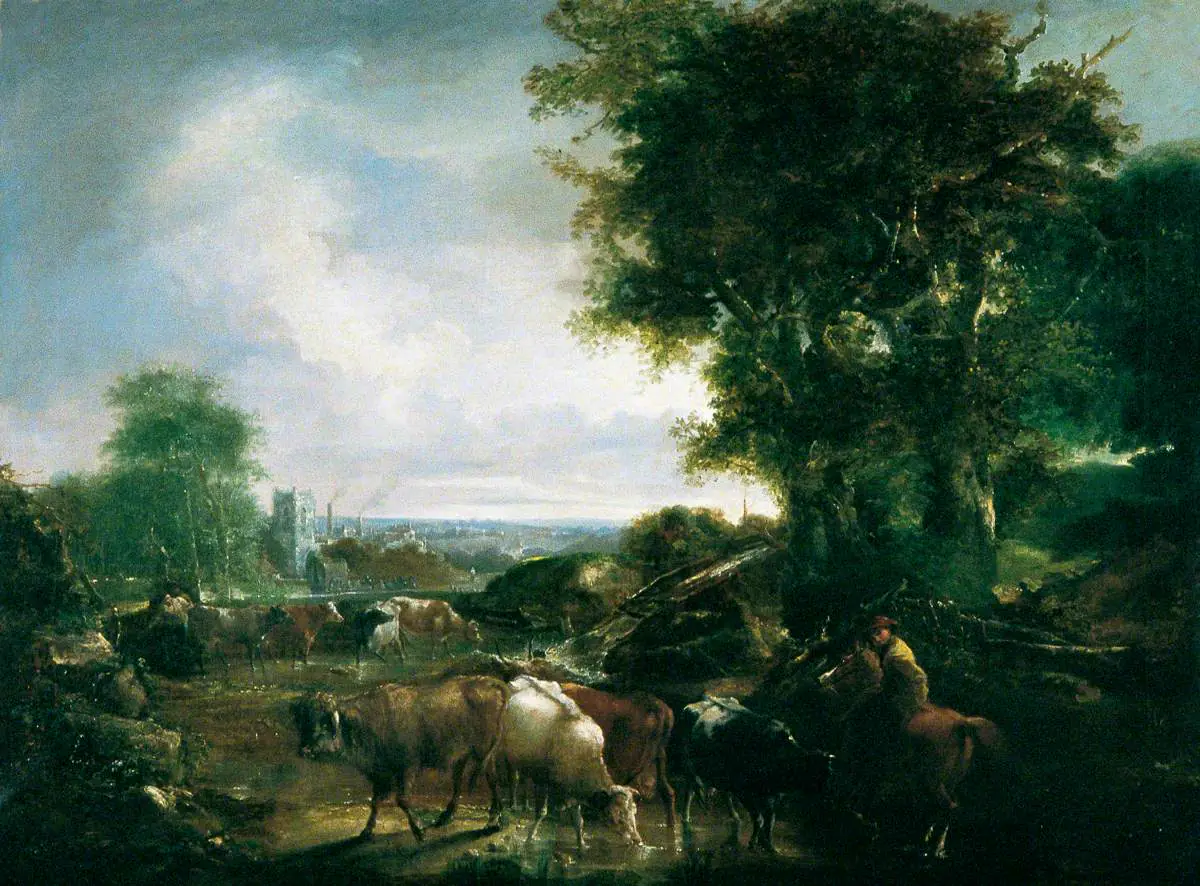
John Joseph BarkerNear Malvern Hills, c. 1860Oil on canvas · Government Art Collection, United Kingdom
Two drovers, one riding and one walking, take cattle along a lane towards a town. Barker’s Malvern country is a working landscape. Elgar knew its roads on foot and by bicycle. At Birchwood Lodge he wrote with the hills in view, and Alice carried manuscripts and proofs to the post.
John Henry Newman
The Dream of Gerontius — the Angel’s farewell
1865
EnglishSoftly and gently, dearly-ransomed soul,
In my most loving arms I now enfold thee,
And, o’er the penal waters, as they roll,
I poise thee, and I lower thee, and hold thee.
And carefully I dip thee in the lake,
And thou, without a sob or a resistance,
Dost through the flood thy rapid passage take,
Sinking deep, deeper, into the dim distance.
In Newman’s poem the Angel lowers the soul into purgatory. These are the first two stanzas of the farewell; the last promises a return in the morning. Elgar gave the Angel to a mezzo-soprano, although Newman’s poem makes the Angel male, and has chorus and semi-chorus sing around the solo voice as the work closes in D major.
Recommended recordings
Violin ConcertoYehudi Menuhin, London Symphony Orchestra, Edward ElgarHMV · 1932A first choice for the partnership and for its historical value. Elgar’s tempos press forward, and Menuhin phrases the long solo line freely; the orchestra’s playing under Elgar comes through despite the age of the recording.
Cello Concerto · Sea PicturesJacqueline du Pré, Janet Baker, London Symphony Orchestra, John BarbirolliEMI · 1965Du Pré plays the concerto’s final soliloquy with urgency before the return of the opening chords. Baker sings Sea Slumber-Song and Where Corals Lie on the same disc, and keeps her voice in balance with the orchestra as it grows louder.
The Dream of GerontiusRichard Lewis, Janet Baker, Kim Borg, Hallé Orchestra and combined choirs, John BarbirolliEMI · 1964Lewis sings the deathbed scene as a man close to exhaustion, and Baker’s Angel answers him with warmth and great assurance. Their duet in Part II is the centre of this performance. The demons’ chorus is fierce, but its ensemble is at times ragged.
Mendelssohn appears in Enigma as a direct quotation; Beethoven appears through the conversation recalled in Nimrod. Elgar drew on Wagner’s recurring orchestral themes to build the drama of Gerontius. Britten later conducted and recorded that work with Peter Pears and Yvonne Minton. Elgar’s own recordings preserve the string players’ slides and his freely changing tempos.
Further reading
Michael Kennedy, The Life of Elgar (Cambridge: Cambridge University Press, 2004). biography
Concise biography of Elgar’s personal and professional life.
Diana McVeagh, ‘Elgar, Sir Edward’, Grove Music Online (Oxford University Press, 2001). reference
Biographical reference, work-list and bibliography; subscription required.