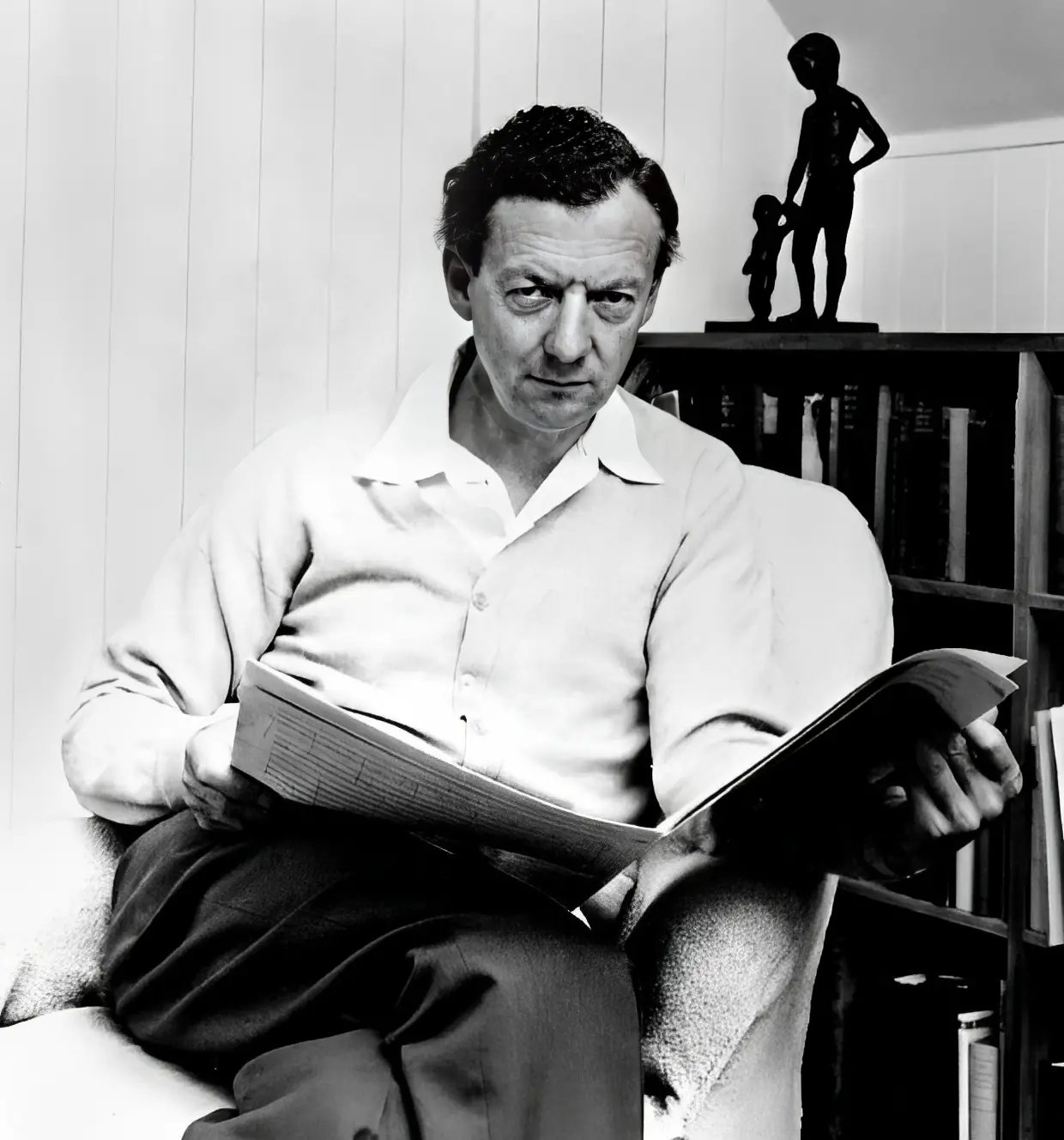
Born 22 November 1913, Lowestoft, SuffolkDied 4 December 1976, Aldeburgh, Suffolk
Composer who wrote Grimes and Aschenbach for Peter Pears, a work with an ark full of animals for Suffolk children, and a requiem in which dead soldiers speak.
Frank Bridge privately; Royal College of Music, 1930–33, with John Ireland
Home
Lowestoft and London; North America, 1939–42; then Suffolk
Collaborators
Peter Pears · Eric Crozier · Imogen Holst · Mstislav Rostropovich
Founded
English Opera Group, 1947 · Aldeburgh Festival, 1948 · Snape Maltings Concert Hall, 1967
Life
Benjamin Britten grew up in a house facing the North Sea at Lowestoft. His father was a dentist; his mother, Edith, sang and encouraged his music. Born on St Cecilia’s Day, 22 November 1913, he learnt piano and viola and filled exercise books with compositions. At the Norwich Festival in 1924 he heard Frank Bridge conduct The Sea. In 1927 his viola teacher, Audrey Alston, introduced him to its composer.
Bridge took him on. The lessons could be uncomfortable. “I used to get sent to the other side of the room,” Britten recalled in the Sunday Telegraph in 1963; “Bridge would play what I’d written and demand if it was what I’d really meant.” In 1937 he thanked his teacher with the Variations on a Theme of Frank Bridge, ten variations for strings, among them a waltz, a funeral march and a fugue.
From 1930 to 1933 he studied composition with John Ireland at the Royal College of Music. At London concerts he heard Mahler and Stravinsky; he wanted to go to Vienna to study with Berg, but his parents were persuaded against it. He had already written the Sinfonietta and the choral variations A Boy Was Born. In 1933 he began writing songs for the children at his brother’s school.
1935–42Film work and America
Britten began working for the GPO Film Unit in 1935. Film music had to fit the footage and was often written for very few players. Radio and theatre work brought further deadlines. On Night Mail (1936) he worked with W. H. Auden, whose verse keeps pace with a postal train. Auden introduced him to politics and literature. During these years the tenor Peter Pears became a close friend. In 1939 the two sailed for North America and became lovers.
In America Britten completed the Violin Concerto, wrote the Sinfonia da Requiem and wrote for the theatre with Auden’s lumberjack operetta Paul Bunyan. In California he was homesick. An essay by E. M. Forster led him to George Crabbe’s poetry; The Borough includes a Suffolk fisherman whose apprentices die in his keeping. Serge Koussevitzky offered a commission for the opera. Britten and Pears returned to Britain in 1942, registered as conscientious objectors and travelled the country giving recitals.
1945Peter Grimes and Aldeburgh
Peter Grimes opened at Sadler’s Wells on 7 June 1945, with Pears as Grimes and Reginald Goodall conducting. Montagu Slater’s libretto gave Crabbe’s cruel fisherman dreams, tenderness and a capacity to deceive himself. In the opera his neighbours talk about him, and by the last act they are hunting him. Orchestral interludes depicting the sea are placed between the scenes. Dawn begins with flutes and high violins, then harp and clarinet arpeggios, with brass chords low in the orchestra.
He followed the large opera with two that could travel: The Rape of Lucretia in 1946 and Albert Herring in 1947. The English Opera Group, founded that year, became his company, and the Aldeburgh Festival, which he launched with Pears and Eric Crozier in 1948, became its home. Concerts were held in the Jubilee Hall and in parish churches, with new pieces alongside Purcell and Bach. Accepting the Aspen Award in 1964, Britten explained: “I write music, now, in Aldeburgh, for people living there”.
Local people took part in the performance. At Orford Church in 1958, Noye’s Fludde filled the ark with Suffolk children playing animals; amateurs played alongside professional instrumentalists, and the congregation sang hymns. The first rain was played on suspended mugs. To help the children learn their parts, Britten, Pears, Imogen Holst and friends made a demonstration recording of the entire work.
1951–54The role of the orchestra
Billy Budd has an all-male cast and is set aboard a warship. Forster and Crozier adapted Melville’s novella, and Pears sang Captain Vere at Covent Garden in 1951. When Vere goes to tell Billy that he must hang, the meeting takes place offstage. The orchestra plays a succession of common chords, passing them from one group of instruments to another. No words are sung for three minutes.
For The Turn of the Screw (1954), Myfanwy Piper adapted Henry James’s ghost story. The opera is scored for six singers and thirteen players. The piano accompanies a boy’s lesson, and the celesta announces Peter Quint. A twelve-note theme follows the prologue, and fifteen variations separate the sixteen scenes. At the end the governess holds the dead child and sings his little song back to him.
1962–64War Requiem and Curlew River
The War Requiem was first performed in the new Coventry Cathedral on 30 May 1962. Britten set the Latin Mass beside nine poems by Wilfred Owen. Soprano, chorus and full orchestra perform the liturgy; tenor and baritone, with a chamber orchestra, sing Owen’s poems as soldiers addressing one another. Boys and organ are placed at a distance. Bells sound C and F♯. In the Offertorium the choir sings of God’s promise to Abraham, while in Owen’s poem Abraham ignores the angel’s reprieve and kills his son.
Britten had wanted an English tenor, a German baritone and a Russian soprano: Pears, Dietrich Fischer-Dieskau and Galina Vishnevskaya. Soviet officials stopped Vishnevskaya travelling, and Heather Harper took her place at short notice. All three intended soloists finally met for the Decca recording in 1963.
Japan had offered another theatre. Britten saw the Noh play Sumidagawa twice during his 1956 visit. “I shall never forget the impact made on me by the Japanese theatre,” he said in a broadcast to Japan in 1958. With William Plomer he moved its grieving mother and river crossing to an English religious community. Curlew River, first performed at Orford in 1964, begins as monks enter singing a hymn; they become the characters in the story and return to their hymn at the end. Seven instrumentalists accompany them. Two more church parables followed.
1967–76Snape Maltings and Death in Venice
The Queen opened Snape Maltings Concert Hall in 1967; Rostropovich was among the festival’s regular guests. Six years later it staged Death in Venice, Britten’s last opera. Pears’s Aschenbach thinks aloud over a piano; Tadzio and the other children dance to tuned percussion. Britten finished the score before undergoing heart surgery in May 1973. A stroke affected his right hand and ended his performing career. He continued composing. The Third String Quartet returns to Death in Venice, and Phaedra was written for Janet Baker.
On 21 November 1974 Pears wrote to him: “I am here as your mouthpiece and I live in your music”. He had sung Grimes, Vere, Quint and Aschenbach, and the songs Britten wrote for him over thirty-five years. Britten became a life peer in June 1976 and died at the Red House on 4 December, in Pears’s arms. Pears lived there until his own death in 1986; their books and manuscripts make up the core of the present archive. They are buried side by side in Aldeburgh churchyard.
Places
Every recorded place, joined in date order. Britten on the MapAll 25 places, with sources
Lowestoft · 22 November 1913 – 1928 · born
Born and grew up in Lowestoft, composing from childhood.
Britten set English words to their spoken rhythms. In Peter Grimes, the Borough’s questions and accusations come in clipped syllables; Grimes’s Now the Great Bear and Pleiades is a long solo song. In Death in Venice, Aschenbach’s thoughts are set as recitative accompanied by piano. Pears’s voice could manage both rapid, nervous declamation and a sustained line, and Britten went on writing parts for him that required both.
♯An interval
The bells of the War Requiem toll C and F♯, a tritone, which divides the octave into two equal halves. The choir sings its prayer for rest against this pair of notes. The interval returns near the end, after the soldiers have agreed to sleep, and only then does the unaccompanied chorus close on F major, with one note moving down a semitone.
𝄋Gradual intensification
The twelve-note theme in The Turn of the Screw rises by fourths and falls by minor thirds. Fifteen orchestral variations carry it through the scene changes, and its intervals appear in the characters’ vocal lines. The final confrontation is a passacaglia, with the theme repeated in the bass under the governess’s questions.
𝄞Solo horn
The Serenade begins with an unaccompanied horn playing natural harmonics. Some pitches sound sharp or flat against the tuning of a piano; Britten wanted their unevenness. Horn and tenor then share six poems about evening, sleep and its dangers. During the last song the horn player leaves the stage, ready to repeat the opening from offstage.
𝄢Assembling an orchestra
The Young Person’s Guide to the Orchestra takes a tune from Purcell’s Abdelazer and passes it round the orchestral families, then gives individual instruments their own variations. A piccolo starts the final fugue; the other instruments enter one after another, until the brass bring back Purcell’s tune over the fugue. The work was written for a school film.
𝄐Without a conductor
In Curlew River, flute, horn, viola, double bass, harp, percussion and chamber organ play without a conductor. The players repeat short figures while the singer continues, and they come together at signs in the score. When the instruments ornament a sung line, each in its own way, several versions of the tune sound at once. This is heterophony. The opening chant lies beneath the instrumental writing.
Works
A selection from the composer’s works.
1937
Variations on a Theme of Frank BridgeOp. 10String orchestra
Ten variations on Bridge’s Second Idyll, written as a portrait of Britten’s teacher. They range from a waltz and a funeral march to a closing fugue. Britten had already tried the theme in an unfinished set of piano variations in 1932.
1939
Les IlluminationsOp. 18High voice and string orchestra; Arthur Rimbaud
Begun in Suffolk and finished in America, these Rimbaud settings were written for the soprano Sophie Wyss. Pears was singing them with Britten by 1941.
Six English poems for Pears and Dennis Brain, framed by the horn’s natural harmonics. The horn rests during the Keats sonnet so that its player can move offstage for the Epilogue.
Peter GrimesOp. 33Opera in a prologue and three acts; libretto by Montagu Slater
Crabbe’s fisherman and his dead apprentices were the subject of Britten’s first great operatic success. The Four Sea Interludes reorder four of the opera’s scene changes into a concert sequence that ends with the storm.
1945
The Young Person’s Guide to the OrchestraOp. 34Orchestra, with optional narration
Written for the educational film Instruments of the Orchestra, released in 1946. Purcell’s tune from Abdelazer is followed by thirteen variations and returns over Britten’s fugue.
1950–51; revised 1960
Billy BuddOp. 50Opera; all-male cast, chorus and orchestra
Forster and Crozier gave Melville’s story a frame in which the ageing Vere remembers the sailor he condemned. Britten reduced the four acts to two in 1960 and kept the unseen interview, which is given to the orchestra alone.
1954
The Turn of the ScrewOp. 54Six singers and thirteen instrumentalists; libretto by Myfanwy Piper
Sixteen scenes joined by variations on one twelve-note theme. Thirteen players provide all the music, from the piano in Miles’s lesson to the celesta that marks Quint’s appearance on the tower.
1961–62
War RequiemOp. 66Three soloists, mixed chorus, boys’ choir, large orchestra, chamber orchestra and organ
Nine Owen poems are set between sections of the Latin Mass for the Dead. The separate groups join only near the end, as the tenor and baritone sing the close of Strange Meeting.
1964
Curlew RiverOp. 71Church parable for male singers and seven instrumentalists
Plomer adapted the Noh play Britten saw twice in Japan, in which a mother crosses a river in search of her son and finds his grave. The performers enter as monks, act the story and leave singing their opening hymn.
1971–73
Death in VeniceOp. 88Opera; libretto by Myfanwy Piper after Thomas Mann
Pears’s last major Britten role, completed before the composer’s heart operation. Aschenbach sings and the children dance. A single baritone plays the succession of strangers who draw Aschenbach towards his death.
In the score
Short examples, engraved and playable.
The Turn of the Screw · pitch schematicTwelve notes from turning intervals
A schematic of the Screw theme’s pitches, with equal crotchets in place of Britten’s rhythm. Each rising fourth is followed by a falling minor third (A–D–B–E), and the same pattern then repeats higher. All twelve notes appear before the sequence is complete.
War Requiem · harmonic schematicA tritone beside an F major triad
A schematic placing the War Requiem’s bell pitches, C and F♯, beside an F major chord. Lowering F♯ to F and adding A turns the tritone into a triad. The schematic illustrates the two sounds and is not a transcription of the ending.
Sister arts
George Crabbe
The Borough, Letter XXII — Peter Grimes
1810
EnglishHe nursed the feelings these dull scenes produce,
And loved to stop beside the opening sluice;
Where the small stream, confined in narrow bound,
Ran with a dull, unvaried, saddening sound;
Where all, presented to the eye or ear,
Oppressed the soul with misery, grief, and fear.
Crabbe, who was born in Aldeburgh in 1754, sent Grimes back to the estuary after the deaths of his apprentices. There he is kept by the sluice and its dull, repeated sound. Britten read the poem in America while he was missing Suffolk. Slater’s libretto gave the fisherman long solo songs, which Crabbe had not given him. The spelling of these six lines is modernised.
Wilfred Owen
Anthem for Doomed Youth
1917; published 1920
EnglishWhat passing-bells for these who die as cattle?
Only the monstrous anger of the guns.
Only the stuttering rifles’ rapid rattle
Can patter out their hasty orisons.
No mockeries for them; no prayers nor bells,
Nor any voice of mourning save the choirs,—
The shrill, demented choirs of wailing shells;
And bugles calling for them from sad shires.
What candles may be held to speed them all?
Not in the hands of boys, but in their eyes
Shall shine the holy glimmers of goodbyes.
The pallor of girls’ brows shall be their pall;
Their flowers the tenderness of patient minds,
And each slow dusk a drawing-down of blinds.
In the opening movement of the War Requiem, the tenor sings this poem with the small chamber orchestra while the large choir is silent. Owen’s lines on guns and shells follow the funeral bells; then the choir returns with the Kyrie.
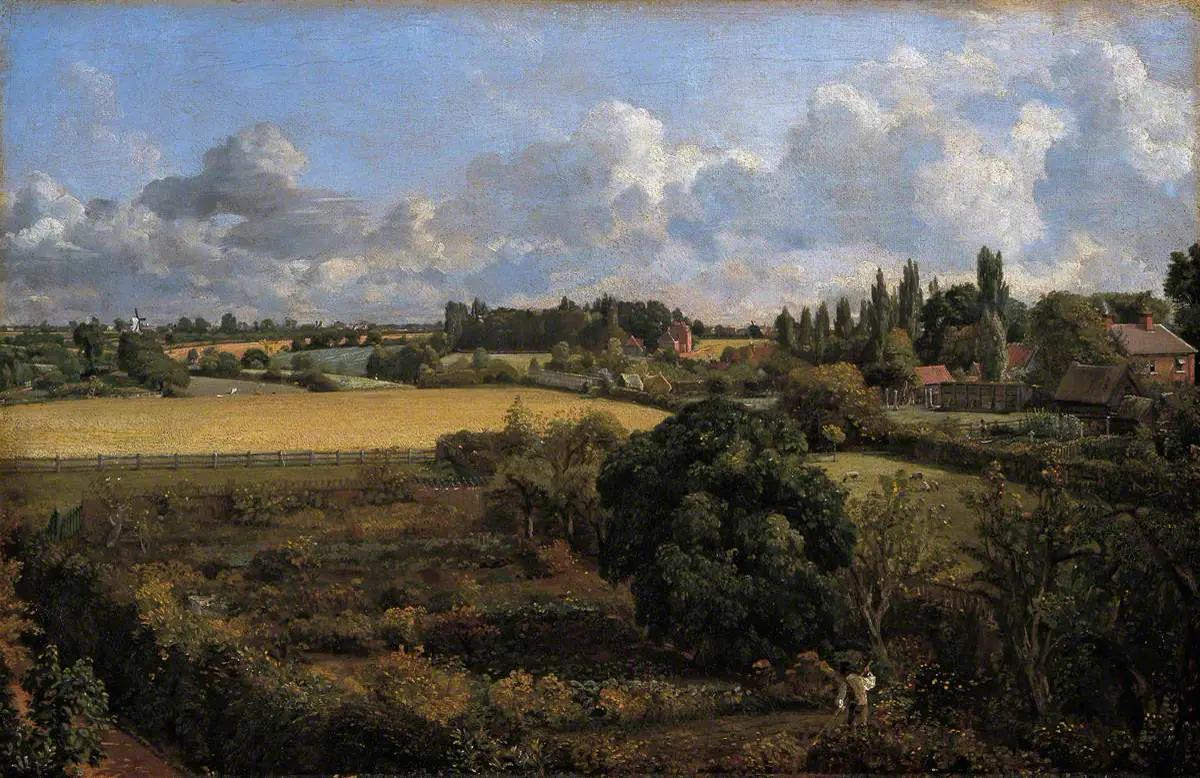
John ConstableGolding Constable’s Kitchen Garden, c. 1815Oil on canvas · Christchurch Mansion, Ipswich
Constable painted his father’s kitchen garden from the family house at East Bergholt in Suffolk, the inhabited, cultivated county that also contains Britten’s churches and fishing towns. At the first Aldeburgh Festival, in 1948, Kenneth Clark lectured on East Anglian painters; later festivals mounted exhibitions of Constable.
Where to hear more
Serenade for Tenor, Horn and Strings, Op. 311943
Peter Pears, tenor; Barry Tuckwell, horn; London Symphony Orchestra; Benjamin Britten, conductor · Decca · 1963
A solo horn frames settings of English poetry about night, sleep and dreams. Pears sings the part Britten wrote for him, with the composer conducting the London Symphony strings; his handling of the poems is the main reason to choose this recording first. Barry Tuckwell is an equal partner in the horn’s exposed calls, around Blake’s rose and in the last offstage echo.
Peter Pears, Claire Watson, James Pease, Jean Watson, Raymond Nilsson, Owen Brannigan, Lauris Elms, Geraint Evans, John Lanigan, David Kelly, Marion Studholme and Iris Kells; Orchestra and Chorus of the Royal Opera House, Covent Garden; Benjamin Britten, conductor · Decca · December 1958
A Suffolk fishing village turns against a fisherman after the deaths of his apprentices. Britten conducts Peter Pears, the tenor who created Grimes, with Claire Watson as Ellen Orford; it is the first choice for the words. Pears makes Grimes’s speech as troubling as his singing, and Britten keeps the Borough scenes at a brisk pace around him.
Galina Vishnevskaya, soprano; Peter Pears, tenor; Dietrich Fischer-Dieskau, baritone; Simon Preston, organ; The Bach Choir and London Symphony Chorus, chorus master David Willcocks; Highgate School Choir, director Edward Chapman; Melos Ensemble; London Symphony Orchestra; Benjamin Britten, conductor · Decca · January 1963
Britten interrupts the Latin Mass with Wilfred Owen’s poems, which Pears and Fischer-Dieskau sing with a chamber ensemble; Vishnevskaya is heard in contrast. His recording finally brought together the three soloists he had wanted for Coventry.
Purcell supplied the tune for The Young Person’s Guide. Bridge taught Britten to question every note, and London’s concerts introduced him to the music of Mahler, Berg and Stravinsky. Oliver Knussen, whose father played bass in Curlew River, recalled Britten urging him in 1964 to learn counterpoint. Pears invited Knussen to become an Aldeburgh director in 1983, and Thomas Adès was artistic director from 1999 to 2008. The festival also gave first performances of music by Harrison Birtwistle.