Paul Berkowitz and Robert Saxton at Guildhall; Alexander Goehr and Robin Holloway at Cambridge
At the piano
Pianist and conductor; chamber-music study with György Kurtág
Posts
Hallé, 1993–95; Aldeburgh Festival, 1999–2008; Boston Symphony artistic partner from 2016
On stage
Three operas, from Powder Her Face to The Exterminating Angel; the ballet The Dante Project
Life
In February 2007 Simon Rattle was rehearsing Tevot with the Berlin Philharmonic. The violins needed several attempts at their very high notes. Thomas Adès, who had written them, sat listening; when Rattle called him up to the podium, he could scarcely say anything. He told Tom Service afterwards that he had been overcome by the sound. Rattle shouted in his ear: “You have to say, thank you!” Rattle had commissioned Asyla for Birmingham a decade earlier and took it to his inaugural concert as Berlin’s chief conductor in 2002.
1971–94Training and early works to Arcadiana
Adès was born in London on 1 March 1971. His mother, Dawn, is an art historian; his father, Timothy, a poet and translator. He studied piano with Paul Berkowitz and composition with Robert Saxton at the Guildhall School, then went to King’s College, Cambridge, from 1989 to 1992, studying with Alexander Goehr and Robin Holloway. He also had chamber-music coaching with György Kurtág, first in Hungary in 1988–89 and again at the International Musicians Seminar in 1993–94. Adès continued to perform as a pianist, playing other composers’ music as well as his own.
In Darknesse Visible (1992), he took John Dowland’s In darkness let me dwell to pieces. Notes from the song become piano tremolos; a line that a singer could sustain moves back and forth between the pianist’s hands. Living Toys (1993) is for fourteen players. A horn plays among gongs and small trumpets in Angels; the bull of Aurochs enters on a bass B. In H.A.L.’s Death, a slowing waltz accompanies the dying computer, and a sopranino recorder represents the astronaut.
The seven movements of Arcadiana (1994) refer to a gondolier in Venice, Mozart’s enchanted kingdom, Schubert’s water song and Watteau’s lovers embarking for Cythera. The central movement, Et… (tango mortale), takes its cue from Poussin’s Et in Arcadia ego, in which death is present in the pastoral retreat. In it a tango is interrupted by slides and pizzicato. Near the end, O Albion gives the four players a quiet chorale in full chords. One more movement follows, Lethe, named after the river of forgetting.
1995–2001Powder Her Face and Asyla
Powder Her Face reached the Cheltenham Festival in 1995. Philip Hensher’s libretto drew on Margaret, Duchess of Argyll, and the divorce that had made her sex life public property. The opera, with its crowded social world, is written for four singers and fifteen players. The instrumentalists’ equipment includes an accordion, fishing reels and scrap metal; the opening brass music passes straight into the Maid’s laughter. There are tangos and scraps of fashionable popular song, often interrupted by a misplaced accent or an unexpected note. The notorious sexual scene attracted the headlines.
Rattle and the City of Birmingham Symphony Orchestra gave the first performance of Asyla in 1997. Cowbells are heard at the opening, and a bass oboe plays a low solo in the second movement. Six percussionists and an upright piano tuned a quarter-tone flat are added to the orchestra. In the third movement, Ecstasio, the orchestra plays dance-club music, repeating its figures with exact precision. In his 2007 interview with Service, Adès compared composing it to tuning a radio: “It was as if the music was on the radio, and I could tune my brain in and find it.” By the time of Tevot he used another image: “But now I think it’s more like flying a plane”.
A Hallé residency in 1993–95 led to chamber and orchestral performances. From 1999 to 2008 he directed the Aldeburgh Festival, the institution Britten had founded. His own piano repertory included Couperin and Janáček. In 2001 he played the première of his Piano Quintet with the Arditti Quartet in Melbourne. The piece has a sonata exposition with a repeat, and its players are soon counting different metres.
One instrumental line climbs by major thirds while another climbs by minor thirds, and an ordinary chord opens out into a harmony that is harder to name. In their conversations published in 2012, Adès told Service, “I don’t believe at all in the official distinction between tonal and atonal music.”
2004–13The Tempest and after
Adès conducted the first performance of The Tempest at Covent Garden on 10 February 2004. Prospero, who governs an island and a daughter, is a baritone. Ariel is a soprano and sings high above him, and Caliban, a tenor, has some of the opera’s most lyrical music. Miranda and Ferdinand have a long duet in Act II. At the end Prospero drowns the book and breaks the staff through which he has commanded the others.
The Violin ConcertoConcentric Paths, written for Anthony Marwood in 2005, places its greatest weight in the middle movement, Paths. The soloist plays chords across all four strings while brass chords descend beneath. Repeated harmonies return in changed scoring as the violin moves from rough multiple stops to a high, sustained line. The two outer movements, Rings and Rounds, are lighter. In the string quartet The Four Quarters (2010), the depiction of a day begins with high violin notes above slower viola and cello. Morning is represented by pizzicato. The last movement depicts a twenty-fifth hour, in dance-like bars of twenty-five semiquavers each.
From 2013Totentanz and The Exterminating Angel
At the 2013 Proms, Simon Keenlyside and Christianne Stotijn sang Totentanz. Keenlyside sang Death; Stotijn sang all the people he summoned. The German text came from the dance-of-death frieze formerly in Lübeck’s Marienkirche, destroyed during the Second World War. Pope, emperor and lesser mortals pass through the score in turn, and the last is an infant. For the infant the orchestra, until then violent, plays a lullaby. The singers repeat tanzen (to dance) while the music descends into the lowest instruments.
“Operas should instead be absurd in a way that is truer than reality,” Adès told Service in the conversations published in 2012. His next opera, The Exterminating Angel, opened at Salzburg in 2016. Tom Cairns wrote the libretto with Adès, based on Luis Buñuel and Luis Alcoriza’s 1962 film. In it, wealthy guests return from the opera, dine and then find that they cannot leave the room. An ondes Martenot is used for the sound of their invisible jailer. Leticia, who is an opera singer herself, has a very high soprano part. One character complains that there are no coffee spoons, and later a woman sings a lullaby to a dead lamb.
Boston appointed Adès its Symphony Orchestra’s artistic partner in 2016. Kirill Gerstein gave the première of his Piano Concerto there on 7 March 2019, with the composer conducting. The concerto is in three movements, fast, slow and fast, and has a formidable solo part. In the finale a three-chord call introduces a fast, tumbling theme. Later the piano introduces another theme, which Adès likened to a ball bouncing downstairs. The complete Dante Project was first given by the Royal Ballet in 2021, choreographed by Wayne McGregor and designed by Tacita Dean. Adès’s score is in three parts, Inferno, Purgatorio and Paradiso. It includes a ferocious piano solo for the suicides in Hell and, on the mountain of Purgatory, recorded voices from Jerusalem’s Great Ades Synagogue.
Where to hear it
Asyla, Op. 171997
London Symphony Orchestra; Thomas Adès · LSO Live · 2016
Asyla calls for six percussionists and treated pianos; Ecstasio, its third movement, takes its pulse from techno. Adès conducts the London Symphony Orchestra in the live Barbican recording, paired with Tevot and Polaris.
Simon Keenlyside (Prospero), Cyndia Sieden (Ariel), Ian Bostridge (Caliban), Kate Royal (Miranda), Toby Spence (Ferdinand); Orchestra and Chorus of the Royal Opera House, Covent Garden; Thomas Adès · EMI Classics / Warner Classics · 2007
Meredith Oakes recast Shakespeare in short, rhyming lines, and Ariel is written for a high soprano. The composer conducts Simon Keenlyside and Cyndia Sieden, the original Prospero and Ariel, in Covent Garden’s 2007 revival, released in 2009. It is the recommended audio recording, with Keenlyside’s troubled Prospero, Sieden’s agile Ariel and a balance that keeps Oakes’s words audible over the orchestra.
Kirill Gerstein, piano; Boston Symphony Orchestra; Thomas Adès · Deutsche Grammophon · 2019
In the slow movement a falling melody is set against rising harmony; the finale has a fast-moving piano theme and a loud clarinet part. Kirill Gerstein, for whom the Boston Symphony commissioned the work, plays its difficult writing on the live première recording under Adès. The 2020 disc adds the 2016 Totentanz, with Christianne Stotijn and Mark Stone clear over the full orchestra.
A bass can climb by major thirds while a middle part climbs by minor thirds and the top line takes whole-tone steps. Where the three lines meet they form changing chords, some familiar and some not. The Piano Quintet and The Tempest use this sort of mechanism. The whole-tone line needs twice as many steps as the bass to reach the next octave.
𝅘𝅥Rhythm and metre
In The Four Quarters, the second violin repeats a thirteen-beat pattern through Days while the other players play independent material. The finale, The Twenty-Fifth Hour, puts twenty-five semiquavers into each bar. Its recurring dance alternates a long step and a short one. The phrases still meet the barline, and the accents divide the bar unevenly.
𝄞Register and colour
The bass oboe’s solo in Asyla has a grainier, lower sound than the ordinary orchestral oboe. At the other extreme, Ariel in The Tempest sings so high that the words sound strange. Adès often sets his players far apart in register. In Nightfalls, the opening movement of The Four Quarters, high violin figures are held above slower viola and cello parts.
𝄋Form and recurrence
The Piano Quintet repeats its sonata exposition. Concentric Paths builds its long middle movement, a chaconne, over returning harmonies. Across these returns the solo violin moves from fierce four-string chords to a sustained line high above the orchestra, and the light dance-like finale follows.
𝄡Old music
The notes of Darknesse Visible come from Dowland’s In darkness let me dwell. Adès broke the song into tremolos and widely separated piano sounds, keeping its pitches but changing their registers and attack. In Arcadiana, a Schubert song gives one movement its title and figuration. Another movement of the quartet is a tango, interrupted by glissandos and pizzicato.
Works
A selection from the composer’s works.
1993
Living ToysChamber ensemble of fourteen players
In Angels a horn plays among gongs; in Aurochs a bull charges on a bass B. In H.A.L.’s Death the dying computer is given a slowing waltz, and the astronaut is played by a sopranino recorder.
1994
ArcadianaString quartet
The seven movements refer to imagined retreats, among them Schubert’s water, Watteau’s Cythera and an English chorale, O Albion. The central movement, a tango of death, refers to Poussin’s tomb inscription.
1995
Powder Her FaceChamber opera in two acts; four singers and fifteen players
Philip Hensher’s Duchess of Argyll is surrounded by servants, lovers and judges, all played by a small cast. The pit contains an accordion, fishing reels and scrap metal; a tango opens and closes the opera.
1997
AsylaOp. 17Large orchestra with bass oboe, six percussionists and keyboards
Written for Rattle and the Birmingham orchestra. The dance-club movement Ecstasio is the third of four. The upright piano is tuned a quarter-tone flat, so its notes sound a quarter-tone below the pitch of the rest of the orchestra.
2004
The TempestOpera in three acts; soloists, chorus and orchestra
Meredith Oakes rewrote Shakespeare in short, singable lines. Ariel is a very high soprano, Caliban a lyrical tenor, and both contest the baritone Prospero’s ownership of the island.
2005
Violin Concerto “Concentric Paths”Violin and orchestra
Written for Anthony Marwood, with a long central chaconne between the quicker Rings and Rounds. In the central movement the four-string chords eventually give way to a high line above the orchestra.
2010
The Four QuartersString quartet
The Emerson Quartet gave the première in 2011. Night is set in high violin notes and morning in pizzicato. The finale, depicting a twenty-fifth hour, is in 25/16.
2013
TotentanzMezzo-soprano, baritone and large orchestra
A baritone Death addresses a succession of people, all sung by one mezzo-soprano. The German text follows the figures in Lübeck’s lost dance-of-death frieze and ends with an infant and a lullaby.
2016
The Exterminating AngelOpera in three acts; large cast, chorus and orchestra with ondes Martenot
After Buñuel and Alcoriza’s film, with a libretto by Tom Cairns in collaboration with Adès. The guests cannot leave their dinner party; an ondes Martenot plays the unexplained force that keeps them there.
2018
Concerto for Piano and OrchestraPiano and orchestra
Kirill Gerstein gave the première in Boston in March 2019. In the finale a three-chord call is followed by a falling theme; a later theme was compared by Adès to a ball bouncing downstairs.
In the score
Short examples, engraved and playable.
Aligned interval cycles — schematicThree rules, six chords
A schematic, with invented notes, of the interval cycles used in the Piano Quintet and The Tempest. The top line rises by whole tones, the middle by minor thirds and the bass by major thirds. The three lines begin together on a widely spaced C major chord, and each following chord comes from the next step in all three. Enharmonic spellings keep the notes readable.
The Four Quarters — metric schematicThe twenty-fifth semiquaver
A schematic of the 25/16 dance in the finale of The Four Quarters. The repeated Gs, which are invented for the example, mark attacks eight, three, eight and six semiquavers apart, making two unequal halves of eleven and fourteen semiquavers. In the quartet itself the longer groups are further divided and the four players have different notes.
Sister arts
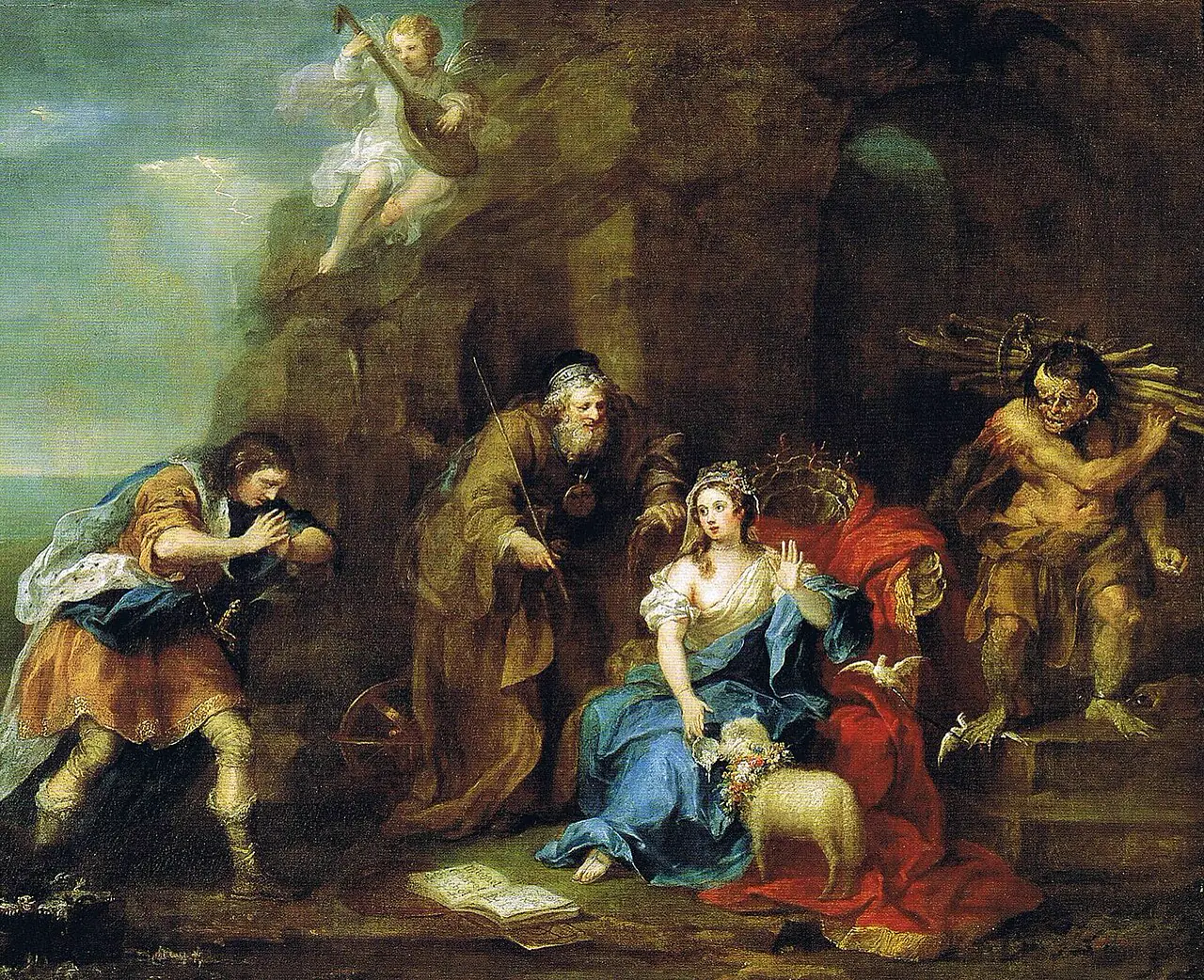
William HogarthFerdinand Courting Miranda, from The Tempest, c. 1736Oil on canvas · National Trust, Nostell, West Yorkshire
Hogarth shows Ferdinand being brought to Miranda, with Prospero at her side and Ariel making music above them. Caliban, at the right, crushes a dove beneath his foot. The painting and Adès’s opera share a source in Shakespeare’s island, where a father watches his daughter fall in love while his servants carry out his supernatural work. Adès wrote Ariel’s part for a high soprano and Caliban’s for a lyrical tenor. These are the two figures at the edges of Hogarth’s scene.
William Shakespeare
Ariel’s song: Full fathom five
The Tempest, c. 1610–11; printed 1623
EnglishFull fathom five thy father lies.
Of his bones are coral made.
Those are pearls that were his eyes.
Nothing of him that doth fade
But doth suffer a sea change
Into something rich and strange.
In Act I, scene 2, Ariel sings this to Ferdinand, who believes his father has drowned. Meredith Oakes’s operatic version, which shortens Shakespeare’s lines for Adès, begins “Five fathoms deep / Your father lies”. Ariel, a high soprano, leads Ferdinand towards Miranda. The king, whose bones the song says have become coral, is still alive.
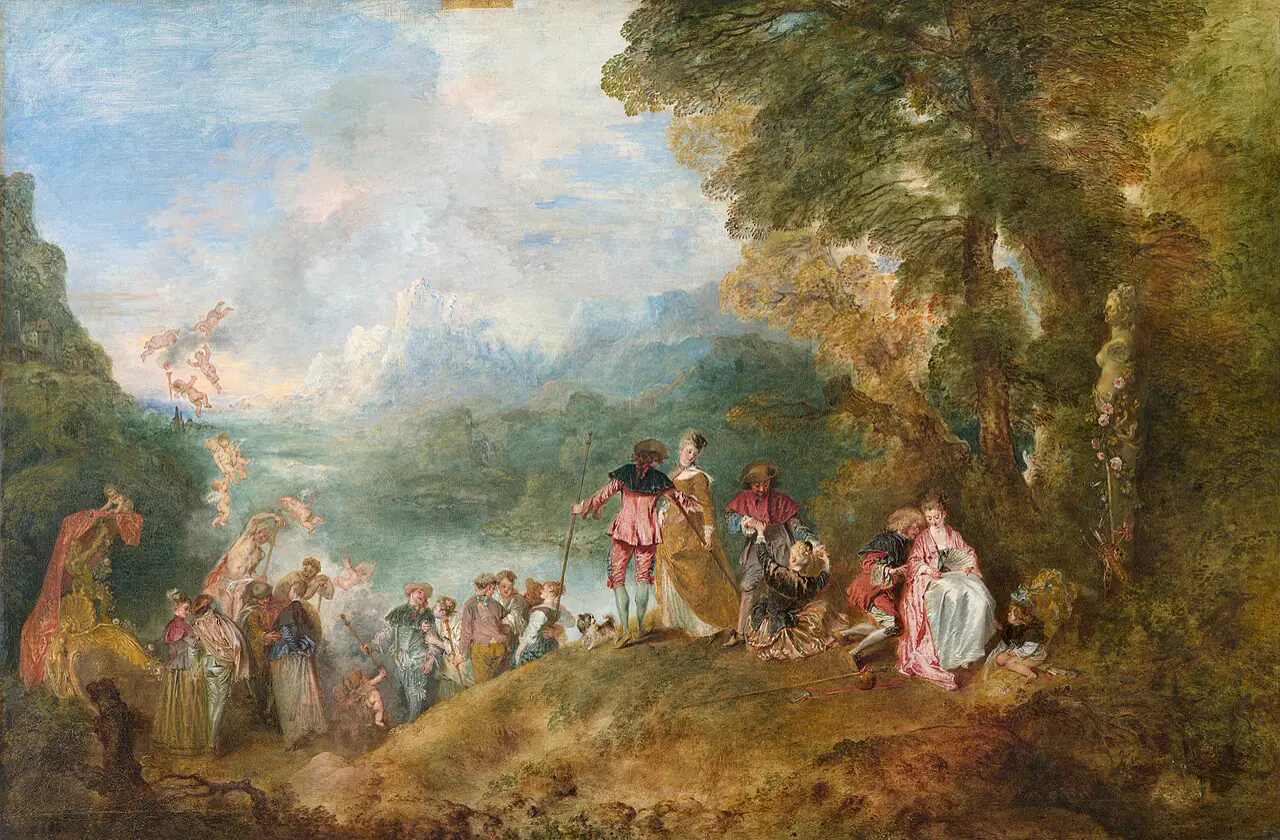
Jean-Antoine WatteauPilgrimage to the Island of Cythera, 1717Oil on canvas · Musée du Louvre, Paris
Watteau submitted this painting to the French Royal Academy in 1717 as his reception piece. Its lovers gave Adès the fifth movement of Arcadiana, L’Embarquement. In his programme note he sent their boat towards Debussy’s L’Isle joyeuse. The other watery destinations in the quartet include a Venetian night, Schubert’s river and Lethe, the last of them.
Recommended recordings
Asyla · Concerto conciso · These Premises Are Alarmed · Chamber SymphonyCity of Birmingham Symphony Orchestra, Birmingham Contemporary Music Group; Simon Rattle and Thomas AdèsEMI ClassicsA first disc of early Adès. Rattle conducts Asyla, which was written for him and his Birmingham players. The smaller companion pieces have exposed solos and quick changes of direction.
Arcadiana · The Four Quarters · Piano QuintetCalder Quartet; Thomas Adès, pianoSignum Classics · 2015An introduction to the chamber music, issued as The Twenty-Fifth Hour. In the slightly dry recording the Calder players’ overlapping rhythms stay distinct; Adès plays the piano part in the Quintet.
Passed toContemporary British operaInterval-cycle harmonyTwenty-first-century concerto writing
Adès has played Couperin and Janáček and worked with Dowland’s music at the piano. He has also engaged with Schubert and Debussy. Kurtág coached him as a chamber musician. In 2007 Adès arranged two of Nancarrow’s studies for player piano for two pianos, so that their competing speeds are played by human hands.