Paavo Heininen in Helsinki · Klaus Huber and Brian Ferneyhough in Freiburg · IRCAM in Paris
Home
Helsinki, then Freiburg; Paris from 1982
Players
Camilla Hoitenga, flute · Anssi Karttunen, cello · Dawn Upshaw and Karita Mattila, soprano
Theatre
L’Amour de loin, Salzburg 2000 · Innocence, Aix-en-Provence 2021
Life
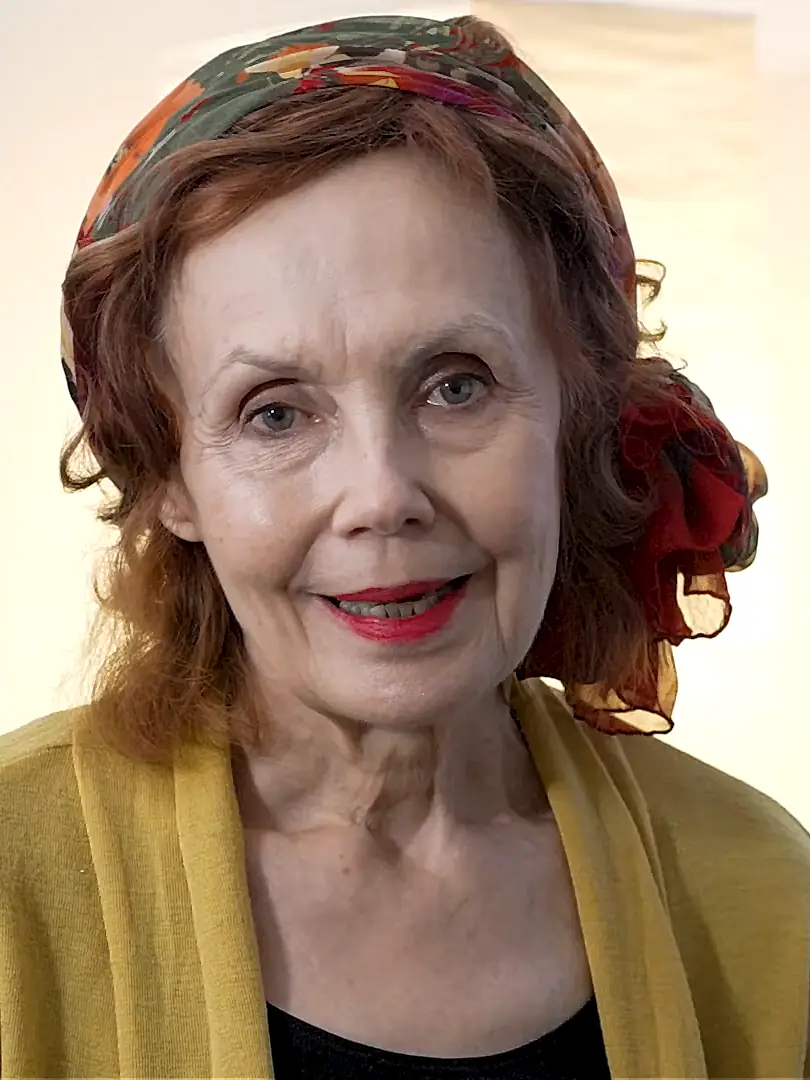
As a small girl, Kaija Saariaho asked her mother to turn off the music coming from her pillow. It was keeping her awake. She recalled this in a conversation with Tom Service published in 2011. Music was already sounding in her head before she had much idea how to write it down. Born in Helsinki in 1952, she grew up outside musical circles. Her father ran a metalworking business. At the family’s summer house in Karelia, she heard Bach on the radio when she was six or seven; later, learning German at school, she learned that his name meant a little river.
Music, from the start, was completely my own thing.
She tried out chords on the living-room piano, to her mother’s irritation. At thirteen she took up the guitar, which she could play alone in her bedroom, and began a piece called Yellow and Nervous. She went to Helsinki concerts on her own and bought whatever records caught her attention. Her father wanted her to become an architect. She could draw and briefly studied visual art, but playing piano for a student theatre brought her back to writing songs.
1976–83Sibelius Academy, Freiburg and IRCAM
Paavo Heininen had no room in his composition class at the Sibelius Academy. Saariaho telephoned him anyway, then went to see him one Thursday, determined to stay in her chair until he accepted her. He tested her musical knowledge by asking her to sing the opening of Stravinsky’s The Rite of Spring. She answered shyly and stayed seated. He took her on. Her studies began in 1976, and she soon became friends with Magnus Lindberg and Esa-Pekka Salonen. After their successive Thursday lessons she and Lindberg sometimes went to lunch together, in tears, trying to work out how to satisfy their teacher.
She helped establish the new-music group Korvat auki! (Open Your Ears!) and travelled to Darmstadt, where she heard the music of Gérard Grisey and Tristan Murail and was immediately impressed by it. In 1981 she went to Freiburg to study with Brian Ferneyhough and Klaus Huber. The move took her out of the small Finnish musical world, where she had found it exhausting to be its conspicuous young woman composer.
In January 1982 she joined a course at IRCAM in Paris. She learned acoustics and computer programming, took a particular interest in the synthetic-voice programme CHANT, and met Jean-Baptiste Barrière, her future husband and electronic collaborator. The equipment let her examine a recorded sound and make new sounds from it. She held that the composing remained her own work.
I don’t want the machine to compose for me – I like composing!
1986–95Lichtbogen, Karttunen and Hoitenga
For Lichtbogen, completed in 1986, she went to the cellist Anssi Karttunen to make recordings and learn more about his instrument. Under the bow, a clear harmonic could break into several pitches, and computer measurements helped her draw a succession of chords from that change. Nine players, with electronics, enlarged the sound. The title came from northern lights she had watched moving silently across the Arctic sky.
The flautist Camilla Hoitenga became another indispensable partner. In NoaNoa (1992), she speaks words from Gauguin’s Tahitian journal while she plays the flute. An early high E is captured electronically and held while she continues to play. Karttunen’s Près, written the same year, sets his live cello among transformed recordings of his own playing.
Saariaho then turned to the orchestra. She was pregnant with her first child while composing Du cristal; a quick triangle pulse and slower low percussion recall the two heartbeats she felt in her body. The piece ends with a cello trill that begins its companion, …à la fumée, in which alto flute and cello have solo roles. In Graal théâtre she wrote for Gidon Kremer’s violin without electronics. Kremer gave the first performance of the concerto at the Proms in August 1995, with Salonen conducting the BBC Symphony Orchestra.
2000–10L’Amour de loin and later operas
L’Amour de loin was staged at Salzburg on 15 August 2000, directed by Peter Sellars and conducted by Kent Nagano. Dawn Upshaw sang Clémence, the countess whom the troubadour Jaufré Rudel loves without having met. Maalouf’s libretto gave the opera three principal characters, the two lovers and a Pilgrim who carries news between them. The soprano and baritone are on opposite shores for much of the opera, and the Pilgrim, a mezzo-soprano, travels between them.
When Jaufré sets sail, his anticipation turns to terror. He falls ill on the crossing and reaches Tripoli dying. The lovers meet in the fifth act. Clémence then turns her anger towards heaven and ends in prayer, addressing a beloved who might be God or the dead man. Saariaho had already written Lonh (1996) for Upshaw, setting fragments of Rudel’s poetry against recorded voices and weather.
Maalouf and Sellars worked with her again on Adriana Mater and La Passion de Simone, both first heard in 2006. Adriana bears a child after rape in wartime; years later, her son sets out to kill his father. In the fifteen stations of La Passion de Simone, a soprano addresses the life of Simone Weil while the philosopher’s words are heard through the electronics. Émilie, first performed in Lyon in 2010, put Karita Mattila alone on stage as Émilie du Châtelet, pregnant and working on Newton. The orchestra includes a harpsichord, an instrument du Châtelet herself played.
2013–23Innocence and HUSH
In 2013 Saariaho invited the novelist Sofi Oksanen and her son, the dramaturg Aleksi Barrière, to dinner to discuss a new opera. Oksanen wrote the story in Finnish; Barrière shaped it into a libretto in nine languages. Innocence, completed in 2018 and first staged at Aix-en-Provence in July 2021, begins at a Helsinki wedding. A waitress recognises the groom’s family. His brother had killed her daughter in a school shooting ten years before.
The wedding guests sing operatically, while the former pupils and their teacher recall the shooting in speech and song. The murdered girl, Markéta, is sung by the folk singer Vilma Jää. The accounts of those who shared the event differ, and the opera gradually sets them against one another. The orchestra links the present celebration with a classroom.
Saariaho had been diagnosed with brain cancer in February 2021. As her motor skills failed, Nastaran Yazdani and Karttunen helped her notate HUSH, a trumpet concerto for Verneri Pohjola. She and Pohjola worked on falling slides, including a low growl imagined as a sound descending the sides of a well. The mechanical pulse of the third movement came from her monthly MRI scans. She finished the concerto in March 2023 and died at home in Paris on 2 June. Pohjola gave the première in Helsinki on 24 August, with Susanna Mälkki conducting the Finnish Radio Symphony Orchestra.
Where to hear it
Lichtbogen1985–86
Avanti! Chamber Orchestra; Hannu Lintu · Ondine · 2001
The work, for nine musicians and live electronics, grew from a cello harmonic breaking into noise. Hannu Lintu conducts Avanti! in a programme that places this early electronic work beside the chamber version of Graal théâtre.
Graal théâtre (chamber version)1994; chamber version 1997
John Storgårds, violin; Avanti! Chamber Orchestra; Hannu Lintu · Ondine · 2001
The violin concerto pairs a lyrical Delicato with a fierce Impetuoso. John Storgårds plays Saariaho’s chamber version with Avanti!, the orchestra he led, under Hannu Lintu.
Daniel Belcher (Jaufré Rudel), Ekaterina Lekhina (Clémence), Marie-Ange Todorovitch (Le Pèlerin); Rundfunkchor Berlin; Deutsches Symphonie-Orchester Berlin; Kent Nagano · harmonia mundi · 2006, 2008
Amin Maalouf’s libretto sends the troubadour Jaufré Rudel across the sea to Clémence, countess of Tripoli. Kent Nagano, who conducted the première at Salzburg in 2000, conducts this studio recording, released in 2009, with a new cast: Daniel Belcher, Ekaterina Lekhina and Marie-Ange Todorovitch. All five acts are included, among them the long crossing before the lovers meet.
For Lichtbogen, Saariaho analysed a single cello note as it changed from a clear harmonic into several rougher pitches, and used stages of that change to build the harmony for the whole ensemble. The chords and the playing technique both came from the same experiment, a bow pressing into a string.
𝄞Strings
The bow can make a held note grainy, or bring a clear pitch out of friction. In Nymphéa, four string players move between harmonics and violent attacks while electronics transform their playing. The players also whisper fragments of a poem by Arseny Tarkovsky, which enter gradually alongside the sounds of the strings.
𝄐Electronics
Electronics allow a note to continue after the action that produced it. Near the beginning of NoaNoa, a high E continues to ring electronically while the flautist moves on. The player also triggers recordings of flute and voice, so the solo flute is joined by other sounds. In Près, the cellist plays against sounds made by recording and transforming his own instrument.
𝄋Time and form
A repeated figure can accelerate until its separate notes are no longer heard individually. Saariaho explored that change in Laterna magica, prompted by Ingmar Bergman’s description of a magic lantern’s turning handle. Six horns interrupt the orchestral phrases, playing together and holding the sound; she associated those passages with the red screens that separate scenes in Bergman’s Cries and Whispers.
𝅘𝅥Voice and theatre
In Innocence the wedding party sings in an operatic style, while the survivors of the school speak and sing their memories in several languages. Markéta, the dead pupil, sings using Finnish folk-singing techniques. When past and present are on stage together, the difference between her voice and those of the adult singers can still be heard.
Works
A selection from the composer’s works.
1982
Laconisme de l’aileFlute, with optional electronics
Begun in Freiburg and finished in Paris, it opens with words about birds from Saint-John Perse’s Oiseaux. The player’s speech leads into the flute line.
1985–86
LichtbogenNine instruments and live electronics
The title came from the northern lights, and the harmony was first derived from recordings of a cello. The ensemble includes piano, harp and percussion alongside flute and five strings.
1987
NymphéaString quartet and live electronics
Written for the Kronos Quartet. The players’ sounds are transformed electronically as they perform, and the players whisper fragments of a poem by Arseny Tarkovsky.
1989–90
Du cristal …à la fuméeOrchestra and electronics; alto flute and cello soloists in the second work
The cello trill that ends Du cristal also begins …à la fumée; the two pieces can be performed separately.
1994
Graal théâtreViolin and orchestra; chamber-orchestra version 1997
Written for Gidon Kremer, who introduced it at the 1995 Proms with Salonen and the BBC Symphony Orchestra. The title comes from the Grail plays of Jacques Roubaud and Florence Delay.
1999–2000
L’Amour de loinOpera in five acts; three soloists, chorus, orchestra and electronics
A Pilgrim carries news between a troubadour and the countess he loves without having seen her. Their first meeting comes in the fifth act, with Jaufré close to death.
2002
OrionOrchestra
Three movements: Memento mori, Winter Sky and Hunter. A piccolo begins the slow middle movement and passes its melody to solo violin and other orchestral players.
2008
Laterna magicaOrchestra
Saariaho rediscovered Bergman’s autobiography while tidying her bookshelves in 2007. Six horns refer to the red screens in Cries and Whispers; the orchestra also speaks words from his book.
2018
InnocenceMultilingual opera; singers, actors and orchestra
A wedding in Helsinki is set alongside memories of a school shooting that took place ten years earlier. Aleksi Barrière adapted Oksanen’s story as a libretto in nine languages. The première was at Aix in 2021.
2023
HUSHTrumpet and orchestra
Her final completed work, written with Verneri Pohjola and first performed after her death. The first movement rises from a low A♭; the third takes its mechanical pulse from her experience of MRI scans.
In the score
Short examples, engraved and playable.
Harmonic series — schematicOvertones of a low C
This illustrative schematic shows a low C and its first eleven harmonics, spread across two staves. The upper B♭ and F quarter-sharp are approximations, because the natural series extends beyond the piano’s tuning. Saariaho’s own experiments also drew on rougher cello sounds containing several pitches, as in Lichtbogen.
Bow pressure — schematicFour bars on the same C
An invented playing exercise: the left hand holds C while the bow releases its excess pressure and moves away from the bridge towards the ordinary playing position. The note becomes clearer as the friction decreases. The synthesised playback repeats an ordinary cello tone; the changing bow instructions are for a human player.
Sister arts
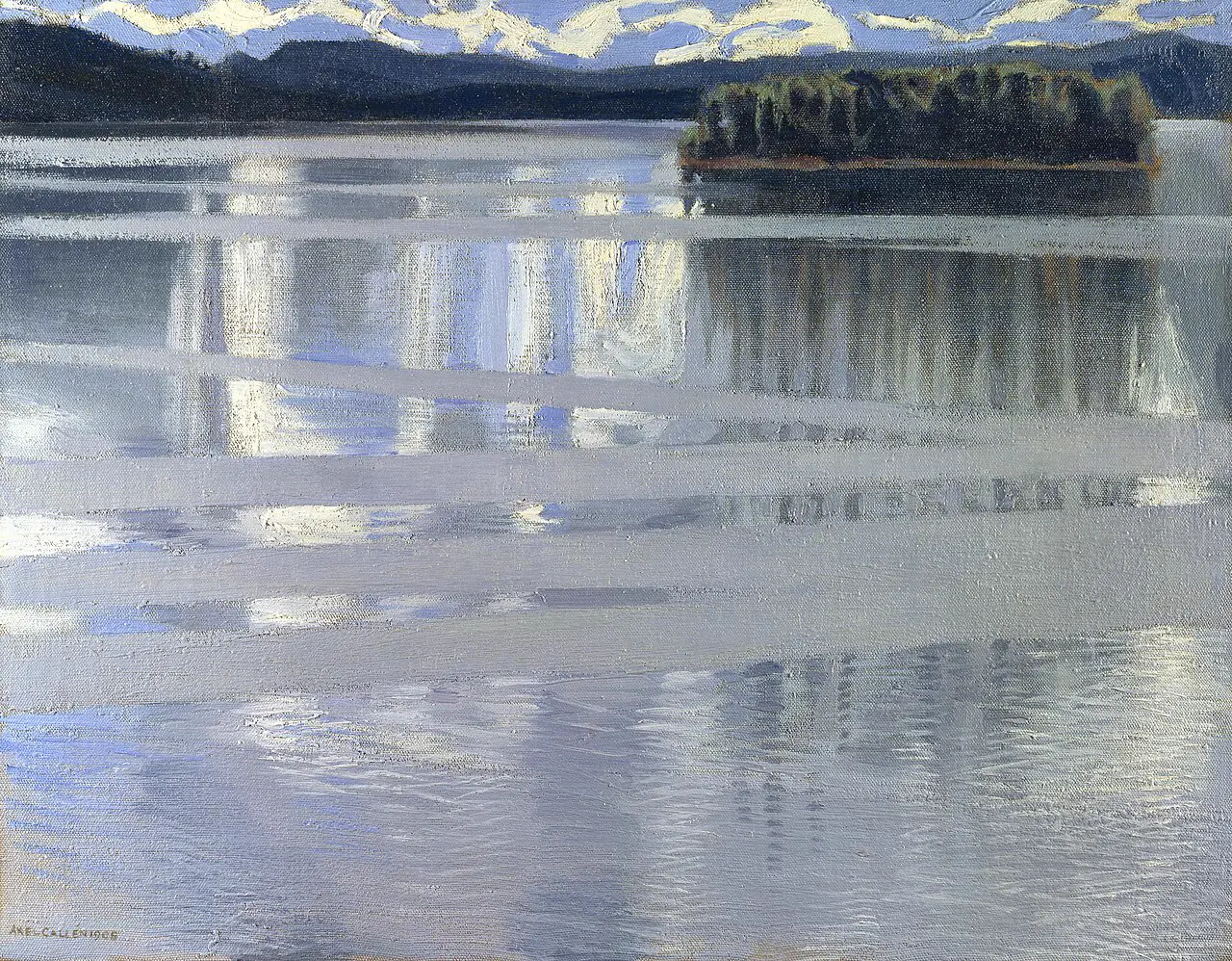
Akseli Gallen-KallelaLake Keitele, 1905Oil on canvas · National Gallery, London
Wind and currents draw the diagonal bands across Gallen-Kallela’s lake, and in the foreground the bands break into smaller ripples. The painting can be set beside Lichtbogen as another picture of movement within a still expanse. Saariaho’s starting image was the northern lights moving silently across a black sky.
Jaufre Rudel
Lanquan li jorn son lonc e may — first stanza
Twelfth century
OccitanLanquan li jorn son lonc e may
M’es belhs dous chans d’auzelhs de lonh,
E quan mi suy partitz de lay,
Remembra’m d’un’ amor de lonh.
Vau de talan embroncx e clis
Si que chans ni flors d’albespis
No-m valon plus que l’yverns gelatz.
Our translationWhen the days are long in May,
I delight in the sweet song of distant birds;
and when I have departed from there,
I remember a love far away.
I go bowed down and bent with longing,
so that neither song nor hawthorn flowers
are worth more to me than frozen winter.
In the poem, Rudel hears birdsong from far away, and de lonh returns at the ends of his lines. Saariaho set fragments of the poem in Lonh (1996), written for Dawn Upshaw. Alongside the live soprano, the electronic part has voices reading the text in Occitan, French and English, together with the sounds of birds, wind and rain.
Anonymous
Vida of Jaufre Rudel — opening
Thirteenth-century biographical tradition
OccitanJaufres Rudels de Blaia si fo mout gentils hom, princes de Blaia.
Et enamoret se de la comtessa de Tripol, ses vezer, per lo ben qu’el n’auzi dire als pelerins que venguen d’Antiocha.
E fez de leis mains vers ab bons sons, ab paubres motz.
Our translationJaufre Rudel of Blaye was a very noble man, prince of Blaye.
He fell in love with the countess of Tripoli without seeing her, because of the good he heard spoken of her by pilgrims returning from Antioch.
He made many verses about her, with good melodies and poor words.
The medieval vida supplied the voyage, the illness at sea and the death in the countess’s arms that became L’Amour de loin. Maalouf named the countess Clémence and made the travelling Pilgrim the third principal character.
Recommended recordings
Private Gardens: Lonh · Près · NoaNoa · Six Japanese GardensDawn Upshaw, Anssi Karttunen, Camilla Hoitenga, Florent Jodelet; electronic collaboratorsOndine · 1997Four close collaborators of Saariaho perform her solo works and works with electronics. Upshaw sings Rudel’s Occitan in Lonh; Hoitenga plays the flute writing she helped Saariaho devise for NoaNoa.
Notes on Light · Orion · MirageAnssi Karttunen, Karita Mattila; Orchestre de Paris, Christoph EschenbachOndine · 2008Karttunen plays the five-movement Notes on Light, which was written for him, and then joins Mattila in the world-première recording of Mirage, made in Paris on 13 March 2008.
Graal théâtre · Château de l’âme · AmersGidon Kremer, Dawn Upshaw, Anssi Karttunen; orchestras conducted by Esa-Pekka SalonenSony ClassicalKremer’s Graal théâtre was recorded at Maida Vale in June 1996. Salonen conducts all three works. The other soloists are Upshaw (soprano) and Karttunen (cello with electronics).
Passed toElectroacoustic chamber musicContemporary multilingual operaFinnish composition after spectralism
Heininen taught her how to keep building a piece, and Grisey and Murail gave her confidence in her own hearing. She welcomed programmes that paired her work with Debussy and Ligeti. She often worked out new musical ideas alongside a player, as with Hoitenga speaking through the flute or Karttunen producing new sounds with his bow.