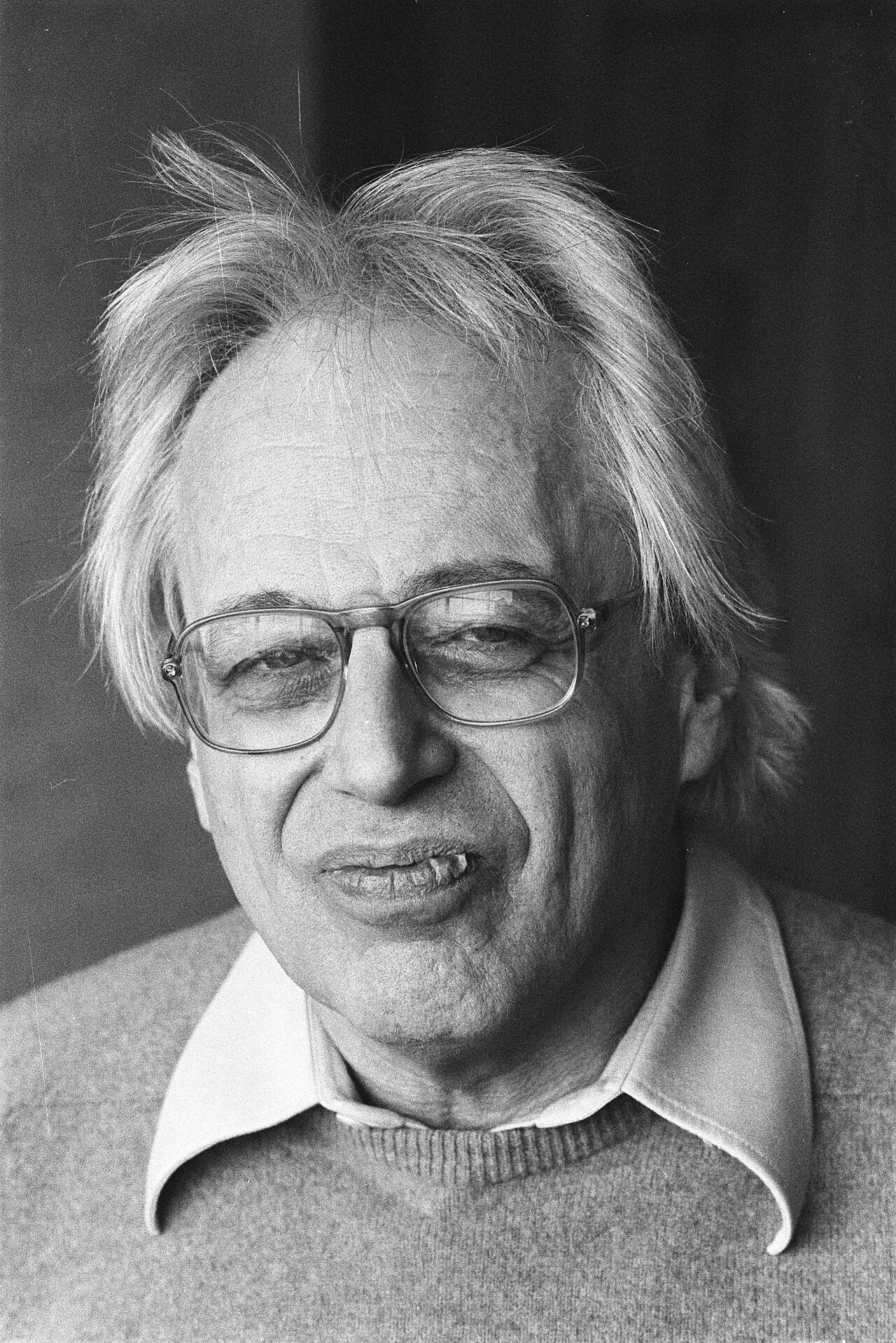
Born 28 May 1923, Diciosânmartin, Transylvania, Romania (now Târnăveni)Died 12 June 2006, Vienna
Composer of orchestral works in which dozens of moving parts are contained within one sustained sound, and of piano études in which the two hands play at different speeds.
Ferenc Farkas in Cluj; Sándor Veress and Farkas at Budapest’s Liszt Academy
Exile
Left Hungary in December 1956; worked at Cologne’s WDR electronic studio, 1957–58
Teaching
Budapest 1950–56 · Stockholm 1961–71 · Hamburg 1973–89
Output
One opera · two string quartets · concertos · eighteen piano études
Life
In December 1956, György Ligeti and Vera, his former wife, hid beneath mailbags on a train out of Budapest. Soviet troops had crushed the uprising; the last stretch into Austria had to be crossed through mud. Recalling the escape to Christopher Ford in The Guardian on 7 May 1974, Ligeti said: “We went across on foot. Four foot.” He made a crawling gesture. He was thirty-three. He and Vera remarried the following year.
1923–56Transylvania, war and Budapest
He had been born in Diciosânmartin, Transylvania, into a Hungarian-speaking Jewish family. They moved to Cluj, where he studied composition with Ferenc Farkas from 1941. He had wanted to study mathematics and physics, but the university’s quota for Jewish applicants kept him out, so music was his second choice. War interrupted the conservatory course. Ligeti was sent into forced labour; his father and younger brother were murdered in concentration camps. His mother survived Auschwitz.
In 1945 he went to Budapest and resumed composition studies with Farkas and Sándor Veress. At the Liszt Academy, where he joined the teaching staff in 1950, he studied and taught counterpoint. Bartók was a more recent model, though the Stalinist authorities banned much of his music along with that of Webern and Schoenberg. Ligeti made folk-song arrangements that could be published and wrote other music that could not be published or performed. His First String Quartet was not given its première until 1958, in Vienna.
At a cousin’s piano he worked on Musica ricercata (1951–53), eleven pieces built from a deliberately restricted supply of notes. In the first, A is repeated in octaves, faster and faster, until D arrives at the end. Each later piece adds one pitch class, and the last, a homage to Frescobaldi, uses all twelve. The cycle includes a waltz, a lament and a memorial to Bartók. It was banned.
1957–61Cologne, tape and Atmosphères
In Cologne he could hear music that he had struggled to hear on Western broadcasts in Hungary. At the WDR electronic studio he worked alongside Gottfried Michael Koenig and Karlheinz Stockhausen, cutting and joining tape with scissors and glue. Artikulation (1958) treats electronic sounds as the elements of an invented language, without words. He later carried that idea into Aventures and Nouvelles Aventures, for three singers and seven instrumentalists.
His work in the tape studio informed what he went on to write for orchestra. Apparitions brought him to international attention in 1960; Atmosphères followed at Donaueschingen in October 1961, conducted by Hans Rosbaud. It opens with a quiet cluster spanning almost five octaves. Later, twenty-eight violins descend while twenty violas and cellos climb, narrowing the space between them to a minor third. In this passage forty-eight separate lines move within a single slowly contracting chord.
Explaining this music to Ford in 1974, Ligeti picked at his jacket sleeve: “Here are different threads, green, blue, yellow – but it gives the one surface.” He used the cloth to demonstrate micropolyphony. Under the apparently motionless sound were closely interwoven parts of the kind he had studied in Budapest. In Lontano (1967), the parts share more familiar intervals and double one another at the octave, so the harmony can be heard through the orchestral texture.
1962–68Requiem, metronomes and Kubrick
The Requiem (1963–65) places its twenty-part Kyrie beside a violently broken-up judgement scene. Ligeti had the apocalyptic pictures of Memling, Bruegel and Bosch in mind; the soprano and mezzo-soprano soloists sing against a choir large enough to hold its own against the orchestra. He set only selected parts of the service. In 1966 he returned separately to its Communion text for Lux aeterna. Sixteen unaccompanied voices enter at the edge of audibility; at the first Domine, the basses enter high in falsetto. After the final notes fade, the conductor goes on beating seven silent bars.
He also wrote music for one hundred metronomes. In the Poème symphonique of 1962 they are wound up, set to different speeds and left to run down. The initial clatter thins into patterns until a single machine is left ticking. In Continuum (1968) the process is reversed. A harpsichordist plays so quickly that the separate plucks merge into a buzzing, nearly stationary sound.
Kubrick then used Atmosphères, the Requiem and Lux aeterna in 2001: A Space Odyssey (1968). Ligeti learnt about the film from a friend and attended its Vienna opening. Nobody had consulted him. He went back with a stopwatch and timed more than half an hour of his music in the soundtrack. He was eventually paid $3,000. An American publisher later asked him to describe his collaboration with Kubrick for a book about the film.
1973–82Le Grand Macabre and the Horn Trio
From 1973 Ligeti taught composition in Hamburg, while working on Le Grand Macabre. He and Michael Meschke adapted Michel de Ghelderode’s play about a threatened apocalypse in Breughelland. Car horns open the opera. Nekrotzar announces the end of the world, meets a court of drunks and schemers, and drinks too much himself; the population survives the catastrophe he has appointed. Elgar Howarth conducted the première in Stockholm in 1978. Ligeti revised the score, and the revised version was first staged in Salzburg in 1997.
After the opera came several lean years, then the Horn Trio of 1982, subtitled Hommage à Brahms. It uses Brahms’s combination of violin, horn and piano, but the three players repeatedly fall out of step. A fast dance divides eight beats in competing ways, and the march also misaligns its parts. In the final Lamento, descending chromatic lines close in around a recurring five-bar pattern, and the low register of the piano is used as a large imaginary drum. The horn plays against its fading resonance.
1985–2006Piano études and late concertos
In these years he took up new rhythmic models. In 1980 he encountered Conlon Nancarrow’s player-piano music and bought two recordings in Paris; he was interested in its simultaneous speeds. In 1982 his former pupil Roberto Sierra introduced him to Simha Arom’s recordings of Central African ensembles, and Ligeti played these records repeatedly. Later, discussing African lamellophones, he explained how a player’s two hands could suggest separate instruments, and he wanted to bring this problem to the piano keyboard.
The eighteen piano études, written between 1985 and 2001, made such problems into pieces. In Désordre, the right hand plays on the white keys and the left on the black; their accents begin together and drift apart. Ligeti himself could play most of the studies only slowly. “Everything is playable. I know my trade!” he told Bruno Serrou in a late-1996 interview for Piano. Pierre-Laurent Aimard became a leading interpreter of these works.
The late concertos took the experiment beyond the keyboard. In the Violin Concerto, an orchestral violin and viola are retuned, horns play uncorrected natural notes, and four woodwind players take up ocarinas. The Hamburg Concerto surrounds its horn soloist with four natural horns. At eighty, speaking to Tom Service in The Guardian on 17 October 2003, Ligeti explained why he had added its seventh movement: “With me, the plan and the piece develop at the same rate.” Illness curtailed his composing. He died in Vienna on 12 June 2006.
Where to hear it
Atmosphères1961
Wiener Philharmoniker; Claudio Abbado · Deutsche Grammophon · 1988
The divided strings move in opposite directions until their separate lines fuse into a slowly changing chord. Abbado conducts the Vienna Philharmonic in Atmosphères and Lontano on the Wien Modern album, beside Boulez’s Notations and music by Nono and Rihm. He keeps the orchestral texture lean enough for individual lines to be heard, and the recording is a good choice for the changing inner detail.
Danny Driver, piano · Hyperion · 28–30 October 2019, St Silas the Martyr, Kentish Town, London
Désordre puts the right hand on the white keys and the left on the black, and the accents in the two hands move out of alignment. Driver’s single-disc recording includes all eighteen studies, from Désordre to Canon.
Isabelle Faust, violin; Les Siècles; François-Xavier Roth · harmonia mundi · September–October 2023, Maison de l’Orchestre national d’Île-de-France, Alfortville
Four ocarinas and retuned violin and viola parts alter the orchestra’s usual tuning. Faust plays a cadenza she devised with Oscar Strasnoy.
In the Kyrie of the Requiem, five choral groups each divide into four parts and follow one another in close canon. The twenty lines are too entangled to be heard separately. Their notes are still exactly written, and instruments double the groups’ entries to help the singers pitch them. The technique is called micropolyphony; in it the voices move continuously while the choral sound as a whole stays static.
♮Orchestral colour
Atmosphères begins with neighbouring semitones spread across nearly five octaves. Within a later cluster, changes of loudness bring first the white-note pitches, then the black-note pitches forward. Harmony changes as particular instruments emerge. One sudden cut takes the music from piccolos to double basses six octaves below; at the end, percussionists brush the strings inside a piano.
𝅘𝅥Displaced accents
The hands in Désordre share a quick underlying pulse, with white keys in the right hand and black keys in the left. Shortening a phrase by a quaver puts their accented notes out of step. The fingers keep moving evenly while the accented notes of the two hands drift further apart.
𝄪Unequal tuning
The Violin Concerto places one retuned violin and one retuned viola beside normally tuned strings. In two movements the horns play uncorrected natural harmonics, whose upper notes do not match equal temperament. Four woodwind players also play ocarinas. With these instruments an interval wavers or roughens where an ordinary orchestra would smooth it out, and the solo violin plays against several different tunings at once.
𝄞Invented speech
Aventures and Nouvelles Aventures give a soprano, alto and baritone phonetic texts without dictionary meanings. An exchange can be intimate or furious in tone before any intelligible word appears. Seven instrumentalists play with the singers. In Le Grand Macabre, the Chief of the Secret Political Police takes over this vocal manner. The role is written for coloratura soprano and is given urgent, half-nonsensical messages.
𝄋Keyboard experiments
The first Musica ricercata piece is built on repeated As, played in octaves, with stronger attacks and at increasing speed, until a D finally enters. In Continuum, for harpsichord, each hand plays on a separate manual, so rapidly that successive plucks fuse. The harpsichord can scarcely sustain a note; in this piece its mechanism produces a nearly continuous hum.
Works
A selection from the composer’s works.
1951–53
Musica ricercataPiano
Eleven pieces whose number of pitch classes rises from two to twelve. The last honours Frescobaldi; six of the others became the Six Bagatelles for wind quintet.
A quartet from the Hungarian years, still close to Bartók. The Ramor Quartet first performed it in Vienna in May 1958, after Ligeti had escaped to the West.
1961
AtmosphèresLarge orchestra
The score opens with a quiet cluster spanning nearly five octaves, and in it forty-eight string parts can play at once. Hans Rosbaud conducted the première at Donaueschingen. The work is dedicated to the memory of the composer Mátyás Seiber.
1963–65
RequiemSoprano, mezzo-soprano, mixed chorus and orchestra
The Kyrie divides the choir into twenty contrapuntal parts; the judgement sequence breaks into dramatic exchanges. In the closing Lacrimosa, the two soloists sing with a reduced orchestra.
1966
Lux aeternaSixteen unaccompanied mixed voices
The first bass entry is in falsetto, on Domine, above the quietly overlapping choir. Seven bars of conducted silence follow the last audible notes.
1967
LontanoOrchestra
The orchestral writing uses unison canons and octave doublings, and recognisable intervals appear within the closely written parts. Ernest Bour conducted its first performance at Donaueschingen.
1974–77; revised 1996
Le Grand MacabreOpera in four scenes; libretto by Ligeti and Michael Meschke after Michel de Ghelderode
Car horns open the opera, which deals with an apocalypse entangled in drinking, sex and court politics. The first production was in Stockholm in 1978; the revised version was staged in Salzburg in 1997.
1982
Trio for Violin, Horn and PianoViolin, horn and piano
A homage to Brahms whose dance and march repeatedly put the players out of step. The final Lamento builds descending chromatic lines around a recurring five-bar pattern.
1985–2001
Études pour pianoPiano; eighteen études in three books
In Désordre, white-key and black-key patterns move out of alignment; in Touches bloquées, keys held down silently leave gaps in a running line. Ligeti admitted that he could play most of the études only slowly.
1989–93
Violin ConcertoSolo violin and chamber orchestra
Five movements with retuned strings, natural horn notes and a quartet of ocarinas. The melody of the second movement goes back to the seventh piece of Musica ricercata.
In the score
Short examples, engraved and playable.
Counterpoint becoming a cluster · schematicFour-part ascent by semitones
An invented schematic of a close canon, with each part entering one crotchet after the last. All four parts climb by semitones, and their staggered entries place neighbouring pitches on top of one another. Here the individual parts can still be heard. In Ligeti’s much denser canons the combined chord is easier to hear than any single line.
Musica ricercata I · schematic restrictionA waits for D
An invented schematic using the two pitch classes of the first piece, A in several octaves and then D. The rhythms and dynamics illustrate the restriction and do not reproduce Ligeti’s score. Repetition and octave doubling vary the music before a new note enters.
Sister arts
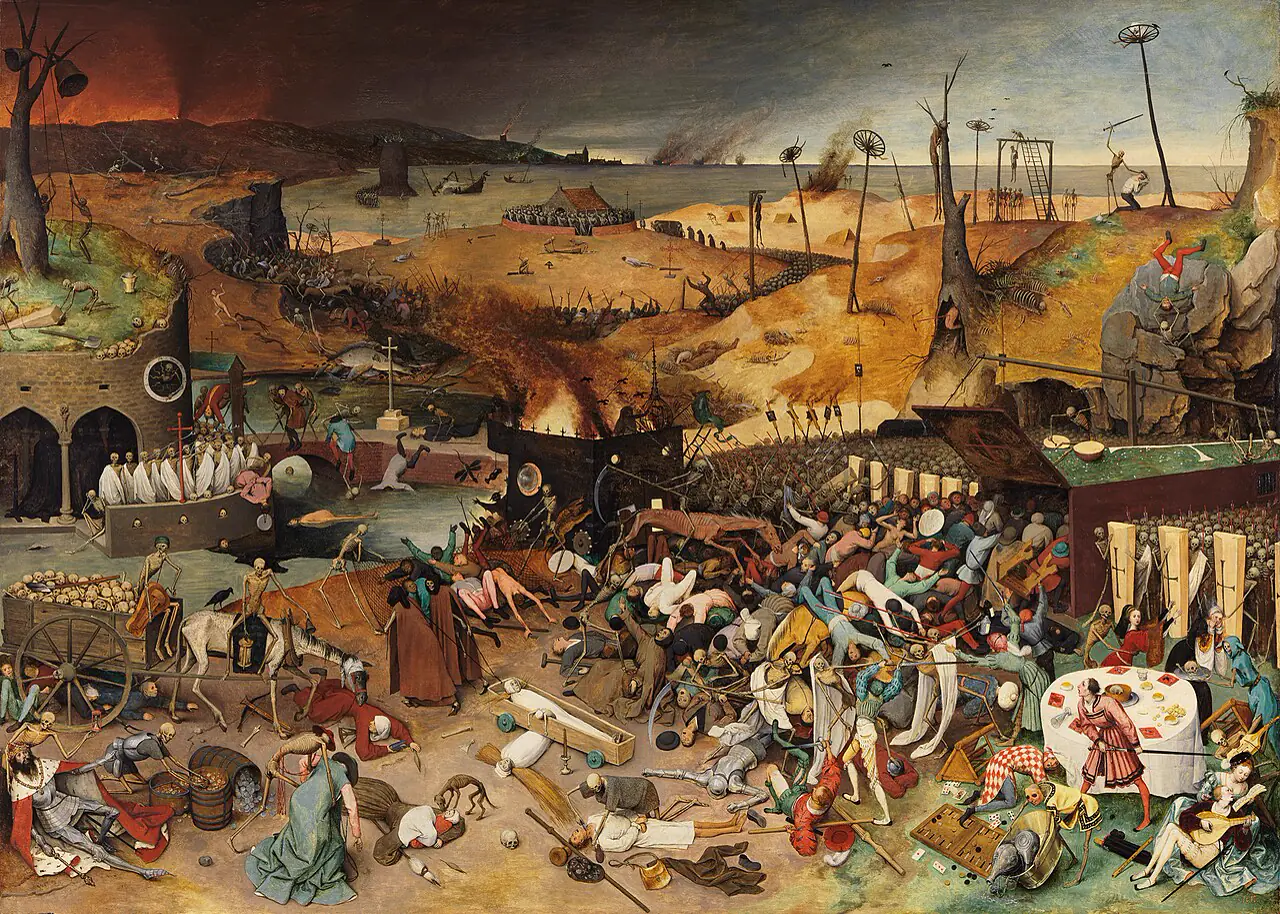
Pieter Bruegel the ElderThe Triumph of Death, c. 1562Oil on panel · Museo Nacional del Prado, Madrid
At the lower right, a man plays the lute while a woman sings; a skeleton joins their music. Around them, Bruegel’s army of death overruns every rank of society. Ghelderode drew on these paintings for the Breughelland of Le Grand Macabre. Ligeti’s Nekrotzar brings the same threat into a world of lovers and drinkers, and then becomes too drunk to carry it out.
Latin Requiem liturgy
Lux aeterna
Traditional Latin text; set by Ligeti in 1966
LatinLux aeterna luceat eis, Domine,
cum sanctis tuis in aeternum, quia pius es.
Requiem aeternam dona eis, Domine,
et lux perpetua luceat eis.
Our translationLet eternal light shine on them, Lord,
with your saints for ever, for you are merciful.
Give them eternal rest, Lord,
and let perpetual light shine on them.
These words belong to the Communion of the Mass for the Dead, a section Ligeti had left out of his Requiem. He set them separately in 1966 for Clytus Gottwald’s Schola Cantorum Stuttgart. The sixteen parts overlap their syllables until Domine is heard in the bass voices, first in falsetto and later low down.
Recommended recordings
Musica ricercata · Piano ÉtudesPierre-Laurent AimardSony ClassicalThe recommended starting point for the piano music. Aimard keeps firm rhythmic control and plays the quieter studies lightly. This volume contains Musica ricercata and the first fifteen études, through White on White.
Cello, Violin and Piano ConcertosJean-Guihen Queyras, Saschko Gawriloff, Pierre-Laurent Aimard; Ensemble intercontemporain, Pierre BoulezDeutsche GrammophonGawriloff, for whom Ligeti wrote the Violin Concerto, plays the solo part in that work. The three works span the 1960s and the later period.
Bartók stands close behind the Hungarian works; Debussy remained a model for Ligeti’s piano writing. In the 1980s he also studied Nancarrow’s records and Simha Arom’s Central African recordings. In Hamburg, Unsuk Chin studied with him from 1985 to 1988. He encouraged her to look beyond the prevailing avant-garde.