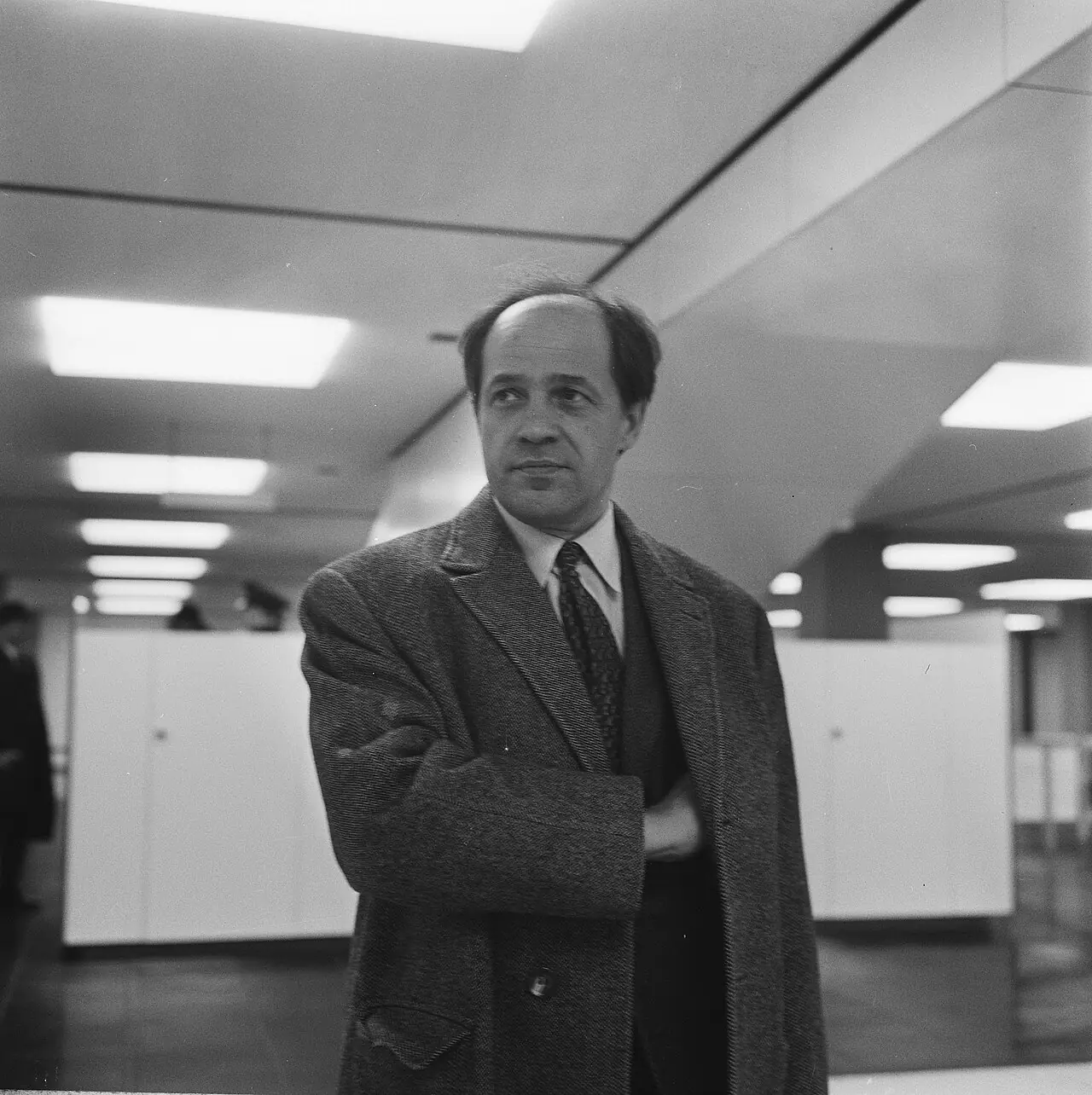
Joined the Renaud–Barrault company in 1946, playing the ondes Martenot
Conducted
BBC Symphony Orchestra, 1971–75 · New York Philharmonic, 1971–77
Founded
Domaine musical, 1954 · Ensemble intercontemporain, 1976 · IRCAM opened in 1977
Life
Pierre Boulez arrived in Paris in 1943 after studying advanced mathematics in Lyon and turning down the engineering career his father wanted for him. He was eighteen and came from Montbrison in central France. Within two years he had won a first prize in harmony at the Conservatoire. His teacher, Olivier Messiaen, also held private classes in which students analysed Debussy’s Jeux and Stravinsky’s The Rite of Spring.
Messiaen’s classroom required concentration. Horn and piano classes could be heard nearby while the students took musical dictation. ‘You learned to listen without sound’, Boulez recalled to Jed Distler in a London interview in August 2000, explaining why he never composed at the piano. He took counterpoint lessons with Andrée Vaurabourg and studied twelve-note music with René Leibowitz, who introduced him to the music of Schoenberg and Webern. By 1946 Boulez had broken with Leibowitz, impatient with his reverence for Schoenberg’s methods.
A working musicianThe theatre and the piano
In 1946 he played the ondes Martenot at the Folies Bergère and on radio, having learnt the electronic instrument from its inventor. That October, Arthur Honegger recommended him to Jean-Louis Barrault for a production of Hamlet. By the end of the year Boulez was directing the company’s stage music and arranging pieces for its small band of players.
Each of the twelve piano Notations of 1945 is twelve bars long; a rapid figure, a held chord or a repeated note can fill one piece. The Second Piano Sonata, begun in 1947, is in four movements, with jagged phrases. Its attacks leap between registers, several lines sound at once in a crowded texture, and the finale passes through fugal writing to a quiet, dispersed ending.
For that two-piano piece, begun in 1951, he borrowed a sequence from Messiaen’s Mode de valeurs et d’intensités. Teacher and pupil gave the première together in Paris in May 1952, when he was twenty-seven. The same month saw the publication of his essay ‘Schoenberg Is Dead’, which attacked Schoenberg’s use of inherited forms with a new pitch language.
Paris, 1954The Domaine musical
The concerts that became the Domaine musical began at the Petit-Marigny in January 1954. The first programme put Bach beside Webern, Stravinsky, Nono and Stockhausen. The patron Suzanne Tézenas was the association’s president and Boulez its treasurer, and the series presented this repertory regularly in Paris.
Le Marteau, first performed under Hans Rosbaud in Baden-Baden in June 1955, sets three short poems by René Char across nine interleaved movements. Its six instrumentalists play alto flute, viola, guitar, vibraphone, xylorimba and percussion, and they join and separate in small combinations. In the third movement the mezzo-soprano is accompanied by the alto flute alone. In the last movement she hums instead of singing words, and the flute, gong and tam-tams play until the music ends in silence.
Words and pathwaysThird Piano Sonata and Pli selon pli
Boulez had met John Cage in Paris in 1949 and presented his prepared-piano music at private concerts. In his own Third Piano Sonata, begun in 1955, the pianist chooses routes through passages whose notes are already written, within limits set by the composer. Only two of its five main sections were published complete during his lifetime. In Constellation–Miroir, red and green printing distinguishes blocks of chords from scattered points of sound, and arrows show the pianist where to go.
Stéphane Mallarmé’s poetry gave him another way of thinking about a work’s shape. Pli selon pli grew around three settings for soprano and instruments and eventually became a five-movement cycle. A large orchestral chord opens Don; the same chord closes Tombeau, after the singer has reached the word ‘mort’. Between them, a syllable may be spread over many notes, or a line of verse sung in a single breath. The cycle reached its fully orchestral form in 1962; Boulez was still revising it in 1989.
Orchestras and a laboratoryBayreuth, IRCAM and Répons
In 1971 he became chief conductor of the BBC Symphony Orchestra and music director of the New York Philharmonic, posts he held until 1975 and 1977 respectively. He also conducted Wagner at Bayreuth. His 1976 Ring, directed by Patrice Chéreau, initially provoked a scandal and returned for five summers. Conducting the whole cycle repeatedly led him to consider how Wagner had returned to ideas invented twenty years earlier and found more in them.
In Paris, President Georges Pompidou had asked him in 1970 to establish a music research institute. The Ensemble intercontemporain followed in 1976 and IRCAM opened in 1977. Specialist players and researchers could now work together over long periods. For Répons, developed with Andrew Gerzso and first performed in 1981, the computer took the clear attacks of harp, cimbalom, keyboards and percussion and sent back transformed, delayed versions.
The central ensemble begins alone. When the soloists enter, they play six broken chords, which are relayed as echoes around the hall. A conventional recording necessarily flattens that effect. ‘The recording is a little bit like having a picture of a mobile by Calder’, Boulez told Distler in their August 2000 interview. The work reached its full length in 1984, and its electronics continued to change after that.
The old manuscriptNotations and Dérive 2
Boulez’s return to the piano Notations began with a photocopy. His former fellow student Serge Nigg sent it while seeking permission for a radio performance, and Boulez no longer had the manuscript. He later expanded those short pieces into much larger orchestral works. In a December 2010 interview with Wolfgang Schaufler, he described how ‘the material in fact composes with you, and you compose with the material’.
Dérive 2 also outgrew its first occasion. Boulez wrote it in 1988 for Elliott Carter’s eightieth birthday, and it expanded into a long work for eleven players, completed in 2006, in which interruptions gradually take up more time than the music they interrupt. From 2010 failing eyesight limited his conducting. He died at home in Baden-Baden on 5 January 2016, aged ninety.
Places
Every recorded place, joined in date order. Boulez on the MapAll 20 places, with sources
In Structures Ia, a note’s pitch, length, loudness and attack can each belong to a different ordered sequence. The writing calls for sudden changes of touch and has no continuous melodic line. Across Book I, isolated events give way to denser combinations; in Ic, rapid figures continue with few interruptions.
♮Small, changing ensemble
In Le Marteau sans maître the voice is accompanied by alto flute, viola, guitar and tuned percussion. The alto flute can follow the voice’s breathing, and the viola can either sustain a note or pluck it. On guitar and tuned percussion each attack fades. The first movement begins with paired instruments, flute with vibraphone and guitar with viola, and then changes the pairings. In the third, only voice and flute remain.
𝄞Attack and long decay
The six soloists of Répons play instruments with sharply defined attacks: pianos, harp, cimbalom and tuned percussion. The electronics pick up those attacks and prolong them through delayed, transformed repetitions. At the soloists’ first entrance, their broken chords are answered by further broken chords from around the room. Until that point the central ensemble has played alone.
𝅘𝅥Several independent pulses at once
Rituel, written in memory of Bruno Maderna, divides the orchestra into eight separated groups. Percussionists keep their groups moving; the conductor cues entrances, and different rates can continue together. The piece opens sparely, with oboe and percussion. Repeated gestures and percussion strokes make its returns recognisable even when the groups no longer share a beat.
𝄋Routes printed in colour
The Third Piano Sonata gives the pianist choices without asking for improvised notes. Trope offers different arrangements of four sections; Constellation–Miroir sets out red chordal blocks and green points of sound, connected by arrows. In performance the pianist chooses a route through the printed material. The resonance is also composed: keys depressed silently leave their strings free to vibrate in response to other notes that are struck.
𝄐Vocal setting of poetry
In the second Improvisation sur Mallarmé, the soprano sets the first quatrain of Une dentelle s’abolit in long, melismatic phrases. The setting of the next quatrain is syllabic, and each phrase is sung in one breath, which partly fixes its pace. Nine players accompany her, four of them percussionists, and maraca strokes recur through the setting.
Works
A selection from the composer’s works.
1945
Douze NotationsPiano
Twelve pieces, each twelve bars long, with abrupt changes of speed, weight and register. Decades later Boulez enlarged several of them into orchestral works.
1947–50
Piano Sonata No. 2Piano
The four movements require explosive attack and the ability to keep simultaneous lines distinct. The fugal writing of the finale is eventually followed by a quiet, widely spaced ending.
1951–52; revised 1953
Structures, Book ITwo pianos
Messiaen joined Boulez for the première of Ia, whose pitch sequence comes from his own Mode de valeurs et d’intensités. The complete book moves from separated, precisely weighted events towards the nearly continuous rapid writing of Ic.
The nine interleaved movements are based on three poems, and the instruments change partners constantly. After the voice’s final wordless humming, flute and deep metallic percussion end the work.
Boulez published Trope and Constellation–Miroir from a projected five-part sonata. Alternative routes and colour-coded passages give the pianist choices within fully written-out music.
1957–62; revised to 1989
Pli selon pli — Portrait de MallarméSoprano and orchestra
Three settings of Mallarmé stand between Don and Tombeau. The large chord that opens the cycle returns at its end. Between the two, the treatment of the words ranges from clear declamation to extended vocal sound.
1972–75; revised 1976 and 1987
Rituel in memoriam Bruno MadernaOrchestra divided into eight groups
A memorial to Maderna, who died in 1973. It begins with oboe and percussion, and larger groups enter in turn. Each group has its own percussion to keep its pulse, so that several tempos run at the same time.
1980–84
RéponsSix instrumental soloists, chamber ensemble and live electronics
The audience sits between a central ensemble and six soloists placed around the hall. At the soloists’ first entrance their arpeggios are transformed electronically; the rest of the piece develops the exchange between struck sound and travelling echo.
1988–2006
Dérive 2Eleven instrumentalists
A birthday tribute to Elliott Carter grew into an extended ensemble work over eighteen years. Brief interruptions become longer than the passages they interrupt, and the work ends with freer writing and a long coda at a different pace.
1997
Anthèmes 2Violin and live electronics
Long harmonics mark the boundaries between the violin’s more active passages, while electronics transpose, layer and move its sound. At the end, dry strokes of the bow’s wood on D cut off the ringing texture.
In the score
Short examples, engraved and playable.
Structures Ia · pitch schematicTwelve pitches from a teacher
Pitch schematic, without Boulez’s rhythm or register: E♭–D–A–A♭–G–F♯–E–C♯–C–B♭–F–B, shown here in equal crotchets. Boulez took this order from the first division of Messiaen’s Mode de valeurs et d’intensités for Structures Ia. In the piece, transformations of the row are combined with separately ordered durations, loudnesses and attacks.
Pitch multiplication · schematicA major third in two positions
Invented schematic, not a passage from a Boulez score. Transposing the major third C–E a tone higher gives D–F♯; combining the two positions gives C–D–E–F♯. This is the transposing-and-combining operation behind pitch multiplication. In Le Marteau sans maître, Boulez applied such operations to segments of his row to make related groups of pitches.
Sister arts
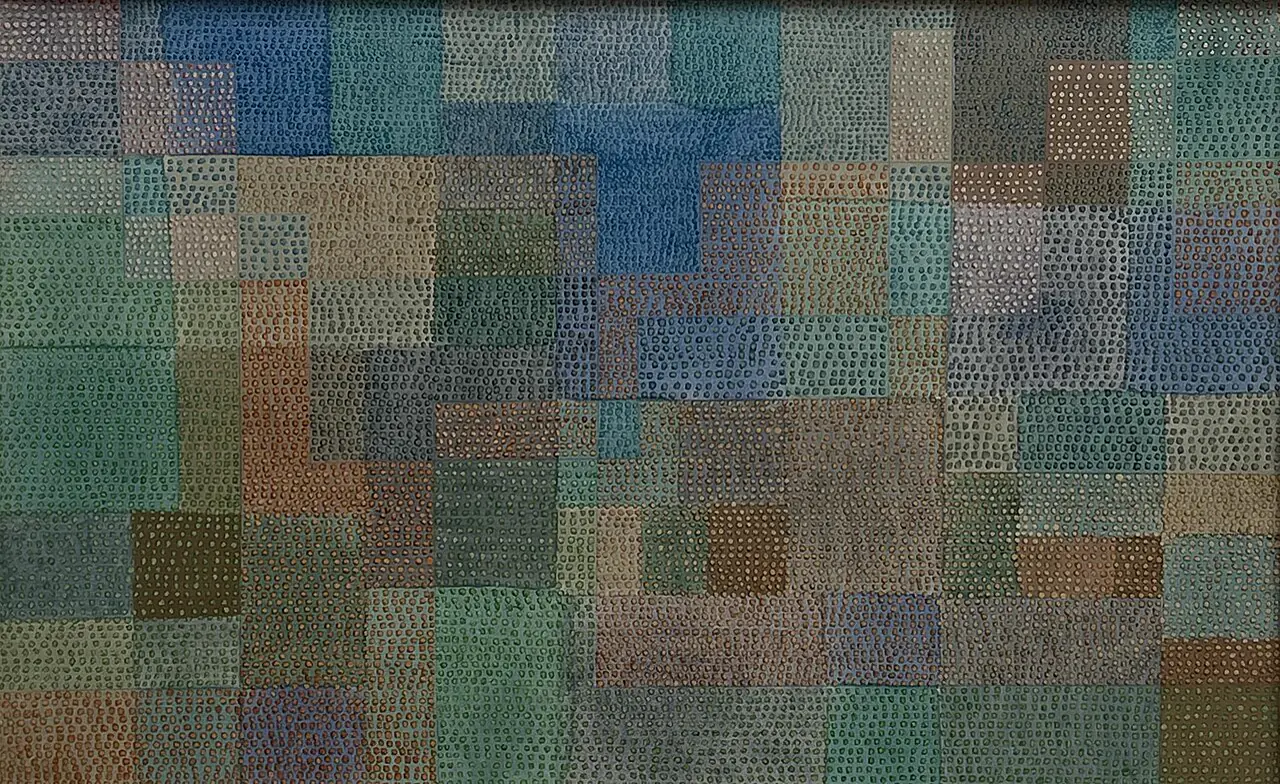
Paul KleePolyphony, 1932Oil and chalk on canvas · Emanuel Hoffmann Foundation, on deposit at Kunstmuseum Basel
Boulez first saw Klee’s work in an Avignon exhibition in 1947, when he was twenty-two; more than forty years later he published Le pays fertile: Paul Klee. In this picture Klee’s coloured rectangles overlap beneath a layer of dots. The separate shapes stay legible and together make up a larger surface, which can be compared with the interweaving instrumental lines in Boulez’s music.
Stéphane Mallarmé
Une dentelle s’abolit
1887
FrenchUne dentelle s’abolit
Dans le doute du Jeu suprême
À n’entr’ouvrir comme un blasphème
Qu’absence éternelle de lit.
Cet unanime blanc conflit
D’une guirlande avec la même,
Enfui contre la vitre blême
Flotte plus qu’il n’ensevelit.
Mais, chez qui du rêve se dore
Tristement dort une mandore
Au creux néant musicien
Telle que vers quelque fenêtre
Selon nul ventre que le sien,
Filial on aurait pu naître.
Our translationLacework dissolves
In doubt of the supreme Game,
Half-opening, like a blasphemy,
Only an eternal absence of bed.
This unanimous white conflict
Of one garland with its double,
Fled against the pale pane,
Floats more than it buries.
But where dream gilds itself
A mandore sleeps sadly
In the hollow, musical nothingness,
Such that towards some window,
With no womb but its own,
One might have been born its child.
Mallarmé’s lace, empty bed and sleeping mandore (a small lute) supply the text for the central movement of Pli selon pli. Boulez set the sonnet for soprano and nine instrumentalists, including four percussionists. Maraca strokes return through the setting, and the fourteen lines expand into phrases whose pace can depend on the singer’s breath.
Recommended recordings
Piano Sonata No. 2Maurizio PolliniDeutsche GrammophonPollini plays the opening attacks at full force and keeps the simultaneous lines clear. His tempo changes are sudden and wide, and the finale ends quietly, with the texture thinning out.
Structures, Books I and IIAloys and Alfons KontarskyWergoA hard-edged account. The exchanges in Book I are played aggressively. With both books on one recording, the change from the sharply separated attacks of Book I to the more varied textures of Book II is easy to hear.
Where to hear more
Le Marteau sans maître1953–55
Hilary Summers, contralto; Ensemble intercontemporain; Pierre Boulez · Deutsche Grammophon · September 2002, Paris
René Char’s poems are sung by a contralto, with alto flute, guitar and viola beside tuned percussion. Hilary Summers sings without display in the composer’s Grammy-winning recording with Ensemble intercontemporain, which plays with restraint and places the silences as carefully as the notes. The spare movement for voice and flute sits among the instrumental pieces.
Ensemble intercontemporain; Pierre Boulez · Deutsche Grammophon · September 1996, Paris
Two pianos, harp, cimbalom and tuned percussion alternate with a chamber ensemble through live electronics. Boulez conducts Ensemble intercontemporain, the players who developed the piece with him. The recording is in stereo, which cannot place the audience inside the circle for the soloists’ first electronically expanded entrance. The coupling is Dialogue de l’ombre double, in which Alain Damiens’s live clarinet plays against its recorded double.
Christine Schäfer, soprano; Ensemble intercontemporain; Pierre Boulez · Deutsche Grammophon · January 2001, Paris
A portrait of Mallarmé for soprano and orchestra, made from settings of his poems. Schäfer sings the definitive 1989 version, with Boulez conducting the Ensemble intercontemporain.
Boulez studied Debussy’s Jeux and Stravinsky’s scores with Messiaen, then learnt the twelve-note music of Schoenberg and Webern through Leibowitz. Philippe Manoury’s two-piano sonata shows the influence of Boulez’s Second Piano Sonata. Saariaho and Philippe Hurel worked at IRCAM, which Boulez had founded.
Further reading
Edward Campbell and Peter O’Hagan, eds, Pierre Boulez Studies (Cambridge University Press, 2016). study
Examines serial technique, large-scale form, stylistic development and reception, with previously unpublished correspondence.