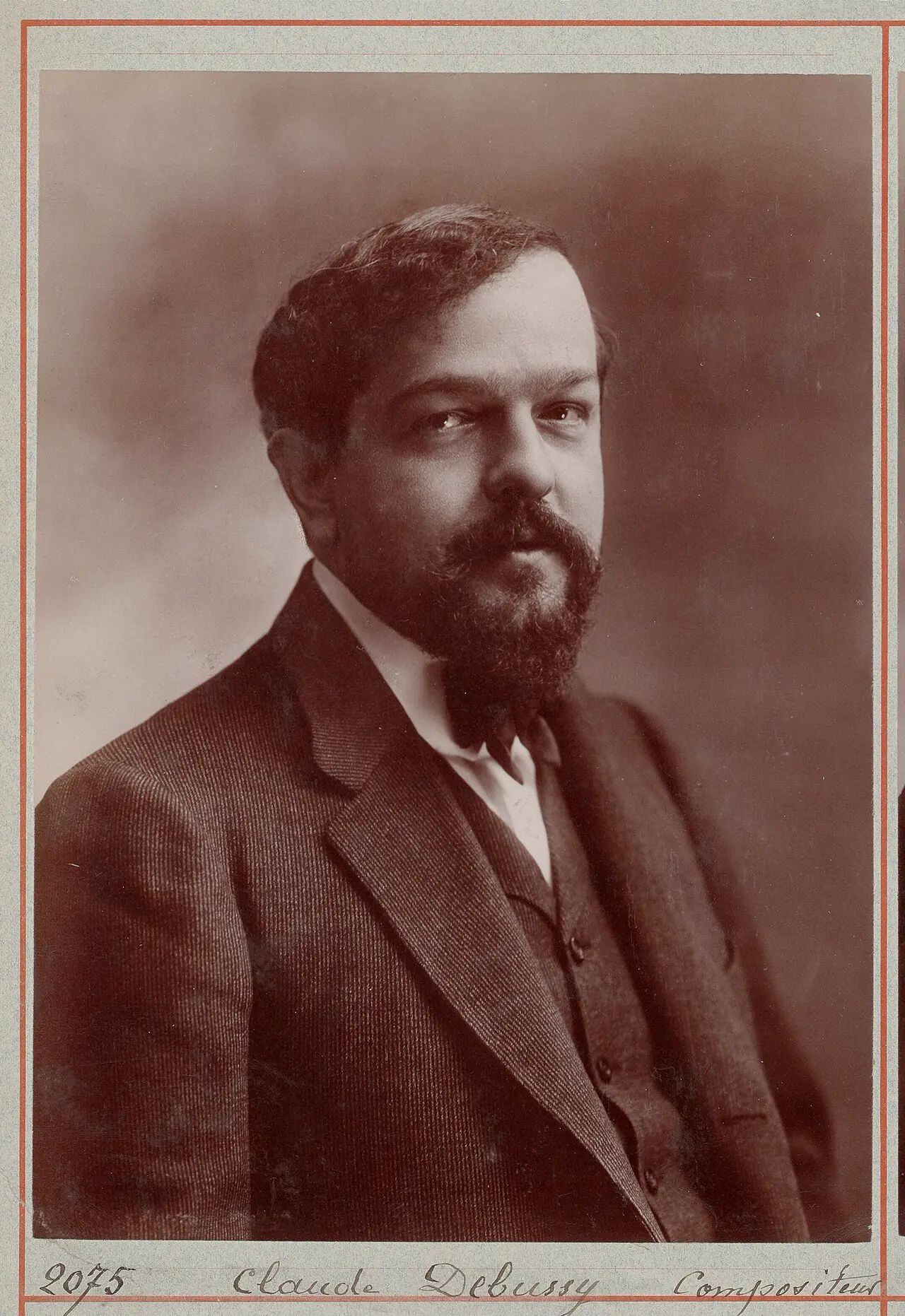
Paris Conservatoire from 1872; piano with Antoine Marmontel, composition with Ernest Guiraud
Turning points
Prix de Rome 1884 · Paris Exposition 1889 · Pelléas et Mélisande 1902
Output
One completed opera, orchestral triptychs, piano collections, songs, a quartet and three late sonatas
Heard and read
Symbolist poetry · Mussorgsky · the Javanese gamelan · Couperin and Rameau
Life
Debussy was born above his parents’ china shop in Saint-Germain-en-Laye, west of Paris, on 22 August 1862. His parents were not musicians. His father fought for the Paris Commune in 1871 and was imprisoned for it. In prison he met Charles de Sivry, whose mother, Antoinette Mauté, taught the piano and said she had been a pupil of Chopin. She took the boy on as a pupil. In 1872, aged ten, he entered the Paris Conservatoire.
Antoine Marmontel, his piano professor, described him in January 1874 as “a charming child, a truly artistic temperament”; the harmony teacher Émile Durand reported in June 1879 that he was “very gifted in harmony, but hopelessly unfocused”. Around 1890, discussing chords at the piano with his old composition teacher Ernest Guiraud, he said: “There is no theory. You merely have to listen. Pleasure is the law.”
He won the Prix de Rome in 1884 with a cantata, L’Enfant prodigue, found the Villa Medici stifling and left early, in 1887. Back in Paris that March he heard the first act of Tristan at the Concerts Lamoureux and called it “decidedly the finest thing I know” in a letter to Ernest Hébert. He went to Bayreuth in 1888 and again in 1889. Within a few years he had turned against Wagner, and in the Mercure de France in January 1903 he described him as “a beautiful sunset that was mistaken for a dawn”.
1889The gamelan
That summer the Exposition universelle, the fair for which the Eiffel Tower was built, brought a Javanese gamelan to Paris. It was an orchestra of gongs and tuned bronze instruments whose layers moved through long rhythmic cycles. Six years later he wrote to Pierre Louÿs about it: “Do you remember the Javanese music, able to express every shade of meaning, even unmentionable shades, which make our tonic and dominant seem like ghosts?” In 1913 he wrote in the Revue musicale S.I.M. that its counterpoint “makes Palestrina seem like child’s play”.
In Pagodes (1903), low fifths are struck and left to ring like gongs; a pentatonic tune moves through the middle of the keyboard; quick figures turn over above it, each layer at its own speed, all sustained by the pedal.
1893–94Prélude à l’après-midi d’un faune
By the early 1890s he was a regular at Stéphane Mallarmé’s Tuesday evenings in the rue de Rome. In December 1893 the Ysaÿe Quartet played his String Quartet, in which one theme runs through all four movements and the scherzo is plucked for much of its length. A year later came the Prélude à l’après-midi d’un faune, after Mallarmé’s poem of a faun waking on a hot afternoon, unsure whether the nymphs he remembers were real. It begins with a flute alone, unaccompanied, sliding from C♯ down to G and back. On 22 December 1894 the audience made the orchestra play the whole piece again. Mallarmé attended the next day’s concert and wrote to Debussy straight afterwards: “The marvel!” Half a century later Boulez dated modern music from that flute.
1893–1902Pelléas
In May 1893 he saw Maurice Maeterlinck’s play Pelléas et Mélisande and spent the next nine years setting it, nearly word for word. Golaud finds Mélisande weeping by a spring in a forest; she cannot say where she has come from; he marries her, and his questions grow more violent. Debussy gave nearly every syllable a single note, at the pace of speech, and gave the orchestra the rest. Maeterlinck had wanted the part of Mélisande for his companion, Georgette Leblanc; when the Opéra-Comique cast the Scottish soprano Mary Garden instead, he told the readers of Le Figaro that he hoped the opera would fail, quickly and loudly. It opened on 30 April 1902, conducted by André Messager, and made Debussy famous.
1903–05La Mer
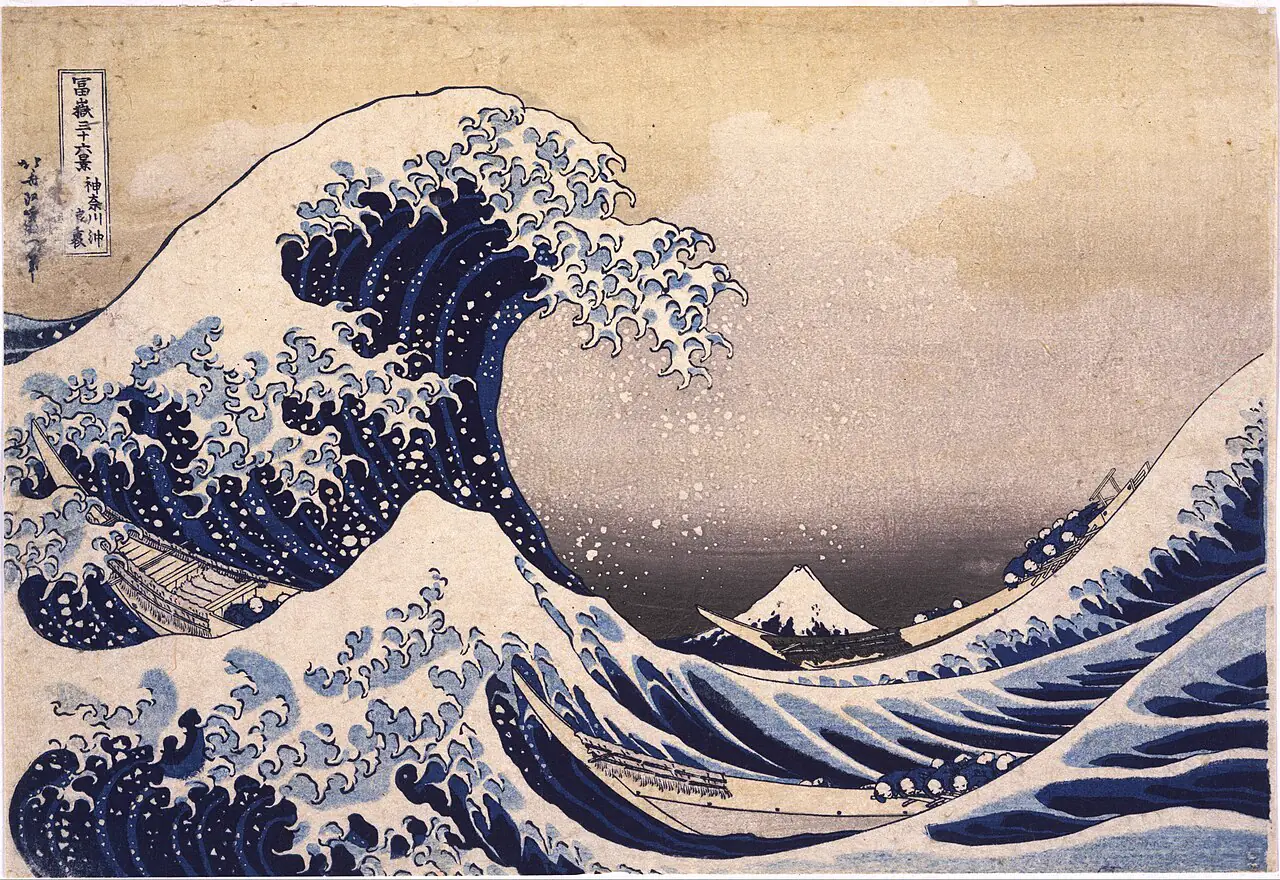
“You perhaps do not know,” he wrote to Messager in September 1903, “that I was destined for the fine life of a sailor and that I was only led away from it by chance.” He was writing from his in-laws’ house at Bichain in Burgundy, far from the sea, and he had begun La Mer. In 1904 he left his wife, Lilly Texier, for Emma Bardac, a singer married to a banker. Lilly shot herself in the chest and survived. Friends took sides, and several broke with him. He finished the score on 5 March 1905, corrected the proofs at the Grand Hotel in Eastbourne and chose Hokusai’s wave for the cover. Writing to Jacques Durand from Eastbourne in July 1905, he described a place where “the sea unfurls itself with an utterly British correctness”. Pierre Lalo reviewed the première in Le Temps on 24 October 1905: “I do not hear, I do not see, I do not smell the sea.”
1903–13Pictures for the piano
Between Estampes (1903) and the second book of Préludes (1913) he rebuilt the piano. Friends recalled that he wanted it to sound like an instrument without hammers. In the Préludes he printed each title at the end, in brackets after three dots: (…Voiles), which can mean sails or veils (he never said which), and (…La cathédrale engloutie), in which the drowned church of Ys rises out of the sea at dawn in slow parallel chords, like bells. In Golliwogg’s Cake-walk, written for Chouchou, the opening of Tristan appears, marked “with great emotion”, alongside banjo chords.
Jeux, a ballet about a lost tennis ball, two girls and a young man at dusk, was danced by Nijinsky on 15 May 1913 at the new Théâtre des Champs-Élysées. Two weeks later, on the same stage, Stravinsky’s Rite of Spring started a riot. Jeux was staged again in 1920 and 1923 and remained on the edge of the repertory.
1914–18War, the late works and death
The war and his cancer came at the same time. In the summer of 1915, at Pourville on the Normandy coast, he wrote twelve Études dedicated to Chopin’s memory, the first of them “for the five fingers, after Monsieur Czerny”, and two of a planned set of six sonatas, signing their title pages “Claude Debussy, musicien français”. He played the piano at the première of the third, the Violin Sonata, in May 1917. He died at home on 25 March 1918, aged fifty-five, while German long-range guns were shelling Paris. The funeral procession went to Père Lachaise through empty streets.
Places
Every recorded place, joined in date order. Debussy on the MapAll 25 places, with sources
He used every scale available to him, including major and minor, the old church modes, the five black notes of the pentatonic scale, and the whole-tone scale, six notes a tone apart, which contains no semitone and no dominant to resolve to. Voiles stays on the whole-tone scale over a held low B♭, except for six bars of black-note pentatonic in the middle.
♮Chords
He let chords stand still and be heard as sounds. A ninth chord can move up a tone and keep its exact shape, a technique textbooks call planing. In La cathédrale engloutie whole stacks of open fifths and octaves move in parallel, representing the bells of a drowned church.
𝄞Orchestration
His orchestration was chosen for colour and was usually quiet. The Faune has no trumpets; Nuages gives its recurring phrase to the cor anglais; Sirènes adds women’s voices singing without words; in the first movement of La Mer sixteen cellos divide into four parts.
𝄋Form
He distrusted development, the German practice of working a theme at length. His forms are built from returns, interruptions and changes of speed. A trumpet call from the first movement of La Mer returns, transformed, in the last; in the central episodes of Jeux the beat is repeatedly stretched and released.
𝄢Piano
The pedal holds a low note while the hands move elsewhere, so three layers can sound at once at three speeds. In Pagodes a gong-like bass, a tune in the middle and quick figures above sound together under one pedal; the second book of Préludes is written on three staves to notate them.
𝄾Words
In Pelléas nearly every syllable is set to one note, at the speed of speech, often on a repeated pitch, so the words are never drowned. His songs set Verlaine, Baudelaire, Mallarmé and Louÿs, and for the Proses lyriques he wrote the poems himself.
Six Verlaine songs. In Il pleure dans mon cœur, following the poet’s image of rain falling on the town, the piano keeps up a steady patter beneath the voice.
Four pieces, including a minuet and a passepied, published only in 1905 after revision. The third is Clair de lune; its title recalls Verlaine’s poem of masked dancers, “masques et bergamasques”, playing the lute by moonlight.
String Quartet in G minorOp. 10Two violins, viola and cello
His only quartet, and the only work he gave an opus number. One theme returns in all four movements; the scherzo is played pizzicato for most of its length.
The three pieces are titled after clouds, a festival and sirens. Nuages is built on a phrase for cor anglais; in Fêtes a procession of muted trumpets approaches from far off; Sirènes adds a wordless women’s chorus.
Composed over nine years. Maeterlinck’s play is set almost word for word, nearly a note to a syllable. First performed at the Opéra-Comique under André Messager.
Three pieces, each depicting a scene: a pagoda, an evening in Granada and gardens in the rain. The last uses two French nursery songs, Nous n’irons plus au bois and Dodo, l’enfant do, against continuous semiquavers.
Three symphonic sketches: dawn to noon on the sea, the play of the waves, dialogue of the wind and the sea. Begun in Burgundy, finished in March 1905 and first performed that October.
Six pieces, among them Reflets dans l’eau and Poissons d’or, after a piece of Japanese lacquer he owned. Of the first book, he told Jacques Durand in August 1905 that the pieces would take their place “to the left of Schumann or to the right of Chopin”.
1905–12
Images for orchestraOrchestra
Gigues uses the Northumbrian tune The Keel Row; Ibéria, in three movements, is set in Spain; Rondes de printemps quotes Nous n’irons plus au bois.
Twelve more, written on three staves where two could not hold the layers. Among them are fog, fireworks, an American clown called General Lavine, and Mr Pickwick to the strains of God Save the King.
1912–13
JeuxOrchestra; ballet for the Ballets Russes
A lost tennis ball, a young man and two girls at dusk, choreographed by Nijinsky. About seventeen minutes long, with frequent changes of tempo in the central episodes. Within a fortnight it was overshadowed by The Rite of Spring.
1915
ÉtudesPiano
Twelve studies written in one summer at Pourville and dedicated to Chopin’s memory. The first, “for the five fingers, after Monsieur Czerny”, begins as a child’s exercise and then departs from it deliberately.
1915
Sonata for flute, viola and harpFlute, viola and harp
The second of six planned sonatas, for an unusual trio. Pastorale, Interlude, Finale.
1916–17
Violin SonataViolin and piano
His last completed work. He played the piano at the première, with Gaston Poulet, in May 1917.
The six notes of Voiles, laid out as a scale over its held low B♭. Every step is a whole tone, so the scale has no leading note and no perfect fifth, and no note functions as a tonic. Schematic; not a quotation from the score.
Voiles — contrasting collectionChange of intervals on five black keys
The five black-key notes that interrupt Voiles for six bars. The steps are uneven here, with minor thirds among the whole tones, and the collection includes a perfect fifth (F♯–C♯). Schematic; not a quotation from the score.
Four ninth chords, each moved a tone up or down with its spacing unchanged, so that none of them resolves. An invented illustration of what textbooks call planing.
Sister arts
Katsushika HokusaiThe Great Wave off Kanagawa, c. 1830–32Colour woodblock print · Tokyo National Museum
Debussy asked for Hokusai’s wave, cropped and redrawn, on the cover of Durand’s first edition of La Mer in 1905. He collected Japanese prints and lacquer; the goldfish of Poissons d’or were those on a lacquer panel he owned.
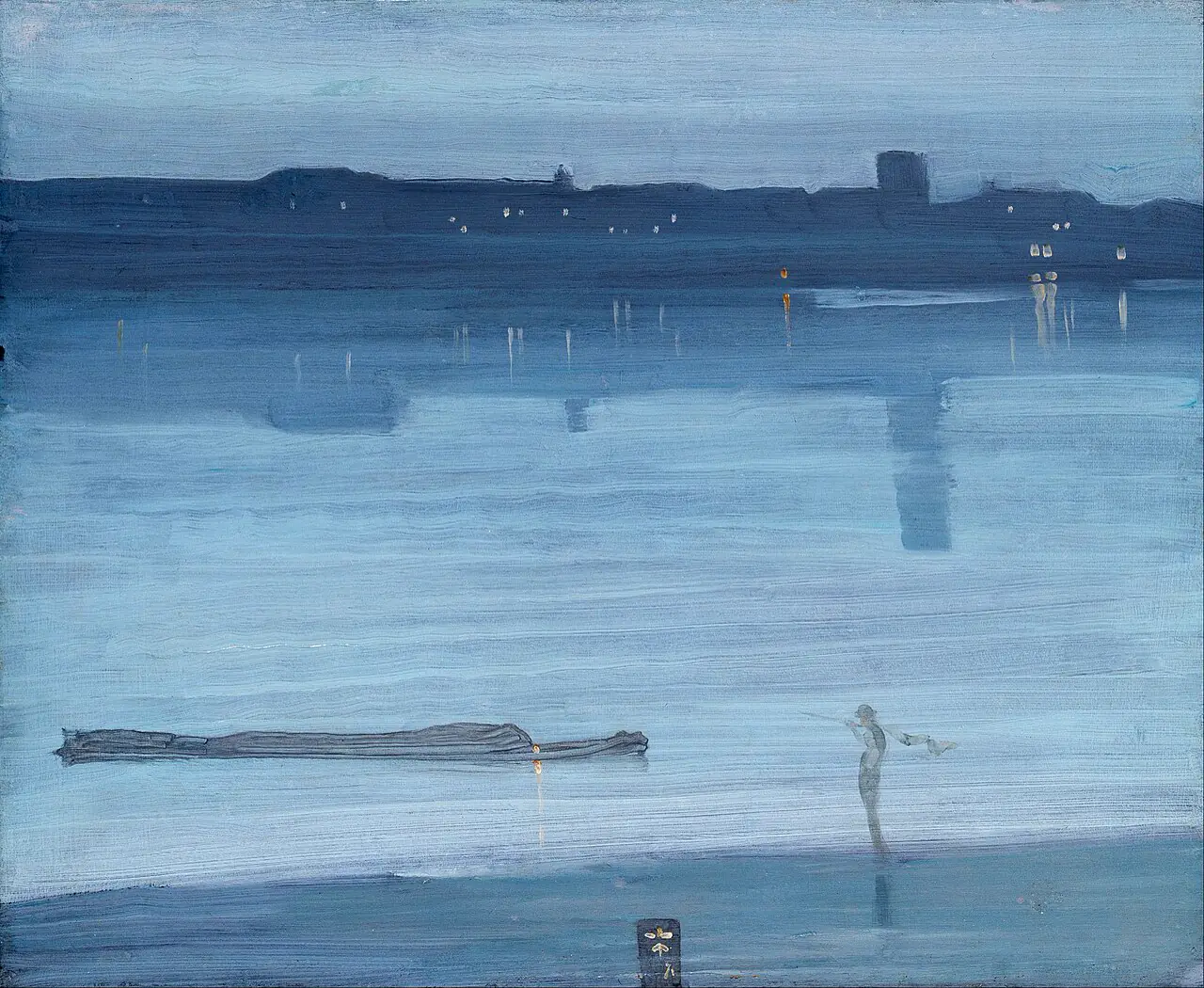
James McNeill WhistlerNocturne: Blue and Silver — Chelsea, 1871Oil on wood · Tate, London
Whistler took the word “nocturne” from music for his night paintings of the Thames. Debussy took it back for his orchestral triptych of 1899, and explained that the title meant “all the various impressions and the special effects of light that the word suggests”.
Stéphane Mallarmé
L’Après-midi d’un faune — opening
1876
FrenchCes nymphes, je les veux perpétuer.
Si clair,
Leur incarnat léger, qu’il voltige dans l’air
Assoupi de sommeils touffus.
Aimai-je un rêve ?
Our translationThese nymphs, I want to perpetuate them.
So clear,
Their light flesh-pink, that it flutters in the air
Drowsy with thickets of sleep.
Did I love a dream?
These are the first lines of the faun’s monologue, in which he wants to keep the nymphs and cannot tell whether he dreamt them. Mallarmé heard Debussy’s Prélude on 23 December 1894, the day after its première, and wrote to him straight afterwards: “The marvel!”
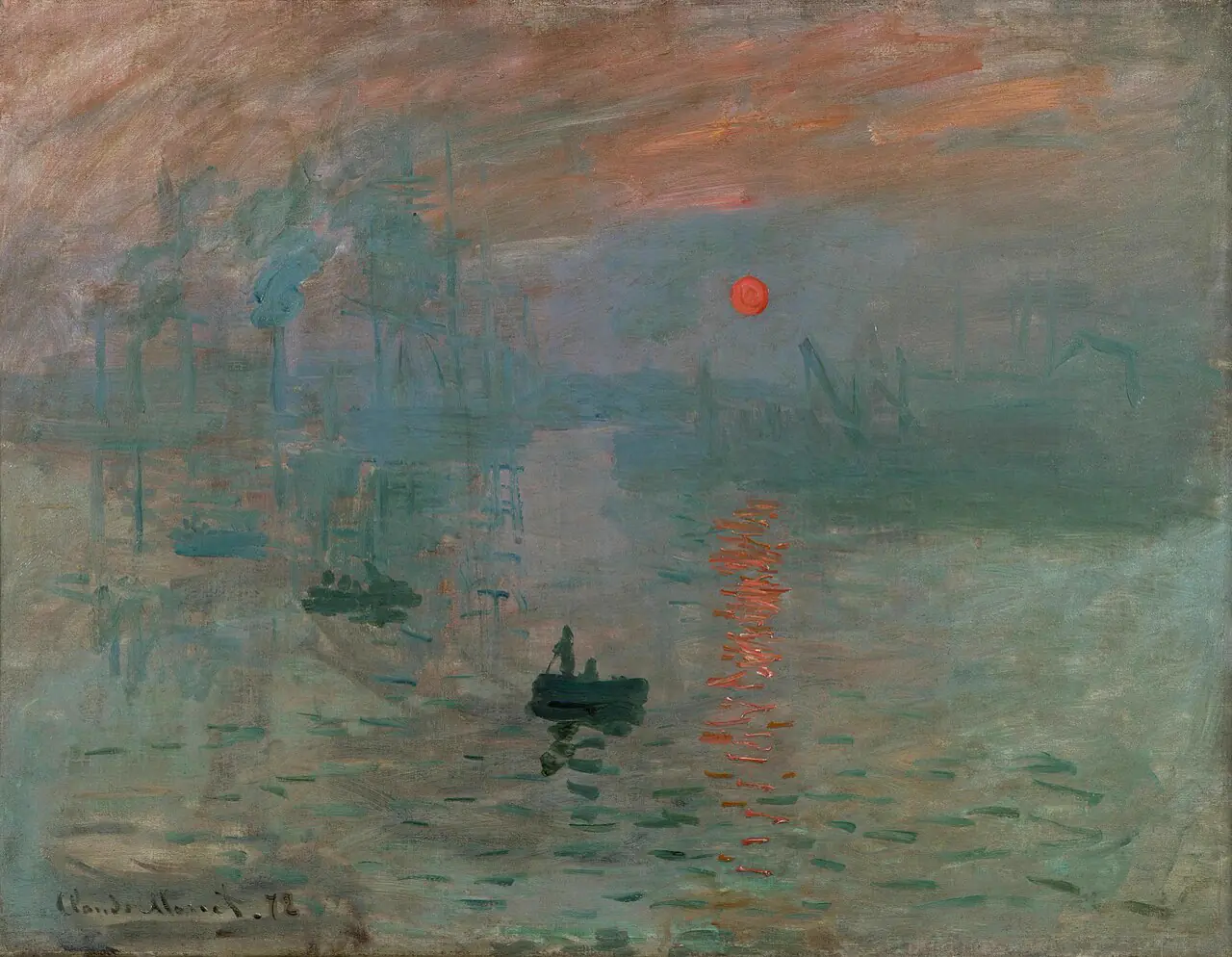
Claude MonetImpression, soleil levant, 1872Oil on canvas · Musée Marmottan Monet, Paris
This painting gave Impressionism its name in 1874. It shows Le Havre at dawn, with a red sun and two dark boats. Debussy rejected the label throughout his career. In 1908 he told his publisher that in the Images he was trying to write “realities — what the imbeciles call ‘impressionism’”.
Recommended recordings
La Mer · NocturnesCleveland Orchestra and Chorus, Pierre BoulezDeutsche GrammophonEach layer of the texture is clearly audible. Boulez believed Debussy was the first modernist, and he performed him as one.
Pelléas et MélisandeJacques Jansen, Irène Joachim, Henri Etcheverry; Orchestre symphonique, Chœurs Yvonne Gouverné, Roger DésormièreEMI / Warner · 1941Made in Paris in 1941, under the Occupation. The French is clear enough to follow without a libretto.
Préludes, Books I and IIKrystian ZimermanDeutsche GrammophonThe most exact on record. Every layer is weighed, and the bass is never lost under the pedal.
ÉtudesMitsuko UchidaPhilips / DeccaUchida plays the late studies as Debussy’s wildest and wittiest piano music.
Piano worksWalter GiesekingEMI / WarnerSoft, quick and lightly pedalled; for decades this was the way Debussy was supposed to sound. His Préludes can be paired with Zimerman’s.
Ravel, thirteen years younger, was frequently compared with him; their friendship cooled in 1904–05. Bartók came to know his music in 1907, when Kodály brought scores back from Paris. Messiaen was given the vocal score of Pelléas at the age of ten. Boulez made the neglected Jeux a central work for his own generation.
Further reading
François Lesure, Claude Debussy: A Critical Biography, English translation and revised edition by Marie Rolf (University of Rochester Press, 2019). biography
A revised English-language biography; the linked introduction explains its relation to Lesure’s earlier French text.