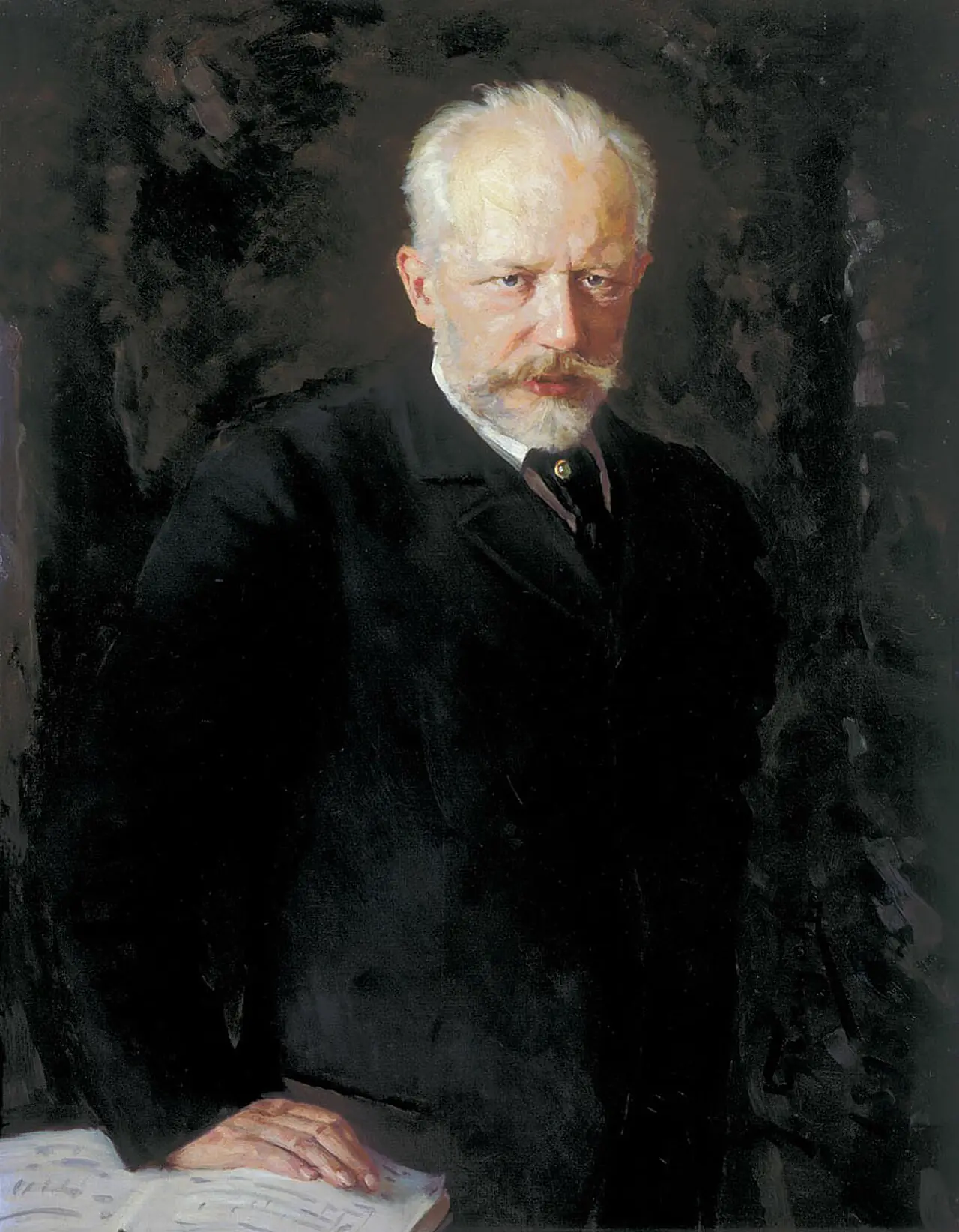
School of Jurisprudence; Saint Petersburg Conservatory, 1862–65, with Anton Rubinstein and Nikolai Zaremba
Livelihood
Moscow Conservatory harmony teacher, 1866–78
Patron
Nadezhda von Meck: an allowance, 1877–90, and a friendship conducted by letter
On stage
Three ballets; Eugene Onegin, The Queen of Spades and other operas
Life
At Kamenka on 6 July 1878, Tchaikovsky was explaining to Nadezhda von Meck how he composed. Ideas came to him in the middle of conversations, and he kept them in his head until he could sketch them on the first sheet of paper to hand. He held that waiting for the right mood was no way to work. “Inspiration is a guest who does not like to visit the idle,” he told her. He then stopped for dinner. At two o’clock he resumed, and went on to sketching, orchestration, fair copies and how far a symphony must keep to its traditional form.
1840–66Leaving the Ministry of Justice
He was born in Votkinsk, where his father managed an ironworks. He grew deeply attached to his French governess, Fanny Dürbach, and began piano lessons at the end of 1845. The profession chosen for him was the law. In 1850 he entered the preparatory class of the Imperial School of Jurisprudence in Saint Petersburg. Four years later his mother died of cholera. He graduated in 1859 and took a post at the Ministry of Justice, while giving more and more of his time to opera and concerts.
Anton Rubinstein’s new Saint Petersburg Conservatory gave him a way out of the civil service. Tchaikovsky enrolled in 1862, studied composition with Rubinstein and theory with Nikolai Zaremba, and in 1863 took leave from the ministry, resigning formally in 1867. In 1866 he moved to Moscow to teach harmony at the new conservatory run by Rubinstein’s brother Nikolai. He earned his living by teaching, writing criticism and translating textbooks, and composed in the remaining hours. He remained on the conservatory staff for twelve years.
MoscowRomeo and Juliet and the First Piano Concerto
Balakirev, the leader of the nationalist circle that included Mussorgsky and Rimsky-Korsakov, suggested Romeo and Juliet. He sent forceful advice about its design, and Tchaikovsky revised it repeatedly between 1869 and 1880. A wind chorale represents the Friar. The feud is set in fast string writing. The lovers’ theme is played by cor anglais and muted violas together.
Nikolai Rubinstein was an equally formidable listener. When Tchaikovsky played him the First Piano Concerto at the beginning of 1875, he greeted it with severe criticism. Hans von Bülow took it up and gave the première in Boston that October. The large D♭ major opening tune does not return after the introduction. Swan Lake followed in 1875–76. It was first staged in Moscow in 1877. The Petipa–Ivanov revival of 1895, with Riccardo Drigo’s alterations to the score, established much of the ballet in the form it is now performed.
1877–78The marriage and the letters
In July 1877 he married Antonina Milyukova, who had written to him declaring her love. Tchaikovsky was gay. He hoped that marriage would quieten gossip and give his life an acceptable public shape; Antonina expected a husband who could love her. By the autumn they were living apart. They never divorced. He went abroad, and while the marriage collapsed he continued work on the Fourth Symphony and Eugene Onegin.
Von Meck’s support made a different life possible. A wealthy widow, she began paying him an allowance in 1877, and the following year he was able to give up regular teaching. In her letters she asked him what a symphony meant and how a melody arrived. In Florence on 1 March 1878 he answered her question about the Fourth with a musical example of the opening fanfare: “This is Fate”. The fanfare interrupts the first movement’s uneasy 9/8 dance and returns in the finale, breaking into festivities built partly from In the Field Stood a Birch Tree.
The letter’s postscript reads: “Yesterday I spent the evening at the National Theatre and laughed a great deal.” Italian comedy had delighted him. In Onegin, a French guest, Monsieur Triquet, offers his little name-day song while jealousy gathers among the younger guests. The singer Yelizaveta Lavrovskaya had proposed Pushkin’s novel as an operatic subject in May 1877. Tchaikovsky went looking for a copy, read it again and spent a sleepless night planning his “lyrical scenes”. Moscow Conservatory students gave the première in 1879.
Tatyana writes her letter alone at night, with the orchestra accompanying her. Onegin answers with composure. Later, at her name-day party, the gossip that helps provoke Lensky’s fatal challenge is spread during a waltz. The final Saint Petersburg ball begins with a polonaise. Onegin finds Tatyana transformed and realises, several years too late, that he loves her.
The working yearsKlin, travels and the ballets
After 1878 Tchaikovsky travelled widely and rented country houses near Moscow, settling at Klin in 1892. He wrote the Violin Concerto in Switzerland in 1878, and the String Serenade and the 1812 overture in 1880. After Nikolai Rubinstein died, Tchaikovsky wrote the Piano Trio of 1881–82 in his memory. Its long variation movement builds to a climax, and then the opening lament returns as a funeral march. His operas ranged from Schiller’s The Maid of Orleans to Pushkin’s Mazepa. By the later 1880s he was conducting his music across Europe, and in 1891 he travelled to America for the opening celebrations of Carnegie Hall.
The Fifth Symphony, completed in 1888, brings its opening clarinet motto into every movement and at the end presents it in E major. For The Sleeping Beauty, Petipa supplied a detailed plan of dances and stage action. Tchaikovsky took pleasure in filling it, with the courtly processions, Aurora’s long adagio with her four suitors and the quarrel between Carabosse and the Lilac Fairy. The première was in 1890. In the same year came The Queen of Spades, in which the Countess remembers a French song from her youth while Hermann pursues his secret of the three cards.
The Nutcracker was first performed on the same evening as Iolanta in 1892. Its miniature overture leaves out cellos and double basses. Later in the ballet come the celesta in the Sugar Plum Fairy’s dance and the children’s chorus in the snow scene.
1893The Sixth Symphony and Tchaikovsky’s death
He conducted the Sixth Symphony in Saint Petersburg on 28 October 1893. The second movement is in five beats to the bar. The third ends with a loud march, and the finale follows, marked Adagio lamentoso. Its violin melody is divided in fragments between the two violin sections and is heard as a single line. The closing pages move down into B minor and end with the lower strings playing alone.
Nine days after the première he died of cholera. He had been proud of the new symphony and was making further plans. Other musicians were already working with his scores: the young Rachmaninoff had arranged The Sleeping Beauty for piano duet. In 1928 Stravinsky made a ballet, The Fairy’s Kiss, from Tchaikovsky’s songs and piano pieces, music he had written for the drawing room.
Places
Every recorded place, joined in date order. Tchaikovsky on the MapAll 23 places, with sources
Votkinsk · 7 May 1840 – September 1848 · born
Born, second son of the mining engineer Ilya Tchaikovsky; the governess Fanny Dürbach joined the family in 1844.
Mariinsky Theatre, Saint Petersburg · 15 January 1890 – 18 December 1892 · premiere
Premieres of The Sleeping Beauty (1890), The Queen of Spades (December 1890), and Iolanta with The Nutcracker (1892). The Sleeping Beauty; The Queen of Spades; The Nutcracker.
The First Piano Concerto begins with the orchestra playing a tune in D♭ major while the pianist plays chords beneath it. The tune does not return. Elsewhere a small figure climbs through a sequence of new pitches, repeated each time at a higher point.
𝄾Rhythm and dance
The second movement of the Sixth Symphony is in 5/4, counted as two beats and then three. With the cellos’ phrasing, the 5/4 can pass for an ordinary dance, though it cannot be waltzed to. The first movement of the Fourth Symphony is in 9/8, which implies three beats to the bar; dotted rhythms and accents work against that three-beat pulse.
♮Harmony
The clarinet melody that opens the Fifth Symphony is in E minor. In the finale it returns in E major, with the third of the scale changed. Tchaikovsky often delays such arrivals. A bass note holds while harmonies move above it, or a repeated phrase climbs through one key after another.
𝄞Orchestration
In Romeo and Juliet the love theme is first played by cor anglais and muted violas in unison. In the overture to The Nutcracker the cellos and double basses are silent, and the string writing is given to divided violins and violas.
𝄋Form and recurrence
In the Fourth Symphony the opening fanfare returns several times and stops the music. It returns even in the finale, which is based on a folk song. In the Fifth the motto appears in all four movements, and its character changes from one appearance to the next. In the Sixth the march, the work’s biggest public triumph, comes one movement before the end, and a slow finale follows it.
𝄐Theatre
The dances in Eugene Onegin have consequences. Guests gossip during Tatyana’s name-day waltz; Onegin flirts with Olga; Lensky’s humiliation leads to the duel. The later polonaise introduces a much grander society and a Tatyana whom Onegin can scarcely recognise. Between these public scenes comes the letter scene, in which a young woman tries out her words, loses heart and begins again.
Works
A selection from the composer’s works.
1866; revised 1874
Symphony No. 1 in G minor “Winter Daydreams”Op. 13Orchestra
The first two movements have landscape titles; the finale works a Russian folk song into a vigorous contrapuntal finish.
1869–80
Romeo and Juliet, overture-fantasyOrchestra
Balakirev proposed the subject and argued over the music; Tchaikovsky made three principal versions. The love theme is first played by cor anglais and muted violas.
Hans von Bülow gave the première in Boston in 1875, after Nikolai Rubinstein had rejected the piece. The famous D♭ major opening tune disappears once the introduction is over.
The swan music returns in the ballet’s separate scenes. Many stage versions descend from the 1895 Petipa–Ivanov revival, whose score Riccardo Drigo altered after Tchaikovsky’s death.
1877–78
Symphony No. 4 in F minorOp. 36Orchestra
Dedicated to von Meck, with an opening fanfare he described to her as fate. The fanfare returns; between its returns come an oboe melody and a scherzo with the strings entirely pizzicato.
1877–78
Eugene OneginOp. 24Opera; soloists, chorus and orchestra
Tchaikovsky entrusted the première to conservatory students in 1879. The opera includes Tatyana’s letter and Lensky’s farewell.
1878
Violin Concerto in D majorOp. 35Violin and orchestra
The first movement places its cadenza before the recapitulation, and the cadenza leads into the return of the opening material. A G minor Canzonetta leads straight into the finale.
1878
Children’s AlbumOp. 39Piano; twenty-four pieces
A collection of piano pieces for children in the tradition of Schumann, made up of prayers, dances, pieces about dolls and songs from other countries. Old French Song uses only a few notes.
1880
Serenade for Strings in C majorOp. 48String orchestra
After a waltz and an elegy, the finale is built on Russian themes. Near the end the broad chords from the opening return, and the music then moves into a fast close.
1881–82
Piano Trio in A minorOp. 50Piano, violin and cello
Written in memory of Nikolai Rubinstein. The variation movement’s many changes of character eventually give way to the first movement’s lament and a funeral march.
1885
Manfred Symphony in B minorOp. 58Orchestra with organ
Byron’s tormented hero is the subject of four movements, outside the sequence of six numbered symphonies. The organ enters late, in the ending; the orchestra has not used it before that point.
1888
Symphony No. 5 in E minorOp. 64Orchestra
The opening clarinet motto returns in every movement, sometimes interrupting a song or dance. On its last appearance it is transformed into a march in E major.
1888–89
The Sleeping BeautyOp. 66Ballet; prologue and three acts
Petipa supplied the dances and stage requirements, and Tchaikovsky wrote music for them that he counted among his best. In the Rose Adagio Aurora dances with her four suitors in turn, accepting a rose from each.
1890
The Queen of SpadesOp. 68Opera after Pushkin
Hermann’s obsession with three winning cards wrecks his love for Liza. The opera includes the Countess’s old French song and the pastoral entertainment.
The familiar suite leaves out much of the complete ballet, including its wordless children’s chorus in the snow scene. The celesta was a new acquisition, and Tchaikovsky wanted it kept secret from rival composers.
The march’s loud finish is followed by an Adagio lamentoso. In the last pages the orchestra is reduced to low strings and the symphony ends quietly in B minor.
Quoted from bars 1–4 of Old French Song, with the opening upbeat; right hand only, with slurs omitted. The melody climbs an octave from D to D, then turns above the upper note. The final D starts the next phrase. Source: Mutopia’s transcription of the 1904 Schirmer edition.
Pathétique · metre workshopDance in two plus three
A schematic of the five-beat dance metre of the Sixth Symphony, with an invented bass line. The bar is counted as two crotchets followed by three, and the accent on beat three begins the second group. Tchaikovsky’s melody runs over this unequal accompaniment.
Sister arts
Alexander Pushkin
Tatyana’s letter, from Eugene Onegin
Chapter III, published 1827
RussianЯ к вам пишу — чего же боле?
Что я могу еще сказать?
Теперь, я знаю, в вашей воле
Меня презреньем наказать.
Но вы, к моей несчастной доле
Хоть каплю жалости храня,
Вы не оставите меня.
Our translationI write to you — what more is there?
What else can I say?
Now, I know, it is in your power
To punish me with contempt.
But if for my unhappy fate
You keep even a drop of pity,
You will not abandon me.
Pushkin presents the letter as his translation of Tatyana’s French. In the opera she sings it herself, alone, through the night. Lavrovskaya suggested that Tchaikovsky set the novel; he went out to find a copy and stayed awake planning the scenes. Russian text of the letter.
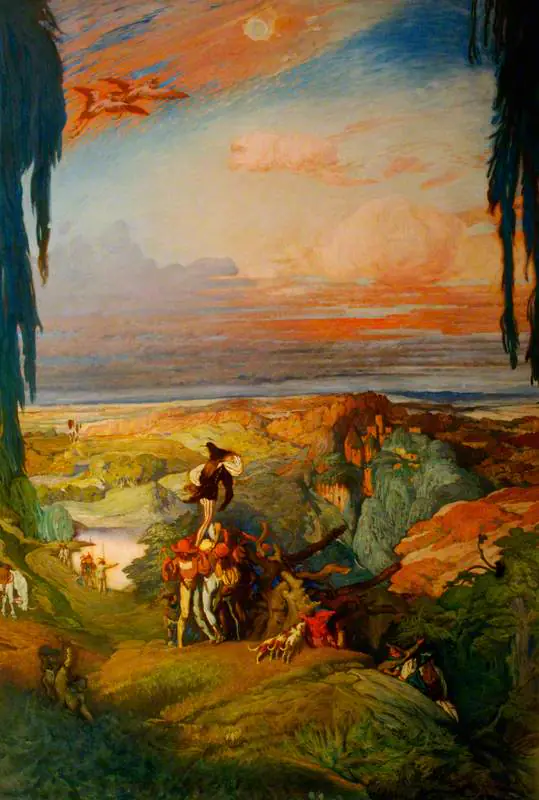
Léon BakstThe Prince Out Hunting Sees the Castle Where the Princess Lies Sleeping, 1913–22Oil on canvas · Waddesdon Manor, Buckinghamshire
James and Dorothy de Rothschild commissioned Bakst’s seven Sleeping Beauty panels in 1913, the year they married, for their London home. Bakst later used the same fairy tale in the theatre: in 1921 he designed Diaghilev’s London production of The Sleeping Princess, to Tchaikovsky’s ballet. This panel shows the hunting party reaching the edge of the enchanted kingdom.
William Shakespeare
Romeo and Juliet, Act II, scene 2
c. 1595
EnglishBut, soft! what light through yonder window breaks?
It is the east, and Juliet is the sun.
Arise, fair sun, and kill the envious moon,
Who is already sick and pale with grief,
That thou her maid art far more fair than she.
Balakirev suggested Shakespeare’s lovers as a subject and went on urging revisions into 1871. The overture’s love theme is first played by cor anglais and muted violas, after the music of the feud.
Recommended recordings
Symphonies Nos. 4, 5 and 6Leningrad Philharmonic, Yevgeny MravinskyDeutsche Grammophon · 1960Brass with a hard edge, and strings that change direction together at speed. Mravinsky takes the march of the Sixth with strict precision. The tam-tam stroke in the finale is quiet.
The NutcrackerConcertgebouw Orchestra, Antal DorátiPhilips · 1975The complete ballet, warm and alert. Doráti gives the little dances their spring without squeezing out their charm, and the recording includes the transformation and snow scenes that the familiar suite omits.
Eugene OneginTeresa Kubiak, Stuart Burrows, Bernd Weikl; Royal Opera House Orchestra, John Alldis Choir, Georg SoltiDecca · 1974Kubiak sang Tatyana and Burrows a lyrical Lensky in this Solti opera recording. Michel Sénéchal sang Triquet as a fussy figure in the party scene.
Some links are direct. Rachmaninoff arranged The Sleeping Beauty for piano duet, and Stravinsky built The Fairy’s Kiss from Tchaikovsky’s songs and piano pieces. The comparison with Prokofiev and Shostakovich is closest in their dance music, where each of them lets a waltz or march continue while the music around it goes badly wrong.
Further reading
Roland John Wiley, Tchaikovsky (New York: Oxford University Press, 2009). biography
Scholarly life-and-works study in the Master Musicians series.
Roland John Wiley, ‘Tchaikovsky, Pyotr Il′yich’, Grove Music Online (Oxford University Press, 2001). reference
Biographical reference, work-list and bibliography; subscription required.