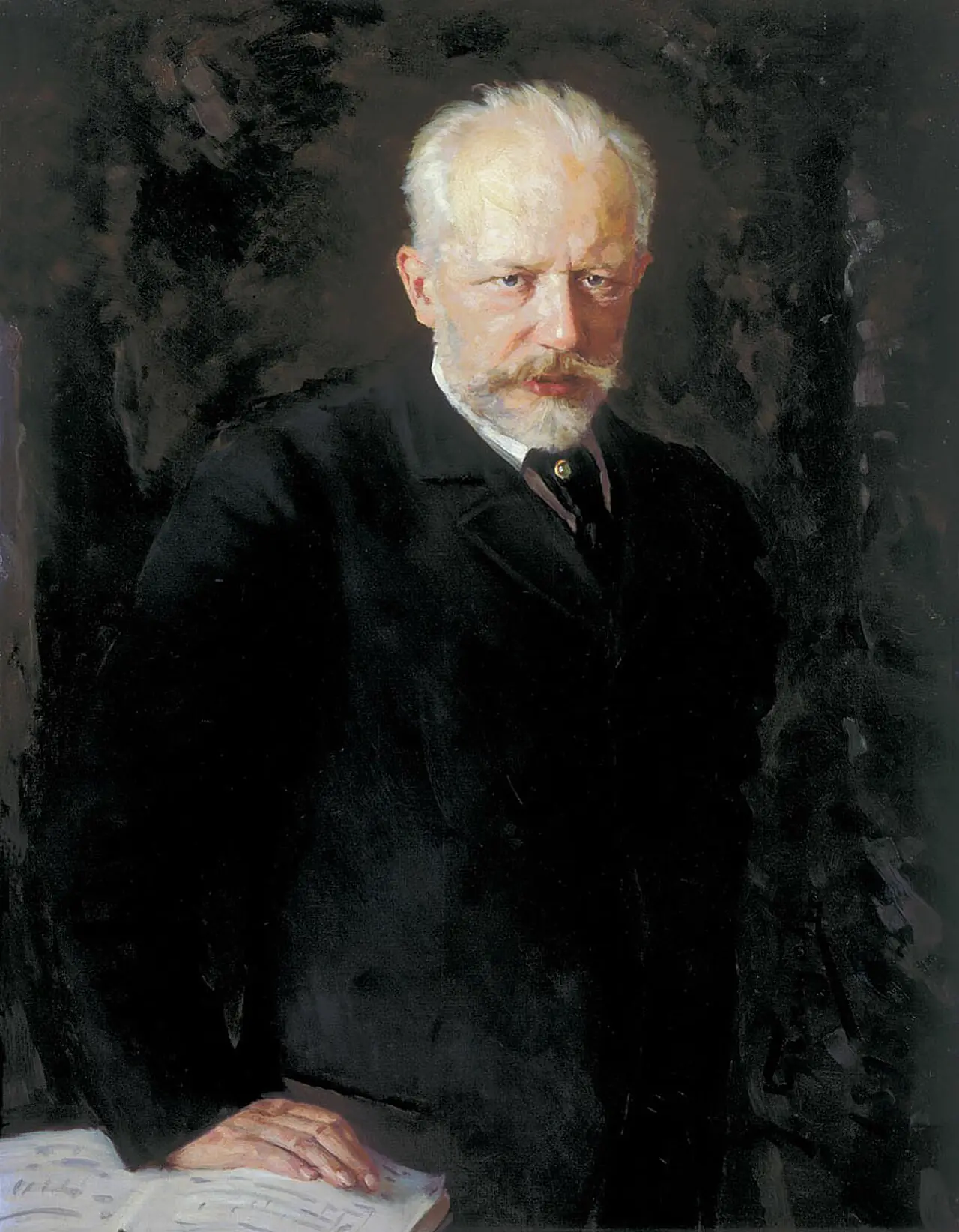
Symphony No. 6 “Pathétique”, Op. 74
10 min
Recording
- IV. Finale — Adagio lamentosoMusopen Symphony10:19
The finale of the Symphony No. 6 in B minor “Pathétique”, Op. 74, marked Adagio lamentoso, opens with a violin melody whose notes pass between the two violin sections; neither plays it complete. After the G major close of the preceding march, the movement returns to B minor and ends in that key.
Listening notes · joins
- Divided melody, first and second violins
The first and second violins play alternate notes of a falling melody. Neither part contains the whole tune. The opening chord is a half-diminished chord in B minor, the symphony’s home key.
- Letter to Vladimir Davydov, 23 February 1893
On 23 February 1893, months before he orchestrated the symphony, Tchaikovsky told Vladimir Davydov that the finale would be “a long drawn-out adagio”. In the same letter he wrote that he felt blissfully sure he could still compose.
- Second theme in D major
The first violins and violas play a broad new melody in D major over a horn accompaniment, and the trombones answer it. The tune moves downwards in long phrases.
- First performance, Saint Petersburg, 1893
Tchaikovsky conducted the first performance in Saint Petersburg on 28 October 1893. Two days later he wrote to his publisher, Jurgenson: “It’s not that it displeased, but it has caused some bewilderment.” He added that he was more proud of it than of any of his other works.
- Climax in descending scales
The broad Andante tune speeds up and spreads across the full orchestra. Its climax comes in fast downward scales. The descending line, first played quietly by the violins, now passes through the whole ensemble.
- Return of the opening theme
The strings bring back the opening melody. Its falling phrases are extended as the rest of the orchestra takes them up, building to another climax.
- Letter to Vladimir Davydov, 14 August 1893
On 14 August 1893, while he was still scoring the symphony, Tchaikovsky wrote to his nephew Vladimir Davydov that it was “the most sincere of all my creations. I love it as I have never loved any of my other musical offspring.” Davydov was its dedicatee.
- Tam-tam stroke and brass chorale
A single tam-tam stroke follows the climax. After a long hold on F♯, the dominant of B minor, trombones and tuba play a chorale.
- Return of the second theme, B minor
The broad melody returns, now in B minor. Muted strings descend over a repeated low B in the double basses. The theme was first heard in D major.
- Death of Tchaikovsky, 1893
Tchaikovsky died of cholera at a quarter past three on the morning of 6 November 1893, nine days after the première, in his brother Modest’s flat in Saint Petersburg. Twenty days after the première, Eduard Nápravník conducted the symphony in a memorial concert.
- Close in the cellos and basses
The final descent passes into the cellos and double basses. The symphony ends in their low register, with B minor still sounding.
Joins
- Bassoon line to the D major Andante
A descending bassoon line dies away over horns and strings. At the Andante the first violins and violas take up a new melody in D major, with the horns in support. The melody moves broadly downwards, and the trombones follow it.
- Return of the opening string theme
The climax of the Andante breaks into fast descending scales and dies down. The strings then play the opening melody again in B minor, in long falling phrases.
- F♯ pedal into the brass chorale
The climax holds F♯ in the bass and its force gradually falls away. A single tam-tam stroke sounds as it dies down, and quiet trombones and tuba take over with a chorale. Their chords round off the dominant harmony before the last return of B minor.
- Second melody returns in B minor
After the low-brass chorale, muted strings play the broad second melody again, now in B minor. Double basses pulse on low B underneath. The other instruments stop one by one, and the falling phrases pass to the lower strings.
Other performances
Historical and comparison recordings, outside the concert’s running order.
- IV. Finale — Adagio lamentosoBerlin Philharmonic Orchestra; Wilhelm Furtwängler, conductor · October–November 1938, Beethovensaal, Berlin10:09
Wilhelm Furtwängler conducted the Berlin Philharmonic in this recording of the finale, Adagio lamentoso, of Tchaikovsky’s Symphony No. 6 in B minor “Pathétique”, Op. 74, made in Berlin in 1938. The falling violin melody passes from one section to the other, and the movement ends on a low B in the double basses.
Listening notes
- Opening melody, divided violins
The first and second violins share the falling melody, alternating one note at a time. Neither section’s part forms the tune on the page. Combined, the two parts make a continuous line above the opening half-diminished chord.
- Letter to Vladimir Davydov, 1893
In February 1893 Tchaikovsky wrote to Vladimir Davydov about the planned finale: “a long drawn-out adagio”. He was delighted with the new symphony and intended to keep its programme secret.
- Andante theme in D major
The Andante has a broad melody in D major. First violins and violas play it above the horns, and trombones reply. The melody moves downwards.
- Return of the opening theme
The opening lament returns in the strings in B minor. Tchaikovsky extends its falling phrases across the orchestra and builds again from the melody that began the movement.
- Final climax over an F♯ pedal
Strings and brass play the returning lament up to its last climax. Beneath the agitated melody the bass holds F♯, the dominant of B minor, before the music begins its long decline.
- Letter to Jurgenson, 30 October 1893
On 30 October 1893, two days after he conducted the première in Saint Petersburg, Tchaikovsky wrote to his publisher Jurgenson. He said the symphony had caused bewilderment, but “I’m more proud of it than any of my other works”.
- Final return in B minor
The broad melody returns for the last time in B minor. Muted strings descend above a repeated low B in the double basses. In the closing pages the texture thins and more of the music passes to the cellos and basses.