How the symphony grew
From Haydn’s “Surprise” Symphony to Mahler’s Ninth
At the Hanover Square Rooms in 1792, Haydn’s new symphony interrupted a quiet tune with a single loud chord. A little over a century later, the last page of Mahler’s Ninth is for strings alone, played softly.
Begin plays the stations in order; Pause stops playback at the current station.Haydn’s surprise
Joseph Haydn · Symphony No. 94 “Surprise”
II. Andante
London, 23 March 1792. At Salomon’s concert in the Hanover Square Rooms, Haydn’s new symphony had the strings play a short, plain tune. They repeat it more softly. Then the whole orchestra plays one fortissimo chord, with timpani. Haydn wrote the symphony during his first London visit. The slow movement sets its C major tune as a series of variations. In the first variation the second violins and violas keep the melody while the first violins play semiquavers around it.
Sources & recording
Boston Symphony Orchestra, Serge Koussevitzky
Excerpt 0:00–2:44 · Full recording & listening notes
- Orrin Howard, LA Phil: Symphony No. 94 — London, date, forces and variations ↗
- Haydn recording guide: theme, first variation and the Orchestra timeline ↗
- YourClassical: Salomon’s Hanover Square concert of 23 March 1792 and the symphony’s premiere ↗
- Haydn’s Symphony No. 94: Andante theme and first-variation scoring, bars 1–48 ↗
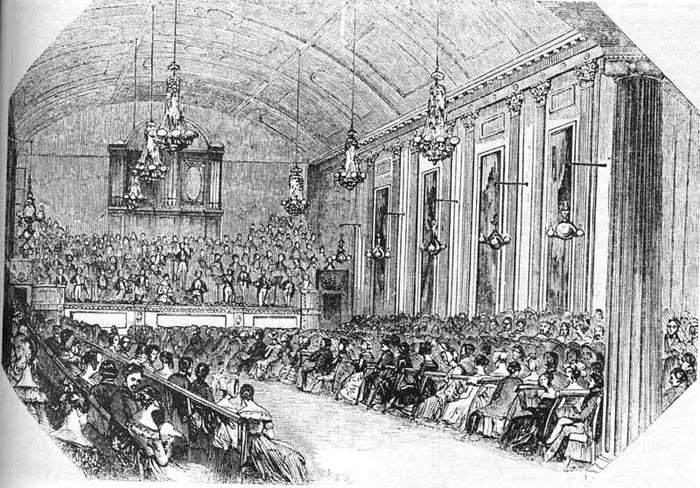
- Commons: Hanover Square Rooms concert engraving, Illustrated London News, 24 June 1843; public domain ↗
- The strings begin a short tune in C major, with a bass note at the start of each bar.
- The quiet repeat ends with a single fortissimo chord from the whole orchestra, including timpani.
- The first violins play semiquavers around the tune, now held by the second violins and violas.
- Hanover Square Rooms, London · premiere · documented
1791–1795
Salomon’s concerts presented his London symphonies, Nos. 93–101, with Haydn directing.
- 18 Great Pulteney Street, London · lived · documented
1791-01–1791-05
Lodged where his host and collaborator Johann Peter Salomon lived; worked in a room lent by Broadwood.
- London (Handel Festival) · heard · documented
1791-05
At the end of May he attended the great Handel Festival, with over a thousand musicians; no venue is named.
- Oxford · travelled · documented
1791-07
Awarded an honorary doctorate at a ceremony; Symphony No. 92 was performed and took its nickname.
Dated places on a present-day coastline.
This year on the MapMozart: the G minor recapitulation
Wolfgang Amadeus Mozart · Symphony No. 40, K. 550
I. Molto allegro
Three years before Haydn’s London visit, Mozart wrote his G minor Symphony, K. 550. It opens with a repeated figure in the violins. In the development, fragments of it pass between strings and winds, and each repetition moves into a less stable key. Mozart then brings the opening back in G minor. The recapitulation is longer than the exposition because the bridge between the themes modulates further. The second theme, first heard in B♭ major, returns in G minor, with semitone clashes in the woodwind and strings.
Sources & recording
Musopen Symphony (Commons credit; ensemble attribution disputed)
Excerpt 2:00–5:38 · Full recording & listening notes
- Matthew Lorenzon, ABC Classic: Mozart’s Symphony No. 40 and sonata form ↗
- Indianapolis Symphony: 1788 chronology and the two scorings ↗
- K. 550 recording guide: provisional sections and common-part Orchestra roster ↗
- Scraps of the opening violin figure pass between instruments and through changing keys.
- The opening returns in G minor; the bridge between the themes is now longer.
- The second theme returns in G minor; it was first heard in B♭ major.
Mozart: five themes in combination
Wolfgang Amadeus Mozart · Symphony No. 41 in C major, K. 551 “Jupiter”
IV. Finale: Molto allegro
Mozart wrote the “Jupiter” Symphony in the summer of 1788, the same summer as the G minor. In the finale the four-note tune C–D–F–E keeps its long notes while quicker figures pass it, and one part can begin before another has finished. The return to C major is followed by further development. In the coda five themes are combined, each keeping its own rhythm as they pass between the instruments. Trumpets and timpani join the final C major chords.
Sources & recording
Bruno Walter, Columbia Symphony Orchestra
Excerpt 3:46–7:16 · Full recording & listening notes
- K. Dawn Grapes, Fort Collins Symphony: the 1788 Jupiter and its five-theme coda ↗
- Mozart, K. 551: full score, finale, bars 225–424 ↗
- Jupiter recording guide: provisional A′, coda and orchestral changes ↗
- Internet Archive: Walter/Columbia transfer and complete finale duration ↗
- The four-note tune returns in C major, with quicker figures moving around it.
- In the coda five themes are combined, with long notes set against running figures and short replies.
- Trumpets and timpani reinforce the final C major chords as the running lines converge.
Beethoven: a pause for an oboe
Ludwig van Beethoven · Symphony No. 5, Op. 67
I. Allegro con brio
The Fifth’s opening rhythm recurs long after its first statement. In the development it passes between instruments and through changing keys, and the exchanges eventually shrink to isolated chords, with silence between the replies. When the opening returns at bar 248, winds and brass reinforce it. At bar 268 the orchestra stops, leaving an oboe alone in an Adagio. Later, bassoons take the call previously played by horns, and the second theme returns in C major, a minor third below its earlier E♭ major.
Sources & recording
Skidmore College orchestra
Excerpt 3:23–6:42 · Full recording & listening notes
- Mutopia 941: Beethoven’s Fifth, first-movement score and orchestral parts ↗
- Beethoven recording guide: bars 125, 196, 248, 268 and 303; Form and Orchestra ↗
- Published score alignment: bar times and alignment qualifications ↗
- The opening rhythm moves through new pitches and keys as the development begins.
- Winds and strings exchange slow chords; the replies grow shorter, with rests between them.
- The opening returns, with winds and brass reinforcing its short-note rhythm.
- At bar 268 the orchestra stops and one oboe plays an unaccompanied Adagio.
- Bassoons take the horns’ old call before the second theme returns in C major.
Brahms’s greeting from the mountains
Johannes Brahms · Symphony No. 1 in C minor, Op. 68
IV. Adagio — Più andante — Allegro non troppo, ma con brio — Più allegro
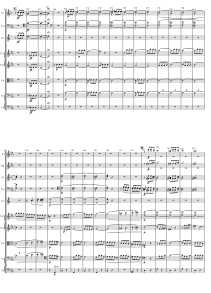
In 1868 Brahms sent Clara Schumann a melody from the Bernese Alps, with the words: “High on the mountain, deep in the valley, I greet you many thousand times.” Eight years later a horn plays a version of that melody in the finale of his First Symphony, over tremolo strings; flutes then take it over. Trombones and bassoons follow with a short chorale. All this comes before the long string theme of the main Allegro. The chorale returns, played loud, in the coda.
Sources & recording
Czech National Symphony Orchestra
Excerpt 2:10–4:34 · Full recording & listening notes
- Brahms-Institut: Symphony No. 1, first-edition finale score ↗
- Malte Krasting, Berlin Philharmonic: Brahms’s 1868 greeting to Clara from the Bernese Alps; German text, translated here ↗
- Kelly Dean Hansen: Op. 68, horn call, chorale and finale design ↗
- Boston Symphony: Brahms’s First and the Beethoven resemblance ↗
- Brahms finale guide: B, C, A and the Orchestra timeline ↗
- The long wind call is held above strings playing rapidly repeated notes.
- Trombones and bassoons play a short chorale. It does not appear again until the coda.
- The call dies away, and the main Allegro follows after this excerpt.
Bruckner: the scherzo of the Seventh
Anton Bruckner · Symphony No. 7 in E major, WAB 107
III. Scherzo — Sehr schnell; Trio — Etwas langsamer
A short repeated figure in the strings opens the scherzo of the Seventh, in A minor. Over it a trumpet plays a call and the clarinet answers; this exchange supplies much of the movement’s material. Bruckner returns repeatedly to the same short figures, moves them between instruments and builds them into long crescendos. Between the loud passages the brass play quietly: trombones and tuba join in a soft chorale while the strings continue to move. Another crescendo begins before the excerpt ends. After it comes the slower trio in F major, in which quiet timpani introduce a melody for the violins.
Sources & recording
Hochschulsymphonieorchester, University of Music and Theatre Munich; Marcus Bosch, conductor
Excerpt 0:00–3:18 · Full recording & listening notes
- Bruckner, Seventh Symphony: 1885 full score, Scherzo and Trio ↗
- Steve Lacoste, LA Phil: Bruckner’s Seventh and its orchestration ↗
- Burgess Hill Symphony Orchestra: A minor scherzo, trumpet and clarinet phrases, repeated string figure ↗
- Bruckner scherzo guide: A, B, C and movement-specific Orchestra roster ↗
- A short repeated figure in the strings opens the scherzo, and a trumpet call rises above it.
- Brass and timpani join the strings in the first loud passage.
- Trombones and tuba play softly in the quieter passage; the strings stay busy beneath them.
- Winds and brass join the strings in another crescendo before the slower trio.
Tchaikovsky’s fading basses
Pyotr Ilyich Tchaikovsky · Symphony No. 6 in B minor “Pathétique”, Op. 74
IV. Finale — Adagio lamentoso
In Klin on 23 February 1893, Tchaikovsky told his nephew Vladimir Davydov that the Sixth would end with “the most drawn-out Adagio”. He was delighted with the new symphony. Here, after the low-brass chorale, a melody first heard in D major returns in B minor and rises to one last climax. The orchestra then drops out until only the low strings remain, and the double basses repeat B as the texture thins. Their pulse grows softer until it is barely audible.
Sources & recording
Musopen Symphony
Excerpt 8:06–10:18 · Full recording & listening notes
- Tchaikovsky Research: Symphony No. 6 and Letter 4865, 11/23 February 1893 ↗
- Tchaikovsky to Vladimir Davydov, Klin, 11/23 February 1893, Letter 4865; Russian text, translated here ↗
- Modeste Tchaikovsky, The Life and Letters, edited by Rosa Newmarch, pp. 702–703: February 1893 letter to Vladimir Davydov ↗
- Boston Symphony: the finale’s low-brass transition and B minor ending ↗
- Finale guide: approximate Link and B′ sections, closing Orchestra reduction ↗
- The second theme returns in B minor, over the low B in the basses.
- The strings play one last swell.
- The remaining phrase descends towards the low strings and their repeated bass pulse.
- The double basses hold a B, growing softer, as the symphony ends quietly.
Mahler: the last page of the Ninth
Gustav Mahler · Symphony No. 9
IV. Adagio — Sehr langsam und noch zurückhaltend
The last page of Mahler’s Ninth begins with muted second violins. The marking is Adagissimo, slower still. Only strings remain, and the long melodies of the finale have broken into phrases of a few notes, separated by rests. One note is held after the others stop, and another, played softly, follows it. A viola plays a small upward turn inside the last D♭ major chord.
Sources & recording
Vienna Philharmonic; Bruno Walter, conductor
Excerpt 15:50–18:30 · Full recording & listening notes
- Mahler, Ninth Symphony: first-edition score, finale, especially printed page 180 ↗
- Lew Smoley, Mahler Foundation: finale’s subjects, returns and final string page ↗
- Mahler Foundation: Ninth Symphony composed in 1909 and first performed in 1912 ↗
- Mahler finale guide: Form sections and the final Orchestra reduction ↗
- Adagissimo: muted second violins begin the final page, with strings alone and long rests between phrases.
- The viola plays its phrase upwards inside the last D♭ major chord, and the remaining notes die away.
Press Begin to start playback.
← → stations · Space pauses · swipe to change station