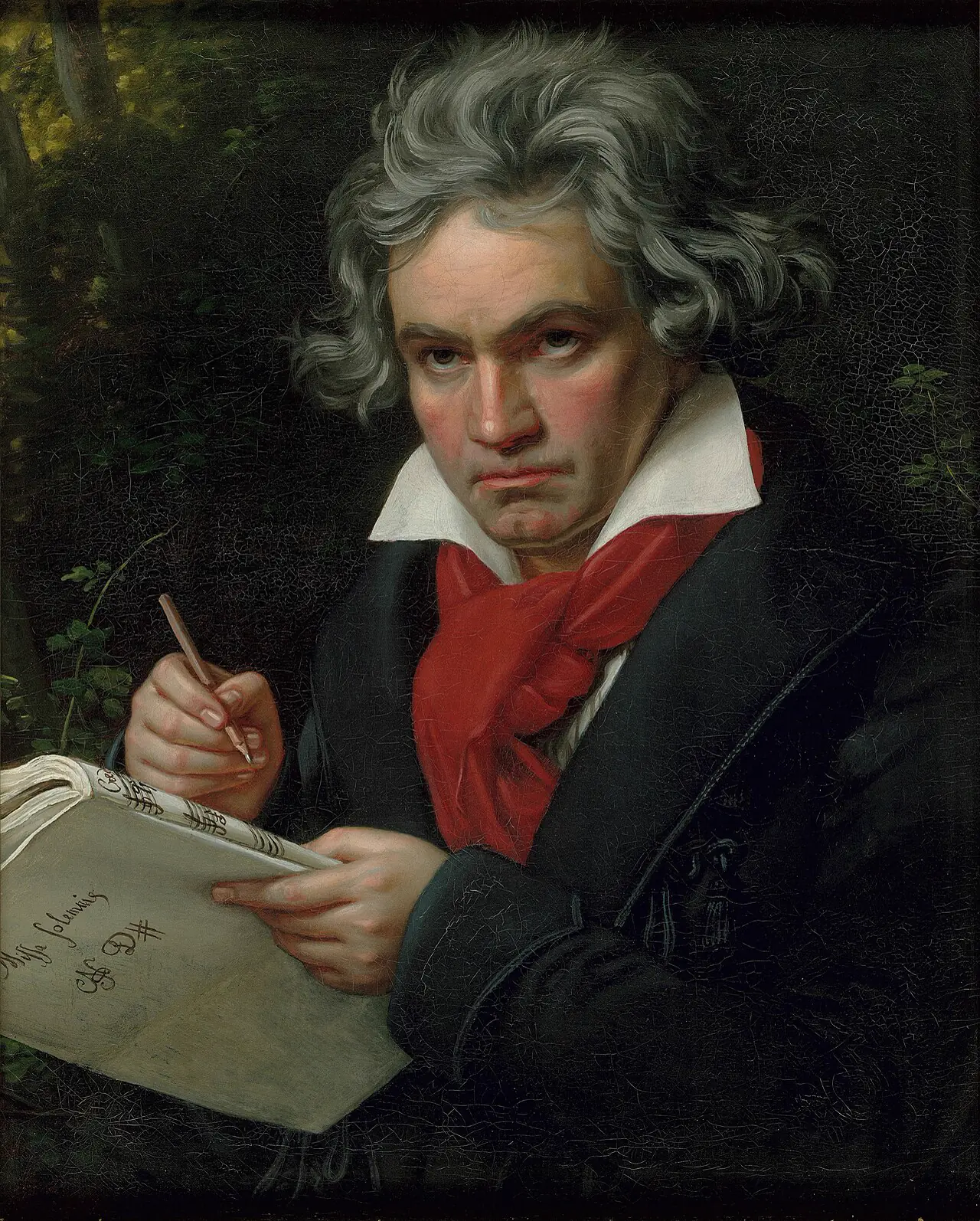
Neefe in Bonn; Haydn, Albrechtsberger and Salieri in Vienna
Home
Bonn until 1792; Vienna and its surrounding villages for the rest of his life
Output
Nine symphonies · five numbered piano concertos · 32 numbered piano sonatas · 16 string quartets · Fidelio
Hearing
Described his hearing loss in 1801; used conversation books from 1818
“I live only in my notes.”
Life
In March 1778 Johann van Beethoven advertised a concert in Cologne by his six-year-old son. Ludwig was seven. His father, a singer in the electoral chapel at Bonn, hoped to launch another child prodigy; his grandfather, also Ludwig, had risen from singer to Kapellmeister in the same establishment. The boy was baptised on 17 December 1770, probably the day after his birth. By his teens he was playing the organ for services and the viola in the court orchestra, where he learned operas as a member of the string section.
Christian Gottlob Neefe put Bach’s Well-Tempered Clavier before him and helped him into paid employment. The Breuning household supplied books, friendship and a refuge from Johann’s drinking. After his mother died in 1787, Beethoven increasingly supported his younger brothers. In November 1792 the elector sent him to Vienna to study with Haydn. He was expected to return. French troops occupied Bonn in 1794, and the court that paid him ceased to exist.
ViennaTeachers, patrons and Op. 1
Haydn taught him composition, Albrechtsberger counterpoint, and Salieri the setting of Italian words. Prince Karl Lichnowsky gave him lodgings and introduced him to the houses where a pianist could make his name. Beethoven improvised, taught, played his own concertos and negotiated with publishers. When the three piano trios of Op. 1 appeared in 1795, the Lichnowsky family alone subscribed for twenty-seven copies. By June 1801 he could tell his old Bonn friend, the physician Franz Gerhard Wegeler, that publishers no longer bargained with him: “I ask, and they pay.”
His early piano sonatas often have four movements, like a quartet or symphony. In the “Pathétique”, the heavy chords of the slow introduction return and interrupt the fast movement. Beethoven was known for improvising at the keyboard, and he also revised his work heavily. The surviving manuscript of the A major Cello Sonata begins as a clean copy and then becomes dense with alterations. Even that version differs from the one he finally published.
1801–02Deafness and the Heiligenstadt Testament
The letter to Wegeler had another subject. Beethoven’s ears roared day and night. He could hear someone speaking softly without making out the words; shouting was painful. Beethoven, then thirty, had been avoiding company for nearly two years, ashamed to confess the defect in the sense on which his profession depended. Wegeler was to tell nobody, not even their mutual friend Eleonore von Breuning.
The following autumn, in the village of Heiligenstadt outside Vienna, he tried to explain his withdrawal. When someone beside him heard a distant flute, he heard nothing, and when another heard a shepherd singing, he again heard nothing. In the letter now called the Heiligenstadt Testament he wrote that he had come close to ending his life: “Only art held me back.” He had music that he still had to write. The Second Symphony, completed that year, has a D major finale with many abrupt stops and jokes.
1803–09The “Eroica” and Fidelio
Two E♭ major chords begin the “Eroica”; the cellos then play a theme that moves to C♯ within its first few bars. The first movement is longer than the first movement of any of Beethoven’s earlier symphonies, with a new theme in the development and a coda that develops the material again. A funeral march follows. The trio of the scherzo is scored for three horns; the finale is a set of variations on a theme he had already used in The Creatures of Prometheus and in his Op. 35 piano variations.
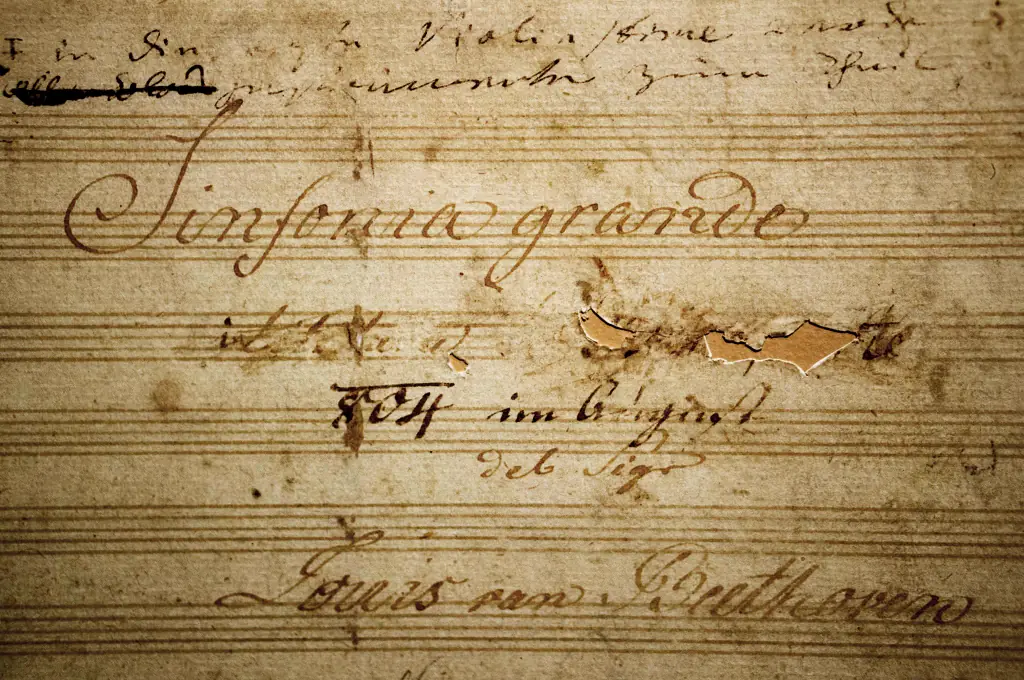
Beethoven had intended to call the symphony Bonaparte. He abandoned that dedication after Napoleon was declared emperor in 1804; the 1806 edition names Prince Lobkowitz as dedicatee and states that the work celebrates the memory of a great man. His opera Fidelio has a domestic subject: Leonore disguises herself as a man, enters a prison and saves her husband from murder. The first production, in French-occupied Vienna in 1805, failed. Beethoven revised the opera in 1806 and again in 1814, and wrote four overtures for it.
The Fourth Piano Concerto begins with the pianist playing alone, quietly. The Violin Concerto begins with repeated strokes on the timpani. These works, the three “Razumovsky” Quartets and the Fifth and Sixth symphonies were all written within a few years. At the Theater an der Wien on 22 December 1808 Beethoven presented both symphonies and the piano concerto in a single concert, together with further music. It lasted about four hours, in a bitterly cold hall. The Choral Fantasy, which closed the programme, broke down and had to be restarted.
1812–18The household
Rudolph was Beethoven’s pupil and his patron, and his name stands on the “Archduke” Trio and the Missa solemnis. In July 1812 Beethoven wrote the letter to his “Immortal Beloved”, whose identity remains disputed. After his brother Kaspar Karl died in 1815, he fought the widow, Johanna, for custody of their son. He won custody in 1820 and tried to regulate Karl’s education and friendships. In 1826 Karl attempted suicide.
Public piano playing had become impossible. From 1818 visitors wrote questions and remarks in conversation books; Beethoven usually answered aloud. The pages record groceries and domestic disputes beside publishers’ offers and plans for concerts. He still walked with manuscript paper and a pencil in his pocket. In 1818 a six-octave grand piano arrived from the London maker Thomas Broadwood, while Beethoven was composing the “Hammerklavier” Sonata.
1818–27Late works and death in Vienna
The “Hammerklavier” ends with a fugue full of leaps and trills, which follows an immense F♯ minor Adagio. His final sonata, Op. 111, has only two movements, a violent C minor first movement and a C major Arietta whose variations subdivide the beat more and more finely. The thirty-three Diabelli Variations take a modest waltz by a publisher as their theme and include a fugue and a concluding minuet. Beethoven worked at the waltz’s repeated chords as persistently as at any theme of his own.
The Missa solemnis was finished three years too late for Rudolph’s installation as archbishop in 1820. In its Benedictus, a solo violin descends towards the voices; military drums interrupt the Agnus Dei’s prayer for peace. The Ninth Symphony was performed in Vienna on 7 May 1824, with Michael Umlauf directing while Beethoven also beat time. In the finale the cellos and basses answer fragments of the earlier movements, then introduce the plain D major tune to which the singers later sing Schiller’s words.
Prince Nikolai Galitzin commissioned three quartets from Beethoven. Op. 131 has seven linked movements; Op. 132 contains a convalescent’s thanksgiving in the Lydian mode. Beethoven replaced the Grosse Fuge at the end of Op. 130 with a shorter finale and agreed to publish the fugue separately. In the score of the last completed quartet, Op. 135 of 1826, he wrote the question “Must it be?” followed by the answer “It must be!” He died in Vienna on 26 March 1827. Three days earlier he had signed a codicil naming Karl his sole heir.
Places
Every recorded place, joined in date order. Beethoven on the MapAll 20 places, with sources
Bonngasse 20, Bonn · December 1770 – November 1792 · born
Baptised 17 December; the Beethoven-Haus, in the old Elector’s capital, is the house where he was born.
The Fifth begins with a rest, three Gs and an E♭ held under a pause. That rhythm passes from melody to accompaniment and from strings to winds; the horns take it up in the scherzo. Beethoven could remove nearly everything recognisable about a tune and keep its rhythm going underneath. The first two statements differ: the second held note lasts longer.
𝄾Accents
In the “Eroica”, the bar is in three beats while a run of accents falls in twos. The players keep their places in the bar against the cross-accents. The Seventh is also built on rhythmic figures, from the dotted figure of its first movement to the long–short–short rhythm of the Allegretto. Beethoven’s rests can be as abrupt as his loudest chords: the whole orchestra stops, and the music starts again with the next attack.
♯Distant keys
The “Waldstein” Sonata opens in C major and places its second theme in E major, four sharps away. The second theme is a calm chordal tune, set against the repeated chords of the opening. In the late quartets Beethoven sometimes drew on older modes. The thanksgiving movement in Op. 132 is in F Lydian, which uses B♮ in place of the B♭ of the F major scale.
𝄋Linked movements
At the end of the Fifth’s scherzo only timpani and strings are left playing, and the C major finale follows without a break. Op. 131 is a continuous sequence of seven movements, beginning with a slow fugue and passing through dance, recitative and variations. Beethoven took care over the joins between movements, and a new movement can begin by taking up a point the previous one left unresolved.
𝆑The orchestra
The “Eroica” calls for three horns, and in the trio of the scherzo Beethoven gives all three a hunting call. In the finale of the Fifth he added instruments that had not played until then: piccolo, contrabassoon and three trombones. They extend the orchestra’s range upwards and downwards at the point where C minor turns to C major.
𝄢Variation and fugue
Diabelli’s waltz gives Beethoven repeated chords, a turn and a bass to work with separately. A single variation may take up only one of these elements, until little of the tune is left. In the “Hammerklavier” fugue, a leap and a trill become figures the hands must follow across the keyboard.
Works
A selection from the composer’s works.
1793–95
Three Piano TriosOp. 1Piano, violin and cello
All three have four movements. The subscription list included twenty-seven copies for the Lichnowsky family.
1798–99
Piano Sonata No. 8 in C minor “Pathétique”Op. 13Piano
The slow Grave introduction returns inside the first movement: its heavy chords interrupt the fast Allegro.
1801
Piano Sonata No. 14 in C♯ minorOp. 27 No. 2Piano
Beethoven called it Sonata quasi una fantasia; the name “Moonlight” came after his death. The sonata opens quietly, and its fastest music comes in the last movement.
1802–04
Symphony No. 3 in E♭ major “Eroica”Op. 55Orchestra with three horns
The cellos’ opening theme, in E♭ major, moves onto C♯. The first movement is followed by a funeral march, and the three horns play in the trio of the scherzo.
1803–04
Piano Sonata No. 21 in C major “Waldstein”Op. 53Piano
A quiet E major chorale answers the first movement’s repeated C major chords. The short slow movement leads straight into a rondo whose tune is set above a widely spaced accompaniment.
1804–06
Piano Concerto No. 4 in G majorOp. 58Piano and orchestra
The pianist begins alone and the orchestra answers in B major. In the slow movement, loud string unisons meet quiet piano chords.
The famous four notes begin after a quaver rest. The scherzo leads straight into a C major finale, where piccolo, contrabassoon and trombones enter for the first time.
FidelioOp. 72Opera in two acts in its final version
Leonore disguises herself as a prison employee to rescue her husband. Beethoven wrote three principal versions of the opera and four overtures before it reached its final form.
1806
Three “Razumovsky” QuartetsOp. 59String quartet
Written for Count Andrey Razumovsky, with Russian tunes in the first two quartets. The third ends with a fast fugue.
1806
Violin Concerto in D majorOp. 61Violin and orchestra
The timpani enter first, playing repeated notes before the theme begins. For much of the movement the violin plays high above that opening.
1807–08
Symphony No. 6 in F major “Pastoral”Op. 68Orchestra
Five country scenes; the dance, storm and thanksgiving are joined. First performed on the same cold December evening as the Fifth.
1809
Piano Concerto No. 5 in E♭ majorOp. 73Piano and orchestra
The opening alternates orchestral chords with solo flourishes that Beethoven wrote out in full. The slow movement leads directly into the finale.
1811–12
Symphony No. 7 in A majorOp. 92Orchestra
The A minor Allegretto opens quietly in the low strings with a long–short–short rhythm, which is taken up in successive entries until the full orchestra plays it.
1817–18
Piano Sonata No. 29 in B♭ major “Hammerklavier”Op. 106Piano
A long Adagio in F♯ minor precedes a fugue with leaps and trills in both hands. The Broadwood piano reached Beethoven while he was writing it.
1819–23
Missa solemnis in D majorOp. 123Four soloists, chorus, orchestra and organ
A solo violin enters on a descending line in the Benedictus; military drums interrupt the Agnus Dei. Beethoven finished the Mass three years after the installation ceremony for which he began it.
1819–23
Thirty-three Variations on a Waltz by DiabelliOp. 120Piano
A waltz by a publisher supplies the repeated chords, turns and bass notes for thirty-three variations. The last variation, after the fugue, is a minuet.
1821–22
Piano Sonata No. 32 in C minorOp. 111Piano
Two movements, the first in C minor, the second a C major Arietta with variations. Across the variations the beat divides into ever smaller notes.
1822–24
Symphony No. 9 in D minorOp. 125Four soloists, chorus and orchestra
The cellos and basses play the finale’s main theme before it is sung. The bass soloist’s opening words were written by Beethoven; the ode that follows is by Schiller.
1824–26
The Late QuartetsOpp. 127, 130–133, 135String quartet
Five quartets and the separately published Grosse Fuge. Op. 131 joins seven movements; Op. 132 contains a recovering patient’s thanksgiving; Op. 135 ends on the question whether it must be.
In the score
Short examples, engraved and playable.
Symphony No. 5 · first movement, bars 1–5The rest as part of the motif
Quoted from bars 1–5 of the Fifth’s first movement, reduced to a single line. Each group of three short notes follows a quaver rest. The second held note crosses a bar-line before its pause, so it lasts longer than the first.
Symphony No. 9 · finaleThe joy theme before the words
Quoted from bars 92–95 of the Ninth’s finale, with the low-string melody moved into treble clef. These first four bars stay within D–A and mostly move by step. Cellos and basses introduce the tune quietly; the voices enter later.
String Quartet Op. 132 · modal schematicF without B♭
A schematic of F Lydian, the white notes from F to F. B♮ supplies the raised fourth that distinguishes it from F major. In Op. 132 Beethoven alternates the slow thanksgiving in this mode with quicker passages marked “feeling new strength”.
Sister arts
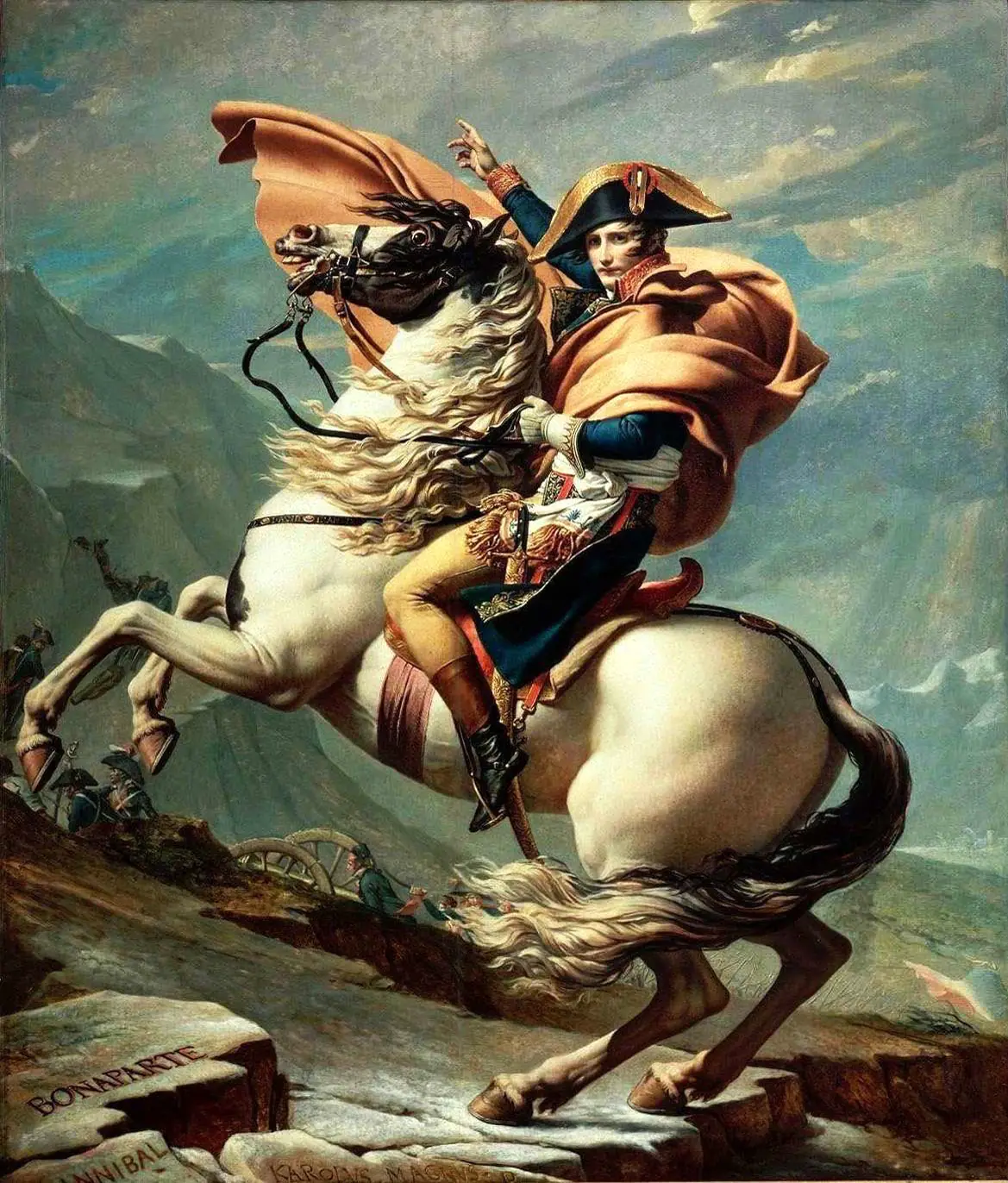
Jacques-Louis DavidBonaparte Crossing the Great St Bernard Pass, 1800–01Oil on canvas · Musée national des châteaux de Malmaison et Bois-Préau
David painted Bonaparte on a rearing horse, with the names of Hannibal and Charlemagne cut into the rocks below him. Bonaparte in fact crossed the pass on a mule. Beethoven admired the young commander at the time he was planning the “Eroica”.
Copyist, with alterations by Ludwig van BeethovenTitle page of the Eroica score, with Bonaparte’s name erased, 1804Ink on paper · Gesellschaft der Musikfreunde, Vienna
The copyist Benjamin Gebauer wrote out this score; Beethoven corrected it and kept it until his death. Bonaparte’s name was scraped away, which left a hole in the page. The pianist Joseph Dessauer bought the manuscript at the estate auction and gave it to the Gesellschaft der Musikfreunde for Beethoven’s centenary in 1870.
Ludwig van Beethoven
Heiligenstadt Testament — art and survival
6 October 1802; postscript 10 October
German proseEs fehlte wenig, und ich endigte selbst mein Leben — nur sie die Kunst, sie hielt mich zurück, ach es dünkte mir unmöglich, die Welt eher zu verlassen, bis ich das alles hervorgebracht, wozu ich mich aufgelegt fühlte.
Our translationLittle was lacking, and I would have ended my life myself — only art held me back; ah, it seemed impossible to me to leave the world before I had brought forth everything that I felt capable of producing.
Writing to his brothers on 6 October 1802, Beethoven explained why he had withdrawn from people he wanted to be among. He recalled standing beside someone who could hear a distant flute while he heard nothing. The letter remained among his papers. Its opening asked those who called him hostile or misanthropic to reconsider.
Friedrich Schiller
An die Freude — opening stanza
1785; revised 1803
GermanFreude, schöner Götterfunken,
Tochter aus Elysium,
Wir betreten feuertrunken,
Himmlische, dein Heiligtum!
Deine Zauber binden wieder,
Was die Mode streng geteilt;
Alle Menschen werden Brüder,
Wo dein sanfter Flügel weilt.
Our translationJoy, beautiful spark of the gods,
daughter from Elysium,
drunk with fire we enter,
heavenly one, your sanctuary!
Your enchantments bind together again
what custom has sternly divided;
all human beings become brothers
where your gentle wing rests.
Schiller’s 1785 ode originally made beggars the brothers of princes. In the revised stanza Beethoven set, all people become brothers. He chose and rearranged the verses for the Ninth, adding the bass soloist’s opening appeal, O Freunde, nicht diese Töne!, before Schiller’s words begin.
Recommended recordings
The Nine SymphoniesBerlin Philharmonic, Herbert von KarajanDeutsche Grammophon · 1961–62The Berlin strings carry long phrases through the tuttis. A good first cycle for the “Eroica” and the Seventh.
The Nine SymphoniesOrchestre Révolutionnaire et Romantique, John Eliot GardinerArchiv ProduktionThe timpani are hard-struck and the brass rough-edged. Gardiner takes the dance rhythms with a sprung, lively pulse, and the wind parts stay clear of the strings.
The Piano SonatasAlfred BrendelPhilipsBrendel brings out the jokes in the music, and the points at which a returning phrase takes on a different meaning. He gives the early sonatas the same attention as the last three.
The Late String QuartetsQuartetto ItalianoPhilipsChosen for the long singing line the four players sustain together in the slow movements. Their Op. 131 takes its seven movements as a single span, at unhurried tempos.
FidelioChrista Ludwig, Jon Vickers, Walter Berry; Philharmonia Orchestra, Otto KlempererEMI · 1962Ludwig sings Leonore with a hard edge to the voice; Vickers sings Florestan. Klemperer takes the prison scenes slowly.
Schubert grew up playing Beethoven’s symphonies; Berlioz heard them in Paris and began planning orchestras of his own. Later composers took different things from him: Brahms the small, persistent figures, Mahler the voices in the symphonies, Bartók the fugues and sudden dances in his quartets. The influence of Beethoven’s own teachers can also be heard in his music, especially Haydn’s habit of turning an ending into a joke.
Chronological life-and-works study informed by research on sketches and correspondence.
Joseph Kerman, Alan Tyson, Scott G. Burnham, Douglas Johnson and William Drabkin, ‘Beethoven, Ludwig van’, Grove Music Online (Oxford University Press, 2001). reference
Biographical reference, work-list and bibliography; subscription required.