St Stephen’s choir, Vienna · accompanying Nicola Porpora · studying C. P. E. Bach
Employer
The Esterházy princes, from 1761 until his death
London
1791–92 and 1794–95; twelve new symphonies
Output
104 numbered symphonies · quartets · keyboard music · operas · masses and oratorios
“The whole company was extremely pleased, and so was I.”
Life
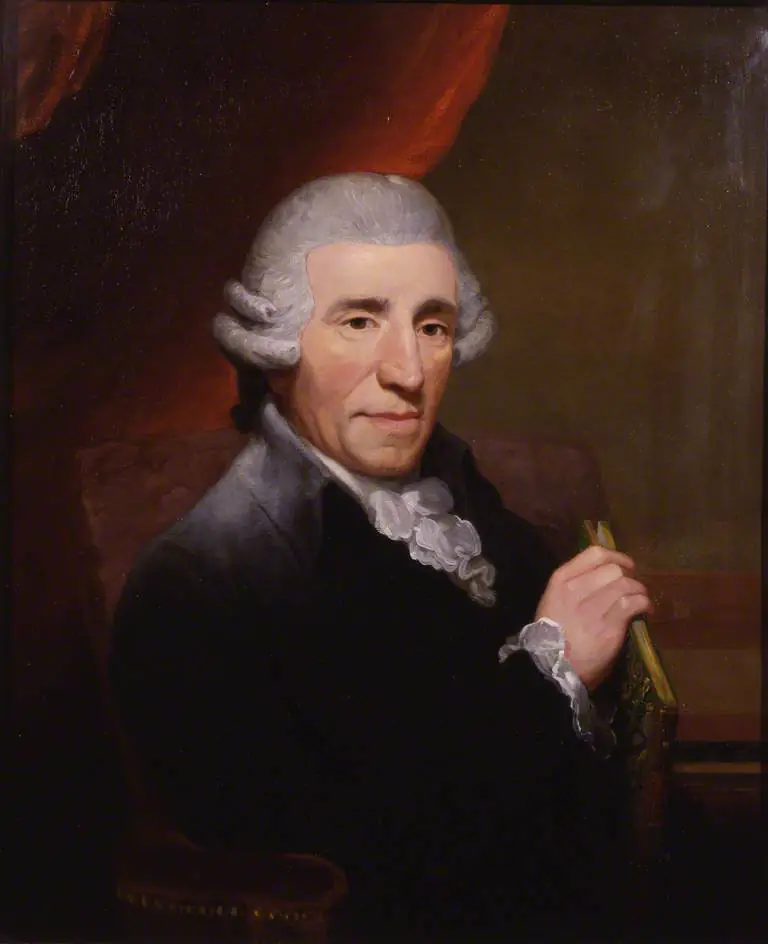
On 4 May 1795, Haydn gave a benefit concert at the King’s Theatre in London. The programme included his new D major Symphony, now numbered 104. Afterwards he wrote in his notebook: “The whole company was extremely pleased, and so was I. I made four thousand gulden this evening. Such a thing can only be done in England.” He was sixty-three. He was a wheelwright’s son and had spent most of his adult life in the livery of a servant of the Esterházy family.
1732–60St Stephen’s, Porpora and Count Morzin
Haydn was born in Rohrau in 1732. His father was a wheelwright who played the harp by ear and sang; his mother had worked as a cook. At about six, Joseph left home for schooling in Hainburg. By 1740 he was a choirboy at St Stephen’s Cathedral in Vienna. As a chorister he sang church music daily but received little instruction in composition. Performances outside the cathedral also gave him chances to get a meal. When his voice broke and he was dismissed in 1749, another musician, Johann Michael Spangler, took him into his family’s crowded room.
For the next years Haydn earned his living by teaching, accompanying and freelance playing. He studied Fux’s counterpoint and worked through the keyboard sonatas of C. P. E. Bach. He became accompanist and servant to the singing teacher Nicola Porpora, and learned from him how to accompany a voice at the keyboard. In the service of Count Morzin he had an orchestra at his disposal, and he wrote his first symphonies there. In 1760 he married Maria Anna Keller. The marriage was unhappy and childless.
EsterházyKapellmeister to the Esterházy princes
Prince Paul Anton Esterházy appointed him vice-Kapellmeister in 1761. Under the next prince, Nikolaus, he became full Kapellmeister in 1766. His contract covered much more than composition. He had to rehearse the musicians, maintain their instruments, answer requests and see that they appeared properly dressed. At Eisenstadt and the new palace of Eszterháza he learnt the abilities of particular players. The 1761 symphonies Le Matin, Le Midi and Le Soir give them solo passages. In Le Matin the double bass also has a solo, in the trio of the minuet.
Haydn described the advantages to his biographer Georg August Griesinger, whose recollections appeared in 1810. As head of an orchestra, he could hear what worked and what weakened an effect, and so could improve it, add or cut, and take risks. “I was cut off from the world … and so I had to become original.” The prince was pleased with his work, and Haydn had regular access to the players. The palace’s opera theatre also required rehearsals, adaptations of other composers’ scores and new operas of his own.
The musicians also had wives and children. In 1772 their stay at Eszterháza dragged on, while most of their families remained in Eisenstadt. Haydn told Griesinger and his fellow biographer Albert Christoph Dies how he put their request to go home to the prince. In the “Farewell” Symphony the fast finale breaks off and an Adagio begins. The players finish their parts, put out their candles and leave, until only two muted violins remain. The prince understood the request. The symphony opens in F♯ minor and ends quietly in F♯ major.
Four playersQuartets, Paris symphonies and Mozart
The six Op. 20 quartets, also written in 1772, give the cello demanding parts, and three of them end with fugal finales. Each player has to take up the subject in turn or drop out while another part has it. Nine years later, in the Op. 33 quartets, Haydn treated ordinary tunes in new ways. In the finale of the E♭ major “Joke”, he breaks the returning melody into fragments separated by long rests. The last fragment, a quiet half of the opening phrase, comes after nearly five bars of silence.
A new contract in 1779 removed the old restriction on selling his compositions beyond the court. Haydn dealt with publishers and accepted distant commissions. The six “Paris” symphonies of 1785–86 went to the Concert de la Loge Olympique, whose orchestra was larger than his own. In No. 83 a G minor opening is followed by an oboe repeating a dotted rhythm, which listeners heard as clucking and which earned the symphony its nickname, “The Hen”.
In Vienna he had found a colleague whose opinion mattered to him. Mozart dedicated six quartets to Haydn in 1785. On 12 February, after hearing the last three at Mozart’s home, Haydn told Leopold Mozart: “Before God, and as an honest man, I tell you that your son is the greatest composer I know, personally or by name.” Leopold wrote the words down in a letter to his daughter. Haydn went on to praise Wolfgang’s taste and knowledge of composition.
1791–95London and the Salomon concerts
Nikolaus died in 1790. His successor Anton cut the musical establishment but retained Haydn’s title and pension, leaving him free to travel. The violinist and impresario Johann Peter Salomon brought him to London in 1791. Haydn was fifty-eight and had never seen the sea. He stayed through 1792 and returned in 1794–95, writing twelve symphonies for English audiences. The loud chord in the “Surprise” Symphony interrupts a quiet tune. Elsewhere in these symphonies he gives the winds prominent melodic writing, delays an arrival or builds a large opening from a few notes.
During these visits he also heard Handel’s oratorios, performed with large choirs and orchestras. Back in Vienna in 1792–94, he taught Beethoven. When he returned from England for good, he had money and an international audience, and he brought with him an English libretto about the creation of the world.
The late worksThe Creation and the late works
Baron Gottfried van Swieten turned that libretto, drawn from Genesis, the Psalms and Milton, into the German text of The Creation. The orchestral opening is in C minor and repeatedly avoids a full cadence. On the word “Licht”, chorus and orchestra enter fortissimo on a chord of C major. Private performances followed in 1798, a public performance in Vienna in 1799, and publication with both German and English words in 1800.
Between 1796 and 1802 he also wrote six late masses for the renewed Esterházy establishment under Nikolaus II. In the Missa in tempore belli, timpani and trumpet calls enter during the Agnus Dei’s prayer for mercy. Haydn used the tune of his 1797 hymn Gott erhalte Franz den Kaiser again in the “Emperor” Quartet, where it passes intact from one player to the next among the four while the accompaniment changes. For The Seasons, completed in 1801, van Swieten adapted James Thomson. The work includes field-workers and hunters, a summer storm and a winter landscape.
In March 1808 he was carried in an armchair to a performance of The Creation conducted by Salieri. Beethoven was among those who came to honour him. The following spring French troops occupied Vienna. Haydn died on 31 May 1809. Shortly before his death a French officer had visited his house and sung the tenor aria about the creation of man from The Creation.
Places
Every recorded place, joined in date order. Haydn on the MapAll 25 places, with sources
Rohrau · 31 March 1732 – 1737 · born
Born to a wheelwright and a cook; his early-childhood home is now a Haydn museum.
In the first Allegro of Le Matin, the flute introduces the main tune in D major. At the end of the development a solo horn restates it in the tonic, two bars before the recapitulation. Haydn builds the movement from a small stock of material, and the opening phrase returns in several different functions.
𝄾When to applaud
The finale of the “Joke” Quartet ends by taking its tune apart. The players give a few notes, then a silence, then another fragment; they know when the next entry comes, and the audience does not. The last short phrase comes after an exceptionally long rest.
♮The withheld chord
At the beginning of The Creation, the C minor tonality is repeatedly unsettled by interrupted phrases and by cadences that do not arrive. The orchestra does not settle on a stable cadence. When the chorus sings “Licht”, the music reaches C major, a chord Haydn has withheld until that point.
𝄡Four independent players
Three Op. 20 quartets finish with fugues: No. 5 has two subjects, No. 6 three and No. 2 four. Elsewhere in the set the cello has a high, demanding part that goes beyond marking the bass. A tune led by one player becomes an accompaniment a few phrases later and then takes the lead again.
𝄞Solo allocation
In Le Matin, the trio of the minuet gives the bassoon and double bass solo parts. In the “Farewell” Symphony, some players have short solos before they leave, until only two violins are left.
𝄆Variations
The F minor keyboard variations alternate a minor theme with a major one, and each theme is varied in turn. Haydn then brought back the minor theme and extended it into a large coda. The manuscript shows the change of plan, with an earlier short ending in the major replaced by four more pages.
Works
A selection from the composer’s works.
1761
Symphony No. 6 in D major “Le Matin”Hob. I:6Orchestra
Written soon after Haydn joined the Esterházy household. The slow opening suggests sunrise; later, the double bass has a solo in the trio of the minuet.
1772
Symphony No. 45 in F♯ minor “Farewell”Hob. I:45Orchestra
The fast finale turns into an Adagio and the musicians leave one by one. Two muted violins finish in F♯ major.
1772
Six String Quartets, Op. 20Hob. III:31–36Two violins, viola and cello
Three fugal finales, and a cello part that makes new use of the upper register. The nickname Sun comes from the rising sun on Hummel’s printed title page.
1781
Six String Quartets, Op. 33Hob. III:37–42String quartet
The set includes the “Joke” and “Bird” quartets. In the “Joke”, the final rests are long enough that the audience cannot tell whether to clap.
1785–86
Six Paris Symphonies, Nos. 82–87Hob. I:82–87Orchestra
Commissioned for the Concert de la Loge Olympique. In No. 83 the oboe’s dotted repeated note under the second theme gave the symphony its Hen nickname.
1786
The Seven Last Words of Our Saviour on the CrossHob. XX:1Originally orchestra; later versions include string quartet and oratorio
Written for devotions in Cádiz. Seven slow meditations are framed by an introduction and an earthquake. Haydn later made quartet and choral versions.
Minor and major themes alternate, then the minor theme returns for a large concluding expansion. Haydn’s manuscript preserves the shorter ending he abandoned.
1795
Symphony No. 104 in D major “London”Hob. I:104Orchestra
First performed at Haydn’s London benefit concert on 4 May 1795. A D minor introduction leads into a D major Allegro. The finale begins with a dance tune over a low, sustained drone.
1796
Trumpet Concerto in E♭ majorHob. VIIe:1Keyed trumpet and orchestra
Anton Weidinger’s keyed trumpet could play the notes between the natural harmonics. Haydn wrote chromatic passages for it that a natural trumpet could not play.
1796
Missa in tempore belliHob. XXII:9Soloists, chorus and orchestra
Haydn’s own title is Mass in Time of War. The solo role of the timpani in the Agnus Dei earned the later name “Paukenmesse”.
1796–98
Die Schöpfung (The Creation)Hob. XXI:2Soloists, chorus and orchestra
Three archangels narrate the creation before Adam and Eve enter the garden. Haydn published the score in 1800 with both German and English words.
1797
String Quartet in C major “Emperor”Op. 76 No. 3 · Hob. III:77String quartet
The slow movement uses Haydn’s new imperial hymn. Each player takes the melody in turn while the other parts play changing accompaniments around it.
1799–1801
Die Jahreszeiten (The Seasons)Hob. XXI:3Three soloists, chorus and orchestra
Van Swieten’s libretto, adapted from James Thomson, follows a year in the country. Its scenes include a summer storm and a hunt in autumn with horns.
In the score
Short examples, engraved and playable.
Gott erhalte Franz den Kaiser · 1797The hymn before the quartet variations
Quoted from the opening phrase of Gott erhalte Franz den Kaiser, melody only, in G major. The phrase begins with a half-bar upbeat and ends on a half-bar. Haydn used the same tune in the slow movement of the “Emperor” Quartet, where it passes from one player to the next.
Sonata exposition · schematicThe same theme in another key
A schematic of an opening idea returning in a new key. The first two bars are in C major and the next two in G major, with the same melodic pattern. Haydn sometimes established the dominant in a sonata exposition in this way, without a new theme.
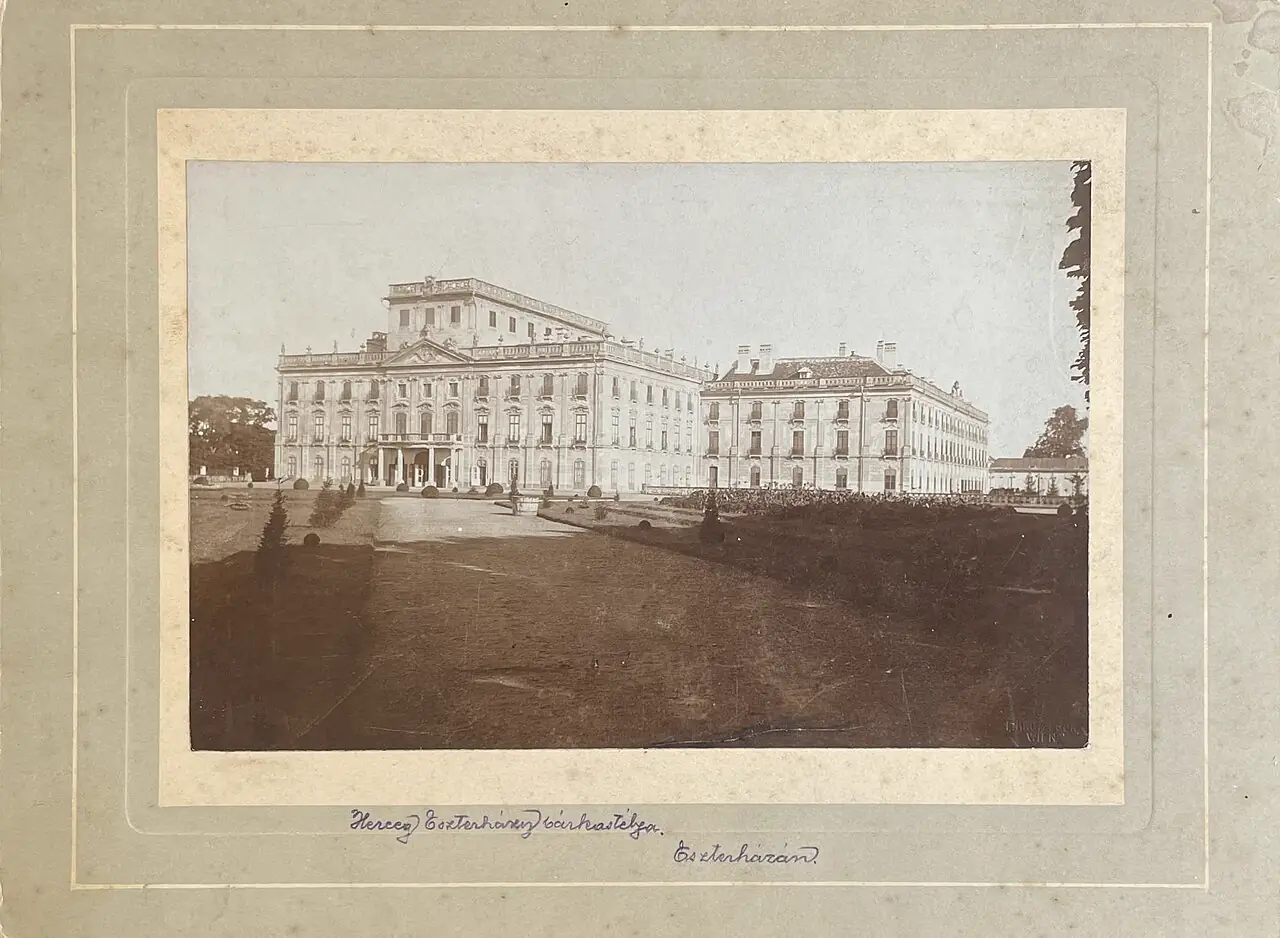
The palace where Haydn supplied operas, symphonies and music for Nikolaus’s baryton, photographed long after his lifetime. In 1772 the musicians staying here wanted to go home to their families; Haydn conveyed their request through the departing players of the “Farewell” Symphony.
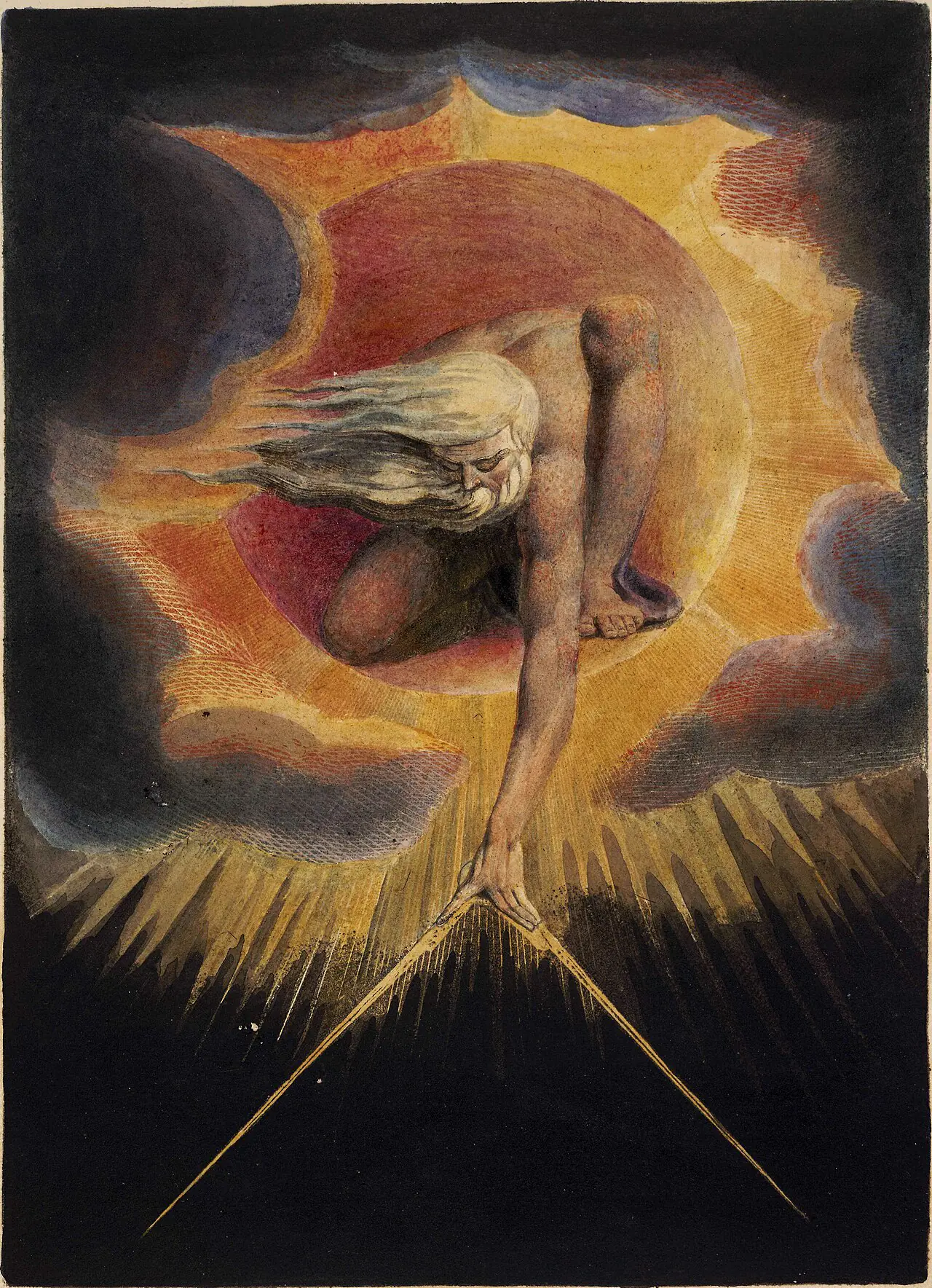
William BlakeThe Ancient of Days, frontispiece to Europe a Prophecy, 1794Relief etching with colour · British Museum, London
Blake’s Urizen bends out of a circle of fire with a pair of compasses, giving the world its dimensions. Blake made the print in London in 1794, during Haydn’s second visit. Four years later came Haydn’s The Creation, with its eventual C major chord.
John Milton
Paradise Lost, Book VII — before the creation of humanity
1667; revised edition 1674
EnglishNow Heaven in all her glory shone, and rolled
Her motions, as the great First Mover’s hand
First wheeled their course; Earth in her rich attire
Consummate lovely smiled; air, water, earth,
By fowl, fish, beast, was flown, was swum, was walked,
Frequent; and of the sixth day yet remained:
There wanted yet the master-work, the end
Of all yet done; a creature, who, not prone
And brute as other creatures, but endued
With sanctity of reason, might erect
His stature, and, upright with front serene,
Govern the rest, self-knowing
Milton fills the earth with creatures, then pauses before introducing the human being who will govern them. Haydn’s The Creation makes the same pause before the tenor aria Mit Würd’ und Hoheit angetan. The English libretto Haydn brought home from London drew on Milton as well as Genesis and the Psalms; van Swieten reshaped it in German. Book VII, lines 499–510.
Recommended recordings
The SymphoniesPhilharmonia Hungarica, Antal DorátiDeccaDoráti and the Philharmonia Hungarica recorded the complete symphonies with the same players throughout, and gave the early works the same care as the twelve London symphonies.
String Quartets, Op. 20Quatuor MosaïquesAstréePlayed on period instruments. The Capriccio of the C major quartet and the slow movement of the F minor quartet are the places to begin.
Die SchöpfungMonteverdi Choir, English Baroque Soloists, John Eliot GardinerArchiv ProduktionThe arrival of light is clean and the choir’s attacks are exact. Gerald Finley sings Raphael; separate singers take Adam and Eve in the final part.
Piano SonatasAlfred BrendelPhilipsThe E minor Sonata, Hob. XVI:34, is a good place to start. The left hand plays arpeggios and the right hand answers them.
Lineage
Drew fromCarl Philipp Emanuel BachNicola PorporaGeorg Christoph WagenseilAustrian church and dance music
Mozart offered Haydn six quartets; Beethoven brought him counterpoint exercises. In both cases the scores were on the table. Haydn’s example also runs through Schubert, where a small phrase can furnish a long movement and a familiar tune can return in changed surroundings.
Further reading
David Wyn Jones, The Life of Haydn (Cambridge: Cambridge University Press, 2009). biography
Connects Haydn’s employment, London visits and musical career with contemporary institutions.
Georg Feder and James Webster, ‘Haydn, (Franz) Joseph’, Grove Music Online (Oxford University Press, 2001). reference
Biographical reference, work-list and bibliography; subscription required.