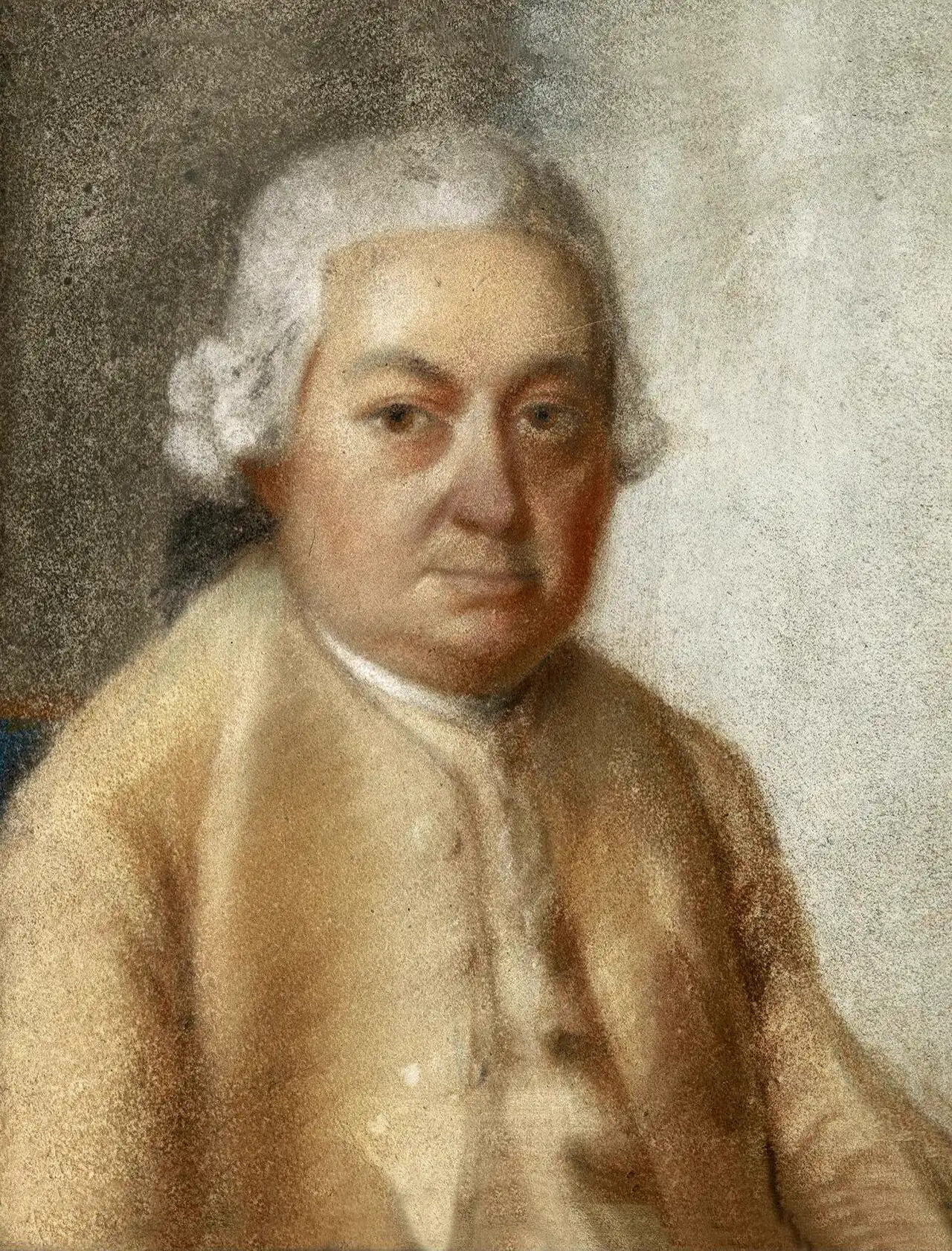
Frederick II’s harpsichordist, 1740–67 · Hamburg music director, 1768–88
At the keyboard
Essay on the True Art of Playing Keyboard Instruments, 1753 and 1762
Catalogue
Wq: Alfred Wotquenne · H: E. Eugene Helm
“A musician can move others only if he is moved himself.”
Life
On 12 October 1772, Charles Burney dined with Carl Philipp Emanuel Bach in Hamburg. Bach’s wife, his lawyer son, his daughter and three or four friends were present; upstairs was a music room hung with pictures, drawings and prints of more than a hundred and fifty musicians. Before dinner Bach had played his Silbermann clavichord; after dinner Burney persuaded him to return to the keyboard, and he played until nearly eleven. As he played, his eyes became fixed and his lower lip dropped. Burney wrote that on a long note Bach could draw from the clavichord “a cry of sorrow and complaint”.
1714–38Youth, Leipzig and Frankfurt
Emanuel was born in Weimar on 8 March 1714, the second surviving son of Johann Sebastian Bach and Maria Barbara. Telemann was his godfather. The household moved to Cöthen in 1717 and Leipzig in 1723, when Sebastian became Thomaskantor. Visiting musicians came to play for his father; the boy heard them at home. “In composition and keyboard playing I never had any teacher other than my father,” he wrote in the autobiography published in 1773.
He studied law at Leipzig and then Frankfurt an der Oder, where he also directed a musical society and composed for public ceremonies. In 1738 he went to Berlin. An opportunity to travel abroad as a young gentleman’s companion was displaced by a summons from Crown Prince Frederick. Two years later Frederick became King of Prussia, and Bach formally entered his service. He remembered accompanying, alone at the harpsichord, the first flute solo Frederick played as king at Charlottenburg.
BerlinFrederick’s court, sonatas and Essay
Frederick’s musical household included his flute teacher Quantz and the brothers Graun. Bach spent much of his working life providing the bass and chords beneath the king’s flute. Outside that duty he published sonatas, wrote concertos and married Johanna Maria Dannemann, a wine merchant’s daughter, in 1744. They had two surviving sons and a daughter. In his autobiography he noted drily that the king had graciously frustrated his attempts to leave the royal service by raising his salary.
The six Prussian Sonatas of 1742 and the six Württemberg Sonatas of 1744 made his name known beyond the court. They follow a three-movement plan, within which a melodic line is suddenly left without its accompaniment, a rest falls where a cadence is expected, and a slow movement is heavily ornamented. In a later character piece, L’Irresoluë (“the irresolute one”), the written metre changes between 3/8 and 3/4.
In 1753 he published the first part of his Essay on the True Art of Playing Keyboard Instruments. Much of it is given to fingering and ornaments. The chapter on performance states: “A musician can move others only if he is moved himself.” In sorrowful passages the player must become sorrowful, and when the music grows excited the player must change with it. Bach disliked a performer who sat at the instrument like a carved figure. The last of the book’s musical examples is a fantasia in C minor written without regular bar-lines.
Bach wanted keyboard players to own both a clavichord and a harpsichord. The first taught expressive touch; the second supplied the strength needed in ensemble playing. He also welcomed good fortepianos. The second part of the Essay, published in 1762, taught accompaniment and improvisation, including how to turn a figured bass into chords, how to support a singer and how to invent a free fantasia. His Gellert songs of 1758, written for domestic devotion, had already applied the same care over expression. Their keyboard parts were fully written out, which left an insensitive accompanist less room to spoil them.
1768Hamburg music director
Telemann died in 1767, and Bach succeeded his godfather as Hamburg music director and cantor of the Johanneum. After repeated petitions to Frederick for release, he moved north in 1768. The posts required music for five principal churches, annual Passions and civic occasions. He assembled programmes from his own music and other composers’ scores. In the winter of his arrival he also announced twenty subscription concerts.
His Hamburg audiences also heard music on a far larger scale than the clavichord. Die Auferstehung und Himmelfahrt Jesu, performed in part in 1774 and revised several times, sets Ramler’s account of the Resurrection and Ascension for soloists, chorus and orchestra. In Heilig, the angels and the peoples of the earth sing from separate choirs. At St Michael’s in October 1776, the choir of angels was placed high above the body of the church and the human choir by the organ. Both choirs joined in the fugue.
Baron Gottfried van Swieten commissioned six string symphonies in 1773, asking Bach to write freely without worrying about the players’ difficulties. The violinist Johann Friedrich Reichardt later remembered leading a trial performance in Professor Büsch’s house. The sixth symphony begins in E major. The first movement ends on a pause, and the next movement begins in F♯ minor.
The four orchestral symphonies of 1775–76 add independent wind parts and separate the cellos from the basses. About forty musicians tried them in Hamburg in August 1776, each symphony twice. When the printed sheets arrived in 1780, Bach complained to Breitkopf that Schwickert had used poor stock. The dedication copy was meant for the Prussian crown prince, and Bach also wanted a handsome copy for himself.
The late keyboardCollections für Kenner und Liebhaber
From 1779 Bach published six collections für Kenner und Liebhaber (for connoisseurs and amateurs), which offered sonatas, rondos and fantasias to subscribers. On 31 August 1784 he advised the composer Johann Christoph Kühnau about music intended for publication: “Be less artful and give more sugar,” adding that in unpublished work Kühnau could let his industry run free. Bach wrote his F♯ minor Fantasia in 1787. He also made a version of it with violin, called C. P. E. Bachs Empfindungen.
At a Hamburg benefit concert on 9 April 1786, Bach placed the Credo from his father’s B minor Mass beside music from Handel’s Messiah and his own Magnificat and Heilig. He died on 14 December 1788. Other composers went on studying his keyboard music. Haydn told his biographers how closely he had studied the sonatas, and in July 1809 Beethoven asked Breitkopf & Härtel to send him Emanuel’s works along with those of Mozart, Haydn and Sebastian Bach.
Served Crown Prince Frederick, then the king’s orchestra from 1740; chamber musician from 1746; wrote the Versuch. Versuch über die wahre Art das Clavier zu spielen.
Bach wrote keyboard phrases that stop and start irregularly. The C minor Fantasia that closes the Probestücke has stretches without bar-lines: the notes still have lengths, but there is no regularly returning accent. A chord can interrupt a run, and a pause can delay the expected answer.
♯Unexpected keys
In the sixth of the Wq 182 symphonies, the E major first movement ends on an unresolved chord, and the slow movement follows in F♯ minor. In the first of Wq 183, the D major first movement leads into a Largo in E♭ major.
𝆏Keyboard touch
On the clavichord a metal tangent keeps the finger in contact with the sounding string. This makes a slight vibrato possible and allows a held note to be varied after it is struck. Bach’s Essay explains how much weight to give an appoggiatura before its resolution. On a modern piano, clean releases matter as much as a singing tone.
𝄋Changes of beat
L’Irresoluë switches repeatedly between 3/8 and 3/4, so that its title, a portrait of indecision, is reflected in the time signatures. The free fantasias go further and remove the bar-lines for whole passages. In a rondo, by contrast, the main tune returns.
𝄢Ensemble writing
The Wq 182 symphonies are scored for strings and continuo, and they alternate sudden loud attacks with exposed quiet answers. Wq 183 gives the flutes, oboes, bassoon and horns lines of their own, with separate cello and bass parts. In Heilig, two choirs answer each other across the room and then join in a fugue.
Works
A selection from the composer’s works.
1742
Six Prussian SonatasWq 48Keyboard
The first of his two early published sonata sets, dedicated to Frederick II. The slow movements are decorated.
1744
Six Württemberg SonatasWq 49Keyboard
Six more three-movement sonatas, published two years after the Prussian set. They contain abrupt pauses and changes of direction.
1750
Cello Concerto in A minorWq 170Solo cello, strings and continuo
The concerto also survives with keyboard and flute solo parts. The cello version has its own passagework; the orchestral parts are shared across the three versions.
1753
Fantasia in C minorWq 63/6, third movementKeyboard
The eighteenth and last Probestück accompanying Part I of the Essay. Bach left out regular bar-lines so that the player could change feeling as freely as a speaker changes tone.
1758
Geistliche Oden und LiederWq 194Voice and keyboard; poems by C. F. Gellert
All fifty-four poems in Gellert’s devotional collection, with fully written keyboard accompaniments. Bach also offered the songs as pieces to play without a singer.
1773
Six String SymphoniesWq 182Strings and continuo
Commissioned by Baron van Swieten and tried out in a Hamburg professor’s house. In the sixth, an E major first movement leads unexpectedly into F♯ minor.
1774; revised 1777–78 and later
Die Auferstehung und Himmelfahrt JesuWq 240Soloists, chorus and orchestra
Ramler’s Resurrection and Ascension text, heard complete in Hamburg concerts in 1778 and 1779. Bach went on revising it until its publication in 1787.
1775–76
Four Orchestral SymphoniesWq 183Orchestra with independent wind parts
Published as symphonies with twelve obbligato parts, including seven wind instruments. About forty players gave each work twice at a Hamburg performance in August 1776.
1776; published 1779
HeiligWq 217Alto, two choirs and orchestral groups
Angels and the peoples of the earth answer from separate choirs, then join in a fugue. The published version opens with an alto arietta.
A late fantasia that alternates between measured passages and free recitative. The related version with violin is titled C. P. E. Bachs Empfindungen (Bach’s feelings).
A schematic of accented notes resolving downwards: F to E over C major, A to G over C major, then D to C over F major. The bass holds while the melody resolves.
Fantasia · schematicA cadence interrupted by another voice
A schematic of an interrupted phrase. A quiet falling line stops, a loud dominant seventh breaks in, and a fermata delays the answer in A minor. Bach’s free fantasias often remove the bar-lines that remain in this teaching example.
Sister arts
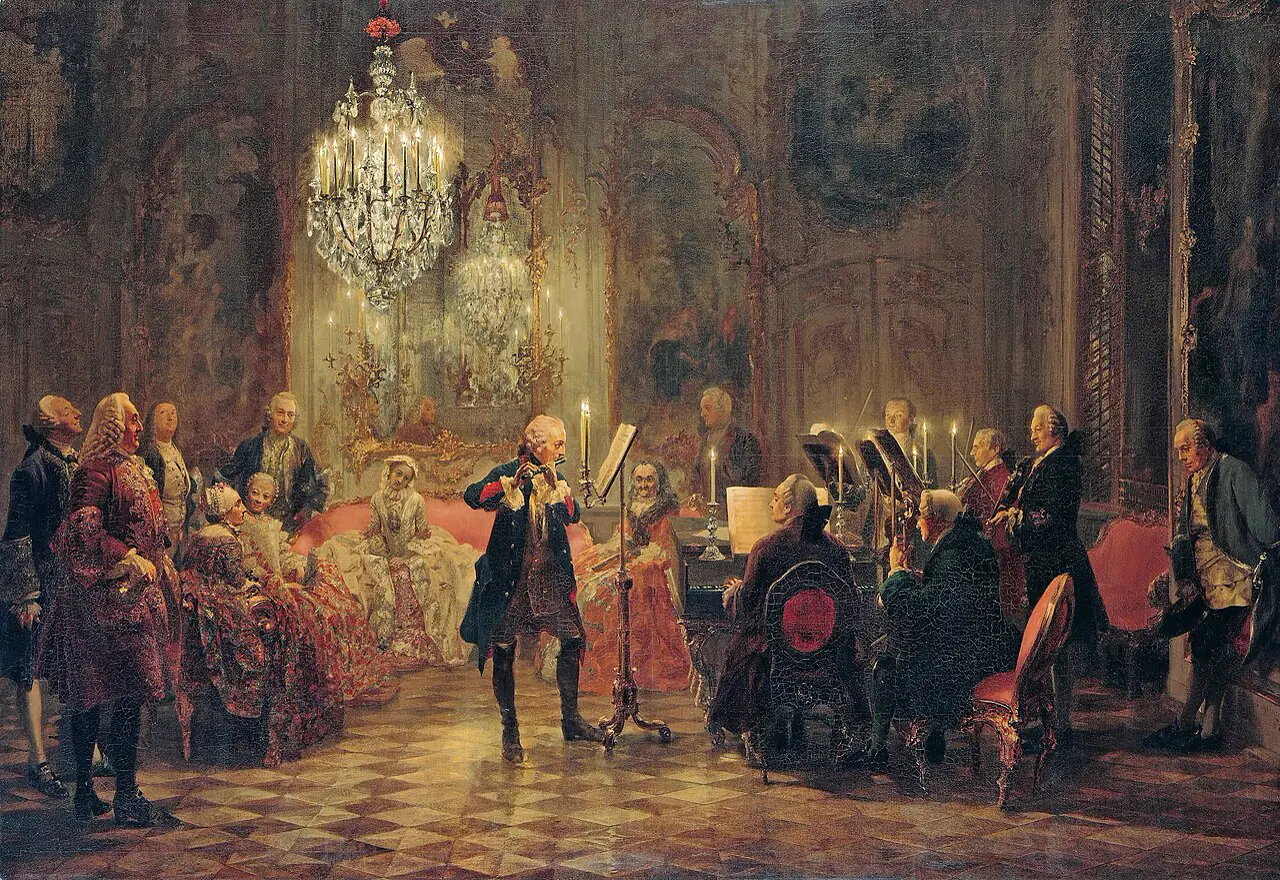
Adolph MenzelFlute Concert of Frederick the Great at Sanssouci, 1850–52Oil on canvas · Alte Nationalgalerie, Berlin
Menzel’s nineteenth-century reconstruction puts Frederick at the centre of the room and Bach at the harpsichord, watching him. For nearly three decades Bach’s job was to supply the accompaniment while his employer played the flute. The candlelight in the picture belongs to Menzel’s staging of the Prussian past.
Christian Fürchtegott Gellert
Die Ehre Gottes aus der Natur — first stanza
1757
GermanDie Himmel rühmen des Ewigen Ehre,
Ihr Schall pflanzt seinen Namen fort.
Ihn rühmt der Erdkreis, ihn preisen die Meere;
Vernimm, o Mensch, ihr göttlich Wort!
Our translationThe heavens proclaim the Eternal’s honour;
their sound carries his name onwards.
The earth proclaims him, the seas praise him;
hear, human being, their divine word!
Gellert published these devotional poems in 1757; Bach published his settings of the whole collection the following year. In Die Ehre Gottes aus der Natur, the keyboard keeps moving while the singer holds longer notes. Gellert received a copy from Bach in March 1758. Beethoven later set six Gellert poems in Op. 48.
Carl Philipp Emanuel Bach
Versuch — the performer’s feeling
1753, Part I, chapter 3, §13
German proseIndem ein Musickus nicht anders rühren kan, er sey dann selbst gerührt; so muß er nothwendig sich selbst in alle Affecten setzen können, welche er bey seinen Zuhörern erregen will; er giebt ihnen seine Empfindungen zu verstehen und bewegt sie solchergestalt am besten zur Mit-Empfindung.
Our translationSince a musician cannot move others unless he is himself moved, he must necessarily be able to put himself into all the states of feeling that he wishes to arouse in his listeners; he makes his feelings understood by them and in this way moves them most effectively to share those feelings.
In the passages that follow, Bach asked the player to become sad in sorrowful music and to change when the mood changed. He also defended appropriate facial expression, holding that to sit like a carved figure at the keyboard was no virtue.
Recommended recordings
Six String Symphonies, Wq 182The English Concert, Trevor PinnockArchiv ProduktionThe best short introduction to Bach’s orchestral writing. Pinnock keeps the attacks exact, the slow movement of the B♭ major symphony sounds improvised, and the finale of the B minor symphony is played with sharp attack.
The Solo Keyboard MusicMiklós SpányiBISThe clavichord volumes are the most valuable part of the set. The clavichord has a small sound, capable of fine distinctions. Volume 12 places sonatas among character pieces, including La Prinzette and L’Aly Rupalich.
Lineage
Drew fromJohann Sebastian BachGeorg Philipp TelemannGerman rhetorical and devotional traditions
Haydn learnt from the sonatas at his own keyboard; Beethoven was still requesting Emanuel’s works from Breitkopf & Härtel in July 1809. The Essay taught fingering, the accompaniment of singers and the treatment of dissonance to readers Bach never met.
Free Wotquenne–Helm concordance, catalogue index and chronological work-list.
Carl Philipp Emanuel Bach, Essay on the True Manner of Playing the Clavier, translated by Tobias Plebuch and Derek Remeš, edited by Mark W. Knoll (Packard Humanities Institute, online edition, n.d.; accessed 16 October 2026). study
Free parallel German–English text with musical examples on fingering, ornamentation, performance and accompaniment.
Cite this page
Contrapunctus. “Carl Philipp Emanuel Bach.” Accessed 20 October 2026. https://mottopanikeiku.github.io/contrapunctus/composers/cpe-bach.html.
@misc{contrapunctus-composers-cpe-bach,
  author = {{Contrapunctus}},
  title = {Carl Philipp Emanuel Bach},
  howpublished = {\url{https://mottopanikeiku.github.io/contrapunctus/composers/cpe-bach.html}},
  note = {Accessed 2026-10-20}
}