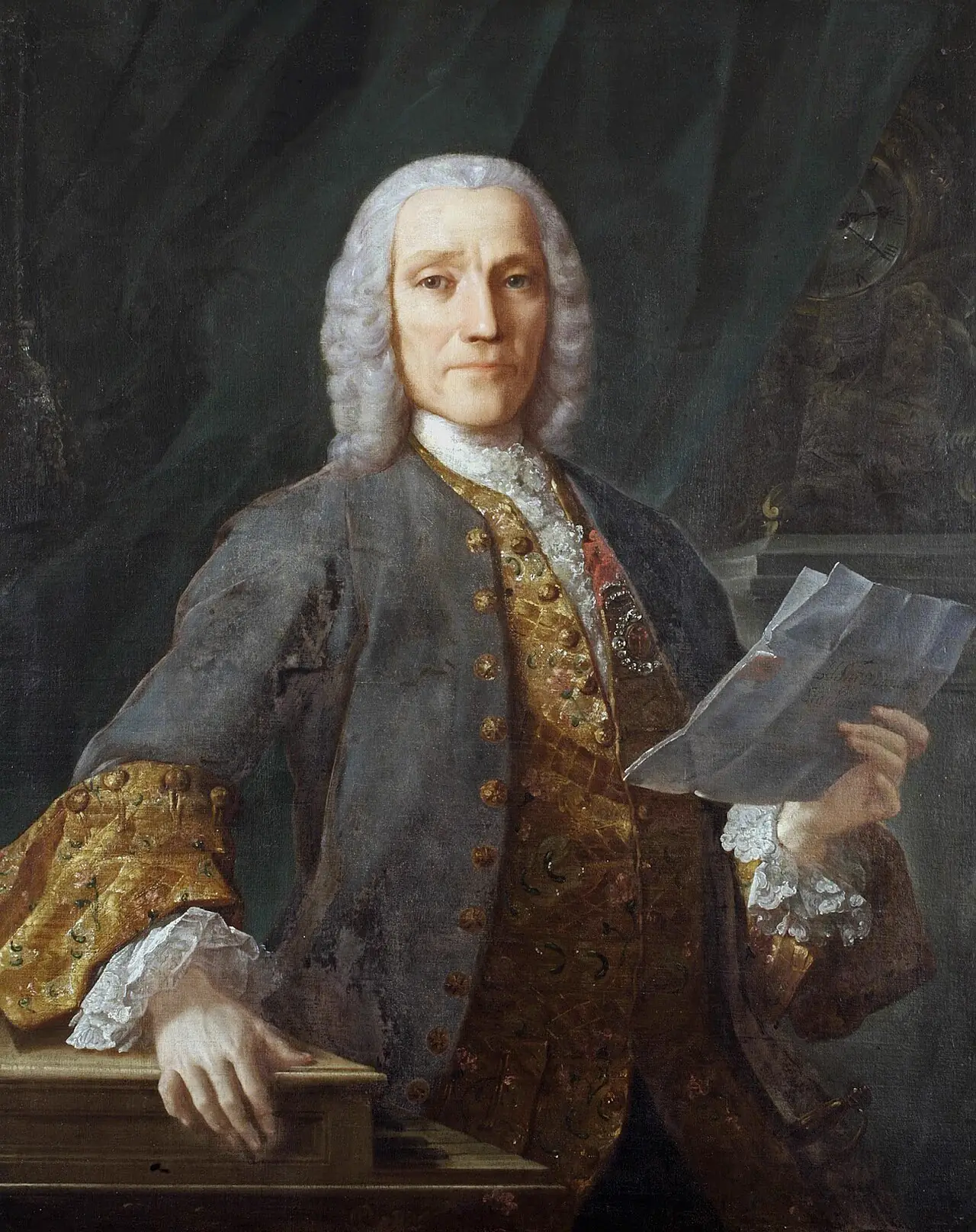
Alessandro Scarlatti’s sixth child; born in 1685, the year of Bach and Handel
Pupil
Maria Bárbara of Portugal, later Queen of Spain; he served her until his death
Courts
Naples and Rome; Lisbon from 1719; Spain from 1729
Sonatas
555 in Ralph Kirkpatrick’s catalogue; most survive in manuscript copies
Life
On 30 May 1705 Alessandro Scarlatti wrote to Ferdinando de’ Medici about his nineteen-year-old son Domenico: “This son is an eagle whose wings have grown; he must not idle in the nest, and I must not prevent his flight.” Domenico already held a post as organist at the royal chapel in Naples and had written operas. His father sent him north towards Venice, by way of Florence, with this recommendation. Domenico later settled much farther from home, as teacher to a Portuguese princess whose marriage took them both to Spain.
ItalyNaples, Rome and the Stabat Mater
Domenico was born in Naples on 26 October 1685, the same year as J. S. Bach and Handel, the sixth of Alessandro’s ten children. His family included singers as well as composers, and several of them worked in opera. He became a salaried royal organist at fifteen. In Rome he served Maria Casimira, the widowed Queen of Poland, who maintained a theatre in her Palazzo Zuccari. Scarlatti supplied her with seven operas between 1710 and 1714, working with the poet Carlo Sigismondo Capece and the stage designer Filippo Juvarra.
At St Peter’s he became assistant director of the Cappella Giulia in 1713 and its head the following year. The Stabat Mater is written for ten independent voices. They sing together in the passages about the grieving mother, then divide into smaller groups. At “Inflammatus et accensus” a tenor begins a long melisma, which the other voices take up in turn. The final ‘Amen’ changes pace again and ends in a fast triple time.
Lisbon and SpainMaria Bárbara
He arrived in Lisbon on 29 November 1719. João V had been waiting impatiently for him, and Queen Maria Anna accompanied him at the keyboard while he sang. His duties included teaching the king’s brother António and his daughter Maria Bárbara. The princess became an exceptional keyboard player. The association that began with these lessons lasted for the rest of Scarlatti’s life, through her marriage, her accession to the Spanish throne and the accumulation of hundreds of sonatas.
Maria Bárbara married the future Ferdinand VI in 1729. Scarlatti joined her in Spain later that year, first at Seville, where the court remained until 1733, then in Madrid and the royal residences around it. In Portugal he had directed court music. In Spain his work centred on the princess’s private music-making. She was his pupil, owned harpsichords and early pianos, and assembled a substantial music library.
In K. 141 in D minor the harpsichord plays rapidly repeated notes, so that each string is plucked again before it has stopped vibrating. Elsewhere, chords thicken until neighbouring notes clash; bass notes are held while the harmony above them changes. These sounds have close parallels in Iberian guitar playing and dance. The D major K. 119 goes furthest in this direction: large clusters of notes interrupt the flow and give the instrument a rougher sound.
Two halvesBinary form in Scarlatti’s sonatas
Within those two halves Scarlatti allowed himself wide freedom. A phrase may be repeated many times over, then dropped for material that does not resemble what came before. The hands may begin by answering one another and end by playing in the same stretch of keyboard. In K. 27 they cross, so that one arm moves above the hand that goes on playing below it. Bass and treble lie far apart, and the crossing hand has to reach its notes in time.
In the sonatas, the closing passage of the first half often returns near the end of the second, now in the home key. Ralph Kirkpatrick called the point from which the two halves follow their corresponding closing courses the ‘crux’. It can be a more useful landmark than the return of the opening tune. Scarlatti was under no obligation to bring the opening tune back.
The slow pieces ask different things of the hands. In K. 87 in B minor, close-set voices move by small steps, one holding a note while another forms a dissonance against it. The hands start close together. K. 208 in A major is marked Adagio e cantabile. Its decorated melody is set above an accompaniment, in the manner of a solo voice. K. 466 in F minor moves through a succession of cadences, each with a different harmony.
The reader and the queenEssercizi per gravicembalo, London, 1738–39
Thirty sonatas reached print in London in 1738–39 as the Essercizi per gravicembalo, dedicated to João V. In his preface Scarlatti addressed amateurs and professionals together, offering “art’s ingenious play” to help them towards fluency at the harpsichord. He asked his reader to be “more human than critical” and signed off with “Vivi felice” — “Live happily”. The collection closes with K. 30, a fugue whose oddly spaced opening notes later earned it the nickname ‘Cat’s Fugue’.
The great manuscript collections were a more private undertaking. Volumes were copied in 1742 and 1749, followed in the 1750s by the two extensive sets now in Venice and Parma. Many sonatas stand beside a companion in the same key. Farinelli, who had joined the Spanish court in 1737, inherited music from the queen’s collection and brought the manuscripts to Italy. Scarlatti died in Madrid on 23 July 1757. Maria Bárbara survived him by little more than a year, and she and the king had secured pensions for his widow and children.
Places
Every recorded place, joined in date order. Scarlatti on the MapAll 14 places, with sources
Naples · 26 October 1685 – 1705 · born
Sixth of ten children of Alessandro Scarlatti; organist and composer at the Chapel Royal from 1701; first operas, 1703.
In K. 27 the hands cross. One hand keeps playing while the other passes over it to reach a distant note, so that bass and treble answer each other across a wide gap. The player has to cover the distance without disturbing the pulse.
𝄋The return home
Most sonatas have two repeated halves. Their endings often correspond: music that first established a new key returns to establish the home key. Between these arrivals Scarlatti can dwell on a phrase, cut it short or take an unusual harmonic detour. Late in the sonata, a passage already heard returns in a different key.
𝅘𝅥A repeated note
K. 141 is in D minor and is built on rapid repetitions of a single pitch. Each attack renews the harpsichord’s fading sound, and changing fingers keeps the chain of notes moving. Below the repeated notes are solid chords.
♮Crowded chords
K. 119 in D major fills the hands with thick chords and dissonant notes. The dissonances sound at the moment the strings are plucked, and a hard edge remains audible after the sound has begun to die. The sonata uses guitar-like strumming and sudden changes from a single line to a fistful of harmony.
𝆏Space for a voice
K. 208 is marked Adagio e cantabile, a slow tempo with a singing line, and its ornaments are part of the melody. K. 87 is written in several voices set close together, with held notes sounding against the notes next to them. K. 208 has a single melodic line over accompaniment, and K. 87 divides its material among several voices.
Works
A selection from the composer’s works.
Early eighteenth century
Stabat MaterTen voices and continuo
The four soprano parts give the upper voices unusual scope to combine and divide. Near the end, a tenor run at “Inflammatus et accensus” passes through the ensemble.
Published 1738–39
Essercizi per gravicembaloK. 1–30Keyboard
The thirty sonatas dedicated to João V include the pastoral D minor K. 9 and end with the G minor fugue K. 30. Scarlatti’s preface addressed amateur and professional players on equal terms.
A schematic of repeated-note playing, for comparison with K. 141. Six semiquavers fill each 3/8 bar; the last bar changes to longer notes and a leap. Each new bass chord changes the harmonic role of the note repeated above it.
Crossed handsLeft hand in two distant registers
A schematic of hand crossing. The right hand plays its tune in the middle of the keyboard. The left alternates a low bass note with a note above the right hand, making a large leap while the tune continues.
Sister arts
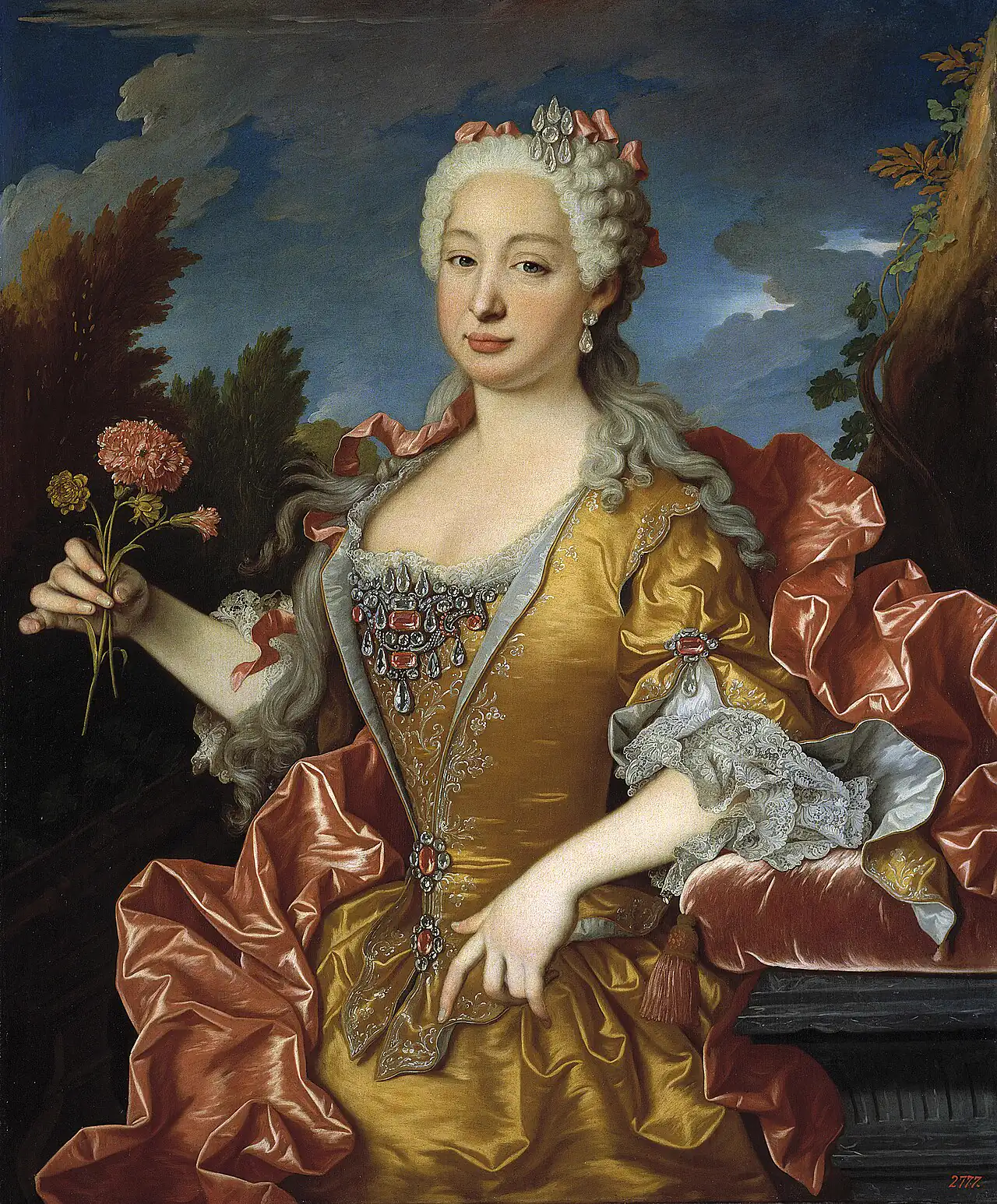
Jean RancBárbara de Braganza as Princess of Asturias, c. 1729Oil on canvas · Museo Nacional del Prado, Madrid
Ranc painted Maria Bárbara around the time of her marriage to the Spanish heir in 1729. She had already had years of lessons with Scarlatti and took her teacher into her new household. She later owned the sonata manuscripts now divided between Venice and Parma.
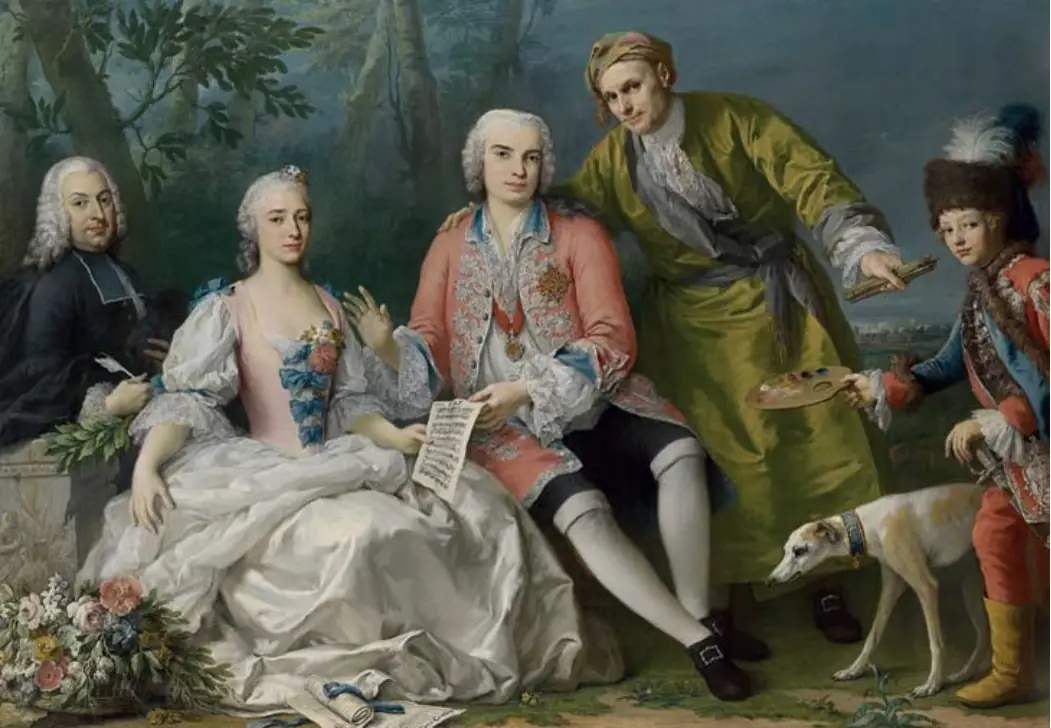
Jacopo AmigoniPortrait group: The singer Farinelli and friends, c. 1750–52Oil on canvas · National Gallery of Victoria, Melbourne
Farinelli appears with the singer Teresa Castellini, the poet Metastasio and Amigoni himself. Castellini was leaving Madrid for Italy, and the painting marks the friendship at that point. The dog wears Farinelli’s initials on its collar. He and Scarlatti served the same royal household, and he later carried the queen’s sonata manuscripts back to Italy. The NGV’s account identifies the sitters.
Domenico Scarlatti
To the reader of the Essercizi — opening sentence
1738–39
ItalianNon aspettarti, o dilettante o professor che tu sia, in questi componimenti il profondo intendimento, ma bensì lo scherzo ingegnoso dell’arte, per addestrarti alla franchezza sul gravicembalo.
Our translationAmateur or professional, expect in these compositions no learned exposition, but art’s ingenious play, to train you in fluency at the harpsichord.
Scarlatti addressed the preface to anyone prepared to sit down and play. The thirty pieces that follow demand considerable skill, and the preface ends ‘Vivi felice’, ‘Live happily’. Scarlatti wrote it for his first readers in London in 1738–39. The Italian is transcribed in the Treccani account; spelling and capitalisation are normalised here.
Recommended recordings
Complete keyboard sonatasScott Ross, harpsichordErato · 1984–85The complete set of 555 sonatas, played with rhythmic spring. Ross gives the unfamiliar works the same care as the recital favourites.
Selected sonatasPierre Hantaï, harpsichordMirareFor a more forceful Scarlatti. Hantaï brings out the music’s brashness, and the clear, open recorded sound of his first Mirare volume gives the repeated notes a hard attack while keeping the quick passages clean.
The Celebrated Scarlatti RecordingsVladimir Horowitz, pianoSony ClassicalThe sonatas played on the piano: eighteen of them, from K. 466 in F minor to K. 39 in A major. Horowitz’s touch moves between delicacy and danger.
Lineage
Drew fromAlessandro ScarlattiItalian vocal writingIberian dance and plucked-string traditions
Scarlatti
Passed toAntonio SolerClementi and the keyboard study traditionVladimir HorowitzScott Ross
The slow sonatas show the influence of Alessandro’s world of singers, alongside the guitar-like chords of Domenico’s Iberian years. Antonio Soler worked in the same Spanish court world; his precise apprenticeship with Scarlatti is uncertain. Clementi helped bring the sonatas into print for later keyboard players. Horowitz played selected pieces on the piano, and Scott Ross recorded all 555.
Further reading
Ralph Kirkpatrick, Domenico Scarlatti (Princeton University Press, 2020 reissue). biography
Biography and source study underlying the Kirkpatrick catalogue numbers.
Malcolm Boyd and Roberto Pagano, ‘Scarlatti, (Giuseppe) Domenico’, Grove Music Online (Oxford University Press, 2001). reference
Biographical reference, work-list and bibliography; subscription required.