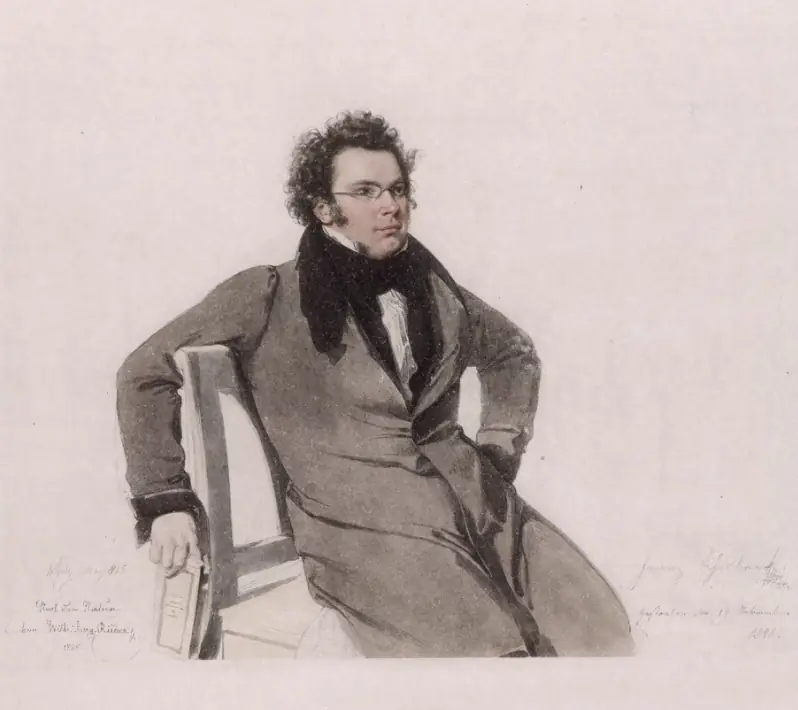
Vienna Stadtkonvikt, 1808–13; composition lessons with Antonio Salieri
At work
School assistant; tutor to the Esterházy daughters at Zseliz in 1818 and 1824; independent composer
Friends
The singer Vogl, the poets Schober and Mayrhofer, the painter Schwind, Josef von Spaun
Output
More than 600 songs; symphonies, chamber music, piano sonatas and duets, masses and stage works
“I like these songs more than all the others, and you will come to like them too.”
Life
In the Schubert family quartet, Franz played the viola, his brothers the violins and his father the cello. He was born on 31 January 1797 in Himmelpfortgrund, a Viennese suburb, and grew up in his father’s schoolhouse. His father taught him violin, his brother Ignaz piano, and the parish musician Michael Holzer taught him further. At eleven he entered the imperial chapel choir and the Stadtkonvikt boarding school, where he played Haydn, Mozart and Beethoven in the school orchestra.
Salieri began teaching him composition in 1812. The next year Schubert left the boarding school, trained as a teacher and returned to his father’s classroom as an assistant. On 19 October 1814, aged seventeen, he wrote Gretchen am Spinnrade. In the piano part the right hand imitates the spinning wheel and the left hand the treadle, while Goethe’s Gretchen sings of her thoughts of Faust. At the point where she recalls his kiss, the accompaniment figure stops. The following year brought roughly 140 songs, among them Erlkönig, as well as church music, a symphony and works for the stage.
1816–21Schubert’s circle of friends
Franz von Schober offered him somewhere to live, which helped him give up schoolteaching. Josef von Spaun, a friend from the Stadtkonvikt, found people willing to help. The poet Johann Mayrhofer shared rooms with him from 1818 to 1820 and supplied words for songs. Moritz von Schwind drew portraits of the circle. In 1817 Schober introduced him to the opera singer Johann Michael Vogl, a professional who could perform Schubert’s songs in houses the composer could not easily get into on his own.
These friends gave practical help. They supplied manuscript paper, lodging and introductions, and in 1821 they raised the subscriptions that paid for Erlkönig to be published as Op. 1. A few songs had already appeared in newspapers and almanacs, and this was the first serious attempt to sell them. Vogl sang and Schubert played. In Erlkönig one singer takes the parts of the father, the child, the narrator and the seductive apparition, while the pianist plays the same galloping triplets beneath all of them.
In the summers of 1818 and 1824 Schubert went to Zseliz, now Želiezovce in Slovakia, to teach Count Johann Karl Esterházy’s daughters. Four-hand piano music, for two players at one keyboard, was suited to this household. He also continued to write operas. Alfonso und Estrella, with a libretto by Schober, and Fierrabras were not staged in his lifetime. The play Rosamunde had two performances in December 1823. Its incidental music survived the play, and one of its tunes was used again in the A minor Quartet and in a set of piano variations.
In 1819 he went to Steyr in Upper Austria with Vogl. Sylvester Paumgartner, assistant manager of the iron mines there and an amateur cellist, took a particular liking to Die Forelle and asked for a quintet laid out like Hummel’s new one. “Schubert soon finished the piece and kept the field to himself,” his friend Albert Stadler recalled to the biographer Ferdinand Luib in the late 1850s.
1822–24The B minor Symphony and illness
The B minor Symphony of 1822 begins with cellos and basses alone, low and quiet. Over the strings, oboe and clarinet introduce the first long melody; later, a new cello tune in G major is interrupted by a silence and a loud outburst from the full orchestra. Schubert finished two movements and began a scherzo, then put the score aside. He had six years left to live. In the same year he completed the Wanderer Fantasy, which joins four sections through the rhythm of one of his songs and ends with a fugue that is very demanding for the pianist.
Schubert composed Die schöne Müllerin in 1823, during a serious illness. A young miller follows a brook to work and falls in love with the miller’s daughter; a huntsman takes her away. Schubert chose twenty poems from Wilhelm Müller’s sequence, leaving out the poet’s framing prologue and epilogue. In the last song the brook takes the singer’s place and sings a lullaby over the drowned young man.
On 31 March 1824 he wrote to the painter Leopold Kupelwieser in Rome of a man “whose brightest hopes have come to nothing”. Later in the same letter he set out his plans. He had written two quartets and an octet and wanted to write another quartet: “In this way I want to clear myself a path towards a great symphony.” The A minor and D minor quartets were part of that plan. The D minor quartet, Death and the Maiden, takes up for four strings the slow repeated chords from the introduction to his 1817 song.
1825–27The Great C major and Winterreise
In 1825 Schubert travelled through Upper Austria with Vogl, singing and playing for friends and hosts. He worked on the C major Symphony in 1825–26. Two horns begin it with a melody that returns, much enlarged, at the end of the first movement. Three trombones are part of the orchestra throughout, sometimes with their own lines. He sent the score to the Gesellschaft der Musikfreunde, which paid him for it. The public performance that established the “Great” C major took place in Leipzig in 1839, eleven years after his death.
In 1827 he returned to Müller for Winterreise. He first came across twelve poems in the almanac Urania and set them as a complete cycle. Later he found twelve more, interleaved among the original poems, and added his new settings after the first group. The walker leaves his sweetheart’s house at night, passes the frozen river and mistakes a graveyard for an inn. The piano keeps up a walking figure. In Der Lindenbaum, the memory of shelter under the tree is set in E major and the cold night in E minor.
When Schubert sang the new songs to his friends at Schober’s, Josef von Spaun remembered them sitting bewildered by the gloom. Schober liked only Der Lindenbaum. Schubert answered, “I like these songs more than all the others, and you will come to like them too.” At the end of the completed cycle, a barefoot hurdy-gurdy player stands beyond the village. The piano repeats a bare fifth. The singer asks whether the old man will accompany his songs, and gets no reply.
1828Last works and death
Schubert carried a torch at Beethoven’s funeral in March 1827. On 26 March 1828, the anniversary of Beethoven’s death, he gave a public concert of his own music. It was a success and made money. During that year he wrote the E♭ Mass, the F minor Fantasy for piano duet, the last three piano sonatas and the C major String Quintet. The quintet adds a second cello; in the first movement the two cellos play the second theme together. In the Adagio, the middle three instruments sustain the tune while the outer two play around it.
On 2 October he offered the sonatas, Heine songs and quintet to Heinrich Albert Probst in Leipzig. “I have played the sonatas in several places to much applause,” he wrote; the quintet was still awaiting a trial. Early in November he took a counterpoint lesson with Simon Sechter. He died at his brother Ferdinand’s home on 19 November, aged thirty-one, and was buried near Beethoven at Währing. Both graves were moved to the Central Cemetery in 1888.
Several of his major works reached the public after his death. Schumann helped bring the C major Symphony to Mendelssohn, who conducted it in 1839; reviewing it in 1840, Schumann praised its “heavenly length”. The String Quintet reached the public in 1850. Johann Herbeck conducted the “Unfinished” in Vienna in December 1865, forty-three years after Schubert had stopped work on it.
Places
Every recorded place, joined in date order. Schubert on the MapAll 15 places, with sources
Himmelpfortgrund, Vienna · 31 January 1797 – November 1808 · born
Born in the suburb, to a schoolmaster; schooled at Lichtental, where Holzer, the parish choirmaster, taught him.
In Erlkönig, one singer takes four parts while the pianist keeps up a gallop that continues without a break. In Die schöne Müllerin, the brook’s accompaniment runs beside the young miller long before the brook sings him to sleep. Schubert often gives the piano information the singer does not yet have, and the bars after the voice stops can alter the meaning of a song. Song also supplied material for his instrumental music. The Trout Quintet, the Death and the Maiden Quartet and the Wanderer Fantasy each take material from an earlier Lied.
𝅘𝅥A wheel, a horse, a drone
In many songs the accompaniment establishes the setting before the voice enters. Gretchen am Spinnrade has turning semiquavers and Erlkönig repeated triplets. At Gretchen’s remembered kiss the semiquavers stop, and when they start again they do so haltingly. At the other end of Schubert’s life, Der Leiermann reduces the piano to a bare fifth and a short repeated figure.
♮Major and minor
In Der Lindenbaum, the tree and the shelter it once promised are set in E major. The night wind brings E minor. Schubert changes the same tune from major to minor by altering a single note of its chord. He also moves readily between keys a third apart: in the C major Quintet the second theme begins in E♭, played by the two cellos together.
𝄋Length and pacing
The opening tune of the “Great” C major Symphony, first played by the horns, returns near the end of the first movement in the full orchestra. In the B♭ Sonata, taking the exposition repeat also means playing a disturbing first-time passage that is otherwise lost.
𝄾Walking
Gute Nacht begins with steady piano chords before the voice enters. This walking motion returns through Winterreise, sometimes slowed, sometimes driven and angry. The major key often goes with a remembered happiness or a dream of spring. In Der Leiermann the player stands still beyond the village, and the turning wheel of his hurdy-gurdy replaces the footsteps.
𝄢Melody and instrumentation
The “Trout” Quintet puts a double bass beneath the cello, which leaves the piano free to play higher up. The C major String Quintet adds a second cello. In its Adagio, second violin, viola and first cello play the long melody, while first violin and second cello, plucking, play around it. When the opening returns after the F minor middle section, the outer parts are more active than before.
Works
A selection from the composer’s works.
1814–15
Gretchen am Spinnrade · ErlkönigD. 118 · D. 328Voice and piano; poems by Goethe
The spinning-wheel figure in the D minor Gretchen stops at the remembered kiss. In the G minor Erlkönig, the piano’s triplets accompany four characters, a narrator, father, child and tempter, all sung by one singer.
1819
Piano Quintet in A major “Trout”D. 667Piano, violin, viola, cello and double bass
Written for Sylvester Paumgartner’s circle in Steyr, following the layout of Hummel’s new quintet, with a double bass below the cello. The fourth movement is a set of variations on Die Forelle; the song’s rippling piano figure does not appear until the last variation.
1822
Symphony in B minor “Unfinished”D. 759Orchestra
Two finished movements and the beginning of a scherzo survive. Johann Herbeck conducted the first public performance in December 1865, long after Schubert had become famous for his songs.
1822
Wanderer Fantasy in C majorD. 760Piano
The song Der Wanderer supplies the C♯ minor Adagio and the long–short–short rhythm that runs through four linked sections. Liszt later made a version for piano and orchestra.
1823
Die schöne Müllerin (The Fair Maid of the Mill)D. 795Voice and piano; twenty poems by Wilhelm Müller
A young miller follows a brook, falls in love and becomes jealous. Schubert left out Müller’s framing prologue and epilogue. The cycle ends with the brook’s lullaby over the young man’s death.
1824
String Quartet in D minor “Death and the Maiden”D. 810Two violins, viola and cello
The slow movement varies the repeated chords from Schubert’s earlier song of the same name. All four movements begin in minor keys; the finale is a tarantella.
1825–26
Symphony in C major “Great”D. 944Orchestra, including three trombones
The opening horn melody returns in the coda of the first movement. Three trombones play throughout the symphony; the manuscript is dated March 1828, after the main work of 1825–26.
1827
WinterreiseD. 911Voice and piano; twenty-four poems by Wilhelm Müller
Schubert set twelve poems in February, then added twelve more in the autumn. The walking chords of Gute Nacht are eventually reduced to a hurdy-gurdy’s bare fifth in Der Leiermann.
Two sets of ImpromptusD. 899 · D. 935Piano; four pieces in each set
The G♭ major melody of D. 899 No. 3 is played over unbroken arpeggios; D. 935 No. 3 varies a tune from Rosamunde. Only the first two pieces of D. 899 were published in his lifetime.
1828
Schwanengesang (Swansong)D. 957 · D. 965aVoice and piano; poems by Ludwig Rellstab, Heinrich Heine and Johann Gabriel Seidl
Haslinger assembled and named the collection after Schubert’s death. In Heine’s Der Doppelgänger, a man recognises himself in the figure grieving outside his former sweetheart’s house.
The Adagio, in E major, breaks into F minor; the C major scherzo is interrupted by a slow trio in D♭ major. The first public performance took place in 1850.
The opening tune has a low G♭ trill, and the slow movement is in the distant key of C♯ minor. In the finale a single G repeatedly stops the music.
In the score
Short examples, engraved and playable.
Erlkönig, D. 328 — accompaniment schematicTriplets on every beat
A schematic of the Erlkönig accompaniment. The repeated G octaves divide each beat into three strokes, and the held bass isolates that pulse. In the song, the left hand moves and the harmony changes beneath the four characters, who are all sung by one voice.
Der Leiermann, D. 911 No. 24 — harmonic schematicHurdy-gurdy open fifth
A schematic of the A–E drone in the published A minor version of Der Leiermann. The fifth has no third, so on its own it is neither major nor minor. This example leaves out the turning piano figure and the singer, and repeats the drone once a bar.
Harmony — a third-relation schematicC major to A♭ major by a common note
A schematic of two keys a major third apart. C major and A♭ major each receive their own dominant seventh. At the join, C is held while E falls to E♭ and G rises to A♭.
Sister arts
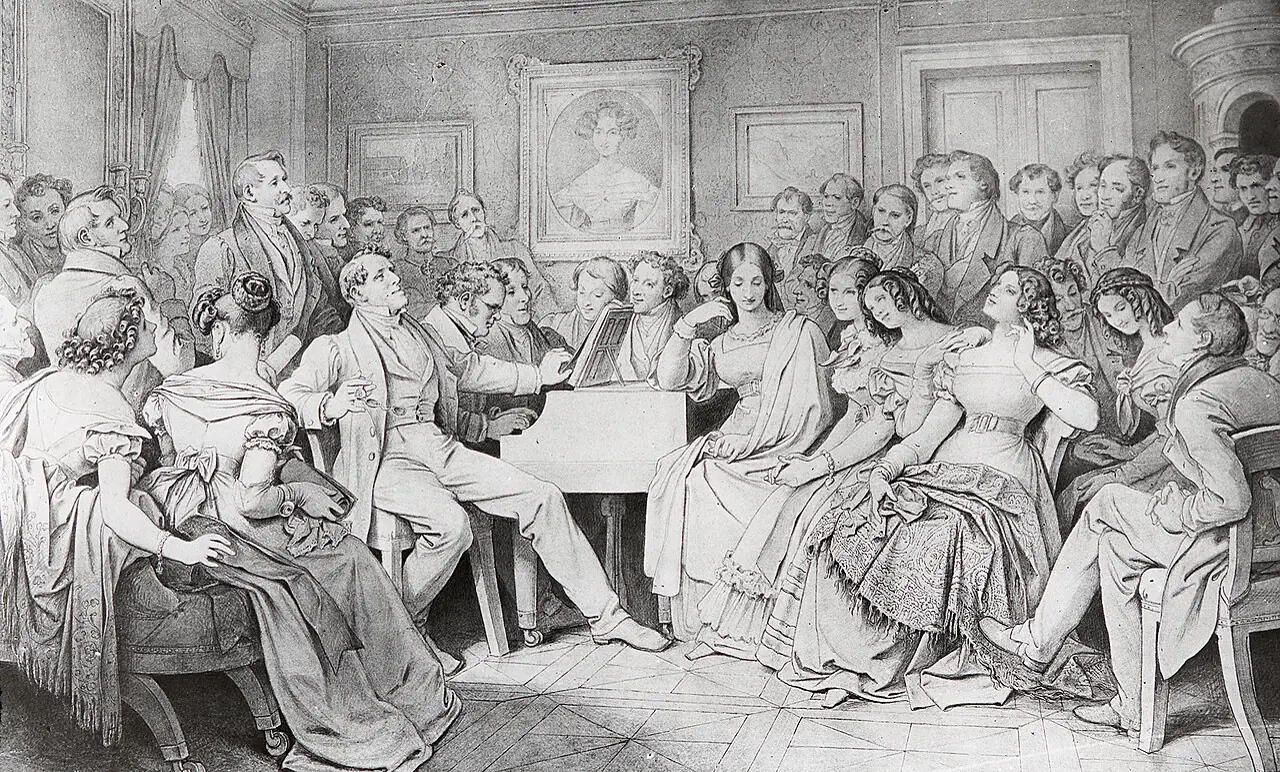
Moritz von SchwindEin Schubert-Abend bei Josef von Spaun (A Schubert Evening at Josef von Spaun’s), 1868Pencil, pen and ink with wash · Wien Museum, Vienna
Schwind, who had belonged to the circle, drew Schubert at the piano with Vogl beside him. Friends fill the room and lean towards the piano. He made the drawing in 1868, forty years after Schubert’s death.
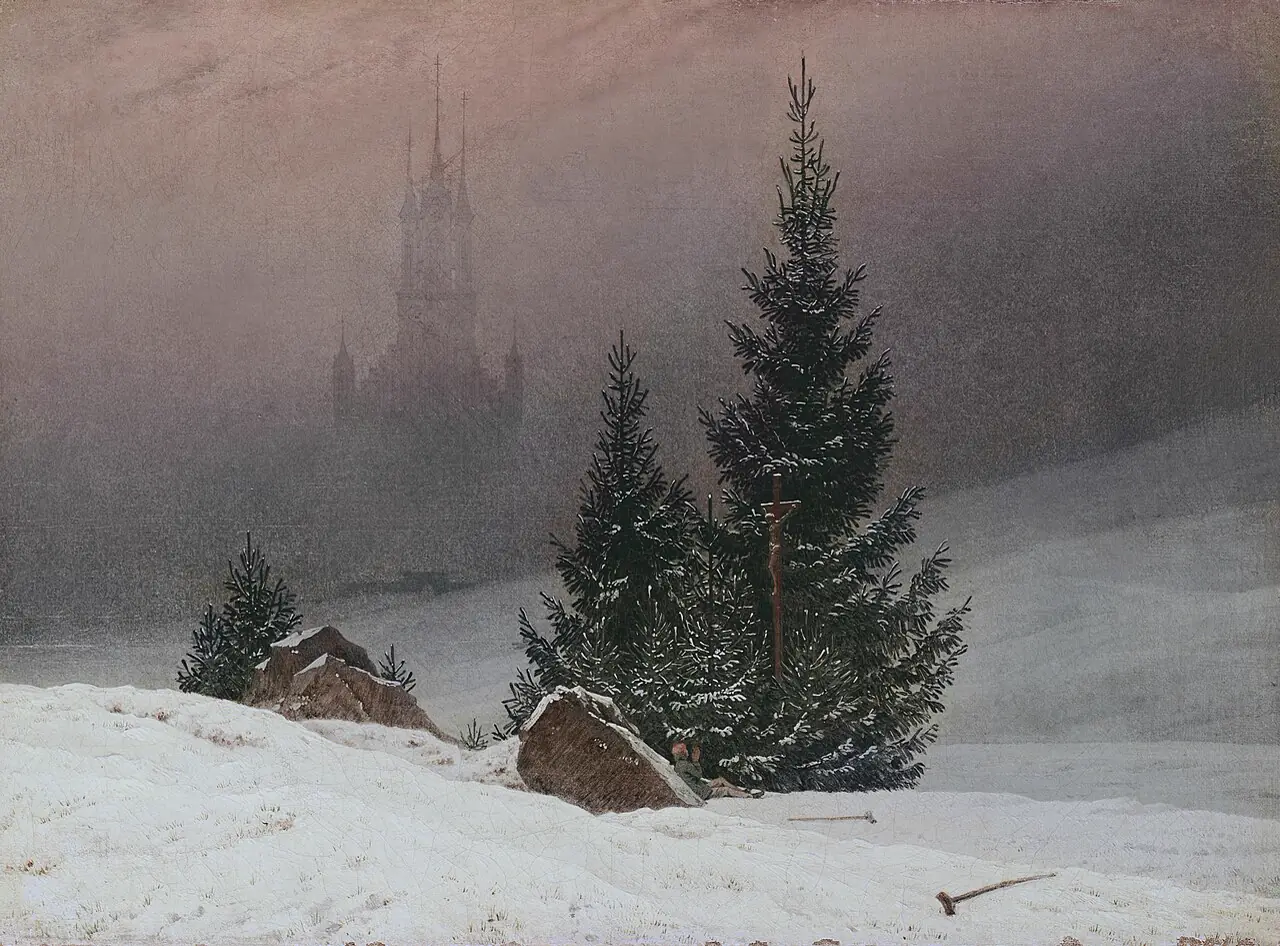
Caspar David FriedrichWinter Landscape, Probably 1811Oil on canvas · National Gallery, London
A man has set down his crutches in the snow and prays before a crucifix. Beyond the firs a church rises in the mist. The three firs around the crucifix recall the Trinity, and the National Gallery reads the picture as holding out the hope of resurrection through faith; a companion painting of the same date and title, in Schwerin, shows a figure with a crutch among dead oaks. In Winterreise the walker approaches a graveyard as an inn, and there is no room for him.
Wilhelm Müller
Der Leiermann — first and last stanzas
Published 1823; collected 1824; set by Schubert 1827
GermanDrüben hinter’m Dorfe
Steht ein Leiermann,
Und mit starren Fingern
Dreht er was er kann.
Wunderlicher Alter,
Soll ich mit dir gehn?
Willst zu meinen Liedern
Deine Leier drehn?
Our translationOver there beyond the village
stands a hurdy-gurdy player;
with stiffened fingers
he turns as hard as he can.
Strange old fellow,
am I to go with you?
Will you turn your hurdy-gurdy
to the songs I sing?
In Müller’s poem the old man stands barefoot on the ice, his plate empty, while the village dogs growl. The first and last stanzas are shown here. Schubert’s piano part imitates the hurdy-gurdy, a string instrument sounded by turning a handle. The poem ends with questions that receive no answer.
Recommended recordings
Winterreise, D. 911Peter Pears, tenor; Benjamin Britten, pianoDecca · 466 382-2 · 1963In their spring dream the awakening is frightening, and the final drone is bare. Recorded at Kingsway Hall in 1963 and released by Decca in 1965. Their heavily annotated scores survive at the Britten Pears archive.
“Unfinished” and “Great” C major symphoniesScottish Chamber Orchestra; Charles MackerrasTelarc · CD-80502 · 1998Natural horns, trumpets and trombones and a small string section are used in the C major Symphony, so the wind and trombone lines are heard clearly above the strings. Mackerras plays all the repeats and keeps the repeated rhythms light.
String Quintet in C major, D. 956Takács Quartet; Ralph Kirshbaum, celloHyperion · CDA67864 · 2012Recorded in May 2012 at Wyastone and coupled with the Quartettsatz, D. 703. In the Adagio the players vary bowing and phrasing in small ways through the long melody. The five players move directly into the F minor middle section without a change in ensemble sound.
Piano Sonata in B♭ major, D. 960Radu Lupu, pianoDecca · 440 295-2 · 1991Coupled with the A major Sonata, D. 664. Lupu plays the opening as a sustained melody and the low trill without added emphasis, and he takes the long exposition repeat with its first-time bars. In the C♯ minor slow movement he keeps the melody in the foreground and the accompaniment quieter beneath it.
Salieri taught him to set words, and in the school orchestra he came to know the music of Haydn, Mozart and Beethoven by playing it. Schumann helped bring the “Great” C major to performance, Liszt took the songs onto the concert platform in piano transcriptions, and Brahms edited the symphonies for the collected edition. Dvořák defended the instrumental music in his 1894 essay. Britten performed the songs with Peter Pears. Luciano Berio’s Rendering (1989–90) places his own music between the surviving passages of a late Schubert symphony sketch.
Further reading
Christopher H. Gibbs, The Life of Schubert (Cambridge: Cambridge University Press, 2000). biography
Concise biography reassessing Schubert’s public career and later biographical images.
Robert Winter, Maurice J. E. Brown and Eric Sams, ‘Schubert, Franz (i)’, Grove Music Online (Oxford University Press, 2001). reference
Biographical reference, work-list and bibliography; subscription required.