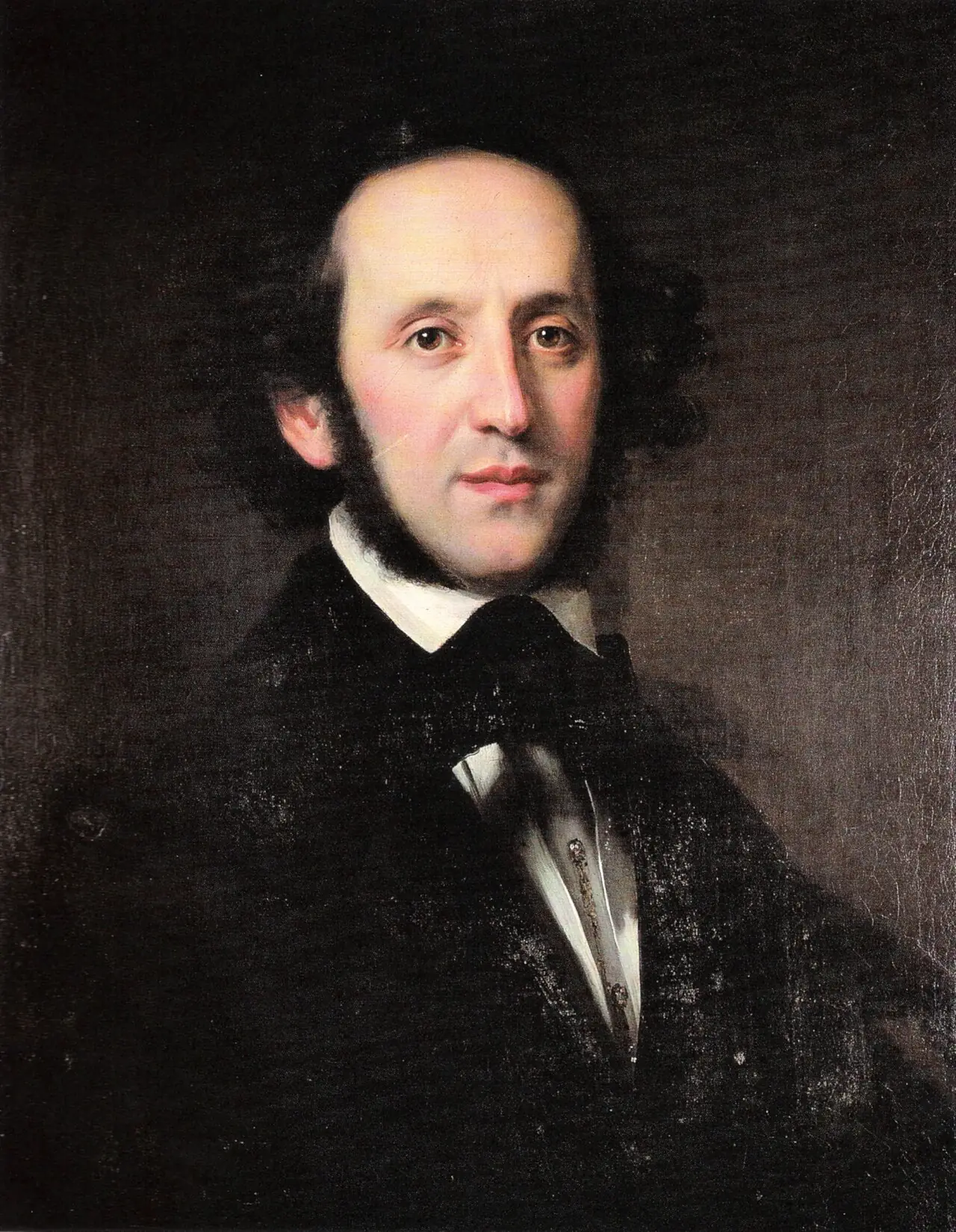
Ludwig Berger, piano; Carl Friedrich Zelter, composition
Posts
Düsseldorf music director, 1833–35; Leipzig Gewandhaus conductor from 1835
Family
Married Cécile Jeanrenaud in 1837; five children; brother of Fanny Hensel
Leipzig and Britain
Leipzig Conservatoire, founded 1843; ten visits to Britain
Life
In 1825 the sixteen-year-old Felix Mendelssohn wrote a birthday present for his violin teacher, Eduard Rietz. It was scored for four violins, two violas and two cellos, and gave Rietz a first-violin part that rises above the other seven players in long arcs. Eleven years later the composer played second viola in a public performance of the E♭ major Octet. Writing to Karl Klingemann on 31 January 1836, he admitted to “heart palpitations”.
BerlinFamily, teachers and early works
Felix Mendelssohn was born in Hamburg on 3 February 1809; the family moved to Berlin two years later. In 1812 his sister Fanny wrote to friends in Hamburg: “Felix has a strong voice and sings all day.” His father Abraham was a banker, his grandfather Moses the Jewish philosopher. Abraham and Lea Mendelssohn had their children baptised as Christians in 1816 and used the additional surname Bartholdy. Fanny and Felix learnt piano with Ludwig Berger and composition with Carl Friedrich Zelter.
The family’s money paid for players. At the family’s Sunday concerts the children heard their scores performed by experienced musicians. Felix wrote string symphonies and concertos at an age when most pupils were still learning to write a correct exercise. Zelter introduced him to Goethe in Weimar in 1821. His education also included drawing, languages and classical literature, and his German verse translation of a comedy by Terence was published in 1826.
The Octet’s scherzo is marked Allegro leggierissimo, as light as possible. Short detached notes pass between the players, and the movement ends high and quiet. In 1826 Mendelssohn used the same kind of writing in the overture to A Midsummer Night’s Dream, which he wrote at seventeen. It opens with four quiet wind chords, and then divided violins play fast in E minor. The lovers have melodic music, the tradesmen have heavier music, and Bottom’s donkey bray is imitated in the orchestra.
1829Bach and the British Isles
On 11 March 1829 he conducted Bach’s St Matthew Passion at the Berlin Sing-Akademie, with the actor and singer Eduard Devrient helping to organise the performance. The twenty-year-old had studied the score given to him by his grandmother Bella Salomon. He continued to work for earlier music in practical ways. He later brought Handel’s Israel in Egypt to Düsseldorf, programmed historical concerts in Leipzig and helped pay for a monument to Bach there.
That spring he made his first visit to Britain, playing and conducting in London before travelling through Scotland with Karl Klingemann. On 7 August, in Tobermory, he sent home a musical sketch of the low, falling phrase that begins The Hebrides. They visited Staffa and Fingal’s Cave the next day. The finished overture took several more years and revisions. The opening figure is first played quietly by bassoons and lower strings, and it stays audible as the rest of the orchestra enters and builds to full strength.
The “Italian” Symphony, prompted by his stay in Italy, had its first performance in London in 1833. The first movement is in A major; the final Saltarello is in A minor and ends in that key. Mendelssohn revised the score and never authorised its publication. The “Scottish”, begun in 1829, was completed in 1842. Its four movements are played without a break, and the finale moves from an Allegro in A minor to a broad closing section in A major.
1835–43At the Gewandhaus
After a frustrating period as music director in Düsseldorf, Mendelssohn took charge of the Gewandhaus concerts in Leipzig in 1835. In 1837 he married Cécile Jeanrenaud; they had five children. The orchestra, the household and his correspondence took time from composition. In March 1839 he conducted the first public performance of Schubert’s “Great” C major Symphony, whose manuscript Schumann had brought to his attention. In 1843 he founded the Leipzig Conservatoire, with Ferdinand David and Schumann among its teachers.
The D minor Piano Trio went through several rounds of revision. Mendelssohn completed a version in July 1839, rewrote it after a private performance, then revised the piano part again at Ferdinand Hiller’s urging. Further changes followed in the proofs. Mendelssohn himself played the piano part at the first public performance in February 1840, with David on violin and Carl Wittmann on cello.
The Songs without Words brought his music into domestic use. In each the melody is set over an accompaniment that a good amateur can often manage, though keeping the two distinct is harder. When Marc-André Souchay asked what particular pieces meant, Mendelssohn replied on 15 October 1842: “If you ask me what I was thinking, I say: precisely the song as it stands.”
1843–46Potsdam, Leipzig and Birmingham
Prussian court duties repeatedly drew him away from Leipzig. One result was the complete music for A Midsummer Night’s Dream, performed at Potsdam in October 1843, seventeen years after the overture. The new Nocturne set a horn melody beside two bassoons; the Wedding March added the trombones. At the end of the play the four wind chords from the opening of the overture returned.
The E minor Violin Concerto was finished in 1844 after years of discussion with David. The soloist enters near the start, plays the cadenza before the main theme returns, then continues in arpeggios beneath the orchestra. At the end of the movement a bassoon holds one note across the gap into the Andante. David gave the première in Leipzig in March 1845, with Niels Gade conducting.
St Paul, first performed in 1836, had already made Mendelssohn a favourite with choral societies. Elijah was first performed in Birmingham in August 1846, in William Bartholomew’s English translation. The chorus takes the part of a people suffering drought, calls on Baal and comments on the prophet’s fate. Mendelssohn continued to revise the work after the première, and the surviving performance materials contain replacement numbers and alterations in his own hand.
1847Fanny’s death and the F minor Quartet
Fanny died suddenly in Berlin on 14 May 1847. That summer Felix wrote the F minor String Quartet, Op. 80, a work of tremolos and fierce accents at odds with the gracious image attached to his name. His own health failed; after a series of strokes he died in Leipzig on 4 November, aged thirty-eight. Wagner’s later antisemitic attacks helped turn admiration into suspicion of an allegedly facile composer. Mendelssohn had left the “Italian” Symphony unpublished, still dissatisfied with a piece audiences loved.
Places
Every recorded place, joined in date order. Mendelssohn on the MapAll 22 places, with sources
Hamburg · 3 February 1809 – 1811 · born
Born in the independent city-state; the family moved to Berlin in 1811 for fear of French reprisals.
Studied with Zelter and Berger; wrote the Octet at sixteen and the Midsummer Night’s Dream overture at seventeen. String Octet; A Midsummer Night’s Dream overture.
The Scottish Symphony was first performed; the Violin Concerto followed on 13 March 1845, with David as soloist. Symphony No. 3 “Scottish”; Violin Concerto.
The Octet’s scherzo is fast and quiet, with detached notes passed between eight players. In A Midsummer Night’s Dream, the violins divide into four parts for the fairy music. Its lightness depends on short bow strokes and clean gaps.
𝄢Fugal writing
The finale of the Octet begins in the second cello, and its running theme passes upwards through the ensemble. With eight parts available, Mendelssohn could go on adding voices long after a quartet would be full. The scherzo returns later in the movement. The writing shows what Mendelssohn had learned from Bach. He wrote the Octet at the age of sixteen.
𝄋No empty pauses
In the Violin Concerto, the soloist is still playing arpeggios at the end of the cadenza when the theme returns. At the end of the movement, a bassoon holds its note after the rest of the orchestra has stopped and leads the music into C major.
𝅘𝅥Piano songs
In the first Song without Words, Op. 19b No. 1, melody and bass answer one another before the piece reaches a settled close. The tune’s phrases can lengthen at points where a cadence is expected. Across the collections, a pianist has to give the melody room without allowing its broken-chord accompaniment to lose the pulse.
♭Bright and dark
The “Italian” Symphony begins in A major and ends with a Saltarello in A minor, played at full speed. In this music minor keys are not used only for sadness. In A Midsummer Night’s Dream the strings of the fairy music enter in E minor after the E major chords of the winds.
Works
A selection from the composer’s works.
1825
Octet in E♭ majorOp. 20Four violins, two violas and two cellos
Mendelssohn wrote it at sixteen as a birthday present for his violin teacher, Eduard Rietz. The finale opens with a fugue that begins in the second cello, and later in the movement the scherzo returns.
1826; 1843
A Midsummer Night’s DreamOpp. 21 and 61Overture; later incidental music with voices and orchestra
The overture came seventeen years before the complete stage score. The later music includes the Nocturne, led by the horn, and the Wedding March.
1829–45
Songs without WordsPiano
Eight books of six piano songs; the final two books appeared after his death.
The opening phrase was sketched in Tobermory on 7 August 1829, before the visit to Fingal’s Cave. Several revisions lie between that page and the familiar B minor overture.
Symphony No. 4 in A major “Italian”Op. 90Orchestra
First performed in London under Mendelssohn in 1833, then withheld from publication. Its fast Saltarello ends in A minor.
1836
St PaulOp. 36Soloists, chorus and orchestra
First performed at the Lower Rhine Festival in Düsseldorf in 1836. Chorales and large contrapuntal choruses frame the story of Saul’s conversion.
1839
Piano Trio No. 1 in D minorOp. 49Piano, violin and cello
Repeatedly revised, including a more brilliant piano part encouraged by Ferdinand Hiller. Mendelssohn played at the public première in February 1840.
1842
Symphony No. 3 in A minor “Scottish”Op. 56Orchestra
Begun after the 1829 Scottish tour and completed thirteen years later. Mendelssohn asked for the four movements to be played without the usual pauses; the final song is in A major.
Written in consultation with Ferdinand David, who gave the première in 1845 under Niels Gade. The cadenza comes before the return of the first movement’s main theme.
First performed in English at Birmingham Town Hall on 26 August 1846. Mendelssohn revised it extensively before publication in 1847.
In the score
Short examples, engraved and playable.
The Hebrides · opening barFalling figure in the low register
Quoted from bar 1 of The Hebrides, at sounding pitch, then repeated. After a quaver rest, F♯ falls towards B through D and the brief C♯–D turn, then drops to the lower F♯. Bassoons and lower strings introduce the phrase. Notation source.
Sister arts
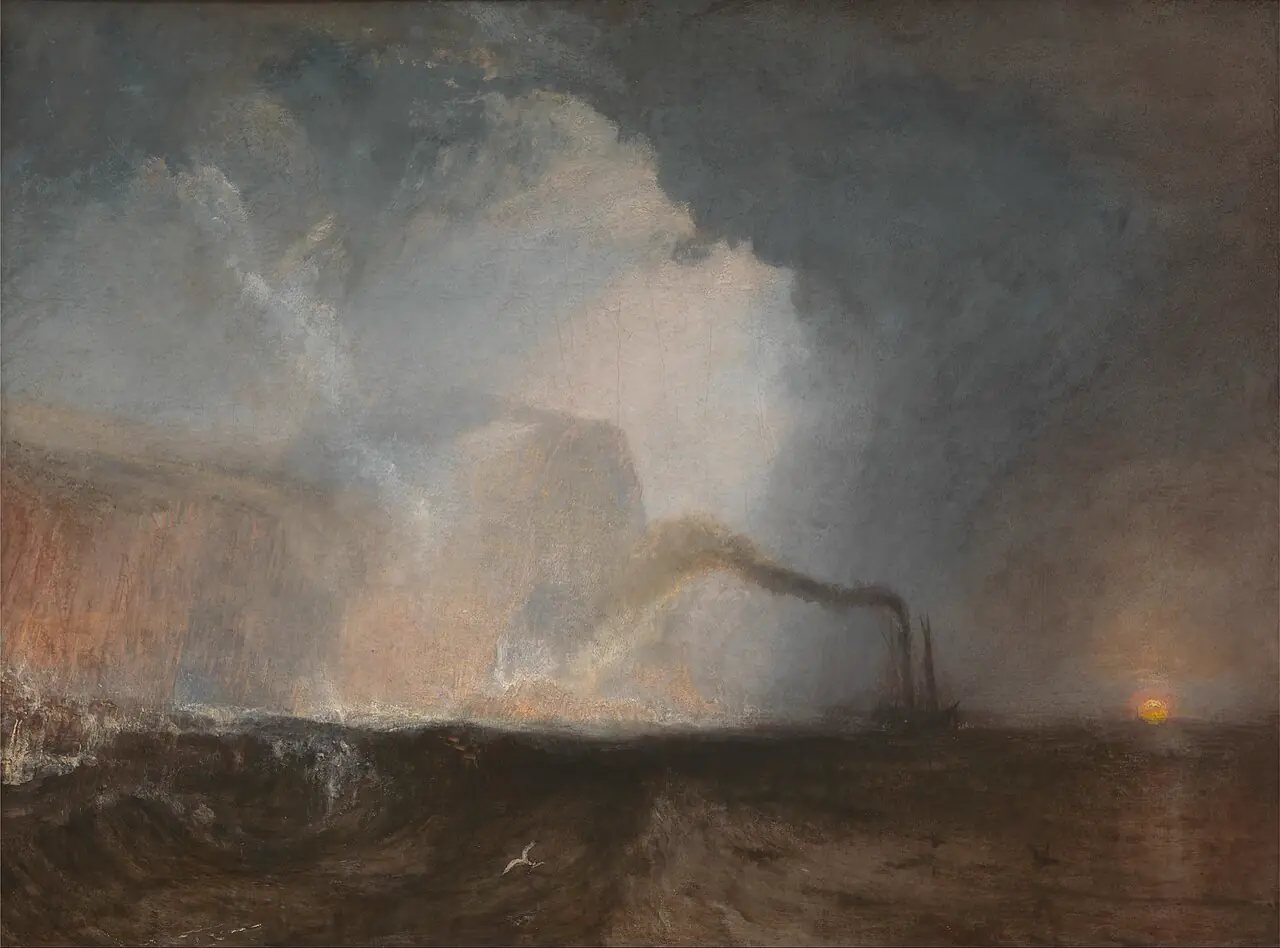
J. M. W. TurnerStaffa, Fingal’s Cave, 1831–32; exhibited 1832Oil on canvas · Yale Center for British Art, Paul Mellon Collection
Turner visited Staffa in 1831, two years after Mendelssohn, travelling from Tobermory on a tourist steamer. The small red point on the painted vessel is its furnace. Collection record.
William Shakespeare
A Midsummer Night’s Dream · Act V, scene 1
First published 1600
EnglishIf we shadows have offended,
Think but this, and all is mended,
That you have but slumbered here
While these visions did appear.
And this weak and idle theme,
No more yielding but a dream,
Puck asks the audience to treat the evening’s confusions as a dream. Mendelssohn had known the play in German translation as a teenager. For the 1843 production he accompanied this farewell with the four wind chords from his 1826 overture.
Recommended recordings
Symphonies Nos. 3 and 4London Symphony Orchestra, Claudio AbbadoDeutsche GrammophonA dependable starting pair: both travel symphonies on one programme, from Abbado’s 1980s cycle with the LSO. The pairing places their very different endings side by side.
Violin Concerto in E minorNathan Milstein, Philharmonia Orchestra, Léon BarzinEMILean, clear playing, with little indulgence in the solo line. Milstein plays the quick passagework cleanly. The recording dates from 1959.
Songs without WordsDaniel BarenboimDeutsche GrammophonThe complete eight books, recorded in 1973. Barenboim, who had experience accompanying singers, phrases the melodies without strain.
OctetEmerson String QuartetDeutsche Grammophon · 2005Four players recorded all eight parts by overdubbing, on eight instruments. The attacks in the scherzo are closely aligned.
Fanny was his first close musical critic; Schumann became a colleague at the conservatoire and an advocate of his chamber music. His fast scherzos and his piano pieces in a singing style served later composers as models of the short piece. Arthur Sullivan received the first Mendelssohn Scholarship in 1856, which helped take him to Leipzig.