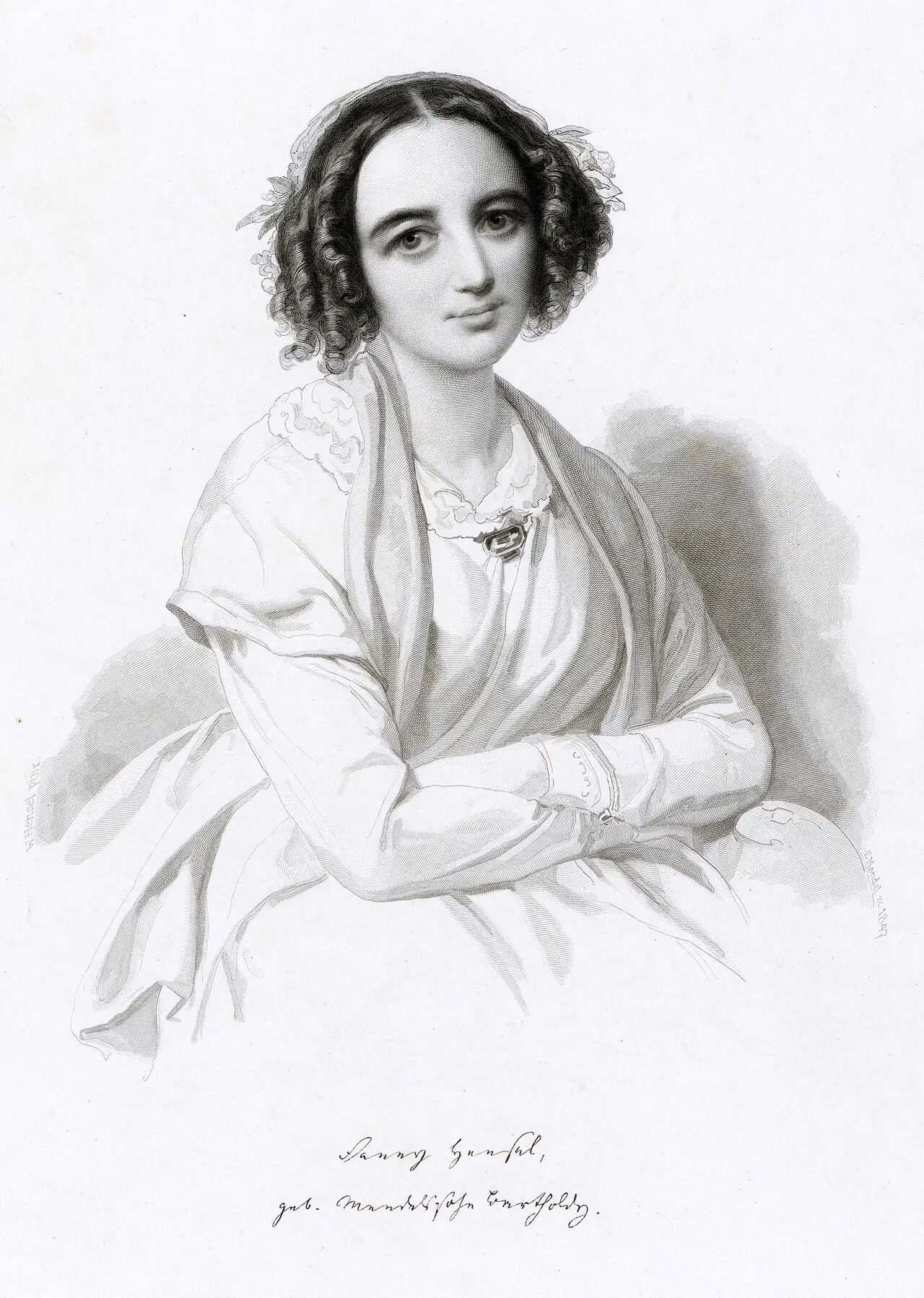
Born 14 November 1805, HamburgDied 14 May 1847, Berlin
Berlin composer who ran the city’s Sunday concerts, wrote more than 450 works and published collections under her own name only in the last year of her life.
Ludwig Berger, piano; Carl Friedrich Zelter, composition
At home
Sunday concerts at Leipziger Straße 3, Berlin; pianist, conductor and organiser
Family
Married the painter Wilhelm Hensel in 1829; son Sebastian born in 1830
Output
More than 450 works; songs, piano music, chamber music, cantatas and an overture
Life
On 9 July 1846 Fanny Hensel wrote to her brother Felix with news she expected him to dislike. A Berlin publisher had offered good terms for her songs, and she had accepted. “In a word, I am beginning to publish,” she wrote, after a long and uneasy preamble about her wish to please the people she loved. She was forty. She had been composing since childhood and directed some of Berlin’s most distinguished private concerts.
Hamburg and BerlinEarly training with Berger and Zelter
Born in Hamburg on 14 November 1805, Fanny was the eldest child of the banker Abraham Mendelssohn and his wife Lea. The family moved to Berlin in 1811. Her grandfather was the philosopher Moses Mendelssohn, an advocate of Jewish civil equality; Abraham and Lea had their four children baptised as Protestants in 1816, and later added Bartholdy to the family name. Fanny’s first piano teacher was her mother. As a child she learnt all twenty-four preludes of the first book of Bach’s Well-Tempered Clavier by heart and played them to her father.
Fanny and Felix studied piano with Ludwig Berger and composition with Carl Friedrich Zelter. They joined Zelter’s Sing-Akademie in 1820; at home, professional players took part in the family concerts, so the children could hear what they had written. Their father nevertheless planned different futures for them. Writing to Fanny in 1820, he assigned music to Felix as a possible profession and to her as an accomplishment. She went on filling her composition books with songs, fugues and sonatas.
Leipziger Straße 3Marriage and the Sunday concerts
In October 1829 she married the painter Wilhelm Hensel. He encouraged her composition and wanted her to publish. They settled in the garden apartment of her parents’ property; their son Sebastian was born the following June. In 1831 Fanny revived the family’s Sunday concerts under her own direction. The concerts were held at a private address. She chose the programmes, rehearsed a choir of about twenty voices, played the piano and directed the performances. Liszt, the Schumanns and the Humboldt brothers were among the visitors.
Her programmes could accommodate an opera or an oratorio. She presented Gluck’s Orpheus in 1833 and Felix’s St Paul in 1837. In 1831 she herself composed three large sacred works, including Lobgesang, associated with Sebastian’s first birthday, and a cantata marking the end of Berlin’s cholera epidemic. The following year brought an Overture in C major.
On 15 June 1836 she sent two piano pieces to the family friend Karl Klingemann in England, hoping they might find someone to play them. She wrote that her sister Rebecka no longer wanted to sing and that her songs lay unheard. Felix was often away. “And so I am quite alone with my music.” That November she told Felix that she stood over publication “like the donkey between two bundles of hay”. Wilhelm wanted it, and Felix opposed it.
The E♭ major String Quartet of 1834 opens with a slow movement containing a minor-key fugue. The quick second movement also moves repeatedly towards minor keys. The third, a Romanze, passes through harmonies remote from the nominal home key. Felix criticised her handling of form. She left the quartet as she had written it.
1839–41Rome and Das Jahr
The Hensels went to Italy in 1839–40. At the Villa Medici in Rome, Fanny met young French musicians who wanted to hear everything she could play. One of them was Charles Gounod, for whom her Bach was a revelation. She also played Beethoven. On 30 May 1840, shortly before her departure, she played the Allegro of a Beethoven sonata in A major, and Gounod begged on his knees for the Adagio.
Back in Berlin, she composed Das Jahr in 1841, a cycle of twelve months and a postlude for piano. January opens in the manner of a fantasy; February is fast; March introduces the Easter hymn Christ ist erstanden. In September, subtitled Am Flusse (by the river), a melody is carried through the moving piano figuration. December introduces Vom Himmel hoch, and the postlude ends the cycle with another chorale. She gave the first version to Wilhelm for Christmas.
The cycle requires a pianist with considerable stamina and enough control to sustain a long note through a run of shorter ones. In places a hymn interrupts the faster figuration. Each month has its own character, and transitions link one month to the next. When she began publishing piano pieces, she took September out of the cycle and included it in Op. 2 without its month’s name.
1846–47Into print
Robert von Keudell, a younger friend who took a close interest in her new music, encouraged publication, and the Berlin firms Schlesinger and Bote & Bock made offers. After her decision in July 1846, songs appeared in print as Op. 1 and piano pieces as Op. 2. The Gartenlieder, Op. 3, were six pieces for unaccompanied voices. Felix eventually sent his blessing. By then Fanny had already dealt with the publisher herself.
On 11 April 1847 Hensel played her finished Trio at a Sunday concert, with Keudell on violin and her brother Paul on cello. The first movement moves forward in piano scales and arpeggios; a short third movement, called Lied, comes before the finale. On 14 May, while rehearsing Felix’s The First Walpurgis Night for another concert, she had a stroke and died. She was forty-one. Felix died less than six months after her.
The Trio appeared in 1850 as Op. 11. Much else was published far later, or circulated under the wrong name. Her Easter Sonata of 1828 was recorded in the twentieth century as a work by Felix. When the scholar Angela Mace examined the manuscript, its handwriting and page numbers matched the missing leaves of Fanny’s composition book. In her diary for April 1829 Fanny had written that she had played her own sonata.
Places
Every recorded place, joined in date order. Hensel on the MapAll 16 places, with sources
Hamburg · 14 November 1805 – 1811 · born
Born the eldest of the four children of Abraham Mendelssohn and Lea Salomon; the family left in 1811.
In September from Das Jahr, the melody is set within a moving accompaniment. The pianist has to sustain its longer notes against the busy figuration around them; heavy pedalling blurs the texture. Hensel later published the piece among her Lieder für das Pianoforte, songs for piano.
♭Tonal instability
The E♭ major Quartet spends much of its time away from its home key. The opening Adagio contains a minor-key fugue, and the Romanze moves through unexpected chords. The finale is in quick notes.
𝅘𝅥Poetry
Nachtwanderer sets Eichendorff’s poem of a solitary walker among clouds, streams and nightingales. The piano part moves continuously while the voice describes the stillness of the night. Hensel also set Goethe, Heine and Rückert. In Op. 7, Nachtwanderer appears alongside Rückert’s Du bist die Ruh, in which the speaker asks another person to become a refuge.
𝄋The calendar
The months of Das Jahr follow the church calendar as well as the weather. March quotes Christ ist erstanden and December Vom Himmel hoch, and a chorale postlude follows the final month. The hymn tunes are set against rapid piano writing, so the cycle calls for sharply different kinds of touch from the performer.
𝄡Chamber music
The D minor Trio begins with a piano part of scales and arpeggios beneath the strings. Hensel knew how much a pianist can do while another instrument holds a note. The keyboard begins the finale alone, in the manner of an improvisation. A short Lied comes before the finale.
Works
A selection from the composer’s works.
1828
Easter Sonata in A majorPiano
Recorded as a work by Felix in the twentieth century, then identified as Fanny’s from her handwriting and the missing pages of her composition book.
1831
LobgesangSoloists, chorus and orchestra
Written for the first birthday of her son Sebastian; one of three large sacred works she composed that year.
1832
Overture in C majorOrchestra
A slow introduction comes before the fast music. It is her only independent orchestral overture.
1834
String Quartet in E♭ majorTwo violins, viola and cello
The opening Adagio contains a minor-key fugue. The work also includes a Romanze. Felix objected, and she did not rewrite it.
1841
Das JahrPiano
Twelve months and a chorale postlude, first given to Wilhelm for Christmas. The couple made an illustrated version on coloured paper in 1842.
1846
GartenliederOp. 3Unaccompanied mixed voices
Six part-songs for a small choir like the one Hensel rehearsed at home; no voice part is limited to supporting the tune.
Published 1846
Sechs LiederOp. 1Voice and piano
Issued by Bote & Bock after her decision of July 1846. No. 3 sets Heine’s Warum sind denn die Rosen so blass.
Published 1846
Vier Lieder für das PianoforteOp. 2Piano
Four piano songs, including September from Das Jahr, published here without its calendar title.
1847
Piano Trio in D minorOp. 11Piano, violin and cello
First played at her Sunday concert on 11 April 1847, with Hensel at the piano. A short Lied separates the slow movement from the finale.
Published 1847
Sechs LiederOp. 7Voice and piano
Opens with Eichendorff’s Nachtwanderer and includes Hensel’s setting of Rückert’s Du bist die Ruh, a poem also set by Schubert.
A schematic of a piano song. The upper part holds long notes while broken chords continue below. The bass moves A–G♯–G–C, changing the harmony beneath the melody. These four bars are invented to show the pianist’s two simultaneous jobs.
Sister arts
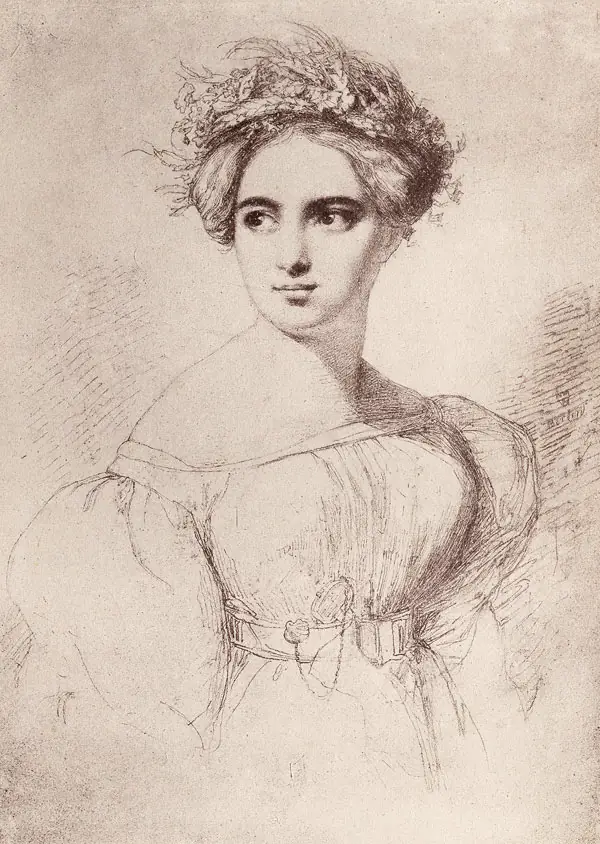
Wilhelm HenselFanny Mendelssohn, 1829Drawing
Wilhelm drew Fanny in the year they married, wearing a wreath of flowers. Later they worked together on Das Jahr. She copied the music onto coloured paper and he supplied the drawings. The September page has a river beside music she called Am Flusse.
Joseph von Eichendorff
Nachts · set as Nachtwanderer
Poem first published 1823; Hensel’s setting published 1847
GermanIch wandre durch die stille Nacht,
Da schleicht der Mond so heimlich sacht
Oft aus der dunkeln Wolkenhülle,
Und hin und her im Tal,
Erwacht die Nachtigall
Dann wieder alles grau und stille.
O wunderbarer Nachtgesang,
Von fern im Land der Ströme Gang,
Leis Schauern in den dunkeln Bäumen —
Irrst die Gedanken mir,
Mein wirres Singen hier
Ist wie ein Rufen nur aus Träumen.
Our translationI walk through the silent night;
the moon steals softly, secretly,
now and again from its dark covering of cloud.
Here and there in the valley
the nightingale wakes —
then all is grey and still once more.
O strange song of the night,
the rivers’ movement far across the land,
a faint trembling in the dark trees —
you send my thoughts astray;
my tangled singing here
is only like a call out of dreams.
In Eichendorff’s poem the walker hears a nightingale and distant rivers, and then his own singing sounds to him as strange as a voice in a dream. Hensel made this the opening song of Op. 7. The piano keeps moving beneath the repeated word stille (still).
Recommended recordings
Piano Trio in D minor · String Quartet in E♭ majorNash EnsembleHyperionThe Trio’s opening is played with force, and the Quartet with a darker, rougher tone. The disc pairs these works with Clara Schumann’s G minor Trio.
Lieder, Vols 1 and 2Dorothea Craxton, Babette DornNaxosDorn gives the piano an unusually clear presence. Craxton phrases the words with care, though she slides into some notes, which not all listeners will like. Volume 1 includes the complete Op. 7.
Where to hear more
Das Jahr (The Year)1841–42
Lauma Skride, piano · Sony Classical · 6–7 October 2005, Rolf-Liebermann-Studios, Hamburg
Twelve piano pieces and an epilogue refer to Hensel’s Italian travels, with a Christmas chorale in ‘December’. Skride plays the whole calendar in the revised cycle, released in 2007, with clean fingerwork in its most demanding passages and clear pedalling in ‘September’, where the moving notes stay distinct around the melody.
Kaleidoscope Chamber Collective: Elena Urioste, violin; Laura van der Heijden, cello; Tom Poster, piano · Chandos · 8–9 November 2021, Potton Hall, Dunwich, Suffolk
Written for her sister Rebecka’s birthday, the trio opens with violin and cello in octaves over a surging piano part. Urioste and van der Heijden play the two short middle movements as a singing partnership.
Fanny and Felix sent each other scores and criticism throughout their lives. His judgement was a reason she delayed publishing, and her comments influenced his revisions. In Rome in 1840 Gounod heard her play Bach and Beethoven at the piano, and this was how he came to know Bach’s keyboard works. She played for him late into the night.