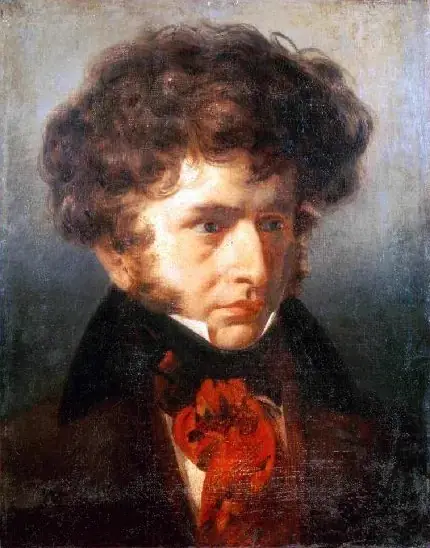
Flute and guitar; composition with Le Sueur and Reicha at the Paris Conservatoire
Livelihood
Critic for the Journal des débats, Conservatoire librarian, touring conductor
Reading
Virgil with his father; Shakespeare at the Odéon; Goethe in French translation
Output
Four symphonies, three completed operas, choral works, songs and an orchestration treatise
“Shakespeare struck me like a thunderbolt.”
Life
When the young Hector Berlioz read aloud the death of Dido, his voice failed him. His father closed the book and said that he was tired, so the boy did not have to explain his tears. Berlioz recorded the kindness in his Mémoires. Louis Berlioz was a doctor in La Côte-Saint-André, between Lyon and Grenoble, and taught his son Latin, history and geography. He expected Hector to follow him into medicine. The boy learnt the flute and guitar, studied maps of distant islands and was deeply moved by the story of Virgil’s abandoned queen.
In 1821 he went to Paris to study medicine. His first visit to the dissecting room at the Pitié hospital, he later wrote, ended with a flight through a window. On the second visit he managed perfectly well. Music was the more durable obstacle. He heard Salieri’s Les Danaïdes at the Opéra and began singing its airs over the cadavers. At the Conservatoire library he copied and memorised Gluck’s scores. His father argued, threatened and withheld support. Hector took composition lessons with Jean-François Le Sueur.
He entered the Conservatoire in 1826, studying with Le Sueur and Anton Reicha. A Messe solennelle and the opera Les Francs-juges, which never reached the stage, gave him experience with large forces. The Prix de Rome took longer. After failing the preliminary examination in 1826, he entered a cantata every year from 1827 and won in 1830 with the fourth. He never became a pianist. In the Mémoires, writing in London in the spring of 1848, he credited that deficiency with freeing him from “the tyranny of finger habits”.
1827–30Harriet Smithson and the Symphonie fantastique
On 11 September 1827 he saw an English company perform Hamlet at the Odéon. Harriet Smithson played Ophelia. “Shakespeare struck me like a thunderbolt,” he wrote, recalling the evening. He knew no English and had read Shakespeare only in Letourneur’s French translation. A few days later he returned to see Smithson as Juliet. In his mind the actress and the playwright became bound up together. He sent Smithson extravagant letters, though she did not know him. She was not in the hall for the first performance of the symphony he wrote with her in mind.
In 1828 Berlioz heard François-Antoine Habeneck’s Conservatoire orchestra play Beethoven. His Symphonie fantastique, first performed on 5 December 1830, follows an artist whose beloved keeps returning to his thoughts. The movements depict a ball, a scene in the country and an opium dream in which he has killed her and is led to execution. After the scaffold comes his own funeral, attended by witches.
Two harps play in the ballroom scene. A cor anglais calls to an oboe placed offstage; at the end of the country scene, the oboe does not reply. Four timpanists play distant thunder. Just before the execution, a solo clarinet begins the beloved’s melody and is cut off by the orchestra. In the finale the funeral chant Dies irae is combined with the witches’ round, and the strings play with the wood of their bows. A printed programme set out the story for the audience.
The Rome prize sent him to the Villa Medici. He walked in the Italian countryside, heard shepherds’ pipes and wrote Le Roi Lear in Nice. Back in Paris, Smithson heard the Fantastique and its sequel Lélio in December 1832. They met, married in October 1833 and had a son, Louis, the following year. Money troubles and professional disappointment strained the marriage; her health declined, and they separated in the 1840s. The singer Marie Recio became his travelling companion and, after Smithson’s death in 1854, his second wife.
1834–40Paganini and Harold en Italie
Paganini owned a Stradivarius viola and wanted a work to play on it. Berlioz showed him the first movement of Harold en Italie. According to the Mémoires, Paganini objected that he was silent for too long: “I have to play all the time.” Berlioz continued the work without him. The solo viola, cast as a traveller, appears in mountain scenes and in a pilgrims’ procession, and has long stretches in which it does not play. When Paganini heard the symphony in December 1838, he sent Berlioz 20,000 francs.
The money freed Berlioz from reviewing for a time. “I had money; Paganini had given it to me to make music, and I made it,” he wrote in his account of composing Roméo et Juliette in 1839. The orchestra alone plays the lovers’ great scene. Singers tell the story, and at the end Friar Laurence reconciles the feuding families. Berlioz dedicated the score to Paganini, who died without hearing it.
Public commissions required music for different spaces. The Grande Messe des morts was performed at the Invalides in December 1837, with four extra brass groups stationed apart from the orchestra. They play in the Tuba mirum. Later the unaccompanied choir sings Quaerens me, and the Sanctus has a part for a single tenor. The Grande Symphonie funèbre et triomphale of 1840 was performed in the streets by a wind band, at the ceremony that reburied the dead of the July Revolution.
The working weekWriting about other people’s music
At the Journal des débats, Berlioz spent working days on other people’s operas. In his prose he explained technical problems, staged absurd conversations and dismantled theatrical institutions. A post at the Conservatoire library supplied another income. Conducting tours took him to Germany, Russia and Britain, where he could rehearse his own music. Parisian theatres were harder to persuade. Benvenuto Cellini failed at the Opéra in 1838; Liszt revived it in Weimar in 1852.
La Damnation de Faust, written in 1845–46, lost money at its Paris concert performances. Its scenes move from a Hungarian plain to a German tavern, Marguerite’s room, the abyss and heaven. Berlioz drew on his youthful Huit scènes de Faust, composed after he read Gérard de Nerval’s translation of Goethe in 1828. In Marguerite’s D’amour l’ardente flamme, set in her room, a cor anglais plays before she sings.
1854–69Les Troyens and last works
L’Enfance du Christ succeeded in Paris in 1854. In it the Ishmaelites take in the exhausted refugee family, and two flutes and a harp play for them. Berlioz then returned to the Virgil he had read with his father. In Les Troyens, composed principally in 1856–58, Cassandra foresees the destruction of Troy; in Carthage, Dido receives the survivors, loves Aeneas and loses him to his duty. Berlioz wrote the libretto himself.
Only the Carthage portion reached the stage during his lifetime, heavily cut, at the Théâtre-Lyrique in November 1863. Both halves were first staged together at Karlsruhe in December 1890, over two evenings. His last opera, Béatrice et Bénédict, after Shakespeare’s quarrelling lovers, had already been given at Baden-Baden in 1862, with spoken dialogue and a nocturnal duet for Héro and Ursule. Marie died that year. Louis died in 1867. Despite worsening illness, Berlioz accepted a final Russian tour in the winter of 1867–68. He died in Paris on 8 March 1869.
Places
Every recorded place, joined in date order. Berlioz on the MapAll 17 places, with sources
La Côte-Saint-André · 11 December 1803 – 1821 · born
Born in the family home, eldest child of a physician; he left for the baccalauréat at Grenoble in 1821.
The viola in Harold en Italie has its own recurring melody. Other events take place around it: pilgrims pass, a serenade is heard, brigands feast. The part contains silences as well as notes, which disappointed Paganini when he first saw it. In the funeral symphony, a solo trombone plays the oration that a human speaker might have given at the graveside.
𝅘𝅥Unsettled melody
The Fantastique’s idée fixe begins by holding G across a barline. It rises to C, falls back and rises higher to E. Long notes are tied over into the next bar, and the phrase reaches a cadence only after some length. In the finale the E♭ clarinet plays the melody in short, clipped notes as a dance, at the point where the beloved arrives at the witches’ sabbath.
𝄐Across the room
The oboe answering the Fantastique’s cor anglais plays offstage; when the cor anglais phrase returns later, the oboe is silent. In the Requiem, four extra brass groups play the summons to judgement from separate places. The Te Deum places organ and orchestra apart.
♮A familiar chord in an unusual context
The Fantastique moves from the C minor of its introduction into C major when the long allegro begins. The pastoral movement is in F major and opens with a cor anglais and a distant oboe. The beloved’s melody returns during the movement. At the close there are bare calls and rumbling timpani.
𝄾Wood against strings
The waltz, scaffold march and witches’ dance in the Fantastique each move at a markedly different gait. In the finale, the slow Dies irae is combined with the fast round dance. The violinists and violists then turn their bows over and strike the strings with the wood, producing a dry, rattling sound.
𝄋Narrator
In Roméo et Juliette, a small chorus supplies the outline of the play and solo voices comment on it. The orchestra takes the love scene and Queen Mab’s flight. Voices return for the reconciliation, when Friar Laurence must persuade the families to stop fighting.
The beloved’s melody returns in all five movements, from its first statement on flute and violins to the E♭ clarinet’s parody of it at the witches’ sabbath. Four timpanists play the thunder at the end of the country scene.
Berlioz wrote the overture in Nice during his Italian stay. It opens with a slow introduction, which is followed by the fast main section.
1834
Harold en ItalieOp. 16Solo viola and orchestra
Paganini wanted more notes for himself and declined the solo part. The solo viola plays through much of this four-movement symphony of Italian scenes.
1834–38
Benvenuto CelliniOp. 23Opera
A sculptor has to cast his statue while love, rivals and the carnival get in the way. The opera failed in Paris in 1838; Liszt revived it at Weimar in 1852.
1837
Grande Messe des mortsOp. 5Tenor, chorus, large orchestra and four additional brass groups
The four brass groups answer the choir’s vision of judgement. The later Quaerens me is sung unaccompanied.
1839
Roméo et JulietteOp. 17Solo voices, choruses and orchestra
Paganini’s gift of 20,000 francs helped pay for the time to compose it. The love scene and Queen Mab scherzo are orchestral; the final reconciliation needs Friar Laurence and the choruses.
1840
Grande Symphonie funèbre et triomphaleOp. 15Wind band; later optional strings and chorus
Written for the tenth anniversary of the July Revolution and a procession through Paris. A solo trombone plays the central funeral oration.
1841; orchestrated by 1856
Les Nuits d’étéOp. 7Voice and piano; later voice and orchestra
Six poems by Théophile Gautier, on a spring outing, ghosts, bereavement and an invitation to sail away. In Le Spectre de la rose, the ghost of a rose visits the young woman who wore it to a ball.
1845–46
La Damnation de FaustOp. 24Soloists, chorus and orchestra
The work includes the Hungarian March and Marguerite’s romance D’amour l’ardente flamme. The first Paris concert performances lost Berlioz money.
1849
Te DeumOp. 22Tenor, multiple choirs, orchestra and organ
First performed at Saint-Eustache in 1855. The organ is placed apart from the orchestra, and the two answer each other across the church.
1850–54
L’Enfance du ChristOp. 25Soloists, chorus and orchestra
Herod’s dream sends the Holy Family into exile; an Ishmaelite household finally offers shelter at Sais. The children’s welcome includes a trio for two flutes and harp.
1856–58
Les TroyensOpera in five acts
Berlioz wrote his own libretto from Virgil, with two acts set at Troy and three at Carthage. In his lifetime only the Carthage portion was staged, with substantial cuts.
1860–62
Béatrice et BénédictComic opera in two acts
Shakespeare’s sparring lovers in an opera with spoken dialogue. Héro and Ursule sing a long, quiet nocturnal duet.
In the score
Short examples, engraved and playable.
Symphonie fantastique · first movementOpening of the idée fixe
A schematic reduction of the idée fixe’s opening, with its upbeat and seven full bars; accompaniment, dynamics and subsidiary slurs are omitted. Flute and first violins play the melody in C major. The phrase has a held G, two upward reaches and slowly descending notes tied across the barlines.
Orchestration laboratorySingle pitch collection shared by two orchestral bodies
A schematic of the same C major triad alternating between high flutes and low brass. The notes of the chord stay the same; the register and instruments change. Berlioz repeatedly tied a returning melody to the sound of a particular instrument.
Sister arts
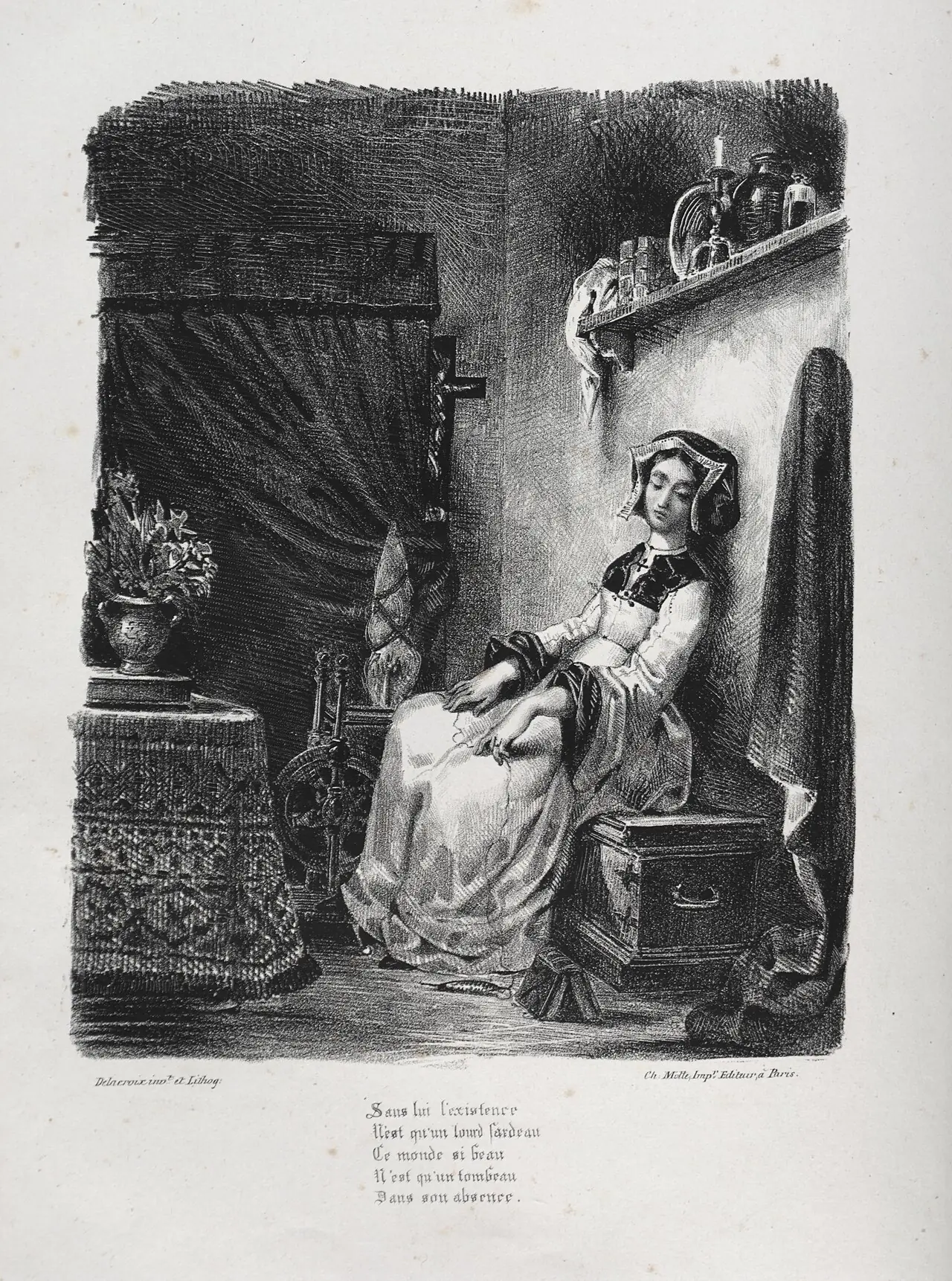
Eugène DelacroixMarguerite with the Spinning Wheel, from the Faust illustrations, 1828Lithograph · Cleveland Museum of Art
Marguerite sits with downcast eyes and her hands in her lap; the spinning wheel stands beside her. Delacroix’s seventeen lithographs accompanied Stapfer’s translation of Goethe in 1828, the year Berlioz read Nerval’s version and began his Huit scènes de Faust. In the later Damnation, Marguerite is again left alone in her room, listening and waiting while Faust travels.
William Shakespeare
Romeo and Juliet · Act III, scene 5
First published 1597
EnglishWilt thou be gone? It is not yet near day.
It was the nightingale, and not the lark,
That pierced the fearful hollow of thine ear;
Nightly she sings on yon pomegranate-tree.
Believe me, love, it was the nightingale.
Juliet hears a bird and insists it is the nightingale, because if it is the lark, Romeo must leave. Berlioz saw Smithson play Juliet at the Odéon in September 1827. His orchestral love scene is also set at night, with interrupted speech and a separation approaching. It does not set these lines.
Virgil
Aeneid · IV, 651–654
First century BCE
LatinDulces exuviae, dum fata deusque sinebat,
accipite hanc animam meque his exsolvite curis.
vixi et quem dederat cursum fortuna peregi,
et nunc magna mei sub terras ibit imago.
Our translationDear relics, while fate and the god allowed it,
receive this life and release me from these cares.
I have lived, and completed the course fortune gave me;
and now a great image of me will pass beneath the earth.
Dido addresses the things Aeneas has left in her room. As a boy, Berlioz broke down while reading her death to his father; the doctor tactfully closed the book. In the final act of Les Troyens, her farewell to her city and memories comes before the Carthaginians’ public curse on Aeneas’s descendants.
Recommended recordings
Symphonie fantastiqueBoston Symphony Orchestra, Charles MunchRCA · 1954The waltz is light in rhythm, and the march is played hard. Munch takes the changes of mood quickly, faster than in more measured performances.
Les TroyensJon Vickers, Josephine Veasey, Berit Lindholm; Royal Opera House forces, Colin DavisPhilipsVickers presents Aeneas as a formidable and troubled figure; Veasey’s Dido commands the court and softens her voice in private. Davis gives the ceremonial scenes time without losing sight of the characters in them.
Les Nuits d’étéRégine Crespin, Orchestre de la Suisse Romande, Ernest AnsermetDecca · 1963Crespin’s French has bite and long breath. Her grand manner suits the rose’s ghost and the grief of Sur les lagunes; for the rustic outing of Villanelle it is more elegant than needed.
Grande Messe des mortsLondon Symphony Orchestra and Chorus, Colin DavisPhilipsDavis keeps the quiet choral pages grave, and the brass summons follows from what comes before it. The exposed voices in Quaerens me matter as much as the percussion.
Gluck taught him how to use an orchestra in the theatre; Beethoven opened the symphony to a new scale of ambition. Liszt transcribed the Fantastique for piano and revived Benvenuto Cellini. Strauss expanded the orchestration treatise. A precedent for the distant instruments and intrusive marches in Mahler’s symphonies can be heard in Berlioz’s separated brass and returning idée fixe.
Further reading
Hugh Macdonald, Berlioz (Oxford: Oxford University Press, 2001). biography
Life-and-works account by an editor of the New Berlioz Edition.
Hugh Macdonald, ‘Berlioz, (Louis-)Hector’, Grove Music Online (Oxford University Press, 2001). reference
Biographical reference, work-list and bibliography; subscription required.