Naval College, Saint Petersburg; composition with Balakirev and years of private study
Teaching
Conservatory professor from 1871; inspector of naval bands, 1873–84
Marriage
Nadezhda Purgold, pianist and composer, 1872
Theatre
Fifteen operas, from The Maid of Pskov to The Golden Cockerel
Life
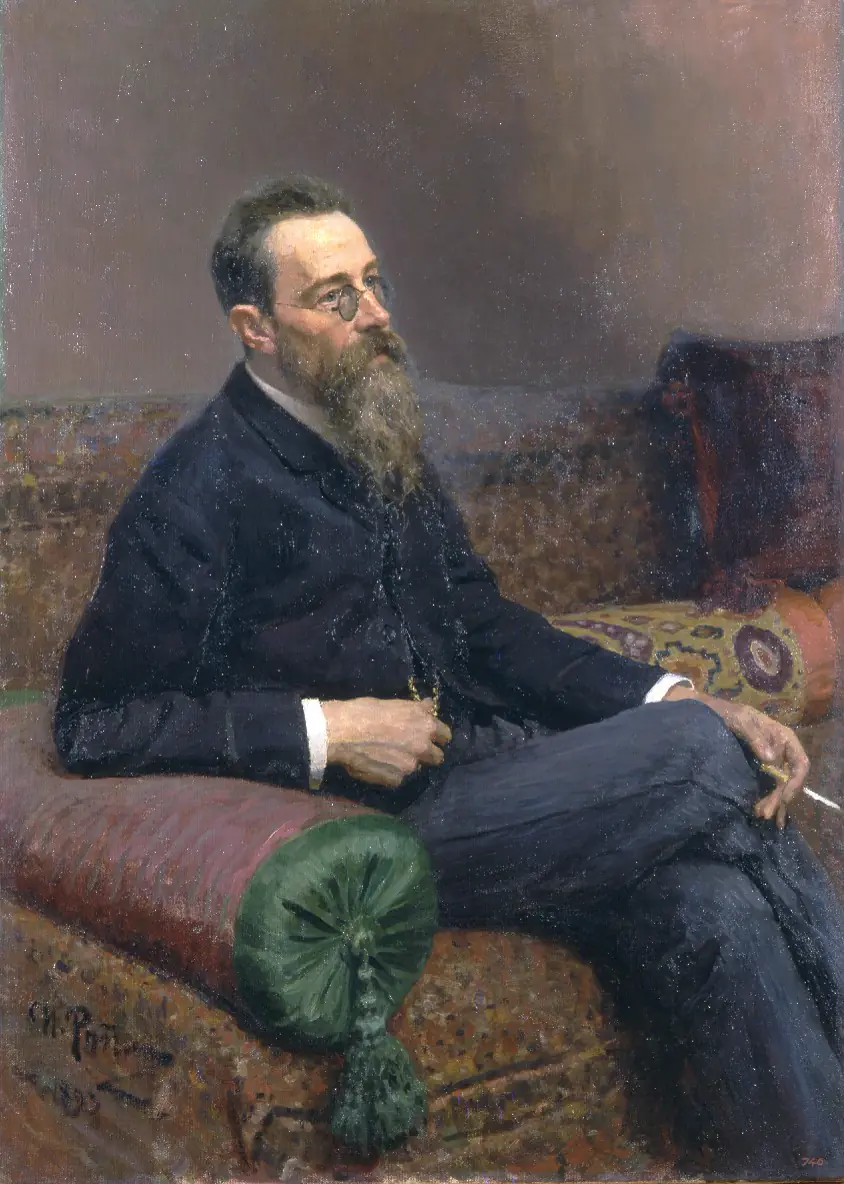
Before he had seen the sea, Nikolai Rimsky-Korsakov rigged a toy brig and read letters from his older brother Voyin, a naval officer. Growing up in Tikhvin, he wanted a ship of his own. His father took him to the Naval College in Saint Petersburg in 1856, and his piano lessons continued alongside his naval education. In 1861 his teacher Fyodor Kanille introduced him to Mily Balakirev, who encouraged the seventeen-year-old cadet to begin a symphony.
The clipper Almaz carried him away in 1862 on a voyage of nearly three years. During a long stop in England he wrote the symphony’s slow movement without a piano, and took a chance to try it at a restaurant. He posted the music to Balakirev, who replied with encouragement and requests for changes. Farther out, he saw the Gulf Stream turn the ocean blue, flying fish and phosphorescence. After his return to Russia he took up music again, and Balakirev conducted the completed First Symphony in December 1865.
The circle around Balakirev included Mussorgsky, Borodin and Cui, the group remembered as the Five. They played one another’s work at the piano and argued over scores. Rimsky-Korsakov’s orchestral Sadko, written in 1867, took the musician of Novgorod down into the Sea King’s kingdom. He acknowledged debts to Liszt and Glinka. The underwater music used a scale alternating tones and semitones.
Saint Petersburg · 1871–74Conservatory professorship and naval bands
His appointment to the Conservatory in 1871 showed how little he knew. He could compose an orchestral work but could not satisfactorily harmonise a chorale or write a fugue. Balakirev wanted an ally inside an institution he distrusted, and the new professor needed textbooks. Writing about these years in My Musical Life, published in 1909, Rimsky-Korsakov called himself ‘one of its best and possibly its very best pupil’. He learnt the rules he was now responsible for teaching.
At home, the timetable was equally practical. He and Mussorgsky shared lodgings in 1871–72 and divided the piano between them. Mussorgsky composed during the morning, then left for his government job; Rimsky-Korsakov took the afternoon. Work on Boris Godunov and The Maid of Pskov went on under the same roof. In 1872 Rimsky-Korsakov married Nadezhda Purgold, with Mussorgsky as best man. A trained pianist and a composer herself, she had already made piano arrangements of his music, including the vocal score of The Maid of Pskov.
Appointed inspector of naval bands in 1873, he exchanged his officer’s uniform for a civilian post and began to study wind instruments by playing them himself. That summer he acquired a trombone, a clarinet and a flute. He could not manage the high notes of the brass, and the woodwind needed more patience than he could spare. His later Principles of Orchestration would explain what such instruments could do together, down to the danger of covering a low flute. Maximilian Steinberg completed the book for publication after his death.
1880–88The Snow Maiden to Scheherazade
He composed The Snow Maiden in the summer of 1880 at a rented house in Stelyovo. In his recollection of the work he mentioned the birds in the garden and the misshapen stumps in the forest; the old piano there stood a whole tone below pitch. Ostrovsky’s play gave him its heroine, a daughter of Frost and Spring who wants to join human life, set among folk songs and seasonal ceremonies. When she at last feels love, the sun melts her, and the community that remains sings a hymn to the sun.
In 1887, while occupied with Borodin’s unfinished Prince Igor, he turned sketches for a violin fantasy into Capriccio espagnol. At the first orchestral rehearsal the players applauded after each movement, and he asked to dedicate the piece to them. His 1909 memoir calls its instrumental choices ‘the very essence of the composition’. The exposed cadenzas, changing soloists and percussion rhythms were part of the piece from the start.
Scheherazade and the Russian Easter Festival Overture followed in 1888. In the suite the solo violin represents the storyteller, while the other themes pass from one episode to another without a fixed identity. A fanfare first heard on muted brass returns during the final shipwreck. For the overture he drew on Orthodox chant and on memories of Easter services in Tikhvin. The church melodies, sung unaccompanied in worship, are scored for a concert orchestra with rushing strings, brass and ringing percussion.
Friends’ manuscriptsEditing Mussorgsky and Borodin
After Mussorgsky died in 1881, his manuscripts passed to Rimsky-Korsakov, who had once shared a flat with him. Rimsky-Korsakov found passages of great invention beside harmonies and part-writing he considered unacceptable. He altered them for publication and performance. His cuts and reorchestration of Boris Godunov imposed his own judgement on another composer’s drama, and admirers of Mussorgsky objected. He defended the work and acknowledged that his edition might eventually be discarded. For Night on Bald Mountain he assembled a concert piece from successive versions, keeping the bell and the dawn from later operatic material.
Mamontov’s MoscowNadezhda Zabela and Mikhail Vrubel
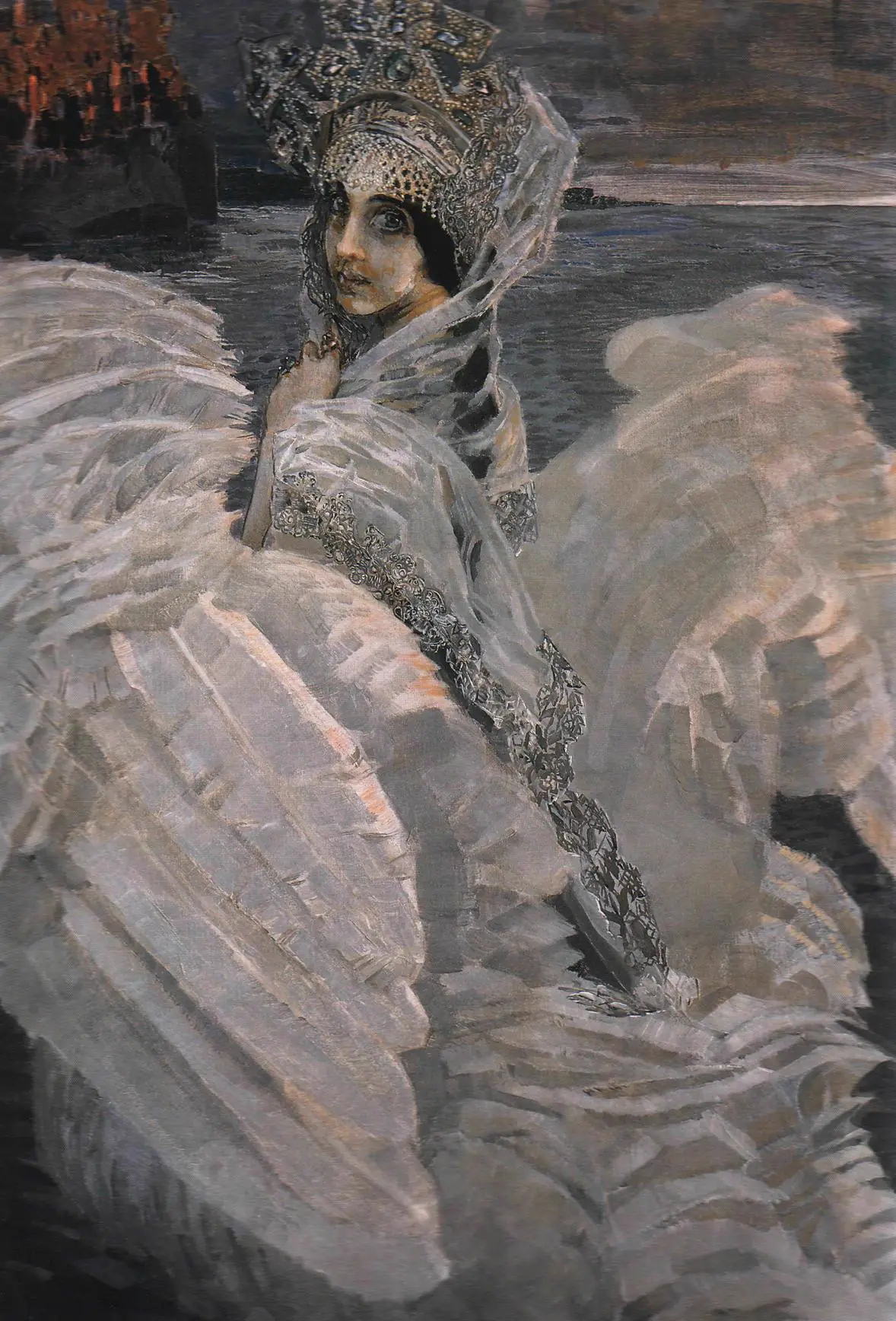
Savva Mamontov’s Private Opera brought his fairy tales into the company of painters. Nadezhda Zabela sang Volkhova in the operatic Sadko; her husband Mikhail Vrubel designed its scenery and costumes. In 1900 she created the Swan Princess in The Tale of Tsar Saltan. During preparations Vrubel read Pushkin aloud in the evenings while she rehearsed the role day after day. His painting The Swan Princess came out of this household as well as out of the theatre.
1905–08The last years
In 1905 Rimsky-Korsakov defended protesting Conservatory students and publicly opposed police intervention. The authorities dismissed him. Glazunov and Lyadov resigned in solidarity, and letters of support arrived from across Russia. A student performance of his opera Kashchei the Immortal became a political meeting, with speeches after the curtain call. Police stopped the concert that was to follow, and the theatre’s iron curtain was lowered. In the autumn he returned to a Conservatory that had been granted greater independence, with Glazunov elected director. He also taught Stravinsky privately from 1905 until 1908.
The Legend of the Invisible City of Kitezh, first staged in 1907, begins among forest birds and follows its heroine through invasion and bereavement to a city hidden from its attackers. There Fevroniya sends a letter of forgiveness to the man who betrayed her. In The Golden Cockerel, completed in 1907 after Russia’s defeat by Japan, Tsar Dodon loses his sons and his army, then his life.
The censors demanded cuts. Writing to his publisher Jurgenson on 9 March 1908, Rimsky-Korsakov answered: ‘I have no intention of changing anything.’ He died at Lyubensk that June without seeing the opera staged. Moscow heard it in 1909. At the Bolshoi the authorities had Dodon renamed a commander and his army made Persian, so that a Russian audience would not see a Russian tsar behaving in this way.
Free Music School, Saint Petersburg · December 1865 · premiere
Balakirev conducted the premiere of the First Symphony, which had been begun under his guidance; the composer acknowledged the applause in uniform. Symphony No. 1.
The fourth movement of Capriccio espagnol gives successive cadenzas to horns and trumpets, solo violin, flute, clarinet and harp. The rest of the orchestra drops out or holds back during each cadenza. The piece began as a fantasy for violin, and in the finished scoring the solo passages are shared among the sections of the orchestra.
𝅘𝅥𝅯A practical balance
Rimsky-Korsakov was aware of the weak points in his own scoring. In the third movement of Capriccio espagnol, he warned that brass could drown the woodwind and recommended reducing the brass marking from ff to f. His orchestration book makes similar practical points. A flute’s low register is weak and an oboe’s is penetrating, so two players given the same dynamic do not carry equally.
♮An underwater scale
In the orchestral Sadko, the descent into the Sea King’s world brings a scale alternating tones and semitones. The octatonic collection has eight notes; two interleaved diminished-seventh chords fit inside it, as the schematics below show. Its repeated spacing offers several related chords without requiring an immediate return to one home key. Glinka’s whole-tone writing for magic scenes was a precedent for this change of harmonic setting.
𝄋Recurring themes
A solo violin returns several times in Scheherazade, and the orchestra plays the material of the tales between its appearances. Rimsky-Korsakov singled out the muted trumpet-and-trombone fanfare in the second movement, which returns during the shipwreck in the fourth. Giving every theme a permanent character name overlooks these changes of role within the same musical family.
𝅘𝅥Orchestration and the voice
Rimsky-Korsakov sometimes left the orchestra silent. Lyubasha’s song in Act I of The Tsar’s Bride is unaccompanied, sung to a room of drinking men who fall quiet to hear it. In Sadko, the three visiting merchants each sing their own account of a distant country. Elsewhere in the opera, piano and harp imitate the plucked strings of Sadko’s gusli as the singer tells his story.
♯Easter outside the church
The Russian Easter Festival Overture takes melodies from the Orthodox Obikhod, a collection of liturgical chants. In the slow opening, solo instruments play in the free rhythm of recitation before the faster main section begins. Detached and plucked strings keep the music moving beneath statements in the brass, and triangle and glockenspiel add the sound of bells. In church these chants were sung without instruments.
Works
A selection from the composer’s works.
1867; revised 1869, 1892
Sadko, musical pictureOp. 5Orchestra
A musician goes down to the Sea King’s underwater kingdom, where the music uses a scale of alternating tones and semitones. The young composer named Liszt and Glinka among the music’s ancestors.
1880–81
The Snow MaidenOpera; prologue and four acts
Ostrovsky’s daughter of Frost and Spring wishes for human love; when it comes, it exposes her to the sun, which melts her. Songs and seasonal ceremonies surround the heroine.
1887
Capriccio espagnolOp. 34Orchestra
Five connected movements, from a projected fantasy for violin, scored for full orchestra. The Alborada returns in a new key and scoring, and a series of cadenzas features individual players.
1888
ScheherazadeOp. 35Orchestra with prominent solo violin
Across four movements drawing on The Thousand and One Nights, the solo violin repeatedly returns as the storyteller. The orchestral themes recur from one episode to another, so a melody heard earlier may return in a different context.
Orthodox chant melodies are heard in slow instrumental recitatives before the orchestra moves into the Easter celebration. Rimsky-Korsakov drew on his memories of the services he had attended as a child in Tikhvin.
1894–96
Sadko, operaOpera in seven scenes
The Novgorod musician’s adventures run from merchants’ songs to a dance beneath the sea that wrecks ships above. Volkhova, the Sea King’s daughter, becomes the river that links his home to the wider world.
1898
The Tsar’s BrideOpera in four acts
Lyubasha substitutes poison for a supposed love potion intended for her rival Marfa, at the moment the tsar chooses Marfa as his bride. In her final delusion Marfa sings of happiness while the guilty survivors stand by.
1899–1900
The Tale of Tsar SaltanOpera after Pushkin
The Flight of the Bumblebee accompanies a prince, transformed into an insect, on his way to his estranged father. The Swan Princess’s magic eventually reunites the separated family.
1903–04; revised 1905
The Legend of the Invisible City of Kitezh and the Maiden FevroniyaOpera in four acts
The Battle of Kerzhenets interrupts a story that begins with Fevroniya among the forest birds. After the invasion and loss, a wedding is prepared in the hidden city.
1906–07
The Golden CockerelOpera in three acts with prologue and epilogue
Dodon wants a kingdom that will let him sleep; the Astrologer’s bird promises to keep watch for him. The opera turns Pushkin’s fairy tale into a joke at the ruler’s expense, and the censors kept it from the stage during the composer’s lifetime.
Schematic, not a quotation from a score: eight ascending quavers, C–D–E♭–F–G♭–A♭–A–B, followed by a whole-bar C. The steps alternate tone and semitone all the way to the octave.
Harmonic workshop · schematicTwo diminished sevenths inside one scale
Schematic, not a quotation: two four-note chords, each held for one bar. C–E♭–G♭–A and D–F–A♭–B divide the preceding eight-note collection into two diminished sevenths; A and B stand for the enharmonic spellings B𝄫 and C♭.
While Nadezhda Zabela prepared the Swan Princess for the 1900 production of The Tale of Tsar Saltan, Vrubel read Pushkin aloud in the evenings. He designed the scenery and costumes for the production and also painted this picture of the bird-woman. It had been sold by April, before his wife sang the role on stage that autumn.
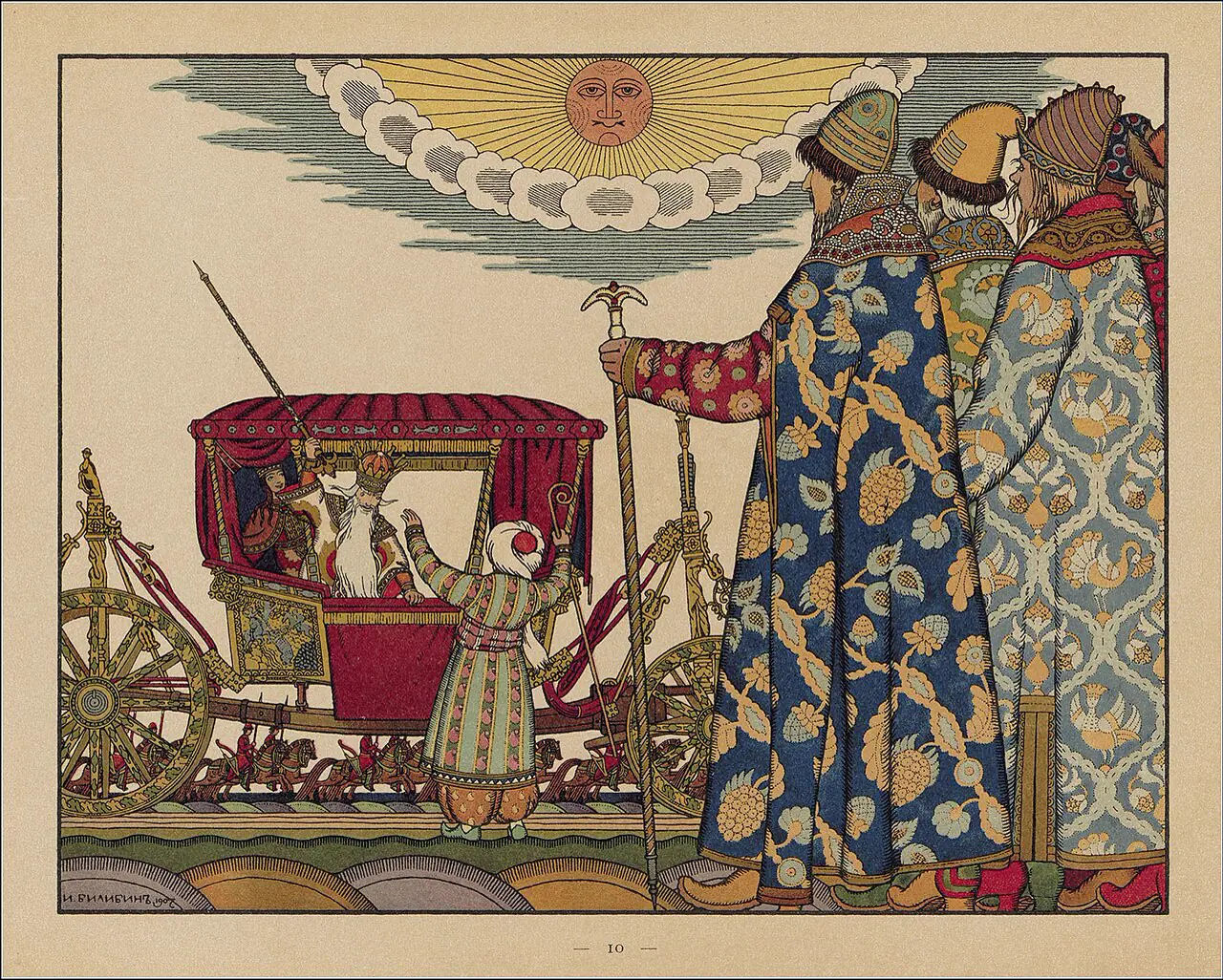
Ivan BilibinIllustration to Pushkin’s The Golden Cockerel, 1907Colour book illustration
This is a book illustration, published in 1907, the year Rimsky-Korsakov finished his opera. Bilibin later designed Sergei Zimin’s Moscow production of 1909, giving its scenery the flat, sharply outlined character of a popular print. The Bolshoi’s production that year used a different artist, Konstantin Korovin, and a text that changed Dodon from a tsar into a commander.
Alexander Pushkin
The Golden Cockerel — final couplet
1834; published 1835
RussianСказка ложь, да в ней намек!
Добрым молодцам урок.
Our translationThe tale is a lie, but there’s a hint in it:
A lesson for good young men.
The censor removed this couplet from the tale’s first publication in 1835; Pushkin protested in his diary. Rimsky-Korsakov and his librettist Vladimir Belsky later had their own dealings with the censors over the same story.
Recommended recordings
ScheherazadeSidney Harth, violin; Chicago Symphony Orchestra, Fritz ReinerRCA · 1960Sidney Harth plays the violin solos, and the Chicago brass play at full weight. Reiner keeps the detail audible in the shipwreck; the producer, Richard Mohr, reported that the finale was recorded in one unspliced performance.
ScheherazadeConcertgebouw Orchestra, Kirill KondrashinPhilips · 1979Herman Krebbers’s gentle, inward violin makes this the more confidential telling. Kondrashin lets the Concertgebouw’s rich sound expand without constantly nudging the tempo, and the soloists stay within the ensemble, even at their most elaborate.
The Legend of the Invisible City of KitezhGalina Gorchakova, Yuri Marusin; Kirov Opera Orchestra and Chorus, Valery GergievPhilips · 1994Gorchakova gives Fevroniya a full-blooded voice, and Gergiev drives the battle fiercely. The close vocal balance sometimes obscures orchestral detail, but the dramatic urgency makes a strong case for hearing the entire opera.
Lineage
Drew fromMikhail GlinkaMily BalakirevFranz LisztRussian folk song and Orthodox chant
Glinka and Liszt supplied models for the young composer’s sea music and supernatural scales. Stravinsky learnt at his desk, orchestrating piano reductions and comparing them with the originals; Prokofiev took his orchestration class at the Conservatory. In The Firebird, Stravinsky still gives Kashchei’s magic octatonic harmony and the human characters folk-like, diatonic tunes, the same distinction his teacher had drawn.
Historical scholarly biography with a bibliography and list of compositions.
Marina Frolova-Walker and Mark Humphreys, ‘Rimsky-Korsakov, Nikolay Andreyevich’, Grove Music Online (Oxford University Press, 2001). reference
Biographical reference, work-list and bibliography; subscription required.
Nikolay Rimsky-Korsakov, My Musical Life, edited by Carl Van Vechten (Knopf, 1923). letters
Autobiography, freely available in digitised form. Its recollections are best read alongside later documentary research.
Nikolay Rimsky-Korsakov, Principles of Orchestration, completed by Maksimilian Steinberg, translated by Edward Agate (Berlin: Editions Russes de Musique, 1922). study
Free English treatise with examples illustrating instrumental combinations and orchestral balance.
Cite this page
Contrapunctus. “Nikolai Rimsky-Korsakov.” Accessed 20 October 2026. https://mottopanikeiku.github.io/contrapunctus/composers/rimsky-korsakov.html.