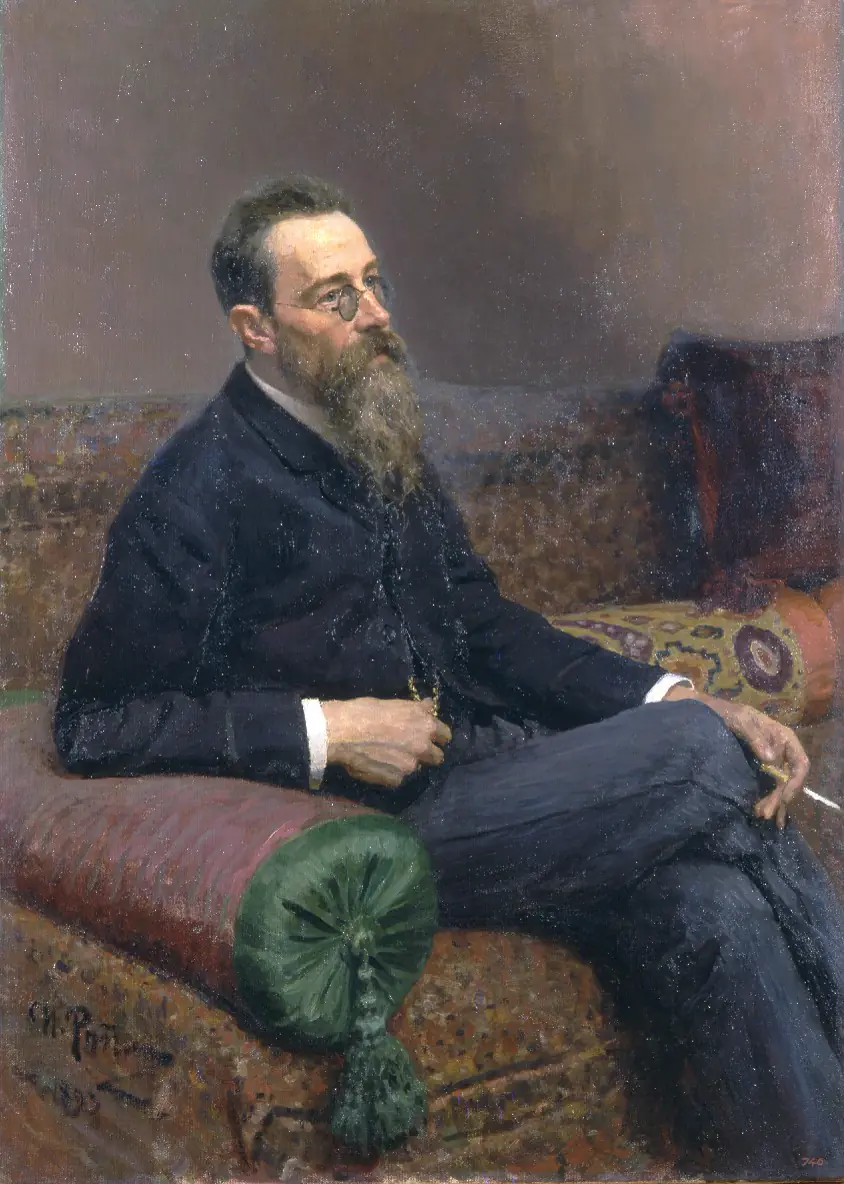
The Prophet, Op. 49 No. 2
Recordings
Historical and comparison recordings, outside the concert’s running order.
- The Prophet, Op. 49 No. 2Fyodor Chaliapin, bass; orchestra conducted by Percy Pitt · 10 October 1921, Hayes, Middlesex3:51
In Rimsky-Korsakov’s The Prophet, a setting of Pushkin’s poem, a man crossing the desert meets a six-winged angel who tears him apart and remakes him as a prophet. Chaliapin sings with Percy Pitt and orchestra, recorded at Hayes in 1921.
Listening notes
- Opening and entry of the bass
Firm chords open the song, marked Andante, before the bass voice enters quietly. His first phrases are measured, close to speech. When the six-winged angel appears in Pushkin’s desert, the accompaniment changes to flowing figures beneath the voice.
- Dedication to Stasov, 1897
Rimsky-Korsakov wrote The Prophet in 1897 and dedicated it to Vladimir Stasov. It is the second of two Pushkin songs published as Op. 49; the first is The Upas Tree.
- Pushkin’s poem, 1826
In Pushkin’s poem the angel opens the man’s eyes and ears, replaces his tongue with a serpent’s sting and puts a burning coal where his heart was. The man lies in the desert like a corpse.
- Final invocation, con forza e maestoso
The ending is marked con forza e maestoso, “forcefully and majestically”. Chaliapin’s bass sings God’s command. In Pushkin’s 1826 poem the prophet must cross seas and lands and “burn people’s hearts with the word”.
- The Prophet, Op. 49 No. 2Fyodor Chaliapin, bass; orchestra conducted by Albert Coates · 20 October 1927, London4:25
Chaliapin returned to The Prophet, Op. 49 No. 2, with Albert Coates in 1927. In Rimsky-Korsakov’s orchestral setting of Pushkin’s short poem, a single bass voice tells of an angel, a burning coal and a command from God.
Listening notes
- Opening, Andante
Rimsky-Korsakov begins with firm chords and a quiet bass voice, marked Andante. Pushkin’s speaker is wandering in a dark desert. When a six-winged angel appears, his measured phrases open out and the accompaniment begins to ripple.
- London recording, 1927
On 20 October 1927 Chaliapin recorded the song in London with Albert Coates. Six years earlier, on 10 October 1921, he had recorded it at Hayes with Percy Pitt. He sang it again in Russian, this time with a different conductor.
- Pushkin’s poem, lines 21–26
In Pushkin’s poem, the angel cuts open the man’s chest, removes his trembling heart and puts a burning coal in its place. The man lies like a corpse in the desert. God speaks after this.
- Final invocation
The bass sings the final command, marked Con forza e maestoso, over continuous accompanying figures. In Pushkin’s text God sends the remade man across seas and lands to speak. The accompaniment continues after the voice stops.