The recorded century
Performers on record: acoustic horn and microphone
In Milan in 1902, Caruso and a pianist recorded Vesti la giubba into a recording horn. In the 1920s, microphones recorded Rachmaninoff’s piano playing and Chaliapin’s bass voice, and the records preserved every slowing and quickening of their phrasing.
Begin plays the stations in order; Pause stops playback at the current station.Caruso and Cottone, Milan
Ruggero Leoncavallo · Pagliacci
Vesti la giubba — piano-accompanied side
On 30 November 1902 in Milan, Enrico Caruso recorded Vesti la giubba with Salvatore Cottone at the piano. Both performed into a horn. Sound entering the horn vibrated a diaphragm, which moved the stylus cutting the groove, so the voices and instruments supplied all the energy themselves. In acoustic studios, a performer’s distance from the horn could determine whether an accompaniment was audible or overwhelmed the singer. On this recording Cottone’s piano plays separate, percussive notes beneath Caruso’s sustained tenor. In the aria, Leoncavallo’s clown Canio has to perform despite his grief.
Sources & recording
Enrico Caruso, tenor; Salvatore Cottone, piano
Excerpt 0:00–2:03 · Full recording & listening notes
- Kolkowski, Miller and Blier-Carruthers: acoustic mechanism, balance and performer directions ↗
- DAHR: Gramophone 2875b, Caruso, Cottone and 30 November 1902 ↗
- Caruso 1902 guide: tenor, piano and the complete side ↗
- Leoncavallo: Vesti la giubba, Italian libretto of Canio’s aria ↗
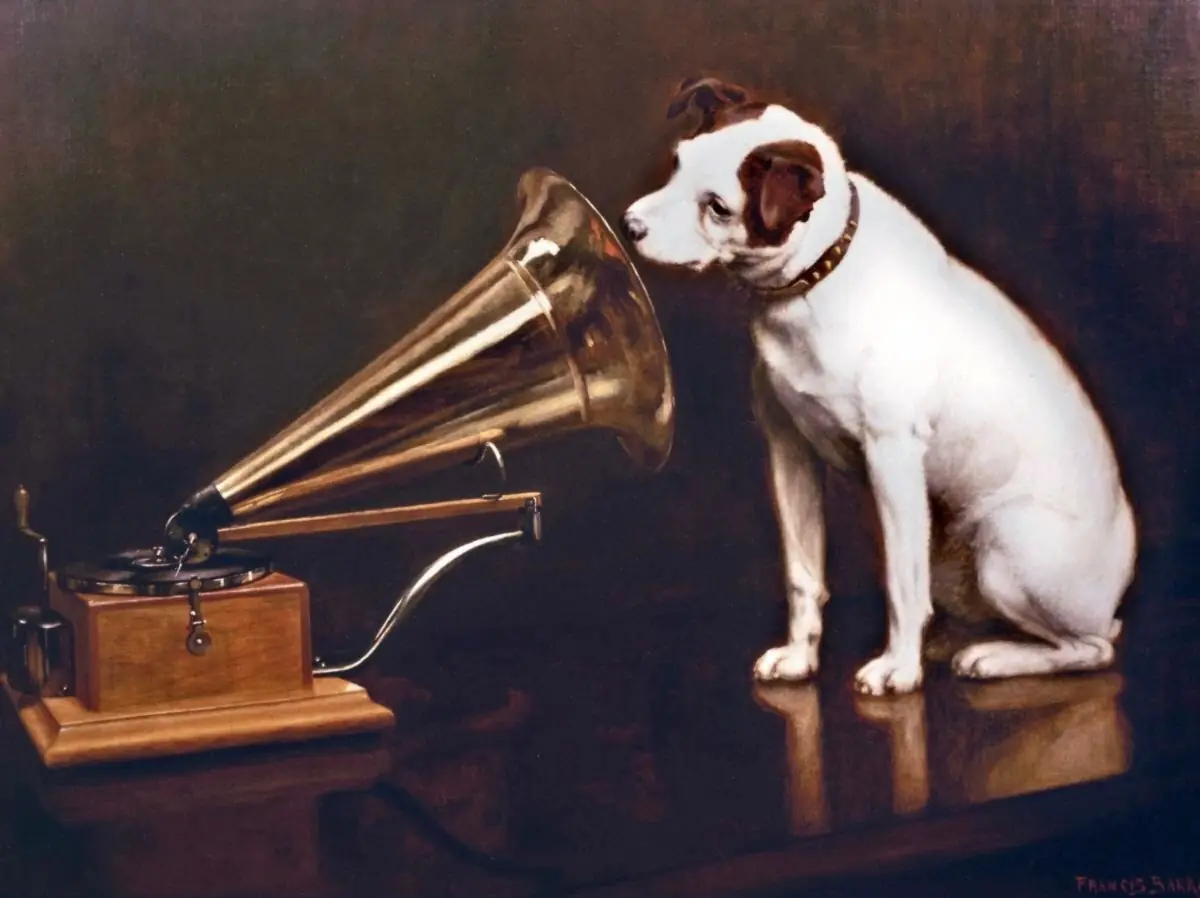
- Wikimedia Commons: Francis Barraud, His Master’s Voice, 1898–99; public-domain painting and reproduction ↗
- Cottone accompanies Caruso at the piano.
- The tenor’s phrase grows again above the piano’s separate attacks.
- Caruso sustains the broad phrase while Cottone keeps the accompaniment moving.
- Voice and piano close the short side.
The clown with orchestral accompaniment
Ruggero Leoncavallo · Pagliacci
Recitar!… Vesti la giubba
Here an orchestra accompanies Caruso. On this Victor side the instruments can sustain a phrase beneath his voice, where Cottone’s piano had to strike each note and let it decay. Canio begins with the outburst of the recitative, then orders himself into his costume. In Leoncavallo’s Pagliacci, the audience has paid and expects to laugh, and the performer must turn his own tears into the clown’s grimaces. Caruso sings the command on long vowels. The orchestra plays beneath him as the melody broadens.
Sources & recording
Enrico Caruso, tenor; orchestra
Excerpt 0:00–2:22 · Full recording & listening notes
- DAHR: Victor C-4317, original master and later dub distinction ↗
- Internet Archive: Victor 88061, attributed to 17 March 1907; the transferred disc’s master remains unconfirmed ↗
- Leoncavallo: Canio’s recitative and aria, Italian text ↗
- Published Caruso comparison: master attribution and corresponding phrases ↗
- Caruso orchestral-side guide: provisional phrase landmarks ↗
- Caruso begins Canio’s recitative, now with orchestral accompaniment.
- The voice eases before the next expansion of the phrase.
- Sustained notes in the orchestra accompany the tenor’s melody.
- Canio’s command to laugh, set as a long lament.
Beethoven and the side limit
Ludwig van Beethoven · Symphony No. 5 in C minor, Op. 67
I. Allegro con brio
On 10 November 1913, Nikisch and the Berlin Philharmonic recorded Beethoven’s Fifth. Recording an orchestra acoustically called for special measures. Stroh string instruments, fitted with aluminium horns, reinforced the ordinary strings and directed their sound towards the recording horn. Nikisch also had to fit the music on the disc. At his broad tempo, the exposition repeat of the first movement would have overrun the first side, so he left it out, and the exposition is heard only once.
Sources & recording
Berlin Philharmonic Orchestra, Arthur Nikisch
Excerpt 0:00–3:02 · Full recording & listening notes
- Science Museum Group Journal: Nikisch session, Stroh reinforcement, side capacity and omitted repeat ↗
- Published Beethoven comparison: Nikisch aligned to the repeated exposition ↗
- Nikisch recording guide: early crest and unrepeated exposition ↗
- Nikisch and the Berlin Philharmonic recorded the complete symphony in a single day.
- The exposition is played without its written repeat.
Paderewski and rubato
Frédéric Chopin · Nocturne in F♯ major, Op. 15 No. 2
Larghetto
Paderewski recorded Chopin’s F♯ major Nocturne in New York on 14 May 1917. His hands often play separately: the accompaniment sounds first and the melody follows it. Chords can be spread from bottom to top. In his essay for Henry T. Finck’s Success in Music and How It Is Won (1909), Paderewski rejected, for soloists, the rule that time borrowed in one phrase must be paid back in another: “What is lost is lost.” Chopin’s doppio movimento doubles the pace for the middle section.
Sources & recording
Ignacy Jan Paderewski
Excerpt 0:00–2:24 · Full recording & listening notes
- DAHR: C-19781, take 1, New York, 14 May 1917 ↗
- Jonathan Woolf: Paderewski’s American recordings, dislocation and arpeggiation ↗
- Paderewski, Tempo Rubato, in Finck’s Success in Music (1909), pp. 454–461: compensation argument and quotation ↗
- Paderewski 1917 guide: opening, faster middle and return ↗
- Published Op. 15 No. 2 comparison: five recorded perspectives ↗
- The melody rests on its accompaniment, which leaves room for Paderewski to sound his hands separately.
- The upper line plays the melody freely over the piano’s supporting notes.
- Chopin’s doppio movimento makes the middle section quicker.
- The loud middle section gets quieter before the opening song returns.
Rachmaninoff’s Edison recordings
Sergei Rachmaninoff · Prelude in C♯ minor, Op. 3 No. 2
Rachmaninoff recorded the Prelude for Edison in 1919; it was a piece he had brought with him from Russia. The Diamond Disc was issued to buyers in December 1920. The excerpt begins at the Agitato, where triplets carry the tune towards the return of the opening chords. The score sets that return out on four staves, although only two hands are playing. The chords then die away into the quiet coda, and the last sounds are widely spaced.
Sources & recording
Sergei Rachmaninoff
Excerpt 1:46–3:47 · Full recording & listening notes
- National Park Service catalogue: Edison recording in 1919, issue in December 1920 ↗
- Wikimedia Commons: Edison recording and Adam Cuerden restoration credit ↗
- Mutopia: Prelude Op. 3 No. 2, Agitato, four-stave return and coda ↗
- Published Rachmaninoff comparison: Edison reference and remakes ↗
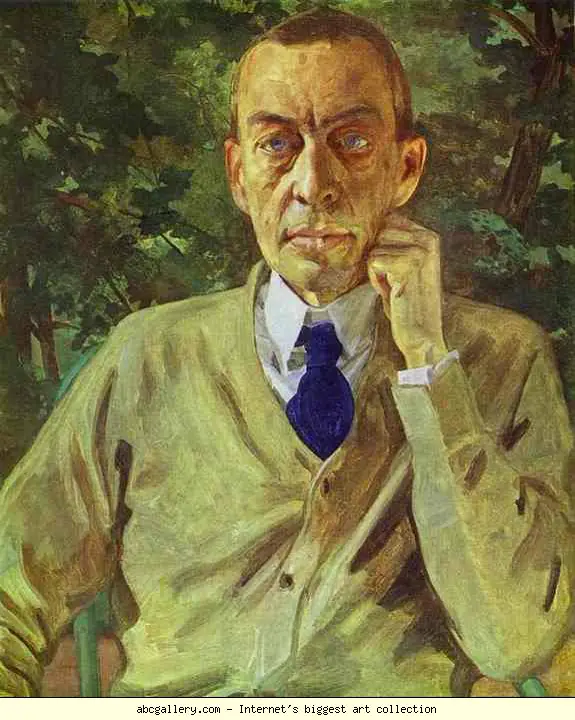
- Wikimedia Commons: Somov’s 1925 portrait ↗
- The melody runs through triplets towards the chordal return.
- The opening call returns, written on four staves for the pianist’s two hands.
- Quiet, widely spaced chords finish the coda.
Prelude: second sitting
Sergei Rachmaninoff · Prelude in C♯ minor, Op. 3 No. 2
Two years later, Rachmaninoff recorded the Prelude again, for Victor. The studio still recorded through a horn. The quick central passage follows the quiet opening and drives towards the familiar chords, here recorded on another day by another company. He presses the triplets forwards and still gives the returning chords ample room. In this performance the chordal return is already close when the excerpt begins. After it, in the coda, the hands move apart and the dynamic falls to quiet.
Sources & recording
Sergei Rachmaninoff, piano
Excerpt 1:34–3:29 · Full recording & listening notes
- DAHR: B-25650 — 1921 sessions; two issued takes, with this transfer’s take unresolved ↗
- DAHR: Victor 814 and its master references ↗
- Published Rachmaninoff comparison: phrase correspondence and playback-speed qualifications ↗
- 1921 recording guide: the agitated middle, chordal return and coda ↗
- Mutopia: Prelude Op. 3 No. 2, Agitato, four-stave return and coda ↗
- After the quiet opening, the piano moves in the agitated middle section.
- The broad chords return across the keyboard.
- The piano moves from the large chords to a quiet close.
The microphone
Sergei Rachmaninoff · Prelude in C♯ minor, Op. 3 No. 2
By the time Rachmaninoff returned to the Prelude in New York on 4 April 1928, Victor had changed its machinery. A microphone turned the piano’s sound into an electrical signal, and amplification supplied the energy to drive the cutting stylus. Victor and Columbia had introduced the process commercially in 1925; it captured a wider range of sound. The issued performance was take 23. Rachmaninoff had written the piece, with its triplets and heavy chords, thirty-six years earlier. It ends with a quiet coda.
Sources & recording
Sergei Rachmaninoff, piano
Excerpt 1:32–3:30 · Full recording & listening notes
- Library of Congress, Recorded Sound Timeline: microphone recording and Columbia/Victor’s 1925 introduction ↗
- Science Museum Group Journal: acoustic sound energy and the change to electrical methods ↗
- Yale University Library, History of 78 RPM recordings, p. 2: microphone, amplified electrical signal and cutting stylus ↗
- DAHR: BVE-25650, issued take 23, 4 April 1928 ↗
- Published Rachmaninoff comparison: corresponding phrases and transfer processing ↗
- 1928 recording guide: the middle, return and closing coda ↗
- Mutopia: Prelude Op. 3 No. 2, composed in 1892 ↗
- The triplets lead into the return of the chords.
- The opening call sounds in the broad chordal passage.
- The coda drops from the loud dynamic of the return and ends on soft chords.
Chaliapin’s acoustic recording of The Prophet, 1921
Nikolai Rimsky-Korsakov · The Prophet, Op. 49 No. 2
On 10 October 1921, at Hayes, Chaliapin recorded Rimsky-Korsakov’s The Prophet, with Percy Pitt conducting the orchestra. Pushkin’s poem of 1826 begins with a thirsty wanderer in a dark desert. A six-winged angel opens his eyes and ears, tears out his tongue and replaces his heart with a burning coal. The bass narrates these events before delivering God’s command. The opening is measured and close to speech. At the end the score is marked con forza e maestoso, forcefully and majestically.
Sources & recording
Fyodor Chaliapin, bass; orchestra conducted by Percy Pitt
Excerpt 0:04–3:44 · Full recording & listening notes
- DAHR: Cc550, Chaliapin with Percy Pitt, 10 October 1921 ↗
- IMSLP: Two Romances, Op. 49, original voice-and-piano setting ↗
- Pushkin, The Prophet (1826): original Russian poem ↗
- Rimsky-Korsakov: The Prophet, collected-edition vocal score, pp. 91–97; final marking on p. 97 ↗
- Published Prophet comparison: corresponding phrases; the late quiet passage has uncertain alignment ↗
- 1921 Prophet recording guide: voice, accompaniment and closing command ↗
- Chaliapin’s measured bass phrases open Pushkin’s vision.
- The voice continues above a flowing accompaniment.
- A quiet orchestral passage connects the sung phrases.
- The opening tempo returns.
- The bass sings the final command, marked con forza e maestoso.
The Prophet: the electrical recording, 1927
Nikolai Rimsky-Korsakov · The Prophet, Op. 49 No. 2
On 20 October 1927 Chaliapin recorded The Prophet in London with Albert Coates, six years after the acoustic side with Percy Pitt. In this electrical recording he sings Pushkin’s text again and takes more time over the whole song. There are quiet orchestral passages between the main vocal declamations. In the last section God commands the remade man to cross seas and lands and set human hearts alight with his words. Chaliapin sings this command above a busy accompaniment. After his last syllable the orchestra continues to the final chords.
Sources & recording
Fyodor Chaliapin, bass; orchestra conducted by Albert Coates
Excerpt 0:04–4:19 · Full recording & listening notes
- Swiss Foundation Public Domain: Chaliapin, Coates, 20 October 1927 and electrical transfer ↗
- Chaliapin discography: October 1927, Cc10957 take 2 ↗
- Published Prophet comparison: the 1921 and 1927 performances and their corresponding passages ↗
- 1927 Prophet recording guide: phrases and closing accompaniment ↗
- Pushkin, The Prophet (1826): the final divine command, paraphrased from the Russian ↗
- Rimsky-Korsakov: The Prophet, collected-edition vocal score, p. 97 — final vocal line and accompaniment ↗
- Science Museum Group Journal: acoustic recording conditions ↗
- Chaliapin shapes the opening in measured, speech-like phrases.
- The accompaniment moves beneath the sustained bass line.
- A quiet orchestral passage leaves space between the vocal phrases.
- The opening pace returns before the final command.
- The bass sings above the running accompaniment.
- The accompaniment continues after the last sung phrase to the closing chords.
Press Begin to start playback.
← → stations · Space pauses · swipe to change station