École Niedermeyer, 1854–65; Saint-Saëns became his teacher and lifelong friend
Madeleine
Choirmaster 1877–96; principal organist 1896–1905
Conservatoire
Composition professor 1896–1905; director 1905–20
Output
Songs, piano music, chamber music, Requiem and the opera Pénélope
Life
As a boy, Fauré often went into the chapel to play the harmonium. His father ran a teachers’ training school at Montgauzy, near Foix, and Gabriel Fauré’s first musical experiences were on the small instrument in its chapel. In October 1854 his father took him to Paris and enrolled him at Louis Niedermeyer’s new school for church musicians. He was nine. For eleven years he studied plainchant, the organ and the polyphony of Renaissance church music.
After Niedermeyer died in 1861, Camille Saint-Saëns took over the piano class. When the official lesson was over, he played the boys Schumann, Liszt and Wagner, composers well outside their syllabus. Saint-Saëns became Fauré’s teacher, champion and friend, and remained so for sixty years. Fauré left school in 1865 with prizes and the Cantique de Jean Racine, a setting of a French prayer over a flowing keyboard part, in which each new choral entry joins a phrase already under way.
1866–83Rennes, Paris and the Madeleine
His first post was at Saint-Sauveur in Rennes, where he played the organ from 1866 and taught piano to supplement his pay. The parish priest had grounds for doubting his devotion. Fauré slipped out during sermons for a cigarette, and in 1870 arrived for Mass in evening clothes after a night at a ball. He was asked to resign. Saint-Saëns helped him find another post in Paris; when war with Prussia broke out later that year, Fauré volunteered and fought in the actions to lift the siege of the city.
Back in Paris after the war, he worked at Saint-Sulpice with Charles-Marie Widor. The two sometimes improvised at the church’s separate organs, each trying to catch the other out with unexpected changes of key. He also joined the new Société Nationale de Musique, founded in 1871 to give French composers a hearing. Its concerts included chamber music, which had no place in the opera houses. Among the works performed there were his First Violin Sonata, warmly received in 1877, and the First Piano Quartet, begun the year before.
Pauline Viardot’s salon was another place where his music was heard. Fauré fell in love with her daughter Marianne; they became engaged in July 1877, and she broke off the engagement in November. That same year he became choirmaster at the Madeleine. In 1883 he married Marie Frémiet, daughter of the sculptor Emmanuel Frémiet; they had two sons. The household was paid for by his church services and private lessons. His publisher bought songs outright, so a successful song earned him no further royalties.
He travelled with Messager to hear Wagner, attending the Ring in Munich in 1879 and later visiting Bayreuth. At the piano he could turn Wagner’s themes into a dance. In the scherzo of his own First Piano Quartet the strings pluck their chords while the piano moves between groups of two and three. In the slow movement the same four players play a close, choir-like lament.
1887–94The Requiem
The Requiem was first performed at the Madeleine on 16 January 1888. Fauré had begun it the previous year and went on enlarging it through the 1890s. The first version was scored mainly for low strings and organ, with a solo violin above them in the Sanctus. The priest complained about the novelty. Fauré had spent years accompanying other composers’ funeral music.
In a conversation with Louis Aguettant on 12 July 1902, he explained his view of death: “a happy deliverance, an aspiration towards happiness beyond”. The main body of the Dies irae, with its fire and judgement, is absent. The baritone’s Libera me sets words of fear, and the choir enters with a violent interruption. The sopranos sing the final movement, In paradisum, over a continuous organ figure. The final key is D major.
In the Pavane, written in 1887, the flute plays a tune in F♯ minor; Robert de Montesquiou’s optional choral words give the dancers jealousies and petty quarrels. Fauré wrote the nine Verlaine settings of La bonne chanson in 1892–94 during his affair with the singer Emma Bardac. She tried out the songs as he brought them to her. The piano repeats melodies from earlier songs, the keys change often, and the final song sets the lovers’ happiness in spring.
1896–1920Director of the Conservatoire
In 1896 he became principal organist at the Madeleine and succeeded Massenet as composition professor at the Conservatoire. Ravel, Charles Koechlin, Florent Schmitt and Nadia Boulanger passed through his class. When the actress Mrs Patrick Campbell needed music for her London production of Pelléas et Mélisande in 1898, Koechlin helped his teacher with the hurried orchestration. In the concert suite, a flute and harp play the Sicilienne; in the spinning music the strings play a continuous figure beneath an oboe.
In June 1905, a month after the scandal over Ravel’s exclusion from the Prix de Rome final, Fauré succeeded Théodore Dubois as director of the Conservatoire. He had never been a student there. He brought in outside judges for examinations and competitions, which upset professors who were used to favouring their own private pupils, and he widened the range of music taught. The old guard called him Robespierre. His duties left him time to compose only in the summer holidays, which he spent at a hotel by a lake.
Fauré’s hearing had begun to fail in 1903. The trouble went beyond deafness, because high and low notes sounded distorted and out of tune to him, so that he heard a performance as different from what was written on the page. He went on teaching and composing until he retired from the Conservatoire in 1920. In 1922 the President of the Republic attended a public tribute to him at the Sorbonne, where Fauré sat through a concert of his own works that he could scarcely hear.
The late musicPénélope to the String Quartet
Pénélope, first performed in Monte Carlo in 1913, is in three acts and centres on Penelope’s waiting. Its returning themes follow Wagner’s example, while Penelope’s vocal lines are written in the manner of Fauré’s songs. In the Second Piano Quintet, completed in 1921, the viola begins a long melody over C minor arpeggios in the piano. The piano keeps up this motion as the other strings enter, until a sudden passage of chords stops it.
That same year Fauré, then in his seventies, set four poems by Jean de La Ville de Mirmont, who was killed in the First World War at the age of twenty-seven, as L’Horizon chimérique. The poems are about ships, distant places and imagined departures. Fauré dedicated the cycle to the young baritone Charles Panzéra, who gave the first performance in 1922 with his wife Magdeleine at the piano.
On 9 September 1923, writing from Annecy, he told Marie that he had begun a string quartet, “without piano”. He added that Beethoven had made the genre so formidable that everybody else had “the jitters”. All his earlier chamber works had included a keyboard; this one was for four strings alone. The viola enters first and the violin replies. In the Andante the phrases rise and fall in dynamics nearly every bar.
He finished the quartet in September 1924. He refused the offer of a private performance because his damaged hearing would have spoiled it. He died in Paris on 4 November. At his state funeral at the Madeleine four days later, the Requiem was performed again.
Places
Every recorded place, joined in date order. Fauré on the MapAll 16 places, with sources
Pamiers, Ariège · 12 May 1845 – 1849 · born
Born the fifth son and youngest of six children of a schoolmaster-turned-inspector, Toussaint-Honoré Fauré.
Conducted his incidental music for the English premiere of Maeterlinck’s Pelléas et Mélisande, orchestrated with Koechlin’s help. Pelléas et Mélisande (incidental music).
Fauré’s harmony can change key beneath a melody. In La bonne chanson, the inner notes of the piano part keep moving and familiar phrases return in new chords. The connecting line often lies between the tune and the bass. The harmony is made by the movement of individual voices, and one small step in a voice can lead to a distant harmony.
𝄡Modes and church music
In the final String Quartet, the opening viola phrase is answered by a violin melody containing F♮ in E minor. The semitone gives the melody a Phrygian colour. Fauré’s schooling had made such modal turns a normal part of his musical language. The Requiem has the tenors’ unison prayer and sustained low strings, both habits of the church choir carried into the concert hall.
𝅘𝅥Rhythm
The scherzo of the First Piano Quartet alternates between 6/8 and 2/4, so that three notes to a beat become two. The strings play pizzicato while the piano plays running figures; in the trio the strings are muted.
𝄞Song
In Clair de lune the piano plays its minuet before the singer enters. The voice follows the rhythm of Verlaine’s French, and the minuet continues with its own tune below it. The two parts do not phrase together. In La bonne chanson, melodies from earlier songs return in the accompaniment and link the nine poems, including at points where the singer has moved on to new words.
𝄢Chamber writing
The Second Piano Quintet begins with the viola over piano arpeggios; the first violin is one of the voices that join it. The Andante starts with the four strings alone before the piano enters. Fauré moved the melody from instrument to instrument. The final String Quartet, which has no keyboard part, begins with another viola phrase, answered by the violin.
Works
A selection from the composer’s works.
1865
Cantique de Jean RacineOp. 11Mixed chorus and keyboard; later orchestral versions
A graduation work awarded the École Niedermeyer’s composition prize. Racine’s French paraphrase of the Latin hymn Consors paterni luminis is set in successive choral entries over a keyboard accompaniment.
1875–76
Violin Sonata No. 1 in A majorOp. 13Violin and piano
Its successful first performance at the Société Nationale in 1877 helped establish Fauré as a composer. The scherzo is quick.
1876–79; finale revised 1883
Piano Quartet No. 1 in C minorOp. 15Piano, violin, viola and cello
A lament in C minor and a skittish scherzo are among the four movements. Fauré rewrote the finale in 1883, three years after the first performance.
1887
Pavane in F♯ minorOp. 50Orchestra, with optional mixed chorus
A flute plays the melody of the dance. The optional chorus sets words by Robert de Montesquiou, which add flirtation and bad temper to the formal dance.
1887–1900
Requiem in D minorOp. 48Soprano and baritone soloists, chorus, organ and orchestra; several versions
First performed at the Madeleine in 1888, then enlarged in stages. Low strings and organ accompany the prayers; In paradisum ends the work in D major.
The opening melody is built from long phrases of irregular length; a central tune lies high over quick semiquavers. The first idea returns quietly after the stormy section ends.
1898
Pelléas et MélisandeOp. 80Incidental music for orchestra; concert suite
Written for Mrs Patrick Campbell’s London staging, with help from Koechlin. The suite keeps the spinning wheel, the flute’s Sicilienne and Mélisande’s funeral music.
1919–21
Piano Quintet No. 2 in C minorOp. 115Piano and string quartet
The viola opens over piano arpeggios. The second movement is a scherzo in which plucked notes, rapid bowing and longer melodies pass through one another without a break.
1923–24
String Quartet in E minorOp. 121Two violins, viola and cello
His last work, completed in September 1924, begins with the viola and ends in E major. Fauré’s damaged hearing kept him from hearing a performance.
In the score
Short examples, engraved and playable.
Modal cadence — schematicG♮ or G♯ before A
A schematic of two minor-key cadences. In the first, E minor moves to A minor with G♮ unaltered. In the second, G is sharpened, so that it lies a semitone below A and leads more strongly to it.
Common-note harmony — schematicHeld note with changing chords
A schematic of chords connected by a common note. E stays in place while C major changes to A major, then A minor, then C major again. Small movements in the upper voices join chords whose bass notes are a third apart.
Sister arts
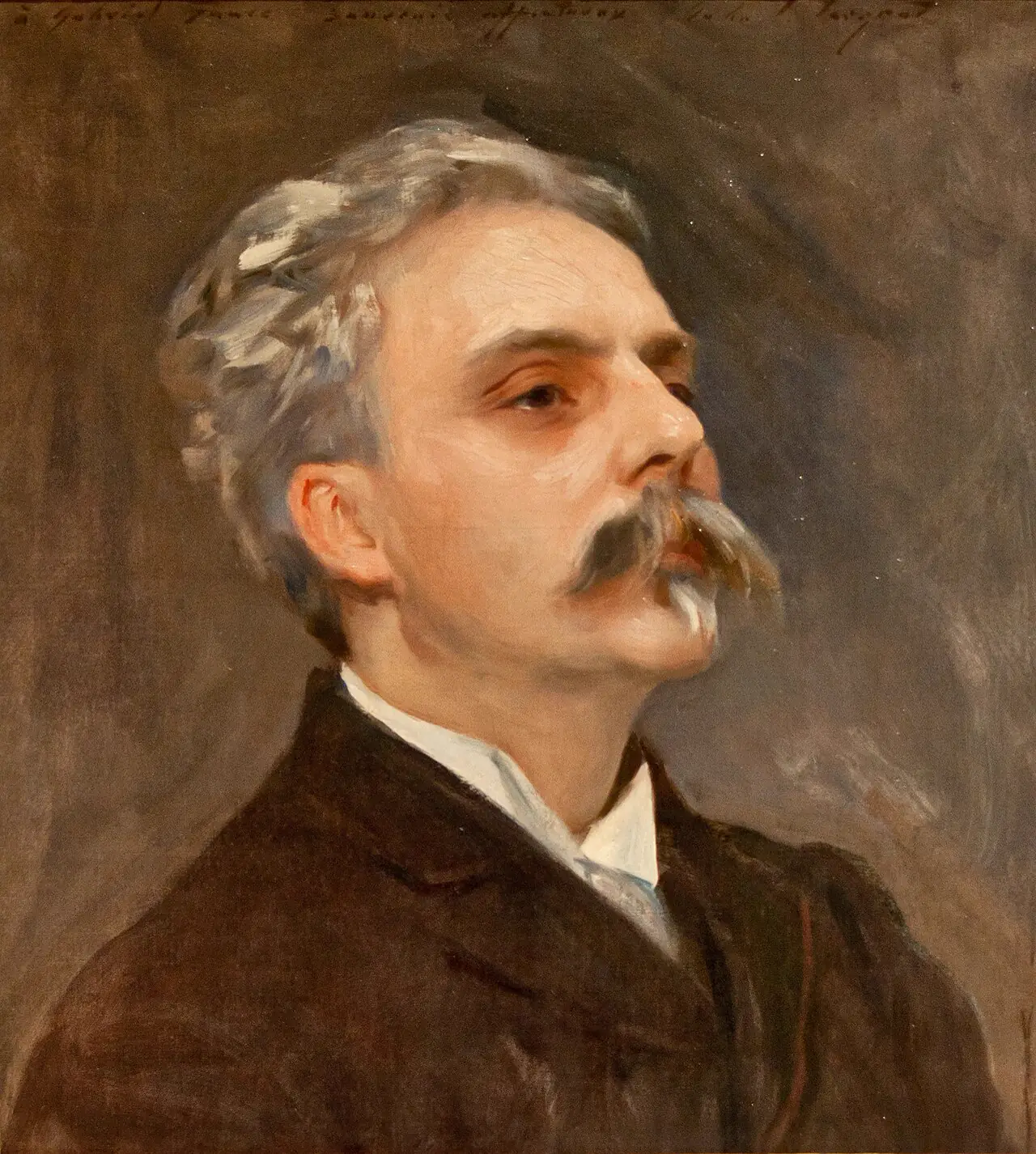
John Singer SargentGabriel Fauré, 1889Oil on canvas · Musée de la musique, Philharmonie de Paris
Sargent played the piano, admired Fauré and helped to bring his music to audiences in England. He inscribed this portrait to the composer as an affectionate souvenir. Fauré wears a black coat against a grey background, his face turned slightly away.
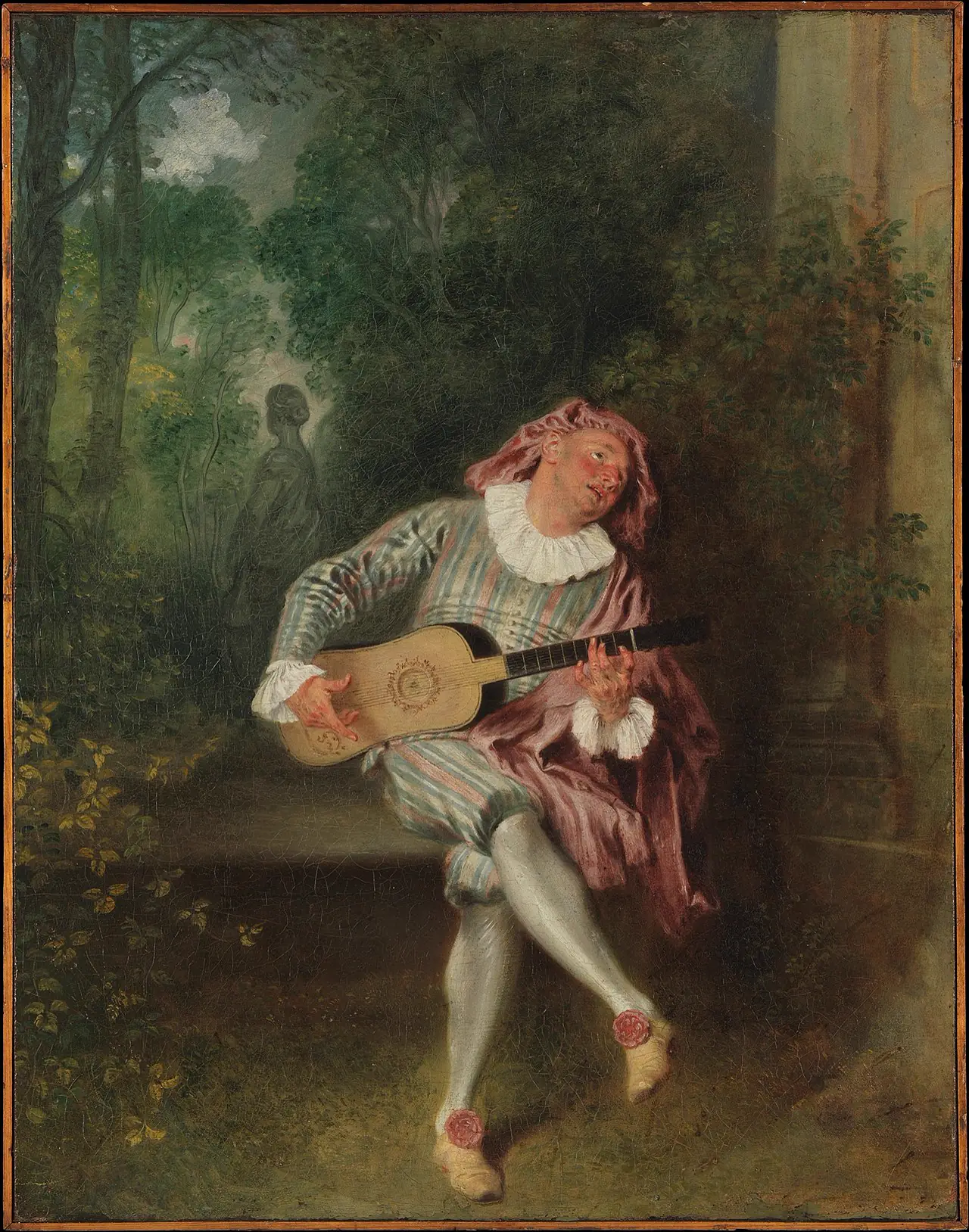
Antoine WatteauMezzetin, c. 1718–20Oil on canvas · The Metropolitan Museum of Art, New York
Mezzetin sings to his guitar; behind him a garden statue is turned away. Verlaine took the lovers and entertainers of Watteau’s paintings as the setting for Fêtes galantes. In Fauré’s Clair de lune the piano plays a minuet under the poem’s masked dancers, and the voice sings the lines about their sadness.
Paul Verlaine
Clair de lune
1869; set by Fauré in 1887
FrenchVotre âme est un paysage choisi
Que vont charmant masques et bergamasques,
Jouant du luth et dansant et quasi
Tristes sous leurs déguisements fantasques.
Tout en chantant sur le mode mineur
L’amour vainqueur et la vie opportune,
Ils n’ont pas l’air de croire à leur bonheur
Et leur chanson se mêle au clair de lune,
Au calme clair de lune triste et beau,
Qui fait rêver les oiseaux dans les arbres
Et sangloter d’extase les jets d’eau,
Les grands jets d’eau sveltes parmi les marbres.
Our translationYour soul is a chosen landscape
Which masks and bergamask dancers go enchanting,
Playing the lute and dancing and almost
Sad beneath their fanciful disguises.
While singing in the minor mode
Of conquering love and accommodating life,
They do not seem to believe in their happiness,
And their song mingles with the moonlight,
With the quiet moonlight, sad and beautiful,
Which makes the birds dream in the trees
And the fountains sob with ecstasy,
The tall, slender fountains among the marble statues.
Fauré set this poem in 1887 as Op. 46 No. 2. The piano starts the dance before the voice enters, then continues its own melody under the words. In Verlaine’s poem the revellers sing about happiness while scarcely believing in it, and the fountains sob.
Recommended recordings
RequiemVictoria de los Ángeles, Dietrich Fischer-Dieskau, Chœurs Élisabeth Brasseur, Orchestre de la Société des Concerts du Conservatoire, André CluytensEMI / WarnerRecommended for the soloists: de los Ángeles sings the Pie Jesu with a warm tone, and Fischer-Dieskau shapes every word. Cluytens takes slow tempos; the chorus is less tidy than on many newer recordings.
Piano Quartets Nos. 1 and 2DomusHyperionThe First Quartet’s scherzo is quick, with piano and pizzicato strings trading short phrases. The Second’s more urgent piano writing is played at full weight without covering the string lines.
Complete piano musicKathryn StottHyperionA generous, singing account, especially persuasive in the long phrases of the Sixth Nocturne. In the late nocturnes Stott keeps the bass always in play.
At the school, Saint-Saëns played Schumann, Liszt and Wagner to his pupils at the piano, and he later helped Fauré find work. Ravel, Koechlin, Schmitt and Nadia Boulanger all studied in Fauré’s class at the Conservatoire, and each went a different way. Ravel dedicated his String Quartet to Fauré in 1903. Twenty years later Fauré began a string quartet of his own.