Contrapunctus
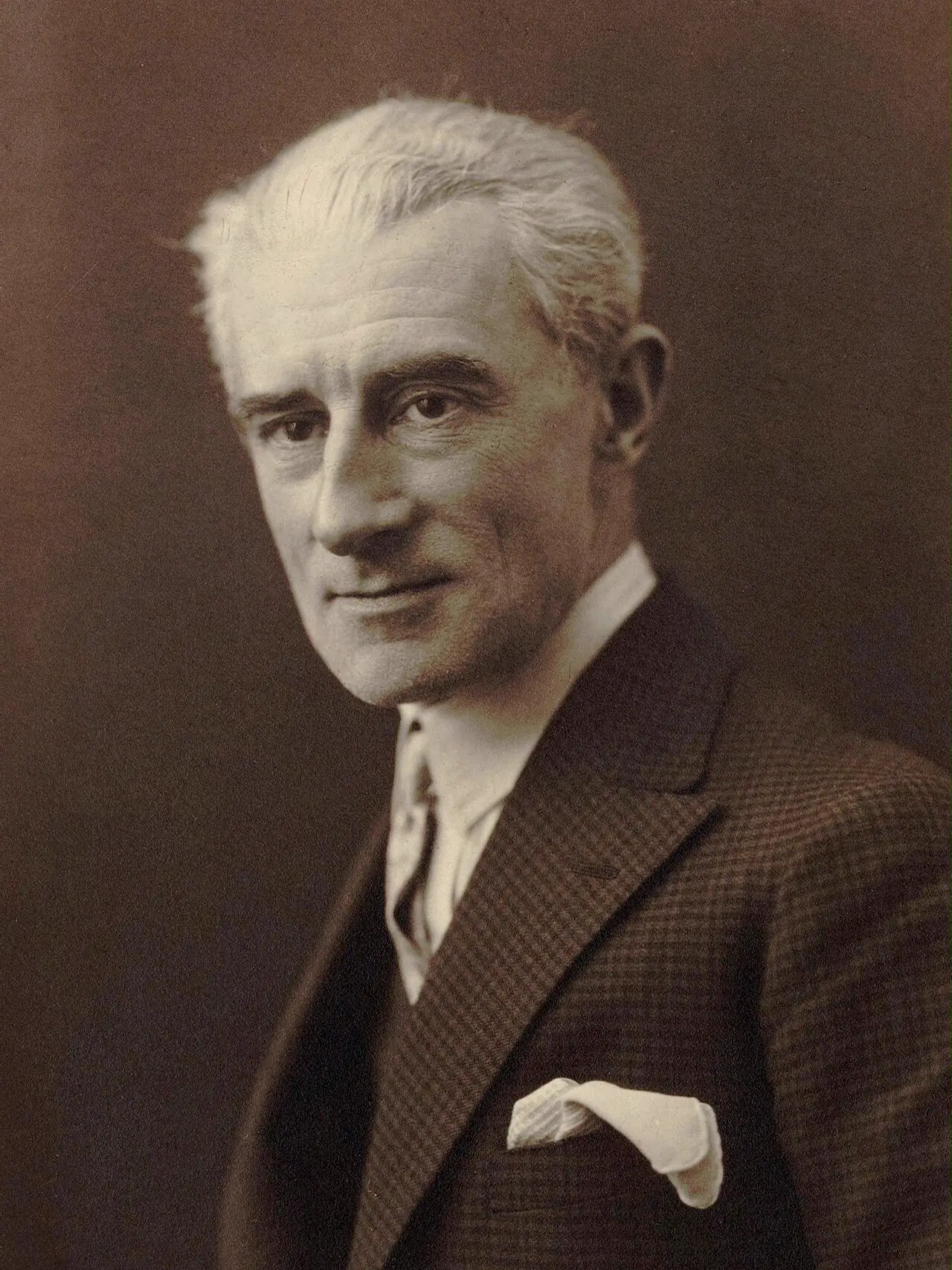
Portrait of Maurice Ravel
Maurice Ravel in 1925; photographer unknown. Bibliothèque nationale de France.

MauriceRavel

Born 7 March 1875, Ciboure, French Basque CountryDied 28 December 1937, Paris

Composer of a ballet built from two tunes and a snare drum, and of a suite of dances dedicated to his war dead.

Trained
Paris Conservatoire from 1889; Fauré for composition, André Gedalge for counterpoint
Friends
Ricardo Viñes · Maurice Delage · Tristan Klingsor · M. D. Calvocoressi
Home
Le Belvédère, Montfort-l’Amaury, 1921–⁠37; now a museum
Output
Two operas, two piano concertos, ballets, songs, chamber and piano music; no symphony
“Does it never occur to these people that I may be artificial by nature?”
— To M. D. Calvocoressi, recalled in his Musicians Gallery (1933)

Life

Ravel’s father took his sons to factories to see the machinery, and his mother sang to them. Pierre-⁠Joseph was a Swiss-born engineer; Marie Delouart was Basque and had grown up in Madrid. Maurice was born in Ciboure on 7 March 1875, and the family moved to Paris three months later. He went back to the Basque coast many times. Spain appears often in his music, in the plucked-guitar attacks of Alborada del gracioso, the habanera in the Rapsodie espagnole and the clocks of a Toledo clockmaker’s shop in L’heure espagnole.

1889–⁠1905Conservatoire, Apaches and Debussy

He entered the Paris Conservatoire at fourteen, studied piano with Charles-⁠Wilfrid de Bériot and lost his place in 1895 for failing to win the required prizes. André Gedalge gave him counterpoint lessons from 1897, and in January 1898 he entered the composition class of Fauré. Ricardo Viñes, his friend since adolescence, gave the first performances of Jeux d’eau, Miroirs and Gaspard de la nuit, pieces he could not have played himself with comparable command.

In 1902 Ravel attended every performance in the first run of Debussy’s Pelléas et Mélisande. The two men were friends, though never intimate. Their supporters then began arguing over who had invented what. Ravel’s Habanera dated from 1895 and his Jeux d’eau from 1901, both before Debussy’s Estampes. The comparisons soured the friendship. Ravel also helped support Lilly Debussy after her husband left her. His admiration for the music continued. “For Debussy the musician and the man I have had profound admiration,” he told an audience in Houston in 1928, “but by nature I am different from him.”

Ravel tried five times for the Prix de Rome. In 1901 he won a lesser prize; in 1905, with the Quartet and Jeux d’eau already published, he failed the preliminary round. Every one of the six candidates admitted to the final was a pupil of Charles Lenepveu, who sat on the jury. Pierre Lalo, usually a hostile critic, protested. Ravel spent part of that summer cruising the Rhine on the yacht of Misia and Alfred Edwards.

1901–⁠12Piano, chamber and orchestral works

Jeux d’eau, dedicated to Fauré, sets arpeggios over held bass notes. Liszt had shown a way; Ravel worked out his own fingering and pedalling. The five Miroirs, each dedicated to an Apache, range from solitary birdcalls to a boat pitched on immense waves. In Gaspard de la nuit he printed Bertrand’s poems beside the music. Ondine sings within the rippling chords, the bell of Le Gibet tolls the same B♭ throughout, and Scarbo moves abruptly between loud attacks and silence.

The String Quartet of 1902–⁠03 links its four movements through returning themes; its scherzo begins with all four players plucking, two against three. In the orchestral songs Shéhérazade, to poems by Klingsor, a traveller imagines Asia, a woman hears a flute through a wall, and a beautiful stranger declines an invitation.

In December 1907 the young Ralph Vaughan Williams arrived in Paris and took lessons from Ravel four or five times a week until the end of February. The Rapsodie espagnole was first played in March 1908 by Colonne’s orchestra at the Châtelet. Four years later Ravel took the piano part in the French première of Vaughan Williams’s On Wenlock Edge.

Ma mère l’Oye began as piano duets for the children of Cipa and Ida Godebski. Ravel drew on Perrault, Madame d’Aulnoy and Madame Leprince de Beaumont. Laideronnette, Empress of the Pagodas is built on a pentatonic scale to suggest an imagined China, and in the orchestration the Beast is given to a contrabassoon and, once he becomes a prince, to a solo violin. He expanded the suite into a ballet in 1912. On 8 June that year, Nijinsky and Karsavina danced Daphnis et Chloé for Diaghilev, with Fokine’s choreography, Bakst’s scenery and Pierre Monteux conducting. In his autobiographical sketch of 1928 Ravel said he had wanted “a vast musical fresco”, and that he had been concerned with “faithfully reproducing the Greece of my dreams” more than with archaism. A wordless chorus joins the orchestra. The daybreak scene is scored with rushing figures for water and birdsong in the woodwind, and the final dance is in five beats to the bar.

His other stage work was a smaller comedy. L’heure espagnole, composed in 1907 and staged in 1911, is set in a clockmaker’s shop, where the clockmaker’s wife entertains several would-be lovers. The men hide inside clocks, and a muleteer carries the clocks up and down the stairs.

1914–⁠19War and Le Tombeau de Couperin

The outbreak of war found him at Saint-⁠Jean-de-Luz, finishing his Piano Trio, which he described as “de couleur basque”. The opening divides eight quavers into 3+2+3, a rhythm that also appears in his sketches for Zazpiak-⁠Bat, a Basque piano concerto he abandoned. The scherzo takes the name Pantoum from a Malay verse form in which lines return; the slow movement is built on an eight-bar bass theme. He hurried to complete the trio so that he could enlist. Rejected for aviation service, he became a lorry driver and carried supplies near Verdun in 1916. Illness and an operation interrupted his service. His mother died in January 1917.

He refused to join the wartime league campaigning against contemporary German and Austrian music. French composers, he told its committee in 1916, would impoverish themselves by refusing to hear foreign colleagues. He had studied Schoenberg’s Pierrot lunaire and collaborated with Stravinsky on Mussorgsky’s Khovanshchina in 1913.

Le Tombeau de Couperin, begun before the war, was finished in the summer of 1917 at Lyons-la-Forêt, in the villa of Madame Fernand Dreyfus. Written in memory of the dead, it consists of a prelude, a fugue, dances and a toccata. The piano writing calls for a light touch. Long gave the first performance of the piano suite in 1919. Ravel orchestrated four movements that year and gave the prelude’s quick notes to the oboe, in an exposed part. Rhené-⁠Baton conducted the première of the orchestral version in February 1920.

1920–⁠28Le Belvédère and La Valse

Diaghilev rejected La Valse in 1920; Camille Chevillard conducted the Lamoureux Orchestra in its concert première that December. The music opens on low rumblings in the orchestra, out of which a Viennese ballroom takes shape; the waltz fills out and then breaks apart. Ravel had conceived the project before the war. In 1922 he told Maurice Emmanuel that it expressed “an upward progression of sound”, to which the stage would add light and movement. The score places its imperial court around 1855.

At Le Belvédère, the house he bought in Montfort-l’Amaury in 1921, he collected mechanical toys and coffee cups with holes. “Does it never occur to these people that I may be artificial by nature?” Calvocoressi recalled him asking, in his 1933 memoir. In the Sonata for Violin and Cello the two instruments do the work of an ensemble. His 1922 orchestration of Mussorgsky’s Pictures at an Exhibition, commissioned by Koussevitzky, gives the old castle a saxophone and the ox-cart a high tuba solo.

Colette wrote the libretto of L’Enfant et les sortilèges, with its disobedient child and talking furniture; the opera was first performed in Monte Carlo in 1925 under Victor de Sabata. The score includes a foxtrot, coloratura writing and imitations of animal cries, and at the end the child binds an injured squirrel’s paw. The Chansons madécasses followed. They set Parny’s poems of desire and colonial violence for voice, flute, cello and piano.

Jazz was already in his Violin Sonata before his North American tour of 1928. On 7 March, his fifty-third birthday, he was at Eva Gauthier’s home in New York with Gershwin among the guests; the next day he recommended Gershwin to Nadia Boulanger. That year Ida Rubinstein commissioned Boléro. When plans to orchestrate Albéniz’s Iberia fell through, Ravel made a ballet from two tunes and a two-bar pattern on the snare drum. Nijinska put Rubinstein on a tavern table. On the night of the Opéra première, 22 November 1928, Ravel was in Madrid, on a concert tour of Spain and Portugal. The orchestra grows, the pulse stays steady, and near the end the music moves abruptly from C major to E major. Toscanini conducted the concert première in New York in November 1929; in January 1930 Ravel recorded the piece with the Lamoureux Orchestra, which Albert Wolff had prepared.

1929–⁠37The two piano concertos

Paul Wittgenstein, who had lost his right arm in the war, commissioned the Left-⁠Hand Concerto. It begins low in the strings and contrabassoon, and the soloist enters with a cadenza only after a long orchestral climb. Ravel told Calvocoressi he wanted to avoid “the impression of insufficient weight in the sound-texture” beside a two-handed solo. The piano part leaps between bass and melody while the pedal holds the notes together. Ravel noted that the later “jazz section” is built from the themes of the first section. Wittgenstein gave the first performance in Vienna on 5 January 1932. In Paris that month, Marguerite Long introduced the Concerto in G with Ravel conducting, and the two toured it across Europe until May. In Vienna in February, Ravel heard Wittgenstein play the Left-⁠Hand Concerto with a second piano in place of the orchestra, and was scandalised. Between the jazz-inflected outer movements of the G major Concerto is an Adagio in E major, in which the piano plays alone at length before passing its melody to the cor anglais.

Don Quichotte à Dulcinée sets three poems by Paul Morand: a Chanson romanesque in the form of a guajira, a Chanson épique in the form of a Basque zortziko, and a Chanson à boire in the form of an Aragonese jota. The cycle was written for a Chaliapin film, which used Ibert’s music instead. It was Ravel’s last completed composition, and his dispute with the film company reached court in June 1933. Martial Singher sang the première of the orchestral version on 1 December 1934. A few days earlier Ravel had conducted Boléro at the Opéra-⁠Comique, his last known appearance as a conductor. A neurological illness gradually left him unable to write or play. In tests with Théophile Alajouanine and Manuel Rosenthal he could still detect mistakes in his music and hear when a piano was out of tune. Clovis Vincent operated on his brain in December 1937. Ravel died on the 28th, aged sixty-two.

Places

A map of Maurice Ravel’s recorded places; numbers correspond to the list below.
Every recorded place, joined in date order. Ravel on the Map
All 170 places, with sources
  1. Paris · 1875–⁠1880 · childhood

    Family home at 40 rue des Martyrs after leaving Ciboure.

    Maurice-⁠Ravel.net: residences and birthplace
  2. Ciboure · 7 March 1875 · born

    Born at 12 rue du Quai, now 27 quai Maurice-⁠Ravel.

    Maurice-⁠Ravel.net: residences and birthplace
  3. Paris · 1880–⁠1886 · childhood

    The family lived at 29 rue de Laval, now rue Victor-⁠Massé.

    Maurice-⁠Ravel.net: residences and birthplace

  4. Paris · 1886–⁠1896 · lived

    Lived at 73 rue Pigalle.

    Maurice-⁠Ravel.net: residences and birthplace

  5. Paris · 1889–⁠1903 · studied

    Studied piano and composition at the Conservatoire, including Fauré’s class; later continued as an auditor.

    Wikipedia: Maurice Ravel

  6. Paris · 1889 · heard

    Heard Russian music at the Exposition Universelle, including Rimsky-⁠Korsakov’s concerts.

    Wikipedia: Maurice Ravel

  7. Paris · 1896–⁠1899 · lived

    Lived at 15 rue Lagrange.

    Maurice-⁠Ravel.net: residences and birthplace

  8. Paris · April 1898 · premiere

    Ricardo Viñes premiered the original piano version. Menuet antique.

    Wikipedia: Menuet antique

  9. Paris · 1899–⁠1900 · lived

    Lived at 7 rue Fromentin.

    Maurice-⁠Ravel.net: residences and birthplace

  10. Paris · 1900–⁠1901 · lived

    Lived at 40 bis rue de Douai.

    Maurice-⁠Ravel.net: residences and birthplace

  11. Paris · 1901–⁠1904 · lived

    Lived at 19 boulevard Péreire.

    Maurice-⁠Ravel.net: residences and birthplace

  12. Opéra-⁠Comique Paris · 1902 · heard

    Attended Debussy’s Pelléas et Mélisande repeatedly and admired its treatment of voice and language. Pelléas et Mélisande (Debussy).

    Wikipedia: Maurice Ravel

  13. Salle Pleyel, rue Rochechouart, Paris · 5 April 1902 · premiere

    Viñes premiered Jeux d’eau and the Pavane at the original, pre-1927 Pleyel hall. Jeux d’eau; Pavane pour une infante défunte.

    Wikipedia: Jeux d’eau · Wikipedia: Salle Pleyel

  14. Levallois-⁠Perret · 1904–⁠1908 · lived

    Lived at 11 rue Chevallier, now rue Louis-⁠Rouquier.

    Maurice-⁠Ravel.net: residences and birthplace

  15. Paris · 1904 · premiere

    Jane Hatto sang the first performance of the orchestral song cycle. Shéhérazade.

    Maurice-⁠Ravel.net: Shéhérazade

  16. Schola Cantorum de Paris · March 1904 · premiere

    The Heymann Quartet introduced the String Quartet. String Quartet.

    Maurice-⁠Ravel.net: String Quartet

  17. Soissons · June 1905 – July 1905 · travelled

    Joined Misia and Alfred Edwards aboard the yacht Aimée after the Prix de Rome controversy.

    Maurice-⁠Ravel.net: Germany and the yacht Aimée

  18. Liège · June 1905 – July 1905 · travelled

    Stopped in Liège on the yacht’s route through Belgium.

    Maurice-⁠Ravel.net: Germany and the yacht Aimée

  19. Amsterdam · June 1905 – July 1905 · travelled

    Spent a week in Amsterdam during the Aimée voyage.

    Maurice-⁠Ravel.net: Germany and the yacht Aimée

  20. Düsseldorf · June 1905 – July 1905 · travelled

    Encountered the industrial Rhineland during the yacht voyage.

    Maurice-⁠Ravel.net: Germany and the yacht Aimée

  21. Cologne · June 1905 – July 1905 · travelled

    Stopped at Cologne while ascending the Rhine aboard Aimée.

    Maurice-⁠Ravel.net: Germany and the yacht Aimée

  22. Koblenz · June 1905 – July 1905 · travelled

    Visited Koblenz on the upstream journey toward Frankfurt.

    Maurice-⁠Ravel.net: Germany and the yacht Aimée

  23. Frankfurt am Main · June 1905 – July 1905 · travelled

    Visited the museum and old town at the voyage’s furthest German destination.

    Maurice-⁠Ravel.net: Germany and the yacht Aimée

  24. Dordrecht · June 1905 – July 1905 · travelled

    Stopped at Dordrecht on the return voyage through the Netherlands.

    Maurice-⁠Ravel.net: Germany and the yacht Aimée

  25. Veere · June 1905 – July 1905 · travelled

    Visited Veere during the yacht’s return through Zeeland.

    Maurice-⁠Ravel.net: Germany and the yacht Aimée

  26. Middelburg, Zeeland · June 1905 – July 1905 · travelled

    Stopped at Middelburg on the return voyage.

    Maurice-⁠Ravel.net: Germany and the yacht Aimée

  27. Vlissingen · June 1905 – July 1905 · travelled

    Visited Vlissingen before the voyage followed the Belgian coast.

    Maurice-⁠Ravel.net: Germany and the yacht Aimée

  28. Ostend · June 1905 – July 1905 · travelled

    Stopped at Ostend on the Belgian coastal leg of the voyage.

    Maurice-⁠Ravel.net: Germany and the yacht Aimée

  29. Le Havre · June 1905 – July 1905 · travelled

    Returned to France at Le Havre at the end of the Aimée voyage.

    Maurice-⁠Ravel.net: Germany and the yacht Aimée

  30. Salle Érard · January 1906 · premiere

    Ricardo Viñes premiered the complete piano cycle. Miroirs.

    Maurice-⁠Ravel.net: Miroirs

  31. Lyon · 10 March 1906 · premiere

    Paule de Lestang gave the first complete performance of Sonatine. Sonatine.

    Wikipedia: Sonatine (Ravel) · Geographic coordinates: Lyon

  32. Hermance · August 1906 · travelled

    Holidayed with his father in Hermance.

    Maurice-⁠Ravel.net: travel chronology

  33. Paris · 22 February 1907 · premiere

    Introduction et allegro received its first public performance. Introduction et allegro.

    Maurice-⁠Ravel.net: Introduction et allegro

  34. Paris · 1908–⁠1917 · lived

    Family home at 4 avenue Carnot.

    Maurice-⁠Ravel.net: residences and birthplace

  35. Théâtre du Châtelet Paris · March 1908 · premiere

    The Concerts Colonne introduced Rapsodie espagnole. Rapsodie espagnole.

    Maurice-⁠Ravel.net: Rapsodie espagnole

  36. Salle Érard · 9 January 1909 · premiere

    Ricardo Viñes premiered Gaspard de la nuit. Gaspard de la nuit.

    Maurice-⁠Ravel.net: Gaspard de la nuit

  37. London · 25 April 1909 · travelled

    Made his first concert appearance abroad, performing his own music.

    Maurice-⁠Ravel.net: travel chronology

  38. Salle Gaveau Paris · 20 April 1910 · premiere

    Jeanne Leleu and Geneviève Durony premiered the four-hand suite. Ma mère l’Oye, piano duet.

    Wikipedia: Ma mère l’Oye

  39. London · January 1911 · travelled

    Performed on the January British concert tour.

    Maurice-⁠Ravel.net: travel chronology

  40. Newcastle upon Tyne · January 1911 · travelled

    Visited Newcastle on the January concert tour.

    Maurice-⁠Ravel.net: travel chronology

  41. Edinburgh · January 1911 · travelled

    Visited Edinburgh on the January concert tour.

    Maurice-⁠Ravel.net: travel chronology

  42. Manchester · 27 February 1911 · premiere

    Henry Wood conducted the first performance of Ravel’s orchestral Pavane. Pavane pour une infante défunte, orchestral version.

    Wikipedia: Pavane pour une infante défunte

  43. Opéra-⁠Comique Paris · May 1911 · premiere

    The Opéra-⁠Comique introduced his first opera, L’Heure espagnole. L’Heure espagnole.

    Wikipedia: Maurice Ravel

  44. Salle Gaveau Paris · 9 May 1911 · premiere

    Louis Aubert premiered Valses nobles et sentimentales. Valses nobles et sentimentales.

    Maurice-⁠Ravel.net: Valses nobles et sentimentales

  45. Hondarribia · 13 October 1911 · travelled

    Wrote from Fuenterrabía near the end of his Basque holiday.

    Maurice-⁠Ravel.net: Spain

  46. Théâtre Hébertot · 29 January 1912 · premiere

    Gabriel Grovlez conducted Ma mère l’Oye at the venue then called Théâtre des Arts. Ma mère l’Oye, ballet.

    Wikipedia: Ma mère l’Oye

  47. Théâtre du Châtelet Paris · 8 June 1912 · premiere

    The Ballets Russes premiered Daphnis et Chloé with Nijinsky and Karsavina. Daphnis et Chloé.

    Maurice-⁠Ravel.net: Daphnis et Chloé

  48. Clarens Switzerland · March 1913 – April 1913 · worked

    Worked with Stravinsky on the orchestration of Mussorgsky’s Khovanshchina. Khovanshchina, revised orchestration.

    Maurice-⁠Ravel.net: travel chronology

  49. Thorpe-le-Soken · 13 December 1913 – 17 December 1913 · travelled

    Visited novelist Arnold Bennett at his Thorpe-le-Soken home.

    Maurice-⁠Ravel.net: travel chronology

  50. Saint-⁠Jean-de-Luz · 1914 · worked

    Completed the Piano Trio as war began. Piano Trio.

    Wikipedia: Maurice Ravel

  51. Salle Érard · 14 January 1914 · premiere

    Jane Bathori sang Trois poèmes de Stéphane Mallarmé under Inghelbrecht. Trois poèmes de Stéphane Mallarmé.

    Maurice-⁠Ravel.net: Trois poèmes de Stéphane Mallarmé

  52. Geneva · April 1914 · travelled

    Visited Geneva for a concert engagement.

    Maurice-⁠Ravel.net: travel chronology

  53. Paris · 1915 · premiere

    The Piano Trio received its first public performance. Piano Trio.

    Wikipedia: Maurice Ravel

  54. Verdun · 1916 · worked

    Served near Verdun as an army lorry driver.

    Wikipedia: Maurice Ravel

  55. Paris · 1917 · lived

    Convalesced with the Dreyfuses at 1 rue de Chazelles after military service.

    Maurice-⁠Ravel.net: temporary homes, 1917–⁠1920

  56. Lyons-la-Forêt · June 1917 – November 1917 · lived

    Stayed at Le Frêne and completed Le Tombeau de Couperin. Le Tombeau de Couperin.

    Maurice-⁠Ravel.net: temporary homes, 1917–⁠1920

  57. Saint-⁠Cloud · June 1918 – November 1918 · lived

    Stayed at 7 avenue Léonie and composed Frontispice. Frontispice.

    Maurice-⁠Ravel.net: temporary homes, 1917–⁠1920

  58. Megève · November 1918 – April 1919 · lived (inferred)

    Wintered at the Hôtel Mont-⁠Blanc; the arrival and departure months are approximate.

    Maurice-⁠Ravel.net: temporary homes, 1917–⁠1920

  59. Salle Gaveau Paris · 11 April 1919 · premiere

    Marguerite Long premiered Le Tombeau de Couperin. Le Tombeau de Couperin, piano version.

    Wikipedia: Le Tombeau de Couperin

  60. Saint-⁠Cloud · May 1919 – September 1919 · lived

    Returned to 7 avenue Léonie while seeking a permanent home.

    Maurice-⁠Ravel.net: temporary homes, 1917–⁠1920

  61. Lamastre · December 1919 – April 1920 · lived (inferred)

    Completed La Valse at Hérold’s Lapras home; marker is nearby Lamastre. La Valse.

    Maurice-⁠Ravel.net: temporary homes, 1917–⁠1920

  62. Paris · February 1920 · premiere

    Rhené-⁠Baton and the Pasdeloup Orchestra introduced the four-movement orchestral version. Le Tombeau de Couperin, orchestral version.

    Wikipedia: Le Tombeau de Couperin

  63. Châteauneuf-en-Thymerais · May 1920 – August 1920 · lived

    Stayed with Haour at La Bijeannette and worked on the Violin and Cello Sonata. Sonata for Violin and Cello.

    Maurice-⁠Ravel.net: temporary homes, 1917–⁠1920

  64. Vienna · October 1920 · travelled

    Made his first recorded visit to Vienna.

    Maurice-⁠Ravel.net: travel chronology

  65. Théâtre du Châtelet Paris · December 1920 · premiere

    Camille Chevillard conducted the orchestral premiere of La Valse. La Valse.

    Maurice-⁠Ravel.net: La Valse

  66. Le Belvédère, Montfort-l’Amaury · 1921–⁠1937 · lived

    Made Le Belvédère his permanent home and composed his late works there.

    Maurice-⁠Ravel.net: residences and birthplace

  67. ATN Hôtel, Paris · 1921–⁠1932 · lived

    Regular Paris pied-à-terre at 21 rue d’Athènes, opposite the Godebskis’ apartment.

    ATN Hôtel: Ravel’s Paris residence, 1921–⁠1932

  68. Brussels · February 1921 · travelled

    Visited Brussels for a performance of L’Heure espagnole. L’Heure espagnole.

    Maurice-⁠Ravel.net: travel chronology

  69. Salle Pleyel, rue Rochechouart, Paris · 6 April 1922 · premiere

    Hélène Jourdan-⁠Morhange and Maurice Maréchal premiered the Violin and Cello Sonata. Sonata for Violin and Cello.

    Maurice-⁠Ravel.net: Sonata for Violin and Cello · Wikipedia: Salle Pleyel

  70. Lyons-la-Forêt · May 1922 – September 1922 · lived

    Returned to Le Frêne and orchestrated Mussorgsky’s Pictures at an Exhibition. Pictures at an Exhibition, Ravel orchestration.

    Maurice-⁠Ravel.net: temporary homes, 1917–⁠1920

  71. London · June 1922 – July 1922 · worked

    Recorded piano rolls in June; performed at Lady Rothermere’s concert in July.

    Maurice-⁠Ravel.net: travel chronology

  72. Amsterdam · September 1922 · travelled

    Visited Amsterdam for musical engagements.

    Maurice-⁠Ravel.net: travel chronology

  73. Paris · 19 October 1922 · premiere

    Koussevitzky introduced Ravel’s orchestration of Mussorgsky’s Pictures at an Exhibition. Pictures at an Exhibition, Ravel orchestration.

    Wikipedia: Pictures at an Exhibition

  74. Milan · November 1922 · travelled

    Visited Milan on an Italian concert journey.

    Maurice-⁠Ravel.net: travel chronology · Wikipedia: Milan

  75. Venice · November 1922 · travelled

    Visited Venice during the Italian journey.

    Maurice-⁠Ravel.net: travel chronology

  76. London · 1923 · travelled

    Returned for concert engagements in April and October.

    Maurice-⁠Ravel.net: travel chronology

  77. Rome · April 1923 · travelled

    Visited Rome during the Italian concert journey.

    Maurice-⁠Ravel.net: travel chronology

  78. Antwerp · April 1923 · travelled

    Performed in Antwerp during the April Belgian concert journey.

    Maurice-⁠Ravel.net: travel chronology

  79. Amsterdam · October 1923 · travelled

    Visited Amsterdam on the autumn Dutch concert tour.

    Maurice-⁠Ravel.net: travel chronology

  80. The Hague · October 1923 · travelled

    Visited The Hague on the autumn Dutch concert tour.

    Maurice-⁠Ravel.net: travel chronology

  81. Haarlem · October 1923 · travelled

    Visited Haarlem on the autumn Dutch concert tour.

    Maurice-⁠Ravel.net: travel chronology

  82. Rotterdam · November 1923 · travelled

    Returned to the Netherlands for Rotterdam engagements.

    Maurice-⁠Ravel.net: travel chronology

  83. Madrid · April 1924 – May 1924 · travelled

    Rehearsed in Madrid and conducted La Valse and his Debussy orchestrations on 4 May. La Valse.

    Maurice-⁠Ravel.net: Spain

  84. Aeolian Hall (London) · 26 April 1924 · premiere

    Jelly d’Arányi premiered the violin rhapsody Tzigane. Tzigane.

    Maurice-⁠Ravel.net: Tzigane

  85. Barcelona · 18 May 1924 · travelled

    Performed with Marcelle Gerar and the Trio Casadesus for the chamber-music association.

    Maurice-⁠Ravel.net: Spain

  86. Opéra de Monte-⁠Carlo · 21 March 1925 · premiere

    The Monte Carlo Opera premiered L’Enfant et les sortilèges. L’Enfant et les sortilèges.

    Wikipedia: Maurice Ravel

  87. Hamburg · 28 January 1926 · travelled

    Gave a concert with Louise Alvar during the northern European tour.

    Maurice-⁠Ravel.net: Germany and the yacht Aimée

  88. Copenhagen · 30 January 1926 – February 1926 · travelled

    Gave chamber and orchestral concerts, performing and conducting his music.

    Maurice-⁠Ravel.net: Scandinavia

  89. London · February 1926 · travelled

    Returned from Scandinavia for the British concert tour.

    Maurice-⁠Ravel.net: travel chronology

  90. Glasgow · February 1926 · travelled

    Visited Glasgow during the February British tour.

    Maurice-⁠Ravel.net: travel chronology

  91. Edinburgh · February 1926 · travelled

    Visited Edinburgh during the February British tour.

    Maurice-⁠Ravel.net: travel chronology

  92. Bridge of Allan · February 1926 · travelled

    Visited Bridge of Allan during the February British tour.

    Maurice-⁠Ravel.net: travel chronology

  93. Oslo · 6 February 1926 · travelled

    Appeared with the Oslo Philharmonic and presented chamber works.

    Maurice-⁠Ravel.net: Scandinavia

  94. Stockholm · 12 February 1926 · travelled

    Gave a concert during his only Scandinavian tour.

    Maurice-⁠Ravel.net: Scandinavia

  95. Milan · March 1926 · travelled

    Travelled to Milan for rehearsals.

    Maurice-⁠Ravel.net: travel chronology · Wikipedia: Milan

  96. American Academy in Rome · 8 May 1926 · premiere

    Jane Bathori sang the first performance of Chansons madécasses. Chansons madécasses.

    Maurice-⁠Ravel.net: Chansons madécasses

  97. Antwerp Opera vicinity · 2 October 1926 · premiere (inferred)

    Flemish Opera staged Sonia Korty’s ballet of La Valse; marker uses the opera information point. La Valse, first ballet production.

    Maurice-⁠Ravel.net: La Valse

  98. Bern · November 1926 · travelled

    Visited Bern during the late-November Swiss tour.

    Maurice-⁠Ravel.net: travel chronology

  99. Basel · November 1926 · travelled

    Visited Basel during the late-November Swiss tour.

    Maurice-⁠Ravel.net: travel chronology

  100. Geneva · November 1926 · travelled

    Visited Geneva during the late-November Swiss tour.

    Maurice-⁠Ravel.net: travel chronology

  101. Paris · 1927 · premiere

    George Enescu and Ravel premiered the G-major Violin Sonata. Violin Sonata No. 2.

    Maurice-⁠Ravel.net: Violin Sonata No. 2

  102. New York City · 4 January 1928 – 8 January 1928 · travelled

    Began the American tour here; returned repeatedly through 21 April.

    Maurice-⁠Ravel.net: American itinerary, 1928

  103. Boston · 9 January 1928 – 14 January 1928 · travelled

    Conducted the Boston Symphony in January; returned on 2 April.

    Maurice-⁠Ravel.net: American itinerary, 1928

  104. Chicago · 18 January 1928 – 21 January 1928 · travelled

    Presented his music during Chicago Symphony concert engagements.

    Maurice-⁠Ravel.net: American itinerary, 1928

  105. Cleveland, Ohio · 22 January 1928 – 26 January 1928 · travelled

    Visited Cleveland for concerts on the American tour.

    Maurice-⁠Ravel.net: American itinerary, 1928

  106. San Francisco · 1 February 1928 – 5 February 1928 · travelled

    Appeared in San Francisco during his West Coast concert engagements.

    Maurice-⁠Ravel.net: American itinerary, 1928

  107. Los Angeles · 6 February 1928 – 8 February 1928 · travelled

    Presented his music during the Los Angeles stop.

    Maurice-⁠Ravel.net: American itinerary, 1928

  108. Seattle · 13 February 1928 · travelled

    Gave a concert during the northwestern leg of his American tour.

    Maurice-⁠Ravel.net: American itinerary, 1928

  109. Vancouver · 14 February 1928 · travelled

    Crossed to Canada for a Vancouver concert.

    Maurice-⁠Ravel.net: American itinerary, 1928

  110. Portland, Oregon · 15 February 1928 · travelled

    Returned from Canada and performed in Portland.

    Maurice-⁠Ravel.net: American itinerary, 1928

  111. Denver · 19 February 1928 · travelled

    Performed in Denver after the Pacific Northwest engagements.

    Maurice-⁠Ravel.net: American itinerary, 1928

  112. Omaha, Nebraska · 21 February 1928 · travelled

    Stopped in Omaha for a concert on the eastbound journey.

    Maurice-⁠Ravel.net: American itinerary, 1928

  113. Minneapolis · 22 February 1928 · travelled

    Performed in Minneapolis before returning to New York.

    Maurice-⁠Ravel.net: American itinerary, 1928

  114. New York City · 7 March 1928 · heard

    At Éva Gauthier’s birthday party, heard Gershwin play and met the composer. Rhapsody in Blue; The Man I Love.

    Chicago Symphony Orchestra: when Ravel met Gershwin

  115. Kansas City, Missouri · 14 March 1928 · travelled

    Gave a Kansas City concert on the March leg of the tour.

    Maurice-⁠Ravel.net: American itinerary, 1928

  116. Toronto · 22 March 1928 · travelled

    Returned to Canada for a Toronto concert.

    Maurice-⁠Ravel.net: American itinerary, 1928

  117. Detroit · 29 March 1928 · travelled

    Gave a Detroit concert during the March tour.

    Maurice-⁠Ravel.net: American itinerary, 1928

  118. Phoenix, Arizona · April 1928 · travelled

    Visited Phoenix during the Arizona stop between Houston and Buffalo.

    Maurice-⁠Ravel.net: American itinerary, 1928

  119. Grand Canyon National Park · April 1928 · travelled

    Visited the Grand Canyon during the Arizona interlude.

    Maurice-⁠Ravel.net: American itinerary, 1928

  120. New Orleans · 5 April 1928 · travelled

    Visited New Orleans for a Southern concert engagement.

    Maurice-⁠Ravel.net: American itinerary, 1928

  121. Houston, Texas · 6 April 1928 – 7 April 1928 · travelled

    Gave Houston concerts during the April Southern leg.

    Maurice-⁠Ravel.net: American itinerary, 1928

  122. Buffalo, New York · 17 April 1928 · travelled

    Performed in Buffalo before the final Canadian engagement.

    Maurice-⁠Ravel.net: American itinerary, 1928

  123. Montreal · 19 April 1928 · travelled

    Gave his Montreal concert near the end of the American tour.

    Maurice-⁠Ravel.net: American itinerary, 1928

  124. Oxford · October 1928 · travelled

    Received an honorary doctorate from Oxford University.

    Maurice-⁠Ravel.net: travel chronology

  125. Bilbao · November 1928 · travelled

    Conducted the Bilbao symphony orchestra and attempted to address the musicians in Basque.

    Maurice-⁠Ravel.net: Spain

  126. Pamplona · November 1928 · travelled

    Visited Pamplona on the Spanish and Portuguese concert tour.

    Maurice-⁠Ravel.net: Spain

  127. Zaragoza · November 1928 · travelled

    Visited Zaragoza and the basilica of Nuestra Señora del Pilar.

    Maurice-⁠Ravel.net: Spain

  128. Valencia · November 1928 · travelled

    Gave a concert during the Spanish tour with Madeleine Grey and Claude Lévy.

    Maurice-⁠Ravel.net: Spain

  129. Granada · November 1928 · travelled

    Manuel de Falla presented the Granada concert.

    Maurice-⁠Ravel.net: Spain

  130. Málaga · November 1928 · travelled

    Gave a concert and caught a severe cold during the Málaga stay.

    Maurice-⁠Ravel.net: Spain

  131. Madrid · November 1928 · travelled

    Performed at the French embassy during the Iberian concert tour.

    Maurice-⁠Ravel.net: Spain

  132. Palais Garnier, Paris · 22 November 1928 · premiere

    Ida Rubinstein premiered Boléro while Ravel was touring Spain and Portugal. Boléro.

    Maurice-⁠Ravel.net: Boléro · Maurice-⁠Ravel.net: Spain · Wikipedia: Palais Garnier

  133. Porto · 24 November 1928 · travelled

    Presented his music with Madeleine Grey and Claude Lévy for Orpheon Portuense.

    Maurice-⁠Ravel.net: Portugal

  134. Vienna · February 1929 – March 1929 · travelled

    Returned to Vienna for musical engagements.

    Maurice-⁠Ravel.net: travel chronology

  135. Royal Opera House London · 7 July 1931 – 8 July 1931 · travelled

    Attended Covent Garden performances of his ballets.

    Maurice-⁠Ravel.net: travel chronology

  136. Antwerp · 1932 · travelled

    Conducted the G-major concerto for Marguerite Long on their European tour. Piano Concerto in G major.

    Wikipedia: Ravel Piano Concerto in G major, European tour

  137. Brussels · 1932 · travelled

    Conducted the G-major concerto for Marguerite Long on their European tour. Piano Concerto in G major.

    Wikipedia: Ravel Piano Concerto in G major, European tour

  138. Vienna · 1932 · travelled

    Conducted the G-major concerto for Marguerite Long on their European tour. Piano Concerto in G major.

    Wikipedia: Ravel Piano Concerto in G major, European tour

  139. Bucharest · 1932 · travelled

    Conducted the G-major concerto for Marguerite Long on their European tour. Piano Concerto in G major.

    Wikipedia: Ravel Piano Concerto in G major, European tour

  140. Prague · 1932 · travelled

    Conducted the G-major concerto for Marguerite Long on their European tour. Piano Concerto in G major.

    Wikipedia: Ravel Piano Concerto in G major, European tour

  141. London · 1932 · travelled

    Conducted the G-major concerto for Marguerite Long on their European tour. Piano Concerto in G major.

    Wikipedia: Ravel Piano Concerto in G major, European tour

  142. Warsaw · 1932 · travelled

    Conducted the G-major concerto for Marguerite Long on their European tour. Piano Concerto in G major.

    Wikipedia: Ravel Piano Concerto in G major, European tour

  143. Berlin · 1932 · travelled

    Conducted the G-major concerto for Marguerite Long on their European tour. Piano Concerto in G major.

    Wikipedia: Ravel Piano Concerto in G major, European tour

  144. Amsterdam · 1932 · travelled

    Conducted the G-major concerto for Marguerite Long on their European tour. Piano Concerto in G major.

    Wikipedia: Ravel Piano Concerto in G major, European tour

  145. Budapest · 1932 · travelled

    Conducted the G-major concerto for Marguerite Long on their European tour. Piano Concerto in G major.

    Wikipedia: Ravel Piano Concerto in G major, European tour

  146. Vienna · 5 January 1932 · premiere

    Paul Wittgenstein premiered the Left-⁠Hand Concerto with Robert Heger and the Vienna Symphony. Piano Concerto for the Left Hand.

    Wikipedia: Piano Concerto for the Left Hand (Ravel)

  147. Salle Pleyel Paris · 14 January 1932 · premiere

    Marguerite Long premiered the G-major concerto with Ravel conducting. Piano Concerto in G major.

    Wikipedia: Ravel Piano Concerto in G major

  148. San Sebastián · 28 August 1932 · travelled

    Attended the Basque celebration of his music at the Gran Kursaal.

    Maurice-⁠Ravel.net: Spain

  149. Basel · December 1932 · travelled

    Returned to Basel for a late concert engagement.

    Maurice-⁠Ravel.net: travel chronology

  150. Le Mont-⁠Pèlerin · February 1934 – April 1934 · lived

    Stayed at a Swiss clinic as his neurological illness worsened.

    Maurice-⁠Ravel.net: travel chronology

  151. Paris · December 1934 · premiere

    Martial Singher gave the first performance of Don Quichotte à Dulcinée. Don Quichotte à Dulcinée.

    Maurice-⁠Ravel.net: Don Quichotte à Dulcinée

  152. Telouet · 1935 · travelled

    Visited the Atlas mountain palace at Telouet during the Moroccan journey.

    Maurice-⁠Ravel.net: Morocco

  153. Madrid · February 1935 · travelled

    Revisited Madrid with Léon Leyritz while travelling toward Morocco.

    Maurice-⁠Ravel.net: Spain

  154. El Escorial · February 1935 · travelled

    Visited El Escorial on the outward journey to Morocco.

    Maurice-⁠Ravel.net: Spain

  155. Algeciras · February 1935 · travelled

    Took the ferry from Algeciras to Tangier with Léon Leyritz.

    Maurice-⁠Ravel.net: Spain

  156. Tangier · February 1935 · travelled

    Arrived by ferry; passed through Tangier again on the return from Fez.

    Maurice-⁠Ravel.net: Morocco

  157. Marrakesh · February 1935 – March 1935 · travelled

    Stayed at La Mamounia with Leyritz during the recuperative journey.

    Maurice-⁠Ravel.net: Morocco

  158. Fez, Morocco · March 1935 · travelled

    Visited Fez, its gardens and its old city with Leyritz.

    Maurice-⁠Ravel.net: Morocco

  159. Seville · March 1935 · heard

    Heard La Niña de los Peines sing cante jondo during the return journey.

    Maurice-⁠Ravel.net: Spain

  160. Córdoba, Spain · March 1935 · travelled

    Visited Córdoba while returning from Morocco through Andalusia.

    Maurice-⁠Ravel.net: Spain

  161. Burgos · March 1935 · travelled

    Stopped in Burgos on the return journey with Leyritz.

    Maurice-⁠Ravel.net: Spain

  162. Vitoria-⁠Gasteiz · March 1935 · travelled

    Visited Vitoria on the return through northern Spain.

    Maurice-⁠Ravel.net: Spain

  163. Pamplona · March 1935 · travelled

    Stayed in a hotel room formerly associated with Sarasate.

    Maurice-⁠Ravel.net: Spain

  164. Kasba Tadla · 10 March 1935 · travelled

    Continued from Marrakesh to Kasba Tadla before travelling on to Fez.

    Maurice-⁠Ravel.net: Morocco

  165. Bilbao · August 1935 · travelled

    Returned to Bilbao with Leyritz on his final Spanish holiday.

    Maurice-⁠Ravel.net: Spain

  166. Burgos · August 1935 · travelled

    Revisited Burgos during his final journey outside France.

    Maurice-⁠Ravel.net: Spain

  167. Pamplona · August 1935 · travelled

    Returned to Pamplona during the final Basque journey.

    Maurice-⁠Ravel.net: Spain

  168. Roncesvalles · August 1935 · travelled

    Visited Roncesvalles on his last journey outside France.

    Maurice-⁠Ravel.net: Spain

  169. Paris · 28 December 1937 · died

    Died after an unsuccessful brain operation.

    Wikipedia: Maurice Ravel

  170. Levallois-⁠Perret Cemetery · 30 December 1937 · buried

    Buried beside his parents in the family grave.

    Maurice-⁠Ravel.net: residences and birthplace

The Web of Influence

Influences

Teachers, encounters and borrowed music, each with its account and sources in the Web of Influence.

Influences received

Influences passed on

Ravel in the Web of Influence

The sound

Three-hand piano texture

A bass note rings under the pedal while a tune is played in the middle of the keyboard and quick notes move above it. Jeux d’eau and Ondine require the pianist to keep these three layers separate with two hands. The chords keep their added sevenths and ninths, so the harmony stays dense even in a passage held over one bass note.

Fixed note

The B♭ bell in Le Gibet continues to toll while the chords around it change. In the Prélude à la nuit of the Rapsodie espagnole, a descending four-note figure returns throughout the movement. Ravel often held a single note or a short phrase in place while the harmony around it changed.

Orchestration

In Boléro, a horn, celesta and two piccolos play the tune together at different pitches, reinforcing the horn’s overtones until they sound like a new instrument. Elsewhere Ravel gave an existing instrument an unexpected role. The contrabassoon plays the Beast in Ma mère l’Oye, and in his orchestration of Mussorgsky the melody of the old castle goes to an alto saxophone.

Dance and imbalance

The Piano Trio opens in 8/8, divided 3+2+3, with a shorter group in the middle. Daphnis et Chloé ends with a dance in 5/4. In La Valse, the three-beat ballroom rhythm takes increasingly violent accents until it comes apart. In Boléro the drum repeats its two bars while the orchestra adds more and more instruments on top.

Spanish idiom in the keyboard writing

In Alborada del gracioso the piano plucks, strums and repeats single notes in the manner of a guitarist; its central song is written in the style of an unaccompanied singer’s phrase. The Rapsodie espagnole incorporates Ravel’s 1895 Habanera. His last songs, Don Quichotte à Dulcinée, move from the guajira’s shifting groups of beats to a Basque zortziko, and use a jota for the drinking song.

Older forms and precise fingering

The Tombeau contains a three-part fugue and dances whose steps remain distinct under their ornaments. The Trio’s passacaglia begins with an eight-bar theme low in the piano and builds upwards through the strings. Ravel used these old forms throughout his life. The Menuet antique dates from 1895, and the title Valses nobles et sentimentales refers to Schubert.

Works

A selection from the composer’s works.

  1. 1899; orchestrated 1909
    Pavane pour une infante défunte (Pavane for a Dead Princess)Piano; later orchestra
    An imagined Spanish court, with a G major melody that returns between episodes. Ravel gave the opening of the orchestral version to a solo horn.
    Recordings in the Hall
  2. 1901
    Jeux d’eauPiano
    Ravel dedicated the piece to Fauré. It is built on two themes, and Ravel never orchestrated it. The water figuration is written for struck notes and the sustaining pedal.
  3. 1902–⁠03
    String Quartet in F majorTwo violins, viola and cello
    Themes from the opening return in all four movements. In the scherzo the quartet plays largely pizzicato, with groupings of two and three beats set against each other.
    Recordings in the Hall
  4. 1903
    ShéhérazadeVoice and orchestra; poems by Tristan Klingsor
    The three songs are about a dream of Asia, a flute heard through a wall and a refused invitation. The long Asie takes up more than half the cycle. An earlier orchestral overture has the same title.
  5. 1904–⁠05
    Miroirs (Mirrors)Piano
    Five pieces, each dedicated to a member of Les Apaches. Ravel orchestrated the boat on the ocean and the Spanish morning song; the moths, birds and bells remained piano pieces.
    Recordings in the Hall
  6. 1907–⁠08
    Rapsodie espagnoleOrchestra
    Prelude to the night, malagueña, habanera and fair. The Habanera had existed as a piece for two pianos since 1895; the descending four-note figure of the prelude returns later in the score.
  7. 1908
    Gaspard de la nuitPiano; after Aloysius Bertrand
    The three movements depict a water spirit, a gallows and a tormenting dwarf, and Bertrand’s poems are printed before them. In Le Gibet, placed between Ondine and Scarbo, a B♭ is repeated throughout.
    Recordings in the Hall
  8. 1908–⁠10; ballet 1911–⁠12
    Ma mère l’Oye (Mother Goose)Piano duet; orchestral suite and expanded ballet
    Written for the Godebski children, then orchestrated and enlarged into a ballet. Sleeping Beauty’s pavane and the fairy garden frame tales by Perrault, Madame d’Aulnoy and Madame Leprince de Beaumont.
    Recordings in the Hall
  9. 1909–⁠12
    Daphnis et ChloéBallet: large orchestra and wordless mixed chorus
    Diaghilev’s ballet of shepherds and pirates is Ravel’s largest orchestral score. Suite No. 2 takes the dawn, the lovers’ pantomime and the final dance in five beats from the complete ballet.
  10. 1914
    Piano Trio in A minorPiano, violin and cello
    Finished as war broke out. It has an opening in uneven Basque-inflected rhythm, a scherzo named after the Malay pantoum verse form, a passacaglia and a finale in changing metres. The strings often play far apart, with the piano in the register between them.
  11. 1914–⁠17; orchestrated 1919
    Le Tombeau de CouperinPiano; four-movement orchestral version
    Six piano movements bearing the names of seven men killed in the war. The orchestral version keeps the Prélude, Forlane, Menuet and Rigaudon; the Fugue and Toccata remain piano-only.
    Recordings in the Hall
  12. 1917–⁠25
    L’Enfant et les sortilèges (The Child and the Spells)One-act opera: soloists, chorus and orchestra; libretto by Colette
    A destructive child is confronted by the furniture, crockery and animals he has harmed. First performed in Monte Carlo in 1925 under Victor de Sabata.
  13. 1919–⁠20
    La ValseOrchestra; also versions for piano and for two pianos
    Waltzing couples are seen through clouds in an imperial ballroom around 1855. In a letter of 1922 to Maurice Emmanuel, Ravel rejected a political reading of the work’s collapse.
    Recordings in the Hall
  14. 1922
    Pictures at an Exhibition — orchestration of MussorgskyOrchestra, including alto saxophone, celesta, two harps and percussion
    Koussevitzky commissioned this orchestration of Mussorgsky’s 1874 piano suite. The solo trumpet in the Promenade, the saxophone in The Old Castle and the high tuba in Bydło were Ravel’s choices.
  15. 1928
    BoléroBallet for large orchestra, including saxophones and two snare drums
    Two tunes and a two-bar drum pattern, repeated through a long crescendo. After a long stretch in C major, the music turns to E major near the end. Nijinska’s production for Ida Rubinstein opened at the Paris Opéra on 22 November 1928.
    Recordings in the Hall
  16. 1929–⁠30
    Piano Concerto for the Left Hand in D majorLeft-hand piano and orchestra
    Commissioned by the war-wounded Paul Wittgenstein, who played the first performance in Vienna on 5 January 1932. Low strings and contrabassoon open a single movement in which the piano part carries bass, chords and melody with one hand and the pedal.
  17. 1929–⁠31
    Piano Concerto in G majorPiano and orchestra
    Dedicated to Marguerite Long, who gave the first performance in January 1932. The E major Adagio opens with a long piano solo; later the cor anglais plays the melody while the piano accompanies with running figuration.
  18. 1932–⁠33
    Don Quichotte à DulcinéeBaritone and piano or orchestra; poems by Paul Morand
    A lover’s pledge (a guajira), a prayer (a Basque zortziko) and a drinking song (an Aragonese jota), intended for Chaliapin’s film of Don Quixote. The film used Ibert’s music; these three songs became Ravel’s last completed work.

In the score

Short examples, engraved and playable.

Boléro, opening two barsThe snare drum’s twenty-four strokes

Quoted from bars 1–⁠2 of the first snare-drum part in the 1929 Durand score. There are ten strokes in the first bar and fourteen in the second, where the last beat changes from two quavers to two semiquaver triplets. The printed tempo is crotchet = 72. Playback substitutes one piano note for the unpitched drum.

Pavane pour une infante défunte, piano originalMelody held across the half-bar

The melody quoted from bars 1–⁠2 of the piano original, with accompaniment and slurs omitted. The first G lasts five quavers and is held across the middle of the bar before the melody moves on. The Henle excerpt shows the full piano writing. The playback uses a horn sound, the instrument Ravel later gave the melody in his orchestration.

Harmony workshop — schematicParallel major ninth chords

A schematic of parallel major-ninth chords. Every chord has a root, third, fifth, major seventh and ninth; the whole shape moves by a tone without changing its spacing. The F♯ and C♯ in the second chord already lie outside C major.

Piano Trio, first movement — rhythmic schematicEight quavers grouped three, two, three

A schematic of the Trio’s 3+2+3 grouping, with invented pitches and sustained notes to show where the accents fall. The short middle group places the last accent earlier. Ravel’s 8/8 differs from the 5/8 usual in the Basque zortziko.

Sister arts

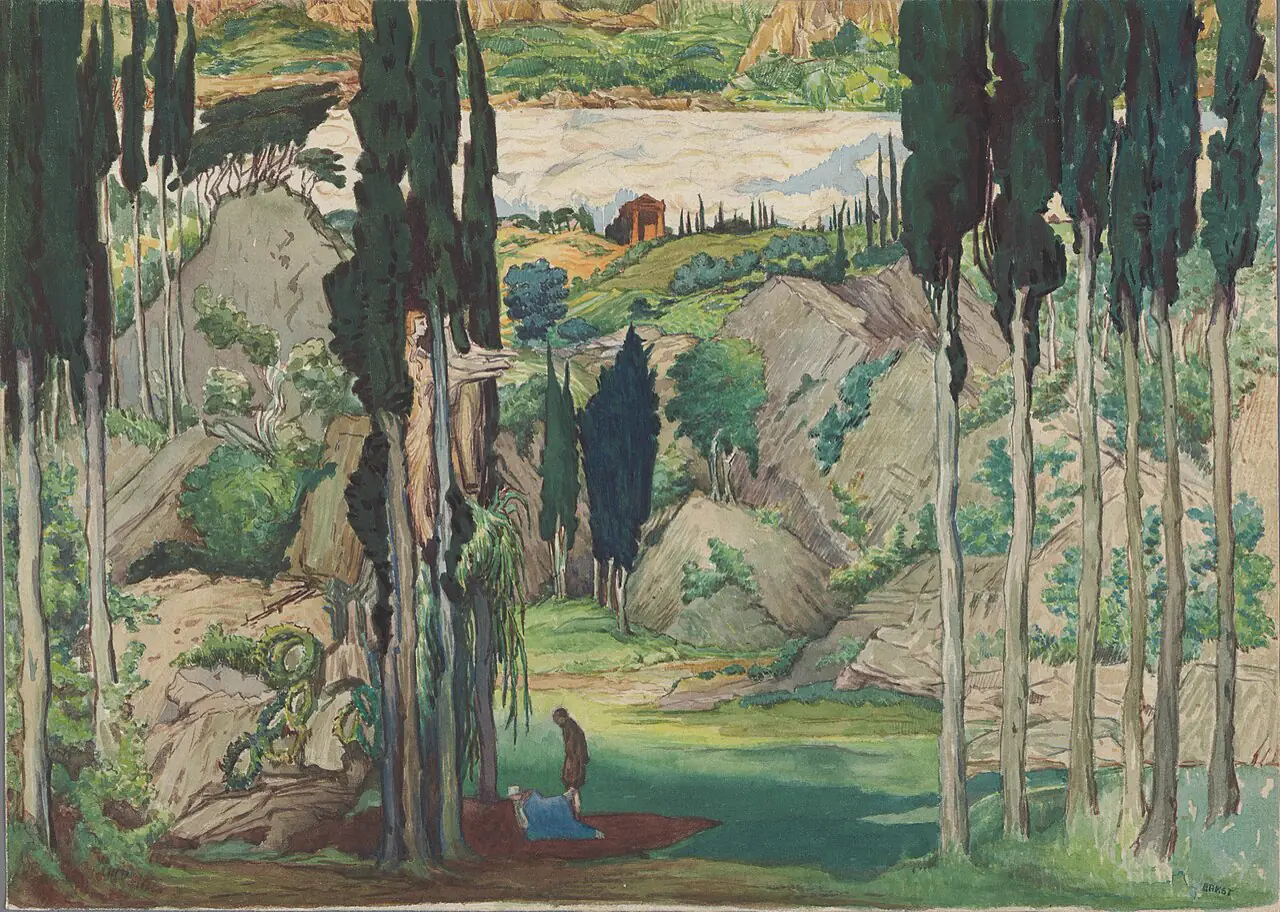
Léon Bakst, Set design for Act I of Daphnis et Chloé, 1912
Léon BakstSet design for Act I of Daphnis et Chloé, 1912Watercolour on paper · MS Thr 414.4 (9), Howard D. Rothschild Collection on Ballets Russes of Serge Diaghilev: Drawings and Prints, 1907–⁠1956, Harvard Theatre Collection, Houghton Library, Harvard University

Bakst’s trees are much taller than the two figures beside the water, and a small temple stands in the distance. This is his Act I set for the 1912 Daphnis et Chloé, made for the production in which Nijinsky and Karsavina danced the lovers. Ravel’s score includes a wordless chorus.

Aloysius Bertrand

Ondine — opening and closing paragraphs

1842; text from the 1895 edition
French— « Écoute ! — Écoute ! — C’est moi, c’est Ondine qui frôle de ces gouttes d’eau les losanges sonores de ta fenêtre illuminée par les mornes rayons de la lune ; et voici, en robe de moire, la dame châtelaine qui contemple à son balcon la belle nuit étoilée et le beau lac endormi. […] Et comme je lui répondais que j’aimais une mortelle, boudeuse et dépitée, elle pleura quelques larmes, poussa un éclat de rire, et s’évanouit en giboulées qui ruisselèrent blanches le long de mes vitraux bleus.
Our translation“Listen! — Listen! — It is I, Ondine, brushing these drops of water against the resonant diamond panes of your window, lit by the dull rays of the moon; and here, in a watered-silk dress, the lady of the castle watches from her balcony the beautiful starry night and the beautiful sleeping lake. […] And when I answered that I loved a mortal woman, sullen and vexed, she shed a few tears, burst out laughing, and vanished in showers that streamed white down my blue stained-glass windows.

Ondine taps on a man’s window, offers him her underwater kingdom and is rejected in favour of a mortal woman. She cries, laughs and turns into rain. Ravel printed Bertrand’s poem before the first movement of Gaspard de la nuit. Near the end of the movement the rapid water figuration stops briefly for an unaccompanied melodic line. The omitted paragraphs contain her invitation; the French follows the 1895 edition.

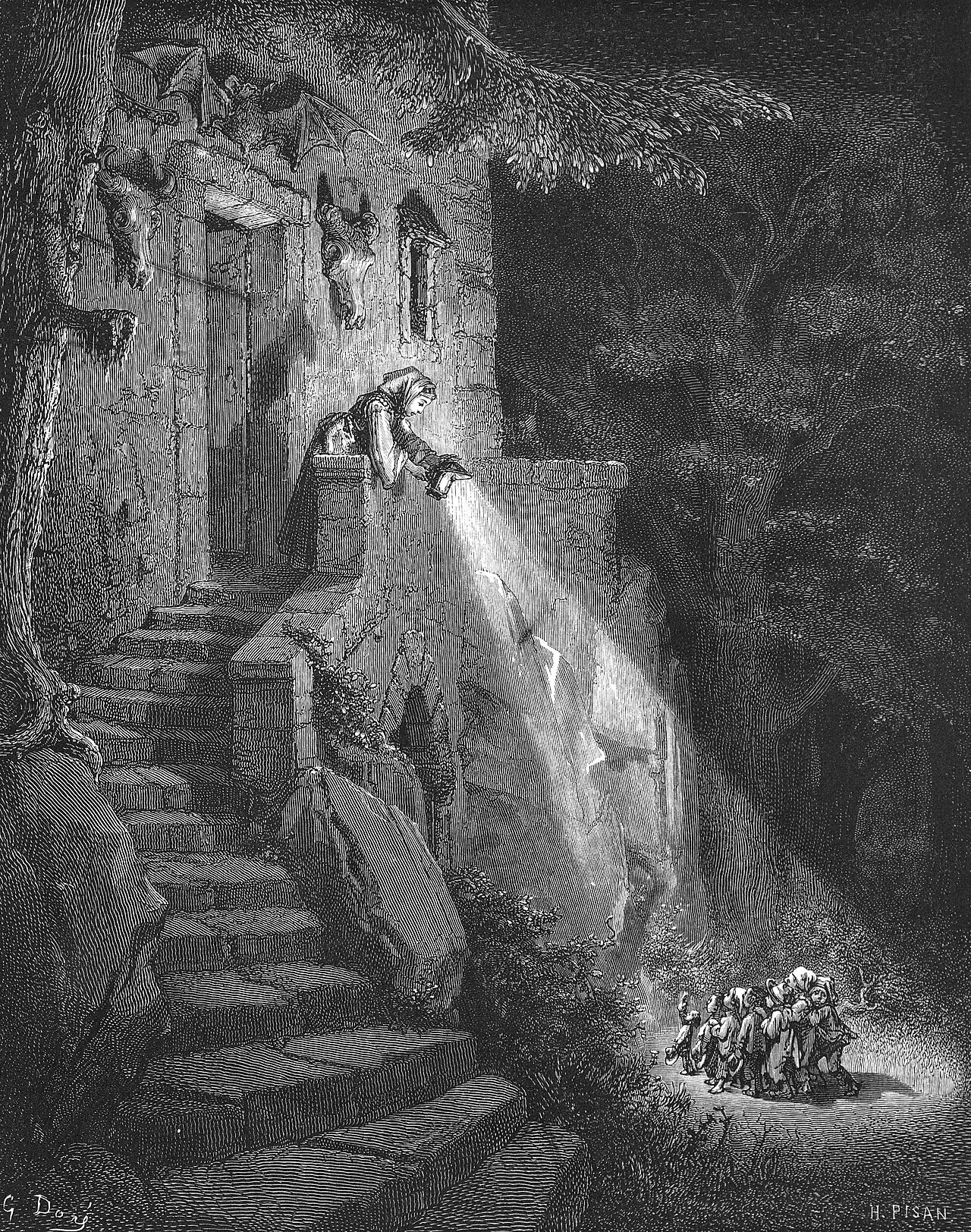
Gustave Doré, Le Petit Poucet: the children at the ogre’s door, 1867 edition
Gustave DoréLe Petit Poucet: the children at the ogre’s door, 1867 editionWood engraving after Doré; engraved by H. Pisan · Les Contes de Perrault, J. Hetzel, Paris; National Library of Poland

Doré shows Perrault’s seven children gathered under a lantern at the ogre’s door. For Petit Poucet Ravel set an earlier moment in the same tale, when the children try to find their way home after birds have eaten the trail of breadcrumbs. The phrases run through changing bar lengths, and birdcalls in the orchestra break in on them repeatedly.

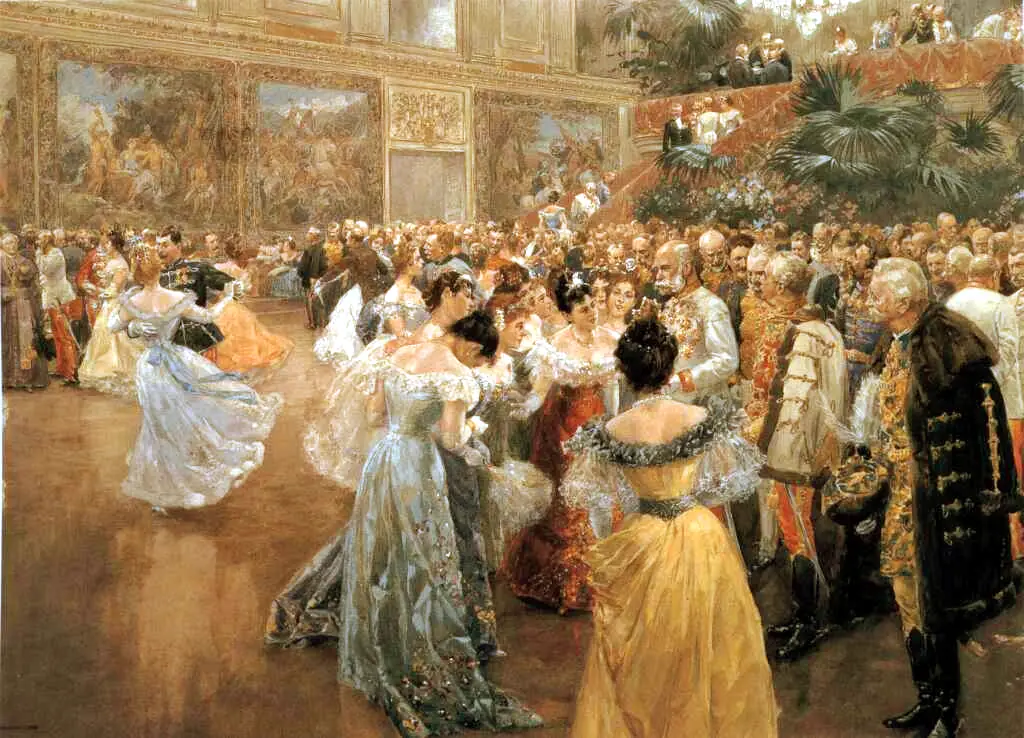
Wilhelm Gause, Court Ball in Vienna, 1900
Wilhelm GauseCourt Ball in Vienna, 1900Watercolour · Wien Museum, Vienna

Gause’s painting shows uniforms, chandeliers and a crowded floor in an imperial ballroom of the kind named in La Valse. Before the war Ravel had planned a tribute to Johann Strauss called Wien. In the finished score the couples first appear through clouds. By the end the three-beat dance rhythm has broken down.

Maurice Ravel

Preface to the score of La Valse

1920
FrenchDes nuées tourbillonnantes laissent entrevoir, par éclaircies, des couples de valseurs. Elles se dissipent peu à peu : on distingue une immense salle peuplée d’une foule tournoyante. La scène s’éclaire progressivement. La lumière des lustres éclate au ff. Une Cour impériale, vers 1855.
Our translationWhirling clouds give glimpses, through gaps, of waltzing couples. Little by little they scatter: one makes out an immense hall filled with a turning crowd. The stage grows gradually brighter. The light of the chandeliers bursts out at the ff. An imperial court, about 1855.

Ravel’s scenario includes a lighting cue: the chandeliers blaze at ff. The waltz begins much more quietly, with divided double basses and fragments in the bassoons. The dancers come into view gradually.

Recommended recordings

  • Piano Concerto in G majorMartha Argerich, Berlin Philharmonic, Claudio AbbadoDeutsche Grammophon · 1967Argerich and Abbado take the quick movements with strong rhythmic spring and keep the Adagio separate from them in pace and character. The original coupling was Prokofiev’s Third Concerto.
  • Daphnis et Chloé — complete balletLondon Symphony Orchestra, Royal Opera House Chorus, Pierre MonteuxDecca · 1959Monteux conducted the première in 1912. The recording includes the chorus and the long approach to the dawn; Douglas Robinson directs the singers.
  • BoléroOrchestre des Concerts Lamoureux, Maurice RavelPolydor · 1930Ravel conducted this recording, after Albert Wolff had prepared the orchestra, and it belongs beside any modern account. The original Polydor discs, 566030–⁠31, preserve the composer’s handling of the work’s long crescendo.
  • Gaspard de la nuitSamson François, pianoEMI · 1967François’s later stereo recording. His playing suits the sudden entrances and disappearances of Scarbo, one of Bertrand’s creatures.
  • ShéhérazadeRégine Crespin, Orchestre de la Suisse Romande, Ernest AnsermetDecca · 1963Crespin sings Asie with a large voice. Recorded in Geneva and coupled with Berlioz’s Les Nuits d’été, another cycle of French orchestral songs.
  • Piano Concerto for the Left HandKrystian Zimerman, London Symphony Orchestra, Pierre BoulezDeutsche Grammophon · 1996Zimerman keeps the piano’s changes of voice clear. This LSO performance is coupled with a G major Concerto recorded in Cleveland in 1994.
  • String Quartet in F majorQuatuor ÉbèneVirgin Classics · 2008Coupled with the quartets of Debussy and of Fauré, Ravel’s teacher, so that Ravel’s pizzicato scherzo is heard next to Debussy’s.

Lineage

Fauré and Gedalge taught him; Chabrier and Satie showed him that a short piece could have a distinct character. Liszt’s water music lies behind Jeux d’eau, and Couperin’s name heads the memorial suite. Ravel and Debussy admired each other before their supporters made a rivalry of it.

Vaughan Williams studied with Ravel in 1907–⁠08; Manuel Rosenthal became both pupil and interpreter. Gershwin asked for lessons and was refused, Ravel wanting him to remain himself. The later links to Messiaen and Boulez concern particular chords and instrumental sounds; Boulez’s recordings show his sustained engagement with Ravel.

Further reading

  • Roger Nichols, Ravel (Yale University Press, 2013 paperback). biography

    A biography based on written and oral evidence, including testimony from the composer’s associates.

  • Arbie Orenstein, ed., A Ravel Reader (Dover, 2003). letters

    Documents, correspondence and interviews.

  • Deborah Mawer, ed., The Cambridge Companion to Ravel (Cambridge University Press, 2000). survey

    Discusses piano, chamber, orchestral and stage works, with chapters on performance and early recordings.

Cite this page

Contrapunctus. “Maurice Ravel.” Accessed 20 October 2026. https://mottopanikeiku.github.io/contrapunctus/composers/ravel.html.

@misc{contrapunctus-composers-ravel,
  author = {{Contrapunctus}},
  title = {Maurice Ravel},
  howpublished = {\url{https://mottopanikeiku.github.io/contrapunctus/composers/ravel.html}},
  note = {Accessed 2026-10-20}
}