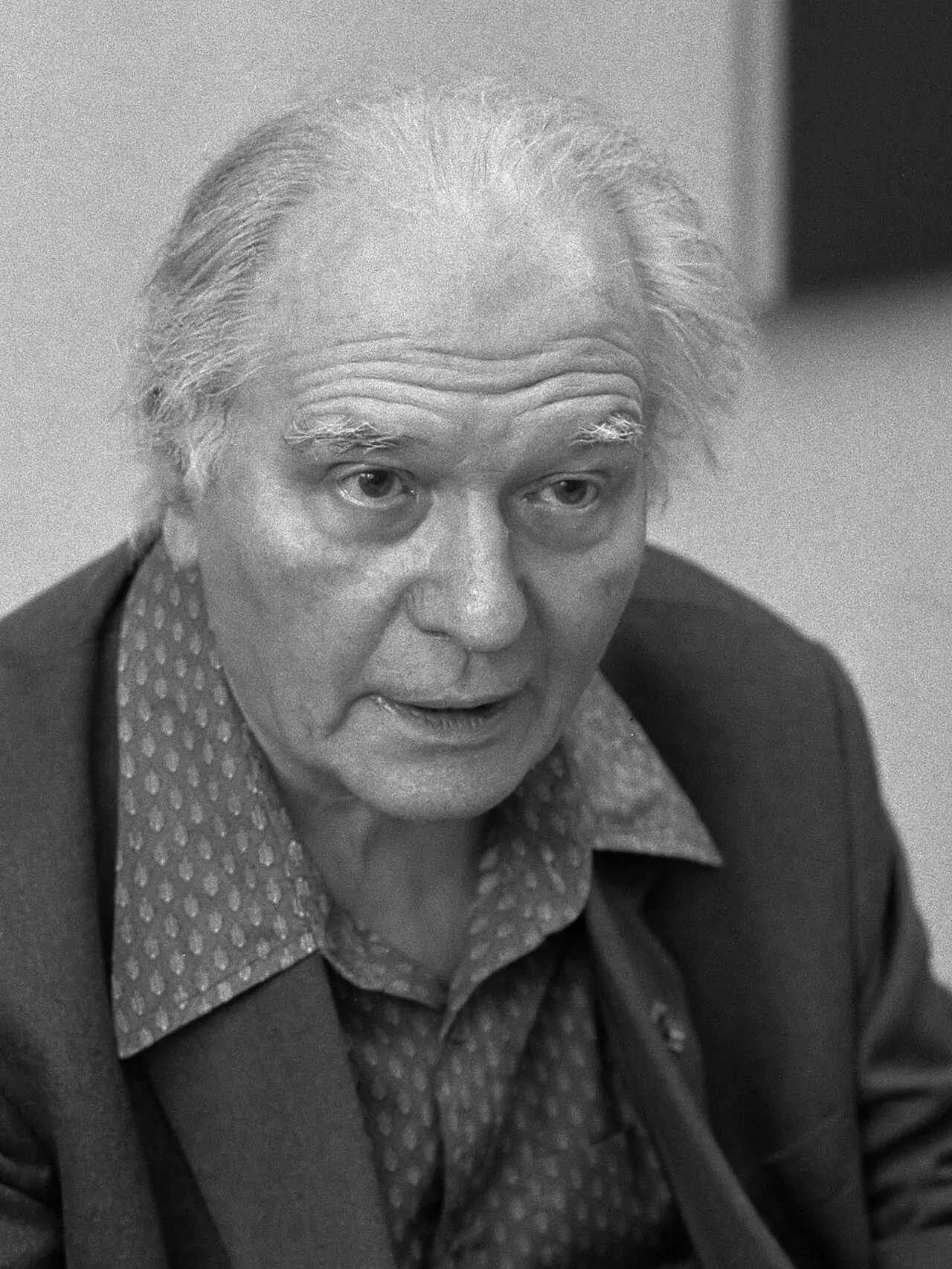
Paul Dukas, Maurice Emmanuel and Marcel Dupré at the Paris Conservatoire
Posts
Organist of La Trinité, Paris, 1931–92
Teaching
Paris Conservatoire, 1941–78; pupils included Boulez and Stockhausen
At the piano
Yvonne Loriod, his collaborator from the 1940s and wife from 1961
“This work is a love song.”
Life
Olivier Messiaen was born in Avignon at midnight on 10 December 1908, and his grandfather marked the birth by singing the old carol Il est né, le divin enfant. His mother, Cécile Sauvage, had written L’Âme en bourgeon while she was expecting him. He later said there had been “only one influence in my life, and it happened before I was born”. At seven and a half, in wartime Grenoble, he sat on a bench in the town park reading the vocal score of Gluck’s Orphée and realised he could hear it in his head. “So, I was a musician,” he recalled. He also staged Shakespeare for his brother Alain, using cardboard figures and coloured cellophane from sweet boxes, with sunlight to light the theatre. Their father, an English teacher and Shakespeare translator, was away at the front. Olivier taught himself the piano. At ten, in Nantes, his teacher Jean de Gibon gave him Debussy’s Pelléas et Mélisande, and he played and sang it until he knew it by heart. Writing about himself in 1970, he said that the mountains of the Dauphiné “are his true home”.
1919–39Organist of La Trinité
He entered the Paris Conservatoire in 1919, studying composition with Paul Dukas, music history with Maurice Emmanuel, and organ with Marcel Dupré. In 1931, aged twenty-two, he became organist of La Trinité. He kept the job for the rest of his life. The church divided his Sundays between plainchant, older concert music and his own compositions. At vespers he improvised, because the short intervals in the service left no room for complete pieces.
The Cavaillé-Coll organ could play very softly or fill the church with reed stops. L’Ascension began as an orchestral work in 1932–33; in the organ version he replaced the third movement with a new Transports de joie, and the final prayer is set in long, slow phrases. La Nativité du Seigneur ends with the fast toccataDieu parmi nous. His Catholic subjects were precisely defined: Christ’s birth in the nine movements of La Nativité (1935), the life of resurrected bodies in Les Corps glorieux (1939).
In 1932 he married the violinist and composer Claire Delbos. They gave recitals together, and he wrote Thème et variations for her. She was the Mi of Poèmes pour Mi; their son Pascal was born in 1937. Messiaen also joined Jolivet, Daniel-Lesur and Baudrier in La Jeune France, founded in 1936. In 1944 he published Technique de mon langage musical, an account of his own musical methods with examples of his unusual scales and rhythms.
1940–41Quatuor pour la fin du temps, Stalag VIII-A
After his capture in 1940, Messiaen met the clarinettist Henri Akoka and the cellist Étienne Pasquier in a makeshift camp near Nancy. By July they were in Stalag VIII-A near Görlitz. With the violinist Jean Le Boulaire, they rehearsed a trio in the camp washrooms. A piano was found, and a guard supplied manuscript paper. Messiaen built seven more movements around the trio. The slow melody for cello came from an earlier piece for six ondes Martenot.
The four men gave the first performance of Quatuor pour la fin du temps that January evening, with Messiaen at the piano. The angel of the work comes from Revelation 10, announcing that time will be no more. In the opening Liturgie de cristal the clarinet plays a blackbird’s song while the other instruments play trills representing daybreak and the waking of the birds. Later the clarinet holds very long notes, then breaks into birdsong. In the sixth movement all four players play together in unison and octaves. In the last movement only violin and piano play. The violin has a long melody over slowly repeated chords in the piano, rising towards the top of its range. Messiaen had written this music in 1930 as the second part of his organ Diptyque.
1941–49Yvonne Loriod and Turangalîla
Back in occupied Paris in 1941, he began teaching harmony at the Conservatoire. Seventeen-year-old Yvonne Loriod was among his pupils. In Visions de l’Amen (1943), which they played together, he gave her the fast first-piano part and kept the principal themes for himself. The following year he wrote Vingt Regards sur l’Enfant-Jésus. Loriod played all twenty at the Salle Gaveau on 26 March 1945, with Messiaen explaining each piece. Critics quarrelled over his theology and the extravagance of the piano writing.
At home, Claire was becoming seriously ill. Messiaen took over the domestic chores and got Pascal ready for school; eventually she needed institutional care. She died in 1959. During those years Messiaen and Loriod came to love each other, though his marriage and their Catholic faith held them back. Speaking to Michael White in The Independent on 10 January 1999, Loriod recalled: “I never called him by his first name.” To her he was Messiaen, or maître.
Love and death are the subjects of Harawi, Turangalîla-Symphonie and Cinq Rechants, his three works on the Tristan myth. “This work is a love song,” he wrote in the programme for Turangalîla’s Boston première on 2 December 1949. He explained the Sanskrit title. Lila is play and love, and turanga is time, “the time which runs like a galloping horse”. Koussevitzky’s commission had grown into ten movements, with a large piano part and the sliding electronic tone of the ondes Martenot. The first movement sets two themes against each other. Trombones in thirds play the “statue” theme, which Messiaen compared to “the heavy, terrifying brutality of old Mexican monuments”; two clarinets answer with the “flower” theme, “like two eyes reflecting each other”. Leonard Bernstein conducted; Loriod played the piano and Ginette Martenot the ondes. In the sixth movement the strings play a slow melody beneath the piano’s birdsong.
The classroom and the fieldsTeaching, birdsong and Loriod
In the 1949 piano study Mode de valeurs et d’intensités, drawn from thirty-six pitches, twenty-four durations, twelve attacks and seven dynamic levels, each note always keeps its own duration, loudness and manner of attack. Boulez and Stockhausen took up the experiment. Messiaen continued his work on rhythm in Livre d’orgue (1951), in which birdsong interrupts the rhythmic calculations. His pupils at the Conservatoire also included Xenakis, Grisey, Murail and George Benjamin. After years of teaching harmony and analysis, he became professor of composition in 1966 and held the post until he retired in 1978.
In the field, the ornithologist Jacques Delamain helped him to recognise birds by ear. Loriod drove, ran the tape recorder and came on the early-morning outings; Messiaen filled notebooks. Réveil des oiseaux follows a woodland from night into morning. Oiseaux exotiques brings together Asian and American species that are never found in the same place. The thirteen piano pieces of Catalogue d’oiseaux place each bird among its neighbours at a particular hour. Messiaen and Loriod married in 1961. At home she checked his proofs, and the vocal score of Saint François d’Assise took her two years to make.
André Malraux commissioned Et exspecto resurrectionem mortuorum to commemorate the dead of both world wars. It is scored for winds, brass and metallic percussion, without strings, and was first performed in the Sainte-Chapelle in May 1965. The large La Transfiguration de Notre Seigneur Jésus-Christ followed in 1965–69. It sets Latin texts for choir, with seven instrumental soloists, and birdsong appears among the orchestral bells.
1972–92From Utah to the Paris Opéra
In April 1972 Messiaen and Loriod went to Utah. Alice Tully had commissioned a work for the American bicentenary, and he wanted to see Bryce Canyon and hear its birds. At Cedar Breaks he wrote “immense solitude” in his notebook. Des canyons aux étoiles… names Bryce, Cedar Breaks and Zion, and its title moves from the canyons to the stars. “Heaven is symbolized by Zion Park and the star Aldebaran,” Messiaen wrote. The piano has whole movements to itself. So does the horn, which plays alone in Appel interstellaire, with silences between its calls. Elsewhere a wind machine and a sand-filled geophone join the percussion.
Saint François d’Assise occupied him from 1975 to 1983. He wrote the libretto himself, taking Francis through the encounter with a leper, the Angel’s music, the sermon to the birds and death. The very large orchestra included three ondes Martenot. At the première at the Paris Opéra in November 1983, Seiji Ozawa conducted, José van Dam sang Francis and Christiane Eda-Pierre the Angel.
He returned to the organ in Livre du Saint Sacrement (1984), then to glass and birds in Un vitrail et des oiseaux. The New York Philharmonic commissioned Éclairs sur l’Au-Delà… for its 150th anniversary. A superb lyrebird, which Messiaen heard on an Australian tour for his eightieth birthday, led him to revise the plan of the work, and it has a movement to itself. In an interview a few months before his death he said he had imagined himself “in front of a curtain, in darkness, apprehensive about what lay beyond: Resurrection, Eternity, the other life.” The work ends with the strings playing a melody above quietly struck triangles. Messiaen died on 27 April 1992, before the première; he had been looking forward to rehearsing it with Zubin Mehta. Loriod edited his treatise on rhythm, colour and birdsong. She also kept a cupboard of tapes of the improvisations she had recorded beside him at La Trinité.
Places
Every recorded place, joined in date order. Messiaen on the MapAll 19 places, with sources
Avignon · 10 December 1908 · born
Born in Avignon to Pierre Messiaen and the poet Cécile Sauvage.
Messiaen wrote some of his melodies at very slow tempos. In the Quartet’s cello Louange, the bow sustains a phrase while the piano repeats its chords. The final violin movement goes higher still. Each note has to be sustained for its full length, and the difficulty for the player is carrying a line across that slow tempo.
𝅘𝅥Uneven steps
A short extra note can interrupt a rhythm in mid-stride. Messiaen also used patterns whose durations read identically backwards, for instance 3–2–1–2–3. In the Quartet’s Danse de la fureur all the players play the same line in unison, so every change of length is heard clearly. In Oiseaux exotiques, drums and woodblock play Greek and Indian rhythmic patterns beneath the birds.
𝄞Birdsong
The birds are named, and each has its own call. In Oiseaux exotiques, an Indian mynah shrieks at the opening; later the piano sets the bobolink beside the mewing call of the catbird. Catalogue d’oiseaux adds the surrounding countryside and the hour of day. A piece in it may spend as long on the night-time setting of a bird as on its song.
𝆑Piano
Loriod’s playing could match the brilliance of a percussion section. In Turangalîla the piano plays alongside glockenspiel, celesta and vibraphone, then plays its birdsong over the strings. The opening of Vingt Regards requires slow chords with their individual notes carefully balanced. This Theme of God returns throughout the cycle among the rapid passagework.
♮Chords
His second mode alternates semitones and tones. It has eight notes within the octave, and several major triads can be formed from them. Chords drawn from the mode can change without the pull of a dominant towards its tonic. The two scale schematics below set out the notes. At the keyboard, the same small set of pitches can be spread into widely spaced chords.
𝄋Winds and metal
Et exspecto leaves out the orchestral strings. Low winds and brass play against metal percussion, leaving bells and gongs room to ring. Turangalîla has a different band, with an electronic soloist: the ondes Martenot can hold a note or slide between pitches. Its long melodic line crosses the piano and the percussion.
Works
A selection from the composer’s works.
1932–34
L’Ascension (The Ascension)Orchestra, 1932–33; organ version, 1933–34
The organ version has its own third movement, Transports de joie. Both versions end with a slow prayer.
Quatuor pour la fin du temps (Quartet for the End of Time)Clarinet, violin, cello and piano
The four instruments heard at Stalag VIII-A repeatedly separate: clarinet alone, a trio, cello with piano, finally violin with piano. In the sixth movement all four play in unison.
1944
Vingt Regards sur l’Enfant-Jésus (Twenty Contemplations of the Infant Jesus)Piano
Twenty pieces for Loriod, from the slow chords of the Father’s gaze to the final piece on the Church. The Theme of God returns throughout the cycle.
A love song on a large scale, in ten movements, with a formidable piano part and the ondes Martenot playing above the orchestra. After the dance of the fifth movement, Jardin du sommeil d’amour has long string phrases and birdsong in the piano.
Oiseaux exotiques (Exotic Birds)Piano, winds, brass and percussion
Birdsongs from different continents are played together by an ensemble without strings. The piano has its own cadenzas, and the percussion plays patterns taken from Greek and Indian rhythm.
1956–58
Catalogue d’oiseaux (Catalogue of Birds)Piano
Thirteen pieces in seven books, each named after a bird and set among other species in its own stretch of French countryside; Messiaen dedicated the set to Loriod. La Rousserolle effarvatte, on the reed warbler, takes up the whole central book.
1964
Et exspecto resurrectionem mortuorum (And I await the resurrection of the dead)Woodwind, brass and metallic percussion
Commissioned by Malraux in memory of the dead of the two world wars. The first performance took place in the Sainte-Chapelle.
1965–69
La Transfiguration de Notre Seigneur Jésus-ChristMixed chorus, seven instrumental soloists and large orchestra
The choir sings its Latin text while the solo instruments and the orchestral birdsong play around it. The fourteen movements fall into two groups of seven.
1971–74
Des canyons aux étoiles… (From the Canyons to the Stars…)Solo piano, horn, xylorimba and glockenspiel with orchestra
The twelve movements set Utah landscapes alongside birds from farther afield. Appel interstellaire is for solo horn.
1975–83
Saint François d’AssiseOpera in three acts and eight tableaux; solo voices, chorus and large orchestra with three ondes Martenot
Francis meets a leper and an angel, preaches to the birds and receives the stigmata. Messiaen’s own libretto ends with the saint’s death and new life.
1988–91
Éclairs sur l’Au-Delà… (Flashes of the Beyond…)Large orchestra
The superb lyrebird has a movement to itself, L’Oiseau-lyre et la Ville-fiancée, in this eleven-part orchestral cycle. At the close, violins, violas and cellos play over three softly struck triangles. The New York Philharmonic gave the première on 5 November 1992, after Messiaen’s death.
In the score
Short examples, engraved and playable.
Scale schematic · second modeAlternating semitone and tone
Schematic: C–D♭–E♭–E–F♯–G–A–B♭, followed by the octave C. Raising every note by a minor third produces the same collection. There are therefore only three distinct transpositions, counting this starting form.
Scale schematic · third modeThree groups within the octave
Schematic: a tone and two semitones, repeated three times to reach the octave. Moving the whole collection up a major third reproduces its notes, leaving four distinct transpositions. The 5/4 bar fits all ten notes of the ascent, including the upper C.
Rhythm schematic · a palindromeEleven quavers around a centre
Schematic: five notes lasting 3–2–1–2–3 quavers. Read from the end, the durations are the same, which makes this a non-retrogradable rhythm. Both bars repeat the same pattern on C.
Sister arts
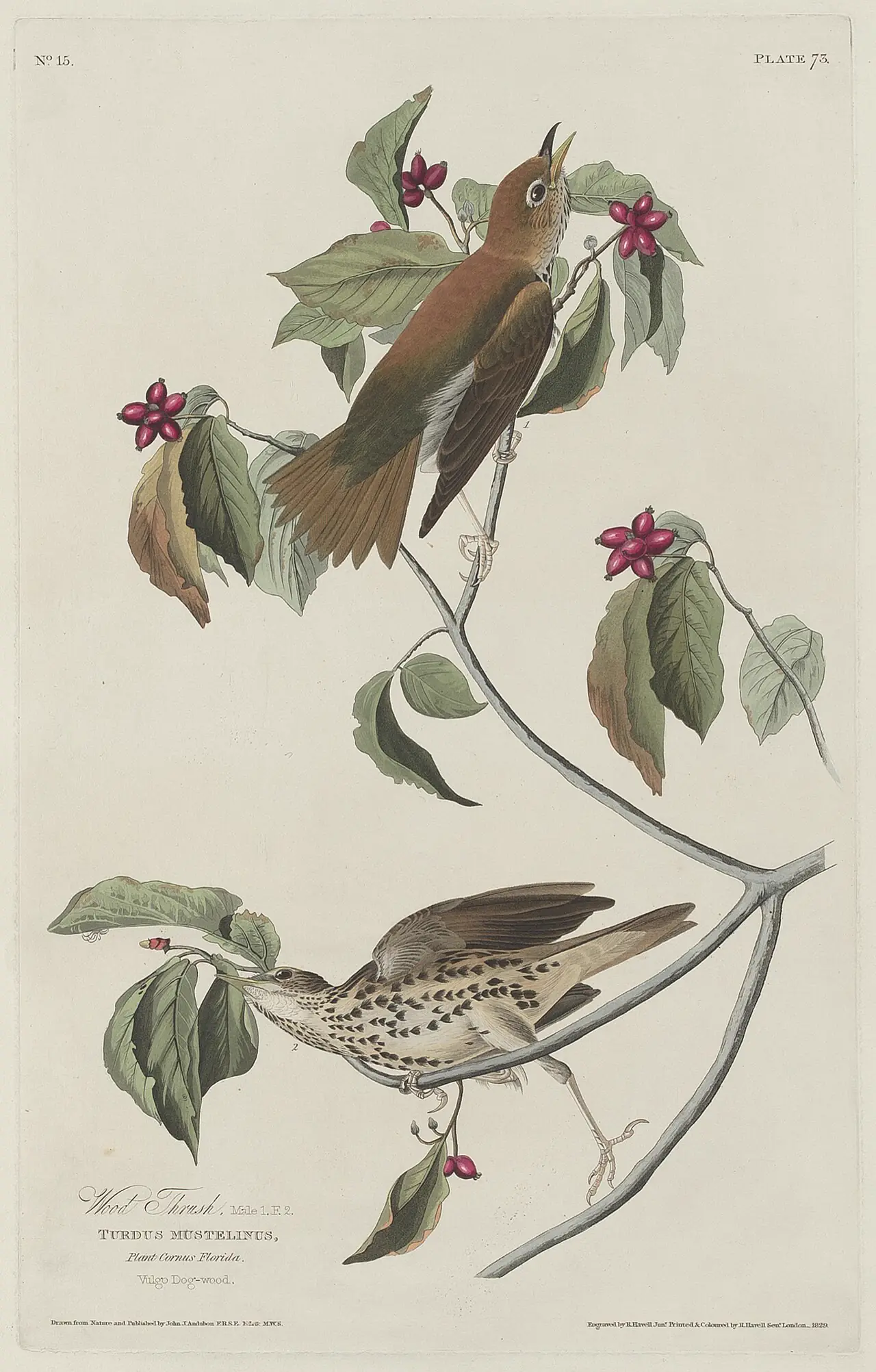
Robert Havell after John James AudubonWood Thrush, plate 73 of The Birds of America, 1829Hand-coloured engraving and aquatint on Whatman wove paper · National Gallery of Art, Washington, DC; 1945.8.73
In Audubon’s picture, two wood thrushes occupy the dogwood branch, one with its beak open, the other reaching beneath a leaf. This is the bird Messiaen called La Grive des bois in the tenth movement of Des canyons aux étoiles…. His transcription, made by ear, gives it a clear major arpeggio followed by a lower rustling phrase.
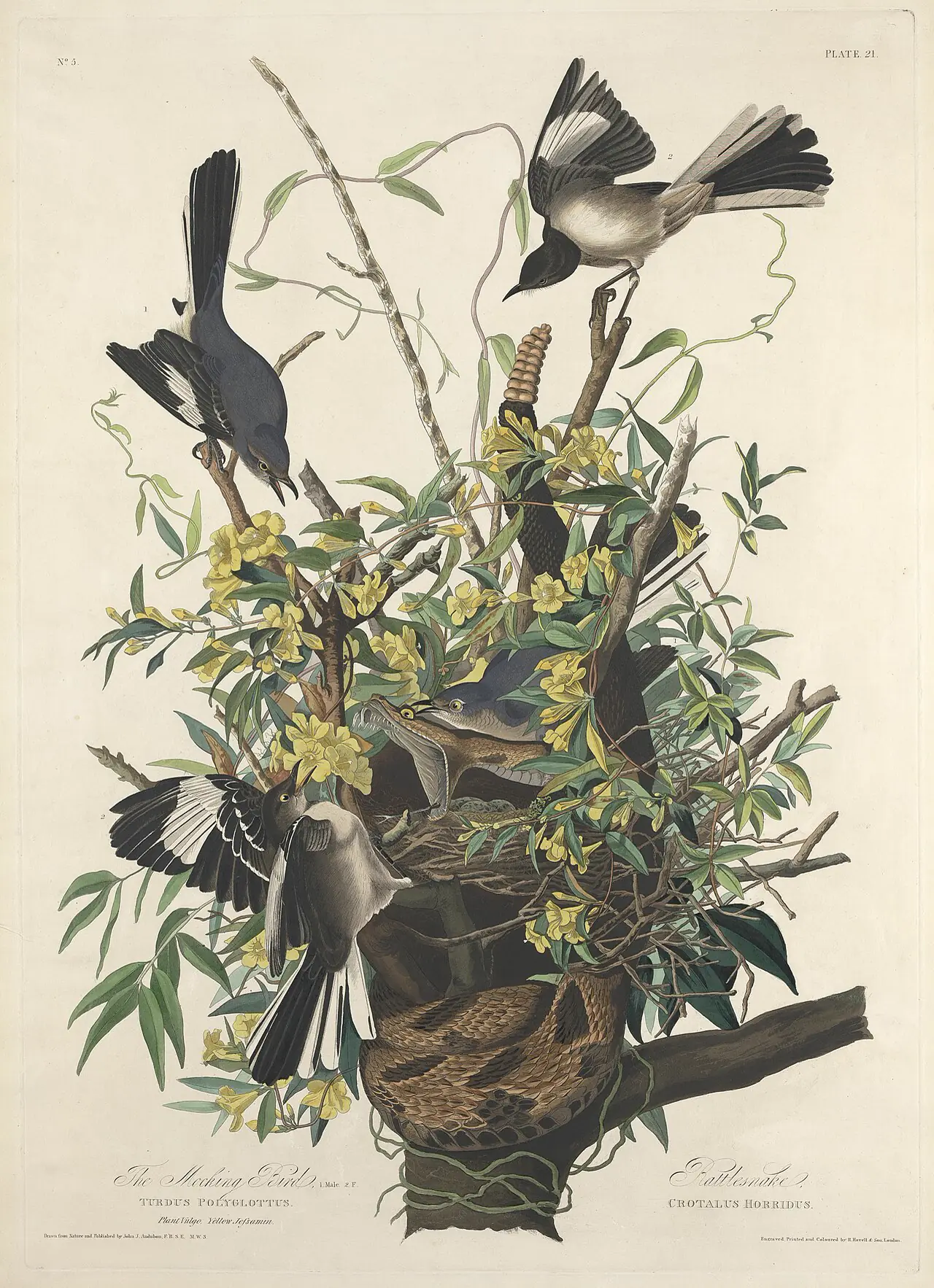
Robert Havell after John James AudubonThe Mocking Bird, plate 21 of The Birds of America, 1827Hand-coloured engraving and aquatint on Whatman wove paper · National Gallery of Art, Washington, DC; 1945.8.21
Audubon’s mockingbirds defend their nest against a snake, wings spread in alarm. Messiaen gave the same species a piano solo, Le Moqueur polyglotte, in Des canyons aux étoiles…. Its quick calls and trills change constantly.
John of Patmos; Latin Vulgate tradition
Revelation 10:1, 5–6 — the angel’s oath
First century CE; Clementine Vulgate edition, 1598
LatinEt vidi alium angelum fortem descendentem de cælo amictum nube,
et iris in capite ejus, et facies ejus erat ut sol,
et pedes ejus tamquam columnæ ignis:
Et angelus, quem vidi stantem super mare et super terram,
levavit manum suam ad cælum:
et juravit per viventem in sæcula sæculorum,
qui creavit cælum, et ea quæ in eo sunt:
et terram, et ea quæ in ea sunt: et mare, et ea quæ in eo sunt:
Quia tempus non erit amplius:
Our translationAnd I saw another mighty angel come down from heaven, wrapped in a cloud,
with a rainbow over his head, his face like the sun,
and his feet like columns of fire.
And the angel I saw standing on the sea and on the earth
lifted his hand towards heaven
and swore by him who lives for ever and ever,
who made heaven and all that is in it,
and earth and all that is in it, and the sea and all that is in it:
that time would be no more.
The Quartet takes its images from Revelation 10: an angel clothed with a cloud, with a rainbow above his head and feet of fire. Messiaen gave two movements to the angel, including the seventh, the tangle of rainbows. The words are not sung in the Quartet.
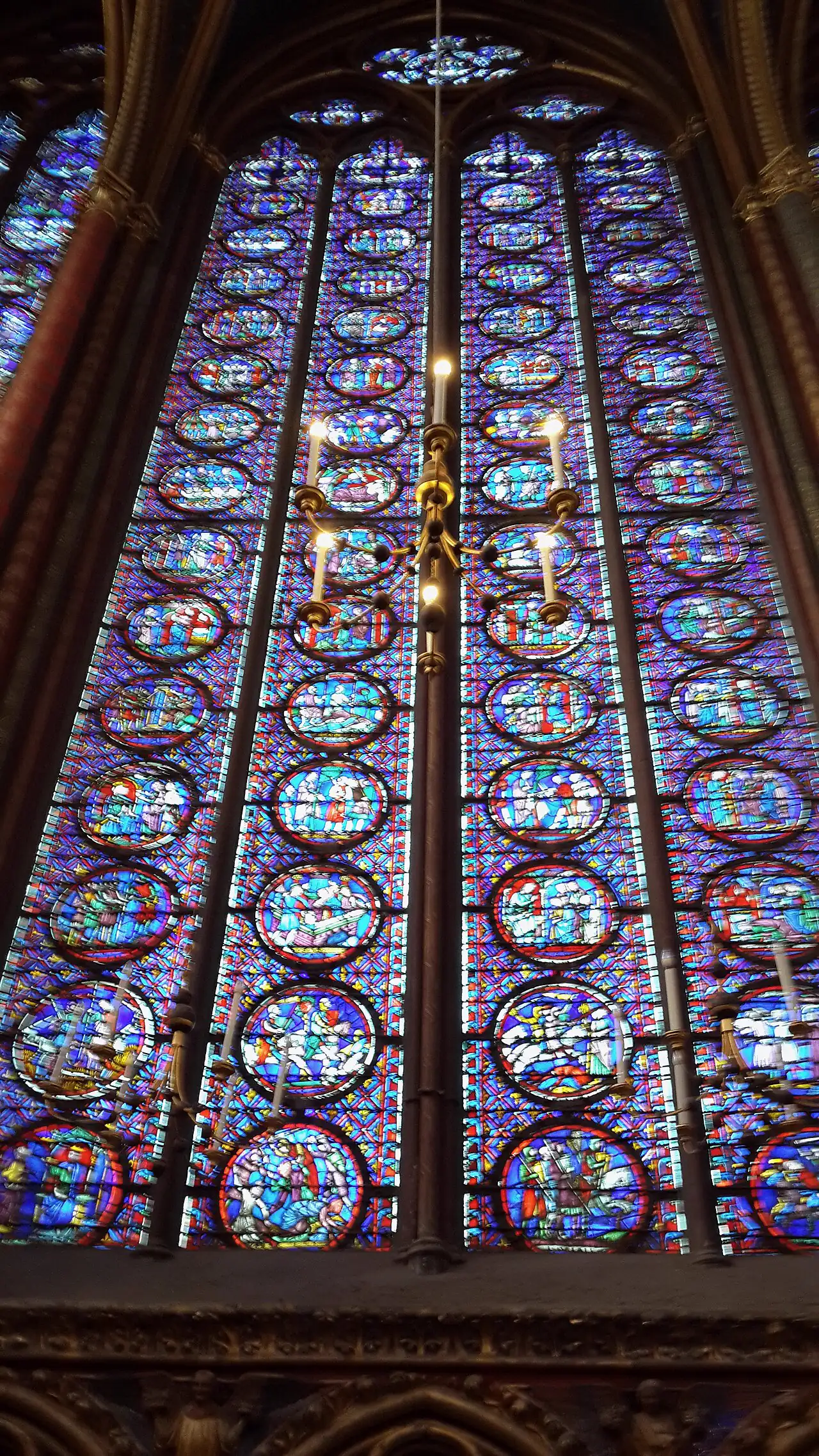
Thirteenth-century Parisian glass painters; photograph by Yair HaklaiJudith and Job window, Sainte-Chapelle, c. 1248, with later restorations; photographed 12 April 2017Stained glass in lead; colour photograph · Upper chapel, Sainte-Chapelle, Paris
Messiaen first visited the Sainte-Chapelle as a child with his parents. In 1965 he returned for the première of Et exspecto resurrectionem mortuorum in the chapel, conducted by Serge Baudo. Judith and Job are among the biblical stories shown in the southern windows.
Recommended recordings
Turangalîla-SymphonieYvonne Loriod, piano; Jeanne Loriod, ondes Martenot; Orchestre de l’Opéra Bastille, Myung-Whun ChungDeutsche Grammophon · 431 781-2 · 1991 (release)A first choice for the Loriod sisters. The pianist of the première plays beside her sister on the ondes Martenot, and the piano part was written for her.
Quatuor pour la fin du tempsGil Shaham, violin; Paul Meyer, clarinet; Jian Wang, cello; Myung-Whun Chung, pianoDeutsche Grammophon · 469 052-2 · 2000 (release)Wang plays the cello’s slow movement of praise with sustained tone; Meyer plays the solo clarinet movement between the ensemble movements.
Complete organ worksOlivier Latry, organDeutsche Grammophon · 471 480-2 · 2002 (release)Notre-Dame’s organ, recorded with unusual clarity. Latry keeps the abrupt changes of stops and the rapid birdsong figures clear, and his account of the severe Livre d’orgue is a particular reason to choose this set.
Catalogue d’oiseauxPierre-Laurent Aimard, pianoPentatone · PTC 5186670 · 2018 (release)Aimard, Loriod’s pupil, gives each bird a distinct outline. He balances the chords clearly, which is important in music where a sudden change of sonority can bring another bird into the same landscape.
Where to hear more
Quatuor pour la fin du temps1940–41
Tashi: Ida Kavafian, violin; Richard Stoltzman, clarinet; Fred Sherry, cello; Peter Serkin, piano · RCA Red Seal / Sony Music · 1975
Eight movements for clarinet, violin, cello and piano grew out of Messiaen’s captivity in 1940–41. Tashi plays the dances with close unanimity and gives the cello’s slow ‘Louange’ a continuous line.
Messiaen’s twenty piano meditations on the infant Christ begin with the recurring ‘Theme of God’, which Osborne plays with great stillness at each return. He has the stamina for the whole cycle and a touch that varies from the quietest chords to the dance rhythms of ‘Regard de l’Esprit de joie’, and the violent writing stays clear. Hyperion CDA67351/2, recorded at Henry Wood Hall, London, and released in 2002.
Jean-Yves Thibaudet, piano; Takashi Harada, ondes Martenot; Royal Concertgebouw Orchestra; Riccardo Chailly, conductor · Decca · March 1992
A solo piano and the electronic ondes Martenot play with a very large orchestra through ten movements of love music. Chailly’s recording makes the crowded instrumental lines unusually clear, with Thibaudet in the virtuoso piano part.
Debussy reached him through the score of Pelléas, a present from his childhood teacher; Dukas and Dupré later taught him composition and organ. Stravinsky’s rhythms contributed to his own investigations. In turn, Boulez took notes from Mode de valeurs et d’intensités into Structures. Messiaen’s class also included Xenakis, Grisey and Murail, who went on to write very different music.
Further reading
Peter Hill and Nigel Simeone, Messiaen (Yale University Press, 2005). biography
A documentary life-and-works study drawing on the composer’s private archive.
Christopher Dingle, The Life of Messiaen (Cambridge University Press, 2007). biography
The linked opening chapter connects childhood, literature and early musical discoveries with the composer’s development.