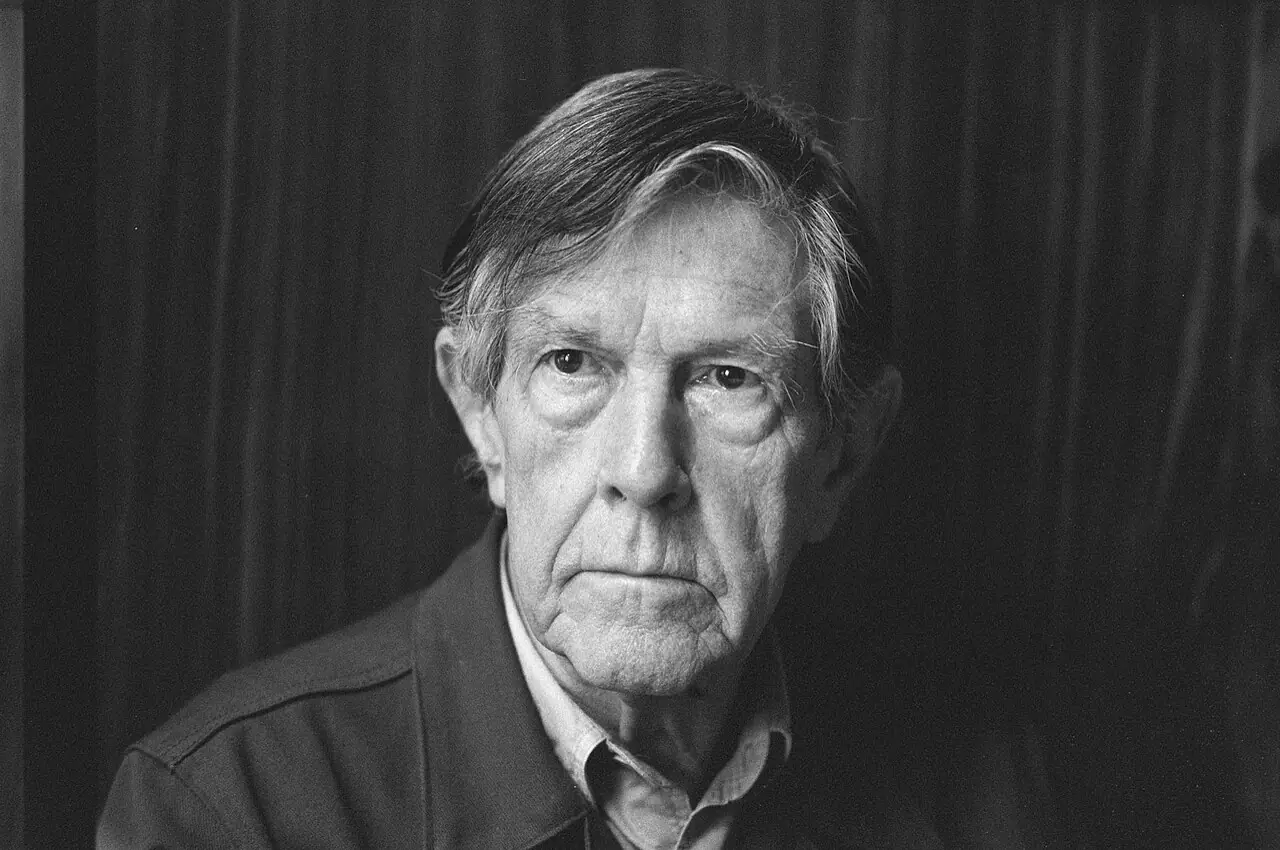
JohnCage
Composer who put bolts between piano strings, composed with chance operations, and wrote a piece of four minutes and thirty-three seconds made up of the sounds around a concert.
- Trained
- Richard Buhlig · Henry Cowell · Adolph Weiss · Arnold Schoenberg
- Collaborators
- Merce Cunningham, life partner and choreographer · David Tudor, pianist and electronic composer
- At the piano
- Prepared strings · percussion on the closed lid · chance-composed keyboard music
- Alongside music
- Lectures and poems · mushroom study · drawings, prints and watercolours
“My favorite music is the music I haven’t yet heard.”
Life
In Seattle in 1940, Syvilla Fort needed music for her dance Bacchanale. Cage wanted percussion, but the performance space had room for a piano and little else. He put objects between its strings: rubber, screws, bolts, weather-stripping. A key could then produce a rattle or a muffled knock, and the performer still sat at the keyboard. This was the first prepared piano.
1912–38Los Angeles, Europe and Schoenberg
Cage was born in Los Angeles on 5 September 1912, the son of an inventor and of a mother who wrote for the Los Angeles Times. He entered Pomona College in 1928 and left after two years, hoping to become a writer. In Paris he worked briefly for an architect, and in Mallorca he painted and composed. He later recalled standing at a street corner in Seville and noticing how many sights and sounds went on together in a single experience, and how much he enjoyed it.
Back in California, Richard Buhlig took an interest in his compositions; Henry Cowell directed him towards further study with Adolph Weiss and Schoenberg. Cage attended Schoenberg’s classes in Los Angeles from 1935. His later account of their disagreement became a favourite story. Schoenberg warned that without a feeling for harmony he would come to a wall. Cage remembered answering, “Then I’ll spend my life knocking my head against that wall.”
At the Cornish School in Seattle, where he began teaching and accompanying dance in 1938, lengths of time supplied the divisions. A drumstroke and a silence could occupy the same allotted space. Third Construction (1941) sets four percussionists within a framework of twenty-four groups of twenty-four bars, each player dividing the phrases differently. The instruments include tin cans, rattles, drums and a conch shell. Xenia Kashevaroff, whom Cage married in 1935, played in his percussion ensembles.
1940–48Cunningham and Sonatas and Interludes
At Cornish he also met Merce Cunningham, who became his life partner and closest collaborator. After a period teaching in Chicago, Cage and Xenia moved to New York in 1942, staying at first with Peggy Guggenheim and Max Ernst. The marriage ended in divorce in 1945. Cage and Cunningham gave a programme of Cunningham’s solo dances in 1944. In their later collaborations, dance and music were made independently and brought together in performance.
In New York in 1946, Cage exchanged musical knowledge with the Indian musician Gita Sarabhai. He also read the art historian Ananda K. Coomaraswamy. The Sonatas and Interludes, composed in 1946–48, came out of his study of the permanent emotions of Indian aesthetics and their tendency towards tranquillity. Forty-five piano notes are prepared. The short pieces include repeated halves, small turning figures and pauses in which a struck string rings until it stops. The preparations, which include screws, alter the sound of the piano before the first phrase is played.
Cage and Cunningham visited Black Mountain College in North Carolina in April 1948. That summer Cage returned and organised a festival of Satie, including Le Piège de Méduse. Buckminster Fuller played the Baron; Cunningham danced the mechanical monkey. Cage’s lecture championed Satie against Beethoven, provoking an argument among the college’s musicians.
1951–58Chance operations and 4′33″
Christian Wolff gave Cage a copy of the I Ching, the Chinese Book of Changes. In Music of Changes (1951), Cage used its chance operations, with charts governing sounds, silences, durations and dynamics. The result demanded formidable precision from David Tudor, its dedicatee. The pianist strikes the keyboard, plucks strings and makes sounds on the piano’s lid, and the pedals have detailed instructions too. Cage had removed his preferences from many decisions.
On 29 August 1952, Tudor performed 4′33″ at the Maverick Concert Hall in Woodstock. In each of its three movements the performer plays nothing, and the time is filled by the sounds of the hall and its surroundings. Cage connected the work with Robert Rauschenberg’s white paintings and with his visit to Harvard’s anechoic chamber, a room designed to suppress reflections of sound. He reported that he heard sounds even there. He had been writing measured silences into his scores for years before this piece, in which the pianist played no notes at all.
At Black Mountain that same summer, Cage arranged simultaneous activities around an audience: Cunningham danced, Tudor played piano, Rauschenberg played records, and poems were read. The participants remembered the details differently, but all recalled that separate actions took place at the same time. In the Concert for Piano and Orchestra (1957–58), the instrumental parts are likewise separate. There is no single coordinating score. An optional conductor moves like a clock and provides time, while the players follow their own elaborate instructions.
1954–92Stony Point and the late works
In 1954 Cage moved to the Gate Hill cooperative at Stony Point, north of New York. He studied mushrooms with Guy Nearing and helped found the New York Mycological Society. His New School classes brought experimental music into contact with artists including George Brecht, Dick Higgins and Allan Kaprow; Toshi Ichiyanagi attended in 1958. Meanwhile Tudor became an electronic composer in his own right.
In Empty Words (1974), Cage used Thoreau’s prose as the material for a long vocal performance, in fragments too small to carry an ordinary sentence. At about the same time he wrote the thirty-two Etudes Australes for Grete Sultan, taking a star atlas as his source. These piano studies are extremely difficult. In his autobiographical statement he explained that such performances could demonstrate that the apparently impossible was possible.
For Ryoanji (1983–85), named after Kyoto’s rock garden, Cage traced portions of stones’ outlines. A flute, oboe, trombone, voice or double bass follows the resulting curves as sliding pitches, above a percussion accompaniment. He used the same stones in his drawings and his scores. From Two (1987), many late works carry titles giving the number of players; flexible time-brackets allow a sound to begin or end within a stated interval. Cage received the Kyoto Prize in 1989 and died in New York on 12 August 1992.
Where to hear it
- Sonatas and Interludes1946–48Philipp Vandré, prepared piano · Mode 50 · 1994, Frankfurt
A good first recording of the work, which consists of sixteen sonatas and four interludes. Forty-five notes of the piano are prepared, producing a range of small percussion sounds. Vandré plays a small Steinway O with carefully chosen preparations, on an intimate scale; the label’s useful notes explain how the instrument’s string lengths affect the preparations.
- Music of Changes1951Martine Joste, piano · Mode 147
Cage’s chance operations produced four books of precisely written piano music, made up of sharp attacks, silences and sounds made inside the instrument. The recording is recommended for the sudden attacks and abrupt silences of the score; Joste plays the complicated notation with physical force, and the disc places the work between Seven Haiku and the Suite for Toy Piano.
- Third Construction1941Third Coast Percussion · Mode 243 · June 2011, Boutell Memorial Concert Hall, Northern Illinois University, DeKalb
Four percussionists play different phrase patterns within the same twenty-four-bar spans, taking turns on tin cans, rattles, drums and a conch shell. Third Coast’s recording has rhythmic drive and clearly separated instruments, and couples the piece with the other two Constructions; Gregory Beyer and Ross Karre play in First Construction. The filmed edition shows the players moving rapidly between instruments.
- Five · Seven · Thirteen1988–92Essential Music; John Kennedy and Charles Wood, directors · Mode 239 · 1993–94
Essential Music plays Five by blowing into bottles, which take the sustained pitches, an instrumental choice Cage approved. Seven and Thirteen expand the group. These late works allow players to place their sounds within specified time-brackets, and sustained notes overlap without a conductor coordinating their entries.
These recordings are under copyright, so the Hall cannot play them; the links go to the labels’ and artists’ own uploads and to streaming services.
Places

All 12 places, with sources
- Los Angeles · 5 September 1912 · born
Born at Good Samaritan Hospital; the map marks the city.
- Claremont, California · September 1928 – June 1930 · studied
Studied liberal arts at Pomona College before leaving for Europe.
- Paris · 1930 · studied
Briefly studied architecture with Ernő Goldfinger and encountered modern music.
- Sóller, Mallorca · 8 August 1931 – 13 September 1931 · worked
Composed his earliest identified composition during his European travels.
- Seattle · September 1938 · worked
Joined the Cornish School faculty as composer, percussion teacher and dance accompanist; met Merce Cunningham.
A John Cage Compendium — Cornish appointment, September 1938 · Merce Cunningham Trust — biography
- Chicago · September 1941 – May 1942 · worked
Taught Sound Experiments at László Moholy-Nagy’s School of Design and composed for CBS radio. The City Wears a Slouch Hat.
A John Cage Compendium — Chicago appointment and 31 May 1942 broadcast
- New York City · June 1942 – 1954 · lived
Moved east with Xenia Cage, initially staying with Peggy Guggenheim and Max Ernst; worked with modern dancers.
A John Cage Compendium — arrival in June 1942 and Stony Point move in 1954 · Cage — An Autobiographical Statement, New York recollections
- Black Mountain, North Carolina · 1 July 1948 – 25 August 1948 · worked
Taught and organised a Satie festival at Black Mountain College, including Le Piège de Méduse with Buckminster Fuller and Cunningham.
A John Cage Compendium — Black Mountain summer session, 1948
- Woodstock, New York · 29 August 1952 · premiere
Attended David Tudor’s first performance of 4′33″ at the Maverick Concert Hall; the map marks Woodstock. 4′33″.
A John Cage Compendium — Woodstock, 29 August 1952 · John Cage Trust — 4′33″ catalogue entry
- Stony Point, New York · 1954 · lived
Moved to the Gate Hill cooperative with a group including M. C. Richards, David Tudor and Karen Karnes.
- Cambridge, Massachusetts · 1988–1989 · worked
Held Harvard’s Charles Eliot Norton professorship of poetry and gave the lectures published as I–VI.
John Cage at Bard College symposium programme — biography and Norton lectures, PDF p. 8 · Cage — An Autobiographical Statement, Norton lectures
- New York City · 12 August 1992 · died
Died in New York, aged seventy-nine.
John Cage at Bard College symposium programme — death date and place, PDF p. 8
Influences
Teachers, encounters and borrowed music, each with its account and sources in the Web of Influence.
Influences received
The sound
Prepared piano
A prepared key can produce a metallic ring, a rattle or a short wooden-sounding knock. In Sonatas and Interludes, bolts, screws, rubber and other materials alter forty-five notes; the pianist plays written rhythms at the keyboard while the preparations change what those rhythms sound like.
Measured rhythm
Third Construction is written for drums, tin cans and a conch shell within a twenty-four-by-twenty-four-bar design. Each player has a different rotation of the same proportions. The players share spans of time, but their phrases end at different places.
Chance and notation
In Music of Changes the results of chance operations are written out as detailed instructions. Sudden chords, silences and sounds made inside the piano are fixed in the score, along with intricate pedal markings. Cage reached these results through the I Ching, and the pianist plays them as written.
Independent parts
The Concert for Piano and Orchestra gives its pianist sixty-three pages containing eighty-four kinds of notation. Players select material and determine durations within the work’s rules. A flute and a piano may sound together, but neither part was written as an accompaniment to the other.
The room
4′33″ places three silent movements inside a concert. During them a breath, a cough or traffic outside can be heard, and the score supplies no tune to cover these sounds.
Late sustained sounds
Ryoanji bends pitches along curves traced from stones. In the later time-bracket pieces, performers choose beginnings and endings within allotted intervals, so sustained notes overlap differently at each performance. A chord can change when one player stops while another continues.
Works
A selection from the composer’s works.
- 1939Imaginary Landscape No. 1Two variable-speed turntables, frequency recordings, muted piano and cymbalThe work uses test-tone records as instruments. It was conceived for recording or broadcast and first presented in Seattle.
- 1939First Construction (in Metal)Six percussionists and an assistantBrake drums, anvils, bells and gongs play with a piano whose strings are played with a metal rod. Composed in November and first performed that December.
- 1940BacchanalePrepared pianoBegun in 1938 and completed for Syvilla Fort’s dance in 1940. Limited space for percussion led Cage to alter the piano’s strings.
- 1941Third ConstructionPercussion quartetFour interlocking phrase schemes within twenty-four groups of twenty-four bars; tin cans, rattles and a conch shell among the instruments.
- 1942The Wonderful Widow of Eighteen SpringsVoice and closed pianoWords from Joyce’s Finnegans Wake; the pianist taps the instrument’s closed lid beneath a chant-like vocal line.
- 1946–48Sonatas and InterludesPrepared pianoSixteen sonatas and four interludes, dedicated to Maro Ajemian. The pieces use repeated halves and spaced sounds, played on a piano prepared at forty-five notes.
- 1950String Quartet in Four PartsTwo violins, viola and celloThe seasons run from summer to spring. Muted, non-vibrato chords slow towards the third movement, marked “Nearly Stationary”.
- 1951Music of ChangesPianoFour books composed using I Ching chance operations. The resulting sounds, silences, tempi and pedals are written out for the pianist.
- 19524′33″Any instrument or combination of instrumentsThree movements of performer silence. David Tudor gave the première at the Maverick Concert Hall in Woodstock on 29 August 1952.
- 1957–58Concert for Piano and OrchestraPiano and a variable selection of orchestral instruments; optional conductorIndependent parts, with no coordinating score. The pianist chooses from sixty-three pages of different notations; the conductor acts as a clock.
- 1974Empty WordsVoice; text drawn from Thoreau’s JournalsThe four parts break down, in turn, sentences, phrases, words and syllables. The last part leaves only letters and sounds.
- 1974–75Etudes AustralesPianoThirty-two studies for Grete Sultan, using Antonín Bečvář’s atlas of the southern stars as their source. Cage set out to make them very difficult to perform.
- 1983–85RyoanjiVoice or instrumental soloists, percussion or orchestral accompaniment; tape as requiredStone outlines become glissandi. The solo parts may be combined; the accompaniment represents the raked sand of the rock garden.
- 1987TwoFlute and pianoThe first of the Number Pieces. Time-brackets give the two players latitude over the placement of sounds within the allotted duration.
In the score
Short examples, engraved and playable.
Rhythmic structure — schematicOne, one, two: one bar and four bars
Chance selection — schematicFixed phrase from sixteen random draws
Sister arts
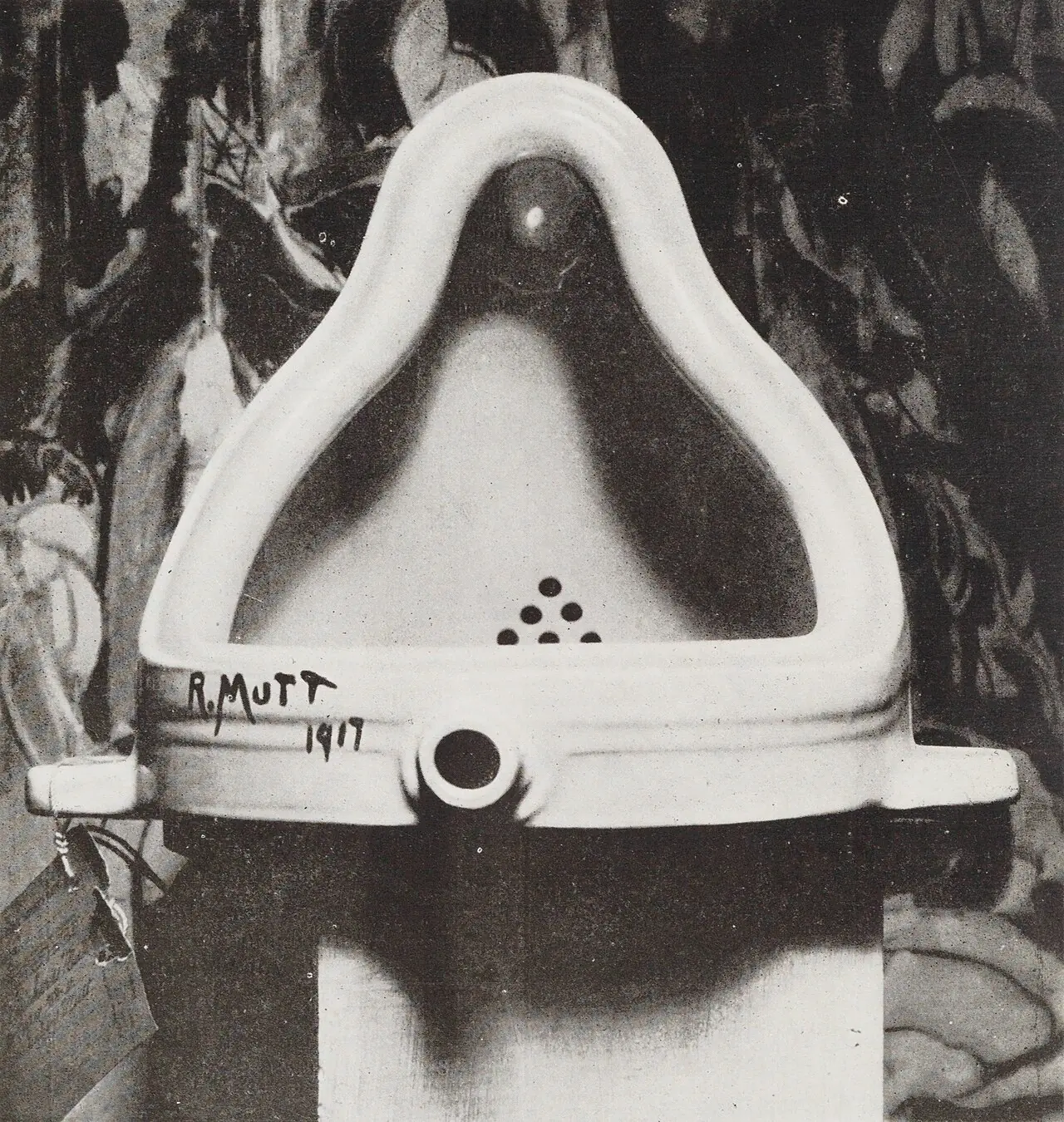
The photograph shows a urinal signed “R. Mutt”. Duchamp became Cage’s friend and chess teacher. After Duchamp’s death, Cage made the visual work Not Wanting to Say Anything About Marcel. Cage’s own work used everyday objects such as tin cans and the altered piano.
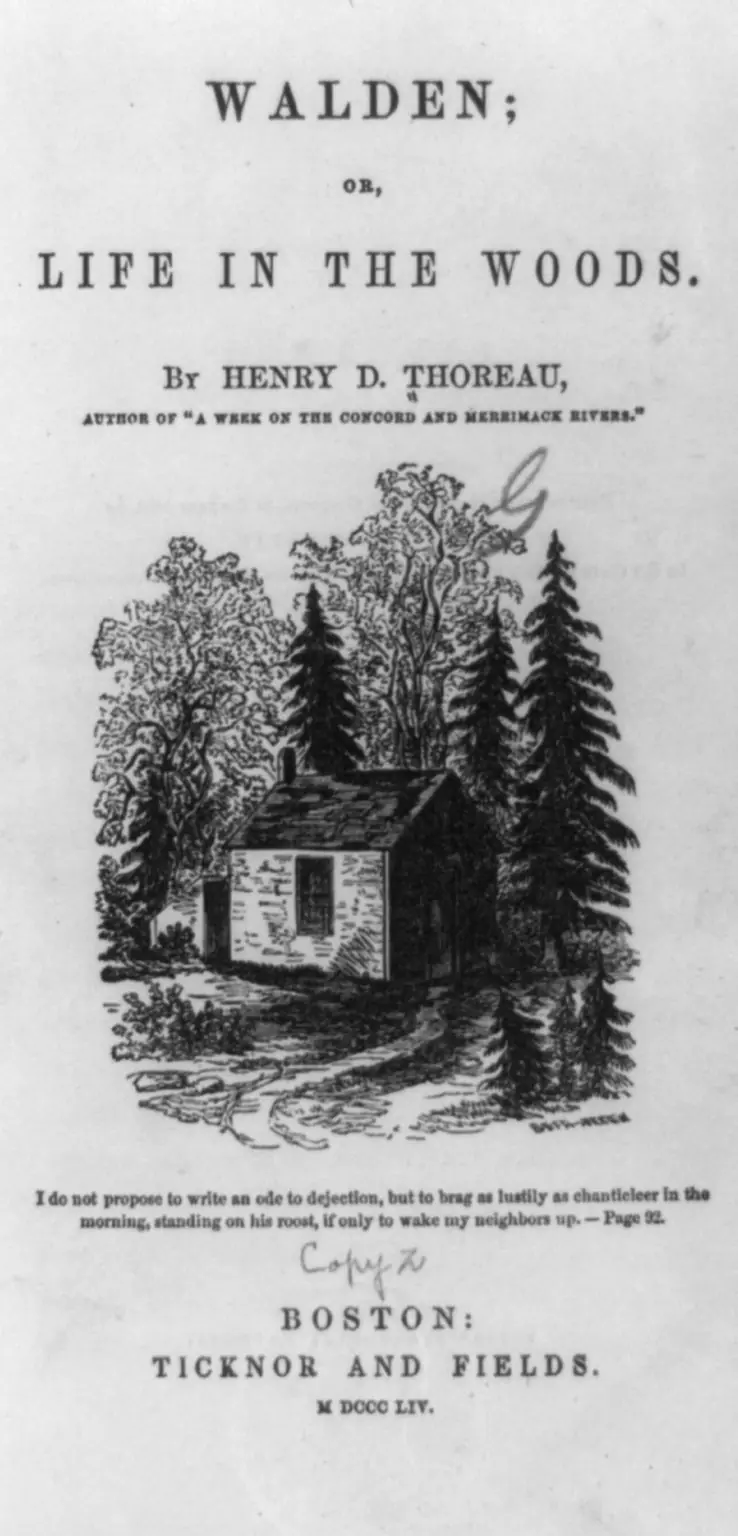
Thoreau’s cabin appears above the publisher’s name on the 1854 title page. Cage drew the text of Empty Words from Thoreau’s Journals, using phrases, syllables and letters from them for his own speaking voice.
Recommended recordings
- RyoanjiFenwick Smith, Michael Miller, Petur Eiriksson and Anthony D’Amico; New England Conservatory Philharmonia, Stephen DruryMode 41 · 1991Four soloists divide the curves traced from stones between them, above the orchestral accompaniment. An alternative to the versions with a single soloist, recorded at the Boston festival with Cage present.
Lineage
Cowell directed Cage towards Schoenberg; in place of structural harmony Cage used counted durations. Feldman’s graph scores helped prompt Music of Changes. Cunningham developed dance independent of the music, and Tudor took their work into live electronics. At the New School, Brecht, Higgins and Ichiyanagi brought composition into contact with the activities that later gathered around Fluxus.
Further reading
- John Cage, Silence: Lectures and Writings, 50th anniversary edition (Wesleyan University Press, 2013). primary writings
Cage’s own lectures and essays, and the starting point for his treatment of silence, composition and the performance of a text.
- James Pritchett, The Music of John Cage (Cambridge University Press, 1993). study
Explains the compositional work behind the ideas, especially the difference between using chance to make a score and leaving decisions to performers.
- John Cage, The Selected Letters of John Cage, edited by Laura Kuhn (Wesleyan University Press, 2016). letters
Correspondence. Useful for tracing the people, practical requests and artistic exchanges behind Cage’s works, and as a check on the familiar anecdotes.
- Kenneth Silverman, Begin Again: A Biography of John Cage (Northwestern University Press, 2012). biography
A substantial account of Cage’s life among musicians, dancers, artists and friends.
Cite this page
Contrapunctus. “John Cage.” Accessed 20 October 2026. https://mottopanikeiku.github.io/contrapunctus/composers/cage.html.
@misc{contrapunctus-composers-cage,
  author = {{Contrapunctus}},
  title = {John Cage},
  howpublished = {\url{https://mottopanikeiku.github.io/contrapunctus/composers/cage.html}},
  note = {Accessed 2026-10-20}
}