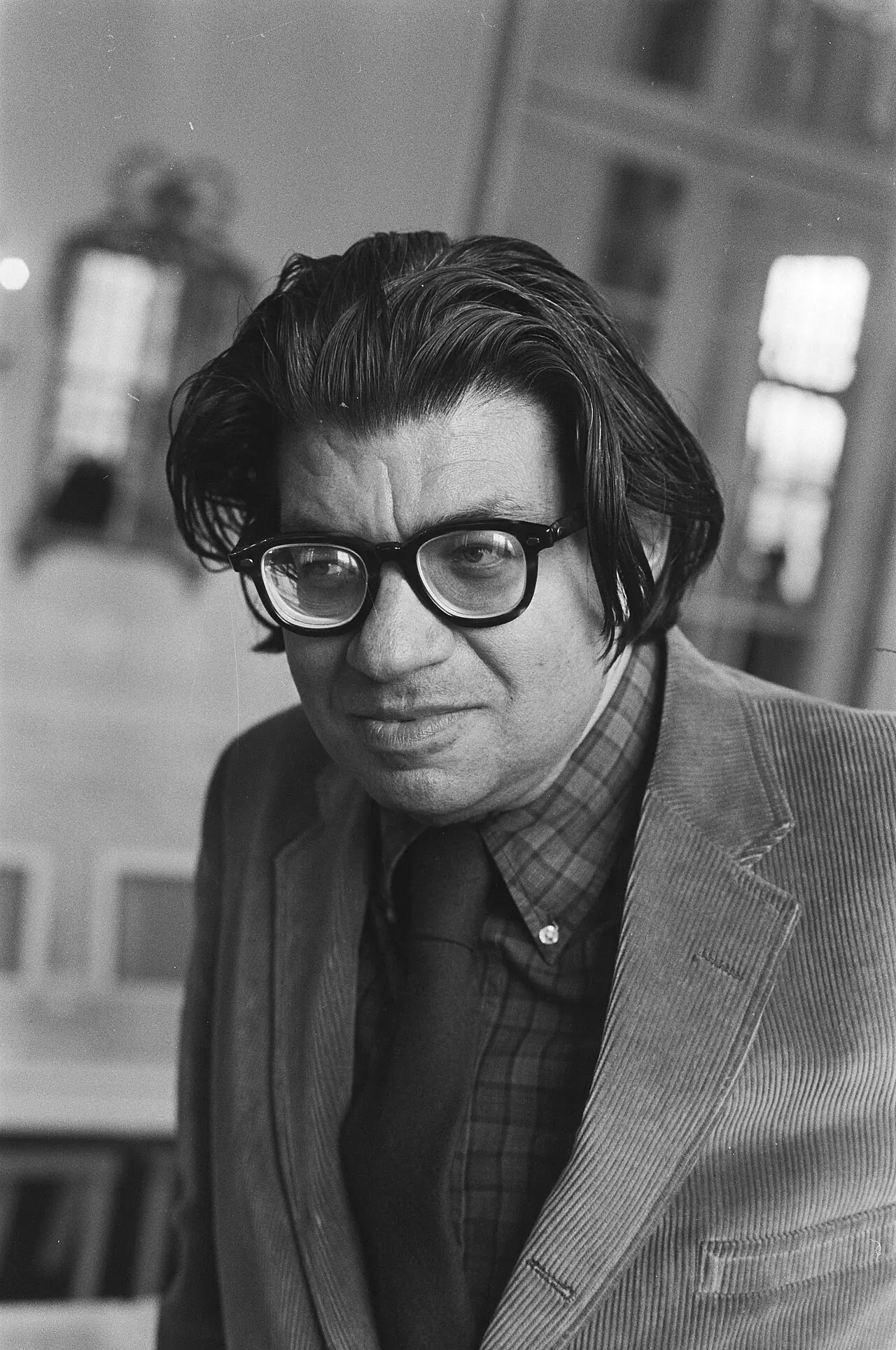
MortonFeldman
Composer of quiet, softly struck piano writing and of a string quartet that can last six hours.
- Trained
- Vera Maurina Press, piano; Wallingford Riegger and Stefan Wolpe, composition
- Circle
- John Cage · David Tudor · Earle Brown · Christian Wolff · Philip Guston · Mark Rothko
- Posts
- Dean, New York Studio School, 1969–71; taught at SUNY Buffalo from 1973
- On the page
- Grids with pitches left open; independent parts; later, precisely counted repetitions
Life
In January 1950 Morton Feldman heard Webern’s Symphony, Op. 21, at Carnegie Hall, with Dimitri Mitropoulos conducting the New York Philharmonic. Afterwards he saw John Cage in the hall and walked over. “Wasn’t that extraordinary?” he asked. Remembering the meeting for Alan Beckett in International Times in November 1966, Feldman said that Cage was shaking with excitement. Cage asked what he did; Feldman said he wrote music. They made an appointment to look at it.
Cage’s apartment impressed him nearly as much as the concert. Five flights up were windows looking over the East River, plants, a straw mat, Japanese cushions and a Steinway. Feldman, brought up among conventional furniture, went out and bought a drafting table and fluorescent lamp like Cage’s. He later moved into the same building. Cage encouraged him to trust what he was already doing. In that 1966 interview Feldman said of the debt, “I owe him everything and I owe him nothing.”
1926–50New York, Riegger, Wolpe and Varèse
Feldman was born in New York on 12 January 1926, into a Jewish family from eastern Europe. Vera Maurina Press, who had studied with Busoni, taught him piano. He studied composition privately, taking counterpoint with Wallingford Riegger from 1941 and then lessons with Stefan Wolpe from 1944. Wolpe introduced him to Edgard Varèse, whom Feldman went on visiting nearly every week. Varèse treated the sound of an instrument as material to build with in its own right, apart from a note’s place in a chord.
Wolpe’s political convictions sometimes made the lessons uncomfortable. Feldman told Alan Beckett in 1966 that Wolpe had once scolded him in his studio on Fourteenth Street over his responsibilities to the man in the street. Looking out of the window, Feldman saw Jackson Pollock crossing the road. He said nothing, and Wolpe went on talking about the public.
The 1950s and 1960sGraph notation and the Projections
Projection 1 (1950), for cello, put those ideas on graph paper. Harmonics, plucked notes and bowed notes occupy separate bands; the cellist moves across the boxes and chooses pitches within their limits. The Projections and Intersections allowed sounds that a composer might not have written at the piano. David Tudor became an indispensable interpreter, working out practical realisations of the graphs. Around him, Cage and Feldman, with Earle Brown and Christian Wolff, formed the circle called the New York School.
Feldman also tried the reverse arrangement. In the five Durations pieces of 1960–61, he supplied the notes and let each player proceed at an independent pace. A piano chord could fade while a string player held on, and the next flute note might arrive before either had finished. He wrote fully notated pieces alongside these experiments. He stopped using graphs after In Search of an Orchestration in 1967; his later scores fixed small differences with changing time signatures and exact rests.
Painters and playersRothko Chapel and the painters
Philip Guston, Rothko, Franz Kline and Pollock were Feldman’s friends, people he argued with and visited. At the Cedar Tavern, Feldman and Cage sat among painters who were making enormous canvases with no story or central figure. For years the family clothing business paid Feldman’s bills. He became dean of the New York Studio School in 1969, spent 1971–72 in Berlin on a DAAD residency, and began teaching at Buffalo in 1973, in a professorship named after Varèse.
The violist Karen Phillips prompted The Viola in My Life, four pieces of 1970–71 with accompaniments that change from piano to orchestra. In them a melody is heard, stops and returns. Talking to Howard Skempton in London on 13 January 1977, Feldman said he wanted it to come back “like a ghost, like a memory”. A short interruption from the snare drum can break the melody off.
At the chapel’s inauguration in 1971, John and Dominique de Menil asked Feldman for a piece in Rothko’s memory. Rothko Chapel was first performed there in 1972. A wordless choir holds chords behind the viola; soprano and alto soloists, celesta and percussion also take part. The soprano’s melody was written on the day of Stravinsky’s New York funeral service. Near the end the viola plays a tune Feldman had written when he was fifteen, over a quiet vibraphone accompaniment.
1976–77Beckett and neither
Feldman met Samuel Beckett in Berlin in 1976 to discuss a proposed opera. As Feldman recalled to Skempton the following January, Beckett said, “Mr Feldman, I don’t like opera.” Feldman answered, “I don’t blame you!” Beckett later sent the short text of neither. Feldman had already started composing, and the opening has no voice because he did not yet have the words. A solo soprano sings the text, often high above repeated orchestral figures. The work was performed at the Rome Opera in May 1977, staged by the artist Michelangelo Pistoletto.
The late worksRugs and repetition
Feldman collected rugs, and they bore on his thinking about repetition. In the 1981 essay ‘Crippled Symmetry’ he described the freedom Anatolian weavers took with apparently symmetrical designs. A border might not meet neatly, and a repeated shape might be stretched. His late scores apply the same irregularity within the bar. A few notes recur, but a rest is lengthened, an accent comes later, or one player begins the next pattern while another is still finishing the last.
In Crippled Symmetry (1983), the flute, keyboard and percussion players count their own repetitions, and parts printed on the same page do not necessarily sound together. The Second String Quartet, written the same year, can last more than five hours. Plucked notes interrupt bowed chords, and small rocking figures return long after they first appear. For Bunita Marcus (1985) lasts roughly seventy minutes and is played very quietly throughout, with the sustaining pedal held down, so that the strings go on sounding through the rests.
Piano and String Quartet, also from 1985, sets the decaying piano sound against four bowed instruments. For the large orchestra of Coptic Light, first performed in 1986, Feldman imagined a sustaining pedal made of instruments. Ancient textiles in the Louvre had set him thinking about what remains of a civilisation in scraps of cloth. He placed two pianos within the orchestra and kept its soft sounds renewing one another.
The last solo piano piece, Palais de Mari (1986), takes about twenty-five minutes. Bunita Marcus commissioned it and played the première in the loft of its dedicatee, the painter Francesco Clemente. Feldman had seen a photograph of the ruined palace at the Louvre. The piece returns to the uneven patterns of his earlier music. In 1987 he returned to Beckett with music for the radio play Words and Music and the ensemble piece For Samuel Beckett. He continued teaching until the end of his life and died of pancreatic cancer in Buffalo on 3 September 1987, aged sixty-one.
Where to hear it
- Rothko Chapel1971Kim Kashkashian (viola), Sarah Rothenberg (celesta), Steven Schick (percussion), Lauren Snouffer (soprano), Sonja Bruzauskas (mezzo-soprano), Houston Chamber Choir, Robert Simpson (conductor) · ECM New Series 2378 · February 2013, The Brown Foundation Performing Arts Theater, Asia Society Texas Center, Houston
Feldman wrote this music for the chapel in Houston that houses Mark Rothko’s paintings. Kim Kashkashian plays the viola part against the choir, and Steven Schick keeps the percussion distinct, on an album released in 2015 that recreates the programme of the chapel’s fortieth-anniversary concert and also includes works by Satie and Cage.
- For Bunita Marcus1985Marc-André Hamelin (piano) · Hyperion CDA68048 · June 2016, Concert Hall, Wyastone Estate, Monmouth
The piano stays very soft, its damper pedal held down while short phrases recur across seventy-two minutes. Hamelin controls his touch closely, changes the tone by small degrees and keeps the rhythm firm. The Wyastone recording, released in 2017, leaves room for the piano’s decay to be heard.
- Piano and String Quartet1985Aki Takahashi (piano); Kronos Quartet: David Harrington, John Sherba (violins), Hank Dutt (viola), Joan Jeanrenaud (cello) · Nonesuch 79320 · November 1991, Skywalker Sound, Marin County, California
Feldman wrote it in 1985 for Aki Takahashi and the Kronos Quartet, who hold its 79-minute span steadily on this recording, released in 1993. A strong first choice for the late chamber music. Mark Swed wrote in the liner note: “Chords never appear the same way twice; repetitions of motives are always subtly altered in rhythm.”
These recordings are under copyright, so the Hall cannot play them; the links go to the labels’ and artists’ own uploads and to streaming services.
Places

All 14 places, with sources
- New York City · 12 January 1926 · born
Born in Woodside, Queens.
- New York City · 1941 · studied
Began composition lessons with Wallingford Riegger.
- New York City · 1944 · studied
Studied composition with Stefan Wolpe.
- Carnegie Hall New York · 1950 · heard
Heard Webern’s Symphony and met John Cage in the lobby.
- New York City · 1950 · lived
Moved into Cage’s building on Monroe Street and entered the New York School circle.
- New York City · 1969–1971 · worked
Served as dean of the New York Studio School.
- Berlin · September 1971 – October 1972 · lived
Held a DAAD artists’ residency in West Berlin.
- Rothko Chapel, Houston · 1972 · premiere
Feldman’s Rothko Chapel was first performed in the Houston sanctuary. Rothko Chapel.
Rothko Chapel: first Feldman performance in 1972 · Wikipedia: Rothko Chapel coordinates
- Buffalo, New York · 1973–1987 · worked
Held the Edgard Varèse professorship at the State University of New York at Buffalo.
- Berlin · 1976 · travelled
Met Samuel Beckett, beginning the collaboration that produced Neither. Neither.
- Rome · 1977 · premiere
Neither received its first production at the Teatro dell’Opera. Neither.
- Darmstadt · 1984–1986 · worked
Taught at the Darmstadt summer courses.
IRCAM: Morton Feldman biography · Geographic coordinates: Darmstadt
- Beth Moses Cemetery, West Babylon · 1987 · buried
Buried at Beth Moses Cemetery on Long Island.
- Buffalo, New York · 3 September 1987 · died
Died at his Buffalo home.
Influences
Teachers, encounters and borrowed music, each with its account and sources in the Web of Influence.
Influences received
Influences passed on
- None listed.
The sound
Attack and decay
A piano note starts to decay as soon as it is struck, and a bowed string can sustain its sound. In Piano and String Quartet the instruments are combined on the basis of this difference. The strings can hold a chord after the piano has faded, or stop and leave its last vibrations exposed.
Register and spacing
False Relationships and the Extended Ending returns repeatedly to an E♭ a minor tenth above middle C. Other notes are grouped around it; it serves as a point of reference, and no home key is established. In Why Patterns?, Feldman spread the instruments across different octaves so that their separate lines remain clear even when their attacks fall together.
Notated freedom
In Projection 1, the cellist chooses pitches inside Feldman’s boxes. In Durations, the pitches are fixed and the players choose how long to hold them. Later Feldman wrote the rhythms out precisely. Each of these notations settles differently who decides when the flute enters, what note it plays, and whether the piano is still sounding when it does.
Unequal repetition
Crippled Symmetry begins with a four-note flute pattern whose rhythms keep changing. The vibraphone and piano have patterns of their own. A repeat sign can hold one player back while the others move ahead, so notes that sit next to each other on the printed page may never sound together in performance. The players have to count throughout to keep the quiet music going.
Duration and memory
The Second String Quartet keeps its four players together for hours, and small figures return after long absences. A chord may recur long after its last appearance. Palais de Mari uses similarly altered repeats over twenty-five minutes, with the pedal held down while its quiet chords change.
Melody
Tunes are rare in Feldman. In Rothko Chapel, after long stretches of wordless choral chords, the viola plays a melody from his adolescence above the vibraphone. In The Viola in My Life, the solo tune enters without preparation, stops, and later returns.
Works
A selection from the composer’s works.
- 1950Projection 1CelloThe cellist reads boxes for harmonics, plucked notes and bowed sounds, choosing the pitches. Feldman’s first graph score.
- 1960–61Durations I–VFive different chamber combinationsFive experiments with fixed notes and independent timing. A chord can contain a different combination of instruments each time the piece is played.
- 1970–71The Viola in My Life I–IVSolo viola with different ensembles; No. IV with orchestraWritten for Karen Phillips. A solo melody comes and goes among the surrounding instruments. The third piece is for viola and piano only.
- 1971Rothko ChapelSoprano and alto soloists, mixed choir, viola, celesta and percussionCommissioned by John and Dominique de Menil for the Houston chapel and first played there in 1972. The closing viola melody was written when Feldman was fifteen.
- 1977neitherSoprano and orchestra; text by Samuel BeckettOne soprano sings Beckett’s brief text; there are no other characters. Feldman wrote the orchestral opening before the words had arrived.
- 1983Crippled SymmetryFlute/bass flute, piano/celesta, vibraphone/glockenspiel; three playersThree musicians, six instruments, about ninety minutes. Each player follows a separate chain of repeats, so the notes on the page meet in changing combinations.
- 1983String Quartet No. 2String quartetOne continuous movement that can last more than five hours. The FLUX Quartet’s recording takes six hours and seven minutes.
- 1985For Bunita MarcusPianoAbout seventy minutes of very soft piano with the sustaining pedal held down. Minute changes in the spacing of notes and rests keep the strings ringing in new combinations.
- 1985; first performed 1986Coptic LightLarge orchestra, including two pianosFeldman’s last large-orchestra work, conceived as a sustaining pedal made of instruments. His starting point was the ancient Coptic cloth in the Louvre.
- 1986Palais de MariPianoThe last solo piano work, commissioned by Bunita Marcus and dedicated to Francesco Clemente. Marcus gave its première in the painter’s loft.
In the score
Short examples, engraved and playable.
Late pattern writing · schematicRepeated figure with one displaced return
Independent parts · schematicIndependent attacks and changing overlaps
Sister arts
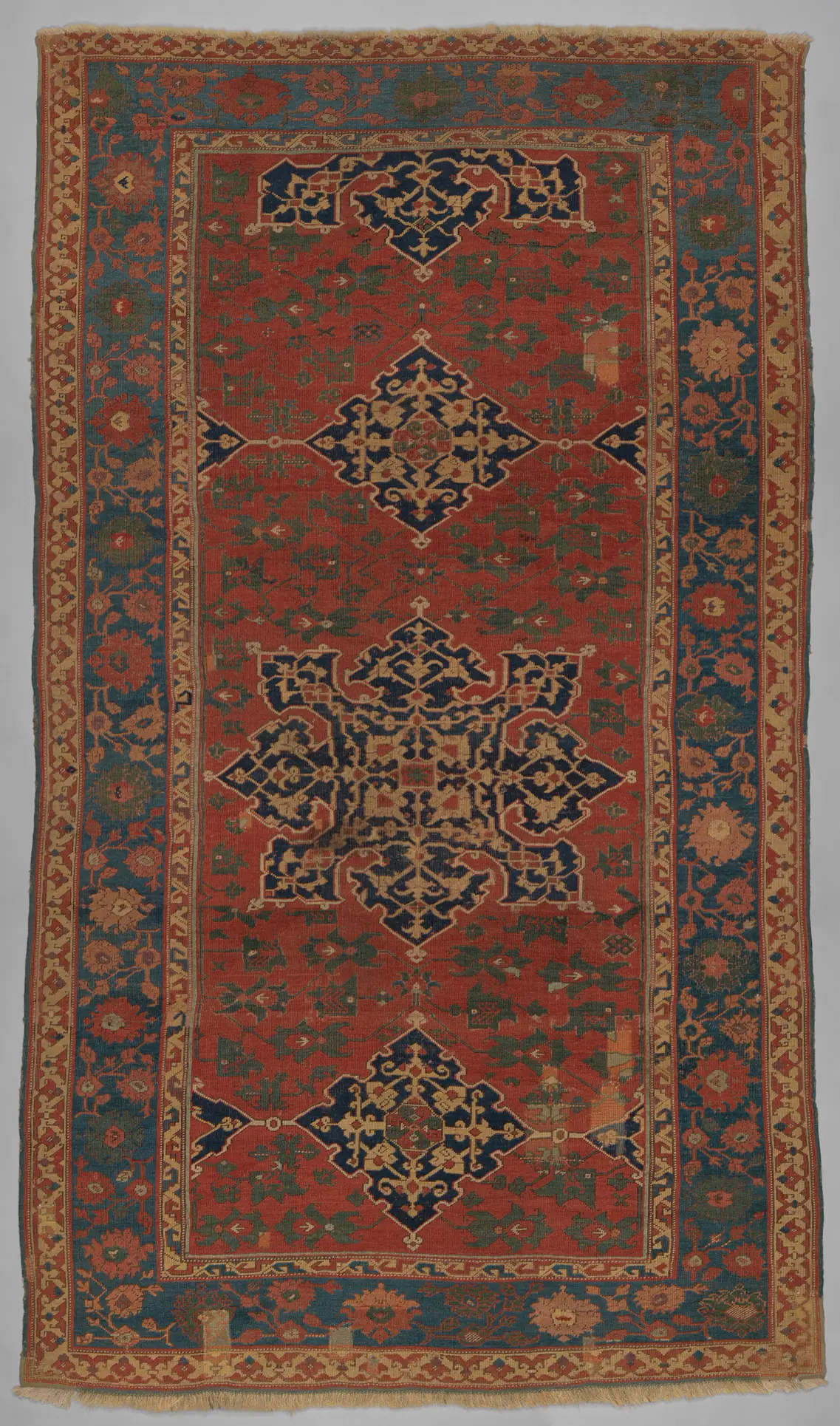
At the sides and top of this Anatolian carpet, the border cuts through blue medallions. Feldman collected rugs and studied the small irregularities of their repeated shapes in his essay ‘Crippled Symmetry’ (1981). He took the weaver’s adjustments to a pattern during weaving as a model for a musical repeat that could change length.
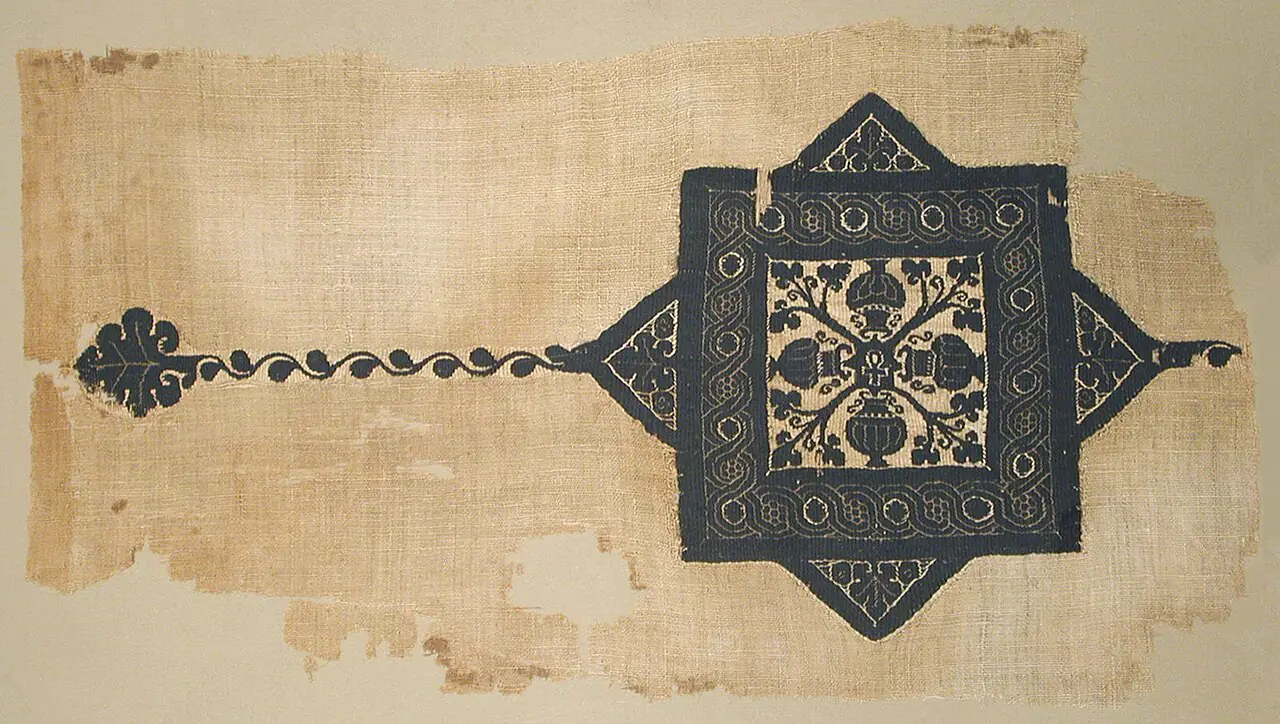
Feldman stood before Coptic textiles in the Louvre and wondered how a scrap of cloth could preserve the character of an entire civilisation. Coptic Light grew from that visit. This Egyptian fragment in the Met, woven in linen and wool, is a textile of the kind that survived in this way. Its edges are damaged and its woven design remains.
Lineage
Webern brought Feldman and Cage together at Carnegie Hall; Wolpe had already introduced him to Varèse. Howard Skempton’s 1977 interview records a younger composer learning directly from Feldman’s talk about sounds and instruments. Bryn Harrison drew on ‘Crippled Symmetry’ when devising his own rhythmic grids. Jürg Frey studied Feldman’s scores in the 1980s and took encouragement from their plain decisions about how a piece could go on.
Further reading
- Morton Feldman, Give My Regards to Eighth Street: Collected Writings, edited by B. H. Friedman (Exact Change). study
Feldman’s essays, lectures, programme notes and other writings connect composing with the New York visual arts.
- David Cline, The Graph Music of Morton Feldman (Cambridge University Press, 2016). study
Reconstructs the notation, organisation and genesis of the graph works from published and unpublished sources.
- IRCAM, ‘Morton Feldman: Biography’ (online resource). reference
A chronological account of his teachers, graphic notation, artistic friendships and institutional posts.
Cite this page
Contrapunctus. “Morton Feldman.” Accessed 20 October 2026. https://mottopanikeiku.github.io/contrapunctus/composers/feldman.html.
@misc{contrapunctus-composers-feldman,
  author = {{Contrapunctus}},
  title = {Morton Feldman},
  howpublished = {\url{https://mottopanikeiku.github.io/contrapunctus/composers/feldman.html}},
  note = {Accessed 2026-10-20}
}