Magda Kardos in Timișoara; Veress, Farkas, Kadosa and Weiner in Budapest
Teaching
Piano and chamber music at the Liszt Academy from 1967
Marriage
Married the pianist Márta Kinsker in 1947; they performed Bach and Játékok together
On stage
Troussova, Paris 1981 · Fin de partie, Milan 2018
Life
Kurtág was eleven or twelve when his parents named the symphony coming from the radio: Schubert’s “Unfinished”. He was astonished that anyone could recognise such music. When he heard it again alone, he recognised it himself. “I asked for and was given the score,” he told Bálint András Varga in their 1982–85 interview; he then learned the piano arrangement. At home he and his mother played Beethoven symphonies four hands, sometimes far beyond their abilities, and read on regardless.
He was born in Lugoj in 1926, in the Banat, where Hungarian, Romanian and German were everyday languages. In nearby Timișoara his piano teacher Magda Kardos entrusted him with younger pupils, so he began teaching while still a teenager. At the Budapest Academy’s entrance examinations in September 1945 he met György Ligeti, whose scores he already regarded as the work of a fully formed musician. Both young men had grown up with Bartók as their great example.
Kurtág began his studies in Budapest in 1946. He studied composition with Sándor Veress and then Ferenc Farkas, piano with Pál Kadosa and chamber music with Leó Weiner. He qualified in piano and chamber music in 1951 and in composition four years later. The pianist Márta Kinsker became the first reader and critic of his new pieces, and he trusted her ear through every later crisis. They married in 1947.
Paris, 1957–58Paris and Marianne Stein
After the suppression of the Hungarian uprising, he went to Paris. Walking there with Márta, he realised they had stopped lowering their voices in the street. He attended classes with Messiaen and Milhaud and heard Boulez conduct at the Domaine musical. He found composing very difficult. Marianne Stein, a psychologist who worked with artists, gave him small tasks to attempt.
“She told me to bring two notes together in conjunction with each other,” he recalled to Kate Connolly in Budapest in 2023. Stein meant a melodic connection. Kurtág took it to mean that a piece might begin on C and end on A, and the misunderstanding set him thinking again.
On the way home he stopped in Cologne. Ligeti played him his electronic Artikulation and introduced him to Stockhausen, and Gruppen, for three orchestras, made a lasting impression on him. Back in Budapest, Kurtág wrote the String Quartet and dedicated it to Stein. A wind quintet, eight piano pieces and duos for violin and cimbalom followed. The cimbalom’s hammers strike the strings and leave them ringing. He later placed this sound beside the human voice.
1963–73The Sayings of Péter Bornemisza and Játékok
He had wanted to make an opera from Péter Bornemisza’s Hungarian version of Electra. Instead, the sixteenth-century preacher’s sermons provided the text of The Sayings of Péter Bornemisza, composed between 1963 and 1968. The work is for soprano and piano, in twenty-four short movements grouped as Confession, Sin, Death and Spring. The piano begins by repeating C, then adds D♭, and the voice enters on B♮, so the opening notes lie a semitone on either side of C. Erika Sziklay and Lóránt Szűcs gave the première at Darmstadt in September 1968.
From 1967 Kurtág taught at the Liszt Academy, first piano and then chamber music. In 1973 another teacher, Marianne Teöke, asked him for pieces for her pupils. Játékok began with the child’s wish to touch the instrument. In these pieces a beginner could play across the whole keyboard, slide over the keys or sound a cluster with a forearm. Kurtág asked for the same concentration on these actions that he demanded from professional players rehearsing a phrase of Beethoven.
The collection included pieces addressed to particular people: bells for Stravinsky, a birthday greeting for the publisher Alfred Schlee, and homages to Ferenc Farkas and to Márta. Husband and wife played these pieces in concert alongside his four-hand Bach transcriptions. Their 1996 recording places the Sonatina from Actus tragicus among pieces lasting less than a minute. The two players share one keyboard.
1981–89Troussova and Kafka-Fragmente
Rimma Dalos entered his life as the Russian translator of the Bornemisza texts for a record booklet. Her own poems became Messages of the Late Miss R. V. Troussova, twenty-one brief accounts of loneliness and desire, sung in Russian. Adrienne Csengery, the Ensemble intercontemporain and Sylvain Cambreling gave the Paris première on 14 January 1981, and the work brought Kurtág international recognition at fifty-four. The instrumental ensemble includes mandolin, harp and cimbalom. In one song the woman asks why she should not squeal like a pig, and the soprano sings unaccompanied.
For years Kurtág had copied passages from Kafka’s diaries and letters into his notebooks. In 1985, when teaching interrupted work on a piano concerto, he started setting them. Kafka-Fragmente grew into forty pieces for soprano and violin, completed in 1987. The texts include walking sticks, a railway station, a tram and bodies trying to find their way. In the tram scene the violinist changes instruments and moves from one side of the singer to the other. The two violins are tuned differently and stand for two people in Kafka’s text.
The work also commemorates the dead. Officium breve (1988–89) names the composer Endre Szervánszky in its title, and other friends are commemorated within its fifteen movements. A canon from Webern’s Second Cantata is transcribed for the four strings. At the end comes a melody from Szervánszky’s Serenade for Strings, in an older, more flowing style. Kurtág cuts it off on a held chord.
1994–2026Beckett at La Scala
His Berlin Philharmonic residency produced Stele (1994), a thirteen-minute work for a very large orchestra, dedicated to Claudio Abbado and his players. One of its three movements is a lament; the keyboard instruments include a concert piano and a small upright. …concertante… (2003) was written for the violinist Hiromi Kikuchi and the violist Ken Hakii, who gave the première in Copenhagen as soloists with another large orchestra.
Kurtág had seen Beckett’s Fin de partie in Paris in 1957, when he had too little French to understand it properly. Sixty-one years later his operatic setting reached La Scala, conducted by Markus Stenz and staged by Pierre Audi. The characters are Beckett’s Hamm, Clov, Nagg and Nell; Hamm’s parents live in rubbish bins. Márta had sat beside Kurtág at the piano while he composed and insisted that he work every day. In his 2023 interview with Connolly he called her his “Muse Gendarme”.
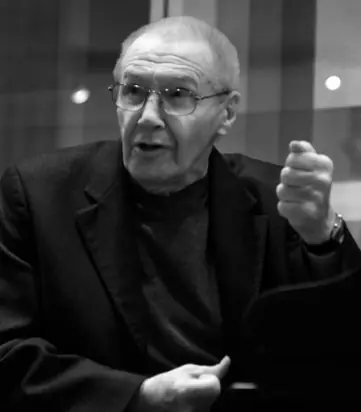
Márta died in 2019. “I still hear her chiding me for being too pompous and priest-like, too polite,” he told Connolly four years later. He turned one hundred on 19 February 2026. The next evening in Budapest, Maria Husmann sang the première of his second opera, Die Stechardin, with András Keller conducting. In the opera a woman waits beyond death for the man she loved. At the end of the performance a photograph of Márta appeared at the back of the stage.
Where to hear it
Játékok — selectionsfrom 1973
György Kurtág and Márta Kurtág (piano) · ECM New Series · July 1996
These miniature piano games include palm-strokes, a peal of bells for Stravinsky and homages to friends. György and Márta Kurtág recorded this selection for two and four hands in Vienna, interleaving it with four of his Bach transcriptions; some of the short pieces are abrupt, and both players share one keyboard.
Juliane Banse (soprano); András Keller (violin) · ECM New Series · September 2005
Forty pieces for soprano and violin set fragments of Kafka’s diaries, letters and other writings, some lasting only seconds, though a few seconds of speech can open into a scene several minutes long. Banse changes vocal colour from fragment to fragment; Keller, who advised Kurtág on the violin writing and played the première, gives the violin a part equal to the voice. Both recorded the cycle with Kurtág at the sessions.
Berliner Philharmoniker; Claudio Abbado (conductor) · Deutsche Grammophon · December 1994, live
Wagner tubas and cimbalom join the large orchestra in Stele, whose central lament is marked ‘desperate’. Abbado and the Berlin Philharmonic, the work’s dedicatees, recorded this performance live in December 1994.
In Játékok the player can use the whole arm. A palm or forearm sounds a cluster; a slide crosses keys too quickly to count. The beginner can make a decisive musical event before mastering individual notes. Kurtág’s graphic signs give these movements a shape and a place in time, and the player decides how the sound should begin, ring and stop.
♯Intervals
At the opening of The Sayings of Péter Bornemisza, the piano repeats C before adding D♭; the soprano enters on B♮. The first note then has a semitone neighbour on either side. Later the piano plays chords of eight or more pitches, and the singer’s leaps can span two octaves.
𝅘𝅥Speech
In Troussova, the soprano squeals without accompaniment in Why Should I Not Squeal?; in What Misery, voice and cimbalom follow one another in canon. In Kafka-Fragmente, the vocal line extends into speech and screaming. Some phrases call for more breath or a wider leap than the singer can comfortably supply.
𝄾Silence
Officium breve ends with a song that breaks off. Kurtág borrowed the Arioso from Szervánszky’s Serenade for Strings, let its melody run, then cut it off on a suspended chord. It comes after a long series of short movements.
𝄋Memory
Hommage à R. Sch. is scored for Schumann’s players in the Märchenerzählungen, clarinet, viola and piano. Schumann’s imaginary figures Eusebius and Florestan appear in the movement titles. The long final movement brings Master Raro together with the medieval composer Machaut. At its close the clarinettist plays a single soft stroke on a bass drum.
Works
A selection from the composer’s works.
1959
String QuartetOp. 1String quartet
The new beginning, dedicated to Marianne Stein. Six movements lead from the opening Poco agitato to a closing Adagio. The title page gives the composer, then thirty-three and recovered, his first opus number.
1963–68
The Sayings of Péter BornemiszaOp. 7Soprano and piano
A Hungarian preacher’s sermons set as a concerto for soprano and piano. The twenty-four movements pass through confession, sin and death to spring; the piano part has dense chords and fugues, and the soprano part has very wide leaps.
1973 onwards
Játékok (Games)Piano solo and piano duet
Begun for children, later filled with pieces for friends. Palm strokes, slides and short melodies stand beside birthday greetings and memorials; Bells salutes Stravinsky, and several pieces bear the name of Kurtág’s teacher Ferenc Farkas.
1976–80
Messages of the Late Miss R. V. TroussovaOp. 17Soprano and chamber ensemble
Twenty-one poems by Rimma Dalos, whose maiden name was Troussova. The voice moves between intimate speech, desire and animal cries. Cimbalom, mandolin, harp and percussion are grouped differently for each song.
1985–87
Kafka-FragmenteOp. 24Soprano and violin
Forty pieces in four parts, ranging from pieces lasting seconds to Der wahre Weg, the long homage to Boulez. In the tram scene, the violinist changes both instrument and position beside the singer.
1988–89
Officium breve in memoriam Andreae SzervánszkyOp. 28String quartet
Fifteen movements make a brief memorial service. A canon is taken from Webern’s Second Cantata. The final Arioso is taken from Szervánszky’s Serenade for Strings and stops before its melody has finished.
1990
Hommage à R. Sch.Op. 15dClarinet, viola and piano, with bass drum
Schumann’s Eusebius, Florestan and Master Raro return in six movements. The farewell lasts longer than the other five together; its procession descends into the low register of the piano and ends with a single bass-drum stroke played by the clarinettist.
1994
SteleOp. 33Large orchestra
An orchestral memorial in three movements, with a lament at its centre. The very large orchestra, assembled for about thirteen minutes of music, includes bass flute, cimbalom, two harps and a small upright piano.
2003
…concertante…Op. 42Violin, viola and orchestra
Written for Hiromi Kikuchi and Ken Hakii, who gave the first performance in Copenhagen. Fantasy, recitative and chorale all appear in the score. The title begins and ends with dots.
2010–17
Fin de partieFour singers and orchestra
Beckett’s four inhabitants of a room, including two parents in rubbish bins. Kurtág’s first opera was performed at La Scala in 2018, when he was ninety-two; Pierre Audi staged it and Markus Stenz conducted.
2023–25
Die StechardinSoprano and piano, or orchestra
In Christoph Hein’s German libretto a woman speaks from beyond death. Maria Husmann gave the première in Budapest the day after Kurtág’s hundredth birthday; the orchestral version was prepared by Zsolt Serei.
In the score
Short examples, engraved and playable.
Játékok — schematicAttack, space, reply
Schematic, invented for this page: C–D–E–F sound together, then the same white-note cluster is repeated an octave higher and quietly. A whole bar separates them; the final rest has a fermata. The fixed pitches here illustrate the attack and pause; in Játékok a hand movement often determines the notes.
Chamber writing — schematicSemitone shared between players
An invented schematic of a semitone exchanged between players. The violin passes E–F to the cello; each instrument later repeats its pair an octave higher and more softly. Every answer follows a rest.
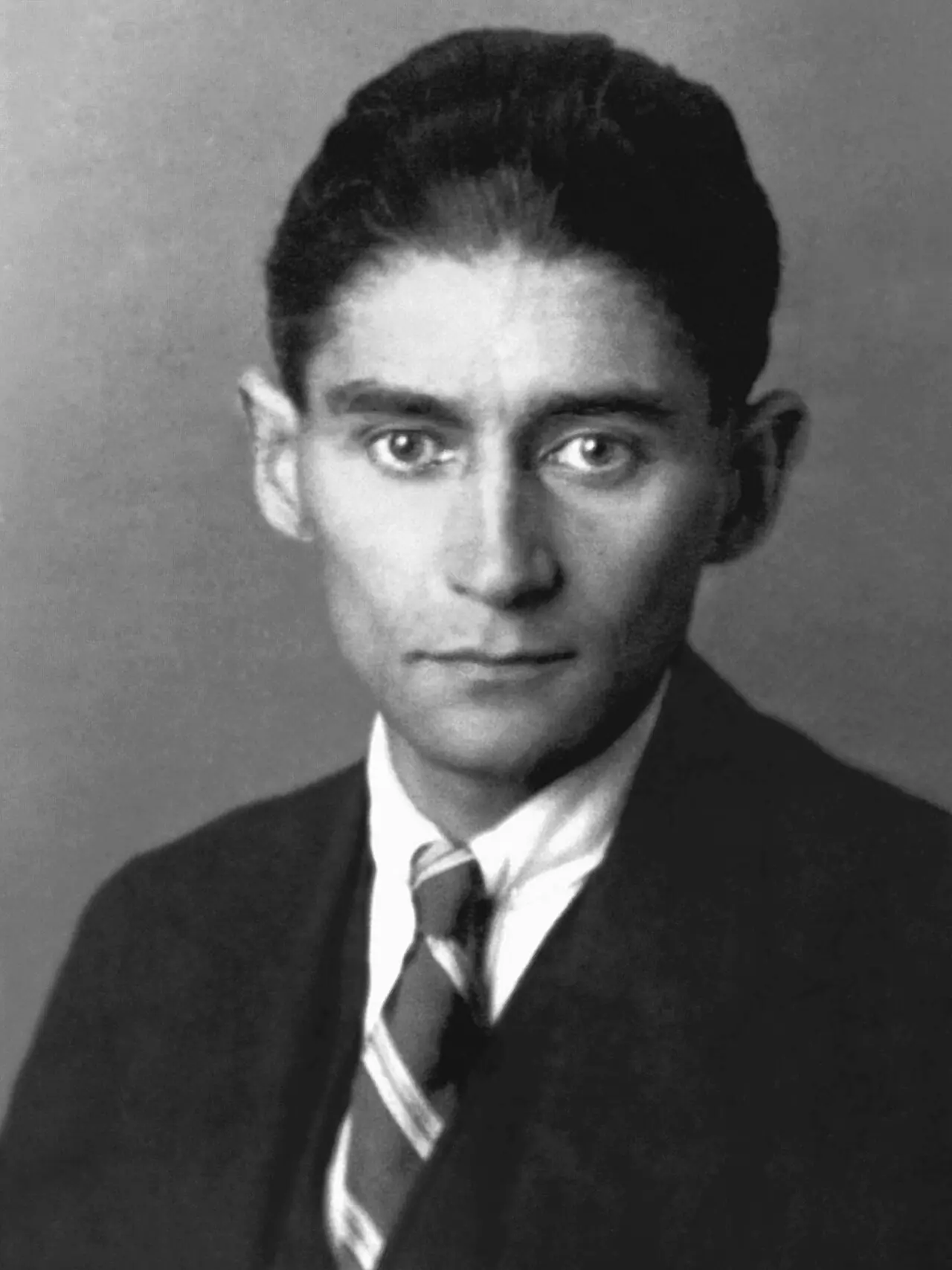
Kurtág had been copying Kafka’s diaries and letters into notebooks for years before he began Kafka-Fragmente in 1985. The forty settings take their texts from small incidents in Kafka’s writing, among them walking sticks, a railway station and two musicians on a tram. The photograph is a late portrait of Kafka.
Franz Kafka
Die Guten gehn im gleichen Schritt
Early twentieth century; set by Kurtág 1985–87
GermanDie Guten gehn im gleichen Schritt.
Ohne von ihnen zu wissen, tanzen die andern
um sie die Tänze der Zeit.
Our translationThe good walk in the same step.
Without knowing of them, the others dance
the dances of the time around them.
The lines that open Kafka-Fragmente are about orderly walkers with dancers moving round them. The cycle returns repeatedly to feet, paths and difficult progress. Kurtág dedicated it to Marianne Stein, the psychologist who had helped him begin composing again in Paris. Three decades later she was still helping him with his work.
Friedrich Hölderlin
An Zimmern
1812
GermanDie Linien des Lebens sind verschieden,
Wie Wege sind, und wie der Berge Grenzen.
Was hier wir sind, kann dort ein Gott ergänzen
Mit Harmonien und ewigem Lohn und Frieden.
Our translationThe lines of life are different,
as paths are, and the boundaries of mountains.
What we are here, a god may complete there
with harmonies and everlasting reward and peace.
Hölderlin lived with the family of the Tübingen carpenter Ernst Zimmer from 1807 until his death in 1843; Zimmer preserved these lines in an 1812 letter to the poet’s mother. Kurtág set them in 1994 as the fourth song of Hölderlin-Gesänge, Book I, Op. 35a. The song is for a single baritone, and the lines promise harmonies and peace.
Recommended recordings
Music for String InstrumentsKeller QuartetECM New SeriesThe Keller players studied with Kurtág, and they play with firm attacks. The disc pairs Op. 1, the first work in his catalogue, with Officium breve, a later quartet that draws heavily on other composers’ music.
Kurtág / Ligeti: Music for ViolaKim Kashkashian, violaECM New Series · 2012Kashkashian plays the Kurtág pieces from The Carenza Jig to the broken phrases of Faltering Words. She and Manfred Eicher chose the order of Kurtág’s pieces, which are followed by Ligeti’s much larger Sonata.
Passed toChamber-music teachingContemporary miniature and memorial cycles
These connections appear in the music itself. Bach is the source of the four-hand transcriptions; Schumann is the source of characters and of a clarinet–viola–piano trio; Webern is the source of a canon in Officium breve. Bartók lies behind the idea that a child’s piano piece can be a composer’s experiment. Ligeti brought Kurtág to Stockhausen and urged him towards Beckett. Kurtág’s pupils included András Schiff and the Keller Quartet.