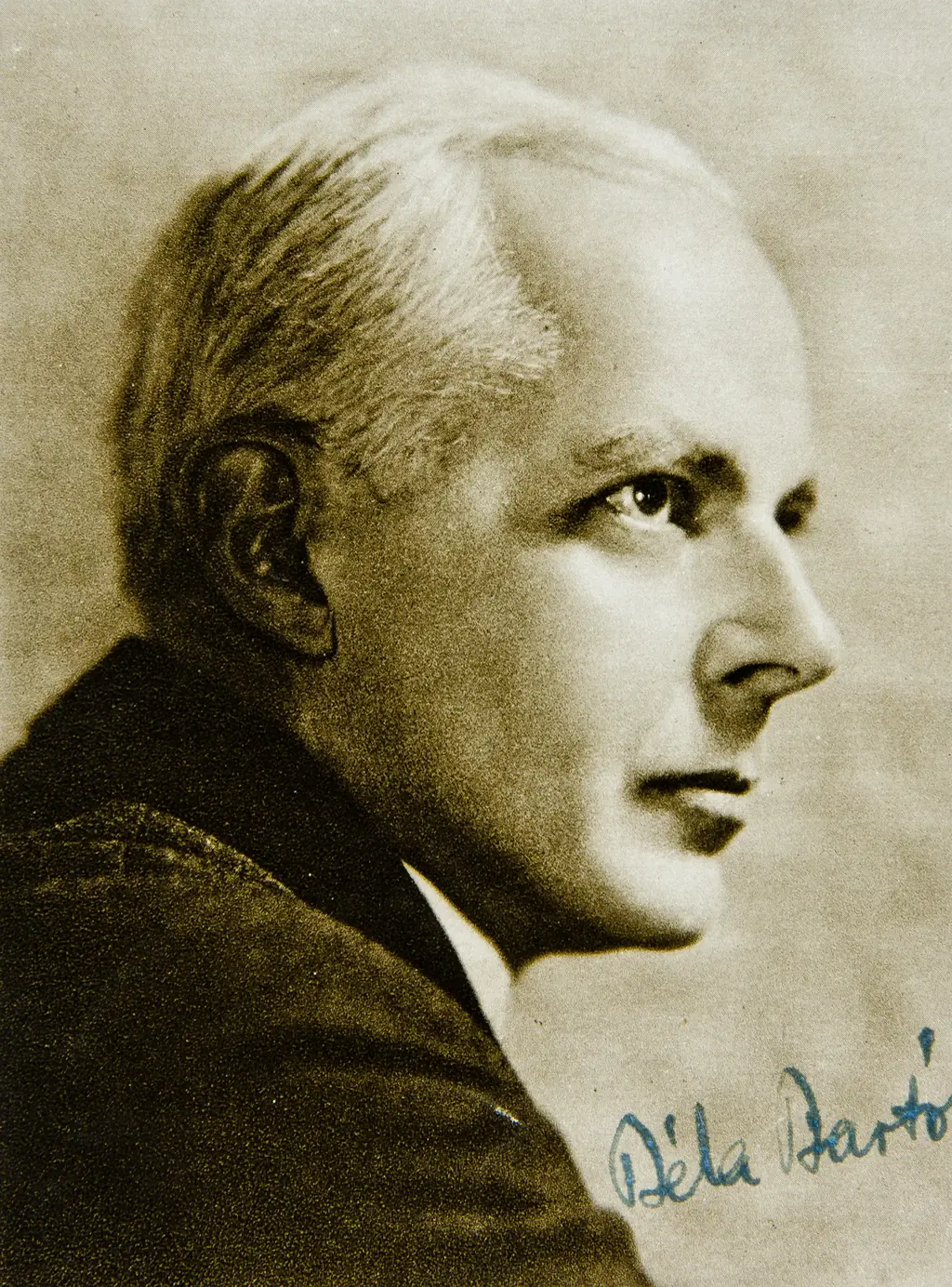
BélaBartók
Composer who saw a future for concert music in village songs and used a phonograph to record how they were sung.
- Trained
- István Thomán, a Liszt pupil, and Hans Koessler; Budapest Academy, 1899–1903
- Posts
- Piano professor in Budapest, 1907–34; folk-music research in Budapest and at Columbia University
- Collecting
- Hungarian, Slovak and Romanian villages; Biskra, 1913; Turkey with Adnan Saygun, 1936
- Output
- Six quartets, three piano concertos, two violin concertos, three stage works and Mikrokosmos
Life
In May 1904 Bartók went to stay with the Fischer family at Gerlicepuszta. He had a piano sent out, practised four hours a day and composed for four or five more. There he heard Lidi Dósa, a young woman from Transylvania in the family’s service, singing to the children in her care, and began writing down her songs. Their Hungarian music differed from the urban entertainment that usually went by that name, and he wanted more of it. Two years later the writer Béla Balázs went collecting with Bartók and recorded in his diary that the frail-looking pianist wore him out: “I was already very tired, but he kept urging and driving me on to collect more!”
1881–1907Budapest Academy and folk song
Bartók was born in Nagyszentmiklós in 1881, when the town belonged to Hungary; it is now Sânnicolau Mare in Romania. His father, director of an agricultural school, died when he was seven. His mother Paula supported Béla and his sister by teaching, moving between towns before settling in Pozsony, now Bratislava. At the Budapest Academy he studied piano with István Thomán, who had studied with Liszt, and composition with Hans Koessler.
In 1902 Bartók heard Strauss’s Also sprach Zarathustra in Budapest on 12 February, and it made a deep impression on him. He wrote afterwards that Strauss belonged in the line of those who had taken music a step further: “Bach, Haydn-Mozart, Beethoven; and Wagner was the last one.” His own Kossuth, written the next year, celebrated the Hungarian revolutionary and mocked the Austrian imperial anthem. In Bartók’s programme for the eighth section, the Austrian troops approach on the first two bars of the anthem in distorted form, which enter like fugue subjects until the trombones play it loudly. After this came Dósa’s songs and the friendship with Zoltán Kodály. In 1906 the two men published a joint collection of Hungarian folk-song settings. Kodály also brought music by Debussy back from Paris, and in it Bartók found pentatonic phrases that recalled the songs he was collecting.
A phonograph cylinder let him hear a performance again after the singer had gone. He collected thousands of Hungarian, Slovak and Romanian melodies and compared them across borders. In 1913 he went to Biskra in Algeria to record rural Arab music; in 1936 he worked in Turkey with Ahmet Adnan Saygun. At his desk he classified the songs by syllable count, phrase endings and melodic shape, and went back to his transcriptions to correct and compare them.
The tunes entered his scores in different ways. For Children gives young pianists Hungarian and Slovak melodies with accompaniments fitted closely to them. Elsewhere he wrote original songs in the manner of village songs. A quartet could take over the uneven beats and pungent intervals of the songs without quoting a tune. From 1907 he taught piano at the Academy, and the post paid for his own playing and his song collecting. That July he set out on his first collecting trip to Transylvania. In August he told the pianist Etelka Freund that he had found “the Sekler melody types, which I had thought nonexistent”.
1907–23Stefi Geyer and Duke Bluebeard’s Castle
He fell in love with the violinist Stefi Geyer in 1907 and wrote her a concerto. She did not return his love, and the complete concerto was not published in his lifetime. Music associated with her also appears in the First Quartet, which opens slowly and moves by stages to a fast dance. In 1909 he married Márta Ziegler; their son Béla was born the next year.
Balázs wrote the libretto for Duke Bluebeard’s Castle in 1911. It has two characters and seven locked doors. Judith demands the keys, and Bluebeard hands them over one at a time. Each room has its own orchestral sound. Judith finds blood in room after room, and each time the music marks it with a semitone. The fifth door opens on Bluebeard’s kingdom, a full C major chord with an organ beneath it. The opera had its Budapest première in 1918. This came after the ballet The Wooden Prince, another collaboration with Balázs, succeeded in 1917.
The Miraculous Mandarin is set in a city. Three men use a girl to lure customers whom they can rob; the stranger who arrives survives their attempts to kill him until she embraces him. Bartók began the score in 1918–19 and orchestrated it in 1924. It is written with sliding wind lines and pounding repetitions, and its theatre is very different from that of Bluebeard. The 1926 Cologne première provoked a local ban.
War and new borders had curtailed his collecting. He worked increasingly on the recordings and notebooks already in hand, while tours and Universal Edition carried his compositions abroad. The Dance Suite, commissioned for Budapest’s fiftieth anniversary in 1923, joined invented tunes in several folk idioms. That year he divorced Márta and married his piano pupil Ditta Pásztory. Their son Péter was born in 1924. Ditta later became his partner at a second piano.
1926–39Piano works, quartets and Cantata profana
In 1926 he wrote the Piano Sonata, the First Piano Concerto and Out of Doors. In these works the piano is used percussively, and elsewhere its decaying sounds are left to sustain. In “The Night’s Music”, quiet dissonant chords lie behind isolated calls and a sustained melody.
The Second Quartet, of 1917, had a slow and desolate ending. The Third, in 1927, was laid out as a set of connected sections, with scraping bows, slides and close imitation. The Fourth, a year later, had a singing cello in its quiet central movement, and its fourth movement was played entirely pizzicato, including strings snapped against the fingerboard. Elizabeth Sprague Coolidge commissioned the Fifth in 1934. Its central scherzo divides nine quavers as 4+2+3.
For Cantata profana in 1930, he took Romanian texts about nine hunters transformed into stags and wrote his own melodies. Explaining the work to Octavian Beu on 10 January 1931, he described his guiding idea as “brotherhood between peoples, a brotherhood despite all war and strife”. He said that he remained a Hungarian composer while welcoming Slovak, Romanian and Arabic influences. In the text, the nine sons cannot return to their father’s house because their antlers will no longer fit through the door.
In 1934 he left regular Academy teaching to prepare an edition of some 13,000 Hungarian songs at the Academy of Sciences. Mikrokosmos, assembled chiefly in 1932–39, is a set of 153 piano pieces for students that draws on his findings. In it the two hands imitate each other, play against each other and keep different accents.
Paul Sacher commissioned Music for Strings, Percussion and Celesta in 1936. Bartók divided the strings into two orchestras. The opening fugue expands from A to a climax on E♭, and in later movements phrases pass from one side of the stage to the other. In the Adagio a xylophone repeats one note and the timpani slide between pitches. The Sonata for Two Pianos and Percussion followed in 1937, and Bartók and Ditta played at its première in Basel in January 1938. In the Second Violin Concerto, written in 1937–38, the finale transforms the themes of the first movement, and the slow movement is a set of variations.
1940–45Music in exile
After the Anschluss in 1938, Bartók moved his publishing to Boosey & Hawkes in London. Hungary’s drift towards Nazism made staying intolerable. The Sixth Quartet of 1939 begins each movement with a sorrowful Mesto; by the finale, sorrow occupies the whole movement. His mother died that December. Following a spring concert visit to America, he and Ditta left Europe in autumn 1940.
In his 1943 Harvard lectures he explained how two different modes could share one home note. Lydian and Phrygian together could supply all twelve notes of the chromatic scale. He called this ‘polymodal chromaticism’; the piano examples below illustrate the idea.
Concert work was scarce, and leukaemia was taking hold. In 1943 Koussevitzky commissioned the Concerto for Orchestra, in memory of his wife Natalie, and Bartók returned to writing a large score. In the second movement the wind players enter in pairs, each pair playing in its own interval; a grave central Elegy stands between the lighter movements. Koussevitzky conducted the Boston première on 1 December 1944, with Bartók and Ditta in the hall. Four days later Bartók told his son Péter that Koussevitzky had called it “the most significant orchestral work of the last 20-25 years”.
Menuhin commissioned the Sonata for Solo Violin in 1944 and played it in New York on 26 November. “It was a wonderful performance,” Bartók wrote. The Third Piano Concerto was for Ditta, with a quiet Adagio religioso interrupted by birdsong. Bartók died in New York on 26 September 1945, still a Hungarian citizen. He left the last seventeen bars of the concerto to be orchestrated by Tibor Serly, and the Viola Concerto in sketches. His folk-music collections continued to appear after his death. In 1988 his remains were returned to Budapest.
Places

All 25 places, with sources
- Sânnicolau Mare · 25 March 1881 · born
Born in Nagyszentmiklós, then in the Kingdom of Hungary.
- Vynohradiv · 1889–1892 · childhood
Lived in Nagyszőlős and gave his first public recital in 1892.
- Bratislava · 1894–1899 · studied
Completed school in Pozsony and studied piano and composition locally.
- Budapest · 1899–1903 · studied
Studied piano with Thomán and composition with Koessler at the Royal Academy.
- Vésztő · 1904–1905 · travelled
Transcribed early folk melodies while visiting his brother-in-law.
- Budapest · 1907–1934 · worked
Taught piano at the Academy of Music.
- Iregszemcse · 1907 · travelled
Collected Hungarian peasant songs in Felsőireg during the spring.
- Biskra Algeria · 1913 · travelled
Recorded Arab folk musicians during an Algerian collecting journey.
- Hungarian State Opera House Budapest · 12 May 1917 · premiere
The Wooden Prince received its first staging. The Wooden Prince.
- Hungarian State Opera House Budapest · 24 May 1918 · premiere
Bluebeard’s Castle received its first staging. Bluebeard’s Castle.
- Cologne · 27 November 1926 · premiere
The Miraculous Mandarin caused a scandal at its stage premiere. The Miraculous Mandarin.
- Budapest · 1932–1940 · lived
Lived at Csalán út 29, now the Bartók Memorial House.
- Adana · 1936 · travelled
Collected Turkish folk music with Ahmet Adnan Saygun.
- Basel · 21 January 1937 · premiere
Paul Sacher conducted Music for Strings, Percussion and Celesta. Music for Strings, Percussion and Celesta.
- Basel · 16 January 1938 · premiere
Played with Ditta Pásztory at the sonata’s premiere. Sonata for Two Pianos and Percussion.
- Saanen · 1939 · lived
Composed the Divertimento during a stay arranged by Paul Sacher. Divertimento.
- Library of Congress Washington · 13 April 1940 · travelled
Performed a chamber recital with Joseph Szigeti.
- New York City · October 1940 – 1945 · exile
Settled with Ditta; transcribed South Slavic recordings at Columbia University.
- Saranac Lake New York · 1943–1945 · lived
Spent summers recuperating in the Adirondacks and composed the Concerto for Orchestra. Concerto for Orchestra.
- Asheville North Carolina · 1943–1944 · lived
Worked on the Solo Violin Sonata while staying in North Carolina. Sonata for Solo Violin.
- Carnegie Hall New York · 26 November 1944 · premiere
Yehudi Menuhin introduced the Solo Violin Sonata. Sonata for Solo Violin.
- Symphony Hall Boston · 1 December 1944 · premiere
Koussevitzky conducted the Concerto for Orchestra. Concerto for Orchestra.
- Ferncliff Cemetery Hartsdale · 1945 · buried
Initially buried in Ferncliff Cemetery.
- New York City · 26 September 1945 · died
Died of leukaemia.
- Farkasréti Cemetery Budapest · 7 July 1988 · buried
Remains returned to Hungary and reburied with state honours.
Influences
Teachers, encounters and borrowed music, each with its account and sources in the Web of Influence.
Influences received
Influences passed on
- None listed.
The sound
Folk melody
In the Romanian Folk Dances Bartók kept the borrowed tunes recognisable and wrote new accompaniments for them. The Dance Suite uses invented melodies with familiar rural turns. Cantata profana sets Romanian words to music of his own. His approaches ranged from keeping a particular singer’s tune intact to writing a quartet that quotes no tune, though village rhythms run through it.
Modes and semitones
Two modes can share a home note and differ in their other notes. C Lydian has F♯; C Phrygian has D♭, E♭, A♭ and B♭. Combined, they make all twelve notes available, with C still at the centre. In Bluebeard, a smaller clash is used: two adjacent notes recur as a sign of blood.
Unequal beats
The Fifth Quartet’s scherzo groups nine quavers as 4+2+3; its trio groups ten as 3+2+2+3. The small units stay equal while the larger groups change length. Bartók called this Bulgarian rhythm. Elsewhere a singer’s flexible timing, shaped by speech, leaves the bar line loose, or a piano part places accents across a regular metre.
Returns and arch forms
The Fourth Quartet has five movements. The outer pair share themes, the inner pair are paired with each other, and the slow third movement stands alone. In the Sixth, the introduction expands until it makes up the finale. In the Second Violin Concerto, the last movement reworks the first.
Night music
In Out of Doors, soft piano clusters are held while short calls sound above them. Music for Strings, Percussion and Celesta extends the night music: a single xylophone note repeats, speeding up and slowing down, the timpani play glissandos, and the strings hold chords beneath these sounds. In the Fourth Quartet a plucked string is pulled so that it snaps back against the fingerboard, adding the sound of string striking wood.
Counterpoint and space
The opening fugue of Music for Strings, Percussion and Celesta begins on A, and its entries rise and fall in fifths towards E♭. The string players sit in two groups, so later exchanges pass from one side of the platform to the other. The Solo Violin Sonata, by contrast, asks one player to play several voices using double stops and changes of pitch.
Works
A selection from the composer’s works.
- 1908–09String Quartet No. 1Op. 7 · Sz. 40 · BB 52Two violins, viola and celloIts slow opening is associated with Stefi Geyer, for whom Bartók had written his early Violin Concerto. Three connected movements lead to a fast dance.
- 1911Duke Bluebeard’s CastleOp. 11 · Sz. 48 · BB 62Two singers, spoken prologue and orchestraJudith opens seven doors, each with a different orchestral sound. At the fifth, Bluebeard’s kingdom appears in C major above the organ.
- 1918–19The Miraculous MandarinOp. 19 · Sz. 73 · BB 82Pantomime for large orchestra and wordless mixed chorusThe Cologne première in 1926 caused a scandal and led to a ban. The complete stage score continues beyond the familiar suite and adds a wordless chorus in its final scenes.
- 1923Dance SuiteSz. 77 · BB 86OrchestraWritten for the fiftieth anniversary of Budapest’s unification. Five dances and a finale join invented folk-like melodies, with a recurring ritornello between them.
- 1926Out of DoorsSz. 81 · BB 89Solo pianoFive pieces, from “With Drums and Pipes” to “The Chase”. In “The Night’s Music”, isolated calls and a long melody enter over soft dissonant chords.
- 1928String Quartet No. 4Sz. 91 · BB 95Two violins, viola and celloThe muted second movement has a plucked counterpart in the fourth. Between them, a cello plays over nearly motionless strings.
- 1930Cantata profanaSz. 94 · BB 100Tenor, baritone, double mixed chorus and orchestraNine hunters become stags and can no longer enter their father’s house. Bartók adapted Romanian texts but composed the melodies himself; the première was in London in 1934.
- 1936Music for Strings, Percussion and CelestaSz. 106 · BB 114Two string orchestras, percussion, piano, harp and celestaPaul Sacher commissioned it for his Basle Chamber Orchestra. A slow fugue opens a slow–fast–slow–fast sequence of movements, and its theme returns in the later movements.
- 1937Sonata for Two Pianos and PercussionSz. 110 · BB 115Two pianists and two percussionistsBartók and Ditta played the pianos at the Basel première in January 1938. At the end, the pianists stop and the percussion finishes alone.
- 1939String Quartet No. 6Sz. 114 · BB 119Two violins, viola and celloEach movement begins with a Mesto melody; the last remains slow throughout. The Kolisch Quartet, its dedicatee, gave the New York première in 1941.
- 1943Concerto for OrchestraSz. 116 · BB 123OrchestraKoussevitzky commissioned it in memory of his wife Natalie and conducted the 1944 Boston première. In the second movement each pair of wind instruments plays in a different interval. Bartók lengthened the ending of the finale in 1945.Recordings in the Hall
- 1945Piano Concerto No. 3 in E majorSz. 119 · BB 127Piano and orchestraWritten for Ditta. In the slow movement a quiet chorale is interrupted by birdsong. Tibor Serly completed the orchestration of the final seventeen bars.
In the score
Short examples, engraved and playable.
Harmonic vocabulary · schematicAcoustic scale on C
Unequal beats · schematicSeven quavers grouped 2+2+3
Polymodal chromaticism · schematicTwo modes on one fundamental
Night-music texture · schematicQuiet field with intermittent calls
Sister arts
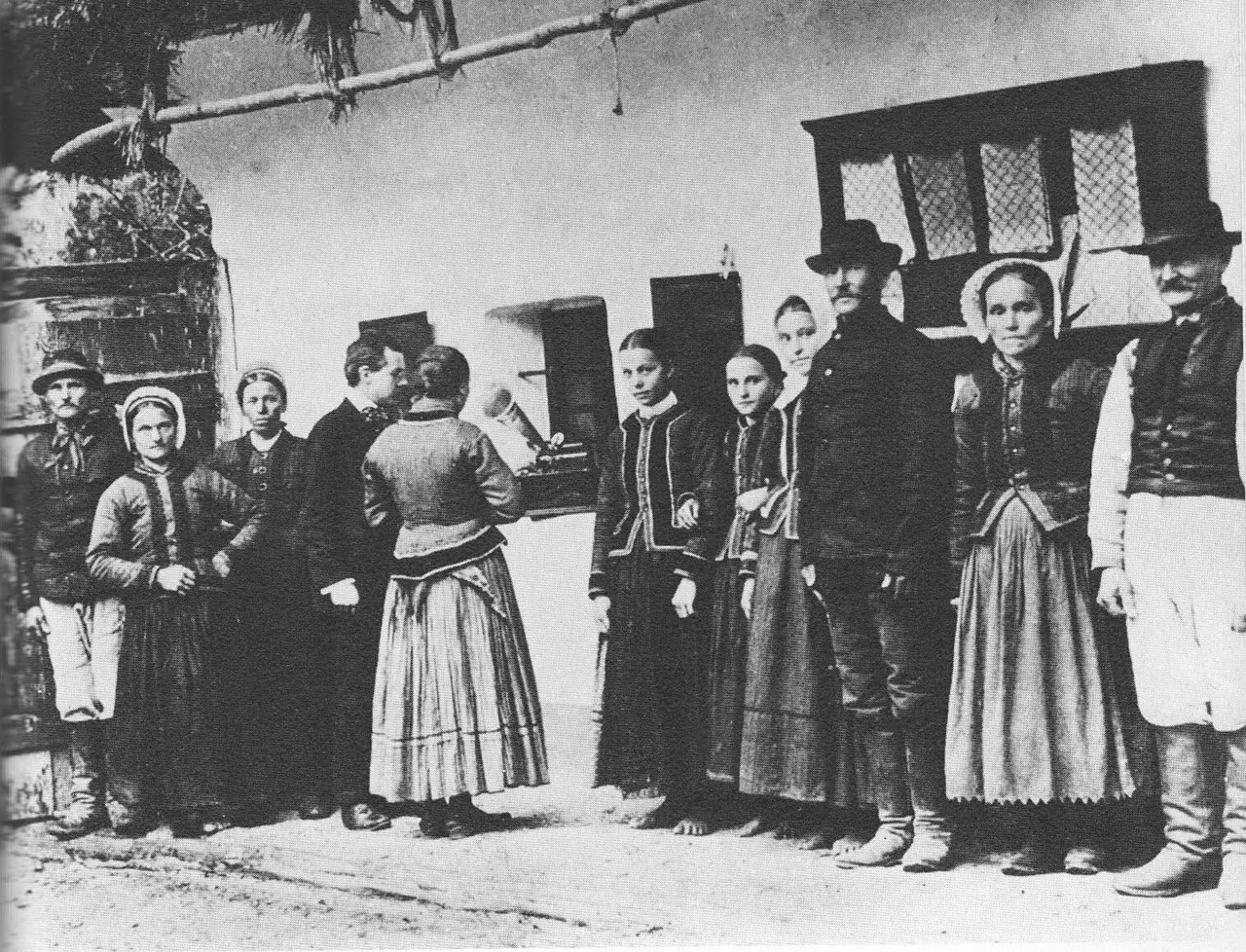
Bartók brought the phonograph to Zobordarázs, now Dražovce, in 1907. A singer faces its horn while the neighbours gather around. The melodies in For Children began with singers like these. The cylinder preserved a particular performance, including details he could return to later with a pencil and manuscript paper.
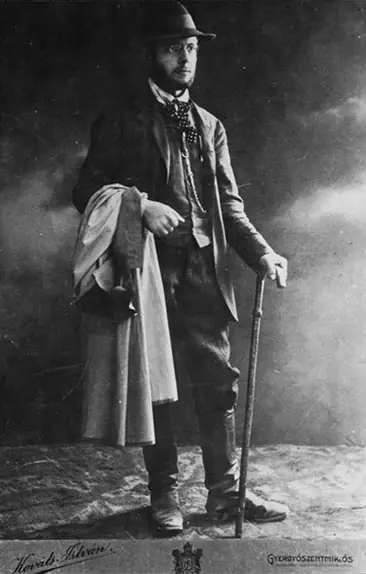
István Kováts photographed Bartók at Gyergyószentmiklós, now Gheorgheni, during his first Transylvanian collecting trip in 1907. That summer Bartók wrote to Stefi Geyer about the pentatonic songs he was finding. He wrote a violin concerto for her in the same year.
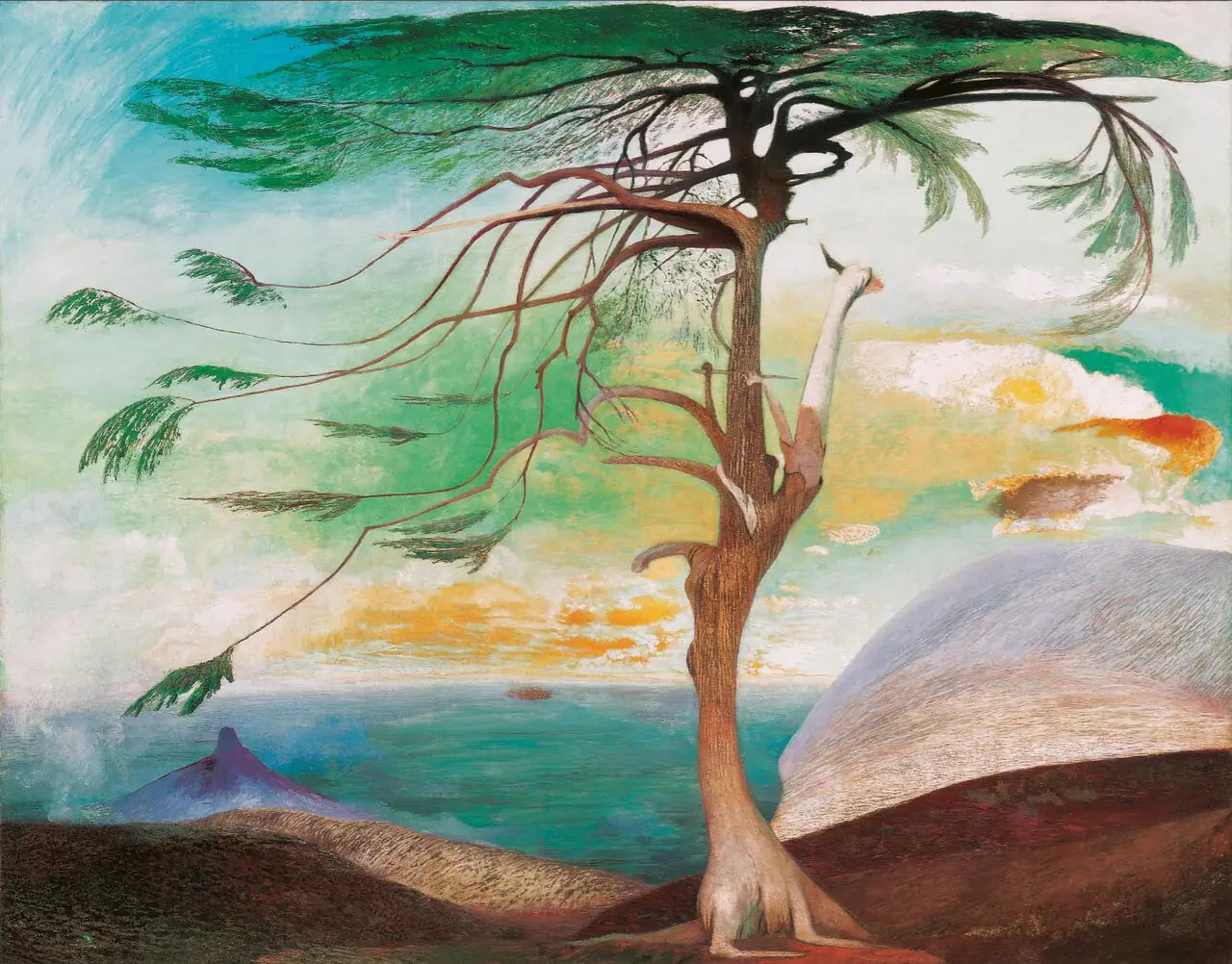
Csontváry travelled around Europe and the eastern Mediterranean looking for subjects; Bartók went abroad with his phonograph. In this painting a single very large tree fills the picture, with a few living branches set against the open sky. It is paired here with Bartók’s night pieces, in which a single call sounds against an otherwise quiet background.
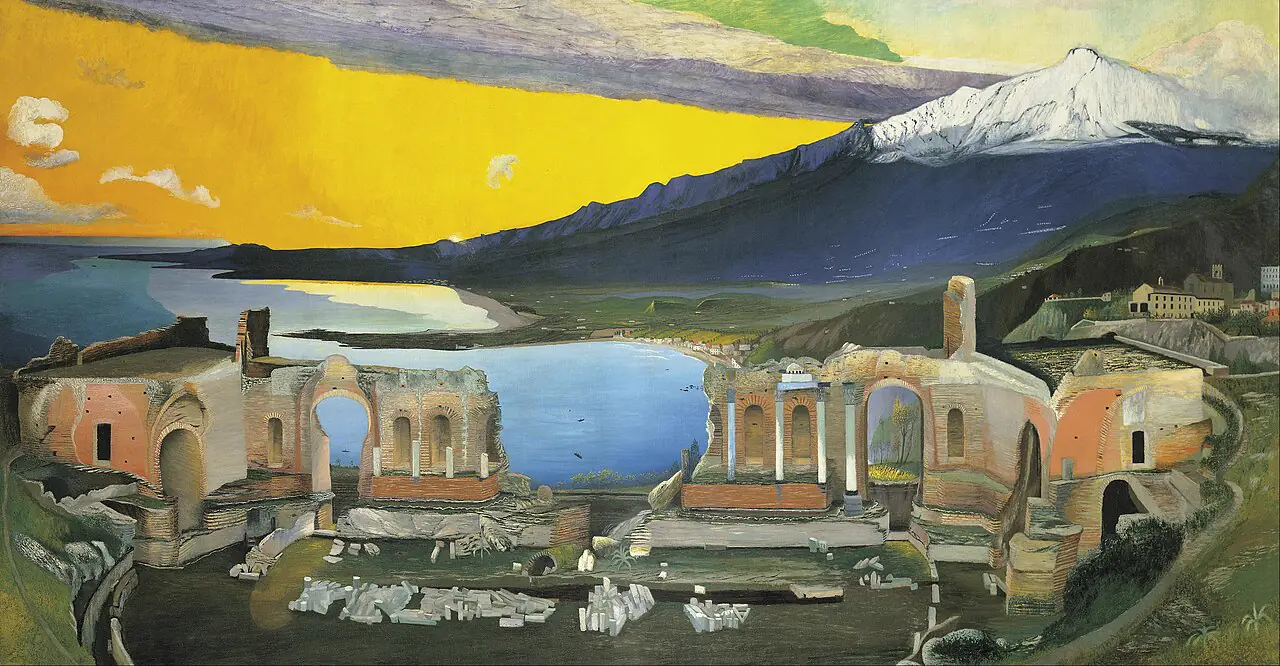
Csontváry’s canvas is nearly six metres wide. The empty theatre stands in the foreground and the coast and mountain lie far beyond, so the picture is built from sharply separated distances. In Bartók’s Music for Strings, Percussion and Celesta the two string orchestras answer each other across the platform, and the percussion is placed in a space of its own.
Recommended recordings
- Violin Sonata No. 2 · Rhapsody No. 1Joseph Szigeti, violin; Béla Bartók, pianoVanguard · 1940The historical recording, made live at the Library of Congress on 13 April. Szigeti slides between notes and Bartók rolls chords.
- Concerto for OrchestraChicago Symphony Orchestra, Fritz ReinerRCA Victor · 1955The wind pairs are clearly characterised, and the finale’s fast counterpoint is sharply played. Recorded on 22 October 1955; Reiner had studied with Bartók in Budapest.
- Piano Concertos Nos. 1–3Géza Anda; Berlin Radio Symphony Orchestra, Ferenc FricsayDeutsche Grammophon · 1959–60Recorded at the Jesus-Christus-Kirche, Berlin: Nos. 2 and 3 in September 1959, No. 1 in October 1960. A first choice for the complete set. Anda plays the early concertos with force and keeps their dance rhythms. Fricsay keeps the orchestral replies alert.
- Duke Bluebeard’s CastleChrista Ludwig, Walter Berry; London Symphony Orchestra, István KertészDecca · 1965Ludwig sings Judith and Berry sings Bluebeard. Decca recorded the performance in Kingsway Hall, and the recorded sound gives full scale to the opening of each door.
- The Six String QuartetsTakács QuartetDecca · 1996A complete cycle, strong in the dances and in the dark slow movements. The Fourth’s pizzicato scherzo is played with physical bite, and the Sixth’s returning Mesto is kept in its place within the larger argument.
Lineage
Kodály was Bartók’s companion in the field, and village singers and instrumentalists supplied music that neither man could have invented at a desk. Debussy helped Bartók hear new possibilities in their modes, and Beethoven remained a guide to building a quartet from a few related phrases. Ligeti and Kurtág grew up with his music; Boulez returned to the orchestral scores again and again as a conductor.
Further reading
- David Cooper, Béla Bartók (Yale University Press, 2015). biography
Covers ethnomusicology, composition, teaching and piano performance, together with the political circumstances of emigration.
- László Somfai, Béla Bartók (University of California Press, 1996). study
A source-oriented study, catalogued under manuscripts and criticism of Bartók’s compositions.
- Budapest Bartók Archives, ‘Bartók compositions: In chronological order’ (online catalogue). catalogue
An institutional work-list for checking dates and the sequence of compositions.
Cite this page
Contrapunctus. “Béla Bartók.” Accessed 20 October 2026. https://mottopanikeiku.github.io/contrapunctus/composers/bartok.html.
@misc{contrapunctus-composers-bartok,
  author = {{Contrapunctus}},
  title = {Béla Bartók},
  howpublished = {\url{https://mottopanikeiku.github.io/contrapunctus/composers/bartok.html}},
  note = {Accessed 2026-10-20}
}